Tools for Super 7

Tools for Super 7

Home Forums Manual machine tools Tools for Super 7

Viewing 25 posts - 1 through 25 (of 30 total)
  • Author
    Posts
  • #436109
    Roger King 1
    Participant
      @rogerking1

      Had a very successful weekend – Daz and Pete came down from Nott'num and spent 4 hours going right through my newly-purchased Super 7, which was an education in itself. The first thing Daz did was wind the topslide out of the way and say, 'yep, it's one of mine' – recognizing his own scraping on the slide from 1980. He pronounced it a very nice example, which has had little use and needed nothing replacing apart from the spindle wick and the bed scraper felt. Even the tailstock height was within a thou.

      So – now I'm ready to start using it more. Question one: what is the best type of cutting tool to use, and where's the best place to get them? I have a few of Dad's old HSS ones, and a box of things somebody sold him with small trapezoidal screw-in tips, which he didn't like at all, and I've not had much luck with, either.

      Nearly all of my work is with mild steel. All suggestions welcome!

      #13688
      Roger King 1
      Participant
        @rogerking1
        #436110
        Brian Oldford
        Participant
          @brianoldford70365

          Do you have their contact details please?

          #436112
          Roger King 1
          Participant
            @rogerking1

            They've not changed:

            Darren Boden – [email protected]

            07790 364189

            #436114
            Lainchy
            Participant
              @lainchy

              My experience (albeit very little as a noob) is the insert tools are great for roughing out, but for finishing and fine cuts, a nice sharp, well ground HSS tool bit is miles better.

              #436116
              John Haine
              Participant
                @johnhaine32865

                I use mainly insert tipped carbide for general turning and boring, and a Diamond Tool holder with HSS bit when I fancy a change. Also a TC insert parting tool. Modern tipped tools work well and give a good finish if you keep the speed up – that includes for parting too.

                What do you mean by "mild steel"? Quite a lot of stuff that goes by that description never seems to turn to a good finish.

                #436118
                Roger King 1
                Participant
                  @rogerking1

                  Thanks – where's the best place to buy HSS bits?

                  By 'mild steel', I mean the stuff outlets like Metals4U sell as 'bright mild steel'. Probably not best quality, I'm guessing.

                  #436119
                  Howard Lewis
                  Participant
                    @howardlewis46836

                    A Super 7 is barely going to be fast or rigid enough to use carbide tips to their maximum. Wait for the howls!

                    HSS will work quite well.

                    A Tangential Turing tool (Such as the Diamond tool sold commercially – There have been at least two shop made examples in articles in MEW ) will work extremely well.

                    The toolbit is HSS, and once you have made a Centre Height Gauge, setting the tool to centre height is an absolute doddle. Grinding is the same, since there is only one face to grind, rather than three on the normal knife tool.

                    The only thing that you can't use it for is boring!

                    Howard

                    #436122
                    SillyOldDuffer
                    Moderator
                      @sillyoldduffer
                      Posted by Roger King 1 on 05/11/2019 16:12:20:

                      Thanks – where's the best place to buy HSS bits?

                      By 'mild steel', I mean the stuff outlets like Metals4U sell as 'bright mild steel'. Probably not best quality, I'm guessing.

                      Nothing to do with 'quality', but ordinary mild-steel is a structural steel, not bad but not particularly good for machining. You can do better.

                      When buying metal look at what the specification has to say about machinability. Of the mild-steels EN1A is about twice as machinable as ordinary mild-steel, and EN1A Pb is roughly three times better. More broadly, something like EN9 is about 3 times harder to machine than mild-steel, and many stainless steels are evil.

                      Bright mild-steel is useful when the stock being finished off the shelf saves time by reducing the need to machine it. Otherwise Black mild-steel is the same composition, but has slightly different physical properties due to not being processed further to make BMS. It's cheaper and has fewer locked in strains to cause warping when cut.

                      Given there's at least a 3:1 range in the machinability of metals that might be called "mild-steel", and even more problems across the full family of steels, my advice is to avoid unknown scrap. Painful experience taught me it's a bad mistake to assume a lathe or milling machine will happily cut any old metal!

                      My HSS mostly came from ArcEuroTrade. It's fine.

                      Enjoy your Myford!

                      Dave

                      PS. Personally, I think it extremely unlikely that steel made in the past can be better than the same steel made today. Not least because Metallurgy is better understood today and steel makers generally have more advanced plant. Rose-tinted glasses apart, anyone own 1970 TV that's better than a new one?

                      #436126
                      Michael Gilligan
                      Participant
                        @michaelgilligan61133
                        Posted by SillyOldDuffer on 05/11/2019 16:53:54:

                        […]

                        PS. Personally, I think it extremely unlikely that steel made in the past can be better than the same steel made today. Not least because Metallurgy is better understood today and steel makers generally have more advanced plant. Rose-tinted glasses apart […]

                        .

                        I think I must disagree, Dave [depending of course upon where on the timeline we choose to put “in the past”] …

                        Modern ‘general purpose’ steels will inevitably contain significant percentages [no, I don’t know the numbers] of recycled material of variable origin.

                        Whilst I have no doubt that the best modern material is more tightly specified than in days of yore … the general purpose stuff is probably getting progressively worse.

                        MichaelG.

                        .

                        Edit: I’ve just found some ‘bedtime reading’ … if either of us is up to it.

                        http://makir.mak.ac.ug/bitstream/handle/10570/3350/Thesis%20Final%20V%20T%20K.pdf?sequence=1&isAllowed=y

                        Edited By Michael Gilligan on 05/11/2019 18:10:07

                        #436133
                        Neil Wyatt
                        Moderator
                          @neilwyatt
                          Posted by Howard Lewis on 05/11/2019 16:18:04:

                          A Super 7 is barely going to be fast or rigid enough to use carbide tips to their maximum. Wait for the howls!

                          HOWL!

                          Just down to the choice of tool. Any carbide tool that works with a mini lathe (and there are plenty) will be fine on a S7.

                          Neil

                          #436142
                          not done it yet
                          Participant
                            @notdoneityet

                            Can this model not run to excess of 2000rpm? Plenty fast enough for carbide on most diameters. Perhaps not on much less than 10mm with cheaper inserts.? Maximum efficiency may not be attainable, but let’s face it – it is not a commercial machine (for high production rates.

                            Motor power might be a large factor in not being able to ‘maximise’ some of these inserts, but there are other positive attributes, so no need to condemn them entirely. But, at the same time ‘barely’ does mean ‘just’ in my book, so not a total fail.smiley

                            #436146
                            Roderick Jenkins
                            Participant
                              @roderickjenkins93242

                              On my S7 I now use ccgt tips for 90% of my turning. The exceptions are rough interrupted cuts or large reductions in diameter.

                              Rod

                              #436157
                              Bazyle
                              Participant
                                @bazyle

                                Don't over-think it and get drawn into expensive tools until you have done a lot of reading round the subject.
                                If you are able to meet up with some model engineers perhaps one will give you a suitable tool to start off with. Otherwise look on ebay for a job lot of half a dozen smaller tools for less than £1 each, 1/4 in or 5/16. Not sure if 3/8 is too big for a Myford. People are often selling off batches they have collected or acquired from work. At least some of them will be pre-formed and jus tneed a quick touch up.

                                Talking about black iron is all very well but where do you get it outside some old stockists in the midlands. Most of the ME suppliers only stock mild steel of undefined type.

                                #436166
                                IanT
                                Participant
                                  @iant

                                  Hi Roger,

                                  Your Super 7 sounds in much better condition than mine – and I use both Insert & HSS on mine with no problems.

                                  Everyone here has their own personal experience and preferences – so you will often get apparently contradictory advice. I use my Eccentric tool holder (on the S7) for a lot of my ferrous work and it's very easy/simple to keep the tool sharp. I use insert tooling for parting, boring and screw-cutting (all things where tool grinding can be tricky) but HSS (and indeed carbon steel) for just about everything else especially non-ferrous work.

                                  The best advice I can give you with respect to using HSS is to use small tool sections (I use 3/16th square) as it is much easier to shape and keep sharp than larger sections (1/8th is even easier but 3/16th is a bit stiffer). I used to use small section HSS only on my smaller lathes and "bigger" stuff (1/4" upwards) on the Super 7. I now have 3/16 tools set up in simple steel blocks and regularly use them on the S7 as well as my shapers (also in suitable holders). Most of my work is on the small side by the way but not all of it…

                                  Which brings me to my final point. Everyone here has different interests and needs. Someone building 6" scale traction engines or repairing cars will have a different view of things from someone making clocks. So your Super 7 will be viewed as a (very expensive) 'baby' lathe by some and the height of luxury by others…

                                  Anyway, I'm more than a bit jealous to hear your S7 is in such nice shape – I wish mine was as good. Maybe it will be one day…

                                  Regards,

                                  IanT

                                  #436185
                                  Nigel McBurney 1
                                  Participant
                                    @nigelmcburney1

                                    The S7 was designed in the early 1950s when the world used Hss tools and learned to grind them correctly,their performance was more than satisfactory ,never saw carbide tools on small lathes,when machining fine work Hss tools cut accurately with fine finish,and are a lot cheaper than carbide tips and HSS can be ground easily into any shape or form. Using high speeds with carbide will cause higher wear on a small lathe,remember you are not earning a living so why thrash the lathe to death. On my Colchester I use carbide tips on stainless steel,long roughing runs on steel and finish off with HSS tips also have efficient chip breakers which reduces the large amounts of curly swarf.most of my turning is with HSS.I do have a set of Myford brazed on carbide tools ,purchased in good condition cheaply,I use these when roughing out ,iron sand castings and non ferrous sand castings,as these can ruin the cutting edge of HSS tools.and I also keep the lathe bed clean as the swarf from castings can abrade the bed. I feel that there is a tendency to use carbide tip tooling as a lot of lathe users do not know how to grind and sharpen HS,just take a look at some of the second hand hss bits on auto jumble stalls,the previous owners must have clueless when grinding these tools..

                                    #436191
                                    Roger King 1
                                    Participant
                                      @rogerking1

                                      Thanks to all for all the really helpful advice. I think for now I will stick with the HSS, as that's what I am familiar with on Dad's old ML10 (although by no means an experienced machinist!). Like everything it's practice, practice – and I will search out a good guide on sharpening. I have a couple of Myford-specific books, and a list of a few more to get.

                                      I also need to do a bit of thinking around what metal I use and the above advice will help with that too.

                                      Sorry to make you green, Ian!

                                      #436197
                                      Anonymous
                                        Posted by SillyOldDuffer on 05/11/2019 16:53:54:

                                        Rose-tinted glasses apart, anyone own 1970 TV that's better than a new one?

                                        No, but as the quality of the picture has gone up, the quality of the programmes has gone down. Sure doesn't run into the Shannon-Hartley law limitations. On the plus side it means I spend more time in the workshop rather than on the couch.

                                        As SoD hints, of the low carbon steels En1A turns very well and the leaded version, EN1APb is even better. However EN3B has a propensity to tear and needs some experimentation to get a good finish. I use a lot of EN3B as most hot rolled steel is essentially EN3B, and is cheaper than cold drawn.

                                        I also find that EN1A rusts easily, often overnight, whereas EN3B is much less prone, even in a damp environment, like a kitchen.

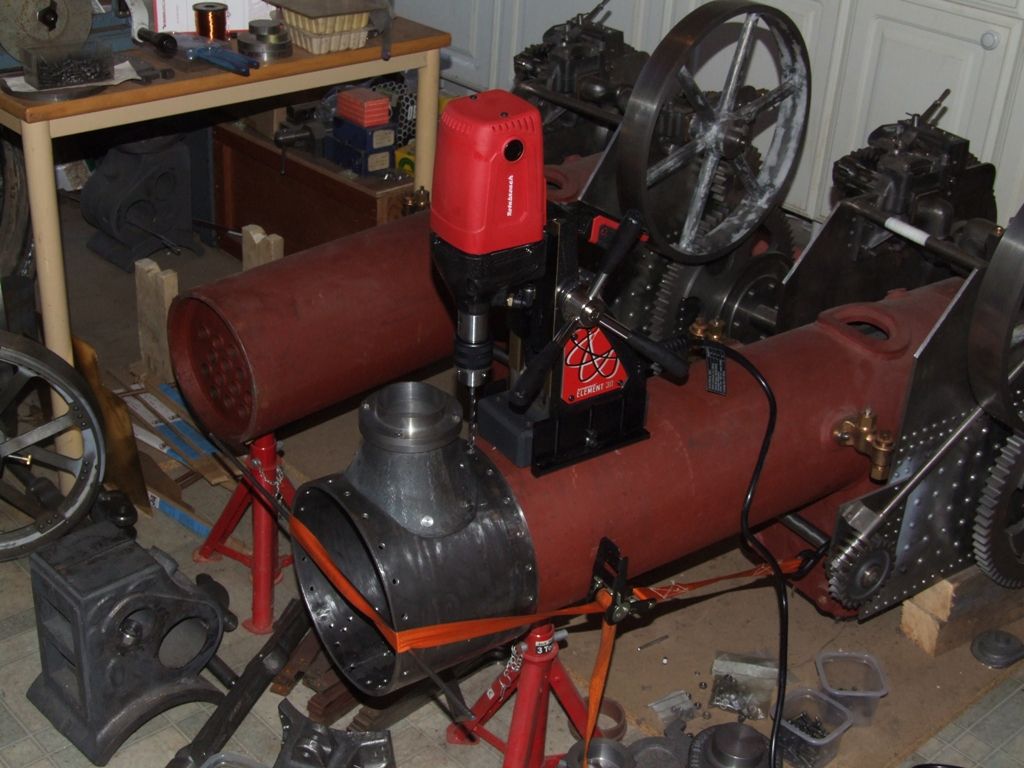
                                        drilling_smokebox_me.jpg

                                        Andrew

                                        #436201
                                        Michael Gilligan
                                        Participant
                                          @michaelgilligan61133

                                          laugh

                                          #436212
                                          Vic
                                          Participant
                                            @vic

                                            I use a Tangential tool for much of my turning and inserts for specific jobs. I particularly like the polished inserts and find they work really well on my little 8 x 14 lathe. I gave up using insert parting tools as I found the tips didn’t last long so I use the T shape HSS parting blades as they’re far more economical.

                                            #436218
                                            Roger King 1
                                            Participant
                                              @rogerking1

                                              OK, I've googled 'tangential tool' and discovered that it's one that basically points upwards. What's the advantage of this over a horizontal tool?

                                              #436220
                                              thaiguzzi
                                              Participant
                                                @thaiguzzi
                                                Posted by Roger King 1 on 06/11/2019 13:28:54:

                                                OK, I've googled 'tangential tool' and discovered that it's one that basically points upwards. What's the advantage of this over a horizontal tool?

                                                Easy sharpening.

                                                Easy centre height resetting.

                                                #436228
                                                Neil Wyatt
                                                Moderator
                                                  @neilwyatt
                                                  Posted by thaiguzzi on 06/11/2019 14:11:47:

                                                  Posted by Roger King 1 on 06/11/2019 13:28:54:

                                                  OK, I've googled 'tangential tool' and discovered that it's one that basically points upwards. What's the advantage of this over a horizontal tool?

                                                  Easy sharpening.

                                                  Easy centre height resetting.

                                                  Unless you get a piece of HSS that's prone to chipping along the length of the bar… took me ages to figure out why it was going blunt so fast!

                                                  Neil

                                                  #436229
                                                  Greensands
                                                  Participant
                                                    @greensands

                                                    A couple of recent postings give details of how to make up a tangential tool having a rhombus shaped shank set at 12 degrees. How critical is this setting and on what basis is it derived?

                                                    #436257
                                                    Vic
                                                    Participant
                                                      @vic

                                                      All the Tangential tools I’ve seen have had Square section shanks. The general advice I read many years ago was for the bit to tip 12° forward and 12° to the left as you face the machine. I’ve made several to that spec and they work fine. Anyone tried anything different?

                                                      This is the last one I made.

                                                      2d0b018b-b839-4ed9-bf71-8fb9217db03c.jpeg

                                                    Viewing 25 posts - 1 through 25 (of 30 total)
                                                    • Please log in to reply to this topic. Registering is free and easy using the links on the menu at the top of this page.

                                                    Latest Replies

                                                    Home Forums Manual machine tools Topics

                                                    Viewing 25 topics - 1 through 25 (of 25 total)
                                                    Viewing 25 topics - 1 through 25 (of 25 total)

                                                    View full reply list.