Running 380V 3-phase motor on 230V 1-phase

Running 380V 3-phase motor on 230V 1-phase

Home Forums Electronics in the Workshop Running 380V 3-phase motor on 230V 1-phase

Viewing 25 posts - 1 through 25 (of 26 total)
  • Author
    Posts
  • #851454
    jimalm
    Participant
      @jimalm

      Hello all

      I have recently bought a Leinen MLZ4S. It was probably ordered by the original owner in 1967, but the inspection certificates are dated in early 1969. My problem is that I only have 230V single-phase power in my workshop. The motor is by Bauknecht. It has 3 speeds and I saw in running on 400V 3-phase mains in Holland when I bought it. I also ran it on the same power in Germany, where I crated it up for shipping to me here in France. As you will see below, it is important to have no doubt about the fact that it really does run on 400V. Oh … and without any smoke or fire!

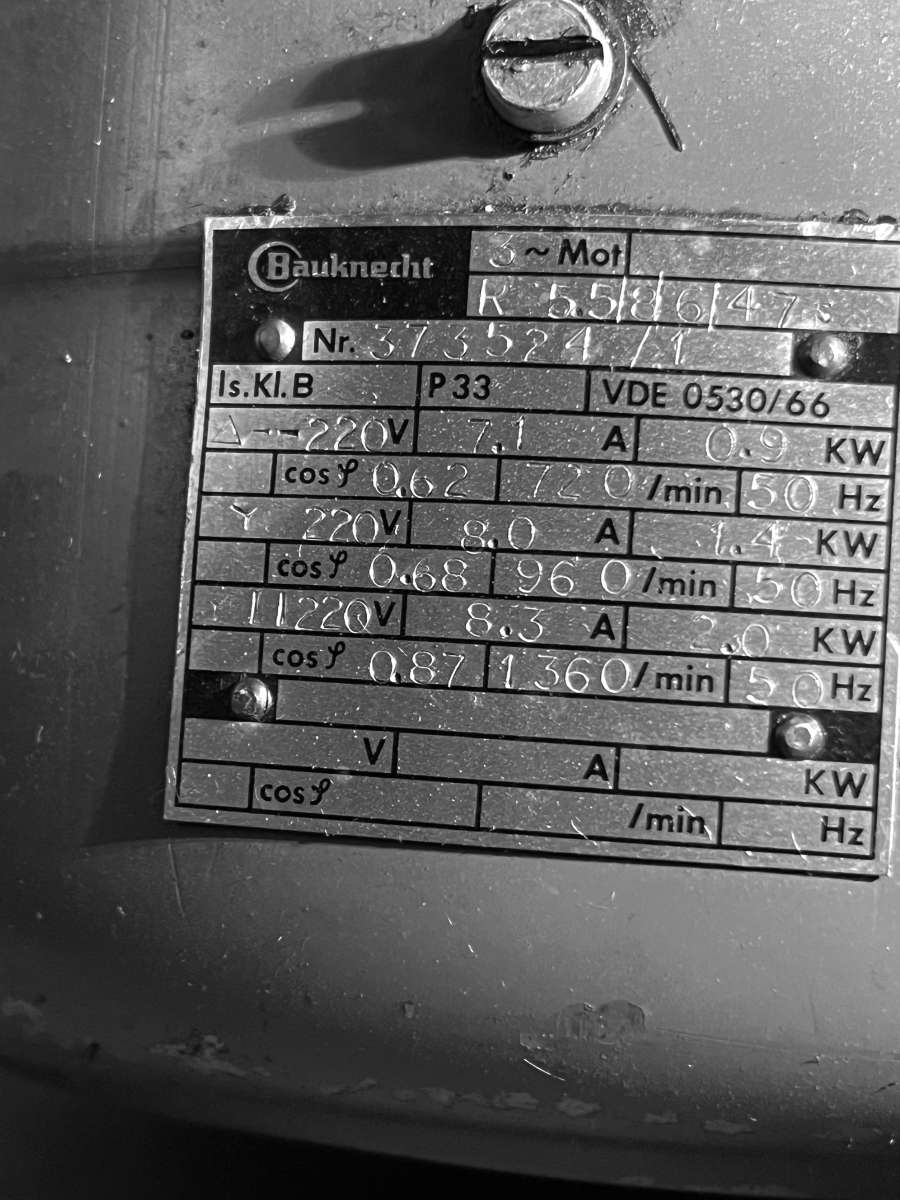
      Now that I have the lathe here, I have been able to get a good photo of the nameplate on the motor (see attatched). The first line of the nameplate specifies the 3-phase input. The next line says, “R55/8/6/4 7s3. Presumably that means (among other things?) the motor runs with 8, 6 or 4 poles. Then there’s a serial number. Then the Insulation Class, etc. Then the nameplate provides separate information for each speed. They are ALL rated 220V!! So how does it run on 400V?? Incidentally, there is only the original switch etc., and no transformer involved.

      I have “chatted” extensively with ChatGPT, Google Assistant and Claude AI about this situation. They all demonstrated an ability, very convincingly, to come to different conclusions not only from one AI to another or from one chat to another, but often within a single chat. Of course one has to do one’s own thinking anyway, and especially when chatting with AI, but now I’m wondering if anyone in this group can help me out.

      ChatGPT has provided the most logical explanation, which is that the practice in Germany for what gets specified on 3-phase multi-speed motor nameplates has changed since the 1960’s. Back then, they specified winding voltage; now, they specify mains voltage. I say, maybe, maybe not. I have just today seen a photo of the nameplate on another MLZ4S motor perhaps a bit older than mineIMG_0939, also made by Bauknecht, and it specifies 380V for all 3 speeds. Same motor, different nameplates? More likely, different motors, but then, how does my 220V motor run on 380 or 400V?

      Any ideas? Or, does anyone have a motor with a nameplate similar to mine and, if so, does it run on 220 or 380V?

      Regards

      Jim

      #851468
      timdotd
      Participant
        @timdotd

        My electrical engineering is a little rusty these days, but I read that plate as specifying the voltage for the each one of the individual phases – ie three phases at 220V connected in a star configuration, which means the 3-phase connection is 400V in total.

        That said, I’ve never seen a rating plate like that before, so I may be no more reliable than AI..!

        [ETA: this might be a Dahlander motor, which varies the speed by switching the internal configuration of the coil connections?]

        #851491
        noel shelley
        Participant
          @noelshelley55608

          Interesting ! 220v star at 720rpm but delta 220v for 960rpm and 1360rpm Could well be a Dahlander motor. The data plate is giving basic info but is not a wiring diagram. I have to admit I’ve never seen one like this.  Good luck Noel.

          #851503
          DC31k
          Participant
            @dc31k
            On noel shelley Said:

            220v star at 720rpm but delta 220v for 960rpm and 1360rpm

            Please look again at the picture. It is delta at 720, star at 960 and double star (denoted by the II after the star symbol) at 1360.

            What is the body part that is often confused with the elbow?

            #851507
            John Haine
            Participant
              @johnhaine32865

              Whatever it is, I would be inclined to use the connection for highest speed, 1360, disconnect all the switchery which would be irrelevant, and connect in delta to a VFD.  One reason for getting rid of the switchery is that if you forget and change a switch with a VFD you may well blow it up.

              #851511
              noel shelley
              Participant
                @noelshelley55608

                Yes ! Got it back to front, it’s delta and  star 1 and star 11. My fault. Noel.

                #851518
                Robert Atkinson 2
                Participant
                  @robertatkinson2

                  I would connect it permanently in Delta (720 RPM, 220V) with a VFD and then you can increase the speed by running the VFD up to 100Hz to get to around 1400 RPM.  You will not get full torque at high speed but if you need high speed torque is less of an issue.

                  Robert.

                  #851570
                  Bob Worsley
                  Participant
                    @bobworsley31976

                    According to my book on induction motors, a three speed motor has two separate windings, one for one speed, one that is the same as a two speed motor for two speeds. How many wires are there? Possibly 3 commoned wires for single speed and 6 commoned for the two speed winding.

                    If you can identify the windings then easiest thing is then to find a 110V transformer and a 20uF capacitor, wire the 3 lead winding to the 110V and put cap from one end of the 110V to the third wire. The motor can then run, unloaded, without blowing it up, the 110V is enough to run but not do anything. If successful then experiment with the 6 lead winding.


                    #851585
                    Versaboss
                    Participant
                      @versaboss

                      As the owner of a LZ4S I can say with some confidence thaat the lathe has a Dahlander motor, and it runs perfectly on our (Swiss) 3-phase supply of 400V. Unfortunately the motor nameplate is not accessible, at least not from the side. What I ‘know’ (from hearsay) is that it is difficult to drive a Dahlander via a VFD unit.

                      If it’s of any use, I could copy or take a photo of the circuit diagram.

                      Perhaps it would work (as someone proposed before) by using only one speed on the VDF and block the other two positions of the spped switch.

                      Regards,
                      Hans

                      #851639
                      Vic
                      Participant
                        @vic

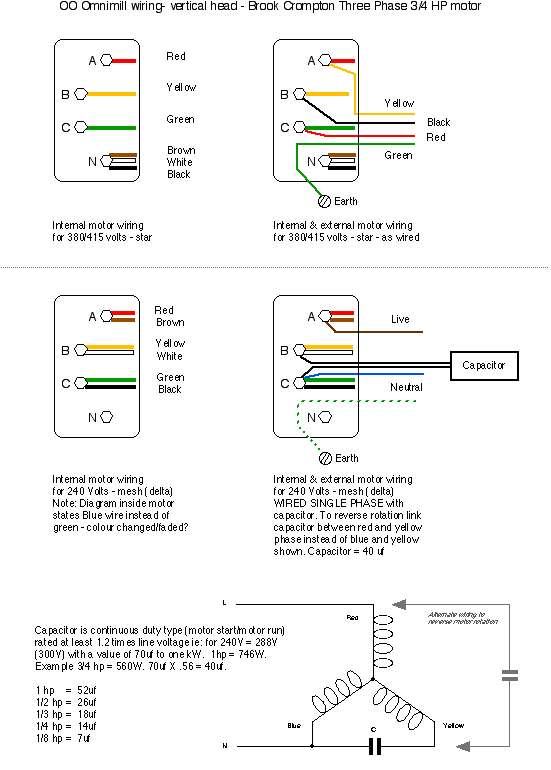
                        I’m not sure if this helps, but just to say I ran my old 3 phase Elliott Omnimill on 240V single phase quite happily until I sold it on.
                        it was a long time ago but I followed the instructions I found online about changing the wiring in the motor junction box and adding a large capacitor in the circuit. Apparently you only get about 80% of the motor power doing this but I didn’t notice this on the Omnimill, it worked just fine.


                        IMG_2923

                        #851657
                        Robert Atkinson 2
                        Participant
                          @robertatkinson2

                          Running a machine with 3 phase motor on single phase with a capacitor may seem OK but only if you haven’t used it on a proper 3 phase supply. This and the other advantages of a VFD make it a bit  pointless using anything other than a VFD.
                          The capacitor solution (Steinmetz) is OK for coolant pumps and fans, not main drive motors.

                          Oh and why does your circuit show a star connected motor when it wired delta?


                          #851682
                          Bob Worsley
                          Participant
                            @bobworsley31976

                            Rubbish.

                            Using a capacitor to generate the third phase works perfectly, since you never run the machine at 100% load then the final tweaking of the capacitor to get a balanced third phase isn’t needed.

                            Why? The power factor of the motor inproves as the load increases, so the phase angles alter, so the real, not imaginary, power provided by the capacitor also chamges, providing the extra current to take the load. Read any book on how an incuction motor works, circle diagrams etc. The current taken from off load to full load hardley changes, the power factor does.

                            Oh, and I have used both a static inverter and three phase, no difference.


                            #851692
                            Robert Atkinson 2
                            Participant
                              @robertatkinson2

                              If what I said is “rubbish” and Steinmetz is perfect why do people, including you, buy inverters?


                              #851701
                              Bob Worsley
                              Participant
                                @bobworsley31976

                                Who said I buy inverters?

                                I designed and made my own converter and ran it for years, now have a three phase supply and use that, no noticable difference.

                                A converter is both large and heavy, and an inverter isn’t, and people seem to have been brainwashed by the comments in forums for years. In unheated garages and sheds I have had a failure rate of near 100% with inverters, welders, battery chargers, cordless drill chargers, in fact anything that uses high vvoltage switching. All the transformer based items still work after decades.


                                #851931
                                Vic
                                Participant
                                  @vic
                                  On Robert Atkinson 2 Said:

                                  Running a machine with 3 phase motor on single phase with a capacitor may seem OK but only if you haven’t used it on a proper 3 phase supply. This and the other advantages of a VFD make it a bit  pointless using anything other than a VFD.
                                  The capacitor solution (Steinmetz) is OK for coolant pumps and fans, not main drive motors.

                                  Oh and why does your circuit show a star connected motor when it wired delta?


                                  That’s easy to say when you have the money. I saved up to buy the mill and couldn’t afford an extra couple of hundred pounds to buy a VFD or change the motor. It cost me £12 to buy a capacitor and I did a lot of good work on it until I sold it on when we moved house.

                                  If anyone else doubts this works perfectly well, the topic is covered in one of the Workshop Practice series on motors. As I remember the topic is covered in quite some depth.

                                  #852020
                                  Robert Atkinson 2
                                  Participant
                                    @robertatkinson2

                                    I’d need a better reference on the exact book to comment on that. There are two books on motors, 16 & 24 in the series and only the second edition (2007) of 16 considers VFDs.

                                    I’ve never said it didn’t work. I just said that it is not a good solution and a VFD is a better option.
                                    If Steinmetz works so well why do motor manufacturers bother with single phase capacitor start and start / run motors?

                                    Robert.

                                    #852032
                                    john fletcher 1
                                    Participant
                                      @johnfletcher1

                                      Converters have been around many years, I have some where a Weston House (the American company) circuit diagram which I used 30/40 years ago, nothing new. When farmers were getting corn driers in the 50s they only had single phase supply and the drier motors were 415 volts, so convertors were fitted. Basically an inductor(big choke) and two banks of capacitors, all in circuit for start up, then one on its own for run. Cheap and cheerful but they worked,  I bought ex power factor correction caps. Then Inverters came along, with Forward/Reverse and speed control at a price folk could afford.

                                      #852034
                                      Bob Worsley
                                      Participant
                                        @bobworsley31976

                                        How converters work? A good starting place is the paper in the Proceedings of the IEE, The Starting of a 3-phase Motor Connected to a Single Phase Supply by Jha, Vol 106 Part A 1959 and subsequent discussion.

                                        Many books refer to this problem, but only as a side issue. I have about 1000 electrical books and there are bits and pieces in many, but you do have to read carefully and work it out yourself.

                                        It isn’t a choke but an autotransformer to boost the 240V to 400V.

                                        I have found that the motor has to be connected in star, in delta there are too many circulating currents and getting the phase balance is not easy, hence the boost transformer.


                                        #852050
                                        Bazyle
                                        Participant
                                          @bazyle

                                          Vic, Thanks for the reassurance that this can be used with an omnimill. Does one use a 250v motor start cap or does it need to be 400v?

                                          #852063
                                          Andrew Tinsley
                                          Participant
                                            @andrewtinsley63637

                                            Robert,

                                            The  book that was referred to is No 47 in the workshop series, entitled  Three phase conversion by Graham Ashley.

                                            I am somewhat amused by the continual warnings about how poor the Steinmetz set up is. I have used it for years and found it perfectly acceptable. I now have 3 phase installed and can tell no difference whatever between the Steinmetz solution and genuine 3 phase. I did run my motors in star configuration using a step up transformer for Steinmetz.

                                            VFDs have lots of advantages and some disadvantages too. I run quite a bit of pre war machinery, some of which have motors integral with the machines. I would not dream of running these motors on a VFD. The insulation resistance of these old motors is not up to the rapid switching and resulting voltage spikes that come with VFDs. One cannot substitute a modern motor in these old machines and a very expensive rewind  would be the result of such a failure.

                                            I speak from long experience of using the Steinmetz solution It would seem that your experience differs from mine, you imply that there is a noticeable difference between a Steinmetz solution and genuine 3 phase. What difference have you noticed, I am always willing to learn.

                                            Andrew.


                                            #852065
                                            Robert Atkinson 2
                                            Participant
                                              @robertatkinson2
                                              On Bob Worsley Said:

                                              How converters work? A good starting place is the paper in the Proceedings of the IEE, The Starting of a 3-phase Motor Connected to a Single Phase Supply by Jha, Vol 106 Part A 1959 and subsequent discussion.

                                              Many books refer to this problem, but only as a side issue. I have about 1000 electrical books and there are bits and pieces in many, but you do have to read carefully and work it out yourself.

                                              It isn’t a choke but an autotransformer to boost the 240V to 400V.

                                              I have found that the motor has to be connected in star, in delta there are too many circulating currents and getting the phase balance is not easy, hence the boost transformer.


                                              Hi Bob,

                                              A few questions:
                                              What do you mean by the term “converter”? This could be any number of types.

                                              Referencing a 66 year old document that is still behind a paywall isn’t very helpful. Do you have any other sources?

                                              A choke is not an autotransformer. In most power electrical contexts a choke is used to limit current in an AC circuit. It does not increase the voltage.

                                              As you are connecting the motor in star with a boost transformer is that a 3 phase transformer?

                                              Would you care to share the circuit of one of the converters you have made?

                                              Robert.

                                              #852069
                                              Bob Worsley
                                              Participant
                                                @bobworsley31976

                                                Converter as in transformer and caps to generate thierd phase at 400V.

                                                I bought the Proceedings, if it is behind a paywall then it should be easy to get a copy.

                                                John referred to a choke, I was just saying that it needs to be an auto-transformer for 400V

                                                No, the third phase is generated byy the caps, just a simple single phase transformer but I have used several trasfromers in series to get the extra 180V.

                                                Circuit is 400V to two phases, then any phase through the caps to the third motor phase. Will need MCBs, switching caps etc but that is a detail.


                                                #852070
                                                jimalm
                                                Participant
                                                  @jimalm

                                                  Hello Hans

                                                  Yes, please do send a copy of the wiring diagram. I know it’s hard to take a picture of the nameplate … on my lathe there is a hatch at the back that provided the best access, but it still took a few tries with my phone to get a photo I could use. I haven’t tried pulling the motor out of its cabinet, and would rather not, or at least not yet.

                                                  Thanks in advance

                                                  Jim

                                                  #852072
                                                  jimalm
                                                  Participant
                                                    @jimalm

                                                    I want to thank everyone for responding to my question. I’m going to wait for word back from a supplier of VFDs that will step my 230V 1-phase up to 400V 3-phase. I know one has to be careful not to change speeds without giving the VFD lots of time for its capacitors to discharge. And if I’m using a VFD, it can give me different speeds so I shouldn’t need to use the motor switch anyway.

                                                    It is very interesting to see that there are other ways of solving my “problem”. I’m not feeling so adventurous just now, but if it turns out I have to buy a new 230V motor plus VFD anyway, then it guess I wouldn’t be losing anything if first I fried my existing motor experimenting to get it to work on 230V.

                                                    Also, I have finally managed to get an appointment (July 10) with the utility company to see about getting 3-phase 400V power. If I can afford it, that would be the simplest solution.

                                                    Many thanks again to all!

                                                    Jim

                                                    #852080
                                                    Julie Ann
                                                    Participant
                                                      @julieann
                                                      On jimalm Said:

                                                      I know one has to be careful not to change speeds without giving the VFD lots of time for its capacitors to discharge.

                                                      Changing speed with a VFD is simple; just turn the control knob. I think the advice you are referring to is to not switch the outputs while the VFD is running, as would happen when reconfiguring a motor to change the number of poles. The reason has nothing to do with discharging the DC link voltage capacitors. It has all to do with breaking a circuit in which substantial current is flowing. The current will try and go somewhere and, since the remaining circuit will have some inductance, the voltage on the output will rise very quickly. The fastest way to destroy a semiconductor is to over voltage it.

                                                      Julie

                                                    Viewing 25 posts - 1 through 25 (of 26 total)
                                                    • Please log in to reply to this topic. Registering is free and easy using the links on the menu at the top of this page.

                                                    Latest Replies

                                                    Viewing 25 topics - 1 through 25 (of 25 total)
                                                    Viewing 25 topics - 1 through 25 (of 25 total)

                                                    View full reply list.