Lightning

Lightning

Viewing 25 posts - 1 through 25 (of 43 total)
  • Author
    Posts
  • #850361
    duncan webster 1
    Participant
      @duncanwebster1

      We had a big thunder storm last week. When we switched the signals on today at least 5 of them are either not working properly or are dead. I lost the will to live after taking 5 down. Oh joy, oh rapture. Got to get them working again before our next public running, so I’d better get my skates on

      #850373
      Bazyle
      Participant
        @bazyle

        When did oil lamps become sensitive to lightning?

        #850374
        duncan webster 1
        Participant
          @duncanwebster1

          I’ve tried 3 times to download DesignSpark so I can look at the pcb files. It lets me register and download the free version, but then won’t open it, says invalid credentials. Anyone got any ideas or an alternative free(or very cheap) package. I’ve used DesignSpark before some years ago so it’ attractive to stick with it.

          #850376
          Dave Halford
          Participant
            @davehalford22513

            If they have been fried these may never be needed again but…………

            #850377
            duncan webster 1
            Participant
              @duncanwebster1

              Just got a quote from PCB way for new boards, very reasonable, but last time I bought boards from China I got hammered by a courier handling charge to cover them paying the import duty, which was only a couple of £. Any one know if they have they got round this. I’m in UK to clarify.

              #850382
              bernard towers
              Participant
                @bernardtowers37738

                I thought the prices quoted from china included all charges unlike the US which I have just been charged $49 on a package worth $260!!!

                #850405
                howardb
                Participant
                  @howardb

                  Is it possible that when the system is shut down, it could be disconnected from 230v mains and connected to earth pins to protect it from the influence of mains lightning spikes?


                  #850410
                  John Haine
                  Participant
                    @johnhaine32865

                    Though regarded as a toy by some, Fritzing is free and works well and doesn’t have a steep learning curve. Then there is KiCad which is also free, harder to use, but designed and maintained by  CERN for the huge amount of electronics they need.

                    #850412
                    noel shelley
                    Participant
                      @noelshelley55608

                      Apart from the trouble of repair I would want to know HOW the system got blown ? Was it mains born or was it a strike to ground near one or more units ? Noel.

                      #850413
                      duncan webster 1
                      Participant
                        @duncanwebster1
                        On howardb Said:

                        Is it possible that when the system is shut down, it could be disconnected from 230v mains and connected to earth pins to protect it from the influence of mains lightning spikes?


                        It’s not connected to the mains, battery powered. Battery charged by solar panel. Cabling is a mix of underground and (mainly) fed through the steel support beams. As it has track circuits, one continuous rail is connected to 0v, the other with breaks is connected to Arduino analogue input pin.

                        I’m about to set off for a week’s holiday, so if I go quiet its not because I’m ignoring suggestions.

                        #850414
                        John Haine
                        Participant
                          @johnhaine32865

                          The only PCB I’ve had made in China so far was sent from the inbuilt “fabricate” feature in Fritzing and used PCBWay.  My first order so a special deal, $15 all in for 5 boards dispatched by Fedex.

                          #850416
                          Juddy
                          Participant
                            @juddy

                            Mind it Mark from youtube can design and make low volume PCB’s Design & Prototyping http://www.perton-electronics.co.uk/design–prototyping.html#

                            He is very good and worth watching his channel https://www.youtube.com/@MendItMark

                            #850418
                            JA
                            Participant
                              @ja
                              On noel shelley Said:

                              Apart from the trouble of repair I would want to know HOW the system got blown ? Was it mains born or was it a strike to ground near one or more units ? Noel.

                              Lightning can produce an electromagnetic pulse that can blow unprotected low current electronics. Just a thought.

                              JA

                              #850419
                              Macolm
                              Participant
                                @macolm

                                Lightning strikes, and for that matter other high voltage flashovers, result in very high voltage drops as a function of the inductance of the path (perhaps in this case rails?), and the very high voltage available. So connecting the rails and associated circuits to ground at multiple points may not prevent destructive voltages spikes occurring along the path if the strike is at an unfavourable point.

                                It is tricky, but not impossible, to design to cope with this. For example, in the days of CRT displays, flashover in the tube could occur occasionally, leading to perhaps 20kV driving a spike round the circuit of the EHT supply. The trick was to protect the low voltage circuitry by having only a single connection to it, or to interpose a protection filter to attenuate the voltage transmitted to the sensitive components.

                                #850432
                                Robert Atkinson 2
                                Participant
                                  @robertatkinson2

                                  The failure will be due to indirect effects. Connecting a processor pin to any bit of wire longer than a couple of feet is asking for failure.
                                  As a minimum put a 100 ohm resistor in series with the input an two diodes between the chip side of the resistor and the chip supply (not the module supply). One diode anode to 0V cathode to pin and the other anode to pin and cathode to chip +ve supply use a 1N4001 or similar diode.
                                  A Zener diode (18V for a 12V supply) across the power input to the module will help as well.
                                  Probably too late now but all connecting wiring should be twisted pairs.

                                  Robert.

                                  #850991
                                  duncan webster 1
                                  Participant
                                    @duncanwebster1

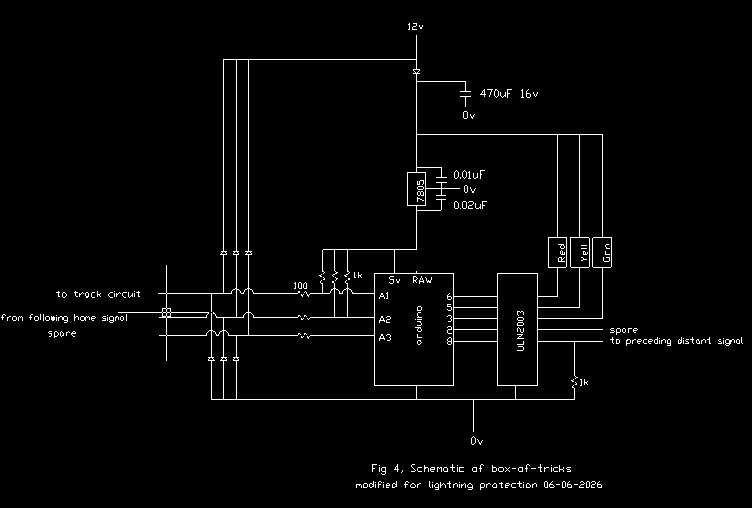
                                    Robert, I’m back from holiday. Before I warm up the soldering iron, is this what you mean? The diode in the supply to the 7805 is to prevent damage when some clown (me) connects it up the wrong way. I suppose it’s superfluous with the new diodes as they will short out a reverse connection. The Arduino is looking for 0-1.7v, 1.7-3.4v and 3.4-5 v to indicate track occupied, clear, faulty connection so I’ll have to alter the settings a bit as the 100 ohm resistor will alter things a bit. In reality I’ve only got a month to rebuild 8 or more signals, so this will be a later add on.

                                    schematic

                                    #850997
                                    Robert Atkinson 2
                                    Participant
                                      @robertatkinson2

                                      Almost, the 100R resistors should be between the external circuit and the diodes and the cathodes of the top diodes should go to the 5V supply not the 12V.
                                      The idea is that that any excessive voltage at the input is diverted to the supply rather than the input of the chip.

                                      Robert.

                                      #851001
                                      peter1972
                                      Participant
                                        @peter1972

                                        I would choose much higher value of resistor than 100Ω but taking into account leakage when the track is soaking wet. In my view the input protection diodes need to be Schottky type.

                                        Are you sure you need to rebuild eight or more signals? Have you tested each one? Or is it obvious that each one has been damaged?

                                        Leave that diode in series with the 12V supply.

                                        I assume one of the 1kΩ resistors needs to go to A3 instead of to A2.

                                        We need to consider lightning hitting the ULN2003 from the preceding distant signal.

                                        I suggest using sockets for the Arduino and ULN2003 so they can be easily replaced if lightning strikes again.

                                        The three-level (ternary) signalling seems sensible but i do not see anything in your circuit diagram that supports this.


                                        #851045
                                        duncan webster 1
                                        Participant
                                          @duncanwebster1

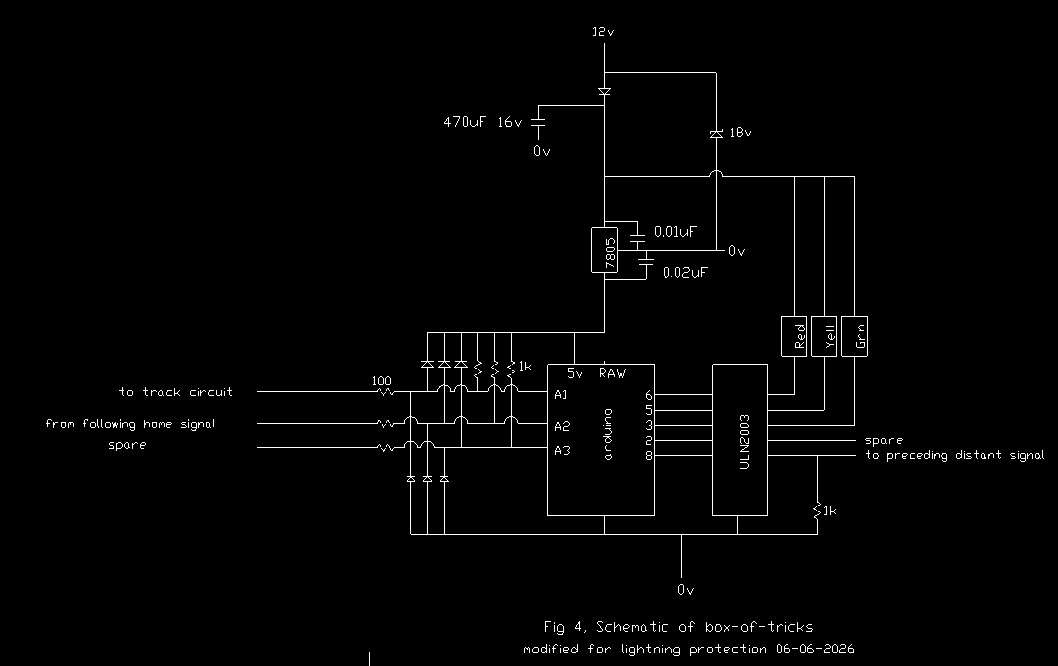
                                          schematic amended, and I’ve worked out how to fit the extra diodes/resistors (I think) by using the other side of the board

                                          Can someone suggest a wattage or part number for the 18v zenner?

                                          Cabling is domestic 1 sq.mm. twin and earth. Changing that is too big a job

                                          I’m fitting sockets for chips

                                          I hope 1n4001 are OK, I’ve got loads, but Scottky aren’t that expensive (1N5817, 1A 20V) if they would be better. FWD volt drop 0.45V, which isn’t a lot better than 1n4001

                                          At the far end of a track section there is another 1k resistor across the track, so if unoccupied there is nominally 2.5V at the Arduino input, if there is a train there will be 0V, and if there is a broken connection there is 5V. With the added 100 ohm resistor these values become 2.62V, 0.45V, 5V, so I’ll just adjust the ranges to suit. The usual reason for broken connection is that the track maintenance crew forget to put the jumpers back between rail ends when they’ve been messing about

                                          Not had any problems with leakage across sleepers, which are plastic. The aluminium rails quickly develop a coat of oxide, and rain water isn’t that conductive anyway.

                                          Thanks to everyone who has contributed

                                          schematic

                                          #851052
                                          duncan webster 1
                                          Participant
                                            @duncanwebster1

                                            what I don’t understand, although I’m sure it’s right is the statement “any excessive voltage at the input is diverted to the supply“. It can only go back to the 5v line and then be blocked by the 7805? Or will that back conduct? Even tho’ I’m getting old I like to learn.

                                            At least 5 of the signals were showing spurious indications, so I’m assuming at least the processors are blown. I ran out of time to check the other 3 in the series but I’ not hopeful. I’ll know later today. I’ll do some testing to see whether the 7805 and ULN are blown before I rip it all apart

                                            #851055
                                            peter1972
                                            Participant
                                              @peter1972

                                              I do not know what microcontroller your Arduinos are using but taking for example the ATmega32U4, then all inputs have protection diodes incorporated. This is reflected in the specified absolute maximum ratings for input pins of -0.5V to Vcc+0.5V (with respect to ground). I expect these diodes have very limited transient current handling capability. That is why I suggested use of Schottky diodes.

                                              We ought to consider what would happen to the Arduino’s 5V supply if a surge current passes through one of the protection diodes that is connected to 5V. Would the 5V supply go above the 6V maximum rating of ATmega32U4? I would therefore be inclined to add 5.6V zener protection (with a resistor).

                                              I note that the connection to the preceding distant signal remains unprotected.

                                              We ought to consider that these circuits are probably not powered up when there is lightning nearby.

                                              I still maintain that using much higher resistor values throughout would give much better protection against lightning transients.

                                              #851083
                                              Macolm
                                              Participant
                                                @macolm

                                                One thing to be aware of with schottky diodes is the very high reverse leakage current. It can be a maximum of several milliamps for a small diode, an amp or more for a larger stud diode.

                                                #851106
                                                Robert Atkinson 2
                                                Participant
                                                  @robertatkinson2

                                                  Hi,

                                                  I suggested 100R as a compromise value not knowing the exact circuit in use. With the circuit shown 1k in series will prevent correct operation of the circuit. A 1N4007 is rated at 45A for a 1ms square pulse. with 100 R in series this is a 4500V pulse. Thus 100 R is adequate to limit the current through the diode.
                                                  The problem with Schottky diode is their low reverse breakdown voltage. I’m aware that most microcontrollers have “diodes” between most pins and the supply rails. Typically these are parasitic rather than designed in. Adding the 100R and 1N4007 diverts most of the energy to the supply and provides a current limiting impedance considerably reducing the stress on the much smaller junctions on the microcontroller. Even better protection, for the input circuit shown, would be to add a 1k resistor between the existing 1k resistor and the pin of the microcontroller.

                                                  The energy from the spike at the input is partially converted to heat in the 100R resistor and partially absorbed into the 5v supply network raising it’s voltage slightly.
                                                  A 5V6 Zener diode across the micro controller supply pins is a good idea for additional protection.

                                                  Robert.

                                                  #851124
                                                  peter1972
                                                  Participant
                                                    @peter1972

                                                    A 1N4007 is rated at 45A for a 1ms square pulse but its forward voltage would then typically be over 1.8V. I doubt the Arduino would survive. Adding a fairly high value of resistor in series with each Arduino input makes sense, but I would prefer to use much higher resistor values throughout.

                                                    With the circuit shown, 1KΩ in series would not prevent correct operation of the circuit if the ternary signalling threshold levels programmed into the Arduino are modified accordingly.

                                                    On Macolm Said:

                                                    One thing to be aware of with schottky diodes is the very high reverse leakage current. It can be a maximum of several milliamps for a small diode, an amp or more for a larger stud diode.

                                                    For the 1N5817 Schottky diode mentioned, the data sheet shows typical reverse leakage current of 3µA with 5V applied (at 25C).

                                                    #851260
                                                    duncan webster 1
                                                    Participant
                                                      @duncanwebster1

                                                      So it’s not as bad as I thought, only 7 blown signals, not 8. At least one of the signals has a blown 7805, which is outputting well over 5v, so what’s happening to the inputs on that one is a bit irrelevant.

                                                      To incorporate the mods suggested would mean a new pcb, and I’ve already got 9 spares. I’ve also got time restraints, got to have them up and running for next public running, so I’ve decided to just fit sockets for the time being. Nano from AliExpress is only about £2, it’s just the pain of fitting them

                                                      On the mk4 board when the panic is over, is it worth a resistor in the feed to the processor, to drop the voltage to 8v, then a beefy capacitor to mop up spikes? Any mileage in passing the inputs/outputs through ferrite beads?


                                                    Viewing 25 posts - 1 through 25 (of 43 total)
                                                    • Please log in to reply to this topic. Registering is free and easy using the links on the menu at the top of this page.

                                                    Latest Replies

                                                    Viewing 25 topics - 1 through 25 (of 25 total)
                                                    Viewing 25 topics - 1 through 25 (of 25 total)

                                                    View full reply list.