Wallace valvegear simulator

Wallace valvegear simulator

Home Forums General Questions Wallace valvegear simulator

Viewing 24 posts - 1 through 24 (of 24 total)
  • Author
    Posts
  • #849128
    Kevan Shaw
    Participant
      @kevanshaw32462

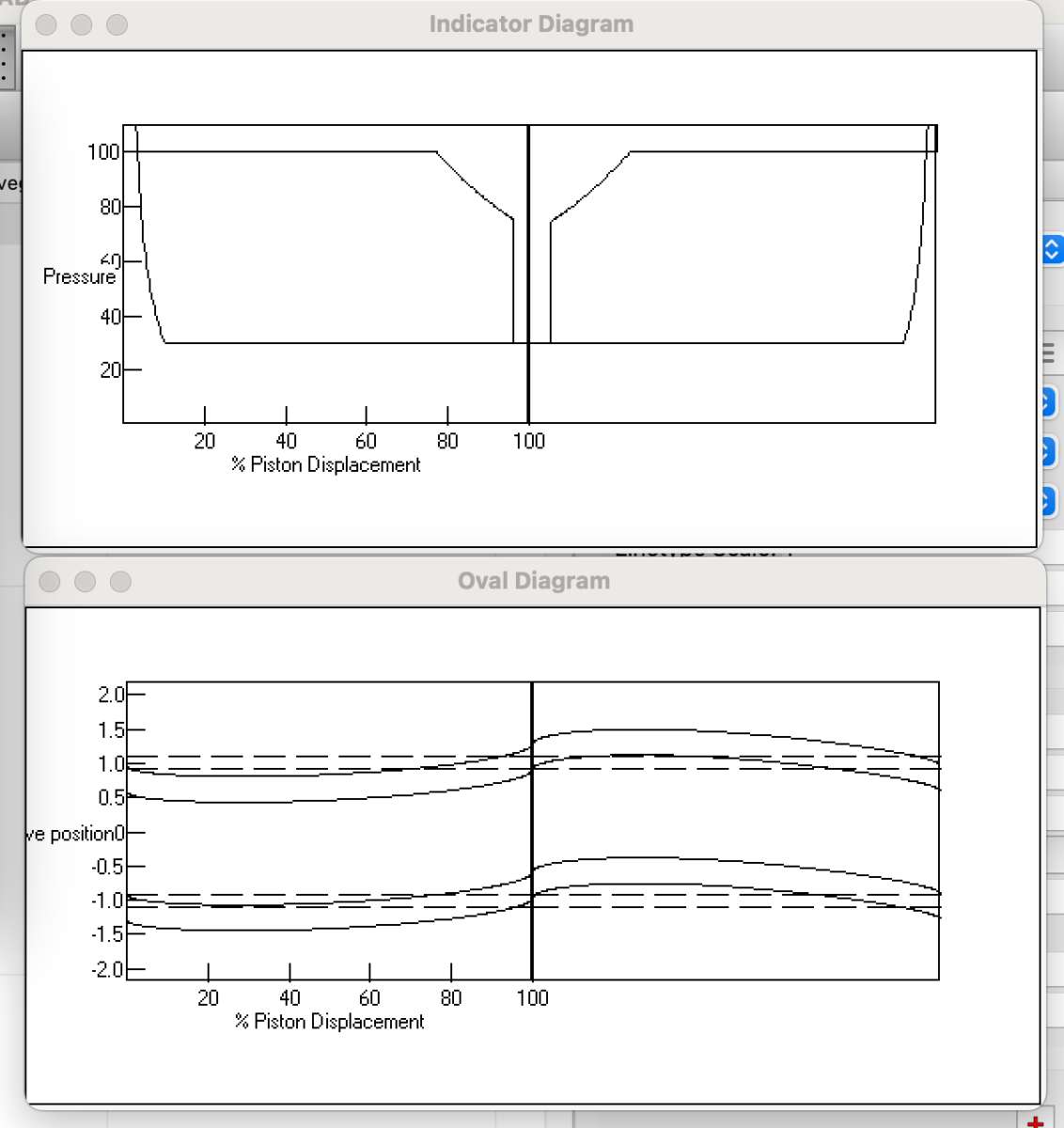
      I am trying to use this to rationalise some issues I am having with valvegear for my D49 project. I need some help in interpreting the indicator diagrams the program generates. I don’t understand the oval diagram at all and don’t understand the trace at the beginning and end where the pressure seems to exceed the max pressure set for the valve chest. Can anyone point me at some resources to help me undertsand these diagrams? Screenshot 2026-05-21 at 21.16.06

      #849136
      Charles Lamont
      Participant
        @charleslamont71117

        I am not familiar with this simulator, but in the indicator diagram, the little loops at the top strongly suggests to me that it is showing there is insufficient clearance volume in the cylinder. When the exhaust closes, even as late as is shown (so it must simulating full gear here), the trapped steam is shown as being compressed to a pressure higher than that of the steam chest (so probably piston valves). As the inlet opens, just before dead centre, the pressure ceases to increase, and then as the piston reverses, the pressure drops to steam chest pressure, giving the (somewhat unrealistic) flat inlet line to the cut-off point.

        The bottom trace shows the edges of the ports as dotted lines, the right hand end of the cylinder in the indicator diagram is at the top in this diagram. The wavy lines indicate the positions of inlet and exhaust edges of the valve. The valve evidently has inside admission, so the inner lines show the inlet edges and the top and bottom lines the exhaust edges. I am surprised by the jerkiness of the valve motion at ‘bottom dead’ in the middle of the diagram.


        #849185
        duncan webster 1
        Participant
          @duncanwebster1

          I think Charles’s diagnosis of compression loops is correct, but it would be most unusual to have over-compression in full gear. Have you entered the clearance volume correctly? I can send you more understandable simulators, one written by Prof Hall in Borland C++, another by me using Python. Both of these produce more understandable oval diagrams. If the Hall one will work on modern Windows it would be easier than mine for which you need to install Python (not terribly difficult). There is also one by an American chap, whose name escapes me at the moment, no doubt someone will remember

          #849197
          Baz
          Participant
            @baz89810

            Duncan, is the American chap you are thinking of Charlie Docksteader? His valve gear simulator program is still available and works on Win10.

            #849218
            Martin Johnson 1
            Participant
              @martinjohnson1

              In your 1st diagram, the exhaust compression loops may well be caused by incorrect entry of the exhaust back pressure.  Look at the exhaust line which is at 30 % of inlet pressure – very odd.

              Charles has explained the 2nd diagram very well and in a perfect world it would show sine curves.  As Charles remarks, the kink at 100 % piston travel is odd.

              I prefer Dockstaders offering but they all have a learning curve which takes time.  Time well spent, though – unless you enjoy lumpy running and re making valve gear parts.

              Martin

              #849226
              duncan webster 1
              Participant
                @duncanwebster1

                Baz, that’s the chap

                Martin, well spotted, unless the loco is a compound, 30 psi back pressure is way too high. I wonder if it’s psia or psig. Probably psig

                #849261
                Charles Lamont
                Participant
                  @charleslamont71117
                  On Martin Johnson 1 Said:

                  In your 1st diagram, the exhaust compression loops may well be caused by incorrect entry of the exhaust back pressure.  Look at the exhaust line which is at 30 % of inlet pressure – very odd.

                  Doh, I should have spotted that.

                  #849266
                  Kevan Shaw
                  Participant
                    @kevanshaw32462

                    Right I put 30 psig in as the exhaust pressure as a guess. What should it be in a typical 5″ gauge logo to have a decent drafting? I also guessed at the likely space when the piston is at full stroke. Having remeasured it is going to be a lot more. There is also a problem with lead. The simulator shows virtually no lead or even negative lead at some valve setttings.


                    Here are some more screenshots. and the set up values I am using

                    https://drive.google.com/drive/folders/1ePQKLSCyZTxtk9YycgRGjVmo5akWW75q?usp=sharing

                    #849268
                    duncan webster 1
                    Participant
                      @duncanwebster1

                      The only back pressure figure I can readily find for a full size engine is single chimney King working at well over normal evaporation rate. this was 10 psi. Double chimney conversion reduced this significantly, but I can’t find a figure. this doesn’t help with a model, where I would expect back pressure to be significantly lower. Jim Ewins did a series of tests with a loco on a stationary test set up. These are at last partially reported in Martin Evans book on model boilers, with his loco working hard he got a whole 0.9 psi back pressure.

                      Typical clearance volume on full size was 10-12%. GWR was less, but they suffered from compression loops at short cut off. Clearance is a necessary evil, how much you need depends how short a cut off you intend to have, and steam chest pressure. I’m not a big driver of model locos, but I doubt anyone runs at much less than 30% cut off, and steam chest pressure is unlikely to be above 100 psi. Most people seem to run with part closed regulator, so in reality a lot less.

                      If you are getting variable lead in an engine with Walschearts valve gear there is something sadly amiss with the design, probably either the angular position of the return crank or the length of the eccentric rod. Both my and Prof Hall’s simulations sort this out for you, but it is easy enough to do it on CAD. I did a few articles on valve gears in ME starting at issue 4718

                      I wouldn’t worry too much about the ‘indicator’ diagrams, what is important is that the cutoff each end is something like the same, the valves open far enough, and do not over run

                      #850026
                      tcsmith
                      Participant
                        @tcsmith

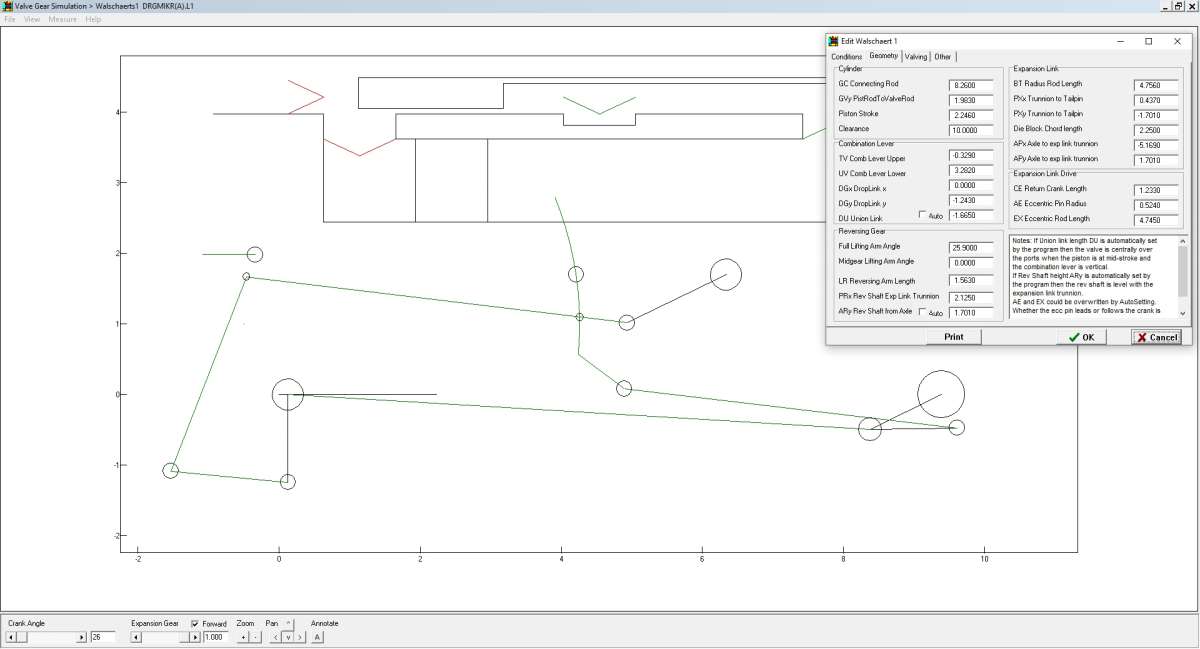
                        Kevin, something looks wrong with the geometry of your sim.   I don’t think the radius rod should “disconnect” from the expansion link like it does.  Looks like the connection of the radius rod to the lifting arm is constraining it’s movement.  There should either be an additional lifting link between the lifting arm and the radius rod or the end of the radius rod should be slotted (I’m not familiar with this particular loco).

                        #850127
                        John Purdy
                        Participant
                          @johnpurdy78347

                          Kevin

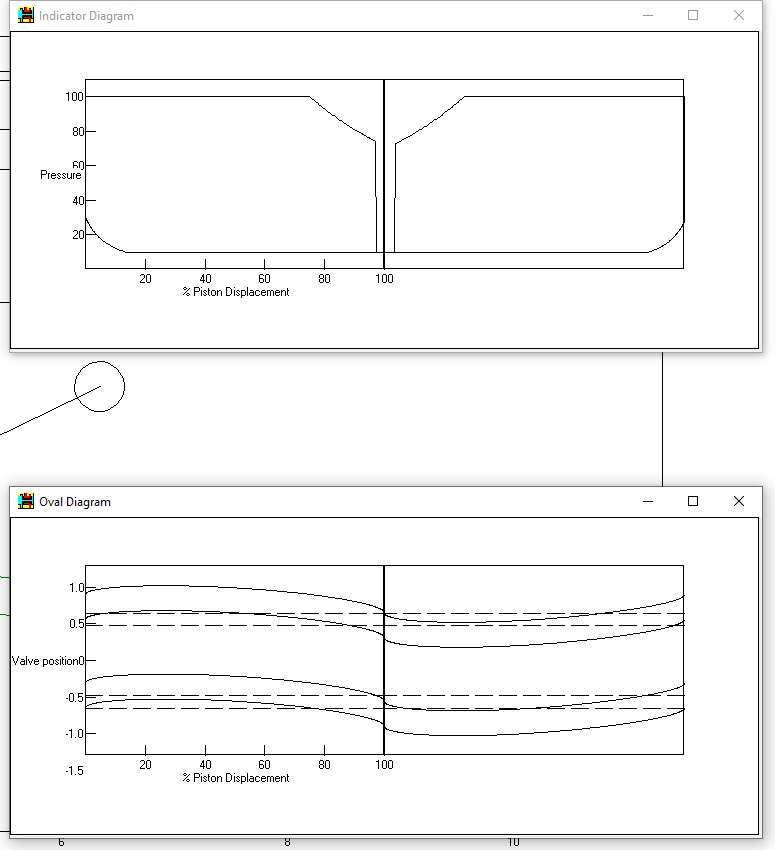
                          From your screen shots I agree with tcsmith, it looks like there is a problem with the radius rod length in your simulation. For comparison here are a couple of pictures from my Wallace simulation of the layout and indicator diagrams for a K28 Mikado I am working on. It’s a 3 1/2″ gauge loco, but is narrow gauge so the dimensions are practically the same as a 5″ gauge one (except for the wheel spacing).

                          John

                          K28 Valve2

                          K28 Valve

                          #850134
                          John Purdy
                          Participant
                            @johnpurdy78347

                            Kevan

                            I’ve sent you a PM.

                            John

                            #850140
                            Martin Johnson 1
                            Participant
                              @martinjohnson1
                              On Kevan Shaw Said:

                              Right I put 30 psig in as the exhaust pressure as a guess. What should it be in a typical 5″ gauge logo to have a decent drafting? I also guessed at the likely space when the piston is at full stroke. Having remeasured it is going to be a lot more. There is also a problem with lead. The simulator shows virtually no lead or even negative lead at some valve setttings.

                              Hi Kevan, as Duncan says there is not the test data to be precise, but comfortably under 5 psi on a model I suggest.  The precise figure is not going to  matter greatly.  If your clearance volumes were wrong that will also help to eliminate the compression loops in your PV diagrams.

                              Sorry I can’t help with the other problems as I have never done a Walschaerts gear.

                              Good luck,

                              Martin

                              #850173
                              John Purdy
                              Participant
                                @johnpurdy78347

                                Kevan

                                I have had another look at your valve gear diagrams and have a couple of questions.  I am not familiar with the D49 valve gear, is the radius rod lifting link connected to the radius rod behind or in front of the expansion link. Your diagrams, and the dimensions in the geometry table, seem to indicate that it is in front. If that is the case you are using the wrong Walschaerts valve gear program. Wallace gives two Walschaerts programs, #1 and #2, #1 is for the lifting link connected to the radius rod behind the expansion link, whereas the #2 is for the lifting link connected to the radius rod in front of the expansion link. If it is in front, then if you bring up the Walschaerts #2 program you will see that there are some additional dimensions required in the “geometry” table. If it is behind then there is something definitely wrong with the dimensions.

                                John

                                #850500
                                Kevan Shaw
                                Participant
                                  @kevanshaw32462

                                  John


                                  Lifting link in front and I haven’t found Wallace#2 program. can you give me a link to it? I am planning another onslaught at the problem later this week, I have a long flight to China which will give me some uninterupted time on this problem!


                                  I don’t understand how the lifting link affects the timing. The position of the die block would seem to do that so I don’t understand how the method of positioning it in the radius link has any effect!

                                  #850516
                                  duncan webster 1
                                  Participant
                                    @duncanwebster1

                                    The position of the die block is set by the lifting link, but it wanders up and down the curved slot as the expansion link rocks to and fro. Known as die slip

                                    #850557
                                    John Purdy
                                    Participant
                                      @johnpurdy78347

                                      Kevan

                                      The problem is that using the program (#1) for the case where the lifting link is behind the exp. link for dimensions of the case where the link is in front of the exp. link means that there are dimensions missing and the lifting link is not connected to the radius rod in the simulation. Which results in a non valid simulation. The #2 program requires the input of these extra dimensions so the lifting link is positioned correctly and is connected to the radius rod.

                                      I have sent you a PM.

                                      John

                                      #850561
                                      Kevan Shaw
                                      Participant
                                        @kevanshaw32462

                                        John & Duncan, Thanks!

                                        #850719
                                        Kevan Shaw
                                        Participant
                                          @kevanshaw32462

                                          John , thanks I have re downloaded the program and found Walcharts’2. In addition to the lifting link geometry being correct it has two additional links for an articulated valve rod. When I try and set these to zero or even near zero the program hangs. Any idea of a work around to nulify these two links without breaking the calculation?

                                          #850726
                                          John Purdy
                                          Participant
                                            @johnpurdy78347

                                            Kevan

                                            I have never had a reason to use the #2 program in anger, all the simulations i have done over the years are for locos with the lifting link behind the exp. link or for Stevenson gear. Maybe someone else here who has used the program for a lifting link in front of the exp. link could comment?

                                            At first glance, my gut feeling would be to make those two dimensions (WV and SV) very long (not”0″), if you e-mail me .jpg images of the “Conditions”, “Geometry”, “Valving”, and “Other” screens under the “Edit” tab I can play with it and see if I can sort it out.


                                            John

                                            #850732
                                            John Purdy
                                            Participant
                                              @johnpurdy78347

                                              Kevan

                                              Further to my last, I think making those two dimensions very long would simulate a solid valve rod and minimize or eliminate any vertical movement of the point “V”.

                                              John

                                              #851966
                                              Kevan Shaw
                                              Participant
                                                @kevanshaw32462

                                                John

                                                This doesn’t work as the pivot for the drop link part of this seems to be fixed I don’t know how it is being calculated I guess it relates to some of the basic geometry. I can’t say I have ever seen this set up in real life so not at all sure why it is this way and why these extra links would be added. I think whatever die slip errors I have from the incorrect location of the lifting links using the Walcharts 1 calculation will be less than the errors introduced by trying to figure out these phantom links in my set up.


                                                Cheers Kevan

                                                #851970
                                                John Purdy
                                                Participant
                                                  @johnpurdy78347

                                                  Kevan

                                                  Kevan
                                                  The length of the valve rod, VW, is defined from “V” to “W” so by increasing it’s length to say 100, “V” remains fixed and “W” moves way off to the right. Which is what we want.
                                                  But for the drop link, the fixed point is “S”, so when increasing the length of the drop link, “SV”, “S” remains fixed and “V” moves down off the page. Not what we want, we want “V” to remain fixed.
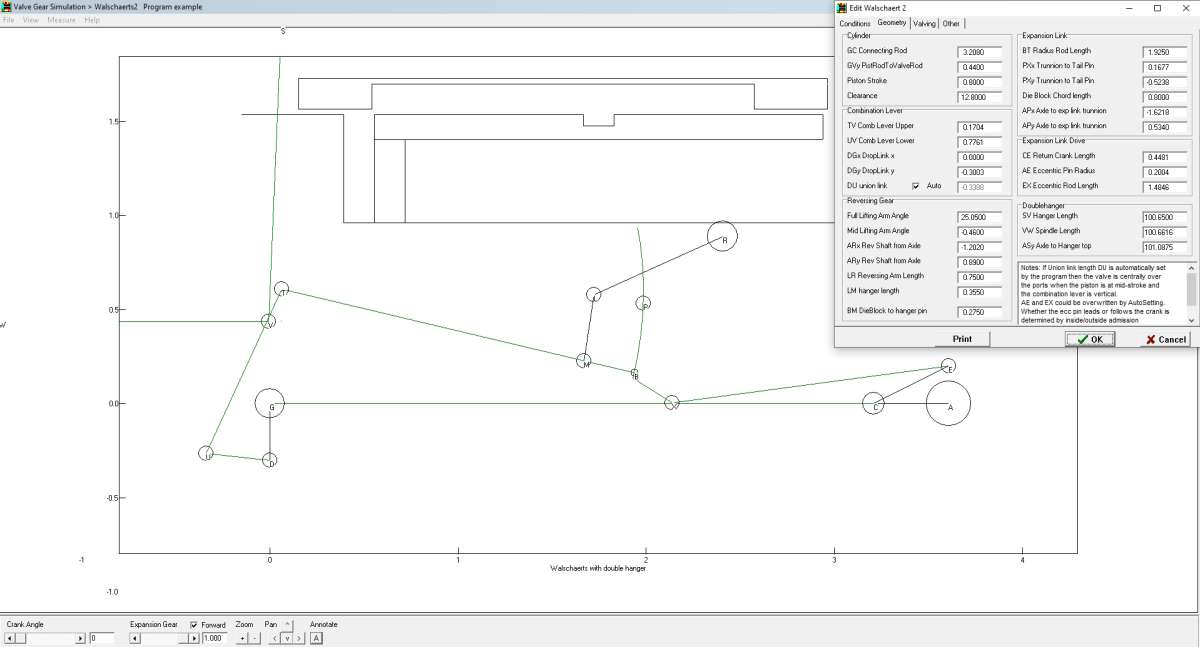
                                                  The way around this is to add exactly equal amounts, say 50 or 100 to the dimension AS suby “Axle to Hanger Top” and “SV”. This moves the top of the hanger “P” up while keeping the point “V” fixed on the combination lever.
                                                  Hope this makes sense.

                                                  John

                                                  #852167
                                                  John Purdy
                                                  Participant
                                                    @johnpurdy78347

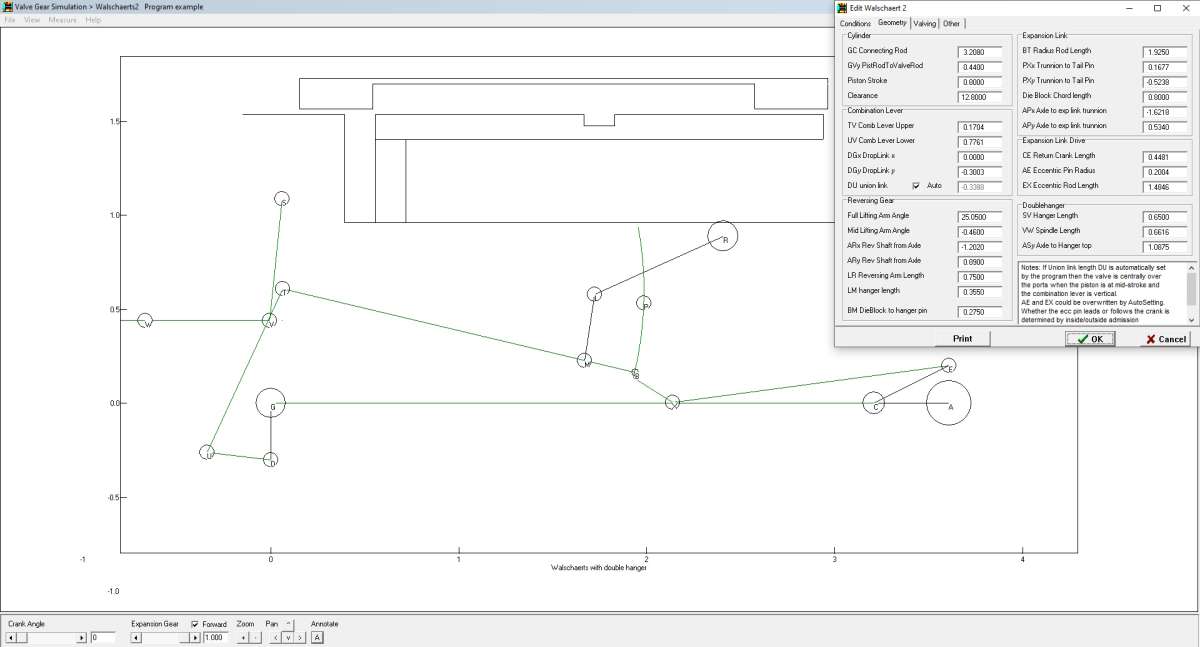
                                                    Here are some pictures to help illustrate my last post. The first is the example Walschaerts #2 diagram as first displayed when the program is started, including the original values in the “Geometry” file.

                                                    The second is the same display with 100 units added (to simulate a solid valve rod) to the dimensions “VW” (the pivoted end of the valve rod ), “SV” (the valve rod drop link) and “AS sub y” (the position of the fixed pivot of the valve rod drop link).

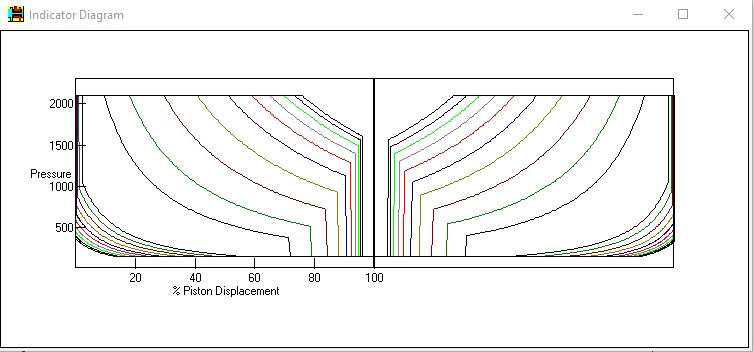
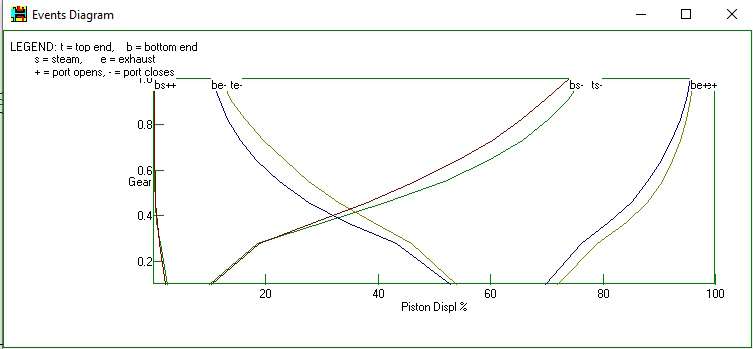
                                                    The third and fourth are the resulting “Indicator” and “Events” diagrams for the modified example.

                                                    John

                                                    Walschaerts 2 Example

                                                    Walschaerts 2 valve rod modified

                                                    Walschaerts 2 Indicator

                                                    Walschaerts 2 Events


                                                  Viewing 24 posts - 1 through 24 (of 24 total)
                                                  • Please log in to reply to this topic. Registering is free and easy using the links on the menu at the top of this page.

                                                  Latest Replies

                                                  Home Forums General Questions Topics

                                                  Viewing 25 topics - 1 through 25 (of 25 total)
                                                  Viewing 25 topics - 1 through 25 (of 25 total)

                                                  View full reply list.