Home › Forums › Beginners questions › Recommendations for first lathe
For anyone else doubting the small lathes can handle 50mm steel I just dug out the little Emco U3 and a bit of 50mm steel.
0.25mm facing cut
0.3mm deep turning cut
230M07 steel
50mm diameter
CCGT 060202 Insert
560rpm
So even with the little uns it is not going to take long to face and turn a steel wheel blank. Bit more work to bring the tread down to diameter, drill and ream a hole and face off the back. Add a little more if you want to make it look pretty with a recess, less work if using a casting or 3D metal print.
Bet use the hand to hand feed I start off with not the faster two hands on the handle I finish off with as it does not give a sgood a finish but OK for roughing out.
Hello Dan,
Welcome to the forum!
Just to introduce ourselves, I’m from Amadeal, a company based in London. We sell lathes, milling machines, and other machining equipment, and one of our machines might suit your needs. We’ve noticed mention of 210 swing machines, which we do carry.
If you look below this thread, you should see our banner, and we also advertise in the Model Engineering Workshop magazine.
Cheers,
Luke
Amadeal Ltd.
<sarcasm>Pah! You can’t use carbide on a small lathe!
</sarcasm>
🙂
I have a Unimat and one of the jobs I use it for is turning crystals for my case making efforts.
Acrylic is simple I hear you say. Well yes, but the Acrylic blank is turned by sticking it with carpet tape to an old Mini caliper piston.
This gets faced every time so it runs true.
Dave
Your mention of needing to turn upto 50mm diameter rather than 2″ suggests that you are more familiar with using metric than imperial. I also had a look on the 16mm Gauge website and the drawings there are mostly metric.
You may find it easier to purchase a machine with metric handwheels as it is one less complication for a beginner. The Sherline can be had in metric form and also very common for the far eastern machines to be in metric. Chances of finding second hand old iron in metric will be a lot less.
Interestingly a lot of the wheel sizes on the 16mm site are less than 50mm with 25-35mm being about average. Some of the locos are not much more than 150mm long, I’ve seen bigger clocks than that so well within the scope of the smaller lathes.
Therer are a couple more advantages of using carbide for the beginner with one of these small lathes.
1. It takes out the variables of being able to grind a HSS tool so you know problens should not be down to the cutting too. HSS can come later when it may be needed.
2. As a lot of the little lathes don’t have that slow a minimum speed if you want to do the odd item at a larger diameter you could well end up with a surface speed that is too high for HSS but will still be well within what Carbide is happy with. So no problems of taking the edge off that HSS tool that you strugged to get more or less right due to running it too fast.
Despite what someone has recommended, steer well clear of the Myford ML10. It’s the most awkward, poorly designed and inconvenient machine you could possibly encounter. I don’t know why Myford bothered. The backgear engagement arrangement is pathetic. The belt guard opens the ‘wrong’ way, the changewheel guard wobbles on a piece of square stock and reversing the leadscrew is very difficult.
If I were to be starting again it would be a ‘no brainer’ to opt for a Chinese machine supplied by a reputable importer. Modern Chinese products have been manufactured in well-invested facilities and are not the ‘made in Hong Kong’ junk they used to be, despite what the more xenophobic commentators might try to tell you. You get a lot of ‘bang for your buck’ with most being supplied with a good range of accessories, chucks and steadies etc., and remember that British-made machines such as the Boxford haven’t been produced for getting on for fifty-years so are going to be well worn although still capable of good work in the right hands. It’s very much up to the individual’s choice, but it would be a new Chinese machine every time for me.
You could pick faults with almost all lathes, the belt guard opening the wrong way and the cover being a bit wobbly are insignificant in comparison to the problems people have with Chinese lathes. For example these are the problems I had with my own.
Sieg C0 – Power supply failure. Common and a £100+ fix
Sieg C1 – Bell mouthed chuck jaws & poor rigidity due to a wobbly cross slide which wasn’t machined properly.
Sieg C2 – Intermittent power supply, wobbly cross slide, unevenly ground bed & an out of align tailstock which also didn’t lock up properly. All round hot garbage.
Some of those problems can’t easily be fixed. How many people have the capability to regrind a bed for example?
At least with a British lathe you get a fundamentally sound machine which was made properly to begin with. The quirks can be rectified. My 70 year old Boxford performs better now that the Sieg C2 did out of the box.
I’d suggest to the OP avoids opinions from people defending their own choices rather than looking at things objectively.
…I think what I need is for someone to just tell me what to buy. Then I can at least start learning about the chosen machine.
Many thanks
Dan
OK I can do that! Management summary, Order a new Sherline OR Far Eastern lathe. Today.
But which Far Eastern lathe? Problem is choosing the right one depends very much on the owner’s needs, so read on. Best to start, as best you can, by identifying requirements, not jumping to conclusions.
I believe Dan:
The above strongly suggests buying new. Advantages:
Things to consider:
Size. 16mm modelling suggests a small lathe, and if that’s all, I vote Sherline. BUT don’t buy a small lathe if there’s a need to do larger work. Reason: big lathes can do small work whilst small lathes can’t do big. Many Model Engineers find the size of what they do creeps up over time, and Myford-size-ish lathes are a good compromise. The slightly smaller WM240 and WM250 lathes from Warco are popular, as are the somewhat bigger than Myford WM280/WM290.
Accuracy/Precision Nothing said so far suggests an unusually good lathe is required! Almost anything will do. That said, a lathe in good condition is easier to use
Features & Accessories As Taig and Sherline have been mentioned, here’s a quick compare. Both popular. Taig are cheaper than Sherline, so why not just buy Taig? Reason is that Taig has limitations: it’s a plain lathe (no screw-cutting), has fewer accessories, and and no upgrade path. In many small workshops a Sherline is a waste of money because the Taig’s limitations don’t matter. But if Sherline’s extra capabilities are needed, then the Taig is a poor choice. Sherline can do milling.
Having mentioned milling it’s at least as important in my workshop as turning. Though Milling Slides fitted to lathes work, in my experience they are left in the dust by proper Milling Machines. I recommend budgeting for a milling machine!
Far Eastern lathes usually come with all the basic accessories.
Metric vs Imperial It pays to buy tools that work in the system that dominates in your workshop. In 2026 advantage lies with Metric unless working to Imperial plans, mending old equipment, or the operator doesn’t understand metric. Otherwise Imperial is slowly dying, and it becomes easier/cheaper to buy metric tooling and stock sizes with every passing year. Fitting a DRO helps – you can work in both.
Investment vs ‘Just a Tool’. I don’t see tools as a financial investment. I’m happy if they do what I need without costing a fortune. If a tool doesn’t do what I need, I change it. Before 1970 buying a lathe was a major investment and it made sense to pay big money for products with a high second-hand value. This approach is crumbling: not even the best traditional makes stay in good condition forever. Wear, tear, and the cost and availability of spares all get worse over time. I chose to “get on with it” by buying new Far Eastern, expecting the machines to need lots of work, and not to last – a risky investment. Turned out the naysayer advice was wrong: what arrived worked out of the box and only needed minor fettling. 12 years later the machines are still going strong… Another point, although Far Eastern lathes are cheap enough to be written off after 5 years, they do have second-hand value. Owners can change up or down if they want, it’s not 1950!
Who to buy from. Cheapest way to buy Far Eastern machines is online, possibly direct from China. Too risky for me in the event something goes wrong. I bought from an established UK supplier (Warco). The real test of a supplier is how they respond to problems, and I’m pleased to report Warco sorted out a problem with no fuss whatever. Play the game though: costs are kept down by not fully inspecting hobby lathes at all stages and what arrives isn’t guaranteed to be perfect. But the purchaser is protected. If the machine isn’t acceptable ring the supplier. Minor faults can often be fixed by the owner under their direction In the worst case the supplier will replace the machine or refund the cost. Most consumer goods are protected financially, not physically by aero-space quality control: dud TV sets and white goods are just replaced. I can’t think of a UK supplier to be avoided.
Beware Bad Advice. Some folk are dead against Chinese goods for -ism reasons, and isms are always suspect. Traditionalism has some merit, but Racism is plain stupid and worse. Should be obvious why it’s unwise to take advice from those who believe that the entire output of Chinese Industry is sub-standard. Or that not buying foreign goods will somehow bring failed British firms back from the grave. Check all advice including mine – it’s the buyer’s responsibility to get his requirements right, and that shouldn’t include keeping internet posters happy!
Bottom line:
With hindsight I wasted a lot of time fretting about which lathe to buy, and in the end it didn’t matter…
Dave
PS Don’t stint on materials. I came badly unstuck as a beginner because Gremlins ensured my entire collection of scrap-metal was rubbish: squidgy Aluminium, work-hardening stainless, chilled cast-iron, difficult Brass, mild-steel that tore, and a ground rod from a printer that resists carbide. Avoid scrap or DIY store metal at first. Buy new metal where the spec includes words like “free-cutting” or “good machinability”. Come back to scrap later – awkward materials are less challenging when you know how good metal cuts.
At least with a problem that can’t be fixed you have the option to return the lathe or a source of replacements. The OP has also said he has little knowledge to be able to pick out a good old lathe and from that I assume he will have problems rectifying any quirks too and unlikely to be able to return it to the seller.
I also worth pointing out to the OP that we do get the odd thread here asking about regrinding Myford beds, Problems with electrics like faulty Dewhurst switches or clapped out Crompton motors. Also not unknown for the chucks on secondhand machines to be bell mouthed and tailstock barrels worn and out of line. Does not affect them all just like not all far easten machines have problems.
As said and suggested by most here the Sherline, taig and Cowells are all better quality than a C0, 1 & 2 which I don’t think have been suggested.
I suggest going for a new lathe from a UK supplier.
If you are unlucky and there is a problem, you can expect them to sort it.
I bought a Wm290 lathe from Warco which had a strange fault. It vibrated at a particular speed. Warco arranged for someone to come and fix it. He spent most of the day here, but couldn’t resolve the issue.
Warco then replaced the lathe with a new one, which I am very happy with.
My first lathe as a beginner was a mini lathe which I bought from Amadeal. I later bought a collet chuck from them . This had unacceptable runout and after they had sent me a replacement which had the same problem I got a full refund.
So if you buy from one of the Uk suppliers you can expect good after sales service if needed.
I think for a beginner this is a major advantage over buying a used one.
Stuart
If it’s any help in making a decision I have a friend with no formal engineering training who builds lovely gauge one engines. on about his sixth I believe. He started with a good ML7, but partly for space reasons and partly because of the lowish top speed, sold this and bought a very lightly used Sherline. This suits him perfectly for his loco building, his only regret is he bought an imperial machine and would with hindsight have bought metric. Has since bought a Sherline mill so must be happy with his choice of maker.
Also beware of people claiming it’s somehow racist to notice that some Chinese products are crap. These people can sometimes think they are morally superior which is a dangerous mindset.
Let’s take one example of a lathe. A Chinese C0 versus an American Sherline. As a Brit, neither protects British industry. (An industry that pretty much doesn’t exist anymore anyway btw). So no vested interest.
On paper the C0 should be better. Cast iron vs aluminium construction. More powerful motor. Prism bed ways etc etc.
In reality it just isn’t. Anyone comparing the two would pick the Sherline because it has been made properly. Anyone with long term experience will also tell you the Sherline has superior reliability.
Imagine dismissing that valuable first hand experience because someone else wants to feel good about themselves by shouting racist at every opertunity. Unfortunately it’s the modern way.
It is absolutely valid to assume some countries produce better products than others based on previous reputation, and it’s fair to generalize, if you want a good pizza it’s probable the Italians do it best. Likewise, Indians probably make the best curries. The French, the best wine.
Before we get carried away I don’t want to see anymore mention of racism and that applies to Moderators as well as members.
But at least it is good to know that nobody here has specifically suggested the smaller far eastern machines to the OP. All I see is better quality small machines, larger far Eastern or good examples of second hand old iron.
This sort of question always throws up the same discussion to the same confussion. Everyone has his own ideas on what is the ideal lathe. Actually none is the ideal.
If you want the near ideal buy a Lorch or Schaublin. I not sure if you can buy either new now. Ten years ago you could have bought a new Hardinge HLV-H for around £80,000.
JA
Schaublin was available new a couple of years ago. Probably not in budget tho…
The Chinese make excellent products of all kinds designed for their market niche. From a quick search the C0 is now only available in the UK from Axminster online at a smidgen under 500 squids. Mill Hill are the UK Sherline stockists but they are coy about prices. From prices on the French stockists site and one in the USA a basic Sherline will be about double that price. The CLM500 mentioned in Mike’s Workshop comes from Machine Mart somewhere between those prices. His site is a testament to what can be done with it. I’m sure it’s Chinese made as well. I expect Sieg etc al make their products in factories equipped with extremely good automatic machinery that is also designed and made in China. It’s also true that there was a lot of dross made for the hobby market over here and sold for example through Woolworths.
If your lathe arrives tomorrow will you have a bench to put it on and another bench for manual work, and materials to work on and the plans for the loco? So let the advice settle down while you get that sorted and find surprise surprise 90% of the work on a loco does not involve a lathe. You have a year of non circular bits to occupy you.
Also just get a 3D printer for the moment (used Ender 3 not a fancy Qidi or Bamboo) and you can knock out a few wagons for your eventual loco to pull. You might then find some of the round metal bits can be metal printed anyway.
Millhill are not hiding prices, have a look at their price list. That is where I got the £1700 from in my first reply to this thread which is based on a 4410C package which would be the sort I thing I would go for. Still a few things you would really want to add to that so price £2000plus.
A year of just benchwork, some people must work slowly. 🥱 I’d have a whole loco done in a month, there are not many parts to these little things.
High Hollowpoint, I might get sent to the headmasters office for going off topic a bit, but, I don’t agree that the French make the best wine, in my opinion Italy make better wine and a lot more wine than just about anywhere else, but you have to go to Italy to taste their best, as they keep all their best in Italy. French wine is also better when in France, and I like theirs too, as well as many other places of our world, but it’s all about taste and preference, and it’s much the same about machinery.
Regards Nick.
Hollowpoint is right. The French make the best wine, Burgundies for a start, except for sparkling wines. Here the English now excel.
The headmaster could be busy.
JA
Some of the nicest wine I’ve had was in Germany… It’s just not exported.
…I think what I need is for someone to just tell me what to buy. Then I can at least start learning about the chosen machine.
Many thanks
Dan
OK I can do that! Management summary, Order a new Sherline OR Far Eastern lathe. Today.
But which Far Eastern lathe? Problem is choosing the right one depends very much on the owner’s needs, so read on. Best to start, as best you can, by identifying requirements, not jumping to conclusions.
I believe Dan:
- Wants to get on with learning by doing and doesn’t want to start with a “mend the tool” project
- Lacks the skills needed to evaluate the all important condition of a second-hand lathe, or to spot parts are missing. He doesn’t want to waste time searching for a good one or sort out transporting it.
The above strongly suggests buying new. Advantages:
- More choice
- Available now
- Transport arranged by seller
- In the event there’s a problem with the machine, the purchase is low-risk because Consumer Protection Law applies, there’s a Warranty, and most UK suppliers are keen to protect their reputations.
Things to consider:
Size. 16mm modelling suggests a small lathe, and if that’s all, I vote Sherline. BUT don’t buy a small lathe if there’s a need to do larger work. Reason: big lathes can do small work whilst small lathes can’t do big. Many Model Engineers find the size of what they do creeps up over time, and Myford-size-ish lathes are a good compromise. The slightly smaller WM240 and WM250 lathes from Warco are popular, as are the somewhat bigger than Myford WM280/WM290.
Accuracy/Precision Nothing said so far suggests an unusually good lathe is required! Almost anything will do. That said, a lathe in good condition is easier to use
Features & Accessories As Taig and Sherline have been mentioned, here’s a quick compare. Both popular. Taig are cheaper than Sherline, so why not just buy Taig? Reason is that Taig has limitations: it’s a plain lathe (no screw-cutting), has fewer accessories, and and no upgrade path. In many small workshops a Sherline is a waste of money because the Taig’s limitations don’t matter. But if Sherline’s extra capabilities are needed, then the Taig is a poor choice. Sherline can do milling.
Having mentioned milling it’s at least as important in my workshop as turning. Though Milling Slides fitted to lathes work, in my experience they are left in the dust by proper Milling Machines. I recommend budgeting for a milling machine!
Far Eastern lathes usually come with all the basic accessories.
Metric vs Imperial It pays to buy tools that work in the system that dominates in your workshop. In 2026 advantage lies with Metric unless working to Imperial plans, mending old equipment, or the operator doesn’t understand metric. Otherwise Imperial is slowly dying, and it becomes easier/cheaper to buy metric tooling and stock sizes with every passing year. Fitting a DRO helps – you can work in both.
Investment vs ‘Just a Tool’. I don’t see tools as a financial investment. I’m happy if they do what I need without costing a fortune. If a tool doesn’t do what I need, I change it. Before 1970 buying a lathe was a major investment and it made sense to pay big money for products with a high second-hand value. This approach is crumbling: not even the best traditional makes stay in good condition forever. Wear, tear, and the cost and availability of spares all get worse over time. I chose to “get on with it” by buying new Far Eastern, expecting the machines to need lots of work, and not to last – a risky investment. Turned out the naysayer advice was wrong: what arrived worked out of the box and only needed minor fettling. 12 years later the machines are still going strong… Another point, although Far Eastern lathes are cheap enough to be written off after 5 years, they do have second-hand value. Owners can change up or down if they want, it’s not 1950!
Who to buy from. Cheapest way to buy Far Eastern machines is online, possibly direct from China. Too risky for me in the event something goes wrong. I bought from an established UK supplier (Warco). The real test of a supplier is how they respond to problems, and I’m pleased to report Warco sorted out a problem with no fuss whatever. Play the game though: costs are kept down by not fully inspecting hobby lathes at all stages and what arrives isn’t guaranteed to be perfect. But the purchaser is protected. If the machine isn’t acceptable ring the supplier. Minor faults can often be fixed by the owner under their direction In the worst case the supplier will replace the machine or refund the cost. Most consumer goods are protected financially, not physically by aero-space quality control: dud TV sets and white goods are just replaced. I can’t think of a UK supplier to be avoided.
Beware Bad Advice. Some folk are dead against Chinese goods for -ism reasons, and isms are always suspect. Traditionalism has some merit, but Racism is plain stupid and worse. Should be obvious why it’s unwise to take advice from those who believe that the entire output of Chinese Industry is sub-standard. Or that not buying foreign goods will somehow bring failed British firms back from the grave. Check all advice including mine – it’s the buyer’s responsibility to get his requirements right, and that shouldn’t include keeping internet posters happy!
Bottom line:
- If happy to work under a 50mm diameter limit with some light milling, then buy Sherline.
- If greater than 50mm, or with a need to cut metal quickly, then chose a bigger Far Eastern lathe based on size/weight/power/cost. I started with a mini-lathe, learned a lot from it, but found it was too small! If I’d started with a WM250-size, I’d probably still be using it. As is, I realised I wanted a lathe a notch bigger than a Myford, and bought the biggest Far Eastern lathe and milling machines where the pair fit sensibly into my workshop.
With hindsight I wasted a lot of time fretting about which lathe to buy, and in the end it didn’t matter…
Dave
PS Don’t stint on materials. I came badly unstuck as a beginner because Gremlins ensured my entire collection of scrap-metal was rubbish: squidgy Aluminium, work-hardening stainless, chilled cast-iron, difficult Brass, mild-steel that tore, and a ground rod from a printer that resists carbide. Avoid scrap or DIY store metal at first. Buy new metal where the spec includes words like “free-cutting” or “good machinability”. Come back to scrap later – awkward materials are less challenging when you know how good metal cuts.
This is simply the best, most practical, best informed post on this thread (and I have read all following posts).
The caution against ‘mystery metal’ is an excellent aside too.
I’ll just add some footnotes to SOD’s post.
The quality of Chinese manufacturing and quality control as regards machine tools, increases as you give them more money. That shouldn’t be surprising but a lot of people do seem surprised by this.
That’s why you hear of so much discontent with Chinese mini lathes (so the 7″x10″, 7×12″, 7″x14″, and 7″x16″ models) and much less with the benchtop lathes 9″x and 10″x and above.
If you can possibly afford (in space and financial terms) it, avoid buying a Chinese mini lathe. They can be made to work really quite well, but it’s really rather a daunting first project to tackle, when you should be just making chips and having fun (ask me how I know).
None of the Chinese lathes fresh out of a Weiss or Seig factory, are as well manufactured and QC’d as say a Harrison, Boxford, or Colchester would have been fresh out of the relevant British factory. That’s not the fault of Chinese manufacturing though, it’s the fault of the West wanting things on the cheap.
The Chinese lathes are, however, with a bit of fettling and adjustment, entirely good enough for our purposes and they are accessible. You can buy a brand spanking new Myford Super 7, made in England, today but it will cost you around £10,000. Depending on the model you buy, the Chinese lathe will be at least as, if not more, capable than the 10 grand Myford.
I would also recommend Warco as a supplier. They’re more expensive than other suppliers but you do get something for your money. The customer service is great and their spares department people are some of the most helpful bunch of people I’ve ever had the pleasure of dealing with.
Finally, I would absolutely recommend going larger than you think you need.
Obviously I’m not suggesting you buy some 16″x40″ behemoth, but if you were to buy, for example, a WM250V from Warco, you will be unlikely to say to yourself “Damn, this thing has too much capability size-wise“. You might conceivably find yourself saying “Oh, I wish I had a bigger work envelope“, were you to buy a smaller lathe of equivalent or greater quality.
(p.s. apologies for the use of imperial in describing lathe swing and distance between centre, I use metric often when in the workshop, but still find inches easier to visualise, in terms of lathe size)
I am afraid I must disagree with Chis. An ML10 is an excellent machine. I have tried one of the more expensive Chinese mini lathes and there is no comparison. For that size lathe, an ML10 is hard to beat. Certainly better value for money than just about anything else in that class.
The “defects” that Chris mentions in his criticism of the ML10 are of an absolutely trivial nature.
Andrew.
This sort of question always throws up the same discussion to the same confussion. Everyone has his own ideas on what is the ideal lathe. Actually none is the ideal.
If you want the near ideal buy a Lorch or Schaublin. I not sure if you can buy either new now. Ten years ago you could have bought a new Hardinge HLV-H for around £80,000.
JA
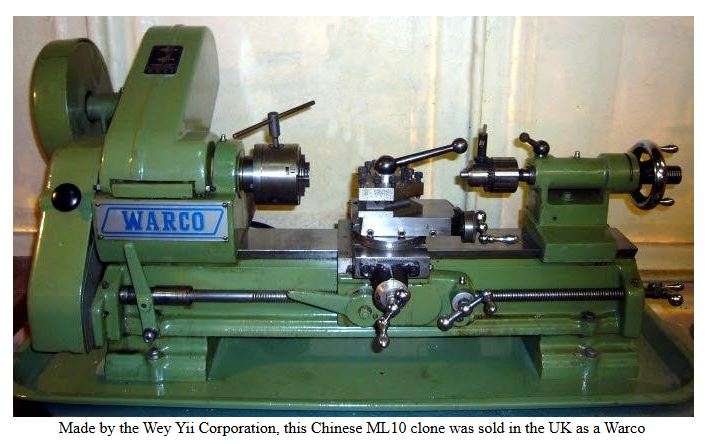
Surely this one is the ideal as it covers the suggestions of all members. 😉
It’s an ML10, it’s Chinese and sold by a reputable UK dealer

You can still get the manual Schublin lathes but I could not see th eprice so I assume “If you have to ask……..”
Nice one Jason! Best of both worlds.
Andrew.
Pros and cons, as i see them, of buying a lathe from different sources.
Direct from China.
Pro Cheaper
Con Expensive to ship back and possibly poor support if faulty.
UK Supplier
Con. More costly
Pro Support, and spares available if required. A faulty machine machine can be rejected and replaced fairly easily.
Quality improved as the manufacturers became aware of market requirements. They found that unreliable, very poorly made machines get a bad reputation and don’t sell. UK importers showed manufacturers that the market wanted good value for money. So quality and back up improved.
New “British” lathe.
Pro New, Supplier support
Con Unlikely to have actually been made in UK.
Pre owned British machine.
Pro Well made WHEN NEW. Some will might have been properly refurbished.
Con May well be worn now. Support and spares may no longer available. The refurbishment might be no more than shiny paint on a badly worn machine.
You need to know what to look for and how to check, or have someone who can do this for you.
What about me?
Started with a used Myford ML7, Bought from an Engineer friend who did a little machine tool dealing on the side. So a pretty good example.
Later, up graded to a larger, more comprehensive Far Eastern lathe.
Both satisfactory, but the new oriental machine was larger, more rigid, comprehensively equipped, and suits my purposes better.
As in everything, “You pays makes your choice and pays your money”
If in doubt, pay a little more for a machine which is a little bigger and more comprehensive than you first think.
Your horizons will expand, in expectations, even if not in size.
When you get the machine, “waste” material by just cutting it, to learn the basics.
Start by making simple tools, such as Centre Height gauge, Sliding Die and Sliding Tap holder, Mandrel handle. Simple to make, and will provide experience, and confidence which will stand you in good stead, because you have an understanding of the basics. And you will have simple tools which can be used for years to do other jobs.
Buy and study some books on lathework.
Stan Bray “Basic Lathework”, (45 in the Workshop Practice Series) or his “The Compact Lathe” if you can find a copy
Harold Hall “Lathework, A Complete Course” (34 in the W P S.)
You will find a set of Zeus Charts useful. Still using my dirty, dog eared ones from 1958!
For smaller sizes you will probably be able to survive using taps and |dies.
IF you want to screwcut, Martin Cleeve’s “Screwcutting in the Lathe” would help, as would Brian Wood’s more expensive “Gearing lathes for Screwcutting) These will show how to calculate and arrange gear trains to cut various pitches., Thread forms are something else to learn about, and add to your widening knowledge of machining.
You will, eventually, be surprised by what you can do, once you own, and can operate, a lathe!
Howard
Home › Forums › Beginners questions › Topics
Started by: Robin Graham
in: The Tea Room
Adrian R2
Started by: Nigel Graham 2
in: Manual machine tools
Diogenes
Started by:
drnewcomb
in: Manual machine tools
alecs
Started by: Mick Bailey
in: Workshop Tools and Tooling
Michael Gilligan
Started by: duncan webster 1
in: Electronics in the Workshop
duncan webster 1
Started by: Carl
in: Materials
old mart
Started by: Mike Henderson 1
in: Traction engines
Started by: anonymouse
in: Materials
anonymouse
Started by: Shaun Churchill
in: CAD – Technical drawing & design
JasonB
Started by: larry phelan 1
in: The Tea Room
Roderick Jenkins
Started by: Andrew Skinner
in: Manual machine tools
bernard towers
Started by: zuji miko
in: Beginners questions
JA
Started by: AStroud
in: Work In Progress and completed items
AStroud
Started by:
JasonB
in: The Tea Room
renardiere7
Started by: Speedy Builder5
in: Workshop Techniques
blowlamp
Started by: bernard towers
in: Electronics in the Workshop
Dell
Started by: wigan2026
in: Workshop Tools and Tooling
Grindstone Cowboy
Started by: southernchap
in: Manual machine tools
peak4
Started by:
Michael Gilligan
in: The Tea Room
alecs
Started by:
drnewcomb
in: Manual machine tools
John Haine
Started by: jaCK Hobson
in: Workshop Tools and Tooling
Charles Jambon
Started by: Andrew Tinsley
in: General Questions
Andrew Tinsley
Started by: Peter Simpson 3
in: Beginners questions
Adam Harris
Started by: Steve Withnell
in: Workshop Techniques
John Purdy
Started by: Phil Whitley
in: The Tea Room
Phil Whitley