Identifying a traction engine

Identifying a traction engine

Home Forums Traction engines Identifying a traction engine

Viewing 25 posts - 26 through 50 (of 53 total)
  • Author
    Posts
  • #823840
    JasonB
    Moderator
      @jasonb

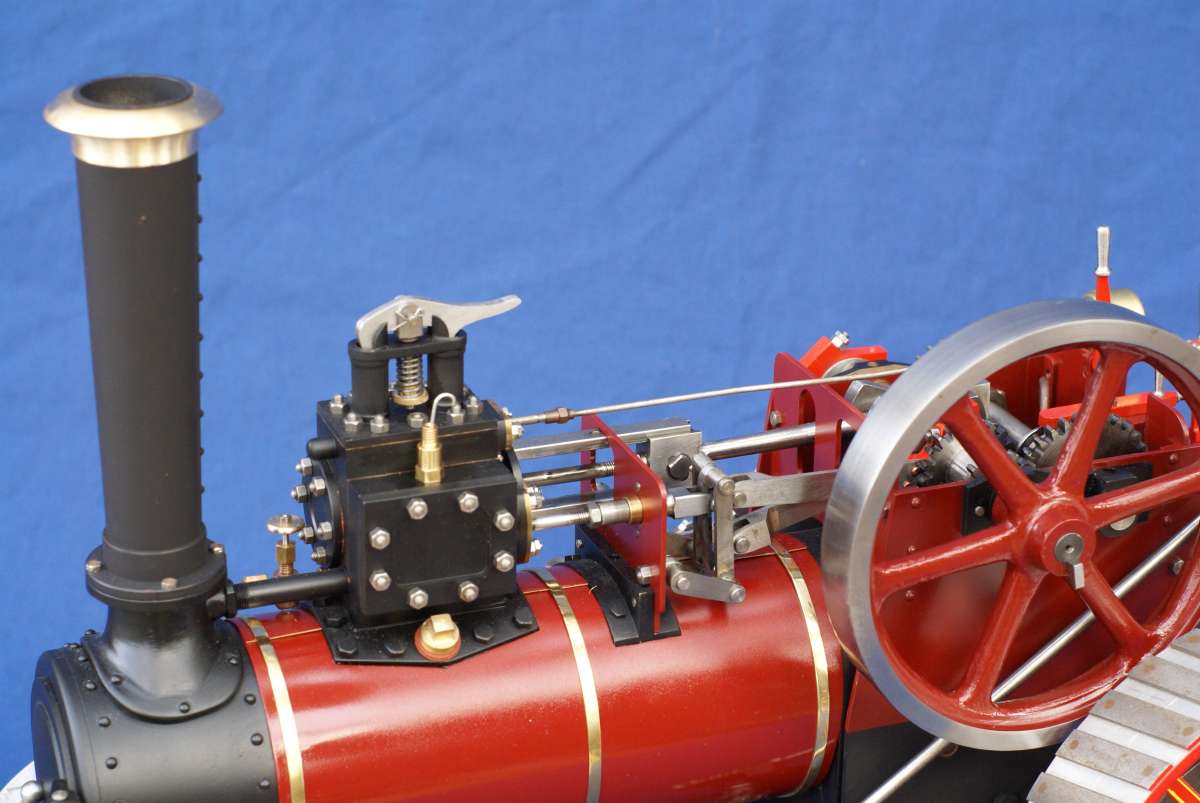
      nothing like an Allchin cylinder and a sposted above the boiler diameter seems larger. Th eregulator being off toth esid eis quite unusual normally there is a cavity on t hetop of te hcylinder for the regulator so that may help eliminate a lot of possible engines.

      Looking at those cylimnder photos the only bit I would say for sure is cast is the rear facing cylinder cover. The rest has been machined all over so who knows.

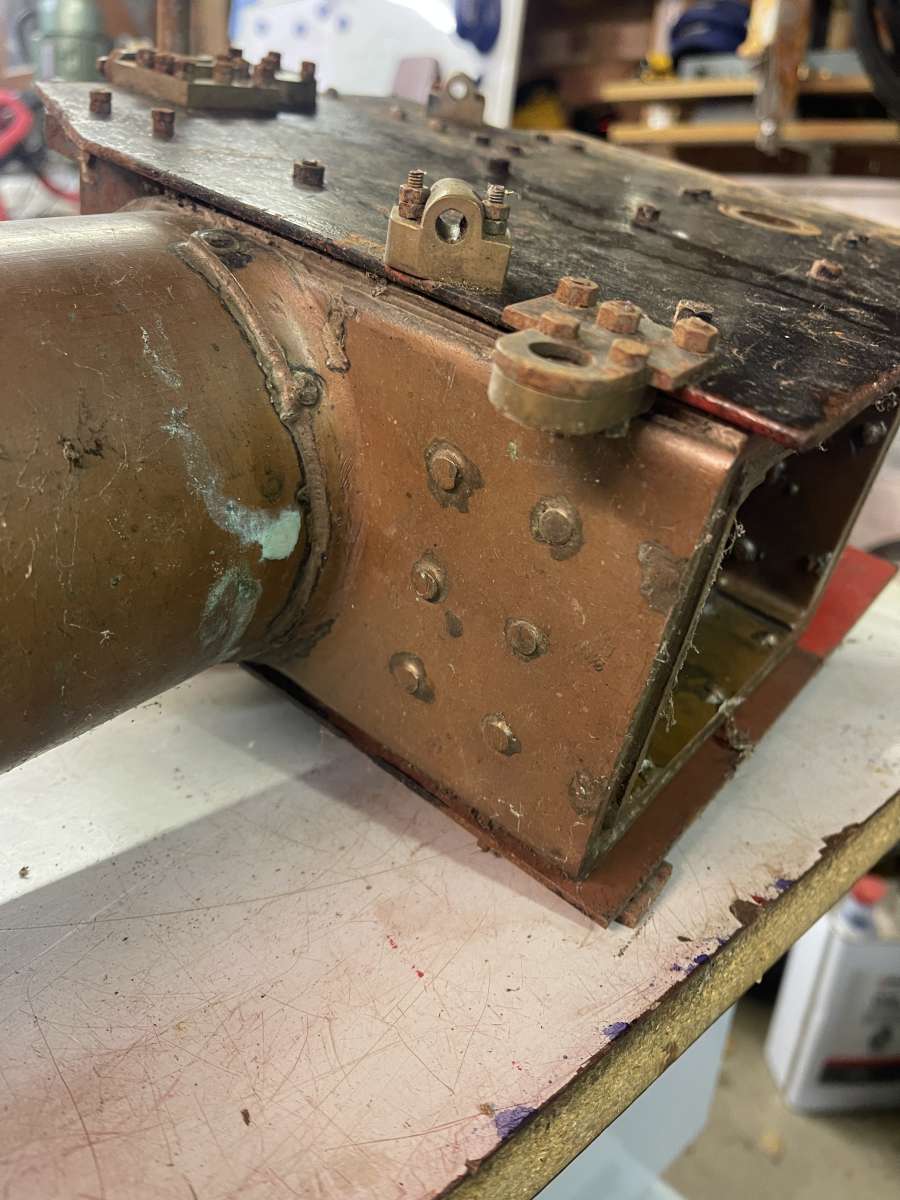
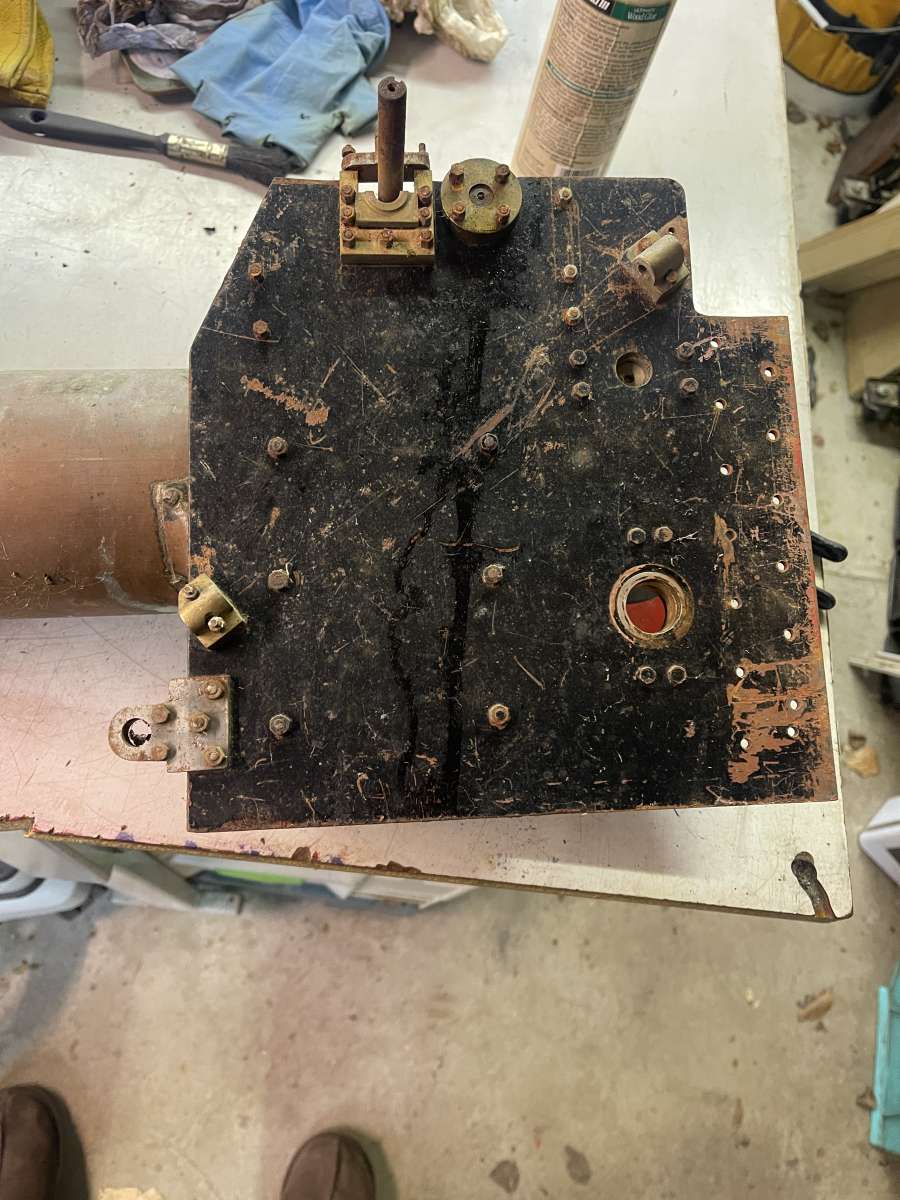
      The fact that the lower curved saddle is separate makes me doubt even more that it was from castings, at the very least it has been adapted for parts that don’t really fit. The thin side flange under the valve chest is also a bit of a weak point and combined with too few bixings into th eboiler unlikely to end happily.

      Looks like the front may be tapped for  ablower but where is the exhaust? Does it come out under the valve chest, certainly not hole in the chimney saddle for it to be plumbed into so no blast pipe.

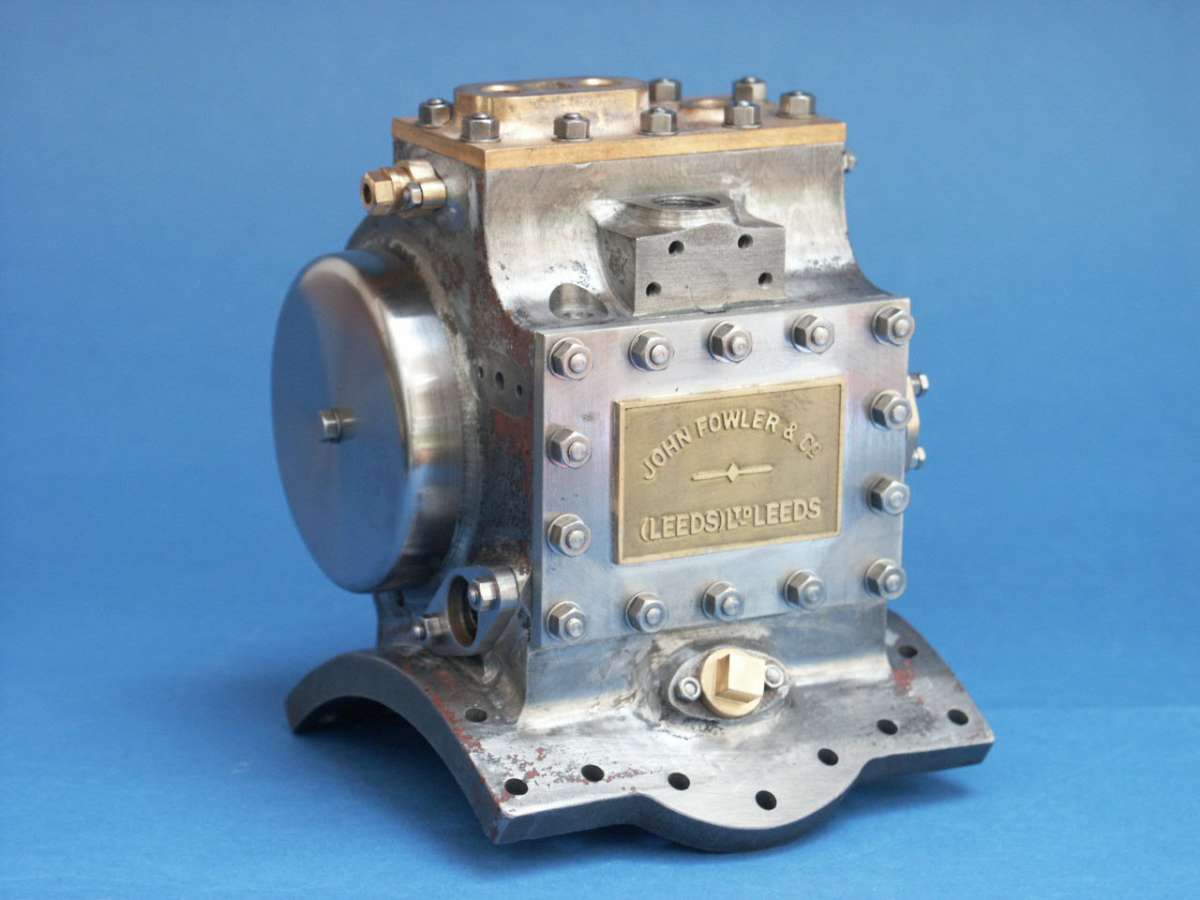
      A couple of typical traction engine cylinder showing the number of fixings and how the flange extends front & back not just at the sides like yours.

      DSC00161

      PICT0066

      #823849
      JasonB
      Moderator
        @jasonb

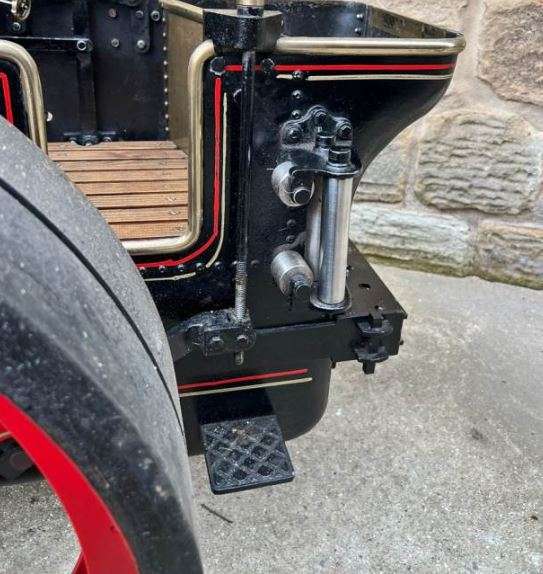
        As for the wedged drawstrap, having them fall out did not seem to bother the likes of Garrets, as seen on the 4CD.

        4cd

        #823852
        Roy Birch
        Participant
          @roybirch29994

          I have just got the pictures of the boiler, the size of the outer dimensions do seem close to the Alchin 1.5 Royal Chester,

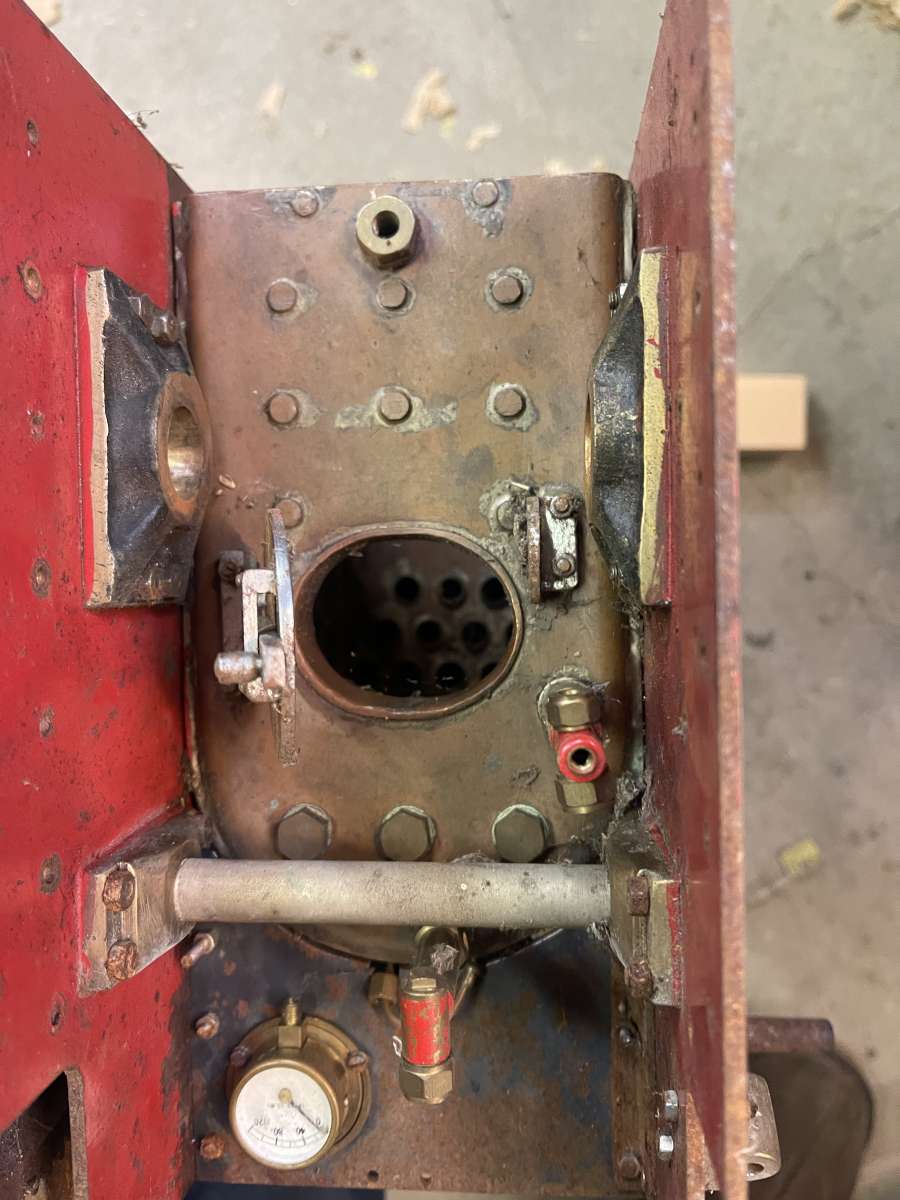
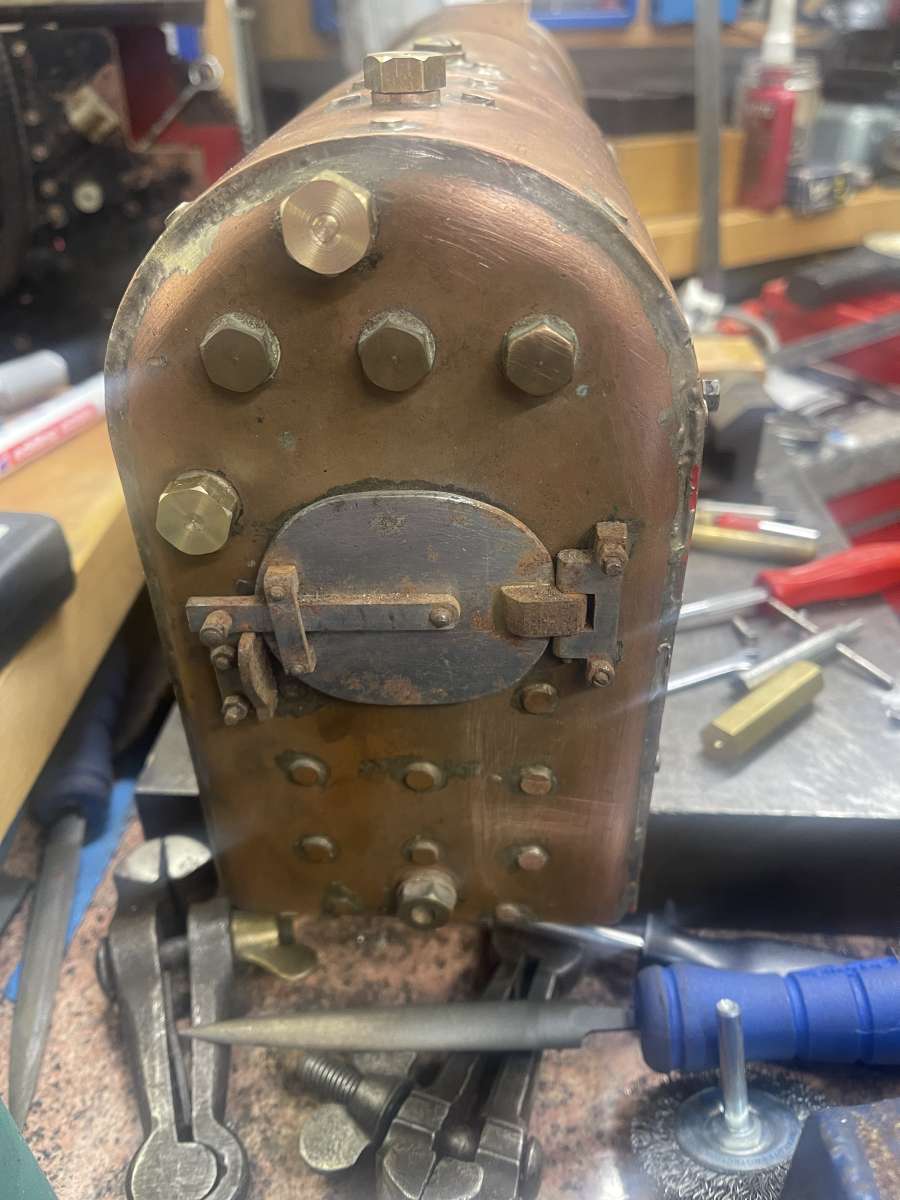
          the barrel thickness is 3/8″ where the saddle fits and the boiler is as near as can be to 15″, the inside diameter of the boiler is 3 3/4″IMG_1632IMG_1640IMG_1633IMG_1639IMG_1637IMG_1635

          #823853
          Nigel Graham 2
          Participant
            @nigelgraham2

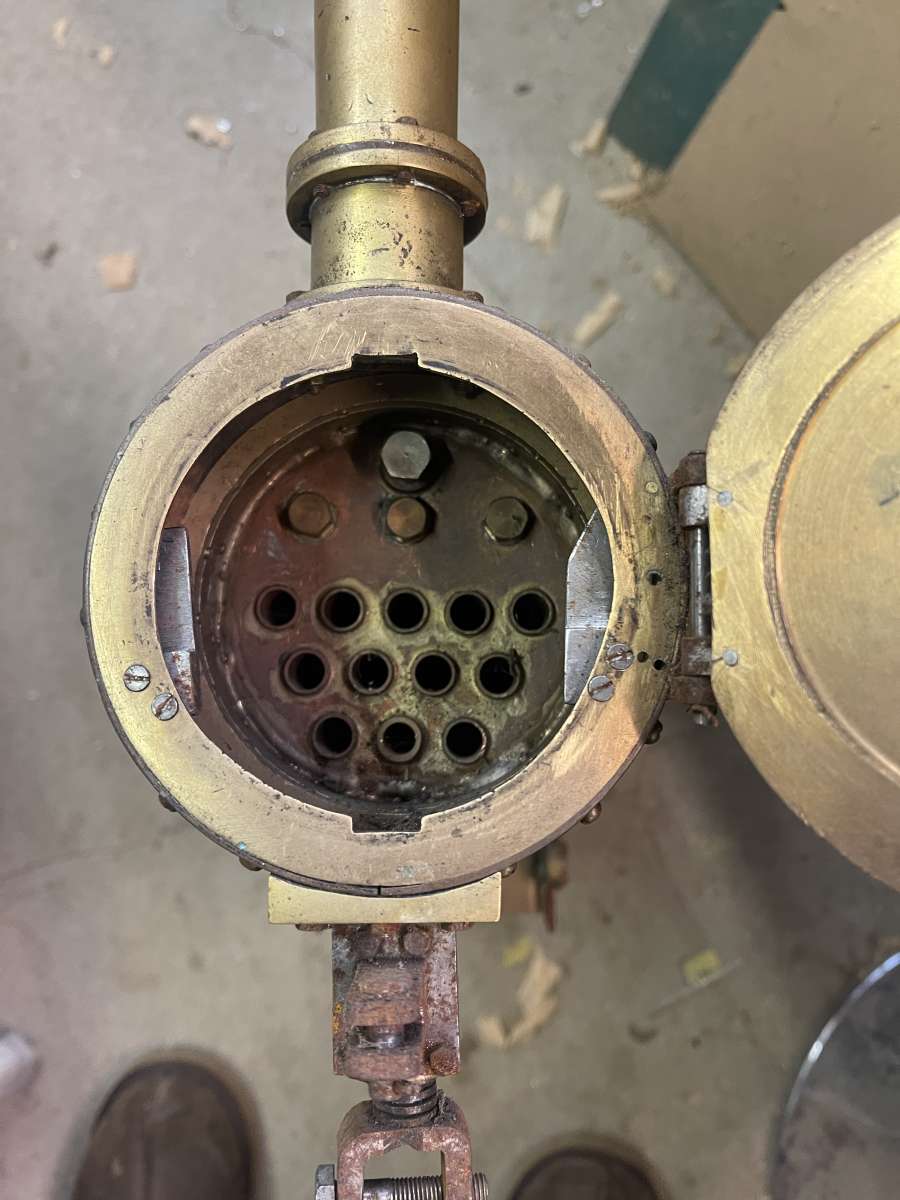
            What are those faint words on the valve-chest cover? Is one, “Ruston”?


            Regarding boiler-testing, if you intend steaming it, I don’t think lack of design calculations necessarily a stop, provided the boiler is sufficiently close to other, known designs and the workmanship looks sound.


            It is not possible to be definite from those photographs but there seems a fair absence of silver-solder runs, so suggesting good-quality silver-brazing. However, unless an optical illusion, the backhead flange seems very deep, and I wonder how much of that is actually within the shell. Again, hard to tell but by rough comparison the shell thickness look about right, bearing in mind its duty on a traction-engine is far more onerous than its railway equivalent.

            The most fallible points are the firebox plate thicknesses, and the presence or absence of adequate stays. Also the arrangement for holding the cylinder to the boiler – as Jason pointed out a while back. With the cylinder now detached you can ascertain what is there.

            Structurally the weakest section of a locomotive-type boiler is not the cylindrical shell but the big flat areas of the firebox, hence the need for adequate staying – but unlike on a railway-locomotive whose boiler sits on the chassis, a traction-engine’s boiler is the chassis, putting considerable strain on the throatplate and its joints.


            Assuming so far the boiler is potentially useable, it should be tested as if new, i.e. a 2X working-pressure hydraulic test. In effect it is new – it has never had water and fire in it.

            Not straight off though. A careful visual examination first. If that is satisfactory, gentle hydraulic tests in stages to working pressure only. If it shows serious seam leaks or other distress at working-pressure or less there is no point going higher: it would need either repairing… or replacing.

            Only if it is happy at that we can consider going up to the safety-factor level.

            That 2WP level is first-time only. The repeat hydraulic tests are to 1.5(WP), 4-yearly for a copper boiler. Under the standard MELG scheme– commercial testing is different.


            Once the working-pressure is known, mark the pressure-gauge indelibly at that. If the case cannot be opened to put a line on the dial without risking wrecking the instrument, a mark, preferably engraved, on the bezel is allowable.


            Carry out those tests yourself, before deciding on a proper, third-party inspection. If it fails there is no point bothering other boiler-admirers, except for advice on repairability.


            So what is the w.p. for this engine? Careful comparison with known models of similar size should give a sensible likely pressure – probably around 90psi. (6 Bar, near enough, for the “Written Scheme of Examination” and Certificate formalities including its Bar*litre capacity).

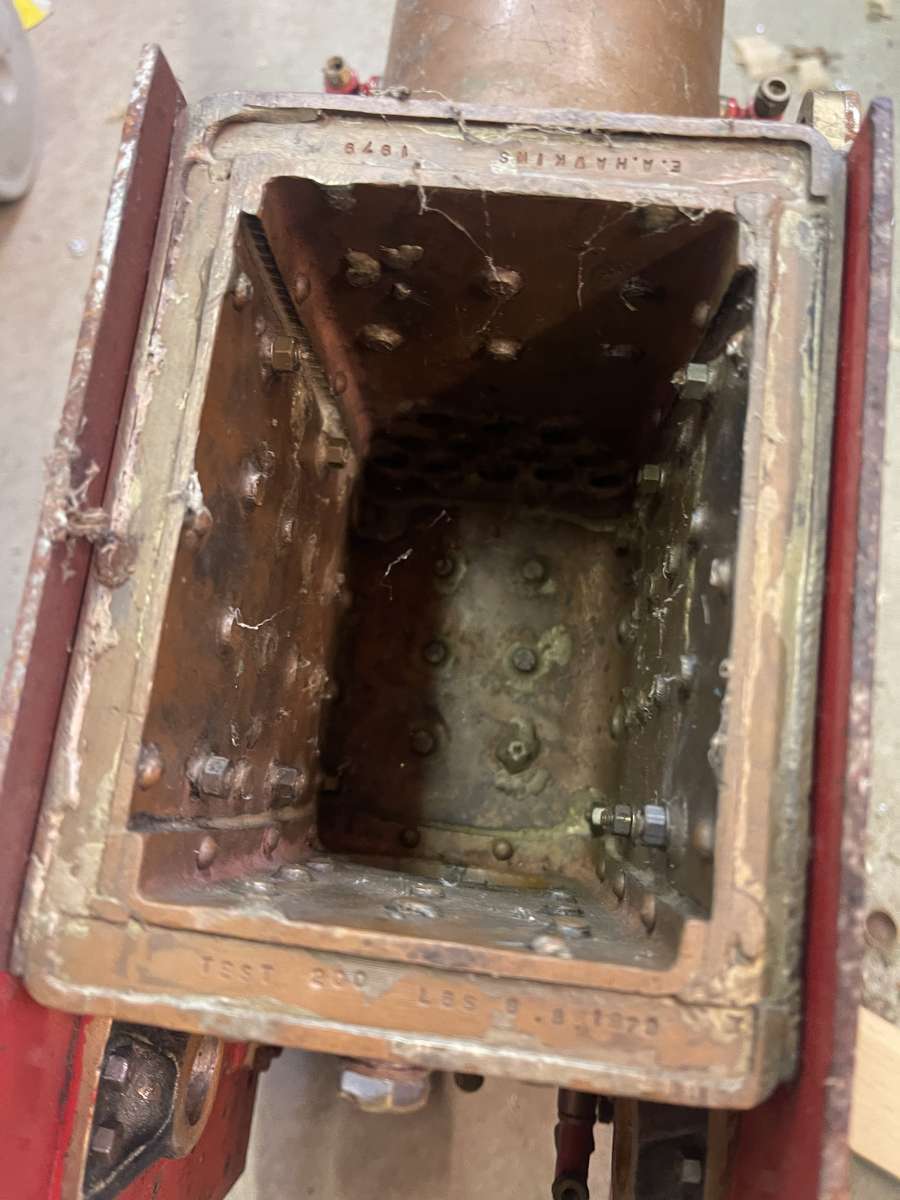
            I see the foundation-ring is stamped with “Test 200psi,” but not the intended working pressure, and it was made long before the present scheme was created. We also see its maker’s name, and the date: good!

            So I would suggest take 200 as what is now called the Initial Shell Test (the 2wp) limit, so the WP should not exceed 100 psi, perhaps 90psi.

            I am reasonably optimistic for this boiler, from the photographs alone.


            The engine needs dismantling anyway to restore everything, so that will free the boiler for full examination: remove the fittings, make an test-set adaptor for one, and blanking plugs / plates for the rest, of the apertures; clean it and look for any other identifying details stamped on it. If you can identify who actually made the boiler, that may help too. Even better if you can find any documents from its construction.


            The next hurdle is by whom to have the boiler tested.

            If you were intending to steam it in your own back garden you should still test it to the present, recognised code for your own safety and peace of mind, but that won’t certify it for any public or club use.

            For that, you have two options: commercially or via an MELG-affiliated model-engineering club (essentially, affiliated to either NAME or “The Federation” that used to use the adjective “Southern”). You have not, I think, said if you belong to one.

            The commercial test will be expensive and anyway likely to need you present the design drawings, and if an unfamiliar type, its calculations.

            A club-scheme inspection – free but only to fully-paid-up, bona-fide club members for insurance reasons – may not need those documents but the inspector is free to decline to test a boiler of unknown provenance. At least being able to examine the boiler without its surrounding metalwork will make life a lot easier for both owner and tester.


            Never mind rusty transmission components, making the flywheel look more prototypical, or the rectitude of the smokebox door hinges….

            Carefully dismantle the entire engine and establish the integrity of the boiler first! 

            Obtain a copy of the present MELG boiler-examination book, and study that to see what is necessary.

            I hope it passes all inspection, and you can complete the engine satisfactorily!

            #823856
            Roy Birch
            Participant
              @roybirch29994

              I am the chairman at Cambridge Model Engineering Society so the boiler test is not a problem, the scribing you refer to is Histon where the original owner lived, the foundation ring of the boiler says E.A.Hawkins 1979 and also Test 200LBS and 8.8.1979. I also know several members of the southern Federation. I have no intention of running this in public or any of my loco,s under construction, my only interest in anything model oriented is the building of the model.

              #823857
              Roy Birch
              Participant
                @roybirch29994

                I still need to get close to identification before going any further as that will tell me what I am rebuilding

                #823858
                JasonB
                Moderator
                  @jasonb

                  I suspect Nigel wa styping that while you posted the boiler photos.

                  It does not look too bad a boiler so worth getting a new test as there is no paperwork for when it looks to have been built back in 1978.

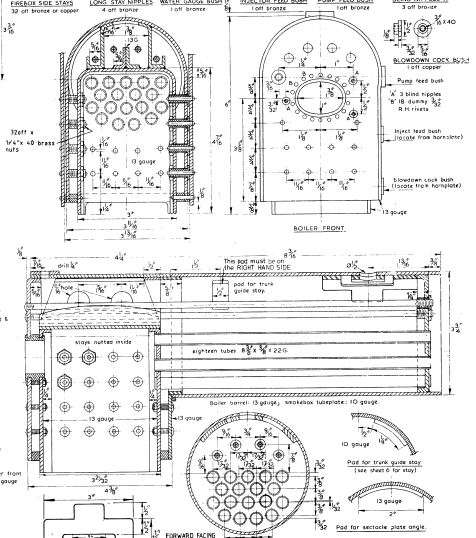
                  Soldering is neat but I wonder if the throat plate to boiler barrel is brazed rather than silver soldered in which case what was the filler rod used. The number of fire tubes and stays do not match the Alchin.

                  allchin

                  #823862
                  Nigel Graham 2
                  Participant
                    @nigelgraham2

                    Evidently I was, Jason!

                    I had no idea of Roy’s experience nor of any intended operation of the engine, so was playing safe.

                    So I exted my apologies to Roy for telling him what he already knows!

                    However, it would be a shame if this engine cannot be finished to full running order, perhaps not by him but by others.


                    I gather there is another thread on this Forum all about the perils of known and unknown knowns and unknowns in queries and replies…

                    #823868
                    Roy Birch
                    Participant
                      @roybirch29994

                      I have to finish it as it forms part of the history of the club and just to be clear I have a very comprehensive workshop at home so finishing this model does not phase me in the slightest once identified.

                      #823872
                      Bazyle
                      Participant
                        @bazyle

                        Since the date and maker are now known there is a cut-off date for designs that may have inspired the builder. It will not be quick but over time, months, the builder may be identified as a club member whose friends might remember him talking about the build. We can hope that he lived a few years after the boiler was made. Also check ME, EIM, and exhibition reports of the time for adverts and mentions of small time suppliers of castings and parts who might only have made a few before giving up.
                        Enjoyed my visit to Cambridge club in 2019 by the way; welcomed even though it wasn’t a public open day.

                        #823875
                        Roy Birch
                        Participant
                          @roybirch29994

                          He is not a member at our club and the name does not show up anywhere, anytime you want to come to Cambridge let me know and I will try to make the facilities available for you, it does not need to be a public open day, this also applies to anyone reading this.

                          #823895
                          Roy Birch
                          Participant
                            @roybirch29994

                            After a phone call with someone who was in the traction model world we have found out that the name on the foundation ring is that of a professional boiler maker of the time which was 1979

                            #825137
                            Roy Birch
                            Participant
                              @roybirch29994

                              Further to the identification of this engine, someone has identified this now as a Burrell 1.5 gauge engine to the Basset Lowke  design, they also had a set of castings for the wheels, the size is also about the same, if this is the case can anyone identify any drawings which I believe were in a 5 page book to build this model?

                              #825140
                              JasonB
                              Moderator
                                @jasonb

                                I do have drawings for a 1.5″ Bassett Lowke but far more detailed than your engine as well as being a 3 shaft.

                                I thought the booklet “how to build a traction engine” covered the 3/4″ scale one. Which as I mentioned earlier is a 4 shaft but not the same shaft layout as yours as the 2nd & 3rd shafts are at the same horizontal height

                                #825154
                                noel shelley
                                Participant
                                  @noelshelley55608

                                  I too have a full set of the drawings for the 1.5″ bassett lowke Burrell. Many large sheets not a small 5 page booklet which I think is for the 3/4″ model.

                                  I also have the model which looks not much like the pictures. In fact I doubt it is as stated. We’re not that far apart Roy, your welcome to inspect my model and the drawings if that would help. I’m 4 miles from Hunstanton.   Noel.

                                  #825162
                                  Roy Birch
                                  Participant
                                    @roybirch29994

                                    Thank you Noel, I might just do that, I have arrived at the conclusion that everyone is a long way apart on what this could be, so if I strip it back to just the boiler and work forward from there does anyone know what traction engine this boiler would fit, I have been told it is a traction engine boiler and not a re purposed loco boiler so it seem that if I can identify a traction engine that this fits then I just make it forward from that point whatever the engine is.

                                    #825177
                                    JasonB
                                    Moderator
                                      @jasonb

                                      it is a bit of an inbetween size, too big for many of the 1.5″ engines which are around the 3dia mark and too small for a 2″ which are 4.5 – 5″” sort of size range. Sounds Like Noel has the same drawings as me and that is a 3″ boiler for the 1.5″ scale of a 7nhp engine.

                                      #825181
                                      Roy Birch
                                      Participant
                                        @roybirch29994

                                        I will send pictures and dimensions to boiler makers to see if they can identify it as my next step.

                                        #841591
                                        Roy Birch
                                        Participant
                                          @roybirch29994

                                          Hello All


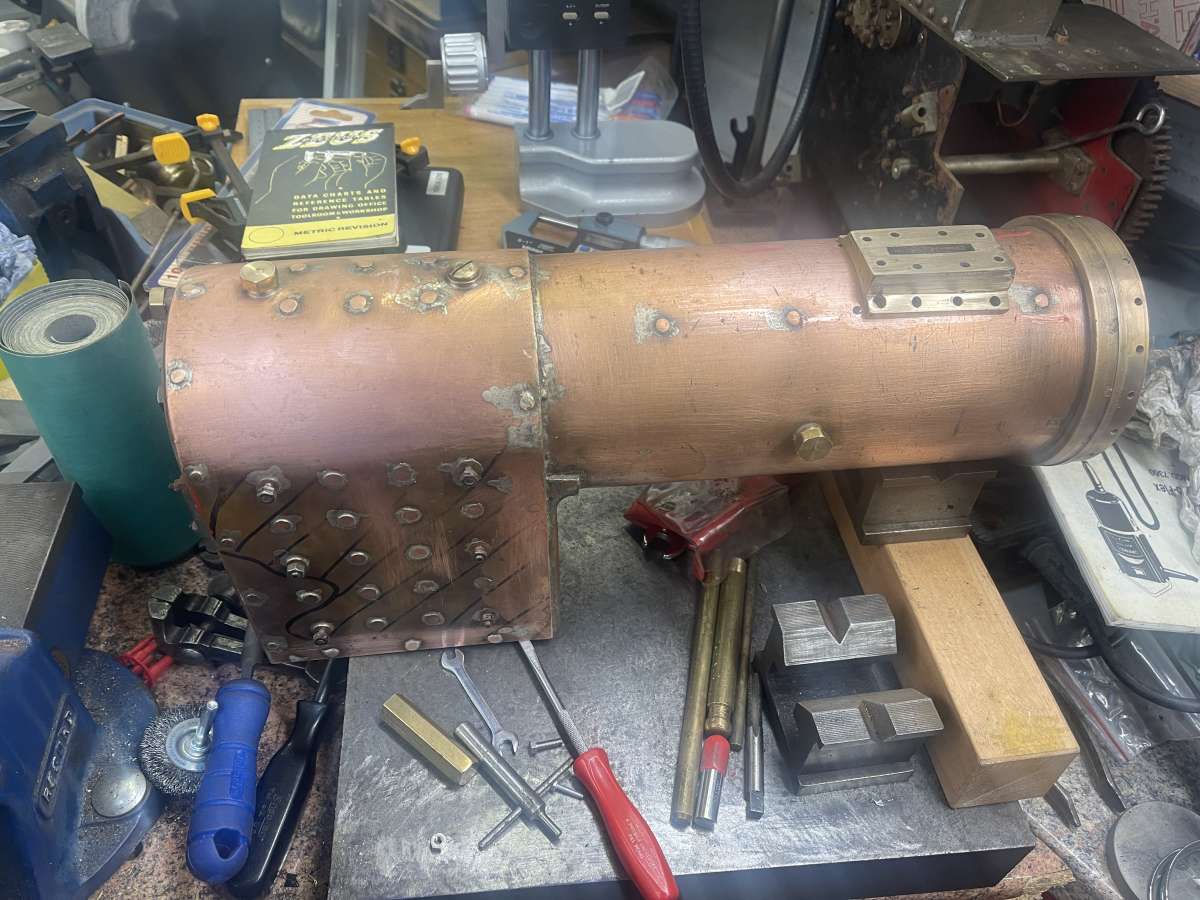
                                          The boiler is now being tested so I am starting on the cylinder pictured above, one thing is that all of the studs seem to be steel and some have suffered corrosion, once the copper boiler returns it will need new studs in the barrel as well, what material should the studs be made of for both the cylinder and the boiler? someone has suggested bronze but the studs are 5BA and 4BA, will bronze be strong enough?


                                          Kind Regards


                                          Roy

                                          #841599
                                          JasonB
                                          Moderator
                                            @jasonb

                                            Bronze is the usual material you see specified for the job on copper boilered traction engines.

                                            #841622
                                            Roy Birch
                                            Participant
                                              @roybirch29994

                                              Thanks for the information, can I ask which type of Bronze, I can get Colphos 90, PB102, PB104?

                                              #841634
                                              JasonB
                                              Moderator
                                                @jasonb

                                                Colphos is nicer to work with so I would go with that.

                                                One option to consider is making special bolts which are easier to fit than traditional studs & nuts. You can either make them as a bolt with a dimple on the hex head to look like the exposed end of a stud or have separate stucs & nuts which are silver soldered together to form a bolt.

                                                #841644
                                                noel shelley
                                                Participant
                                                  @noelshelley55608

                                                  Now the nice weather is here Hunstanton is not far, Come over and look at my 1.5″ Bassett Lowke Burrell and also the full set of drawings I have . Give me a PM if you wish.   Noel.

                                                  #841666
                                                  Roy Birch
                                                  Participant
                                                    @roybirch29994

                                                    IMG_1733IMG_1732

                                                    The Boiler

                                                    Looking at the club archives it appears that this boiler was made by a club member who was well known to be a good engineer, he was also friends with the person named on the name plate on the cylinder, I further discovered that the members who are going to test the boiler were also friends with the builder and one of them is a traction engine man, the plugs are now in and I am waiting for some gasket material so that I can use the lower part of the cylinder block to seal the boiler for testing.  I have also acquired the plans for the original Burrell 3/4 scale traction engine along with the out of print book book by Bassett – Lowke called “How to build a Traction Engine” One of the members testing my boiler did comment that there were a few variations at the club that were freelance engines based on the Bassett Lowke small traction engine. Anyway I will keep you posted on the progress if anyone is interested?

                                                    #841922
                                                    noel shelley
                                                    Participant
                                                      @noelshelley55608

                                                      Having seen this model, it is not an 1.5″ 7hp Burrell ! More likely a 2″ scale. It’s not a repurposed loco boiler, it has an internal reinforcing pad for the cylinder and motion bracket. It is of 4 shaft design, there is no sign of the diff or winding drum. The cast wheels are of massive proportions, looking like nothing I have ever seen and I find it hard to believe that any foundry would make them except for a hideous garden ornament. The flywheel is more in keeping with a stationary engine, to small in diameter and to chunky, not the open design of an agricultural engine or the disc of a road loco. It appears there may be another flywheel in a box. The cylinder block has a separate mounting saddle and the exhaust comes out under the valve chest.

                                                    Viewing 25 posts - 26 through 50 (of 53 total)
                                                    • Please log in to reply to this topic. Registering is free and easy using the links on the menu at the top of this page.

                                                    Latest Replies

                                                    Home Forums Traction engines Topics

                                                    Viewing 25 topics - 1 through 25 (of 25 total)
                                                    Viewing 25 topics - 1 through 25 (of 25 total)

                                                    View full reply list.