brierley drill grinder

brierley drill grinder

Home Forums Manual machine tools brierley drill grinder

Viewing 18 posts - 1 through 18 (of 18 total)
  • Author
    Posts
  • #797163
    gary
    Participant
      @gary44937

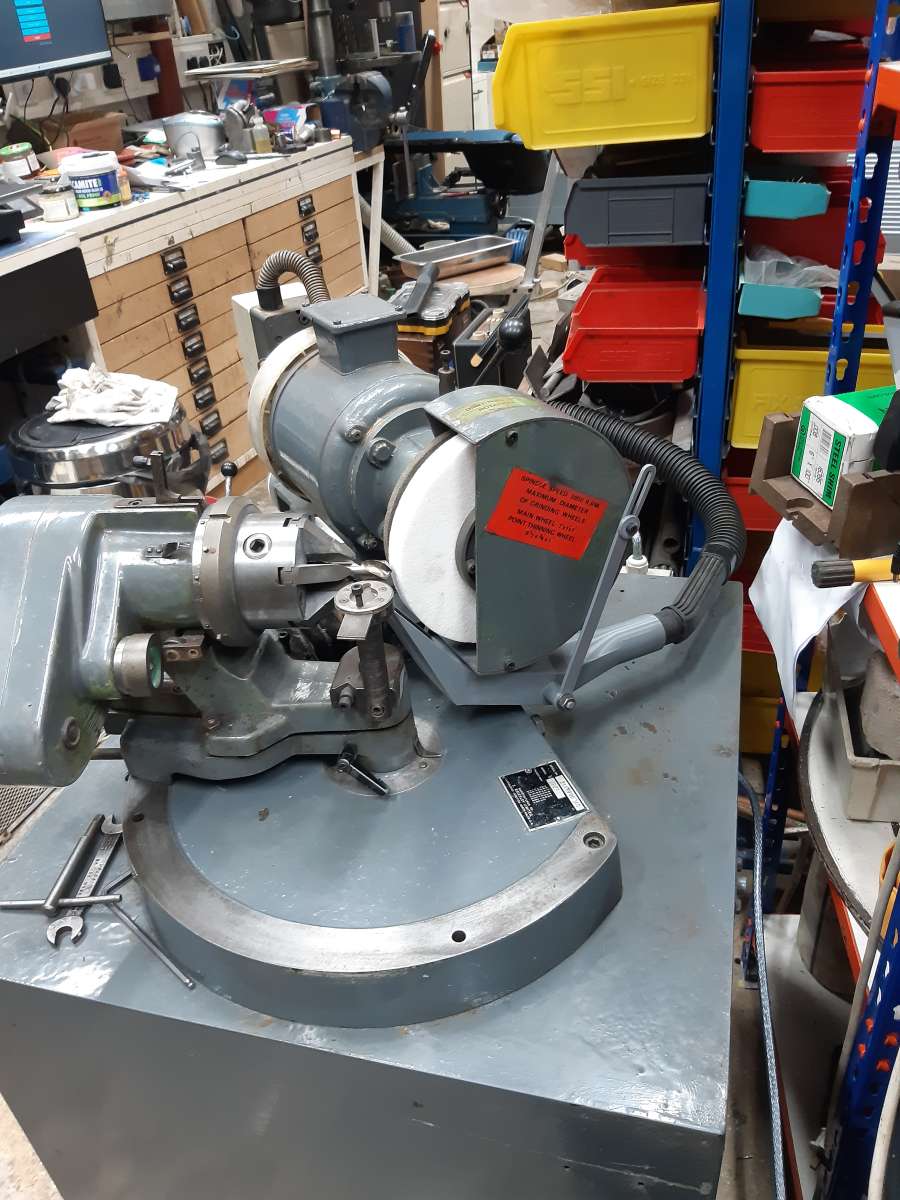
      i am about to refurbish a brierley drill grinder which i havent used yet, the drill steadys are missing, but are they really needed.   gary

      #797182
      bernard towers
      Participant
        @bernardtowers37738

        Noel is the person you need to ask.

        #797191
        DC31k
        Participant
          @dc31k

          It is a bizarre question, or at least, bizarrely phrased.

          Why would Brierley go the the trouble of manufacturing the items and including them with the machine if they were not needed?

          Without them, use of the machine is possible but very fiddly. The way to find out is to try to use the machine without the steady and see how you get on. You will not burn your house down by doing so, hence the experiment is low risk.

          The need for support depends on the length, diameter and helix angle of the drill being sharpened. A steep helix gives less margin for the chuck jaws to grip on. A large diameter has larger flutes so again less margin for the chuck jaws to grip on. A long drill bit is less easy to insert into the chuck from the front, especially if the bit diameter is smaller than the large diameter of the taper.

          The very best you can say is that without any item supplied by the factory as a standard part of the machine’s ‘toolkit’, there will be some reduction in its capabilities and ergonomics. Alternatively, if you want to use it with ease and to its full extent, you need all the parts.

          You either live with that and smile or you make a replacement item (not difficult – cut the small end off a Morse taper parallel sleeve, sleeve it externally to the spindle ID and add a handle). See here for an idea:

          https://www.mig-welding.co.uk/forum/threads/brierley-drill-grinder-zb50.137282/page-5#post-2540521

          3D printed items would work well in this application.

          #797198
          gary
          Participant
            @gary44937

            dc31k  nothing bizarre about a genuine question in my book.  gary

            #797210
            noel shelley
            Participant
              @noelshelley55608

              Hi Gary, I’m here ! I take it you are referring to the tail end steadies ? Which model do you have ? ZB 25 or 32 ? The steady for the parallel shank is a short internal taper, more cone, diameter to suit your machine  and about 1″ deep. The 1 and 2 MT are a short section about 1″ long, one on each of a piece of tube about 8″ long, the 3Mt is just an 1″ long piece of 3MT that you put on the end of the drill being sharpened. I hope that makes sense ? If not get back to me. Noel.

              #797258
              gary
              Participant
                @gary44937

                hi noel its a zb50 . thanks for the info i will get back to you if i run into any problems.  gary

                #797316
                DC31k
                Participant
                  @dc31k
                  On Gary Said:

                  nothing bizarre about a genuine question in my book

                  Please think about the point raised above. If the items are not needed, why does the manufacturer provide them?

                  #797326
                  noel shelley
                  Participant
                    @noelshelley55608

                    Hi Gary, the only purpose of the steady is as it’s name implies to centre the tail end of the drill. Whilst an MT of the right size is best, a disc with the right sized hole, the size of the MT about 1″ in from the tail on a piece of tube of the right OD for your machine will do. Good luck. Noel.

                    #845809
                    Mark Rand
                    Participant
                      @markrand96270

                      Resurecting the old thread because the topic’s appropriate:-

                      I picked up a ZB25 five weeks ago and have been spending time since then cleaning it up, de-rusting it and freeing stuck parts. I’ve only replaced one bearing so far (the large thrust race between the index plate and the chuck carrier), which had suffered from damp storage. Had to surface grind the marks off the face of the index plate, but it was only a couple of thou…

                      I need to replace a few more bearings before I’m happy, but it does run now. It’ll run better when the new grinding wheels arrive (come on Abtec, you’re running late 🙁 )


                      Anyway, I have a question:- In the advertising blurb, Brierley’s happily state that the ZB25 and up will also grind slot drills. The instructions make no mention of this. I could see how the ZNC51 could easily have a program for this, but I’m not sure how the ZB25 & ZB32 would manage it. I can imagine it might be a combination of careful use of the 4-facet technique and the point splitting fixture.

                      Has anyone got any ideas?


                      #845816
                      noel shelley
                      Participant
                        @noelshelley55608

                        Not something I had thought about or tried ! Bearing mind the that a slot drill has two different lengths of cutting edge it would not be easy but using the indexing of the chuck and careful thought as to what has to be achieved I suppose it could be done by careful infeed of the wheel so as not to overshoot across into the other cutting edge. Normally a job for a Clarkson tool and cutter grinder. Good luck and let us know how you get on.  Noel.

                        #845838
                        DC31k
                        Participant
                          @dc31k

                          As above, think of the operation at a conceptual level.

                          You are presenting an item (the slot drill) to an abrasive wheel at a particular angle. You then need to index the item to grind the other edge.

                          Map those angles and movements to the ones provided for on the Brierley.

                          Looking at the Clarkson set-up for this operation, break it down into components (x, y, z, pitch, roll, yaw) and consider how each one can be controlled on the drill grinder.

                          When you say “ZB25 and up”, what would be the lower model that does not offer that facility? Studying it could allow you to identify what is missing (and thus the ‘extra’ on the ZB25) that would prevent a slot drill being ground on it.

                          #845845
                          Mark Rand
                          Participant
                            @markrand96270

                            I’ve done some experimenting this morning. I used the No 6 Pilot Drill cam for the primary relief and the four facet technique to do the secondary relief, but with the pawl on the left-hand side of the index pin to bring the relief closer to parallel with the cutting edge instead of radial to it.

                            I’ll try to use the point splitting attachment to generate the tertiary relief, but first I’ve got to clean and de-rust it and make some bushes (Pity they didn’t design those accessories to use collets).

                            #845848
                            noel shelley
                            Participant
                              @noelshelley55608

                              The point splitting fixture needs a bush to fit EVERY size of drill you wish to work on – fine if you have many drills to do all the same size but otherwise almost a non starter.

                              Put simply the ZB series machines, the bigger the number the bigger the size of drill that can be worked on. They all operate on a loosely similar principles, changing the cam gives differing movement of the chuck in and out whilst the chuck rotates around its axis which is fixed horizontally. It is a specialist drill grinder NOT a tool and cutter grinder like the Clarkson where the work axis can be set to what ever angle you want with the universal head.  Noel.

                              #845884
                              Mark Rand
                              Participant
                                @markrand96270

                                Darn it. I thought I’d replied, but there’s no reply to be seen…

                                Point splitting attachment out of the ultrasonic cleaner (paraffin & Jizer); washing up bowl; oxalic acid; washing up bowl; oven. and reassembled. A lot cleaner now.

                                I’m well aware that they are specifically drill grinders with extras and are limited by the lack of that third axis of rotation and alignment compared with a Clarkson/Quorn, but my curiosity was aroused by the fact that the sales bumf mentions it. Possible Tony’s site has got those fliers mixed in with the models that have the ancillary motor and wheel?

                                If I find the point splitting attachment to be at all useful after making a couple of trial bushes, I might try making a new swivel block for it with an ER25 collet holder built in to it.

                                #845888
                                DC31k
                                Participant
                                  @dc31k
                                  On Mark Rand Said:

                                  ..with an ER25 collet holder built in to it.

                                  Would that not limit the capacity of the attachment? The 25 in ER25 is not the same as the 25 in ZB25.

                                  #845896
                                  noel shelley
                                  Participant
                                    @noelshelley55608

                                    Even an ER 32 only has a capacity of 20mm but for slot drills 5/8″ or 16mm would be big . ER 25 would do for up to 12mm or 1/2″. Noel.

                                    #845905
                                    Mark Rand
                                    Participant
                                      @markrand96270

                                      ER25 actually covers the range up to 16mm.

                                      The slot drill that I’m using for visual guidance is actually a 3/4″ one that I use for aluminium. but the one I’ve been experimenting with is a 16mm one that I buggered up some years ago by working on some high-temperature turbine blade steel that I thought was low carbon…

                                      I’m not sure how useful split point drills are in sizes much above 16mm-5/8″ are. Web thinning comes into its own at the larger sizes if the drills tale too much axial force to work.

                                      I’ve got an ER32 collet set, which I use on the mill for carbide cutters that haven’t had a Weldon slot ground on them. ER32 would be noticeably deeper than the existing ‘original size’ of the lump that the swivel block is machined from. There appears to be no problem with the extra depth, the outside diameter of an ER32 collet would still allow the same position for the drill. The support bars for the drill stop and index pin would need to move outwards, but the geometry would be the same.

                                      The pictures in my head are showing me a cavity with the front cone for the collet (which would normally be the nut) coming back from the front of the swivel block. Then the rear cone of the collet being compressed by a tapered nut or sleeve from the back. So Arse-about-face compared with a civilized ER collet chuck. This would allow the front face of the swivel block to still be in the same place without a great big ER nut sticking out in the way.

                                      Experiments would be needed to see if the collet could be tightened without rotating or whether either an anti-rotation pin/blade would be needed. or even a bearing on the nut so the rear cone didn’t rotate.


                                      Why do I seem to spend all my time rebuilding machine tools or making tools to make tools? :O


                                      #849469
                                      Mark Rand
                                      Participant
                                        @markrand96270

                                        In other news, I’ve replaced the motor and shaft bearings, they were a bit worn due to the grease having migrated away from the balls (some years ago?). I also remade the sleeve that clamps on to the shaft to take the shaft locking pin. Used a bit of EN24T. Pin is now a snug fit rather than a wave and a prayer.

                                        3D printed a dust chute a few days ago, designed in Alibre. I’m happy to say that it works very well:-

                                        20260524_155135


                                      Viewing 18 posts - 1 through 18 (of 18 total)
                                      • Please log in to reply to this topic. Registering is free and easy using the links on the menu at the top of this page.

                                      Latest Replies

                                      Home Forums Manual machine tools Topics

                                      Viewing 25 topics - 1 through 25 (of 25 total)
                                      Viewing 25 topics - 1 through 25 (of 25 total)

                                      View full reply list.