Search Results for 'arc euro'

Search Results for 'arc euro'

Home Forums Search Search Results for 'arc euro'

Viewing 25 results - 101 through 125 (of 4,842 total)
  • Author
    Search Results
  • #801405
    Howard Lewis
    Participant
      @howardlewis46836

      Find a local model Engineering Club, and join. You will net like minded folk who will help you.

      As a newbie, my advice is to buy one or more books on lathe operation,

      Such as Stan Bray, “Basic Lathework” (No 45 in the Workshop Practice Series)

      Harold Hall, ” Lathework, A Complete Course” ( (No 34 in the W P S)

      Neil Wyatt, David Clark and David Fenner (The Mini Lathe W P S 43) have each written books on the mini lathe

      You will certainly need a set of Zeus Charts

      One of the techniques to learn, is how to rotate a handwheel, slowly and steadily, to provide a steady feed.

      If the lathe has change wheels, these can be arranged for the leadscrew to provide a fine feed for turning, but for facing, you will need to provide the fine feed.

      On a mini lathe, a lot of thread cutting can be done using Taps and Dies (Get some lubricant, such as Roco; RTD or Trefolex). The Zeus carts will tell you what size to drill the hole for tapping. When cutting an external thread, put a chamfer on the end of the work to help lead in the Die.

      Back off every half turn to break the swarf. An remember that taps don’t bend, they break!  And that will mean a scrap job!

      A mini lathe with only a 500 W or so motor is not powerful, so don’t expect to be taking deep cuts.

      The operator manual for the Sieg C2 and C3 mini lathes, says that 0.010″ ( 0,25 mm) is a roughing cut, although with care this can be exceeded)

      The same manual, instructs that the lathe should always be started and shut down with the speed control in the Zero position. The current surge on start up can damage the control board!

      Milling is a series of interrupted cuts, and demands rigidity, so if you go down this route, presumably with a vertical slide, do not be ambitious. Do NOT climb mill!  Always have the work moving towards the cutter, never in the same direction.

      Tooling.

      You can use replaceable Carbide tips, but for some jobs High Speed Steel will be needed, so to grind HSS, you will need a bench grinder, and to learn how to grind HSS tools. (Harold Hall has written a book on Tool and Cutter Sharpening – No 38 in W P S)

      Clearance angles , generally, do not need to be too precise, probably anywhere between 5 and 10 degrees will suffice. Excessive clearance angle will weaken the cutting edge and shorten tool life.

      If you do decide to use carbide, tips, buy some spares, (You will need a replacement at 8 pm on a Saturday night!)

      It would be worth, and a useful learning project, to make a Centre Height Gauge.

      A tool that is off centre will not cut properly, and will leave a pip when facing the end of a workpiece.

      Learn, gain experience and confidence, on bits of mild steel, rather than on expensive material such as castings from kits.

      Probably the easiest for a newbie would be to buy a 0 – 6″ (0-150 mm) digital calliper (And spare batteries)

      Either a cheapie from ALDI or LIDL, when they come into stock,  or for about twice as much, from Arc Euro, or a Moore and Wright from Machine DRO

      Later, you will need at least one “clock” Dial test Indicator) and a Magnetic base

      A Plunger clock will usually be graduated on 0.001″ intervals, a finger clock in 0.005″, or the metric equivalents

      A three jaw chuck will not hold work absolutely concentric, a good one will be withing 0.003″ (0.025 mm)

      If you need two or more diameters to be concentric, turn them in succession without disturbing anything.

      Otherwise, you will need a four jaw independent chuck, and use the DTI to set the work concentric (or as eccentic as you need- if you need it to be eccentric)

      You will make mistakes, but learn from them (Not disastrous ones we hope)

      HTH all this will be of help

      Howard


      #800792

      In reply to: Replacement gear

      JasonB
      Moderator
        @jasonb

        ARC do a 12/20 in metal as well as the original plastic, just check the bores are the same if you want to go for spmething stronger.

        #800242
        Andy II
        Participant
          @andyii

          Hello – As a long time forum lurker here, but apparently a rare UK PD400 owner, I thought as my first post I would offer some thoughts on the PD400 given that there appears to be some confusion above:

          The PD400 is an 85 mm centre height machine actually made by Proxxon in Germany i.e. not a rebadged import or a branding exercise. I recall reading that it was developed from the Japanese Toyo ML360 (the big brother to the ML210), which Proxxon had built under license as the PD360 before developing the PD400. At first glance it does indeed look oddly expensive when compared to Chinese machines, but not so expensive when compared to other European built machines (e.g. Myford/Wabeco/Emco when last available). Reflecting that, the (subjective) fit/finish/feel is notably better than any Chinese machine of a similar size that I have seen, whilst not quite being as good as Myford/Emco standards. Is “Made in Europe” worth the extra money? that depends what you want to do with it, how long you think you will use it, and what exactly it is you enjoy about the hobby – i.e. everyone will have their own individual answer 🙂

          Some non-obvious things that I appreciate about the PD400 design compared to other similarly sized machines that I have seen:

          • The two speed motor and three speed poly-v belt drive system of the PD400 gives quite impressive low speed torque compared to the typical variable speed drives on most other machines of the same size. Belt speed changing is a bit of a faff compared to variable speed, but I find in practice that the middle belt speed with hi/lo motor speed can be used for most of what I do, and I appreciate the availability of low speed torque when needed. (The motor is an electrically fully enclosed with external fan type i.e. splashback not strictly necessary).
          • Whilst front mount chucks for the PD400 are harder to find, they are much more convenient to change than the rear mount chucks common on most modern small machines. (Strictly the Proxxon spindle fitting is to German standard DIN6350 i.e. not actually a Proxxon special, but still not so easy to find in the UK. TOS and Bison make chucks that fit, but they are not economical as they once were. However, the dimensions are such that it is possible to fit Chinese standard front mount chucks with a little ingenuity).
          • Graduated handwheels on both the leadscrew and saddle handle make turning to accurate lengths easy. Surprisingly often neither seem to be fitted as standard on other machines, although a leadscrew handle is normally easy to add. The leadscrew clutch that allows the leadscrew to turn without turning the change gears makes using the leadscrew manually to set precise lengths much easier. A tumbler reverse would be nice, but in practice I doubt I would use reverse feed very often and the machine can cut LH threads if needed.

          To make a potentially controversial statement, I am pretty sure that for the kind of work I do the ~50kg PD400 can remove metal on average faster than the ~85kg Myford ML7 that I had access to in the past (old, but reasonable condition). This is the case even for ~100 mm steel diameters (the largest I normally use), for which you would expect the heavier Myford to have a clear advantage. Having never seen an HBM180 I cannot compare to that, but I make the point simply to illustrate that more cast iron does not always translate to a more rigid machine.

          I bought the PD400 because I had an enjoyable experience with a Unimat-3-in-a-cupboard set up during lockdown, when I did not have access to the ML7. The PD400 seemed like a good way of replicating that on a slightly larger scale in a small upstairs spare room. Like all machines it has its oddities, and if I had more space I would have gone for a larger Chinese or second hand machine, but for my use and with my constraints I find that the PD400 works well for its size and is enjoyable to use.

          (It may be worth searching on more European forums with the aid of google translate (if needed) for further opinions, as I think the PD400 is more common there, particularly in Germany).

          #799721
          Martin of Wick
          Participant
            @martinofwick

            On their puff it states a swing of 85mm, having read a little more I realise they must actually mean a CH of 85mm  as they go on to quote 55mm over the cross slide, I was confused by their mistranslation.

            Doesn’t change my view, but it is like a poor version of TOYO 210 or seig C1.

            It was 20 years ago today, that Sergeant Pepper told…. er sorry, that I started out in the hobby looking for an affordable small lathe considered a Proxxon 400 and couldn’t understand why it was 4 times the price of a very similar looking machine from Arc Eurotrade. 20 Years on, I still have my  C1 and very useful and reliable for small stuff it has been.


            #799659
            Nealeb
            Participant
              @nealeb

              I once spent a long time chasing a similar problem, although I was only trying to drill something like EN3B (forget actual spec but ordinary black mild steel) from a local supplier. Never had problems with their steel before but just couldn’t get a 3mm or so drill through the stuff. Changed drills a couple of times – still struggled. When I checked the drill, it seemed to have lost any kind of proper cutting edge. Couple of new drills later, still no success. Then I looked at the tip of a new drill straight from the box. Badly ground – would have probably cut better run in reverse…

              Those were brand new from a UK online seller, although other sizes from the same source bought at the same time were OK. So, even if new drill, might be worth checking. And I now buy from Arc Euro…

              michael rietveld
              Participant
                @michaelrietveld37062

                I live in Germany and have a digital and print subscription to ME&W.
                It is mid-May and I have yet to receive a printed copy of the new magazine Model Engineer and Workshop.
                My last print issue was no.4761, 24 January to 20 February 2025.
                Do other people, particularly living in continental Europe have the same problem ?
                I called Mortons Media and they apparently re-sent the March issue Nr. 4762 on 7th April. They
                have to allow 6 weeks before sending it again, so I will be calling them again soon.
                Mortons have also resent the April issue Nr. 4763 in the mail around 2 or 3rd May.
                Neither of these re-sent issues have arrived, nor the “normal” issues for March, April or May.
                I don’t know who is to blame, UK mail, German mail or Mortons ? So feedback from others who
                are not getting their issues may help.
                I won’t be answering the reader survey until I get my print issues.
                Michael Rietveld.

                #798048
                michael rietveld
                Participant
                  @michaelrietveld37062

                  I live in Germany and have a digital and print subscription to ME&W.
                  It is mid-May and I have yet to receive a printed copy of the new magazine Model Engineer and Workshop.
                  My last print issue was no.4761 24 January to 20 February 2025.
                  Do other people, particularly living in continental Europe have the same problem ?
                  I called Mortons Media and they apparently re-sent the March issue Nr. 4763 on 7th April. They
                  have to allow 6 weeks before sending it again, so I will be calling them again soon.
                  Mortons have also resent the April issue Nr. 4764 in the mail around 2 or 3rd May.
                  Neither of these re-sent issues have arrived, nor the “normal” issues for March, April or May.
                  I don’t know who is to blame, UK mail, German mail or Mortons ? So feedback from others who
                  are not getting their issues may help.
                  I won’t be answering the reader survey until I get my print issues.
                  Michael Rietveld.

                  #797861
                  SillyOldDuffer
                  Moderator
                    @sillyoldduffer
                    On gerry45 Said:

                    …All i need to get to add to my tools is a parting off tool. What would be the best for me and this lathe?

                    Parting off being the most difficult of the basic lathe operations is a subject in itself.  The cutter is broad and needs plenty of power to drive it. The lathe has to be as rigid as possible, so small lathes are a problem.  Big lathes cope better, but not if they’re worn or out of adjustment.   (Condition matters: where is your Sabel on the “as new” to “beaten to death” spectrum?)   A steady hand is needed, or – much better – a powered cross-slide.   Vital to clear swarf and lubricate, especially so with deep cuts.   Front tool-posts being bendy make parting off from the rear popular.  A “Gibraltar Toolpost” fitted at the rear of the slide is more solid, and it grounds cutting forces more effectively, making it less likely the saddle will lift and twist.

                    I use three different types, all sold by ArcEuro, from whom I’ve stolen the pictures, other suppliers available:

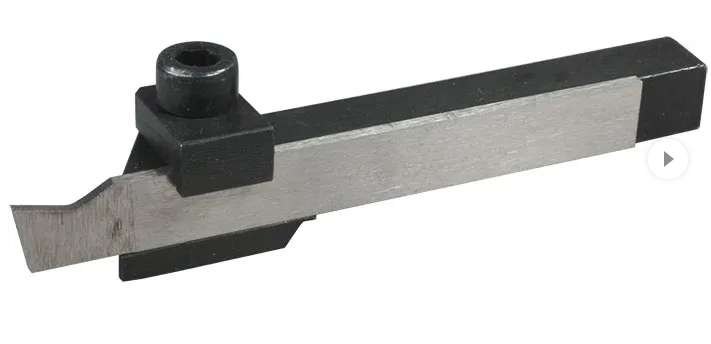
                    1.  An  8mm HSS blade. Used mostly on small diameter Brass, though it does steel too.  Not so good at deep cuts.  The example pictured shows a blade with relief, which is awkward to resharpen, and doing so alters the tool height.  I use an easily resharpened flat blade, no relief, that probably doesn’t cut quite as well.   HSS requires a grinder and grinding skills; not everyone is good at it!

                    parting

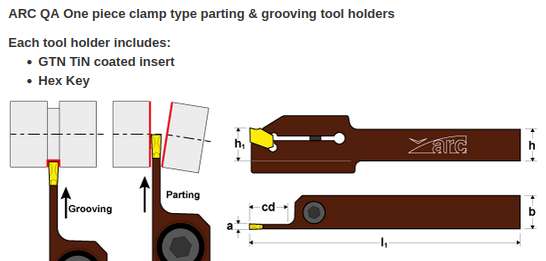
                    2.  A carbide insert holder.   No need to sharpen, and the tool-height isn’t altered by replacing the insert, but carbide prefers to be run faster and harder than HSS, and older lathes may not be up to it.  (Fast cutting with carbide inserts was science fiction when the Sabel was designed.)   That said, carbide mostly works “well enough” at slower speeds, and it would be good for grooving large diameters on a slow lathe.   I mostly use mine for grooving and parting small diameter steel and harder metals, but not as much as expected – see entry No. 3!

                    arceuro


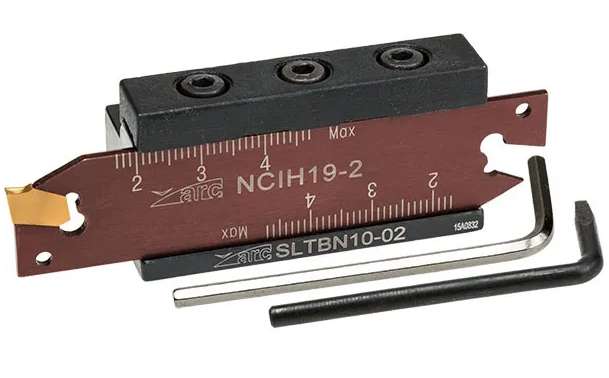
                    3. Is a blade type holder, the advantage being they are stiff enough to take deep cuts, the one pictured parting off up to about 70mm diameter.  I use mine a lot, almost everything apart from fine work in Brass or Aluminium.   It’s rear-mounted in a Gibraltar tool post and the lathe runs in reverse at 2500rpm .   Don’t do this with a simple screw-on chuck, because they come undone!  But reverse is fine with bolt on and cam-lock chucks.   If the lathe can’t do reverse safely, the tool can be mounted upside down and the lathe spun normally – still better than a front tool-post.

                    blade

                    Next question is who to buy the blades and holders from!

                    • Second-hand ex-industrial from ebay and friends.  This is a risk, ex-industrial is often well made, but that counts for nothing if the tool is in poor condition.  Don’t expect any support.
                    • Too cheap from ebay and online friends.   A different risk!  Enthusiastic bargain chasing often ends in tears.  “Too cheap” refers to the build quality, not the asking price.  “Reassuringly expensive” is a well-known con –  buyers believe a high-price means the item must be good.  No “must” about it – fakes, factory seconds, paying for the brand and advertising, etc etc.   Hard to tell the difference between good and bad, so always a gamble.   Often possible to get money back though: read the Terms and Conditions.  Don’t expect any support.
                    • New industrial.  Low risk, but expensive!  Many newcomers arrive in the hobby determined to buy only the best, until they see the prices!  Well supported, not necessarily free.
                    • New mid-range from a reputable supplier.   These days many tools are manufactured for the middle-of-the-road market.  Not as robust as industrial tooling, but certainly not “too cheap” either.   I prefer to buy these from established UK vendors, many of whom advertise of this site, selling into the hobby market.  If by chance they sell you a lemon, they stand by the product – replace or refund.  Support varies: ArcEuro have a good reputation, and Warco sorted me out with no fuss.
                    • Mid-range is a good choice for moderate hobby use, not so much for hard work.   So, are you a genteel hobby metal worker like me who doesn’t stress his tools much, or must you cut lots of metal quickly, day after day like a Victorian piece-rate worker?    If the latter, or you find tools don’t last, go up-market, otherwise save lots of dosh by buying mid-range!   The cash may be needed to buy metal and it’s expensive!!!

                    No-one provides beginner tutorials by phone.  Look to the web for that, including here!

                    Dave


                    #797831

                    In reply to: fly cutter bit

                    Diogenes
                    Participant
                      @diogenes

                      Wait!

                      No, the brazed carbide set you have linked to is not really suitable for a flycutter! – these tools are meant to be presented to rotating work and the shapes & angles are all wrong. Also they often need honing or sharpening before use.

                      With apologies to Warco (if you had one, I’d link to it) – you can use one of these – I’d measure the slot in your fly-cutter and see if it will accept a 10mm shank.

                      It is possible to buy your tooling so that most of the ‘everyday items’ take one standard type of tip/insert (i.e. CCMT06020*) which keeps things simple.

                      https://www.arceurotrade.co.uk/Catalogue/Cutting-Tools/Lathe-Turning-Tools-Indexable/ARC-Indexable-Turning-Tools/ARC-SCLC-L-95-Turning-Tool-Holders

                      SillyOldDuffer
                      Moderator
                        @sillyoldduffer

                        Sad, but I wonder if the need has gone.   My dear old dad rated Honest John highly, and for good reason. Me too, as a young man. Back then buying motor cars was a minefield.  Lots of old-bangers, and UK manufacturers were losing the plot, making hopelessly outdated models and dubious new ones.  Huge quality problems because labour relations were rock-bottom and factories slow to modernise.  At the same time, foreign competitors imported anything from cheap and nasty Warzburgs up to promising, but unproven, Japanese models.  And in the middle, plenty of European makers with serious quality and other problems.  US cars were gigantic gas-guzzlers that were hard to park, couldn’t go round corners, had sickeningly soft suspensions, and unaffordable spare parts.   Buyers worried about MPG after 1973!   Mergers, in the UK and abroad. found firms competing with themselves to sell near identical marques; one of them had to go, and customers had to judge which one was for the chop.  And merged production meant I owned a car with metric, unified, BA, and BS fasteners – insane!  Unfortunately, in the midst of this chaos, the motor trade had more than it’s fair-share of crooks and dodgy sales practices!   And honest dealers struggled with old and new marques with uncertain futures, some of whom couldn’t or wouldn’t support their products.    Necessary for Joe Public to worry because even cheap cars were expensive as a percentage of income.  Buyer beware and Honest John identified the good, the bad and the ugly.  Very helpful!

                        When I’m in rose-tinted mood, I remember working on cars as fun and interest.  But this is highly misleading:  cars that let me down repeatedly were no fun at all.  Essential to have Haynes Manuals and a set of basic tools, not just a hobby.  May be a shock to petrolheads, but most people just want a vehicle that gets them reliably from A to B in reasonable comfort.  The majority have no interest in how the thing works, and no desire to maintain it themselves.

                        All change!  Today improved regulation and advanced manufacturing make it hard to buy an outright lemon.   All the too cheap and unreliable makers were forced out of business.  Cars are relatively cheaper and we get more for the money.   Very few people do home maintenance.   Second-hand cars come with a warranty and can be insured against major repairs. New cars are often hired rather than bought: my neighbour & his wife have a new car each every two years.  Now relatively few maintain their own cars, not least because even simple jobs have become difficult without a lift and the right tools!

                        So Honest John has less to say and fewer people need his advice. Time marches on.

                        Dave


                        #797030
                        John Haine
                        Participant
                          @johnhaine32865

                          If you’re quick, Arc have some 4 way chassis sockets for £1.94 each.

                          https://www.arceurotrade.co.uk/Catalogue/Stepper-Motors/Wiring-Accessories/4-Way-XLR-Chassis-Socket


                          #796539
                          Pete
                          Participant
                            @pete41194

                            Measuring what you have might be the only sure way of identifying that what you have isn’t one of those Asian versions of the ER collets that don’t match to the proper ER series of chuck threads and nuts. Here’s the dimensions of what they should be if they are in fact ER collets. https://www.arceurotrade.co.uk/Catalogue/Collets/ER-Collets

                            #796155
                            Peter Cook 6
                            Participant
                              @petercook6

                              Are you sure it’s not an ER25 set? The collets need to be clicked into the nut before screwing on as seen here. If they are not, then the collet will not tighten up. As Martin wrote, a picture of a collet and the holder might help.

                              John Haine
                              Participant
                                @johnhaine32865

                                Hi Chris, way back I started to build a Woodward intermittent g/hopper on the lines of yours.  The project stalled when my attempt at the pin wheel fell apart alas.  I did however make the count wheel and plates, and mounted the wheel on its arbor between a pair of 1mm bore x 3mm od flange bearings that I got from ArcEuroTrade.  I think I used white spirit to wash out the races first, and I was astonished at how freely the wheel spun in the races.  Setting it off by blowing on the teeth it must have run for 30s or so.  Based on that I wouldn’t have any hesitation about using such bearings on a balance arbor.  These bearings are unshielded, Arc still list the same size but without flange at a very reasonable price.

                                #795809

                                In reply to: Hello from Leicester.

                                noel shelley
                                Participant
                                  @noelshelley55608

                                  Welcome to the party ! You will be amongst friends here and one of the best suppliers of equipment for model engineers when it comes to tooling is not far from you. The knowledgeable team at Arc Euro, always very helpful. I speak as a very satisfied customer. Noel.

                                  #795587
                                  Russell Eberhardt
                                  Participant
                                    @russelleberhardt48058

                                    When I built my JW Regulator I used stainless steel bearings with two metal shields (not seals).  I washed them out in white spirit and then blow dried them.  They then gave reduced friction, as measured before and after by spinning a wheel mounted on them before and after and timing how long it took to stop.

                                    I bought them from Arc Eurotrade for about a pound each.  Why do you need flanged bearings.  I machined the housings for just a light push fit.

                                    Russell

                                    #794304
                                    JasonB
                                    Moderator
                                      @jasonb
                                      On Michael Gilligan Said:
                                      On John Haine Said:

                                      Look for Oldham couplings.

                                      If the stated prices are to be believed … ARC has some astonishing reductions !

                                      https://www.arceurotrade.co.uk/Catalogue/Stepper-Motors/Oldham-Couplings/33mm-Oldham-Hubs—Clamp-Style—Aliminium

                                      MichaelG.

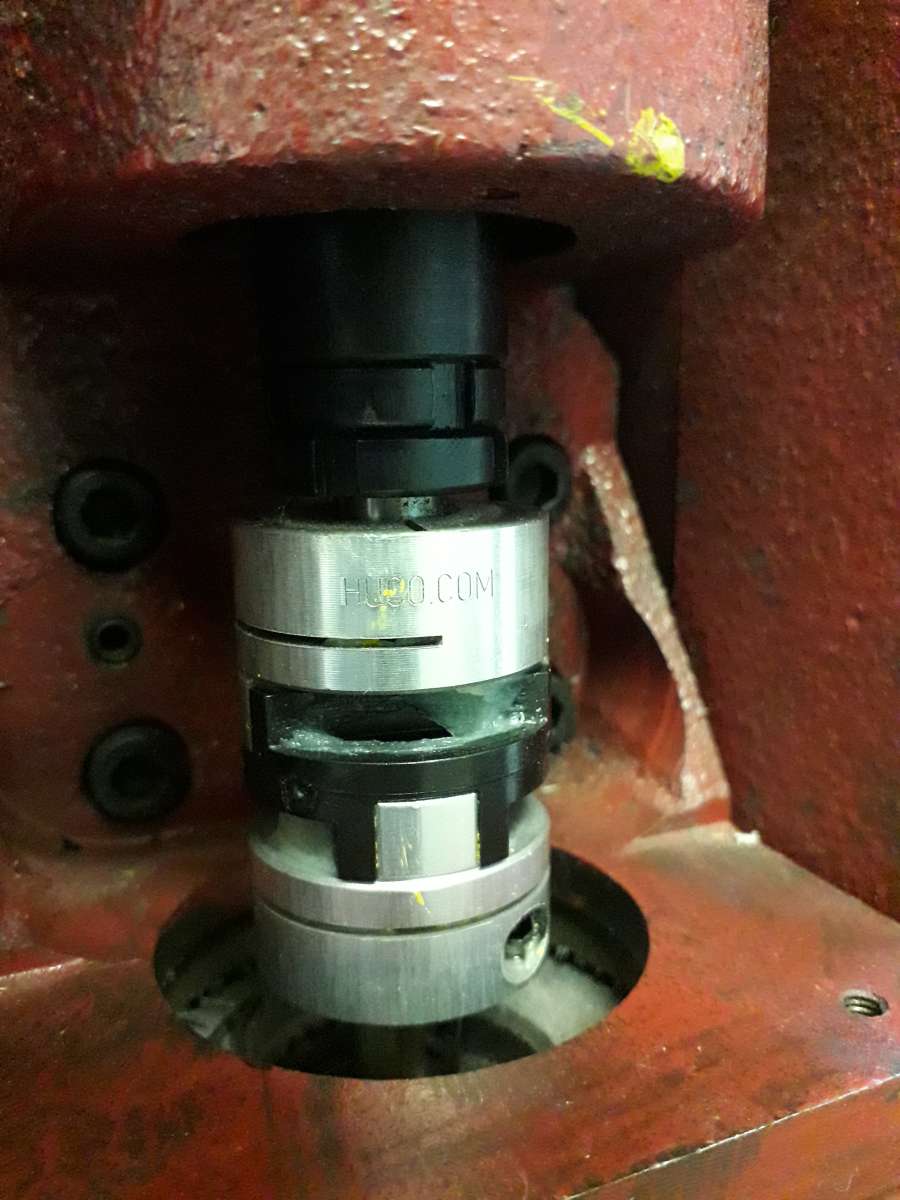
                                      Probably cheap as they don’t have any more of the middle bits to go with them! Out of stock and unlikely to be restocked.

                                      My KX-3 has the same sort of couplings

                                      20190227_191504

                                      #794300
                                      Michael Gilligan
                                      Participant
                                        @michaelgilligan61133

                                        This ARC page seems to make more sense than the first one that I linked:

                                        https://www.arceurotrade.co.uk/Catalogue/Stepper-Motors/Oldham-Couplings/19mm-dia-Oldham-Hubs—Clamp-Style—Aluminium

                                        MichaelG.

                                        #794215
                                        Michael Gilligan
                                        Participant
                                          @michaelgilligan61133
                                          On John Haine Said:

                                          Look for Oldham couplings.

                                          If the stated prices are to be believed … ARC has some astonishing reductions !

                                          https://www.arceurotrade.co.uk/Catalogue/Stepper-Motors/Oldham-Couplings/33mm-Oldham-Hubs—Clamp-Style—Aliminium

                                          MichaelG.

                                          #794158
                                          Dr_GMJN
                                          Participant
                                            @dr_gmjn

                                            I’ve not been able to order a broach yet – Arc Euro won’t let me sign-in, and there appears to be no way of getting a new password. I’ll give them a call on Tuesday I guess.

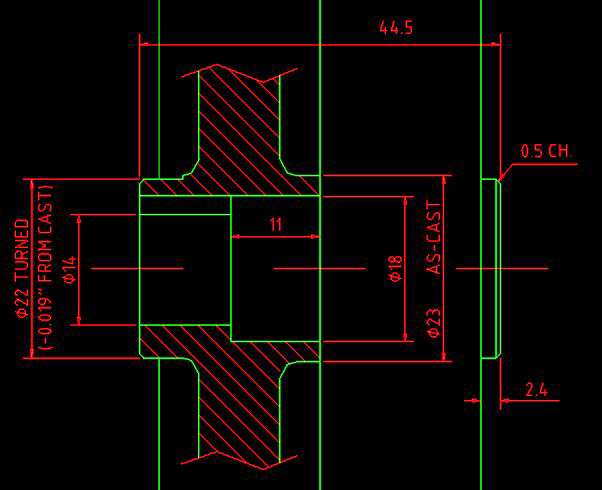
                                            Looking at the hub – I’m a bit concerned that once cleaned-up, the wall thickness where the keys are will be quite thin. I’m not sure what the height of the keyway would be with no shim. I’m thinking I could mill the broach bush to give a shallower hub keyway height, and compensate by having a deeper keyway in the shaft (this has come about becasue the stepped shaft has ended up thicker than the plan – 14mm diameter rather than 11mm). If I do that I might not need a shim at all?

                                            As drawn, the head of the tapered key (about 7mm high) would project above the turned hub by about 2.75mm. I guess this would look wrong, so I might have to reduce it by this amount?

                                            hub_section


                                            #793549
                                            JasonB
                                            Moderator
                                              @jasonb

                                              You can just use a left hand turning tool From memory an 8mm square one should fit. Some people like the button tools that take the RCGT inserts for flycutting aluminium.

                                              ARC also do ready ground HSS which will give you the basic shape.

                                              #793546
                                              petro1head
                                              Participant
                                                @petro1head

                                                Which index cutter would I buy to fit my 63mm flycutter bought from ArcEuro?  The reason I ask is I am crap at sharpening hss

                                                #793425
                                                Dr_GMJN
                                                Participant
                                                  @dr_gmjn

                                                  Thanks Jason, I’m drawing something up now which shows the proportions. Here it is so far:

                                                  Picture1

                                                  Picture5

                                                  Picture2

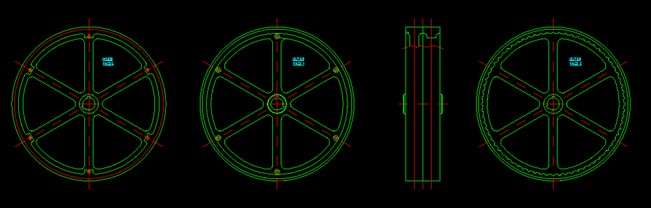
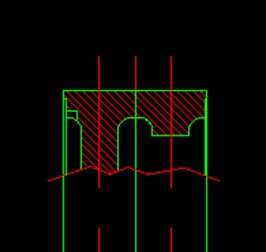
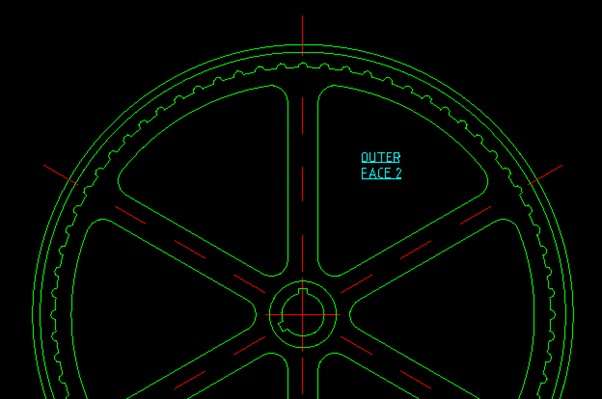
                                                  I’d like to mill the barring slots using the R/T if possible – seems it might be quite satisfying (if it goes well!). I might be able to get away with milling them into the casting, then again they may look too far towards the rim. Should the radius where the slots are, be machined away locally to give a “square” pocket I wonder rather than the asymmetric pocket shown in the section above?

                                                  Picture4

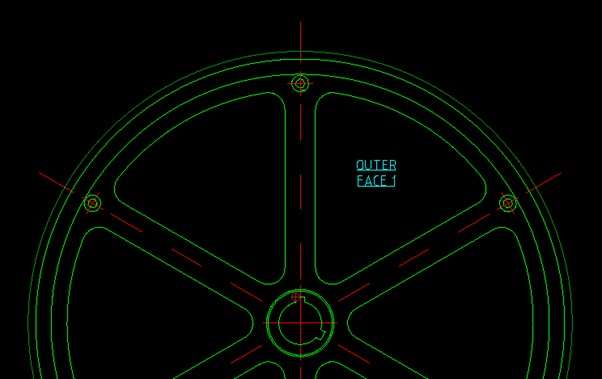
                                                  The tappings are for M3 capheads – the head O/D counterbore just about fits within the un-machined bit of the casting, and remains on the pads on the inside. I might change it to blind drill and tap the opposite side to save filling and flatting the exposed external holes.

                                                  Picture3

                                                  The keyways are at 120 degrees to each other. Since the hub is hollow in the middle, I guess the amount of material to be removed is minimised. I think a 3 mm width of key might be fine, and use a broach. I think a parallel, not tapered keyway, secured with a screw would be OK on reflection? Not sure about the maximum length the broach can take, I think it’s 22 mm on the Arc Euro specs, but the hub is 44.5 mm, so that might need more thought. I’m assuming a simple extension bar would just push the broach through whatever length is needed though?

                                                  Thanks.

                                                  #793093
                                                  SillyOldDuffer
                                                  Moderator
                                                    @sillyoldduffer
                                                    On MEinThailand Said:

                                                    …Everyone (model engineers and suppliers) seem to be doing their ‘own thing’ with no common standardisation.

                                                    I’d describe Model Engineering (whatever that is!) as being “lightly standardised”.   Though ME’s don’t maliciously go for non-standard fittings, nor, with some exceptions, do they have particular rules.

                                                    But there a no dimensions of boiler fittings or threads on the 1950 drawings. So what size do I make the safety valve thread for example? 5/16 X 32, 1/4 X 32 or 1/4 X 40, or whatever else?

                                                    If a commercial safety valve is bought, then the boiler is tapped to accept it.  If an existing boiler is to be fitted with a replacement safety valve, then the thread has to be identified, and a safety valve bought in that size or made to fit.  The ME has to sort it out!

                                                    I’ll be buying a commercial valve and pipe unions so I don’t need to worry about the size of the hex on the unions, but if I was making my own fittings then I’d need to know this. But the info just isn’t there.

                                                    Perhaps because it doesn’t need to be!  Model Engineering rarely applies “American Manufacturing” techniques, i.e. production methods depending on accurate measurement such that all parts are interchangeably made to close tolerances.  We use an older technique, in which parts are made to fit with other parts in one mechanism, and aren’t necessarily interchangeable with the same part on another example of the model.

                                                    A Model Engineer might choose between ⁵⁄₁₆” X 32, ¼” X 32 or ¼” X 40 simply because he has a tap and die for one and not the others!   Or maybe to keep costs down he’s standardised his workshop on Whitworth rather than BA, ME or Unified.  Or he could be fully equipped to do BSC and BSB as well.

                                                    May be best to go with what’s available locally.  In Thailand, US and metric threads may be cheaper and easier to source than ye olde British?  In the UK I prefer metric because for historic reasons there are far too many Imperial Threads, mostly obsolete or obsolescent in 2025.  But then I don’t build 1950 Bassett Lowke traction engines from from old plans! Unfortunately no chance of standardising what went on in the 19th and 20th centuries!

                                                    Modern ME designs tend to be metric, which is less confusing when building new.  Metric doesn’t help with older stuff because converting Imperial to metric, or vice versa, is error prone.

                                                    Choosing between threads, textbook reasons might help.  Coarse threads are good for soft materials like cast-iron, the thread form is robust, and they can be fitted and undone faster; harder to cross-thread a coarse thread than a fine one! Fine threads are stronger and seal better, so theoretically a better choice for a safety valve, the cost being they are a bit fiddly to make and fit.    As Model steam engines aren’t highly stressed, I think coarse or fine would do equally well.

                                                    I recommend Tubal Cain’s “Model Engineer’s Handbook” .  Other vendors available!

                                                    Dave

                                                    #793052
                                                    David George 1
                                                    Participant
                                                      @davidgeorge1

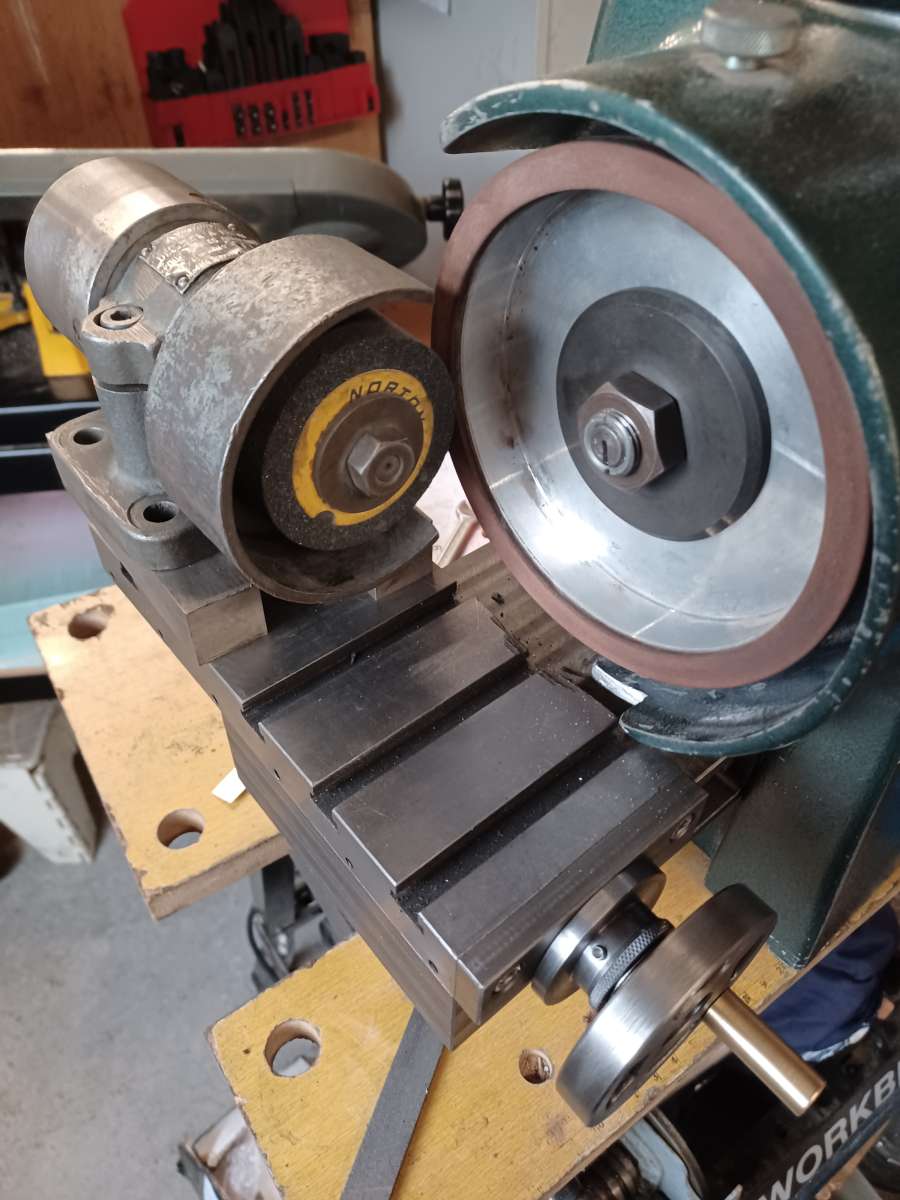
                                                      I bought a diamond wheel for my Taylor Hobson  cutter grinder which I added a tool rest to rest turning tools etc and it worked well. It is a cup wheel from Arc Eurotrade 150mm dia with 3mm depth of diamond on an aluminium body. the wheel is a perfect fit on the arbour with no play and runs very true. It was perfect at first but I have added a cutter grinder to sharpen mills and drills etc and having used the wheel for grinding carbide cutters some steel part tools and the occasional piece of glass for the wife for her stained glass work and now it needed a bit of dressing to get it back to flat and cutting well. I bought a diamond dressing attachment for it, (which cost £100.0 ish on eBay), and after dressing it now again cuts as good as when I first received it.

                                                      20250220_154229

                                                      Dressing the wheel face.

                                                      David

                                                    Viewing 25 results - 101 through 125 (of 4,842 total)

                                                    Latest Replies

                                                    Home Forums Search Search Results for 'arc euro'

                                                    Viewing 25 topics - 1 through 25 (of 25 total)
                                                    Viewing 25 topics - 1 through 25 (of 25 total)

                                                    View full reply list.