Material advice

Material advice

Home Forums Materials Material advice

Viewing 21 posts - 1 through 21 (of 21 total)
  • Author
    Posts
  • #813175
    tobyonekenobi
    Participant
      @tobyonekenobi

      Good morning gentlemen,

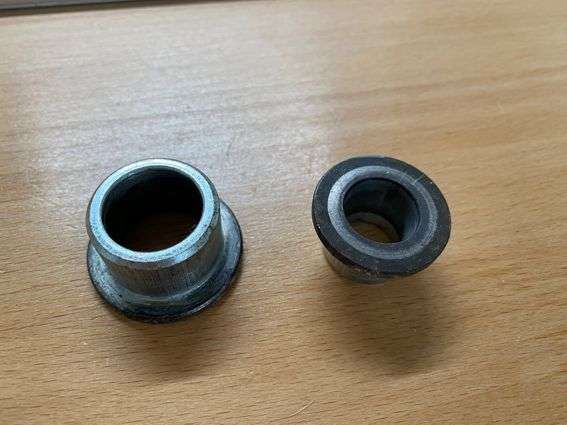
      I’m looking for advice on materials for a tapered ball joint bush. I have a 1970 metric Boxford lathe and use predominantly carbide insert tooling. The original bushes look to be of hardened steel as they don’t scratch easily, they are not particularly large (OD 27mm) so If I have to heat treat them I plan to use a propane touch and hearth and anneal in an oven, but would it be possible to produce these parts with a harder steel in the first place?

      Any advice much appreciated

      Chris


      Bushmall

      #813183
      cogdobbler
      Participant
        @cogdobbler

        Silver steel might do it.

        What is the application? High load?

        #813184
        tobyonekenobi
        Participant
          @tobyonekenobi

          Lower ball joint on a steering knuckle/upright. Some of these cars came with cast steel uprights but later models were fitted with aluminium with steel bushes, the bushes have a habit of sticking to the taper and getting thrown away with the ball joint, hence the need to remake them as they are not or were ever a part sold separately.

          #813212
          bernard towers
          Participant
            @bernardtowers37738

            EN8 hardens ok, bot you could make your job easier if you used something like En 9 or 32 and then case harden.

            #813221
            Ian P
            Participant
              @ianp

              Is this a bush for a track rod end ball joint on a vehicle.

              Actually regardless of the purpose, I’m not sure it needs to be hardened. There is no movement once the taper is mated and if the outer diameter of this bush is a running fit of some sort how will it be held whilst the nut is tightened.

              I’ve made quite a few flanged bushes with a taper bore that are press fitted into a parallel hole, and used whatever steel was to hand.

              Ian P


              #813234
              tobyonekenobi
              Participant
                @tobyonekenobi

                I remember doing case hardening in metal work at school, made an adjustable wrench which I still have, we used Kasenit (which has just aged me :0) ) which I don’t think you can get any more, probably got something to do with the cyanide! Forgive my ignorance here but why would case hardening be any easier than just heating the part up and quenching followed by annealing?

                #813236
                tobyonekenobi
                Participant
                  @tobyonekenobi

                  I did wonder if these parts really needed to be harden but as the original parts are I thought I’d better replicate that. Yes they are a press fit into the aluminium knuckle, one is for the tie rod and one is for the lower control arm. The engineers at Alfa thought for some reason or other that they should be hardened.

                  #813427
                  David George 1
                  Participant
                    @davidgeorge1

                    If you use EN32b steel and case harden they will likely to be strong and wear resistant. You can use CBM nottingham heat treatment for the case hardening. they are very helpfull and will post if far away or collect more localy.

                    David

                    #813447
                    SillyOldDuffer
                    Moderator
                      @sillyoldduffer

                      Mild-steels cannot be hardened because the alloy doesn’t contain enough Carbon.   Adding more Carbon to steel makes it hardenable.

                      Case Hardening compound is still available.  Reliably case-hardening large objects is tricky, but worked OK for me on small parts.  Worth trying. It works by migrating enough Carbon into the surface of mild-steel to create a thin layer of hard steel.

                      Or buy a tool-steel in annealed form.   Trickier to harden ‘just so’, though small parts should be easier.

                      Simple answer is Silver Steel – it’s formulated to de-risk heat treatment in an ordinary workshop.    Unfortunately expensive.

                      How difficult is it to change the bush?   Hardening extends the life of the bush, well-worth doing if replacing it is a pain, and the lathe is worked hard.   However, ff the bush is easily replaced consider compromising on Brass or Bronze, and making it a maintenance consumable.   Boxford were right to harden the bush though – they wear out!  After 50 years…  How long a bush lasts depends on how heavily the lathe is loaded.  As a home workshop machine is unlikely to be driven round the clock at industrial production rates, a soft replacement might last several years.   But I’d do it properly if changing the bush is at all difficult.  And given my limited facilities and skills, I’d cough up for Silver Steel.  Faulty heat treatment in my clumsy paws risks early failure due to cracks or excessive brittleness, and Silver Steel is safer.

                      Dave

                      #813451
                      Ian P
                      Participant
                        @ianp

                        I’m still not convinced that a bush that accepts a (relatively permanently fitted) tapered spigot of a suspension ball joint. that is a press fit into an aluminium casting or forging needs to be hardened.

                        The ball itself and its integral tapered stem will be manufactured from some pretty tough steel and probably heat treated but certainly not brittle although its taper stem will at least feel quite hard.

                        Making a bush with a matching taper bore and then hardening is adding complexity for no useful purpose. A softer steel will allow for minute inaccuracies as the surface will deform/conform and ensure better mating of thetaper surfaces.

                        In use the taper stem is drawn into the bush and suspension part by a nut and is then in place probably for years. There is no movement between ant of these parts and no need whatsoever to harden the bush.

                        The original part that the OP’s thought was hardened might have been made by a sintering process purely for manufacturing expediency so subjectively would ‘feel’ quite hard.

                        Why does this suspension part (that carries the bush) need a new bush fitting?

                        IanP

                        #813453
                        Ian P
                        Participant
                          @ianp

                          I have just re-read the OP’s second post in this topic in which he explains how the original bushes can get lost and as they are not service parts, not available as spares. (in which case where did the bush picture come from?)

                          The new bush may need its external diameter sizing to suit the actual suspension casting bore ID rather than a straight copy of the original.

                          I still maintain that this bush does no need to be hardened.

                          Ian P

                          #813472
                          tobyonekenobi
                          Participant
                            @tobyonekenobi
                            On Ian P Said:

                            I have just re-read the OP’s second post in this topic in which he explains how the original bushes can get lost and as they are not service parts, not available as spares. (in which case where did the bush picture come from?)

                            Why the 3rd degree? I pressed them out so I could get accurate measurements to re-create a second pair. Alfa recommend replacing the whole steering knuckle if they do come out and even go so far as producing a tool to remove the ball joint taper without disturbing them.

                            However your argument makes a good point and I’m inclined to agree with you as there is no movement in any direction.

                            #813477
                            tobyonekenobi
                            Participant
                              @tobyonekenobi

                              On SillyOldDuffer Said:


                              Boxford were right to harden the bush though – they wear out!

                              It’s not a bush for the Boxford, that’s what I’m using to make the bush which is for an Alfa steering knuckle ball joint, there will be no wear on this part as it does not move. Also EN8 is a mild medium carbon steel

                              “EN8 can be heat treated to provide a good surface hardness and moderate wear resistance by flame or induction hardening processes. From the automotive trade to wider general engineering applications, EN8 is a popular steel in industry.” Quote from smiths website.


                              #813504
                              Howard Lewis
                              Participant
                                @howardlewis46836

                                Since the bush is going into an Aluminium alloy component, do NOT use brass or bronze, which contain copper.

                                With dissimilar metals, even steel, in the presence of an electrolyte, (road salt for instance) there will be electrolytic action.  It will be far less with Aluminium alloy/Steel than with anything containing copper.

                                The Aluminium will be corroded away, in preference to the copper containing part.

                                You can’t chance that with a suspension component!

                                Howard

                                #813511
                                old mart
                                Participant
                                  @oldmart

                                  EN19T or EN24T chrome moly steels are harder and stronger than mild steel and machinable. They could be used without any subsequent heat treating. The bush could be a just sliding fit and installedwith Loctite 601 or 638 which would ensure that wated did not finditsway into the joint. Aircraft bushes would have a fillet of sealer around the joint interfaces to further seal against corrosion.

                                  #813535
                                  SillyOldDuffer
                                  Moderator
                                    @sillyoldduffer
                                    On tobyonekenobi Said:

                                    On SillyOldDuffer Said:


                                    Boxford were right to harden the bush though – they wear out!

                                    It’s not a bush for the Boxford, that’s what I’m using to make the bush which is for an Alfa steering knuckle ball joint, there will be no wear on this part as it does not move. Also EN8 is a mild medium carbon steel

                                    “EN8 can be heat treated to provide a good surface hardness and moderate wear resistance by flame or induction hardening processes. From the automotive trade to wider general engineering applications, EN8 is a popular steel in industry.” Quote from smiths website.


                                    Ah, confusion abounds.  My answer was in response to the opening question, no mention of alfa in it, and I didn’t see the later posts.  I  certainly wouldn’t have recommended Brass if I’d known Aluminium was in the game!

                                    Strictly speaking EN8 is a medium carbon steel, not a mild steel  The trade are a bit confused,  for example Metals4U say, my bold;

                                    Buy EN8 mild steel online at metals4U.  But then they contradict themselves:
                                    The term Mild Steel applies to all low carbon Steel that does not contain any alloying elements in its makeup and has a carbon content that does not exceed 0.25%. The term “Mild” is used to cover a wide range of specifications and forms for a variety of Steel.

                                    Then, in the following table, EN8 is shown to contain 0.35% Carbon, over the limit, confirming EN8 isn’t mild-steel!

                                    It’s the spec that confirms EN8 can be hardened, not someone calling it ‘mild-steel’.

                                    Clear as mud, eh!  Good news, if you want to harden EN8, it will.

                                    The original drawings would answer the question authoritatively.  Having access to the stress calculations and other parameters, did the designer know the alloys aren’t remotely critical, or did he have to carefully select them and the heat treatment to maximise strength or reliability?  We can only guess.

                                    Dave


                                    #813542
                                    tobyonekenobi
                                    Participant
                                      @tobyonekenobi
                                      On SillyOldDuffer Said:
                                      On tobyonekenobi Said:

                                      On SillyOldDuffer Said:


                                      Boxford were right to harden the bush though – they wear out!

                                      It’s not a bush for the Boxford, that’s what I’m using to make the bush which is for an Alfa steering knuckle ball joint, there will be no wear on this part as it does not move. Also EN8 is a mild medium carbon steel

                                      “EN8 can be heat treated to provide a good surface hardness and moderate wear resistance by flame or induction hardening processes. From the automotive trade to wider general engineering applications, EN8 is a popular steel in industry.” Quote from smiths website.


                                      Ah, confusion abounds.  My answer was in response to the opening question, no mention of alfa in it, and I didn’t see the later posts.  I  certainly wouldn’t have recommended Brass if I’d known Aluminium was in the game!

                                      Strictly speaking EN8 is a medium carbon steel, not a mild steel  The trade are a bit confused,  for example Metals4U say, my bold;

                                      Buy EN8 mild steel online at metals4U.  But then they contradict themselves:
                                      The term Mild Steel applies to all low carbon Steel that does not contain any alloying elements in its makeup and has a carbon content that does not exceed 0.25%. The term “Mild” is used to cover a wide range of specifications and forms for a variety of Steel.

                                      Then, in the following table, EN8 is shown to contain 0.35% Carbon, over the limit, confirming EN8 isn’t mild-steel!

                                      It’s the spec that confirms EN8 can be hardened, not someone calling it ‘mild-steel’.

                                      Clear as mud, eh!  Good news, if you want to harden EN8, it will.

                                      The original drawings would answer the question authoritatively.  Having access to the stress calculations and other parameters, did the designer know the alloys aren’t remotely critical, or did he have to carefully select them and the heat treatment to maximise strength or reliability?  We can only guess.

                                      Dave


                                      Yes, now I’ve re-read my original post it’s not particularly clear although I’m not sure that any Lathes  have tapered ball joints ;0) and yes the descriptions from metal supply websites seem to be less than accurate, which is odd as the EN numbers are there so that you can be sure what the specs are, its a standard, the clues in the name.

                                      #813562
                                      Martin Connelly
                                      Participant
                                        @martinconnelly55370

                                        Would the hardness help with producing a nice polished surface to help reduce corrosion? Just a thought on why it is hard.

                                        Martin C

                                        #813629
                                        tobyonekenobi
                                        Participant
                                          @tobyonekenobi
                                          On Martin Connelly Said:

                                          Would the hardness help with producing a nice polished surface to help reduce corrosion? Just a thought on why it is hard.

                                          Martin C

                                          I don’t thinks so as it is the same material just a different crystalline structure when hardened.

                                          I’m beginning to think  that perhaps the only reason that this part might be hardened is to prevent any damage to the mating surface when the parts are assembled/disassembled?

                                          #813632
                                          Diogenes
                                          Participant
                                            @diogenes

                                            Yes, so a splitter can be used without risk of chewing the face of the ‘fixed’ half up.

                                            #813641
                                            tobyonekenobi
                                            Participant
                                              @tobyonekenobi
                                              On Diogenes Said:

                                              Yes, so a splitter can be used without risk of chewing the face of the ‘fixed’ half up.

                                              Also would prevent mating face from damage when trying to manoeuvre the lower control arm ball joint taper into the bush when working under a car, delicacies are the first casualties along with the skin on your knuckles in this environment! Doesn’t take much damage to stop a taper fit from working correctly

                                            Viewing 21 posts - 1 through 21 (of 21 total)
                                            • Please log in to reply to this topic. Registering is free and easy using the links on the menu at the top of this page.

                                            Latest Replies

                                            Home Forums Materials Topics

                                            Viewing 25 topics - 1 through 25 (of 25 total)
                                            Viewing 25 topics - 1 through 25 (of 25 total)

                                            View full reply list.