Help! My Metals’ Shrunk!

Help! My Metals’ Shrunk!

Home Forums Materials Help! My Metals’ Shrunk!

Viewing 16 posts - 1 through 16 (of 16 total)
  • Author
    Posts
  • #823388
    Nigel Graham 2
    Participant
      @nigelgraham2

      Task: making two split sleeves, rather like big-bearing liners, to grip a 2.5″ dia overarm in its split clamps in the cast-iron body of a small horizontal mill whose original arm seems to have been 3″ dia.

      The clamping is by springing the casting itself – cheap and simple but a dangerous weak point.


      There were two sleeves in there, rather crude steel rings probably salvaged from something else, with a single saw-cut so trying to squeeze those down with the casting risked breaking the latter.


      Hours of careful turning and boring made two “come-in-handy” steel billets into a couple of short tubes, which I proved to size by assembling them and the over-arm to the mill without clamping.

      Then sawing them in half lengthwise, using the milling-machine.

      One pair fits all right, possibly very slightly looser than it ought be.

      The other pair closed up slightly, so is far too tight by distortion. The warning sign was that when making the first longitudinal saw-cut it kept gripping the slitting-saw, and at the end closed the cut.


      I have not met this problem previously on anything, so, any suggestions, please how I might recover them? If that’s even possible of course.


      Would annealing them help? Provided the oxidation and subsequent cleaning does not reduce their diameters so bringing us back to a different version of square one, and introducing a potential alignment error.

      I can revert to the makeshift sleeves that came free with the mill – cutting them completely in half so they close without unduly straining the machine. I didn’t want that though because they are a bit of a bodge.

      I ought add I may have been caught out by the steel for the one that is giving me grief. I have no idea what alloys either billets were. It cut very nicely but might be something rather exotic.


      …..

      PS: Afore anyone sez owt: Yes I know the title’s inverted comma’s in the wrong place…. I didn’t spot it until I’d posted the message!

      #823390
      Diogenes
      Participant
        @diogenes

        If you can reach the inside, mill two (?or three) shallow axial slots disposed evenly within the curve and put a line of centre-punch dots down each one.

        In extremis you could drill lines of divots and punch those.

        A LITTLE GOES A LONG WAY so start gently with ‘a few’, and gauge the fit as you go, you can always add intermediate hits and ‘go around again’ if it doesn’t spread enough.

        #823395
        bernard towers
        Participant
          @bernardtowers37738

          Or you could use a keyway broach!

          #823396
          Andrew Crow
          Participant
            @andrewcrow91475

            You could try putting in two more equally spaced slots but only partially through,  it may help in being able to open up the bore.

            Andy

            #823401
            Bazyle
            Participant
              @bazyle

              To reduce oxidation if heating you could pint with a garden lime slurry paint. Might be difficult to heat evenly and hot enough.
              I’d go with Andy’s slots.
              You could drill a few holes across the closed up slit and hammer in taper pins to open it out and remove when in place.

              #823404
              Dave Halford
              Participant
                @davehalford22513

                I would have thought the task was to increase the size of the new rod from 2.5″ to 3″ which can be done by Loctite or JB Weld’ing the sleeves, which need not be split or halved it just makes things more fiddly to assemble.

                Therefore I don’t see the tight one being a problem just tap it on the ‘new’ arm with a screwdriver holding the slit open.

                #823426
                Nigel Graham 2
                Participant
                  @nigelgraham2

                  The problem with the sleeve’s two separate parts (like a car engine’s big-end liner), is that they have tightened like a curling leaf, effectively raising their outer surfaces along the centre.

                  Therefore trying to drive them in between the arm and the casting, not only jams the un-clamped arm but dangerously risks breaking the casting.

                  There is no “new” rod, only the original one, half-inch smaller diameter than its “eyes” in the machine body.

                  I didn’t want to fix the sleeves to the bar because I want them to stay in their housings when I adjust the bar’s projection, though that is perhaps not strictly necessary. Provided I remember not to bang my head on it in my cramped workshop.

                  The bar is a milling-machine’s over-arm, and has a short, eccentric spigot to hold the drop-bracket so its journal can be centred accurately on the mandrel. Using that, being able to slide the over-arm in or out is an advantage. Otherwise, one could simply slide the bracket along the arm, and hope to line everything up properly! It’s a bit like losing the centre when raising the head on a round-column mill/drill.

                  Once everything is installed, there is no access to the innards.

                  I’ll try to photograph it.

                  #823476
                  Dave Halford
                  Participant
                    @davehalford22513

                    I didn’t want to fix the sleeves to the bar because I want them to stay in their housings when I adjust the bar’s projection, though that is perhaps not strictly necessary. Provided I remember not to bang my head on it in my cramped workshop.


                    What keeps the ‘shells’ in place when you slide the arm?

                    #823496
                    old mart
                    Participant
                      @oldmart

                      I am in the process of making split bearings out of bronze and I started with a length of bronze bar. Using a 1/16″ saw blade of about 5″ diameter with a 1″ hole in an arbor at very low speed, I cut it into halves for as long as possible (about 2″) and cut off the cut parts. With 180 grit wet and dry paper on the surface table I made the cut faces as flat as possible. The faces were tinned with plumbers solder and lined up together for reheating. This was the difficult bit, getting the halves as closely as possible in line and with the thinnest thickness of solder. I got the soldered assembly in a four jaw independent running as truely as possible and turned half the length round. Then the other end was turned in a three jaw scroll to match. The faced off ends are as good as I could get them, one end is centred exactly on the join and the other is about 0.005″ out. The OD and bores can be produced and hopefully they will work satisfactorialy in stainless steel rods. The halves will be marked before separating and will be glued into the rod and end cap.


                      #823508
                      Nigel Graham 2
                      Participant
                        @nigelgraham2

                        Old Mart –

                        I like that technique for making and fitting bearing liners, but here I am making a clamp so need an appreciable joint gap so the liners will close down on the bar.

                        You could hold the halves together for soldering by twisting wire round them; by an old, so sacrificeable, worm–drive clip; by brass screws just outside what will become the liners; or by simple G-clamps made from a bit of channel or bent steel strip and an ordinary set-screw. (I think that was LBSC’s way!)


                        Dave –

                        Good point I’d not really thought when I started. I gave the second sleeve a small lip to stop it sliding in one direction at least, but had envisaged perhaps a couple of simple dowels / roll-pins / screws to act as retainers.

                        Then realised I could use two 1/4″-BSW tapped holes already in the casting. I drilled the still-cylindrical sleeves with the tapping size (5.1mm) then turned little tails on two set-screws to engage with that hole. Only after dividing the shells into two, realised this placed the cut obliquely to the clamping.


                        Then……

                        I hit the problem that one split shell fitted, sort of, the other didn’t.

                        So I spent this afternoon experimenting.

                        I had already used one of the original sleeves, by halving that lengthways.

                        I adopted, I think, if I understand them correctly, Diogenes’ and Andrew’s suggestion of slots along the remaining original sleeve. Using the slitting-saw, and rotating the sleeve by eye from position to position in a T-slot as “Vee-block”, I cut very thin slots almost through the wall.

                        Oh, and the “Haunted Workshop” ghosts then added their bit by hiding one half of the split, faulty sleeve!


                        So eventually I finished with a reasonably satisfactory compromise. One of the new two-part sleeves in the front eye, the original sleeve for the rear eye, with thin axial grooves to make it flexible.

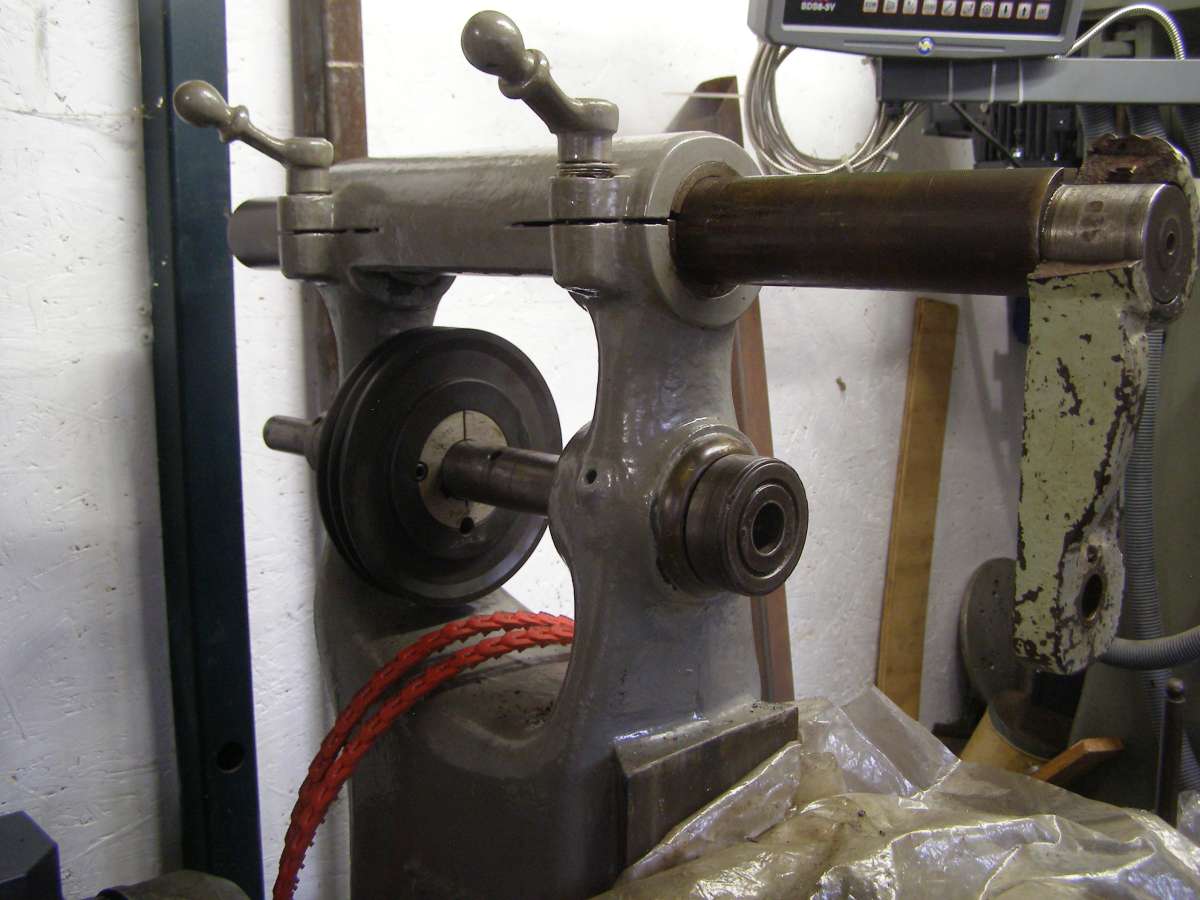
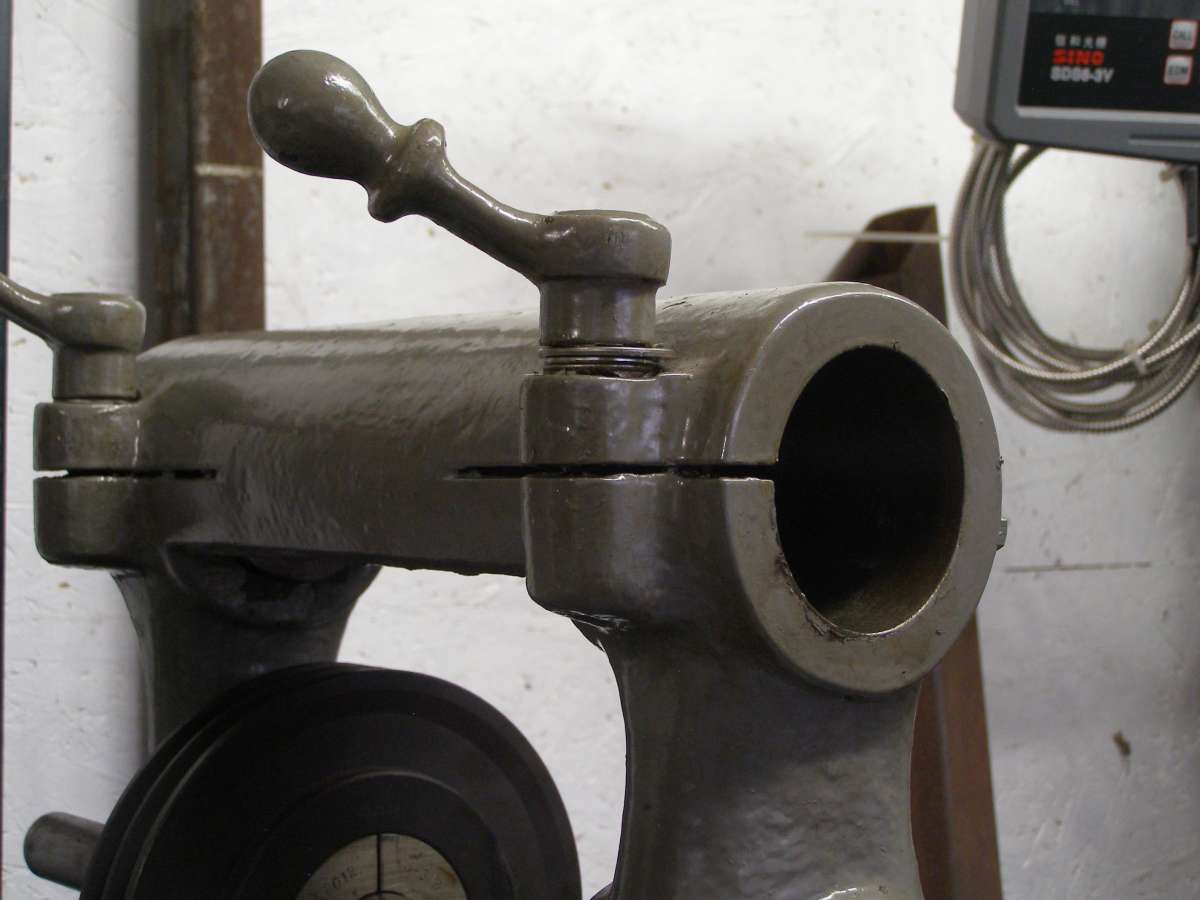
                        The photos show what’s what:

                        The Denbigh H4 Horizontal Mill, for line-shaft drive, with its non-original, 2″ diameter over-arm and the makeshift sleeves that came with it; and the (broken!) even more makeshift, drop-bracket on an eccentric spigot to allow its alignment with the spindle.

                        Note the two link-belts. Many owners of similar machines put the modern drive motor and pulleys out to one side, so as to use continuous belts. This works well but is very ungainly and steals a sizeable volume of workshop.

                        I want the drive above this machine, neater and more compact in a very cramped shed. That DRO unit in the background is on a Myford VMC mill, and side-mounting the Denbigh’s drive to the right could obstruct easy access to the Myford, but to the left, to an adjacent bench-drill! Yet going too high above could obstruct the travelling-hoist’s journeys.

                        That is the next part of the project, and thankyou Diogenes for that worm-drive unit, offering a spindle speed of around 75rpm (1350 motor / 18:1 worm-gear), depending on the intermediate pulley. I can live with a single speed, especially if I restore the table-feed drive.


                        Denbigh Oct 2025 A

                        And without the fittings. The 2.5″ dia apertures as machined by the Staffordshire company. The “Cyclop’s Eye” in my Haunted Workshop piece. It was making the new sleeves for this, that had created the eerie sounds. This picture shows why I am very wary of either an excessively tight fit, or of having to pull the clamps-nuts down too tightly. That little bulge just visible beyond the eye is a puzzle. It is a protrusion holding only a vertical blind hole about 5/16″ dia, and perhaps originally was to hold a lamp.

                        Denbigh Oct 2025 B

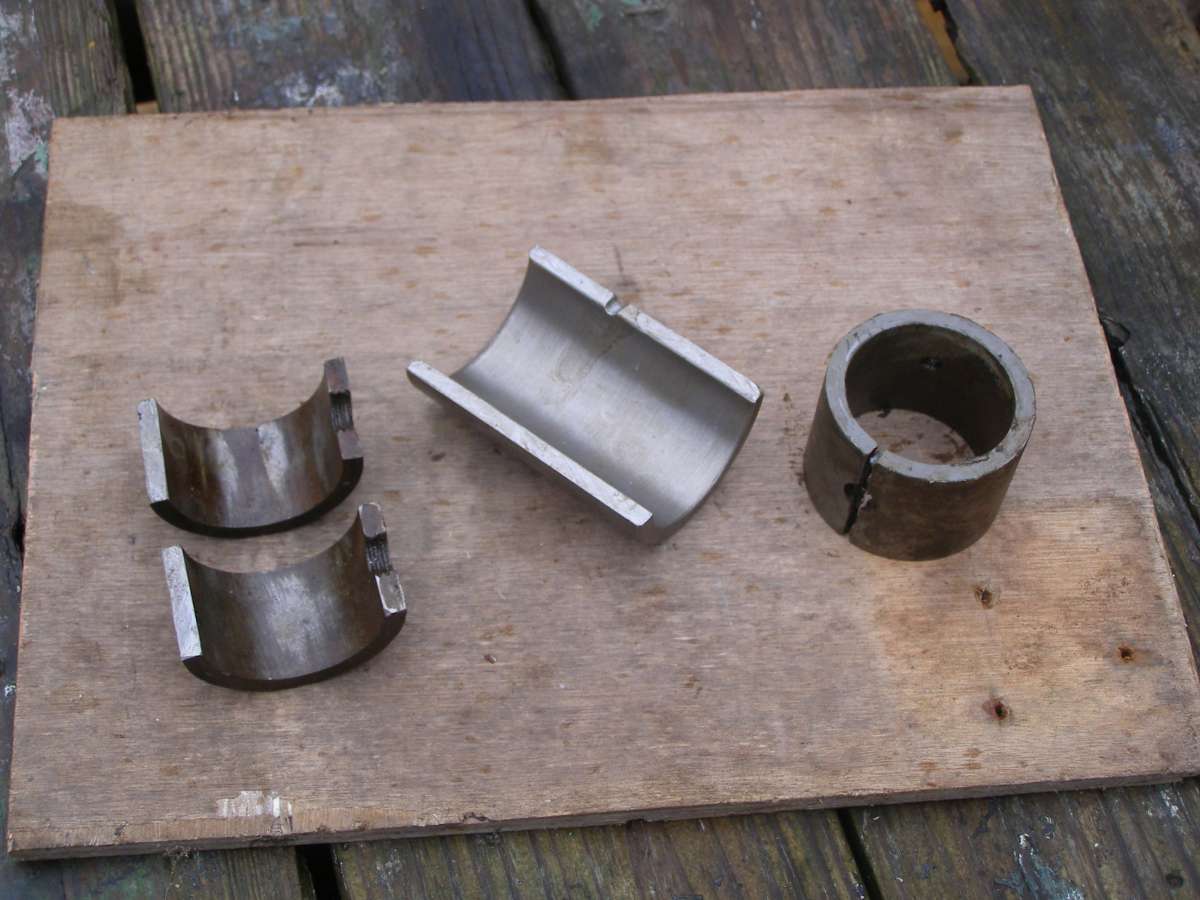
                        The sleeves:

                        Left: one of the previous owner’s efforts, fully halved by me.

                        Centre: one half of my replacements showing the half-hole that engages the locating-screw. It was one of these sleeves that had “Shrunk” (curled inwards).

                        Right: the other sleeve as it came with the machine, with one saw-cut right through; and now with five sawn slots along the outer wall, opposite the through-slot.

                        Denbigh Oct 2025 C


                        #823517
                        Diogenes
                        Participant
                          @diogenes

                          That’s not what – oh, never mind.

                          The mysterious hole in the bulge is for oiling the spindle bearing – probably had one of those press-in jobs with a sprung lid..

                          #823614
                          Nigel Graham 2
                          Participant
                            @nigelgraham2

                            Sorry if I did not understand what you meant.

                            The problem I was trying to solve by cutting those longitudinal slots, was that the sleeves made by the previous owner had used, were too strong to safely be sqeezed down to grip the over-arm without very unfair strains on the casting. The original (Denbigh-made) over-arm would have been the full 2.5″ diameter.


                            I first thought that mystery bulge was for oil, but it isn’t. Its hole is blind and there is no similar feature on the rear bearing.  The spindle oilers are merely simple holes drilled at an angle from small, raised facings on the body, and the front one is visible in my first photo. It would make sense to fit them with lidded oil-pots.

                            Denbigh’s small H-series mills were quite basic, apparently primarily for batch-work by low-skilled operators – the lower-number “aitches” even had lever-operated tables –  and lack much finesse.

                            Mine, an H4 so the series’ largest, even has 6 tpi table screws with very few, stamped, divisions on the tiny dials. (Why on Earth, 0.16666″ lead ?).

                            #823615
                            Michael Gilligan
                            Participant
                              @michaelgilligan61133
                              On Nigel Graham 2 Said:

                              […] Mine, an H4 so the series’ largest, even has 6 tpi table screws with very few, stamped, divisions on the tiny dials. (Why on Earth, 0.16666″ lead ?).

                              Very convenient for working in twelfths !

                              MichaelG.

                              #823624
                              Diogenes
                              Participant
                                @diogenes

                                Ah – apologies, was looking at the wrong bulge, I think.

                                I’d guess there might have been provision for a suds-pipe to flood the cutter..

                                At one time (before ?2020) Tony G. had a lot of photos of a blue H4 which showed some useful detail, but they seem to have gone..

                                #823735
                                old mart
                                Participant
                                  @oldmart

                                  You could get a 3″ diameter bar and forget the sleeves.

                                  I have a spare leadscrew for the Smart & Brown model A lathe which is 1 x 6 ACME and did have thoughts of using it as a mill leadscrew until I realised what a poor choice of pitch it would be with dials in 166.666per turn.

                                  The Tom Senior light vertical has clamps like your overarm and they make it almost impossible to tram the head as they turn the support bar as they are tightened. Fortunately, the head is fitted onto the horizontal bar clamped by two SHCS on holes with just enough play to use for fine adjustment of the tram.

                                  #823771
                                  Nigel Graham 2
                                  Participant
                                    @nigelgraham2

                                    Thankyou chaps! I have just re-examined the measurements, finding I’d misquoted the original over-arm diameter above. Not three-inch.

                                    Over-arm supplied (prob. not original) :  2″ diameter

                                    “Cyclop’s Eye” (as manufactured):          2.5″ bore

                                    Long Feed.      6TPI leadscrew, no dial. (0.1667″ lead)

                                    Vertical Feed:  6TPI, dial calibrated in 5s and 5s (so 0.007″ / minor division. Awkward.)

                                    Cross Feed:    8TPI, dial calibrated 5 X 5 so 0.02 = 0.005″ / minor division. Sensible!


                                    Somewhat unintuitively, and oppositely to my vertical mill, rotate the handle anticlockwise to raise the table.


                                    Michael

                                    Funnily enough I wondered if this machine was specially fitted for twelfths, perhaps for making parts for printing-machines as that trade uses 1/12″ units. It was even possible to buy rules calibrated in them. Though I would expect all the screws to be of 6TPI.


                                    Diogenes –

                                    Or to hold a suds-pipe bracket? Possibly: good suggestion. No reason it could not be used so, whatever its original purpose. I will have a closer look to see if there is an oil-way hidden in muck. Odd that this is not repeated on the other journal, though.


                                    Old Mart –

                                    Errr, yes. I did think of that. Only the existing 2″ diameter bar is heavy enough without one nearly half as heavy again for the same length! Nevertheless a full-diameter bar would be the most elegant and indeed correct solution. My workshop’s travelling-hoist would cope with it much more easily than my muscles, and once located it would normally stay there. Expensive though – perhaps not justifiably.

                                    The material I used for the adaptor sleeves was two separate lengths, neither long enough on their own.

                                    If found some new-to-me bar of oversize diameter it might just fit my Harrison lathe for turning to size.

                                    I pondered a suitable steel tube of smaller diameter with welded-on sleeves, skimmed between centres. I very much doubt 2.5″ o.d. stock tube would be accurate enough.

                                    On a machine like this the drop-bracket is clamped individually to the over-arm so the arm’s orientation does not matter. Though I do see the risk of the problem you describe, that of the bracket moving round as it is tightened. The former owner who made this arm had added the eccentric end to allow adjustment…. by rotating the over-arm. Circular reasoning? I need make a new bracket, and with a proper clamp.

                                    Regarding the peculiar pitch, I created a spreadsheet to give me some idea of nearest binary-fraction equivalents of bits of sixths. It would be easier to fit a simple digital indicator, or simply (and appropriately) a rule and pointer.

                                    I think no long-travel dial because milling-machines like this were normally used for through-cutting, not partial or incremental distances, on the long traverse.


                                  Viewing 16 posts - 1 through 16 (of 16 total)
                                  • Please log in to reply to this topic. Registering is free and easy using the links on the menu at the top of this page.

                                  Latest Replies

                                  Home Forums Materials Topics

                                  Viewing 25 topics - 1 through 25 (of 25 total)
                                  Viewing 25 topics - 1 through 25 (of 25 total)

                                  View full reply list.