Friction in rubber-sealed bearings

Friction in rubber-sealed bearings

Home Forums Manual machine tools Friction in rubber-sealed bearings

Viewing 25 posts - 1 through 25 (of 28 total)
  • Author
    Posts
  • #845049
    Michael Gilligan
    Participant
      @michaelgilligan61133

      I am starting this topic at the specific request of John MC

      Less than one minute of reasonably focussed discussion with ChatGPT led me to a recent 12page paper of direct relevance.

      For general convenience, I have put a copy here:

      https://www.model-engineer.co.uk/wp-content/uploads/sites/4/mediapress/members/79913/678121/Investigation_of_the_Effect_of_Contact_Seal_Geomet.pdf

      .

      Having thrown that pebble in the pond … Let the forum leap into action !

      MichaelG.

      #845122
      old mart
      Participant
        @oldmart

        I had a problem with friction with oil seal overheating when I converted the museums Tom Senior light vertical from MT2 to R8. The area where the lower seal was to run was a nice ground surface on the spindle, so I bought a double lipped plus garter spring seal to fit the metric dimension. The taper roller bearings were partially filled with lithium grease and the seal benefitted from a little moly grease upon assembly. The preload was minimum and as soon as the spindle was run up to 3000rpm it got hot in a couple of minutes. I thought I had used too much preload and reduced it with no change. Even removing the quill and checking endfloat while tightening the preload was unsuccessful. As a last resort, I removed the spindle from the quill and removed grease until only about 10% grease and 90% airspace remained. No difference, but as luck would have it, I happened to touch the vicinity of the top taper roller bearing which was cold. I removed the garter spring first with limited success and since then have removed the whole of the main seal, leaving the tiny bottom external seal lip, and the overheating has stopped. With a greased bearing set, even in the vertical plane, there is very litle movement of the grease and the tiny lip seal serves to keep external contaminents out of the bearings. I have mentioned this before on the forum and keep a spare modified seal in a bag with instructions for fitting in the future together with an explanation as to why the seal has been butchered.

        #845127
        Idler
        Participant
          @idle1

          I regret ever mentioning the topic now.

          #845145
          John MC
          Participant
            @johnmc39344
            On Michael Gilligan Said:

            I am starting this topic at the specific request of John MC

            Less than one minute of reasonably focussed discussion with ChatGPT led me to a recent 12page paper of direct relevance.

            For general convenience, I have put a copy here:

            https://www.model-engineer.co.uk/wp-content/uploads/sites/4/mediapress/members/79913/678121/Investigation_of_the_Effect_of_Contact_Seal_Geomet.pdf

            .

            Having thrown that pebble in the pond … Let the forum leap into action !

            MichaelG.

            An interesting read.  Not sure it helps my answer my question as it doesn’t give an indication of the increase in friction, seals vs no seals.

            I think it some good, extremely specialised research.  The university had the idea, the kit and some time but no funding.  Had a go, generated some good results.  Published it and hoping it will catch the eye of a bearing manufacturer who will fund the next step.  Been there, done that.  It was reckoned that this approach to attracting funded research had a success rat of between 1 in 10 to 1 in 15.  I wish them well.

            Sorry for going off at a tangent.

            #845151
            David George 1
            Participant
              @davidgeorge1

              Before retiring there was a bed mill with a universal spindle which could be angled to any direction but the spindle was oil lubricated drip feed to all gears and bearings. After a while the spindle would drip oil onto the job and the lower spindle seal would leak and it was replaced with a new seal which was a single lip spring loaded seal. when we had to go to a new suplyer they replaced the seal with a different make and when that seal which looked identical was fitted the spindle started to overheat and it turned out the rubber was diferent and we had to replace the seal with correct ruber seal no problems. When I inspected the lip of the seal it had a larger contact area which must have increased friction and therefore more heat produced.

              David

              #845162
              renardiere7
              Participant
                @renardiere7

                In this scenario I would imagine that any tiny changes in specification can create ultimately huge changes in friction due to the vicious circle effect, heating, swelling more friction.

                #845166
                Michael Gilligan
                Participant
                  @michaelgilligan61133
                  On John MC Said:
                  An interesting read.  Not sure it helps my answer my question as it doesn’t give an indication of the increase in friction, seals vs no seals.[…]


                  The increase is from zero

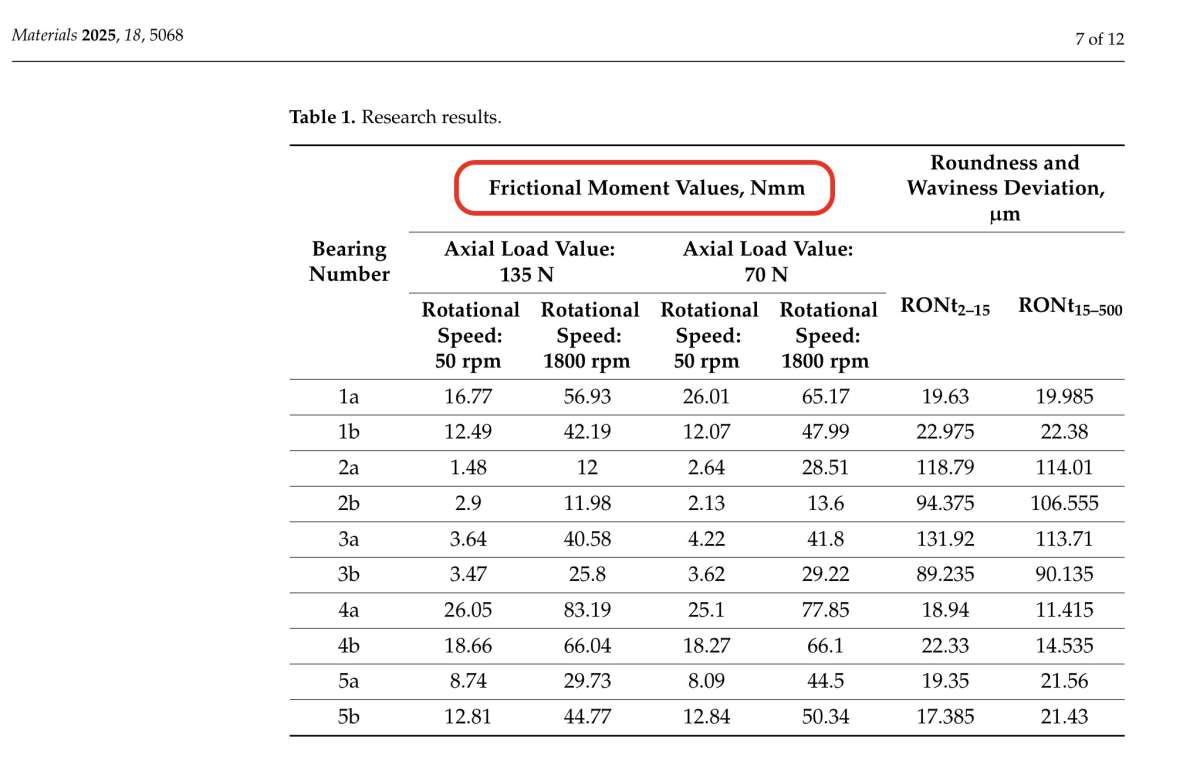
                  Table 1 shows a spread of values … because the physical seals differ

                  .

                  IMG_1577

                  .

                  … there is no simple answer to yo question, John.

                  MichaelG.

                  #845168
                  noel shelley
                  Participant
                    @noelshelley55608

                    Old marts tale is interesting ! But it gets away from what I thought the subject was, that of sealed bearings, not bearings protected by a seal. In Old Marts case double lip and spring. Going off at a tangent, in agriculture even the question of to lube or not is frought with problems ! Where if lubed grit/dust sticks to the lube and becomes grinding paste or let it run dry ? In some cases the bearings were oil soaked beech and it would be the steel shaft that would wear. The bearings were adjusted by paper shims. Wood was favoured for the sieve shaker arms, ash , as steel soon fractured. Noel.

                    #845188
                    John MC
                    Participant
                      @johnmc39344

                      … there is no simple answer to yo question, John.

                      MichaelG.


                      Can’t disagree with that!

                      One thing that is simple; choose the correct seal (sealed bearing or separate seal) and lubrication for the job and there will not a problem.

                      I’m not sure about the zero, might be an extrapolation?   Perhaps a baseline could be set, a bearing without seals.  Not relevant to the experiment but would be interesting.

                      looking at fig 5 in the report.  Frictional moments are plotted on the x axis of the graphs.  Frictional moment for an unsealed bearing is around 1.7 – 2.0.  This suggest a big increase in friction.  Multiplying b****r all by 10 is still b****r all!


                      #845198
                      old mart
                      Participant
                        @oldmart

                        All rubber sealed ball races that I have come across have very little friction increase over unsealed ones. Some of the metal shielded types have a tiny rubber lip and some don’t, they are designed to run at high speeds without noticable heating. My post showed an extreme amount of friction simply because I  bought a seal that matched the size of the spindle. Probably ok for very slow speeds, but not 3000rpm.

                        #845215
                        Graham Meek
                        Participant
                          @grahammeek88282
                          On Idler Said:

                          I regret ever mentioning the topic now.

                          While I can understand the sentiment it has given rise to a little experiment.

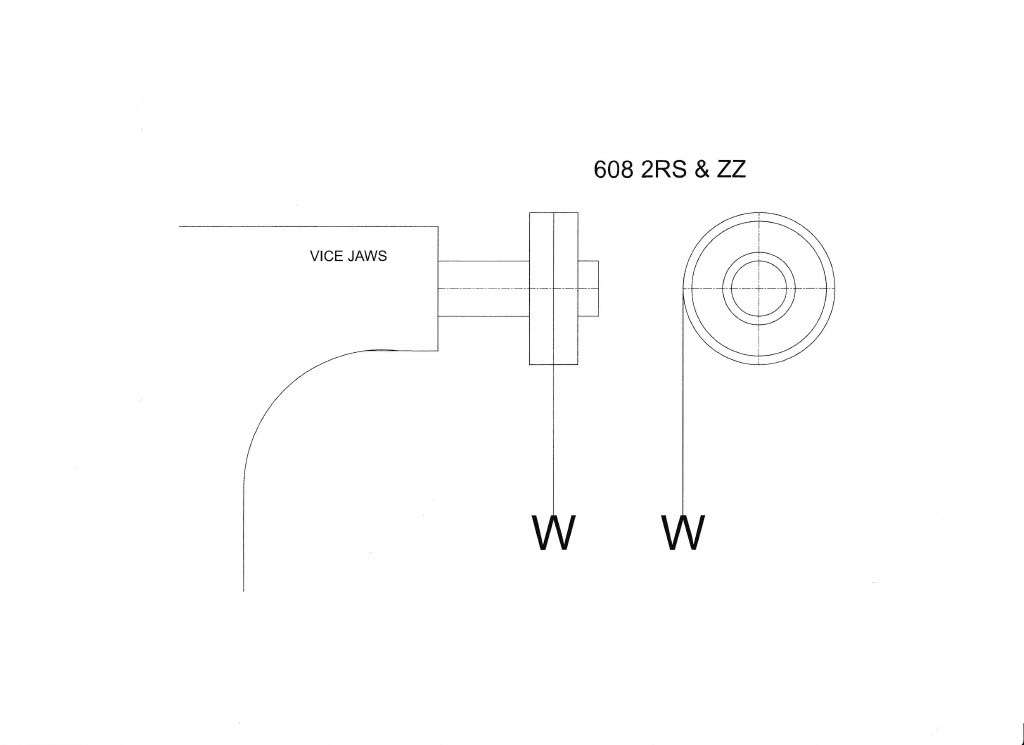
                          Searching through my stash of bearings the only bearings which I have in 2RS, (Rubber Sealed) and ZZ (Shielded) are in 608 size, 8 I/D, 22 O/D by 7mm wide.

                          I set the bearings up in the manner shown below, both bearings were fitted to an 8 mm tapered ground mandrel. The sort used to hold components between centres.

                          Bearing Comparison


                          Both bearings came from the same drawer and were the same temperature. Fishing line was wound around the bearings such that the line did not overlap. The end of the fishing line was secured to the outer track with instant glue to avoid any slippage.

                          Gram weights were added to the hanger at W and the results were as follows. The 608 ZZ took 3 g to rotate the bearing, while the 608 2RS took 14 g to rotate the bearing. Almost a factor of 5 difference.

                          I would have preferred to have had several sizes of bearing to make a more detailed comparison but this simple experiment has shown there is a significant difference in this particular size of bearing between the two forms of sealing.

                          Regards

                          Gray,

                          #845216
                          JasonB
                          Moderator
                            @jasonb

                            It would be interesting to see what load it would take to move the 2RS bearing if the seals were removed, that would eliminate any possibility of other factors affecting the results.

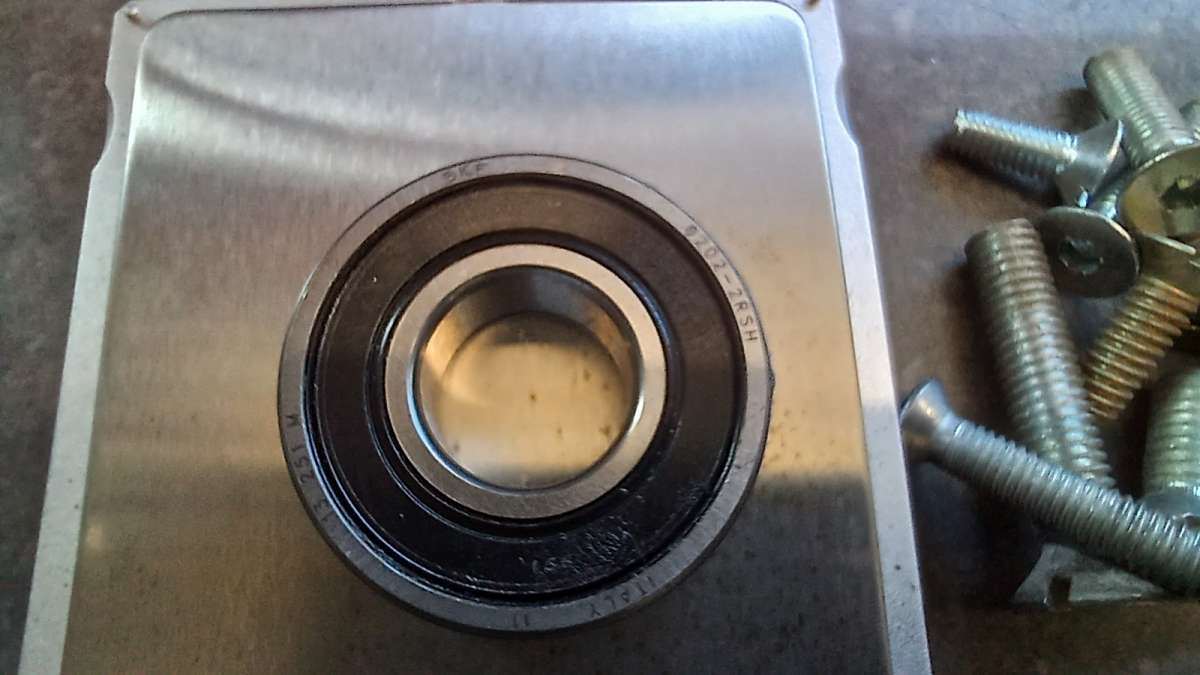
                            Don’t go mucking up your bearings Gray. I have a number of still sealed (in bag) SKF 6202 2RSH 15mm x 35mm x 11 and if I get a chance in the next few days will do just that. I have an unpackaged one adn from feel alone would say it is not something I would be wanting to use in a stirling engine or fridget spinner.

                            #845223
                            Graham Meek
                            Participant
                              @grahammeek88282

                              Hi Jason,

                              I had some 6000 bearings in un-shielded and 2RS, but no ZZ. The problem with the un-shielded type is that they come lubricated in oil, not greased like the others.

                              I did not think there would be so much difference between the two types of bearing. It will be something to bear in mind on future projects.

                              Regards,

                              Gray,

                              #845227
                              John Purdy
                              Participant
                                @johnpurdy78347

                                About 5 years ago I replaced the bearings in the idler pulleys on my 1″ belt sander. They run at about 6600 RPM. The originals were 620ZZ and had become extremely noisy due to ingress of grit. I replaced them with 6202RS ones in the hope they would keep the grit out. The result was that after running for only a minute or so they would get extremely hot, too hot to touch. Even now they still get hot to the touch after extended running.

                                John

                                #845266
                                John MC
                                Participant
                                  @johnmc39344

                                  There could be something amiss there, those bearings, sealed, should be good for three times that speed.  How hot are they getting?

                                  It should be remembered that, when new, sealed bearings will have very noticeable friction compared with the “naked” version.  This friction will reduce considerably after some running time.  Testing new bearings isn’t very helpful, it needs to be done in a more realistic way.

                                  As Jason says, this friction would likely cause problems in very, very low powered applications (my interpretation of his comment), not in, for instance, a machine tool, plenty of other sources of friction, orders of magnitude greater than seal on shaft friction.

                                  #845275
                                  JasonB
                                  Moderator
                                    @jasonb

                                    But how long until the seasl free up? In a mill or lathe situation that may only see 2000rpm max that will take at least 10 times longer than something running at close to a bearings max of 20Krpm. As previously said it is that initial startup that can cause problems and you can’t run in the bearings without starting them.

                                    It is unlikely to be today but I will test with seals, with seals removed and then flush out the grease.

                                    Simply turning one of those sealed bearings in my fingers suggests more drag than if I were turning my whole mill spindle, motor and gearbox. I’m not sure if I can replicate the test on my mill as the spindle is fixed vertically.

                                    Yes I was talking of low power uses but others posting seem to be finding it causing problems in more powerful applications. The bearing will not freewheel at all if you try to spin it

                                    #845281
                                    Kiwi Bloke
                                    Participant
                                      @kiwibloke62605

                                      No-one has mentioned ‘non-contact’ rubber-sealed bearings yet. It sounds like an oxymoron, but such things exist, precisely because of the high drag conventional seals can create. To the naked eye, they look the same as conventional 2RS bearings. I replaced Unimat 3, and probably also Compact 5 (can’t remember…) headstock bearings with this type of bearing because the little Unimat couldn’t handle the drag of conventional 2RS bearings. ‘Fraid I can’t remember how they were identified, although might be able to look it up. If they are available here in end-of-the-tenuous-supply-chain NZ, they should be available in the civilised world.

                                      #845301
                                      Graham Meek
                                      Participant
                                        @grahammeek88282

                                        Here are some of the bearing designations.

                                        Common Designations
                                        RSH (SKF): Contact seal, often used for superior retention and exclusion.
                                        RS1 / 2RS1 (SKF): Rubber seal on one or both sides.
                                        LLB (NTN): Non-contact seal (often behaves like a sealed shield).
                                        LLU (NTN): Contact seal for higher protection.
                                        DDU / 2DU (NSK): Contact seal, excellent for dust/waterproofing.
                                        VV (NSK): Non-contact rubber seals on both sides.

                                        Specific Hybrid Configurations
                                        ZNR / ZNBR: Bearings with a snap ring and a shield on one or both sides.
                                        RSL/2RSL (SKF): Low-friction seals that provide improved grease retention and protection compared to traditional non-contact metal shields.
                                        Shrouded Seals: These consist of rubber seals retained by two steel caps (or shields) on the outer ring, providing maximum protection.

                                        Regards

                                        Gray,

                                        #845305
                                        duncan webster 1
                                        Participant
                                          @duncanwebster1

                                          I fitted rubber sealed bearing to a 4500 rpm grinding wheel spindle. It was alarming how quickly it came to rest when power off. Replaced with shielded (non contact), and it now coasts down much more slowly.

                                          #845316
                                          John MC
                                          Participant
                                            @johnmc39344

                                            Seals will “free up” quite quickly.  I’m not sure that high speed is a prime consideration here.  Once the speed reaches a speed that allows the lubricant sealing mechanism to function, then anywhere in the seals rpm working range will do the job.  It could be argued that low speeds are better for bedding in the seals, a risky way of doing it.

                                            Axially pre loaded bearing assemblies will also free up in a similar way.  I’ve noticed with my latest milling machine that the spindle has noticeable freed up after a few hours of use, but shows no sign of any radial clearance.

                                            Rather than try to measure friction in new sealed bearings, do it with used bearings.  I’m not suggesting dismantling something to find out!   I wouldn’t bother, there’s no argument over the fact over the friction, sealed vs unsealed bearings.

                                            What is open to argument is the increase in friction can cause motors to stall, damaging the drive, and is yet to be resolved.  My money is still on things like incorrect assembly, excess preload, poor choice of seal, lubrication problems or failure of sub standard parts.  I note the one of our suppliers has been somewhat vague in really committing to seal friction being the problem

                                            I mentioned that my mill spindle freed noticeably during the first few hours of use.  To seal the spindle on that I used a Nilos ring to seal the lower bearing.  The reason for this was to make the spindle nose as compact as possible.  Not one of my better ideas, okay up to around 1500 rpm, above that a bit (oil) leaky.  Not so bad that the occasional squirt from an oilcan maintains lubrication.

                                            Non-contact seals, sometimes called “machined seals” are labyrinth seals made of “rubber”.  Worth trying if seal friction is of concern.  Be careful selecting, some have an additional contacting lip.

                                            I was gifted a Unimat 3 lathe.  Poor thing was in a terribly neglected state.  I fitted 2RS bearings to the spindle, the motor had no trouble starting with them.  That was with a time rated motor.  I’m told the continuously rated motor was better?  Haven’t used it in years, must have a look at it.  I have also repaired the spindle from a Unimat SL.  It’s owner had managed to bend it.  I modified it to use sealed bearings, again, the motor didn’t notice them.  unfortunate the owner didn’t notice the motors duty cycle…


                                            #845322
                                            Graham Meek
                                            Participant
                                              @grahammeek88282

                                              How silly it was of me to assume we were not talking about New bearings!

                                              In the bottom of the bin for the “Any Old Iron Man” were the two bearings which I replaced.

                                              To set the scene the bearings are part of a regulator motor assembly which regulates the 3 phase voltages supplying the Linear Accelerators used for Radiotherapy Treatments. This particular unit had been in use for over 10 years and was due for replacement. The motor assembly was thus saved from the scrap pile and found a new home, as well as a new life.

                                              Thus both bearings have done exactly the same duty and under the same conditions being on opposite ends of the shaft concerned.

                                              Using the same set up as depicted above, W for the ZZ bearing was now 1.15 g, and W for the 2RS was 6 g. Clearly there is still a factor of 5, or there abouts at play.

                                              Both bearings are 0.25 g lighter, so they have either lost some grease over the 10 years, or the new bearings have more grease in them.

                                              I had better point out that the Gram weights have not been checked by the NPL for quite some time, but as the same weights have been used throughout I don’t think it will matter.

                                              Regards

                                              Gray,

                                              #845368
                                              John Purdy
                                              Participant
                                                @johnpurdy78347

                                                John MC

                                                I’ve had a look to see if I could find the invoice for those bearings without success, but thinking about it now I think they were replaced at least 10 years, possibly 15 years ago.
                                                I just went out to the shop and measured the temperature of the bearings after running using a hand held IR temperature gun. Here are the results:
                                                Initial bearing temp (workshop ambient) 11.8C
                                                After 1 minute running   38C
                                                After 3 minutes running 55C
                                                After 5 minutes running 66C and still climbing
                                                There was no load on the belt, just running free.

                                                As an aside in the winter when the shop is cold like today there is so much drag due to the seals and grease that the small cap start/run motor doesn’t have enough torque and the belt doesn’t move or moves very slowly. To get it to run I have to manually relieve the tension on the belt till it gets up to speed. The unit is a standard Delta 1″ belt sander.
                                                John

                                                #845446
                                                JasonB
                                                Moderator
                                                  @jasonb

                                                  I got some time this morning and did a similar test to Gray’s using the SKF 6202 2RSH bearing.

                                                  20260422_104234

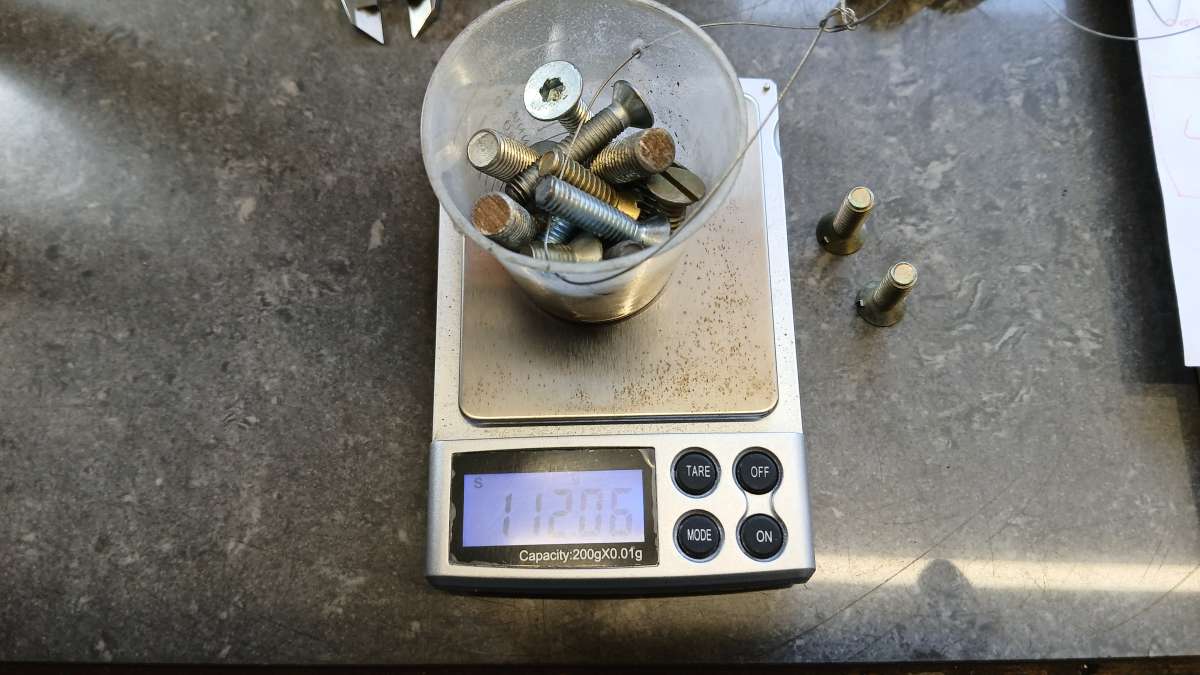
                                                  Not having any 1g weights I made do with filling the suspended container with some screws and weighed the load.

                                                  First with the seals in place as you can see in the video it starts with no rotation then as I put another screw it it moves very slowly. Adding one and then two more sees the speed increase. I weighted the container and screws less the last two put in at 112.06g

                                                  20260422_103744

                                                  Next I popped out the two seals and ran the test again, did not need any screws as the container alone was just enough to get things moving. Weight of just the container was 4.21g

                                                  So some what more friction than Gray measured as that is a factor of 26.6 times more!

                                                  I won’t bother cleaning out the grease as it may just be the cord that gets the bearing moving.

                                                  And NO the washer was not touching the seal.


                                                  #845460
                                                  Peter Cook 6
                                                  Participant
                                                    @petercook6

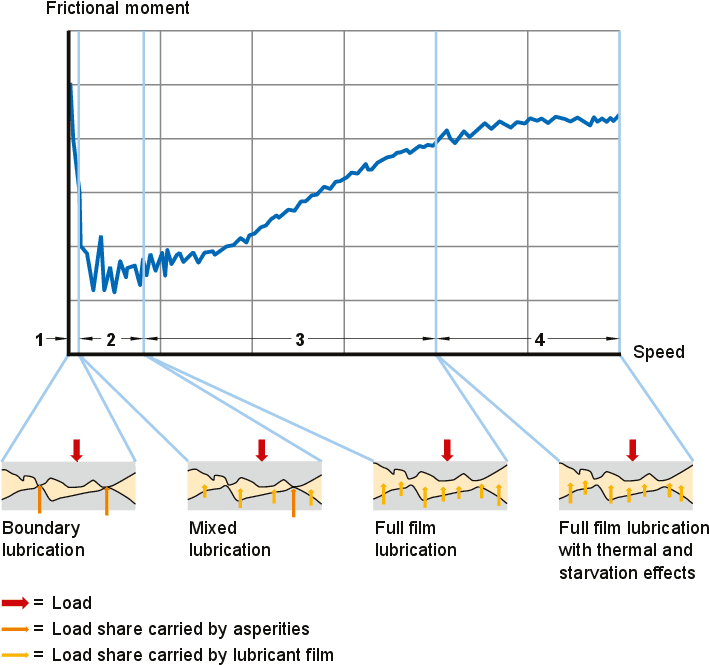
                                                    There was a discussion some time ago on the NAWCC forum about the lubrication of ball races in clocks. One thing that surfaced in that discussion was a graph from SKF of bearing friction against speed (but I am not sure what type was involved).

                                                    The interesting thing (from a clock point of view) was the relatively high level of initial “stiction” involved in starting the bearings from stopped compared with the friction once in motion. The original suggestion that bearings be run unlubricated came from a paper from Boca bearings. However anecdotal evidence suggested that lubrication helped/improved things.

                                                    The Boca test methodology measured the Q of a pendulum suspended using a bearing – so the bearing was in (fairly) continuous motion. However mechanical clock bearings only rotate intermittently, so the “stiction” component is potentially important, and it is possible that lubricating the bearings reduces this high initial peak.

                                                    It struck me that if the SKF graph is valid, the test method used by Graham and Jason is actually measuring the stiction component rather than the rotating friction once the bearing is moving.

                                                    I don’t have the equipment or skills to measure the torque requirements of a rotating bearing so I can’t take the thoughts further.


                                                    #845467
                                                    JasonB
                                                    Moderator
                                                      @jasonb

                                                      Initial Stiction would be even more relevant as it was start up load that promnpted this thread.

                                                      Although once moving the bearing I tested seemed to run at a steady speed, if it were stiction alone then you would have thought speed would pick up?

                                                    Viewing 25 posts - 1 through 25 (of 28 total)
                                                    • Please log in to reply to this topic. Registering is free and easy using the links on the menu at the top of this page.

                                                    Latest Replies

                                                    Home Forums Manual machine tools Topics

                                                    Viewing 25 topics - 1 through 25 (of 25 total)
                                                    Viewing 25 topics - 1 through 25 (of 25 total)

                                                    View full reply list.