Die threading problems

Die threading problems

Home Forums Beginners questions Die threading problems

Viewing 24 posts - 1 through 24 (of 24 total)
  • Author
    Posts
  • #820614
    John Ross 4
    Participant
      @johnross4

      Hi

      I wonder if someone can help, I am trying to cut a 5×16″x32 thread on a brass bar, have made the nominal diameter .313, when I use my die on this it seems to flatten the outside diameter and creates a rubbish thread, have had this with other threads mainly when using brass, any help would be appreciated. All dies are new.

      Thank you

      #820618
      DC31k
      Participant
        @dc31k

        Perhaps you could edit (correct) the topic title as it currently reads ‘Due threading’, which is senseless. If you cannot do this yourself, contact a moderator.

        You do not say what die you are using in terms of its age, history, quality and use on other materials. Starting with a brand new item of best affordable quality, unused on other material, would be a good place to begin your inverstigations.

        #820620
        Tony Pratt 1
        Participant
          @tonypratt1

          Thread outside diameter doesn’t need to be nominal size you can go .305/.310″ with no problem, also is your die sharp and a decent quality make and are you using a tailstock die holder?

          Tony

          #820622
          SillyOldDuffer
          Moderator
            @sillyoldduffer

            A few points:

            • 5/16″ is 0.3125 so 0.313 is a tad oversize.
            • To ease thread cutting loads I reduce the rod under nominal by 2 or 2.5%, so 0.31-ish.  Doesn’t reduce strength much.
            • Most Brass cuts well, but not DIY store Brass, which can be remarkably tough!
            • Brass dislikes blunt cutters.   So I start new taps, dies and drills on Brass, and then move them to steel when they show signs of struggling.  Mild-steel is more tolerant of slightly blunt tools.
            • A tap, die or drill used on steel once is likely to be blunted enough to perform poorly on Brass thereafter.  Especially if the steel isn’t free-cutting.  (Most noticeable with cheaper cutters, but posh tools suffer too.)
            • Cutting fluid isn’t strictly necessary, but it helps!

            Dave


            #820629
            John Ross 4
            Participant
              @johnross4

              Thank you Dave for your comments, yes think a bit oversize and think that the dies are cheap from ebay, can you recommend a good supplier.


              #820631
              Diogenes
              Participant
                @diogenes

                5/16 x 32?

                ..what is this for?

                #820634
                John Ross 4
                Participant
                  @johnross4

                  Hi

                  it is for steam chest slide valve rod in a steam Train


                  #820636
                  Diogenes
                  Participant
                    @diogenes

                    👍 – just checking we weren’t Schrader valve / obscure electrical thread territory!

                    Try Tracy Tools..

                    #820639
                    Julie Ann
                    Participant
                      @julieann

                      I recently had issues screwcutting a 2″ long 5/16″ x 32 ME thread on 303 stainless steel for slide valve rods. First rod screwcut fine but the second rod was a disaster. In the end I bought a new die and mounted it in a sliding die holder in the tailstock. The die cut a lovely thread under power at about 40rpm. Given the stainless steel I used Rocol for lubrication. Before threading I machined the stock to 5/16″ diameter with no concious effort to be undersize. The die came from Avon Engineering Supplies:

                      https://www.avontapdie.co.uk/me-5-16×32-split-die

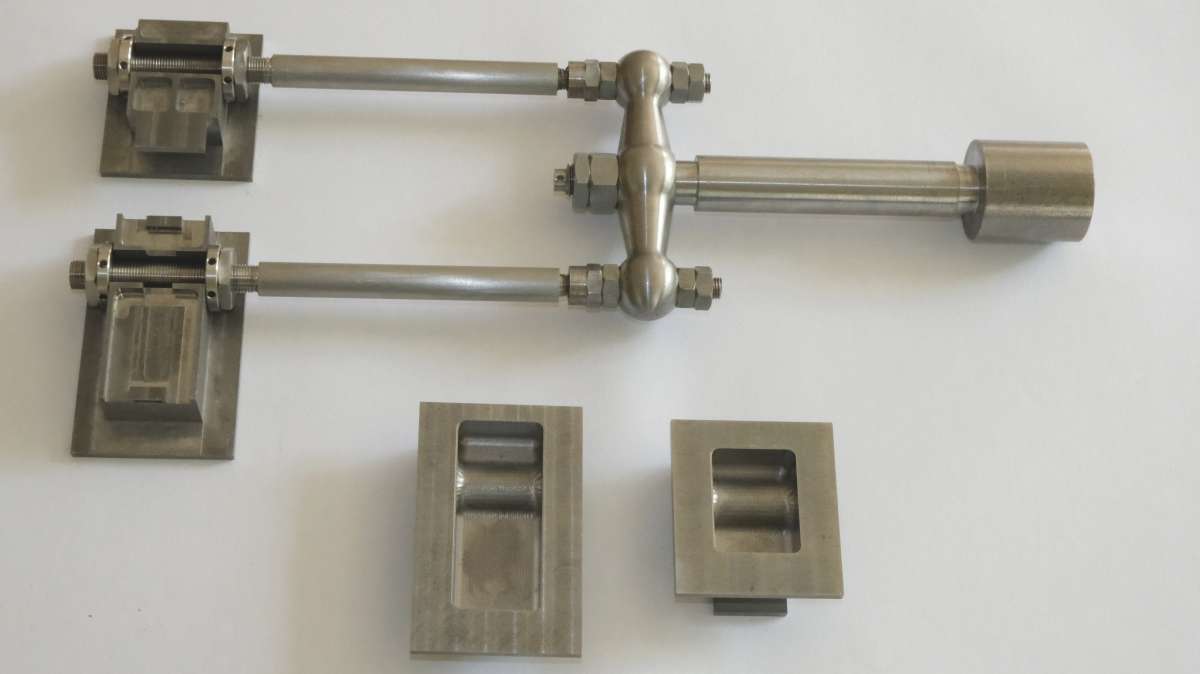
                      The valve rods and slide valves assembled:

                      Slide Valves and Rods

                      Julie

                      #820642
                      John Ross 4
                      Participant
                        @johnross4

                        Hi

                        Thank you for your comments will have a look on their website

                        #820644
                        John Ross 4
                        Participant
                          @johnross4

                          Thank you for suggestion

                          #820664
                          duncan webster 1
                          Participant
                            @duncanwebster1

                            Friend of mine had a job putting a very long thread, I think 3/8 unc or something like that on hundreds of rods. Well over a foot of thread. He made up a holder fixed to an angle plate on the ( locked) cross slide and did them under power with leadscrew engaged. Gets away from possible pitch error if you just let the die drag itself along

                            #821060
                            John Ross 4
                            Participant
                              @johnross4

                              Thank you everyone for your comments, ordered 5/16×32 from EKP Supplies arrived today. Reduced 5/16 by 2/5% as suggested to nominal diameter of.305 and found it made a perfect thread. Will be buying all my taps and dies from EKP Supplies now not ebay as previous.


                              #821104
                              JasonB
                              Moderator
                                @jasonb

                                Do be very careful if taking Dave’s advice to reduce Nominal by 2-2.5% as that does not take into account thread pitch so is a bit Duff. Although his suggested dia is correct it bears no relation to the percentages he mentions.

                                Most manufacturers suggest a reduction based on the pitch, typically 0.1 x thread pitch. This becomes more critical as the pitch becomes smaller and/or diameter increases as you will end up with a very weak thread as it will not be full depth. Also be aware that a lot of round rod can be undersize to start with so may not need reducing.

                                See bottom of page 258

                                So for your given thread of 5/16 x 32 the pitch is 0.031″ so diameter should be reduced by 0.003″ giving 0.310 as your starting dia.

                                Useful chart with the reduction done for you but not listing ME though you can interpolate other threads with similar pitches.

                                See page 267.

                                #821112
                                JasonB
                                Moderator
                                  @jasonb
                                  On JasonB Said:

                                  This becomes more critical as the pitch becomes smaller and/or diameter increases as you will end up with a very weak thread as it will not be full depth.

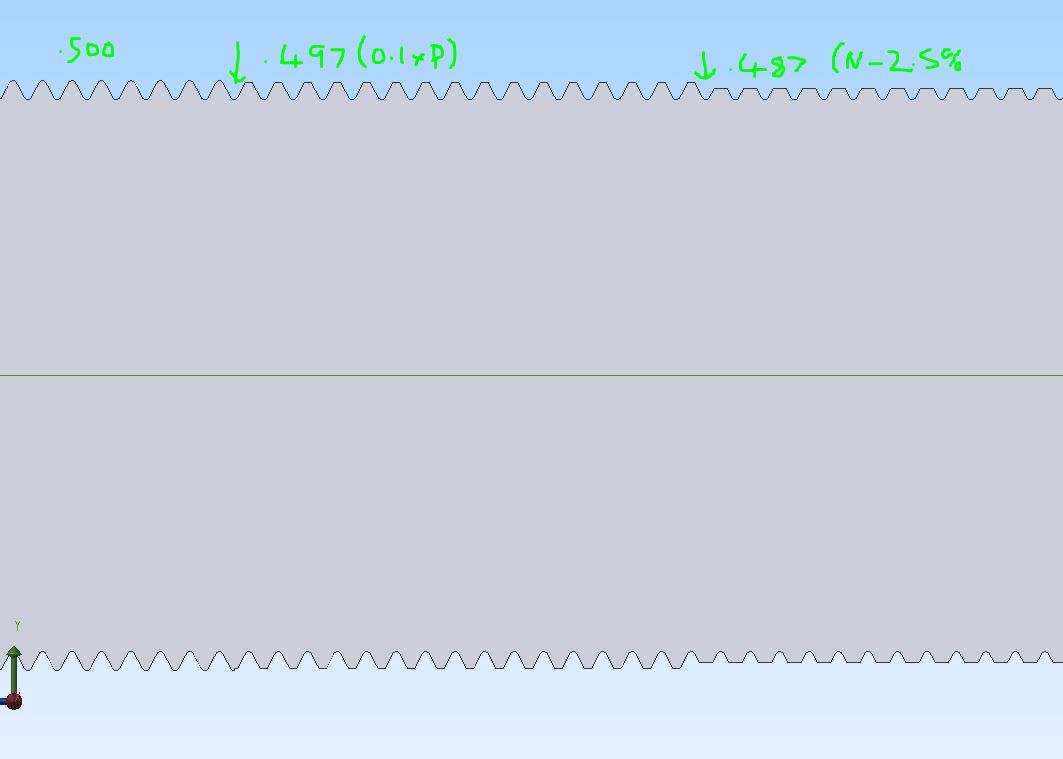
                                  As an example this is a section through a 1/2″ x 40 TPI ME thread.

                                  Nominal dia on the left, reduced by 0.1 x p in the middle which is hardly any loss of depth. But on the right we have Dave’s  (SOD) reduction of 2.5% off nominal.

                                  I’ll leave the  reader to work out the consequences of applying the suggested 2.5% of Nominal reduction to some of the constant pitch thread, anyone for M40x1.0 😯

                                  The situation can be made even worse if you start using larger tapping size holes for the mating female thread as the combined lower engagement percentages can give very little engagement.

                                  duff

                                  #821115
                                  Julie Ann
                                  Participant
                                    @julieann

                                    I use stock material, which as Jason says is usually slightly undersize, or machine to nominal size. There’s no advantage taking off a few thou here and there. Just adjust the die to cut a thread to the required class of fit.

                                    Julie

                                    #821152
                                    SillyOldDuffer
                                    Moderator
                                      @sillyoldduffer
                                      On JasonB Said:

                                      Do be very careful if taking Dave’s advice to reduce Nominal by 2-2.5% as that does not take into account thread pitch so is a bit Duff. Although his suggested dia is correct it bears no relation to the percentages he mentions.

                                      To be pedantic, the advice is Tubal Cain’s not mine!

                                      I submit the approximation is a reasonable Rule of Thumb, and Jason is fussing over a minority case!    Though adjusting diameter by percentage becomes dubious for extremes like 40TPI, it works well enough on common thread sizes, metric and imperial.  Calculating from pitch is more work, especially with Imperial threads.

                                      The following pitch example is ⁵⁄₁₆” X 32ME.

                                      • Imperial threads are specified by TPI, making it necessary to first calculate the pitch.   Not difficult when you know how: 1/TPI (pitch in inches).  1/32tpi = 0.03125″
                                      • Calculate diameter reduction from pitch × 0.1  Here 0.03125″ × 0.1 = 0.003125.   Practically, 3 thou
                                      • Convert the imperial fraction size into the decimal equivalent:  5×16″ = 0.3125″
                                      • Therefore, target diameter is 0.3125″ – 0.003″ = 0.3095″

                                      The pitch arithmetic suggests reducing to 0.3095, whereas 2.5% rule of thumb is 0.30469″ or 0.30625″ at 2%.  If tweaked to 1% when cutting fine threads, % reduction suggests  0.309375″, which is the same as Dormer.

                                      Practical note – when guesstimating the reduction, the start diameter should be as specified for the thread.  Imperial and Metric stock is often ‘nominal’, so measure it first!  That ⁵⁄₁₆” rod might be 8mm metric.  Or vice versa.

                                      A practical factor favours percentage reduction slightly.  Cutting tends to raise burrs and squidge the thread so they’re a shade bigger than expected.  This is probably why John got a good result from 2.5%, even though as Jason says the advice is a bit duff for 32tpi.  Oversize shows up mostly in malleable alloys like mild-steel and the softer Brasses, and is most obvious when making tight fitting threads for maximum strength.   Whilst the maths is good, you can’t ignore the real world!

                                      What the workshop is for makes a difference.  I’m into experimental work with occasional repair, not models.  I rarely make close tolerance threads because home-made cut threads are significantly weaker than rolled screws.  When strength matters, I buy in. My main application is bespoke fasteners, where the thread can be down to 60% engagement without causing problems.     Others take far more trouble, routinely adjusting split dies to get more accurate threads.  Possibly unnecessarily.

                                      Always good to ask, “how good does it need to be?”   My training emphasised that mindlessly pursuing ‘quality’ is an egregious sin.  Professional engineering is about meeting requirements at minimum cost.  The specification and what’s ‘fit for purpose’ and ‘value for money’ are defined in advance. The requirement determines where a product sits between too cheap and high-end, not the builder.  Part of this avoiding ‘paralysis by analysis’, including not wasting time on unnecessarily laborious calculations,   An irony!  We Model Engineers are more likely to commit the opposite error, which is avoiding maths at all costs!  It’s true: I have to overcome my own laziness and stupidity.

                                      However, Model Engineering is a hobby, and we might pursue making the best of all possible objects, time and cost irrelevant.  If the goal is producing a Gold Medal winning exhibition model, then the builder must work to a consistently high standard.  I think most of us have lower requirements, and need not fuss.  But the choice is personal! It’s fun get jobs ‘spot on’ and learning how to excel when needed.  Next time I cut a 40TPI thread, I shall remember Jason!  Next time I cut M10, I won’t!

                                      Dave


                                      #821166
                                      JasonB
                                      Moderator
                                        @jasonb

                                        Well Dave I don’t know where you read that but I’ll see your pedantry and double it.

                                        My Model Engineers Handbook by Tubal Cain it says “The Bar diameter should always be to size or preferably a few thou smaller”

                                        In the Workshop Series on Drills, taps & Dies he says” 5-10% OF THREAD HEIGHT which may be 2-4 thou” this take sinto account the pitch

                                        And as you say yourself Dave the percentage of nominal is dubious for fine threads that is why both of those when applied to 5/32″ x 32 would give a diameter of say 0.310″ in the first instance and as thread height is less than pitch maybe 0.311 to 0.312 for the second” Both far from the 0.008″ reduction that percentage of diameter gives.

                                        The pitch arithmetic suggests reducing to 0.3095, whereas 2.5% rule of thumb is 0.30469″ or 0.30625″ at 2%.  If tweaked to 1% when cutting fine threads, % reduction suggests  0.309375″, which is the same as Dormer.

                                        Yes handy that it equals Dormers numbersbut only at that diameter, Dormer would still be 0.003″ at 5/8″ or 1″ OD but 1% would be 6 and 10 thou!

                                        There may be a bit of extrusion but as most ME supplers sell hard brass not that likely. “Perfect” is probably judged by eye and if the perfect thread has fully formed crests then that could also have been obtaine dby excessively closing teh split die which will result in a far from Perfect fit unless you like a rattling good fit. If the OP is using a hole threaded with an equally bad quality tap a sa gauge to the “perfect fit” then all bets are off.

                                        The use of the thread is probably more important than wanting a medal or what size it is. ME threads are commonly used on steam fittings and you don’t want one of those popping out or simply stripping when you come to tighten the joint which will invariably be in soft metals. Daft going into long discussions about 1 thou difference in boiler thickness calculations if all the screwed plugs blow out on first hydro test. Or the big end studs fail when you try and start that IC engine that took you X years to build.

                                        #821181
                                        duncan webster 1
                                        Participant
                                          @duncanwebster1

                                          Slight truncation of the top of a male thread doesn’t weaken it. Similar to tapping hole being bigger than root diameter for female thread. Making it generally undersize so it is a sloppy fit does weaken it.

                                          #821192
                                          JasonB
                                          Moderator
                                            @jasonb
                                            On duncan webster 1 Said:

                                            Slight truncation of the top of a male thread doesn’t weaken it. Similar to tapping hole being bigger than root diameter for female thread. Making it generally undersize so it is a sloppy fit does weaken it.

                                            Yes but as the top of a male thread is shaped based on the pitch then any reduction should also be based on pitch as using diameter could see the dia slide over the reduced diameter without even cutting a thread which would be a very weak fixing. The reduction should really only flatten the rounded crests and not affect the flanks which are what bear the load. Did you try my example of M40 x 1 with a 2.5% of dia reduction?

                                            #821198
                                            Fulmen
                                            Participant
                                              @fulmen

                                              I agree with Jason here. A model engineer should be able to do this based on pitch. If you’re threading rebar with standard fastener threads you’re forgiven for only considering the diameter, but I think most people here hold themselves to a slightly higher standard.

                                              But if I’m allowed to pick a nit: Neither metric nor Unified have rounded crests. IIRC it’s from Withworth, though I’m sure other threads from the same era do the same.

                                              #821203
                                              duncan webster 1
                                              Participant
                                                @duncanwebster1

                                                I was merely pointing out that contrary to what others have said, slight truncation does not significantly affect strength. The definition of slight will clearly involve a fraction of pitch. A sixteenth off a 6″ whit (2.5 tpi) would hardly notice, take 1/16 off 16 tpi and half the thread is gone

                                                #821208
                                                Fulmen
                                                Participant
                                                  @fulmen

                                                  That is true. A slight truncation has little effect on strength and none on fit.

                                                  #821609
                                                  old mart
                                                  Participant
                                                    @oldmart

                                                    0.313″ is only 0.0005″ oversize, 0.00025″ on the radius and I would expect a DECENT SPLIT die to not have any problems using two passes.

                                                  Viewing 24 posts - 1 through 24 (of 24 total)
                                                  • Please log in to reply to this topic. Registering is free and easy using the links on the menu at the top of this page.

                                                  Latest Replies

                                                  Home Forums Beginners questions Topics

                                                  Viewing 25 topics - 1 through 25 (of 25 total)
                                                  Viewing 25 topics - 1 through 25 (of 25 total)

                                                  View full reply list.