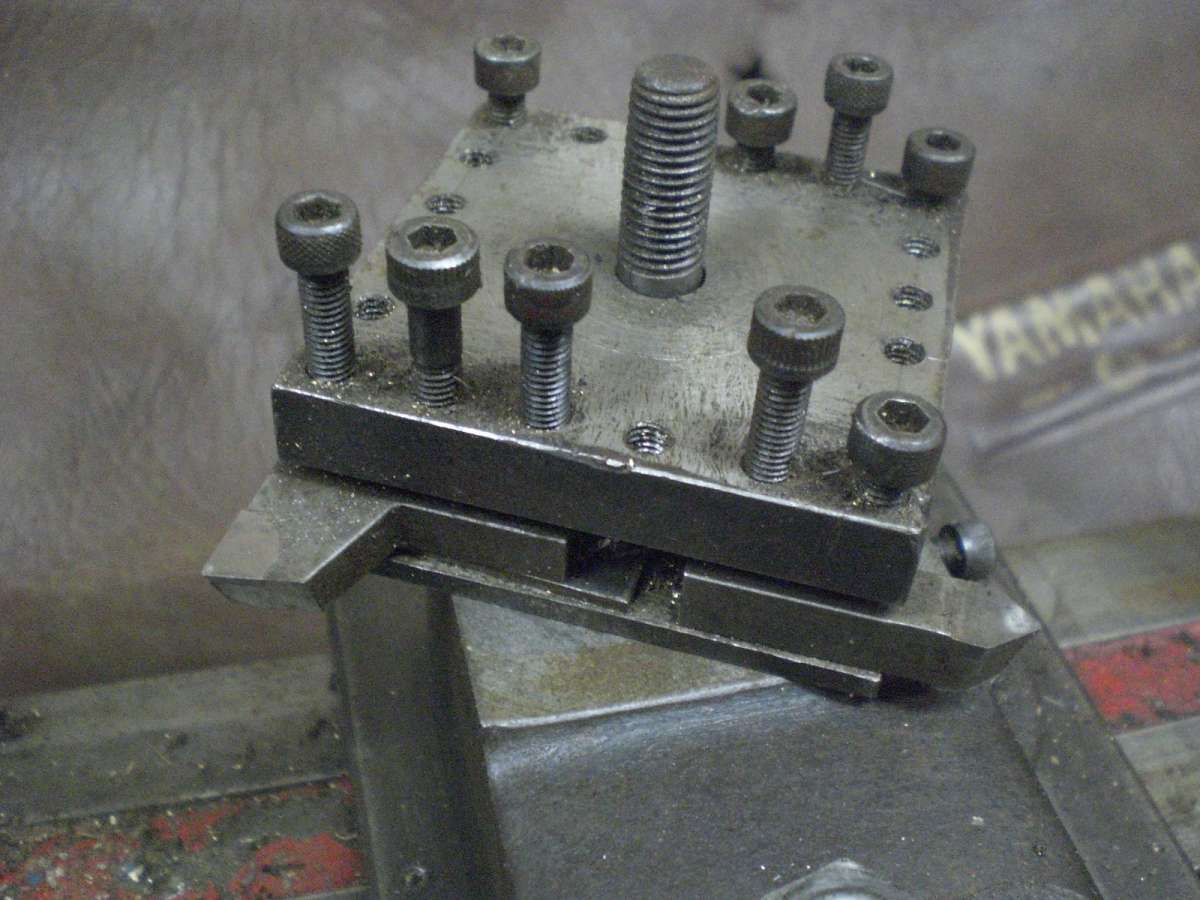
Blackgates 3 Way Toolpost Casting

Blackgates 3 Way Toolpost Casting

Home Forums Materials Blackgates 3 Way Toolpost Casting

Viewing 25 posts - 1 through 25 (of 25 total)
  • Author
    Posts
  • #813393
    John McCulla
    Participant
      @johnmcculla

      Hi all,

      Was considering moving to a three way Toolpost setup on my Warco 250V lathe.

      I know Blackgate Engineering sell castings, but does anyone happen to know the dimensions of the different sizes?

      I also can’t see an option to buy them off Blackgates website, do you have to ring them up to place an order, or have I missed something?

      #813399
      bernard towers
      Participant
        @bernardtowers37738

        I agree its a bit archaic the catalogue hasnt even got page no’s and yes it looks like the good old telephone.

        #813402
        Mark Easingwood
        Participant
          @markeasingwood33578

          I think there is an order form you can download and fill in, or just email them with your order/enquiry.

          #813414
          Pete
          Participant
            @pete41194

            Buy or just make your own that could be done on the lathe it’s meant for. Scroll down for drawings that could be scaled up or down to then fit whatever lathe you have. https://www.model-engineer.co.uk/860/three-way-toolpost-by-david-lammas/

            #813419
            JasonB
            Moderator
              @jasonb

              They give the overall size and tool slot size but I would say you may need to go a bit larger than their largest “Boxford” sizes one. You can give them a call or e-mail and I’m sure they can give you a few more details off the drawing. The PDF of the catalogue gives page numbers.


              As for costings then for the sake of a bit of sawing making your own based on Pete’s link would be a better option as a piece of round or square cast iron can be had for under £20 delivered compared to almost £100 for the casting once VAT and delivery is added.

              #813466
              parovoz
              Participant
                @parovoz

                Minor thought…. Don’t use cast iron as that is a brittle material and could crack under high loadings. Do it in steel….. All commercially made tooling of this type is steel not iron….

                All the best.

                #813481
                JasonB
                Moderator
                  @jasonb

                  I don’t know what grade of iron the Blackgates castings are but SG iron bar is no more expensive than GR17 and acts a lot more like steel. Not hard to machine but can smell a bit due to the sulphur content.

                  #813502
                  Howard Lewis
                  Participant
                    @howardlewis46836

                    I would be wary of using cast iron for a toolpost, for fear of the tensile loads resulting from tightening the tool clamping screws.  Cast iron is strong in compression, but weak in tension.

                    With the upper part of the casting in tension, the sharp corner of the tool slot acting as a stress raiser, cracking might well result.

                    Steel would be my choice for a toolpost, for that reason.

                    If need be, make the toolpost by laminating three pieces of steel, clamped together by internal Allen screws.  That will  save a lot of milling and swarf!

                    That was what i did when I made my four way rear toolpost. Three screws for clamping, with the fourth location for a dowel to locate the post in one of the four reamed holes in the base.

                    Since your post will be three sided, use two screws, and use the “spare” location for a locating dowel.

                    Howard

                    #813529
                    Clive Foster
                    Participant
                      @clivefoster55965

                      Cutting the slots when carving out a tool post of this general style from solid, whether 3, 4 or 2 way, is a considerable palaver with typical Model Engineer machinery. Accuracy is important. I’d drill to remove the majority of material first and finish up with a milling cutter. Even then a job more appropriate to my Bridgeport than smaller benchtop machines which will need rather more care in driving.

                      Far easier, and I think better, to make them in three pieces glued and screwed together with countersunk hex socket screws. Steel plate of suitable thicknesses for top and bottom with an alloy centre. Why alloy? Its only structural duties are to hold the top and bottom plates apart so teh disparity in strength relative to steel matters not an all but its far easier to tap for the screws holding things together. Way back I made a number of four way posts in this style for SouthBend 9″ and Heavy 10 machines. Four M6 or M5 screws, sorry can’t recall which might even have been some and some depending on what I had right then, did the holding together bit in fine style.

                      Having several let me use pre-loaded posts as a sort of poor-boys QC system swopping complete sets over as needed. The T slotted topside favoured by SouthBend made this easy as I made the posts as full sets complete with T nut, central screw and handle. I never fully engineered a locating device to ensure that the posts aways went back in exactly the same place but my methods worked well enough. If I’d not changed machines and gotten a decent set of Dickson QC kit along the way the concept would have been fully sorted.

                      I figured that using a cross drilled rotating centre stud, castellated clamp nut and tommy bar would permit the post to be released with around 1/4 to 1/3 rd of a turn whereupon withdrawing the tommy bar would allow the post to be lifted off and a replacement dropped on. A simple pin for alignment would do. As built up construction is so quick, easy and cheap Clives perfected version would have used two way posts. Neil was kind enough to publish a letter with drawing of the basic concept in MEW some years ago.

                      When you make your own posts give up on the hex socket bolts. Brushing the sward out gets old fast. Making proper small deep square shaded studs is pretty easy and adds the finishing touch. Ordinary hex heads look horrid and scream “can’t be bothered”. T handled square socket spanners can be got not too expensive in a variety of of sizes but making one is a nice simple project.

                      Clive

                      #813548
                      Michael Gilligan
                      Participant
                        @michaelgilligan61133

                        Agreed, Clive

                        A far more rational solution

                        MichaelG.

                        #813571
                        Clive Foster
                        Participant
                          @clivefoster55965

                          Dave Lammas was a very clever man.

                          I recall being very taken with his comment about the dangerous, porcupine like, tendencies of a fully loaded 4 way tool post when the design first appeared in ME. Mostly because I had recent scars to prove the point!

                          However the sets-ups and complications involved in making the 3 way with its slots at appropriate angles conflicted with my lazy mans view of life. So I didn’t make the three way.

                          But I did grab his suggestion that multiple tool blocks were the way to go, see the link in the post from Pete above, so needed a more appropriately lazy way to make a slotted tool-post. Hence adopting built up construction. I made four ways but objectively two ways are easier and plenty if the post is quick to swop. Or even just one way for a boring bar.

                          If anyone else wants to go the multiple block tool-post route is clear that, ideally, something a bit quicker and easier than a stud’n nut fixing is needed.

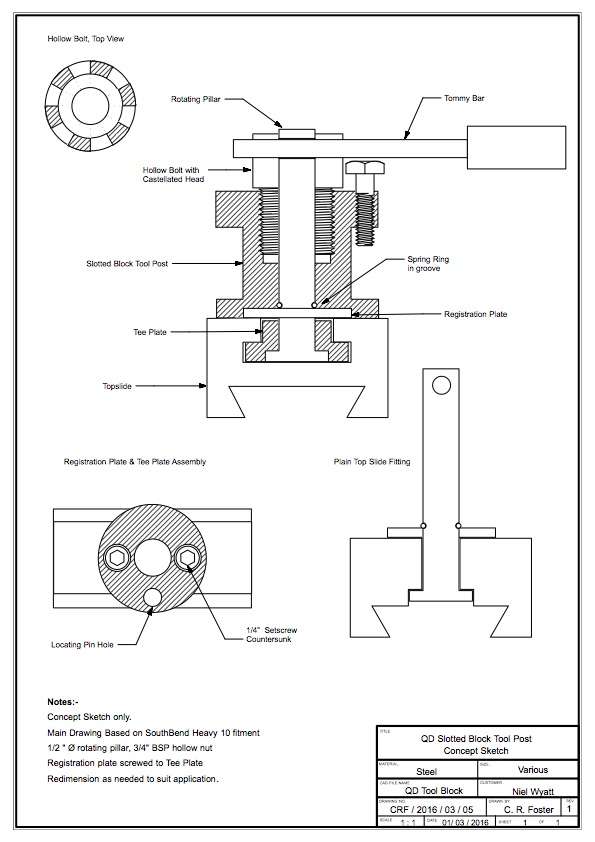
                          Here is a copy of the concept drawings for my stillborn rotating post fixing system as provided for Neil almost a decade ago and over twice that since the original conception. Originally intended for a SouthBend Heavy 10 with a T-slot topside the flange at the base of the post easily sits in a special T-nut locked into the slide by suitable pressure screws. For a conventional screwed in stud type cross slide the slide itself could be modified as shown or a suitable retaining boss fitted on top of the slide with a matching recess is the post base. Indexing to the users choice.

                          The castellated nut remains with the tool-post so, once initially adjusted, only a fraction of a turn will be needed to release the tommy bar allowing the post to be lifted away. I imagine something from the plumbing department could be modified to make the nut if you don’t want to take it all your self (lazy man remember).

                          QD Tool Block

                          Obviously you also need an off machine gauge to set the tools to height using shims before putting on the machine. Off the machine direct measurement is easy. Sorting your shim stock and keeping it sorted is probably harder! Perhaps the colour coded plastic breed would be easier than simple steel.

                          Clive


                          #813574
                          JasonB
                          Moderator
                            @jasonb

                            How times change, When the Lamas article was done it was said to be a cheaper option than a QCTP by having multiple posts all loaded with tools.

                            Now the 3-4 posts suggested would cost £3-400 if using the casting  which would be a lot more expensive than a QCTP and 9 holders. Not sure it is that difficult to machine the castings on a lathe alone, infact possibly easier than machining 3 bits of plate on the lathe.

                            His sketch showing why a 4-way does not work is also a bit outdated given the amount of people using insert tooling which means there is no need to rotate a 4-way or QCTP as the typical holders are designed to be held at right angles to the lathe axis.

                            Regarding the use of cast iron, I had a look at all the tiooling castings that College eng used to supply, all those likely to be under stress were malable iron so reasonable to assume that blackgates are casting in something similar or as I said SG iron bar would be OK.

                            #813586
                            Macolm
                            Participant
                              @macolm

                              A comment – be quite sure the contact with the topslide is restricted to the immediately area of the toolpost outer profile. This ensures best stiffness for operations such as parting off. In particular, the registration plate must be thinner than the recess to ensure the toolpost cannot rock on it. It takes very little to spoil the rigidity.

                              #813589
                              old mart
                              Participant
                                @oldmart

                                The disadvantages of four way toolposts is that unless they are very large, you can only fit short tools because they interfere with each other. The threeway overcomes this limitation but I have never made one. I did make a two way and was using it today on the Atlas 12 x 24. All of the tools at the museum are 17.53mm height, made from 20mm square and all carbide inserts, and I made a longer cross slide for the Atlas which holde the original top slide and the two way, four way , double boring bar and parting off toolposts. Both lathes share the same tooling height.

                                I would also go for steel for the toolpost, despite having a large ammount of metal to mill out, you will only do it once. Ihave seen some very nice three way posts on the Home Shop Machinist forum based in the USA.

                                #813600
                                Clive Foster
                                Participant
                                  @clivefoster55965
                                  On JasonB Said:

                                  How times change, When the Lamas article was done it was said to be a cheaper option than a QCTP by having multiple posts all loaded with tools.

                                  Now the 3-4 posts suggested would cost £3-400 if using the casting  which would be a lot more expensive than a QCTP and 9 holders. Not sure it is that difficult to machine the castings on a lathe alone, infact possibly easier than machining 3 bits of plate on the lathe.

                                  His sketch showing why a 4-way does not work is also a bit outdated given the amount of people using insert tooling which means there is no need to rotate a 4-way or QCTP as the typical holders are designed to be held at right angles to the lathe axis.

                                  Regarding the use of cast iron, I had a look at all the tiooling castings that College eng used to supply, all those likely to be under stress were malable iron so reasonable to assume that blackgates are casting in something similar or as I said SG iron bar would be OK.

                                  Yes Jason times have indeed greatly changed. At 71 I have to think carefully before putting pen to paper, or rather fingers to keyboard, to avoid being obsolete not just once but two or three times over!

                                  However the Lammas 3 way post casting kits are still moderately price competitive with QC systems if you are buying from Mr Dickson!

                                  Realistically even back in the day casting kits for tooling were never overwhelmingly cheaper than respectable hobby market equipment. Perhaps around half the price. Bit more or less depending on complexity. A difference eroded by the builder having to supply various sundry parts such as screws and maybe bearings.

                                  The problem then was industrial grade equipment was, as now, unaffordable new but in those days decent hobby market equipment was rare so make your own was the only way. Mass market kit from the likes of Black and Decker, being firmly aimed at the shed man and wood butcher, was rarely good enough for the likes of us. Often, not that cheap anyway. My first import was an 8″ grinder which made the Messrs Black and Deckers consumer offering it replaced something of a joke in bad taste. Crappy tool-rests on both tho’!

                                  Comparing something like an Arrand, one of the few makers of good hobby market kit then, spindle against a DIY from casting version the price differential for the finished products wasn’t vast. But still a useful number of Mars bars.

                                  My then boss made a 4 way for his Zyto from solid by drilling and milling on that lathe. Regular blow by blow accounts of nightly progress convinced me that no way would I try that on my SouthBend, or perhaps it was the Pools Special that preceded it. I found a just about affordable 4 way for my first SouthBend in an early Chester catalogue which had to do despite objectively being less than wonderful.

                                  The Chester QC systems in that catalogue were relatively inexpensive but still definitely “aspirational” in price in those days.

                                  I didn’t machine the plates for my built up four ways.

                                  Like most such things material availability crystallised the job. Perhaps 35-40 years on the details are vague but I imagine I found some lengths of 3″ wide steel in suitable thicknesses and lump of 2″ square alloy bar. Which worked out well for the SouthBend I was driving at the time.

                                  My 6×4 bandsaw struggled manfully through the cutting accompanied by suitable verbal encouragement. Being one of the first batch sold under the Alpine label it needed much attention over the years to make performance match expectation. But it was what I could afford and jobs always got done. The alloy centre pieces would have been squared off in the lathe after cutting. A quick whip over with the angle grinder, Wolf Grindette – too expensive really but good – and touch of a file would have served to clean up the steel plates enough for safety. £10 and lots of refurbishments worth of two speed ex line shaft 1/2″ pillar drill did the drilling. Greatly helped by the a new Nippy vice I splashed out on in a moment of madness (or sanity!).

                                  Today I’d cut the plates with a 1 mm disk in an angle grinder. Those thin disks are wonderful things although shatter prone if used carelessly. When I went 18V battery for my carry around tools I put the redundant mains powered angle grinder on one of the inexpensive circular saw style slide base mounts. I’m impressed by how well it does straight cuts through thickish material provided you don’t overwork it. So called universal fit meant modifications needed but well worth the £20 it cost.

                                  In my world turning a 4 way to adjust the angle of tool presentation was for emergency access only. As with modern inserts I would grind the appropriate angle on the tools so 90° increments of rotation was the norm.

                                  In a world where insert tooling is becoming the norm the interchangeable block system is well worth re-visiting. Seems silly to pay for tool height adjustment facilities you will never use and accept the bulky toolholder base which, in my experience can get in the way at times.

                                  With the unforgivably short 2 1/2″ travel tailstock SouthBend considered adequate I often enough had to resort to the dreadful, but compact, standard lantern holder when running out of room for the 4 way block around the tailstock unless unacceptable tool overhang was accepted. Probably didn’t have any long enough tools around anyway. A QC block would have been as bad a space hog or worse. Back then a slender long nose running centre would have been a major boon. Nowadays it’s just well nice.

                                  Clive

                                  #813613
                                  Pete
                                  Participant
                                    @pete41194

                                    If I was buying the castings for this, I think I’d want to verify just what grade or type of cast iron Blackgates might be using to be 100% sure. I’m not familiar with the UK designations for metals, but I’d guess Jason’s mention of that GR17 iron would be what’s known as either malleable or possibly it might be ductile iron here in North America. Given it’s simple shape, just buying a block of either that GR17 or even mild steel certainly seems much more cost effective as Jason also mentioned since a casting is going to need machining all over and finish cutting the slots to dimension anyway.

                                    As far as continually finding or adding shims for any fixed 3 or 4 way that seem to make these fixed elevation tool posts slow to use if or when tools need to be changed or resharpened. The methods in this video makes it pretty quick. Although I’d argue it’s just faster and easier to keep the shim stack or in my opinion, better to machine to size any single shims with each tool. Other than a bit of added time to produce them for any new tool, it’s pennies worth of material https://www.youtube.com/watch?v=N90JF6YW9bE

                                    As Dave Lammas mentioned in that article I linked to, he didn’t detail any added design for indexing his tool post which may or may not be important to some. The single spring loaded pin most of the off shore OEM 4 way tool posts come with today certainly aren’t repeatable to a high degree of accuracy if multiple parts are being produced. But many have added or even bought lathes with a dro. Accurate indexing then might become quite important for some. George Thomas mentioned the “excellent Herbert indexing tool posts at his works”. Although I’ve no idea how those tool posts did accomplish the indexing. But he details his own somewhat complex design for a repeatable indexing method on his Myford Super 7 in his Workshop Manual book.

                                    Maybe it’s well outside what the OP wants, but I’ll add this as just food for thought for anyone that might be interested. There’s many designs used for very accurate and repeatable tool post indexing, including manual and even powered indexing on cnc lathes today. Face gears as just one of the methods between the top of the compound and bottom of the tool post itself have also been used with manually indexed tool posts. While it would require some quite accurate machining, I don’t think it’s outside what could be done in most of our shops with a bit of care. His design is meant to be used with at least a very good industrial quality QCTP, but it could easily be used with any 3 or 4 way tool posts just as well. And it’s also one of the simpler indexing designs I’ve seen. https://www.youtube.com/watch?v=S7GxY_QVDtk The actual details for the ball bearing indexing start at around the 4:20 mark. He also makes a strong case about exactly where the tools cutting loads should bear on the lathes cross slide when using a tool block to replace the compound. And he has a more graphical explanation in this short video. https://www.youtube.com/watch?v=lbjWQ0G-ZQw But like some of the better designs of indexing tool posts, I’d still add a short stiff spring to help lift the tool post a fraction as the tool post handle or nut is released for any tool or angular indexing, especially with a fixed tool post instead of a QCTP.

                                    I think the Lammas tool post design has some real benefits as far as gaining better clearance around the lathes tail stock or any centers being used when turning smaller diameters, larger shoulders located on parts, and possibly at the head stock and around the lathe chucks as well. My guess is that was actually part of or an additional benefit of his design.

                                    #813623
                                    JasonB
                                    Moderator
                                      @jasonb

                                      Pete, GR17 or the older 250 grade is grey iron. What we call SG (spheriodal graphite) would be a ductile iron. Not really any difference in costs between the two.

                                      The Lammas design with it’s casting was besigned for making on just a lathe and even the drilling could have been done on that. If builders have other machines like hacksaws or mills then other methods of making become more attractive. These days laser cutting the triangles would be worth thinking about if making a sandwich.

                                      Having recently tested a lathe with a 4-way I personally would not want to go back to using one regularly. Yes you can have dedicated shims but still a bit slower and not as repeatable position wise. Or dedicated tool posts for the commonly used tools as Lammas suggests. But I keep a QCTP for “odd” tools, these are ones that may get used once in a blue moon or may just get made for the job in hand and it is far easier to set their height with the holders screw than keep trying bits of packing.

                                      QCTP also stands for Quick Clean. Just tip it upside down when you take it off and any swarf that has hoyt into the cap hea dscrews falls out.

                                      DCGT holders and inserts get in close enough to small work to miss the tailstock, that applies to QCTP and 4-ways. Use an extended QCTP holder if you want to do the same with HSS.

                                      valve 1

                                      valve 3

                                      #813651
                                      Graham Meek
                                      Participant
                                        @grahammeek88282

                                        A few months back I was considering making the 3 way turret. Due to fouling issues from the tooling in my 4 tool turret and my Compact 5 tailstock. Especially when working between centres.

                                        In the end I opted to make a version of interchangeable tooling. The design is a cross between Harold Hall’s and J A Radford’s design. The tooling works extremely well and did not take very long to make on my diminutive machines. The plus side is this tooling only cost me the Bar stock and one Kipp style handle. Easily less than £20.00.

                                        Once I can get some photographs taken I hope to post the system on my Compact 5 post.

                                        Regards

                                        Gray,

                                        #813694
                                        Pete
                                        Participant
                                          @pete41194

                                          Thanks for the material clarification Jason. I don’t use my 4 way tool posts regularly either.

                                          And I’m looking forward to those pictures Gray.

                                          #813701
                                          duncan webster 1
                                          Participant
                                            @duncanwebster1

                                            My memory says that Radford did a design for a quick change tool system to be mounted in the tailstock. Having just made a batch of threaded bushes which required centre drill, tapping drill, tap to be used in order, and the centre drill is a lot bigger diameter than the tap drill, it would have saved a lot of time. Those capstan attachments with tools sticking out in all directions and the tip a long wat from the tailstock just don’t appeal.

                                            Anyone got details, or is my memory playing tricks (again)

                                            #813705
                                            Graham Meek
                                            Participant
                                              @grahammeek88282

                                              Hi Pete,

                                              It may take a while as I have to master Photoshop. My old Fuji camera package does not work on Win 11.

                                              Regards

                                              Gray,


                                              Hi Duncan,

                                              Your memory is sound, Chapter 8 page 81 of Improvements & Accessories for your Lathe, by the man himself.

                                              Regards

                                              Gray,

                                              #813708
                                              Pete
                                              Participant
                                                @pete41194

                                                Well like anything else you come up with Gray, it will be worth the wait no matter how long it takes.

                                                #813732
                                                duncan webster 1
                                                Participant
                                                  @duncanwebster1
                                                  On Graham 0

                                                  …..m

                                                  Hi Duncan,

                                                  Your memory is sound, Chapter 8 page 81 of Improvements & Accessories for your Lathe, by the man himself.

                                                  Regards

                                                  Gray,

                                                  Well that’s on the Xmas list then. Sorry to mention Xmas so early in ths year

                                                  #813831
                                                  Diogenes
                                                  Participant
                                                    @diogenes

                                                    ^^ – not at all, Duncan, if the kids are back to school ?tomorrow?, it’s more-or-less a given that our local garden-centre will have started with the pine-cones and candles by next weekend..

                                                    #813839
                                                    Nicholas Farr
                                                    Participant
                                                      @nicholasfarr14254

                                                      Hi, I made a four way one, from a slice of 2 1/2″ square bar, about a month or so before MEW 27 came out. It was for my father’s RandA lathe, and I held an end mill in the lathe chuck to cut the slots. Had I’d made one when it was published, I probably would have made a three way one, as I soon realised the problems of other tools getting in the way of the work, and or the tailstock.

                                                      CIMG3478

                                                      As has been said, malible cast iron would be plenty strong enough.

                                                      Regards Nick.

                                                    Viewing 25 posts - 1 through 25 (of 25 total)
                                                    • Please log in to reply to this topic. Registering is free and easy using the links on the menu at the top of this page.

                                                    Latest Replies

                                                    Home Forums Materials Topics

                                                    Viewing 25 topics - 1 through 25 (of 25 total)
                                                    Viewing 25 topics - 1 through 25 (of 25 total)

                                                    View full reply list.