Home › Forums › Beginners questions › Ideas for a small marine engine
I have just been fortunate and landed myself with a myford lathe and a milling machine. I want to start on something simple and was wondering about a small marine steam engine, double cylinder (not oscillating cylinders), cylinders perhaps the sort of wilesco size. So, is this a bit ambitious? and where do i start, are there castings for cylinders like a Wilesco? are there any drawings available?
Any advice would be gratefully appreciated
thanks
Andy
A small marine engine is not ambitious. Have a look at the engines in Stuart Models for some ideas. They sell kits, castings and drawings. A STUART 10V or D10 maybe what you are looking for.
I worked as a mechanical design engineer/draftsman for most of my life but had little practical experience using a mill and lathe when I started to build my 6″ traction engine. You have to start somewhere. (only took 1,500 hours to build over 7 1/2 years).
Have a look on the internet for Bogstandard’s “Paddleduck” Engine Plans, this engine was made from bits in his scrap box.
Yes the Paddle ducks piston valve engine would be more in the “wilesco” sort of size range and being bar stock a lot less expensive than castings particularly if you much a piece up and have to buy even more expensive replacement castings.
If you do particularly want castings then Reeves do the borderer which is a twin and also a bit smaller than the Stuart as is Warrior
Some of the old American magazines can provide usable designs. I have made several from them but updated them to metric and more modern ways of making such as cankshafts built up from parts loctite dtogether rather than cut from solid.
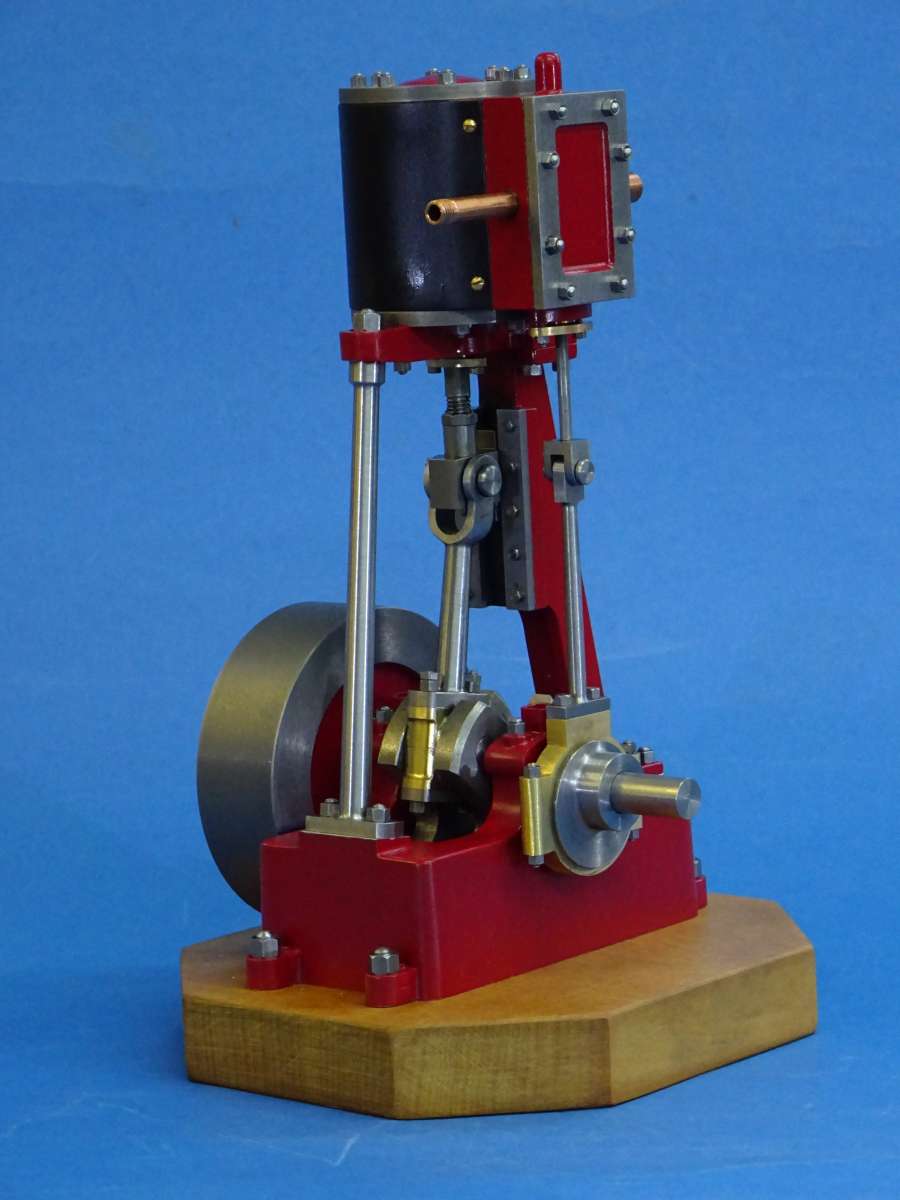
One here on page 214 of the jan 1953 issue
Or this one from 1961
It would be helpful to know what you intend doing with the engine, will be just be a display model when complete or do you want a working engine to put in a model boat?
The 10v and paddleduck engine are quite big. A good starting point for learning but not the best for an actual boat because the appropriate size boat is 5-6 ft long. Yes they will fit in a smaller one but look bloated.
Anyway welcome to the forum. Learn how to search this site, find the posts about recommended books and gradually learn to use the machines expecting to mess up a few times initially.
Find your local ME club.
That little rotary valve engine Jason found in the 1961 Popular Science magazine looks a decently simple starter project. Assuming you want something that makes the wheels go round rather than glass case inhabitant or shelf mounted dust collector.
And it’s different. Clive likes different.
Personally I’d scale it up, one and a half times or even double the design size, if your machine has the capacity.
Never approved of this “something really small is fine for a beginner” idea.
Only thing going for really small is slightly less material cost, even then a bit dubious in “buy a casting” days. Also for fitting on a vertical slide for milling in the days of lathe only workshop, all to often based around one of the horrible cheap British interwar and early post war objects. Portass S, Zyto et al. But as ever depth of pocket ruled. You used what you could afford.
The smaller the machine the tighter, in objective terms, the tolerances and the more accurately you have to make it if it’s going to work. Bit more size gives a little more room for error and, ahem, adjustment without vastly compromising operation or aesthetics. Things tend to be a bit fraught in the workshop after the fourth try at that fiddly little bit that stubbornly refuses to go right hits the scrap bin at approximately Mach 1. We have all been there. Possibly more often than we care to admit.
Back then size was all too often constrained to avoid the need for a seriously large, in small lathe terms, piece of material to carve the crankshaft out of solid. As Jason says built up with Loctite rules these days relaxing the size constraints and reducing the consequences of an error. Cocking up a near finished carved from solid crank with a misplaced cut tends to generate creative commentary. Slipping up on one web of a built up one not so much.
One good point about fractional inch dimensioned designs from that era is that they were designed to be laid out by simple ruler and scriber methods. So inexpensive kit, a bit of care, a bottle of blue or wide end spirit based felt tip pen and a flat surface to work on will let you lay it out just as well as the designer did. A magnifying loupe, or equivalent helps. Just make sure you have a ruler with nice deep engraved dimensions. Printed lines are crap for this sort of thing. 6 inch / 150 mm should do nicely.
Good DRO equipment turns it into an exercise in co-ordinate drilling and machining with no marking needed.
Clive
The 10v and paddleduck engine are quite big
Not sure about big and bloated, the Double 10 looks a bit lost in this 52″ hull, the paddle ducks engine at 10mm bore is about half the size and as I said more in the “wilesco” size range that the OP wants and would fit a 24-30″ hull quite comfortably. I think the double acting Wilesco engines are 12 or 13mm bore but as a we are talking about a twin slightly smaller may work better if being run of a Wilesco boiler.

Don’t be put off by a barstock engine looking what it is, with a bit of thought they can be made to look just like a casting kit engine and as Clive mentions you can take the basic mechanics and adjust the size to whatever you want.
Adjusting the aesthetics of a bar stock engine to look more casting like is probably best done after the engine has been built and test run.
Plenty of tapped holes et al to hold things in place whilst working on them.
Much easier than trying to mount up a knobbly casting for machining work whilst making sure that there is enough material in the right places to get all the features in and aligned. Not to mention the near equal difficulties of holding the darn thing for marking out and getting a legible line or four on rough, cast, surfaces. All too often it’s not practical to clean up with a file where you want to mark.
When starting out everything is hard, to greater or lesser degree, so it’s wise to choose and organise in a way that minimises the number and difficulty of things to be done.
Clive
I don’t think size has anything to do with a beginner’s engine. What is more significant is choosing something that is within the capabilities of your machine tools and your experience. Size is particularly important as regards the boat you want to power with it.
By saying that you are not interested in an oscillator is reducing your options quite significantly as they tend to be by far the engine of choice for smaller hulls. They are also the best type of engine for someone new to the hobby to have a go at.
One of the best sources of small engine plans is the Paddleducks site but again, many of the smaller ones are oscillators. I think one of the best engines you should consider is the Stuart Models Ninety, which is a ‘V’ twin marine engine but a valve operated engine and can be purchased as a set of castings. Check here:
There is also the larger 7V but that is probably bigger than you need to start with. I would also seriously reconsider the idea of an oscillator for your first project. It will enable you to get to know your machine tools doing tasks that are not as demanding as you will find with a valve operated engine and provide you with very useful training. Again the Stuart Models twin oscillator is a superb little engine and comes available as a set of castings. With a built in control valve the twin cylinder double acting engine is an excellent way to get into building your own plant for your first model boat project.
There is also the consideration that buying your first engine as a set of castings complete with a set of drawings, instructions and the required fittings means that there is little research required as all the thinking has been done for you.
I thought size came into it as the OP wanted a Wilesco sized engine so assuming the common 13mm bore x 16mm stroke of say a D52 then the Stuart fixed cylinder engines are going to be a much larger capacity.
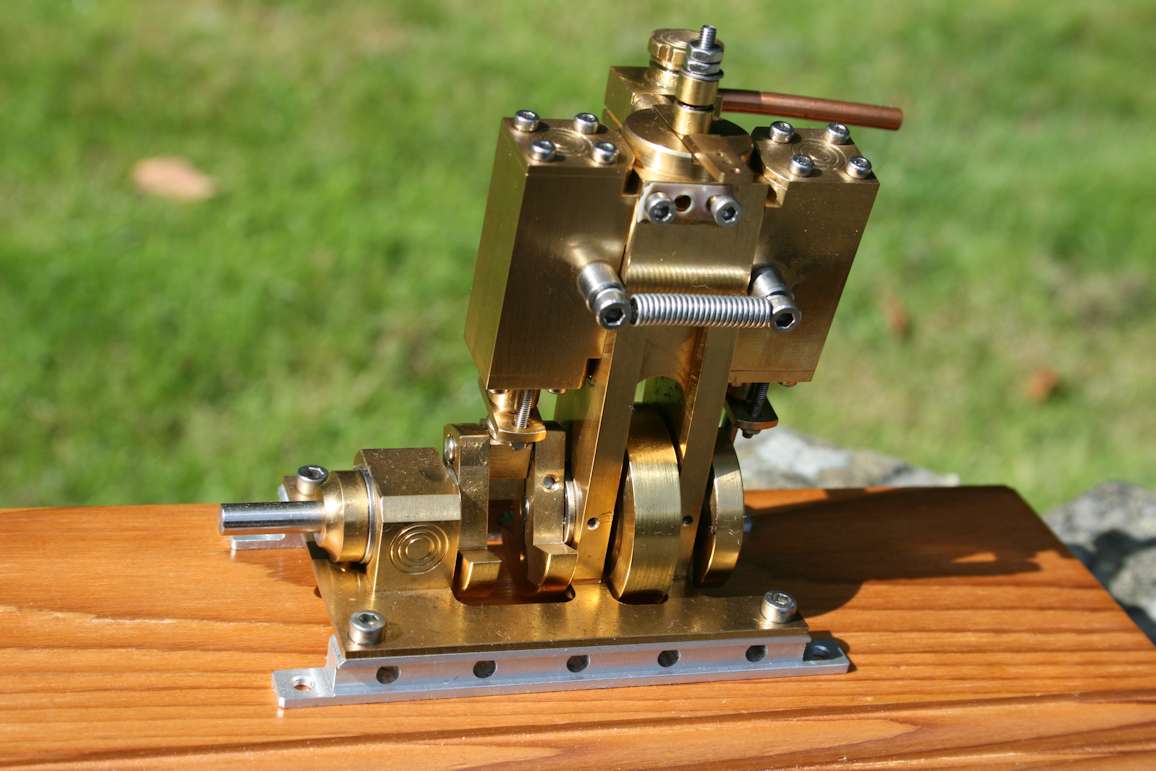
All the “pond boat” engines that I have built dating from the 1920 tend to be in the 3/8 to 5/8 bore range. it would not be hard to even pick one of the singles such as My recently published Bassett Lowke and build a twin cylinder version and at 12mm bore would be close to Wilesco size. If there is interest I could soon draw up a Twin version.
Many thanks for the posts and the information, it is really encouraging to newbie that you haven’t dismissed my naive questions and offered some really good advice.
I have had a rethink about the oscillating engine as it may be a good way to get me going.
JasonB – am I able to see your recently published Bassett Lowke build? it would be good to see that and give me an idea to see if a twin version would be possible for my skills.
I also like the look for the Stuart twin oscillator – probably not best just to go on looks!
thanks again for everyone’s helpful comments.
Andy
Andy, can you give us an idea of what you intend to do with the engine when finished a sthat is most likely to have the biggest effect on what is suggested. An engine for display and just get the odd run on air Will be different for one that is intended to work particularly if in a boat where boiler etc come sinto play.
The BL was is model engineer so a digital subscription or buying a few back issues would let you read the build.
This should take you to some build photos, being a barstock engine it works out a lot cheaper, probably £50 for materials with quite a bit to spare for other projects or muckups. The base can be soldered or stuck together with something like JB Weld otherwise fairly straightforward machining.
I did have a quick play with my 3D part files last night and it would not be hard to use most of the parts to make an inline twin, just a few alterations to some. I have shown a bit of shape to things like the single block cylinder and entablature but they could just as easily be left as rectangular blocks if it is more of a runner than a looker you are after. It could also be done in a Vee configuration is that is more appealing, that also simplifies the crankshaft which is probably the hardest part of an inline twin

Others that would suitable candidates for making into twins are the Stuart Simplex and Gamages NDC again barstock engines. These were all marine engines back in the 1920s when Pond Boats were a popular passtime basically seeing who could get to the far side of the pond first.
One of the biggest challenges I have come across over the years of testing model boilers is helping someone relatively new to the hobby to get started with a suitable project. The problem is that invariably a newcomer isn’t even sure of what questions to ask so tends to base those questions on things they have seen somewhere that they like the look of. At that point no-one has actually explained what is involved in making a particular type of engine so even the initial questions might be based on an impractical ambition.
Added to that is the other main challenge of many experienced modellers not being able to understand that, what they might see as a relatively simple project, to a complete novice might well be too difficult as a starter and could well end up being over facing and off-putting. I nearly always try to suggest that the first project should be the easiest possible way to obtain a satisfactory conclusion that will generate a degree of satisfaction and enthusiasm to take to the next level. For a model boat I always recommend a kit, preferably an open hulled model for ease of build and operation, and for a home made engine I would always recommend an oscillator.
The trick is invariably asking the right questions to determine the original posters levels of experience and capabilities rather than make suggestions based on our own idea of what is simple. Perhaps Andy can let us know just what turning and milling experience he has had so far and whether he has made anything in the past. Does he have a technical background, does he have any experience with operating steam plant either statically or in a model boat. As Jason has suggested, what is the intended use of this engine and, if in a model boat what type of boat would he be considering. If it is for a boat then there is also the consideration that I would usually suggest that a newcomer identifies the boat they would like to make, which will then determine the propeller to be turned and then the size of the engine needed to turn it. From that a suitable size boiler can be identified etc.
So Andy, can you help to fill in some of the gaps to help the knowledgeable chaps here to make appropriate suggestions.
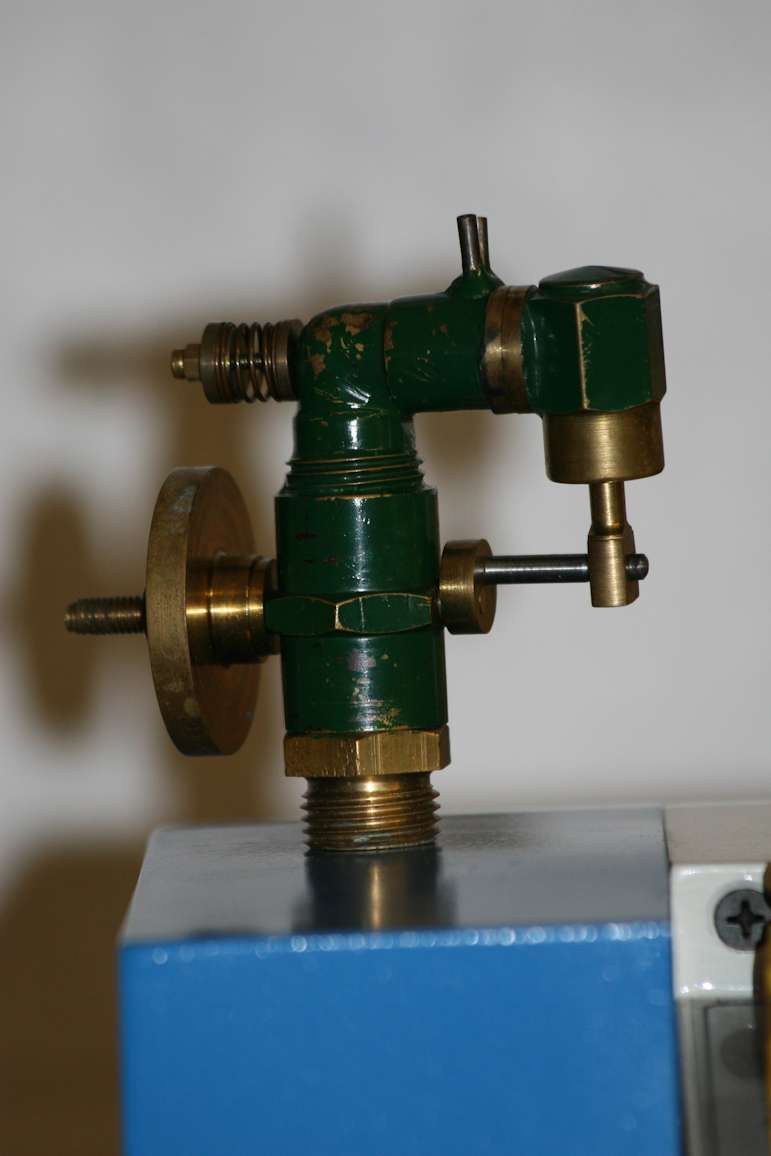
Just to help get things into perspective, when I first went to sea my Dad dabbled in buying and selling antiques at fairs etc. One day I arrived home from a trip and he showed me a steam powered model boat. I didn’t have a clue what it was but I now know it was probably something like a Basset Lowke. I fancied it so asked him if I could buy it. He said sure, for 20 quid. We are talking late 70s here and I was still an apprentice. I asked what he paid for it and he told me 50p. I returned to the ship determined to prove to myself and him that I could make my own engine. All I had to go on was what I had seen of this boat, I didn’t even know what ‘oscillator’ meant then. When I got back to the ship I made a sketch on a piece of paper and took it down the workshop. I made the engine below. The main body is obviously a couple of brass pipe fittings and the cylinder and piston are both made from a scrap brass fuel tank sounding tape weight. The only point being I would suggest that any newcomer starts with something very simple and achievable.

I’m of a different school of thought and tend to encourage someone new to the hobby to make what they want and like the look of rather than steer them down another route. If they start building something they are not so enthusiastic about then there is ahigher risk of them loosing interest and not seeing the project through to the end.
Also it is a bit different here than on Model Boats forum. Just because someone wants to make a marine engine I don’t assume they want to run it on steam let alone put it in a hull . We get a lot of people who make a “mill” engine as their first project but I doubt any will put that into a replica of a lancashire mill so why assume a marine engine will get used in a boat. Also a good proportion here will just run the engine on air. Likewise I would say that 99% of those making a model aero engine be it compression ignition, glow or spark ignition do not have any intent to put it in a plane. They will be happy if it runs when fixed to the B&D workmate. May be different if th equestion were asked on RCM&E
I am also less inclinded to steer a beginner towards a kit which invarable will be based on castings. There are several reasons for this such as costs that I have already mentioned as they are considerably higher than what barstock would cost. Secondly as mentioned by others a bit of bar or rod is easy to hold so that takes one issue faced by the beginner out of the equation. They also won’t have to deal with all the common casting problems like hard spots, undersize castings, pattern shift, etc.
The other reason I tend not to suggest a casting kit to someone new to the hobby is that they are more than likely to have been educated and spent their working life using metric. The available kits are invarably dated and in imperial measure. This not only means they have to start learning to use fractional and inch measurement but that they will be paying a primium for tooling as metric cutters, taps & dies, etc are all a lot cheaper in metric as is material. Add to the fact many will be on imported benchtop machines with metric handwheels and imperial becomes even less user friendly. At least with a barstock engine even if it is an imperial plan then it is easy to change to metric sizes when you buy the materials, kist with short bits of material and fixings included tend to push the builder down that route a sthey are loathed to throw the overpriced parts away.
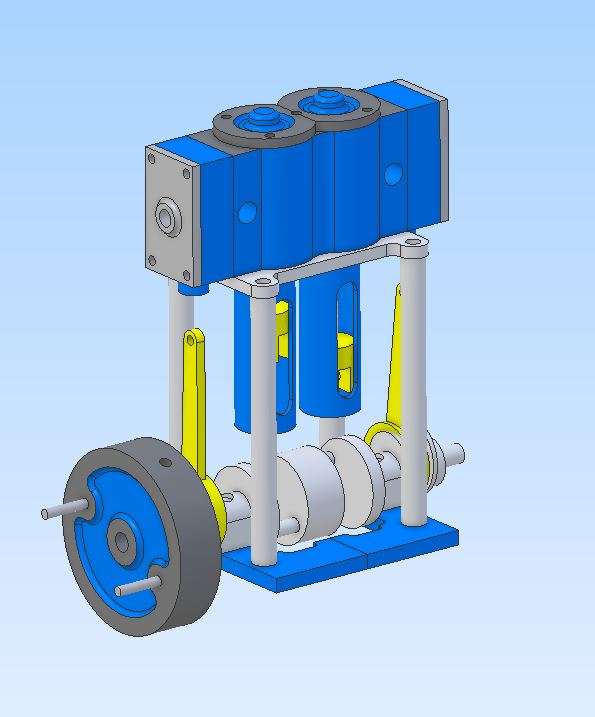
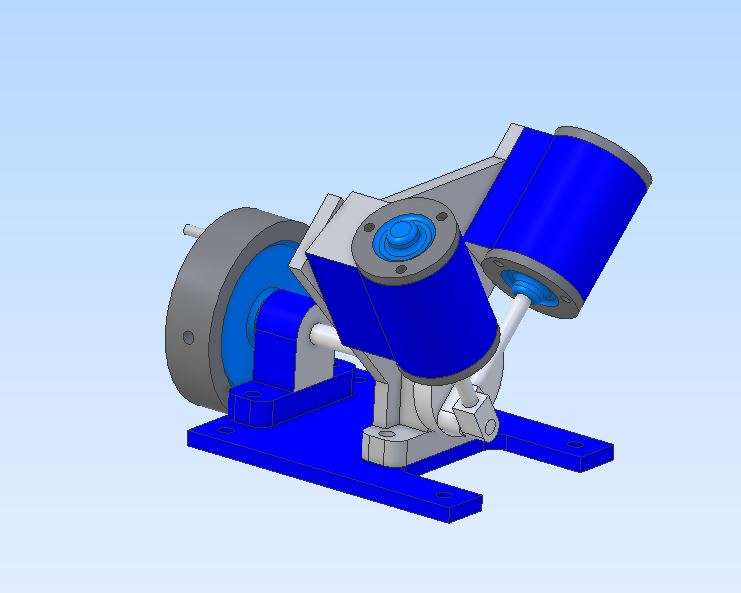
Basic layout of what a 90deg Vee Twin version of the Bassett Lowke as an oscillator may look like.

The kit referred to the model boat. And as I suggested earlier, knowing a bit more about the experience and requirements of the original poster would be very helpful.
A kit can be a good starting point as all the various bits of metal are there with fixings – sourcing small quantities is costly and time consuming when scrap box materials are not to hand, + probably don’t know where to get stuff.
If a marine engine is wanted a Stuart 10V is a simple engine and looks good when completed. The parts not being too fiddly to make for a beginner.
The book by Andrew Smith has a metric set of dims and gives very helpful and detailed set ups for machining.
I started with a D10, Andrew’s book and a Cowells ME90. Then got bitten by the bug !! No cure !
The cost comment is interesting. On numerous occasions when building my “barstock” versions of an engine I have done the sums and compared them to what the same or a comperable casting set would cost. In all cases I have come out at 1-3rd to a half the cost of the castings.
I cost everything so no scrap box diving. Smaller section I cost at a full 300mm length and larger section by the 25mm length so as I said earlier the builder will often end up with material to spare which can either be put towards the next engine or should a part not turn out right you have material to hand for another go. The added bonus is you have a decent length to get hold of rather than short sawn lengths that come with kits.
An example is this vertical the same size as the original Stuart No 7 before it became the A framed 7A. Current cost of a kit is £446.00. Materials including some packs of nuts just under £150. Muck up a 7A cylinder and you are looking at £77.00 compared to £31.00 for the fabricated. Infact nearer £21 as I included a 300mm length of material for the end flanges in the total price so you would have had that to spare.
All materials could be got with one orfer from M-machine and one other order for fixings.

Yes I know some people want to make an engine from castings in which case Stuarts, Reeves or blackgates all have something suitable but when no preference is given barstock can be a viable option. The 10V was my first casting set but I had built barstock steam engines before that but a 10 V does not fall within the OPs requirements of a twin of Wilesco size.
Borderer frome Reeves doe sfit th esize and type requirement if a casting kit were wanted, costs £355. I’ve just priced the barstock required for the castings and it comes out at £167, just under half. If you were to substitute cast iron inplace of bronze for the cylinders, covers etc then you would be at about £100 so I can’t see that buying barstock is costly.
Seems like you have found a good business opportunity especially as so few metric design drawings are available!
C

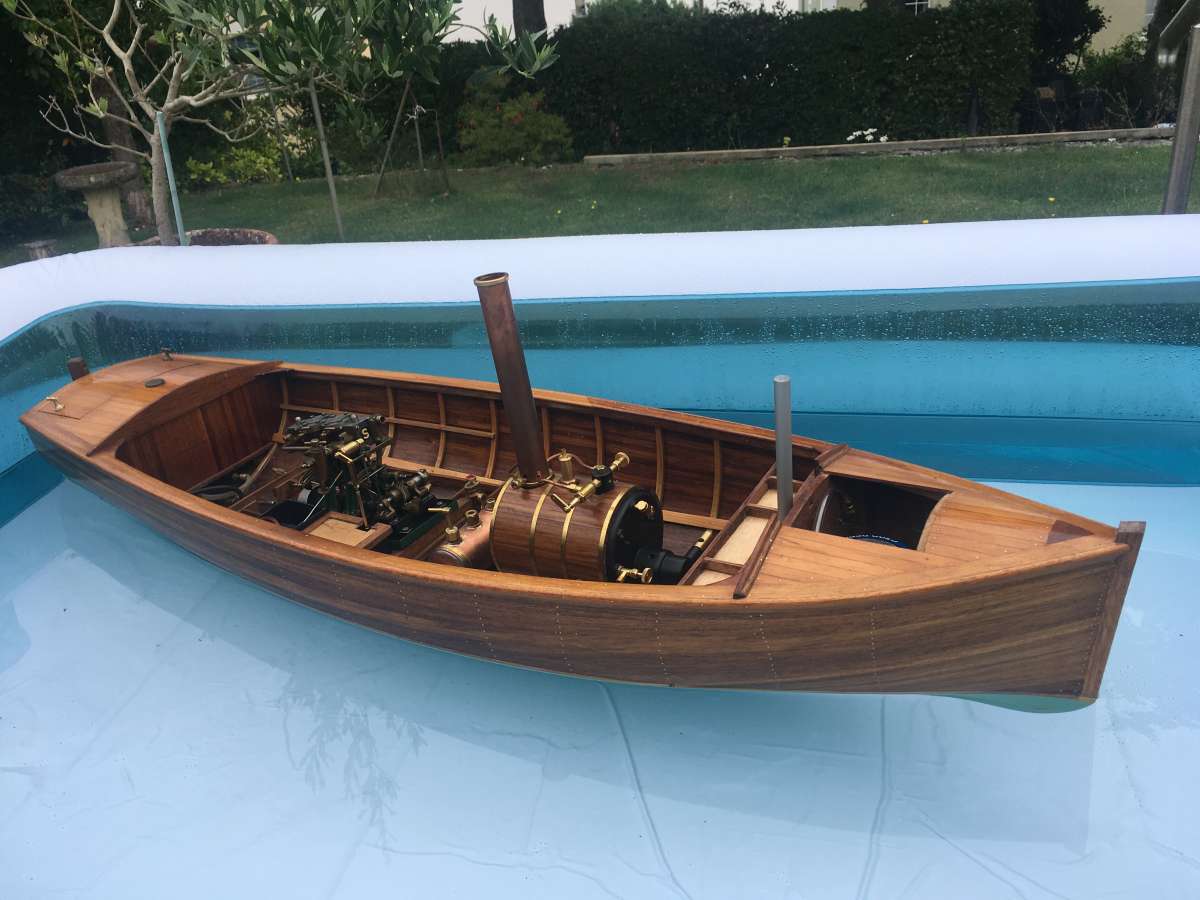
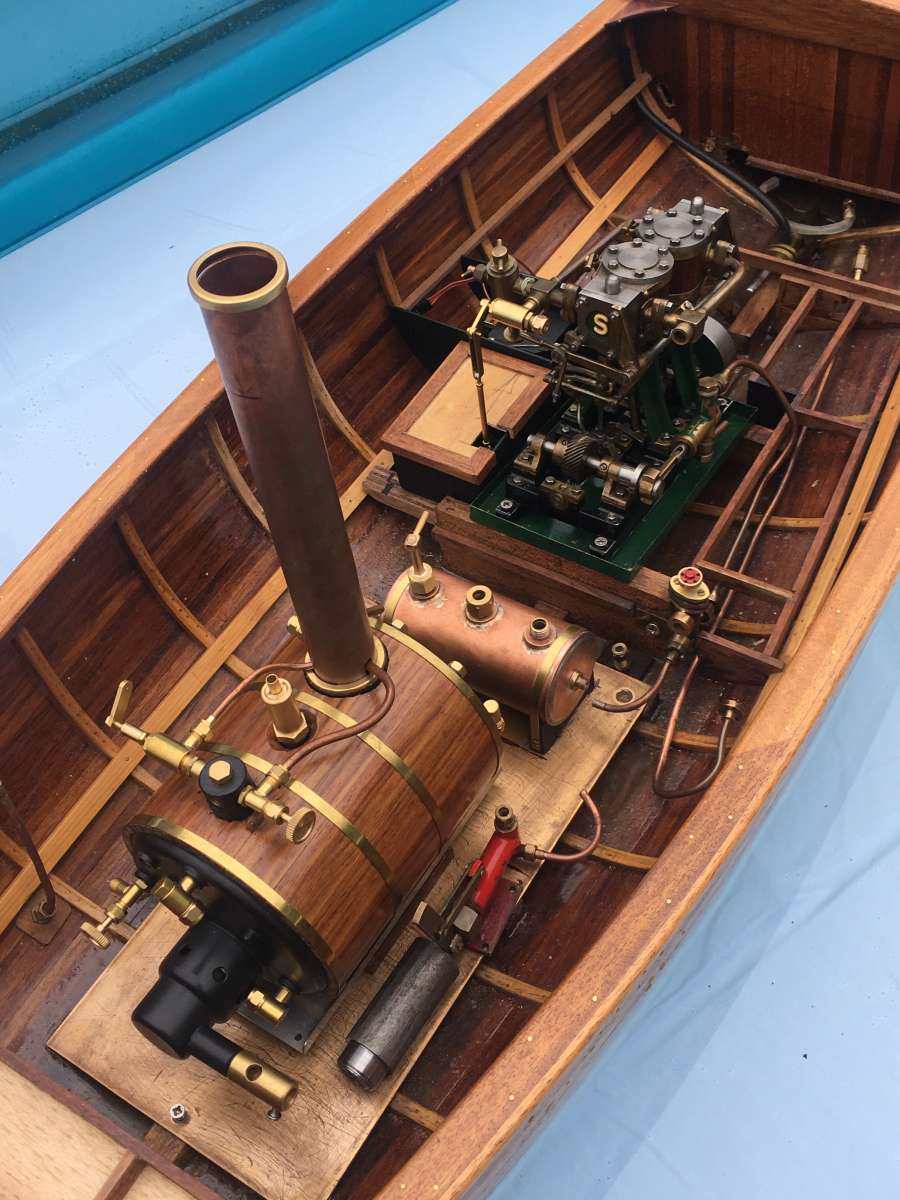
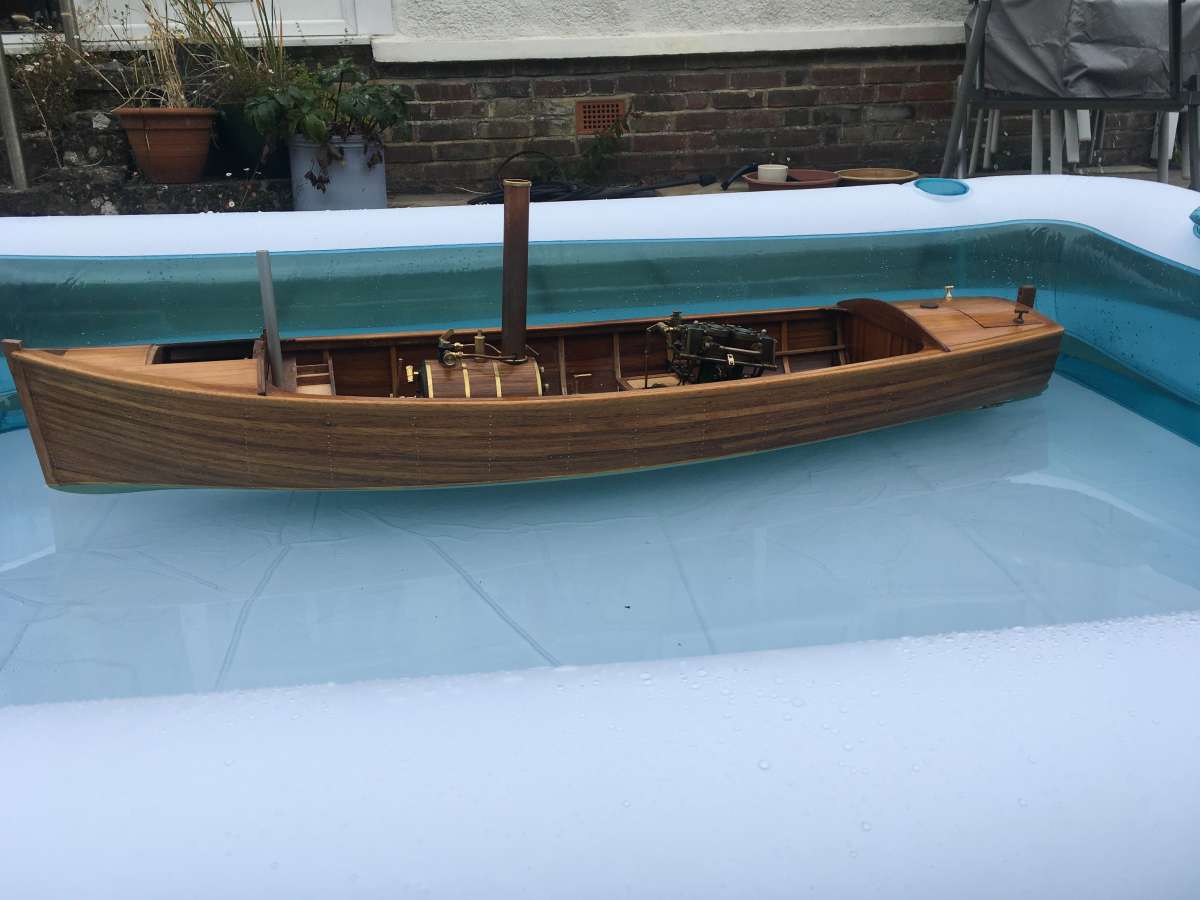
ouple of pics of my steam boat project – been ongoing for many years and recently restarted with a new boiler and radio installation.
Clive has always been a little unconvinced as to the suitability of a “simple” oscillating engine for the very first, ab initio, project of a beginner with no previous machining experience. Especially one working alone without a mentor for physical in shop guidance and support.
Jasons little V twin oscillator is a most attractive design.
But accurately generating the flat surfaces the cylinders run against and arranging for accurate in-line assembly of the crankshaft/drive shaft and bearings may be more than a little challenging for the (probably) under-resourced and (inevitably) under skilled beginner. Accurately creating the slots in his equally attractive trunk guide engine shown further up may also prove difficult for the rank beginner.
A useful listing of the fundamental skills that need to be mastered to within functional tolerances in order of difficulty is :-
1) Accurately placing holes of the correct size in the right position
2) Making cylindrical shafts of the right size
3) Producing adequately flat and smoothly aligned working surfaces of sufficient area
4) Making several parts that can be properly aligned on assembly.
Once those are modestly mastered a beginner’s model engineering career will be safely off the runway and settled into a steady climb towards cruising height or at least be imitating an Ekranoplane skimming noisily (all those swear words!) over the Caspian sea at wave top plus a bit height.
Unless grossly over-ambitious project choices are made the usual “3 rd times the charm” rule will apply. After building skills on 3 judiciously chosen simpler projects you will be ready to either make your 4 th project what you really wanted in the first place or decide to make really good job of something intermediate first.
What I liked about the Popular Mechanics rotary valve twin design is that, if the crankshaft were re-worked to built up design so full circle big end can be used, its almost simple enough to build with a drill press and hand tools. A good ab initio complexity level. OK the fits may end up rattling good and running less than quiet but quite quickly making something where the wheels go round is a vastly greater lift than the usual apprentice course derived starter plans. Over half of which are tooling things not only outdated by modern costs but fundamentally boring.
The “Look I made this height gauge.” (or whatever). “Oh. So.” conversation tends to be deflating.
After re-calibrating from half my first years salary to two weeks pension I still reckon anyone suggesting its appropriate to start with £350 (ish) worth of casting kit that could be wrecked by completely understandable beginner error is out of their little pink mind. Even in today’s world that is still serious money to carve out of the family budget for a purely personal thing. Jasons bar stock Stuart No 7 “look-a-like” at £150 is a much better proposition.
But I still think the first 3 projects should be simple, low expenditure, skill builders aimed at learning to get the important innards and alignments right, hopefully first time, and hang the cosmetics.
The important thing with number 3 is that it turns smoothly, the valve events are right and none of the holes needed elongation to fit. Who cares that the supposed to be square base has a chunk out of the corner ‘cos the bit of steel you found in the road wasn’t quite big enough and one upright is all thread ‘cos you had a bit long enough about the place but no rod left.
What matters is that smooth spinning number 3 proves that the innards are right so you are ready to roll up your sleeves and go for a really nice job on what you really want to make.
Looking back over more than 5 decades Clive now knows he has wasted significantly more time and money by over-ambitious diving in than settling in to nail basics first would have cost. OK he is 12 inch to the foot Home Workshop Guy not modeller but the principle still applies. The mistakes just needed a bigger bin.
Clive
Many thanks for the responses and a really interesting thread to read, i appreciate all the different comments, photos and advice offered.
As for what i would use the engine for, a little bit of background. For many years my son asked Santa for ‘a radio controlled Titanic’ and although i had seen a 1:200 Trumpeter model (i think?) which could include RC, at £1,000 this was well over anything i could afford. Anyway, with the help of a friend we built a RC Titanic from a starting point that my son said it must be 110cm long (no idea where that came from). It is a very loose based boat with rough measurement from his 1:400 airfix Titanic. So we happily sail that on the lake in Buxton with Buxton Model Boat club.
We are collecting various mamod and wilesco models and after seeing a steam boat on youtube we thought it would be good to have a steam boat. One came up for free on Facebook but not in a working order. So we may try to create an engine to fit in that or build another hull based on our titanic hull (which in actual fact is more the shape of a canal narrow boat than ocean going liner!)
i am now reviewing my opinion of ruling our oscilating engine and coming round to the practicality of how to make it go forward and reverse with RC without stalling when out on the water.
having said all that i do like the look of the twin v osciliating engine!
once again many thanks for your comments, much appreciated.
sorry, i should also have said, although i was an apprentice engineer that was some 40 years ago and i havn’t touched a lathe or milling machine since then so i may know some basics but my skills are, shall we say, very basic – probably best assume beginner
Given the date of the Practical Mechanics designs, they should be more suited to building with a limited workshop as that is what most reading the mag back in the day would have had. Most coming into the hobby now don’t really want to pick up a file when they have a lathe or in some cases like Andy a mill as well and I can’t really blame them for that so may as well make use of it. But it does mean the designs are relatively straightforward so that makes them suitable for beginners today partcularly when brought upto date to current methods as a beginner is more likely to get a flat surface by milling than with cold chisel followed by files.
We also have other means of getting instructions of how to build the engines across, better imagery in magazines, even better imagery on teh net eg I tend to post over 100 photos of various setups to show how to machine parts. Youtube to se ethe parts actually being made can also help. But the big change is being able to ask a question and get answers almost straightaway via a forum even if they may vary a bit.
Now we know what you intend to do with the engine a two cylinder is the way to go as it should be self starting when reversed using the RC. You are not going to be wanting to whizz around the boating pond with a Titanic so flash steam and 3500rpm engines are not worth considering. The inline twin or a Vee be it fixed or oscillating would be suitable. There are a fe wless parts in an oscillator so they could be considered “simpler” and they also have the advantage of not needing a two throw crank.
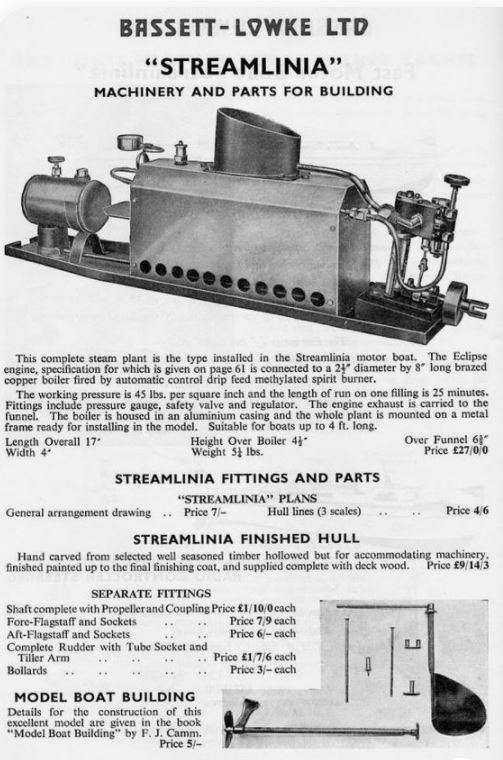
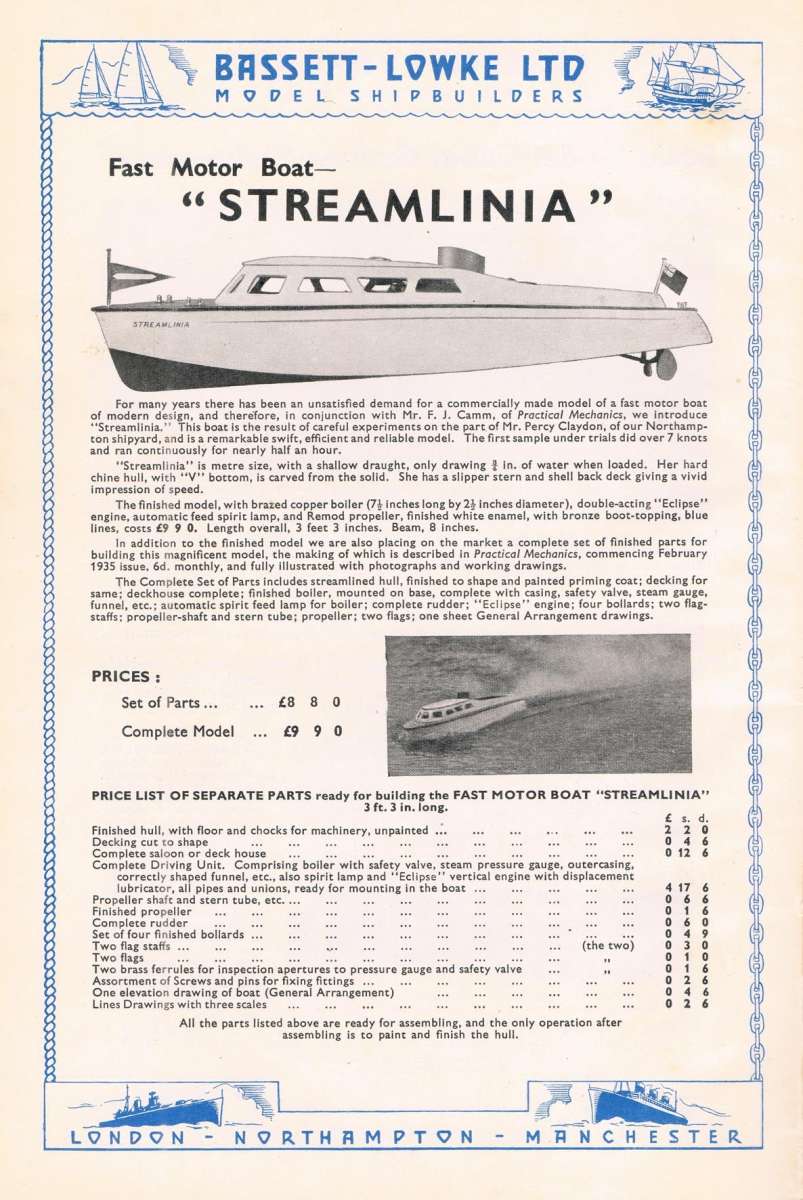
Out of interest the original Basset Lowke “Eclipse” was intended to be used with their “Streamlinea” boiler and they also had a hull by the same name which was 1.0m long so a twin of that sort of size could work in a slow moving Titanic though my gut feeling is that going up a bit in bore and running the engine at a slower revs could well be the better option, Richard S shoud be able to advise.
As for the installation it could be quite simple with just a boiler that will allow running until the water runs out ( as below) or you could go for something more complete like RichardB shows where you have tanks of additional water and a boiler feed pump run off the engine which means you can steam for a lot longer.


Many thanks for the additional information Andy, as I suspected it makes it significantly simpler to offer suggestions when we have a better idea of your levels of experience and the requirements for the engine. It also allows us to cut through the clutter of suggestions not best suited to you. As I strongly suspected an oscillator is almost certainly going to be a better option for you. This is based on the initial ease of manufacture, as Jason mentioned there are far less moving parts to make, and from the point of view of operation.
Most valve operated engines, be they piston valve or slide valve, frequently require two channels to control, one for reversing and one for throttle. There are some valve engines that can be operated by a single channel such as the Hemmens Caton but usually you require two. There is also an electronic device by Denes Designs which automatically mixes the two functions into a single channel but, again, adding complexity. A twin cylinder, double acting oscillator with a built in control valve will allow you full control from a single stick on the transmitter. We usually set this up to be the left hand stick up and down, so the operation remains exactly the same as it would be for most electrically powered models.
With that in mind one of the best sources for plans at the moment is still the Paddleducks site. They are paddlewheel orientated but they have a comprehensive plans and articles download section where you should be able to find a suitable double acting, twin cylinder oscillator plan. Have a look through here:
https://www.paddleducks.co.uk/smf/index.php?action=downloads;cat=9
One of the more active members there in the sites heyday was a very good friend of mine who used the ID Bogstandard and who built this engine, sadly now passed away:

The engine is a bar-stock engine so possibly one of the simpler engines to consider building as a first attempt. Having said that a small oscillator such as that is more than capable of powering a model boat of the 3 to 4 foot size with complete control through a single channel.
If you haven’t operated a steam model before just one or two other things that you might want to bear in mind.
1) Plan the internal layout carefully for accessibility. An open hull is much easier for a first model but, if enclosed the access needs to be quick and easy.
2) A boiler without a feed system is easier to operate for a first time operator. You should aim for a boiler that has a capacity to give you around 15 to 20 minutes running before you will have to bring it in for filling the boiler, emptying the separator and topping up the lubricator.
3) Probably one complexity that is well worth considering is controlling the burner to prevent over pressuring, lifting the safety valve and wasting energy. The easiest is a mechanical valve called an attenuator valve or there are electronically controlled ones as well.
4) Try to arrange the plant to enable the boiler and the gas tank to be sat on a common base. This will enable a bit of waste heat to transmit to the gas tank to offset the gas cooling effects.
5) Mounting the boiler, separator and engine all on a single base and using a simple pin type coupling makes for quick and easy removal of the plant for maintenance.
6) Disposable gas tanks enable dealing with the gas cooling effects but the tanks need a bit more space and are a lot more expensive to run than a refillable tank. Disposable tanks do not need any form of certification.
7) If you are considering building your own boiler discus with a club’s boiler inspector first. He will give you ideas on how to progress to ensure certification is easy.
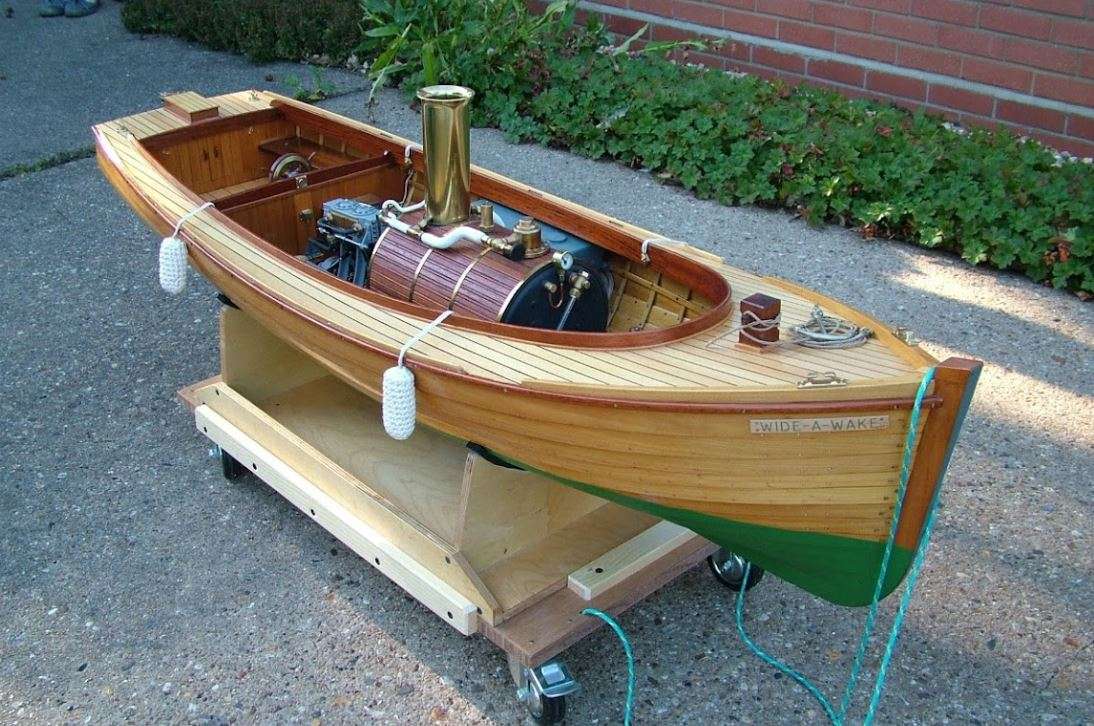
As I suggested above I think a first steam model has more chance of being built and operated successfully if it is kept simple. Large, imposing, impressive models such as the Wide-A-Wake certainly generate interest and look wonderful on the water but they can be complicated to build and need a degree of experience to operate. I have come across a good number of modellers in the past who have admitted they have half built Stuart Turner engines or not completed models sat on a shelf because they have found them too difficult to build, too time consuming or, frequently, too expensive. An engine of the Bogstandard type above I’m sure would be very rewarding to build and install in a model and be within the capabilities of a relative beginner with a technical background.
The engine by John “Bogsteandard is basically one of JP Duval’s designs which is on the web if you don’t want to register for Paddleducks
Home › Forums › Beginners questions › Topics
Started by: Greensands
in: Workshop Tools and Tooling
Andy Stopford
Started by: Nigel Graham 2
in: Manual machine tools
Michael Gilligan
Started by: Thomas Clarke
in: General Questions
Dave Halford
Started by:
John Hinkley
in: CNC machines, Home builds, Conversions, ELS, automation, software, etc tools
John Hinkley
Started by: jaCK Hobson
in: Workshop Tools and Tooling
jaCK Hobson
Started by: duncan webster 1
in: The Tea Room
JA
Started by: anonymouse
in: Materials
anonymouse
Started by: jimalm
in: Electronics in the Workshop
Bob Worsley
Started by: Robin Graham
in: The Tea Room
Howard Lewis
Started by:
Neil Wyatt
in: Exhibitions, Shows and Club Events
Neil Wyatt
Started by: Shaun Churchill
in: CAD – Technical drawing & design
Alan Wood 4
Started by: duncan webster 1
in: Electronics in the Workshop
Macolm
Started by: timdotd
in: Books
Bo’sun
Started by: jimalm
in: Introduce Yourself – New members start here!
Speedy Builder5
Started by: Redpiperbob
in: General Questions
peak4
Started by: TREVOR WILSON
in: Traction engines
Dave Halford
Started by:
drnewcomb
in: Manual machine tools
Speedy Builder5
Started by: Mick Bailey
in: Workshop Tools and Tooling
Nicholas Farr
Started by: Carl
in: Materials
old mart
Started by: Mike Henderson 1
in: Traction engines
Started by: larry phelan 1
in: The Tea Room
Roderick Jenkins
Started by: Andrew Skinner
in: Manual machine tools
bernard towers
Started by: zuji miko
in: Beginners questions
JA
Started by: AStroud
in: Work In Progress and completed items
AStroud
Started by:
JasonB
in: The Tea Room
renardiere7