Seal selection

Seal selection

Home Forums General Questions Seal selection

Viewing 25 posts - 1 through 25 (of 27 total)
  • Author
    Posts
  • #566917
    IanH
    Participant
      @ianh

      I have recently finished a conversion of an ML magneto to coil ignition. This involved squeezing a pair of coils into the magneto body along with some electronics. I have tested the magneto on a car (Morgan 3 wheeler) and the results are very encouraging.

      This is very much a prototype, and I am beginning to think about longer term testing and a version 2 with some improved weather protection. I have replaced the original magneto bearings with standard sealed bearings, but I would like something outboard of the sealed bearing to keep water (rain – the magneto is very exposed on the front of the car) out of the magneto body. I thought about a lip seal but wondered about how it would manage with no lubrication? In dry weather it would be running dry. An option might be to remove the seal on the bearing on the lip seal side anticipating some grease from the bearing lubricating the seal.

      Does anyone have any recommendations for this application? Probably looking at 3000 rpm, shaft diameter 15mm.

      Thanks

      Ian

      #28398
      IanH
      Participant
        @ianh
        #566924
        noel shelley
        Participant
          @noelshelley55608

          I think I would use a double lip (type R23) in Viton – it has a stainless spring, pick out the out board bearing seal and pack the gap with grease, or simply leave the seal in and pack gap with grease. Good Luck Noel.

          #566928
          J Hancock
          Participant
            @jhancock95746

            Is there any way you could fit a 'thrower' to the shaft , so that water doesn't get to the lip seal ?

            #566932
            Bo’sun
            Participant
              @bosun58570

              Hi IanH,

              If you've got room for a lip seal, why not another sealed bearing. The seals would at least be lubricated. "Belt & braces" maybe, but what's wrong with that?

              #566937
              IanH
              Participant
                @ianh

                That makes me wonder about using a separate seal at all – maybe just let the sealed bearing do its job?

                Ian

                #566957
                J Hancock
                Participant
                  @jhancock95746

                  That sealed bearing will not keep water out for very long.

                  #566975
                  old mart
                  Participant
                    @oldmart

                    Motorcycle wheels commonly rely on just the seals built into the bearings, even trials and scrambles machines, so you may be worrying too much.

                    #566987
                    Oily Rag
                    Participant
                      @oilyrag

                      Ian,

                      There are sealed bearings which are 'agricultural duty' which are designed with in built double sealing. These are commonly used on applications such as slurry pumps (slurry being a 'nice' word for the element SH 1T ) where they are exposed to slurry on one side and have the bearing element on the other side. They are also available in stainless steel for added corrosion resistance. Check out RS for something similar to stk no. 893-7458 (20 x 32 x 7) they are available in smaller sizes down to 6 mm shaft sizes.

                      Martin

                      #566990
                      Richard Millington
                      Participant
                        @richardmillington63972
                        Lip seal with open bearings on most OE motorbike wheel setups. Lip seal with sealed bearing will be fine.
                        #567064
                        Howard Lewis
                        Participant
                          @howardlewis46836

                          Before fitting the lipseal to the shaft,and housing, make sure that the shaft is lubricated, so that the lip does not run dry. If there is a keyway, ,or thread on the shaft, wrap that in masking tape before fitting the seal, to prevent damage to the lip.

                          Howard

                          #567073
                          IanH
                          Participant
                            @ianh

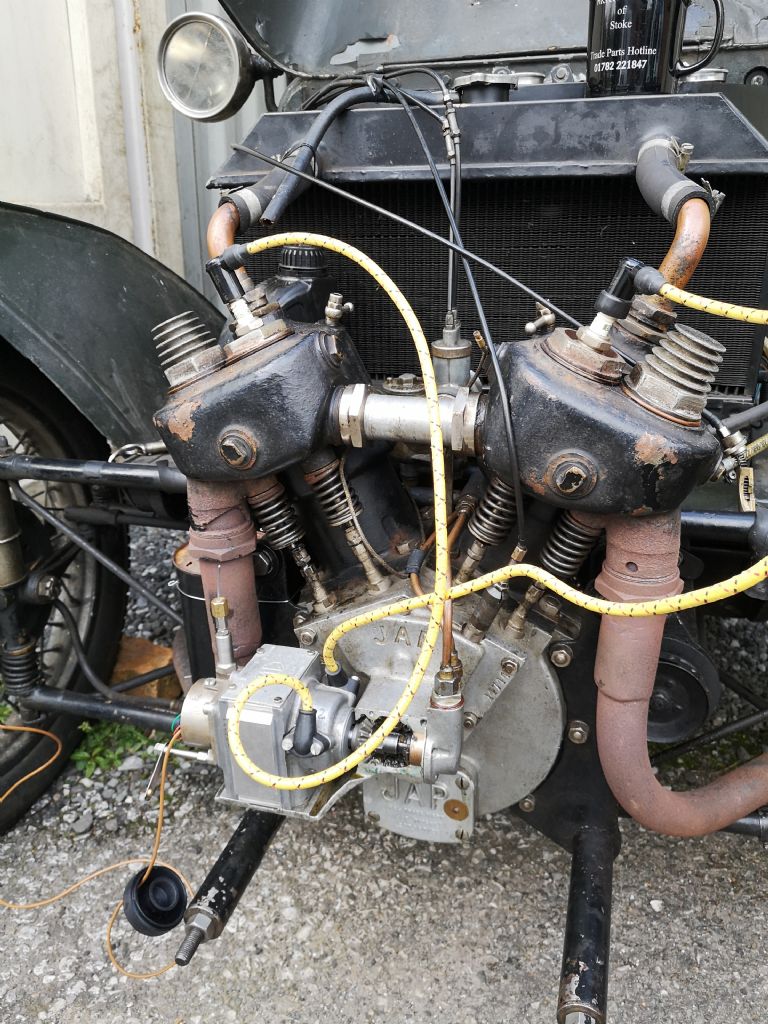
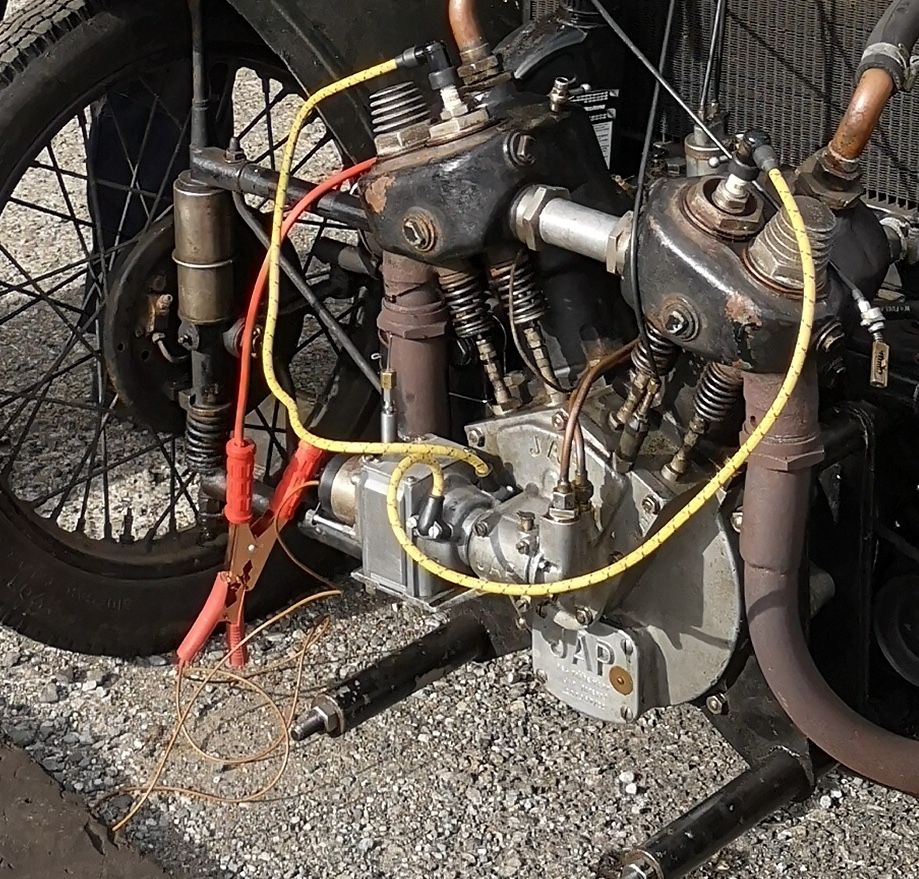
                            Just for interest, here is the magneto on the test car, a 1930 Family Morgan 3 wheeler. Yet to fit the cover over the bevel gear drive and fit the points cover.

                            img_20211011_104523.jpg

                            #567074
                            Oily Rag
                            Participant
                              @oilyrag

                              As Howard says, protect the lip during fitting.

                              A R23 (double lip seal ) can be run in a nominally dry situation by a smear of grease between the two lips, amazing how a little lube can last a long time.

                              Martin

                              #567110
                              old mart
                              Participant
                                @oldmart

                                If you run the mag at 3000 rpm it will outlast the motor.

                                #567112
                                IanH
                                Participant
                                  @ianh

                                  The mag will be lucky to see 3000 rpm on this sidevalve, and would most likely only see it momentarily before something catastrophic happened 😬, but some or the more exciting ohv engines will rev up to 6000 rpm and even a bit beyond. A rev limiter can be programmed into the mag if required to look after the engine.

                                  The electronic mag is designed to run clockwise or anti-clockwise, and by changing the discrete timing board mounted in a dummy cam ring, it can handle different engine types with different V angles.

                                  #567166
                                  Tim Stevens
                                  Participant
                                    @timstevens64731

                                    Let me guess – the mag drives a magnetic pick-up, this triggers an electronic device (in the mag or separate) which feeds a coil the secondary of which is fed to the distributor on the mag spindle. If so, I would be interested in the design of the pick-up. I have a four-cylinder version of a Lucas mag with the same mods, for my 1928 Lea Francis Meadows engine, which has served well (so far) but I hope to sort a more adjustable pick-up.

                                    Now your question: As long as the final feed to the plugs relies on carbon brushes (as early mags and two-cylinder versions often did) there should be no problem of corrosion arising from a fully waterproof sealed  system. This is because you should have no sparks generating corrosive gases. With the later mags and more modern coil distributors, though, there is a rotating spark gap which requires the space to be ventilated. Behind the radiator is usually dry enough, but of course not in your vehicle. I add this detail for anyone else with the same concerns but different.

                                    Do get in touch if I can help further.

                                    Tim Stevens [[email protected]]

                                    Edited By Tim Stevens on 17/10/2021 18:31:07

                                    #567181
                                    IanH
                                    Participant
                                      @ianh

                                      There are plenty of magnetos around where the defunct magneto becomes simply a housing for a set of points. You then you have coils, or a double ended coil tucked away somewhere under the bonnet. The original magneto HT leads are either removed or tucked away somewhere, and the working HT leads from the coil(s) emerge from under the bonnet. This works but loses something in terms of authenticity.

                                      The objective of this project was to develop a magneto that was indistinguishable from the original instrument. This means that the magneto HT leads must be real. The unit must be completely self contained, there can be nothing mounted remotely, and you can only have one wire (the original only has an earth wire) going to the magneto. The original cable advance/retard control must operate as normal. An extra rule I added in was that the double ended coil/wasted spark approach would not be used – it has been associated with carb fires on these engines.

                                      So we have two separate coils inside the magneto body, the secondaries essentially hard wired to the HT pickups – so no distributor and no carbon brushes. There is also a PC board tucked away inside the magneto body with two more or less independent ignition circuits. A relatively small diameter shaft driven by the standard bevel gear passes between the coils and through a hole in the centre of the main PC board. The shaft terminates in the points housing.

                                      The single wire is used to provide 12 volts from the ignition circuit.

                                      Inside the points housing is a dummy cam ring which provides a mounting for the trigger PC board. The manual advance retard control engages with the dummy cam ring in the normal way. The trigger board provides mounting for two Hall sensors, one for each circuit. Each sensor has an associated LED indicator light to allow you to time the magneto. The Hall sensors are mounted on the PC board, separated by an angle chosen to suit the V angle of the engine. On the end of the shaft is a taper on which is mounted a component with a ring magnet that presents N and S poles to the Hall sensors.

                                      To time the magneto, you mount it on the engine without worrying about timing, you just engage the bevel gears. You set the manual adv/retard to max advance and then turn the engine to the appropriate firing point for No 1 cylinder. You then rotate the ring magnet until it just fires No 1 (the LED indicator facilitates this). You nip the ring magnet holder up on its taper, fit the cover and then drive off 😃.

                                      Happy to have a chat about your set up – send me a pm If you would like to have a natter.

                                      Ian

                                      #567202
                                      J Hancock
                                      Participant
                                        @jhancock95746

                                        While driving , that 'drive shaft ' definitely needs protecting from rain,road dust, splashes ,etc.

                                        I am sure you can devise an easily detachable cover to do that .

                                        #567205
                                        IanH
                                        Participant
                                          @ianh

                                          There is a cover for the bevel gears and oil pump drive, here is a close up. You can also see the mag end cover in place.

                                          79cd6a5f-c133-4891-8429-be3f5b8b0e2a.jpeg

                                          #567225
                                          noel shelley
                                          Participant
                                            @noelshelley55608

                                            Back in the sixties I worked for a company producing Luminition. This used an infra red beam and chopper arm, this gave very accurate timimg, notably between one cylinder and the next ! The transistor switching of the primary coil gave a huge spark and with a little adaptation it could be made to fit almost anything. Electronics has moved on, and Hall effect transistors now seem the first choice. Just a thought. Noel.

                                            #567228
                                            J Hancock
                                            Participant
                                              @jhancock95746

                                              Everything brilliantly accessible , if only modern cars were like that !

                                              #567261
                                              IanH
                                              Participant
                                                @ianh

                                                Hi Noel,

                                                I converted my own 1933 coil ignition Morgan to electronic ignition something like 20 years ago. The set up I used was from Luminition and was based on a kit provided for Moto Guzzi motorcycles. The through beam infra red units fit neatly to the contact breaker housing, I made one IR unit fixed and arranged for a bit of adjustment on the other to fine tune the timing on No 2.

                                                The magneto contact breaker housing is smaller and I suspect you would struggle to get the hard wired Luminition through beam units in. If there was a PC board mounted equivalent through beam unit it would be a nice solution. Do you know of a suitable component?

                                                Ian

                                                #567339
                                                IanH
                                                Participant
                                                  @ianh

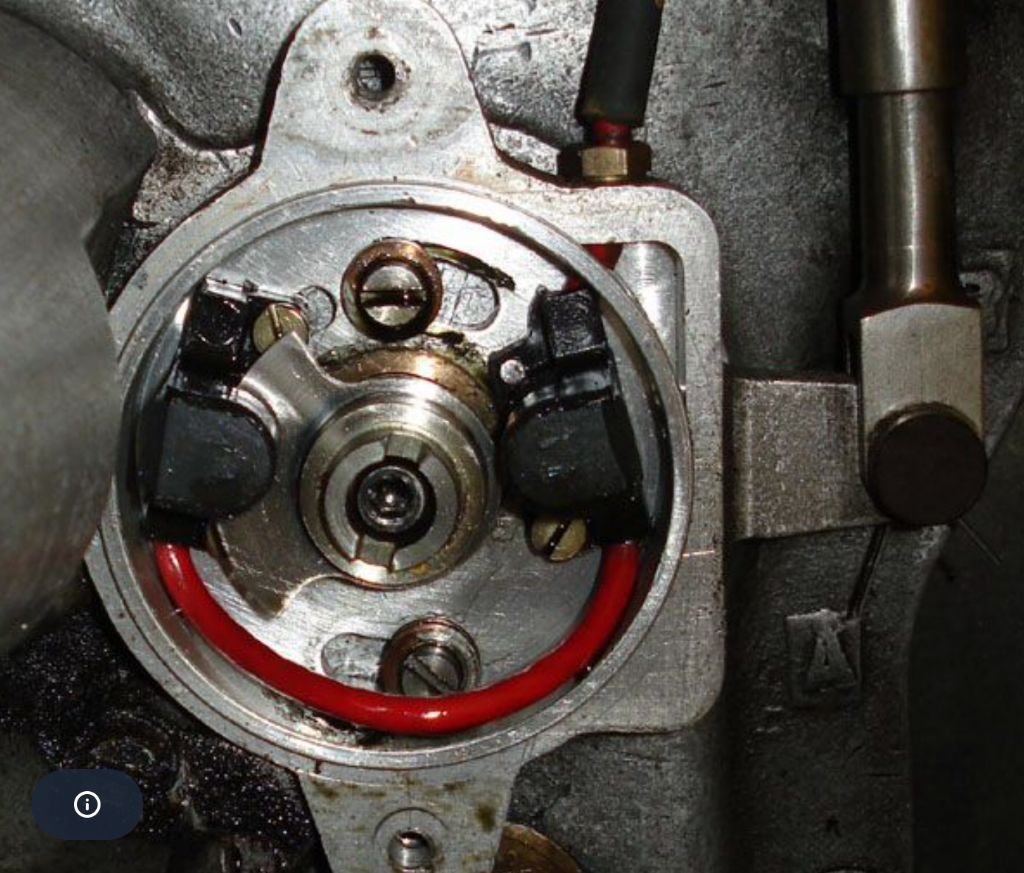
                                                  4e33493d-6163-4959-8e44-dddb45aa370e.jpegHere is the contact breaker housing with the Luminition through beam units installed. The 4 core cable heads off to the control unit under the bonnet and the coils.

                                                  #567357
                                                  Nigel McBurney 1
                                                  Participant
                                                    @nigelmcburney1

                                                    When I rode in trials on uk two strokes 60 years ago,the sealed wheel bearings did not last very long,some of current riders in pre 65 trials have added an extra neopriene seal out board of the bearing with some success, and if memory serves me correctly I believe that my 69 Bultaco had seals between hub and a bush on the spindle to help keep the water out,a mag does not get that much mud but will get a lot of rainwater and 3000rpm is an awful lot faster than a motor cycle wheel. If the ht leads are "live" then there should be a rubber cap which is a tight fit on the lead and the pick up to keep out of the mag,I found some of these rubber caps on a web site selling BTH mag spares,I required one to keep any rain water from the mag of a restored stationary engine. In those days it was difficult to keep water out of Villiers engine electrics and carbs with cut up inner tubes and plastacine,lot easier nowadays with modern sealants.

                                                    #567417
                                                    noel shelley
                                                    Participant
                                                      @noelshelley55608

                                                      Hi Ian,That's a neat adaption. The chopper arm seems very wide ? I was not involved in the electronic side of things but I would think it would be possible to use an infra red source and receiver to make a sensing head to suit almost any applications. Many units only used a single sensing head and a chopper arm of the required number of arms for the cylinders, ie 4,6,8. One of this systems benefits was the very precise relationship of the arms and therefore the accuracy of timing between cylinders, I seem to recall that .25 of 1 degree was claimed. The accuracy of the contact breaker cam was never very good and wear in the distributer bushes would result in timing scattered all over the show. A good coil and a damp night would result in a spectacular light show under the bonnet, and a warning that if you had any heart condition to keep well clear of a running engine ! There are some on here who may be able to help in the design of the electronics of a sensing head. Noel

                                                    Viewing 25 posts - 1 through 25 (of 27 total)
                                                    • Please log in to reply to this topic. Registering is free and easy using the links on the menu at the top of this page.

                                                    Latest Replies

                                                    Home Forums General Questions Topics

                                                    Viewing 25 topics - 1 through 25 (of 25 total)
                                                    Viewing 25 topics - 1 through 25 (of 25 total)

                                                    View full reply list.