DRO errors, or are they??

DRO errors, or are they??

Home Forums Workshop Tools and Tooling DRO errors, or are they??

Viewing 25 posts - 1 through 25 (of 33 total)
  • Author
    Posts
  • #503341
    Sam Longley 1
    Participant
      @samlongley1

      having a Machine Dro on my mill & being very happy with it I decided to buy a DRO for my lathe. I baulked at the cost so bought a Sino Dro at £299-00.

      Not so nice to read & already I wish I had gone to the same as I had bought before, but too late now.

      So my first task was to machine 5 bronze bushes for my boiler. Each one 12mm with a 13.5 mm shoulder. A simple operation. I expected to take a cut on the bronze , measure it with the micrometer, set the dro at whatever size ( say 14mm) then simply machine to 12mm.

      No such luck. On all 5 bushes, Whatever I tried I never achieved the 13.5mm or the 12mm. Each time I came out under my required size.

      I made sure that I locked the cross slide for the final cuts,So I began to suspect something wrong wth the DRO.

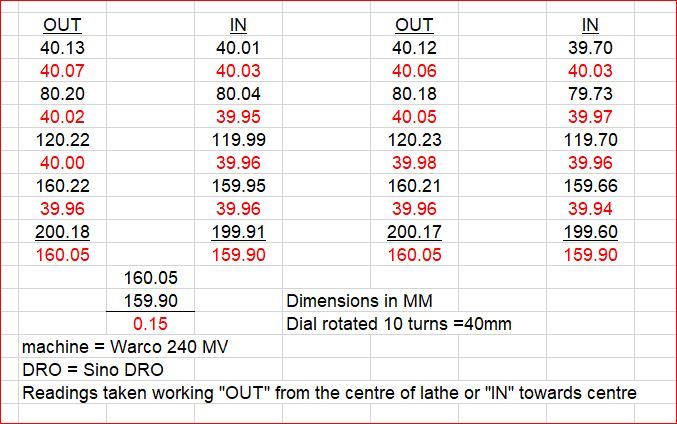
      I decided to wind the cross slide in and out the full width & see what readings I got at 40mm intevals. 40mm being 10 turns of the dial & easier to read zero after each set of 10 turns. I turned in one direction only to avoid backlash

      Below are the readings I obtained. The red figs are the differences. One will see that moving out from the centre the reading differences are different from those going in towards the centre. In only one case do they read 40mm. Also the overall dimension one way is 160.05 & the other way is 159.9. That makes it difficult to decide whether to calibrate the scale ( I think there is a facility to do this)

      So why am I getting these differences? I can accept that I can get a bit of a difference if I do not read the dial perfectly ( Surprised at that though) but is it the screw on my cross slide being out or the scale on the DRO being imperfect?

      is this sort of thing normal with cheap DRO's & can I ever expect to machine anything acurately on my elastic chinese Warco & my cheapo DRO

      dro snip.jpg

      Edited By Sam Longley 1 on 25/10/2020 09:03:20

      #19990
      Sam Longley 1
      Participant
        @samlongley1

        Problems with dimensions

        #503347
        jimmy b
        Participant
          @jimmyb

          I'd use a drop clock and check against that,. At least then you establish where the error lies.

          Jim

          #503348
          David Colwill
          Participant
            @davidcolwill19261

            Could you mount one of the scales from the lathe on the mill and compare the two?

            This would eliminate any errors from reading dials or tolerances in the screws.

            Regards.

            David.

            #503350
            IanT
            Participant
              @iant

              Hello Sam,

              I know nothing of DROs – although I've been interested in watching Joe Pie use his to great effect.

              However, my immediate reaction to your boring undersize, was spring in the boring tool. Did you take at least one spring pass on arriving at the measurement – because that may be the problem. Sorry if I'm teaching you to suck eggs here but just a thought….

              Regards,


              IanT

              Edited By IanT on 25/10/2020 09:33:29

              #503353
              Martin Cargill
              Participant
                @martincargill50290

                Chuck up a piece of bar (say25mm) take a small cut and measure the result. Set the DRO to zero and then take a second (small) cut. Measure again and compare the measured size to the DRO size. carry on in this manner (without resetting the zero on the DRO) See how the sizes compare. This will show if the DRO has a problem and eliminates any leadscrew or backlash issues. Remember to lock the cross slide each cut. Watch to see if the DRO changes size before/during/after each cut as this indicates a locking problem.

                Martin

                #503356
                Tony Pratt 1
                Participant
                  @tonypratt1

                  You are working with 2 possibly questionable components [cross slide screw & or DRO], I would use a decent DTI & slip gauges to check things out but you may not have them? You need to use some thing of an accurate size to measure the DRO readings against.

                  Tony

                  #503357
                  Dave Halford
                  Participant
                    @davehalford22513

                    1. Bronze is more awkward to cut, steel would be a better test.

                    2. It's better to check movement against a dial gauge not the lathe dials.

                    3. It could be mounting bracket slack or the scale may not be dead parallel to the cross slide travel.

                    4. Does the reading change when you lock the cross slide?

                    Edited By Dave Halford on 25/10/2020 09:46:16

                    #503362
                    Zan
                    Participant
                      @zan

                      Strange! Inconsistent errors. This is where slip gauges are a help

                      1. Carefully check all the mountings fir movement also the x slide screw, thrust bearing and the nut ( unlikely but it’s for elimination while you are at it, check the gibs) check there is no movement on a dti while the x slide is being locked

                      2 clamp a block of known size say a 321 block with a bar of flat clamped to it extend beyond say the headstock end So giving two test faces in the same plane
                      use a dti to set it parallel then feed in to zero on tthe block with the dti then zero the x slide dial n DRO. Check on the clamped bar. After a small movement to clear with the saddle
                      this will check the DRO and the feed screw

                      Ha! Some similar comments while I was thinking about this n typing!

                      Edited By Zan on 25/10/2020 09:53:17

                      #503364
                      Bob Worsley
                      Participant
                        @bobworsley31976

                        Zero DRO, grab hold of the toolpost and then as hard as possible push it in, record reading, pull it out, record reading.

                        Seems to me that the screw or nut are loose somewhere?

                        #503367
                        Sam Longley 1
                        Participant
                          @samlongley1
                          Posted by IanT on 25/10/2020 09:32:35:

                          Hello Sam,

                          I know nothing of DROs – although I've been interested in watching Joe Pie use his to great effect.

                          However, my immediate reaction to your boring undersize, was spring in the boring tool. Did you take at least one spring pass on arriving at the measurement – because that may be the problem. Sorry if I'm teaching you to suck eggs here but just a thought….

                          Turning outside diameter

                          #503369
                          Sam Longley 1
                          Participant
                            @samlongley1
                            Posted by Dave Halford on 25/10/2020 09:43:52:

                            1. Bronze is more awkward to cut, steel would be a better test.

                            2. It's better to check movement against a dial gauge not the lathe dials.

                            3. It could be mounting bracket slack or the scale may not be dead parallel to the cross slide travel.

                            4. Does the reading change when you lock the cross slide?

                            Edited By Dave Halford on 25/10/2020 09:46:16

                            I did try steel when I first fitted the DRO but thought it was just a learning issue.

                            My dial gauge will only give  max 25mm of movement & I would not be able to use the full 25mm, which is not a lot but I will try that- thanks

                            The scale is fitted to the cross slide so must be parallel & no way would it move, I am confident of that !!!

                            I lock the cross slide at the reading I want. it does tend to move whilst doing that, but there again there is always backlash in the cross slide, so one might expect the tiniest movement- or would one? I just make sure it is locked on the DRO reading i want. I also check that it does not move thereafter.

                            What I do not understand is why the measurement reads consistently 159.90  one way & 160.05 the other way.

                            I have done more readings than shown on the image & all are similar.


                            Edited By Sam Longley 1 on 25/10/2020 10:16:17

                            #503378
                            blowlamp
                            Participant
                              @blowlamp

                              If you ignore the DRO and only use the cross slide dial, do you then get repeatable diameters that match the cut you have applied?

                              Martin.

                              #503379
                              JasonB
                              Moderator
                                @jasonb

                                The fact you locked the slide on the final pass will have altered the amount the tool was able to deflect so you got a different cut. If your finish cut was also shallower than the measured cut again deflection will have been different.

                                To check the scale put a DTI against the slide and compare that to the DRO not the handwheel.

                                #503380
                                not done it yet
                                Participant
                                  @notdoneityet

                                  I made sure that I locked the cross slide for the final cuts,So I began to suspect something wrong wth the DRO.

                                  I expect this is where you went wrong (my underlining).

                                  #503382
                                  Nicholas Farr
                                  Participant
                                    @nicholasfarr14254

                                    Hi Sam, you are also comparing two sides of your screw/nut combination and there is the possibility of there being slightly more wear in one direction than the other, other factors to consider are the thrust bearing parts of to screw and drag on the dovetail slides can vary in one direction to the other by very slight movement in the gib of even due to wear/bedding in. As has been said, the only way is to check against a good DTI or a known good readout, mounted rigidly.

                                    Regards Nick.

                                    #503385
                                    blowlamp
                                    Participant
                                      @blowlamp

                                      If the unlocked cross slide was moving whilst taking a cut, I would expect the DRO reading to fluctuate too.

                                      Martin.

                                      #503386
                                      SillyOldDuffer
                                      Moderator
                                        @sillyoldduffer

                                        Agree with everyone who said don't compare the DRO with the dials.

                                        Generally even cheap DRO's measure accurately (within their design limits). One thing that might cause Sam's symptoms is the scale and head not aligning properly. Although the fit isn't super-critical, if the head presses against the scale at any point as it traverses, the scale bends slightly and readings pop to and fro as it flexes. Make sure the scale and head are fitted to the lathe so the head runs freely.

                                        As fitting DRO scales can be awkward due to obstacles, their alignment can be compromised, and tiny movements show up. Don't ask how I know…

                                        blush

                                        Dave

                                        #503391
                                        Michael Gilligan
                                        Participant
                                          @michaelgilligan61133
                                          Posted by Sam Longley 1 on 25/10/2020 08:59:58:

                                          having a Machine Dro on my mill & being very happy with it I decided to buy a DRO for my lathe. I baulked at the cost so bought a Sino Dro at £299-00.

                                          […]

                                          .

                                          There are many possibilities for error being caused by installation and/or use [and some excellent suggestions made here] … but :

                                          For the sake of sanity; my first step would be a side-by-side, or end-to-end, comparison of the two systems.

                                          … Could you easily fix the Sino scale on the table of the mill ?

                                          MichaelG..

                                          #503396
                                          Martin Connelly
                                          Participant
                                            @martinconnelly55370

                                            I have had a DRO on my lathe for a long time and CNC retrofitted it after the DRO was on it. The X axis DRO perfectly matches the CNC inputs, set a 10mm move in CNC and DRO shows a 10mm move. However I found that when using the DRO for manual work it was always a case of get close to target size and measure the workpiece then reset the DRO to match. There are too many variables when using a lathe to get consistent results over more than a few millimetres. Examples are workpiece gets slimmer so flexes more or the diameter changes so the cutting speed at the tool changes and so changes the forces on it. Any small error in tool height will also cause apparent errors. So on a lathe I think the X axis DRO is an aid to manual machining but should not be expected to allow hitting a size perfectly after taking off substantial material. The Z axis DRO works great for making things to size because surfacing and facing are such different processes.

                                            My experience, YMMV

                                            Martin C

                                            #503397
                                            Alistair Robertson 1
                                            Participant
                                              @alistairrobertson1

                                              I will say that if the scale is not absolutely parallel to the movement of the slide then there is a (very) strong possibility of an error in your readings.

                                              We had a Dro fitted to a large lathe and the big shafts we were machining were giving problems with errors. On checking the cross-slide scale we found a 0.05mm error on the alignment the DTI from one end to the other. The supplier assured us that that amount would not matter but when the service engineer came along we were able to prove to him that it did. He said that most crossslides were much shorter and any error would not show up.

                                              So very careful alignment is uaually the answer!

                                              #503402
                                              John Baguley
                                              Participant
                                                @johnbaguley78655

                                                I had a similar problem after fitting a DRO to my mill. I decided to check the DRO readings against the movement set by the leadscrew and dial and there were significant differences. Naturally, it being a cheap DRO from China I thought the errors were with the DRO. The first thing I checked was the alignment of the scale but that was fine. Well within spec.I decided to check the DRO readings against a 12" stack of gauge blocks and the readings were spot on. The original errors that I got were due to errors in the leadscrew and not the DRO.

                                                John

                                                #503420
                                                Sam Longley 1
                                                Participant
                                                  @samlongley1
                                                  Posted by John Baguley on 25/10/2020 11:46:42:

                                                  I had a similar problem after fitting a DRO to my mill. I decided to check the DRO readings against the movement set by the leadscrew and dial and there were significant differences. Naturally, it being a cheap DRO from China I thought the errors were with the DRO. The first thing I checked was the alignment of the scale but that was fine. Well within spec.I decided to check the DRO readings against a 12" stack of gauge blocks and the readings were spot on. The original errors that I got were due to errors in the leadscrew and not the DRO.

                                                  John

                                                  Problem against that is that if I machine a diameter of 13.5mm & set the DRO then machine a step to 12mm ( In stages) the difference should be 1.5mm regardless of the dials. Currently it is not.

                                                  I have , this morning machined some steel pieces as smooth as I can get them, each with a step of a diameter recorded on the DRO. Tomorrow I am taking them round to a pattern making friend & asking him to verify the dimensions with his micrometer. I want to make sure that I am measuring the diameters correctly. . I have also used a dial gauge on the end of the cross slide & that varies with the DRO depending where along the slide I am reading (ie near the centre or well out from the centre) .

                                                  I am confident that the scale is parallel. It is only 150mm long & It showed no error on a dial guage

                                                  Although the lathe is 6 years old it has had little use.


                                                  From your comment above I put the dial guage on my mill table & over 20mm it matches the m machines DRO perfectly on both X & Y dimensions

                                                  Edited By Sam Longley 1 on 25/10/2020 13:04:36

                                                  #503427
                                                  Dave Halford
                                                  Participant
                                                    @davehalford22513
                                                    Posted by Sam Longley 1 on 25/10/2020 13:02:59:


                                                    I have , this morning machined some steel pieces as smooth as I can get them, each with a step of a diameter recorded on the DRO. Tomorrow I am taking them round to a pattern making friend & asking him to verify the dimensions with his micrometer. I want to make sure that I am measuring the diameters correctly. . I have also used a dial gauge on the end of the cross slide & that varies with the DRO depending where along the slide I am reading (ie near the centre or well out from the centre) .


                                                    Edited By Sam Longley 1 on 25/10/2020 13:04:36

                                                    It's very easy to force a reading a few thou smaller than it really is.

                                                    So the DRO and dial gauge both agree, do the machine dials also agree?

                                                    It's possible that cross slide screw varies along it's length, or your centre height is not spot on so the tool digs in a little. 

                                                    Edited By Dave Halford on 25/10/2020 14:27:25

                                                    #503437
                                                    Sam Longley 1
                                                    Participant
                                                      @samlongley1
                                                      Posted by Dave Halford on 25/10/2020 14:18:25:

                                                      Posted by Sam Longley 1 on 25/10/2020 13:02:59:

                                                      I have , this morning machined some steel pieces as smooth as I can get them, each with a step of a diameter recorded on the DRO. Tomorrow I am taking them round to a pattern making friend & asking him to verify the dimensions with his micrometer. I want to make sure that I am measuring the diameters correctly. . I have also used a dial gauge on the end of the cross slide & that varies with the DRO depending where along the slide I am reading (ie near the centre or well out from the centre) .

                                                      Edited By Sam Longley 1 on 25/10/2020 13:04:36

                                                      It's very easy to force a reading a few thou smaller than it really is.

                                                      So the DRO and dial gauge both agree, do the machine dials also agree?

                                                      It's possible that cross slide screw varies along it's length, or your centre height is not spot on so the tool digs in a little.

                                                      Edited By Dave Halford on 25/10/2020 14:27:25

                                                      No!! I said that the DRO & dial gauge do not agree. The difference depends on how far i am out from the centre

                                                      To be honest in the end the dials do not matter. They are just a method of checking. If i can measuer a diameter with the micrometer then set the dro to that measurement I would expect to just turn the dial until the DRO gives the reading i want. That way all backlash etc is eliminated. Trouble is it is not happening & it is not happening in a linear fashion so I cannot simply re calibrate the scale & i do not know why.

                                                      I just wondered if others had a similar problem & how they solved it. It may be that they have not actually noticed it or if they have they have not bothered & just adjusted for it as they went.Seems a waste of a DRO if they have though.

                                                    Viewing 25 posts - 1 through 25 (of 33 total)
                                                    • Please log in to reply to this topic. Registering is free and easy using the links on the menu at the top of this page.

                                                    Latest Replies

                                                    Viewing 25 topics - 1 through 25 (of 25 total)
                                                    Viewing 25 topics - 1 through 25 (of 25 total)

                                                    View full reply list.