What can I use this encoder for?

What can I use this encoder for?

Home Forums General Questions What can I use this encoder for?

Viewing 21 posts - 1 through 21 (of 21 total)
  • Author
    Posts
  • #148849
    Ian P
    Participant
      @ianp

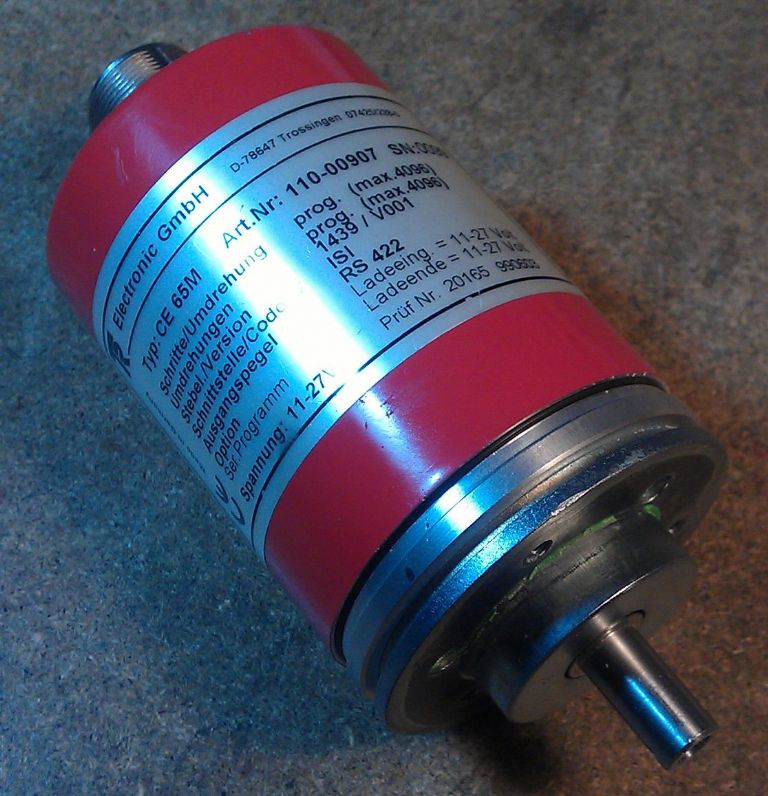
      Absolute Encoder.jpg

      I have had this lying around for a five years now and have yet to find a use for it!

      Its a programmable absolute encoder which gives 4096 pulses per revolution, and, counts to 4096 rotations. If I fitted a rubber tired wheel with a circumference of 1m I could accurately measure distances up to 4km. Thing is, I don't think I will ever need to do that!

      Anybody got any suggestions as to what practical purpose I could put it to in the workshop

      #23237
      Ian P
      Participant
        @ianp

        Has 0.25mm resolution over 4km (with 300mm wheel)

        #148851
        John Haine
        Participant
          @johnhaine32865

          A GREAT manual pulse generator for your CNC mill or lathe!

          #148852
          John Stevenson 1
          Participant
            @johnstevenson1

            Electronic gear hobber.

            See MEW 108

            #148853
            Michael Gilligan
            Participant
              @michaelgilligan61133

              Very high-resolution Indexing for a Rotary Table or Dividing Head ?

              MichaelG.

              .

              P.S. if you need the Manual, this appears to be it.

              Edited By Michael Gilligan on 03/04/2014 22:40:22

              #148857
              Les Jones 1
              Participant
                @lesjones1

                Hi Ian,
                You could connect it to a leadscrew on a machine to give a position readout. (I used this method for my first attempt at fitting a DRO to my milling machine.) You could also use it coupled to s DC motor together with the "UHU Servo" design. This would make it behave like a stepper motor but with closed loop feedback.

                Les.

                #148925
                Ian P
                Participant
                  @ianp
                  Posted by John Haine on 03/04/2014 22:38:10:

                  A GREAT manual pulse generator for your CNC mill or lathe!

                  John

                  I have seen the wheels/knobs fitted to CNC machines but never thought there was anything special behind them. I assumed there would be a bit of a flywheel and an encoder. I would not think that an encoder with a large number increments would be needed as presumably there is a layer of software involved to get the right 'feel' to the system.

                  I think the encoder I have would be wrong for MPG, and incremental type would be more appropriate.

                  Ian P

                  #148928
                  Ian P
                  Participant
                    @ianp
                    Posted by Michael Gilligan on 03/04/2014 22:39:34:

                    Very high-resolution Indexing for a Rotary Table or Dividing Head ?

                    MichaelG.

                    .

                    P.S. if you need the Manual, this appears to be it.

                    Edited By Michael Gilligan on 03/04/2014 22:40:22

                    Michael

                    I have some of the documentation for the encoder but had not seen the one you linked to, so thanks. As you suggest it would make a very high resolution indexer, coupling it to a rotary table is the tricky bit though and any gearing is likely to degrade the potential accuracy. The fact that it is an absolute device would not really be any advantage and because its output signals is serial (RS422) it needs a PC or microcontroller so starts getting a bit involved (for me anyway).

                    Ian P

                    #148929
                    Ian P
                    Participant
                      @ianp
                      Posted by Les Jones 1 on 03/04/2014 22:59:34:

                      Hi Ian,
                      You could connect it to a leadscrew on a machine to give a position readout. (I used this method for my first attempt at fitting a DRO to my milling machine.) You could also use it coupled to s DC motor together with the "UHU Servo" design. This would make it behave like a stepper motor but with closed loop feedback.

                      Les.

                      I think that rather than coupling it to the leadscrew it would be better to fit a small drum to the shaft and convert it to a 'wire encoder'. Keeping it free of swarf is the main problem.

                      Ian P

                      #148934
                      Neil Wyatt
                      Moderator
                        @neilwyatt

                        If you had two, you could combine them with friction clutches and stepper motors to make a 'go to' telescope mount that can also allow for any manual shifts you make, although the resolution is a bit low for actual equatorial tracking.

                        Neil

                        #148940
                        Ian P
                        Participant
                          @ianp

                          Neil

                          I don't know much about telescopes and astronomy but if a 4096 increment encoder is considered low, what is the normal method of getting high resolution tracking? I assume your suggesting direct (1:1) coupling of the encoder to the axis.

                          If I could think of a use for it my encoder could resolve to 1 part in 16,777,216 +/- one digitface 6

                          Ian P

                          #148944
                          Michael Gilligan
                          Participant
                            @michaelgilligan61133
                            Posted by Ian Phillips on 04/04/2014 21:45:07:

                            I don't know much about telescopes and astronomy but if a 4096 increment encoder is considered low, what is the normal method of getting high resolution tracking? I assume your suggesting direct (1:1) coupling of the encoder to the axis.

                            .


                            Ian,

                            Decent Telescope mounts typically use Worm drives … and the bigger the ratio the better.

                            MichaelG.

                            .

                            Edit: Here is a rather nice example of a home-made Equatorial 


                            Edited By Michael Gilligan on 04/04/2014 23:08:36

                            #148994
                            Neil Wyatt
                            Moderator
                              @neilwyatt

                              Hi Ian,

                              4096 steps would be good enough to point a telescope in the 'right direction', but 1/4096 of a day is about 20 seconds. Even through my camera I can see things moving across the sky and the moon moves about 1/6 of its disk in 20 seconds so it would not be good enough for tracking.

                              Michael,

                              I've been playing with the idea of buying an 8" parabolic reflector and making my own mount (put the cash into the optics) but I hadn't thought of making something quite as hefty as that!

                              Neil

                              #149024
                              Ian P
                              Participant
                                @ianp

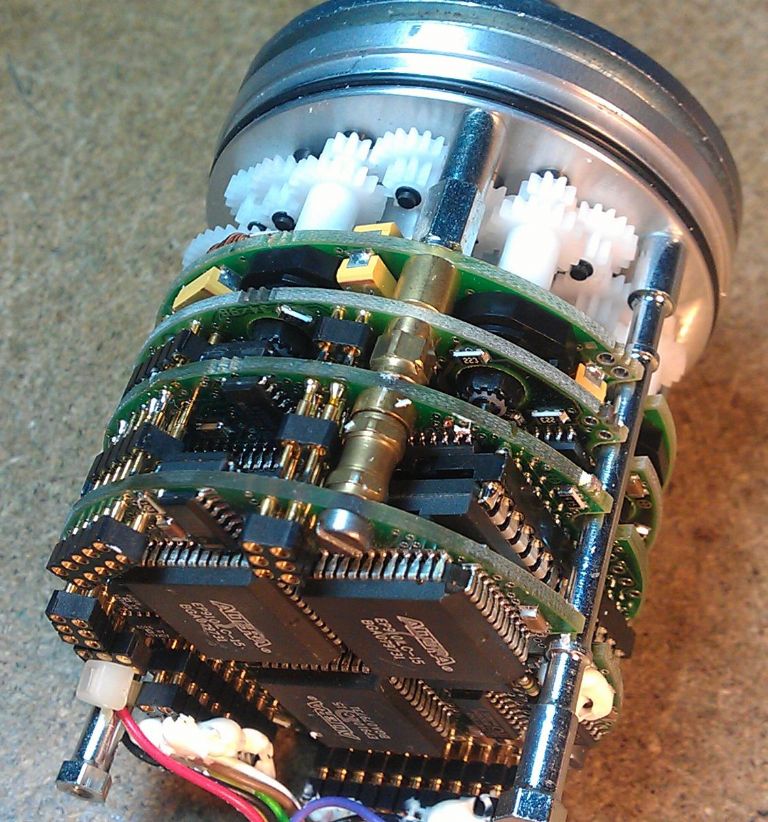
                                encoder internals.jpgNeil

                                Directly coupling the encoder to the axis would give the results you showed but I would not think that is how its normally done. Unless you are on top of a mountain you wont use anywhere near even half of one revolution of the encoder. Presumably encoders when used would be on the shaft of a highly geared drive motor, Correctly geared the encoder I have would resolve to 2-1/2 hundredths of a second.

                                Photographs would still be blurred as I assume long exposures are the norm.

                                If you are taking pictures whilst a telescope is tracking under power is the speed constant (once calibrated) or is it servo controlled in some way from the object being imaged?

                                Ian P

                                Edited By Ian Phillips on 05/04/2014 20:52:09

                                #149031
                                Michael Gilligan
                                Participant
                                  @michaelgilligan61133
                                  Posted by Neil Wyatt on 05/04/2014 15:13:13:

                                  … making my own mount … but I hadn't thought of making something quite as hefty as that!

                                  .

                                  Rather lovely though, isn't it

                                  Meanwhile … you wll probably find this interesting.

                                  MichaelG.

                                  #149098
                                  Neil Wyatt
                                  Moderator
                                    @neilwyatt

                                    HI Ian,

                                    most scope mounts use steppers so an encoder is redundant. My thought was an encoder direct coupled to the scope would allow you to manually re-target and let the software know what you have done. I don't know how fast you can operate that unit but it could be possible to gear it up.

                                    Neil

                                    #149106
                                    Johnboy25
                                    Participant
                                      @johnboy25

                                      Ian…

                                      what a nice bit of kit this is! You could always make a DRO with it. Dividing the output down to a more usefull pulse per rev number using an Arduino micro controller board and a bit of code….

                                      John

                                      Edited By Johnboy25 on 06/04/2014 20:46:11

                                      #149128
                                      Ian P
                                      Participant
                                        @ianp
                                        Posted by Neil Wyatt on 06/04/2014 18:39:41:

                                        HI Ian,

                                        most scope mounts use steppers so an encoder is redundant. My thought was an encoder direct coupled to the scope would allow you to manually re-target and let the software know what you have done. I don't know how fast you can operate that unit but it could be possible to gear it up.

                                        Neil

                                        Max encoder RPM is 6000, but full electronic operational performance is limited to 3000RPM.

                                        Purely out of interest, what sort of reduction ratio is typical between the stepper and the axis?

                                        Ian P

                                        #149179
                                        Neil Wyatt
                                        Moderator
                                          @neilwyatt

                                          THE IDEAL

                                          If I make an EQ mount for my camera, ideally I need it to move with a resolution of better than 1 pixel. Even with the reduced resolution of the display I can still watch objects move across the background in real time.

                                          The moon comes out about 1200 pixels across a diameter. 1200pix ~= 0.5 degree.

                                          360 x 2 x 1200 = 864,000

                                          So ideally around 2 million steps per revolution. I have a big stepper that can do do 1.5 degrees or 240 steps, so that would need to be geared down by 4000:1

                                          That would require the stepper to be driven at about 23Hz.

                                          IN PRACTICE

                                          In practice viewing is never perfect, especially using a camera, and even stars show up as a small group of pixels, not single pixels. Exposures of over a second and stars start to appear as short trails. Perhaps 1000:1 gearing and a ~5Hz drive rate would be adequate.

                                          All of which sounds do-able, but it might be expecting a lot of the quality of the drive train to keep it smooth!

                                          So I resort to google and find:

                                          **LINK**

                                          This give 20-30 arc-seconds as typical which is 64,800 steps, but claims to give a result of 2.5 arc-seconds using feedback from an optical encoder, which is roughly where me 'ideal' would be sitting.

                                          Can anyone elucidate further?

                                          Neil

                                          #149185
                                          Andy Ash
                                          Participant
                                            @andyash24902

                                            From that, I would recommend making an electronic indexing rotary table.

                                            I guess you would need a stepper motor too.

                                            I'm not a huge fan of CNC. I know it has uses and does things I couldn't on a manual machine.

                                            For setting out holes accurately on a PCD, machining flats, or gears.

                                            An electronic indexer must be king.

                                            Touch on, type in the number, press the index button, drill the hole, cut the tooth, whatever!

                                            #149191
                                            Ian P
                                            Participant
                                              @ianp

                                              Andy

                                              If I used a stepper I would not need the encoder (assuming its in a well designed system that does not miss steps).

                                              What I was trying to find out with my original question, is what piece of workshop equipment would make full use of the this encoders ability to know its absolute position (to 1 place in about 17 million) even after its been switched off.

                                              I think all of the suggestions so far could be done with an incremental encoder.

                                              Ian P

                                            Viewing 21 posts - 1 through 21 (of 21 total)
                                            • Please log in to reply to this topic. Registering is free and easy using the links on the menu at the top of this page.

                                            Latest Replies

                                            Home Forums General Questions Topics

                                            Viewing 25 topics - 1 through 25 (of 25 total)
                                            Viewing 25 topics - 1 through 25 (of 25 total)

                                            View full reply list.