Timing Piston Valves

Timing Piston Valves

Home Forums Locomotives Timing Piston Valves

Viewing 23 posts - 1 through 23 (of 23 total)
  • Author
    Posts
  • #839822
    James A
    Participant
      @jamesalford67616

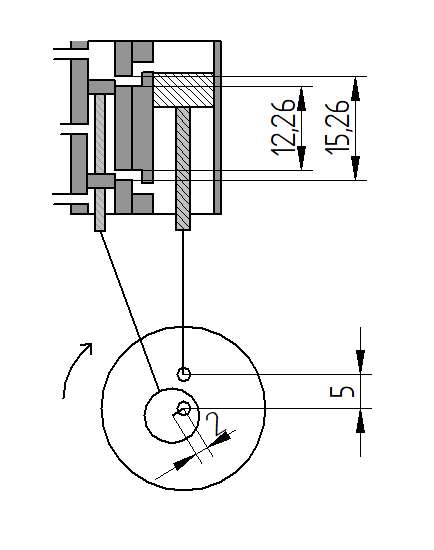
      I am trying to draw some plans for a simple piston valve engine, but am a bit unsure about the timing of the valve to the piston. Can anyone clarify the following for me, please?

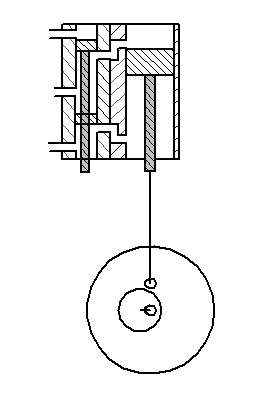
      If the valve has no lap or lead and the piston is at top dead centre, am I right in thinking that the piston valve will also be at top centre, with both ports being open? I have put the drawing below: I hope that it is clear.

      Screenshot 2026-03-01 180144

      James.

      #839825
      JasonB
      Moderator
        @jasonb

        Assuming air is coming in from the middle you still want the valve to trail the crank just like it does with a slide valve leading. You valve should be just coming to midway when the piston is at TDC or BDC

        #839828
        JasonB
        Moderator
          @jasonb

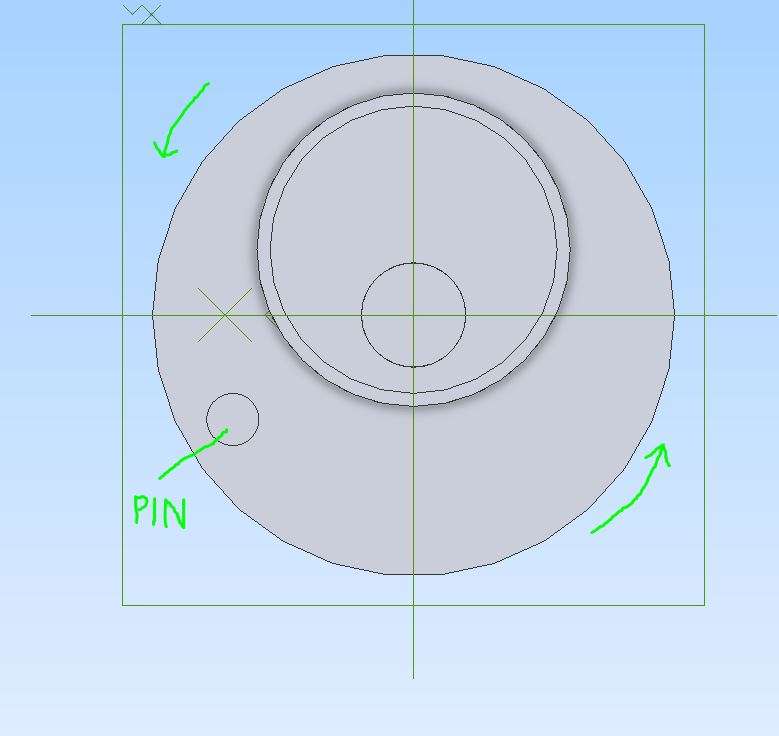
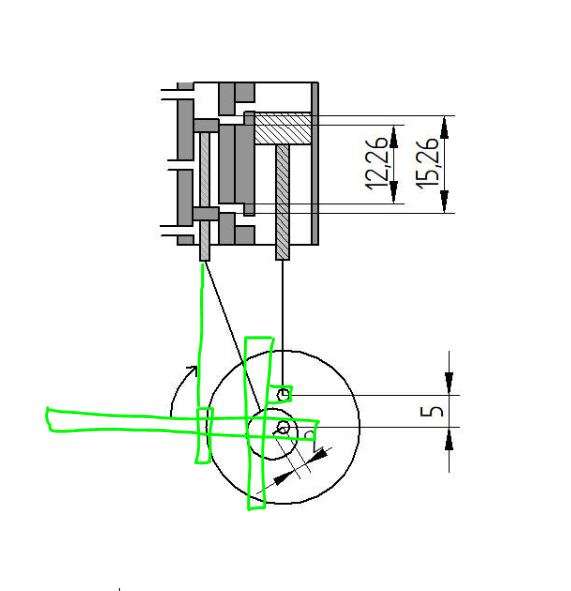
          Here is an end view of a crank with integral eccentric you can see that the high point of the eccentric is a long way (approx 120deg) behind the crankpin.

          piston crank

          #839830
          James A
          Participant
            @jamesalford67616

            Thank you, Jason.

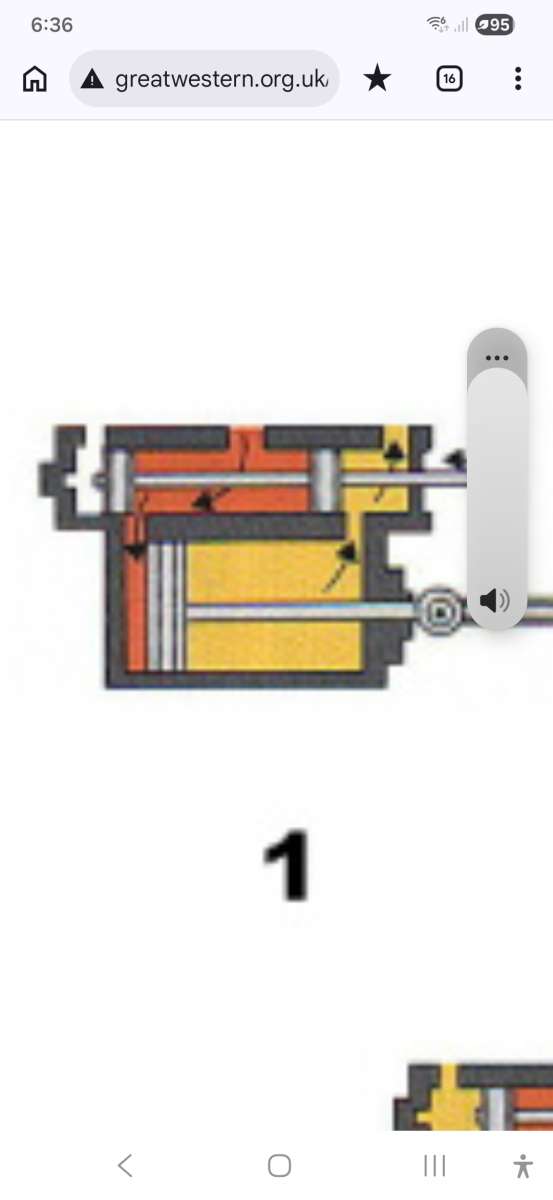
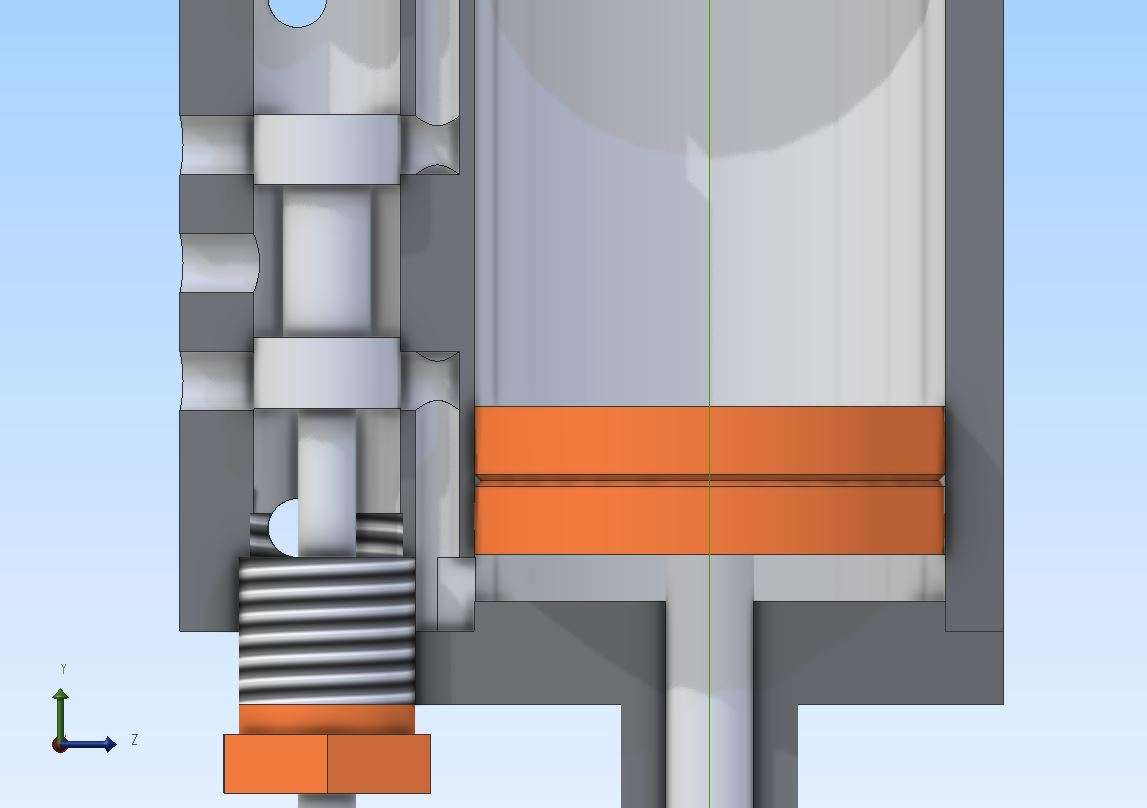
            Yes, steam will be coming in from the middle port. I thought that the position would be as you describe, but the position in the image below confused me.

            James

            Screenshot_20260301_183646_Chrome

            #839858
            Nigel Graham 2
            Participant
              @nigelgraham2

              There should be some lap, otherwise the engine will run non-expansively. Apart from wasting steam (or air), it will not run smoothly.

              This explains why in Jason’s illustration the crank and eccentric centre-lines are at that 120º angle, not 90º, to each other.


              The lap is the amount by which the valve in its mid-travel overlaps the port; given in a simple piston-valve by the two valve heads being thicker on their admission faces the inner ones). The eccentric travel is also made larger for it.

              So that it starts to open to admission the eccentric is taken a bit further round the crankshaft to compensate for it. The amount of lap and the eccentric setting are very much a matter of the individual engine’s design.

              The extra 30º in the drawing, leading for a slide-valve, trailing for a piston-valve, to give that lap displacement is purely illustrative. It is not necessarily 30º in all engines.

              In practice the port does not necessarily open fully to admission, but does so for exhaust.


              #839865
              James A
              Participant
                @jamesalford67616

                Thank you for the further details, Nigel.

                I am unclear, though, why the valve positions in Jason’s explanation and the screenshot that I posted appear to be so very different.

                James.

                #839867
                duncan webster 1
                Participant
                  @duncanwebster1

                  because the screen shot is wrong. With the piston at tdc the valve should be just very slightly open to let steam in. This is called the lead. The valve heads should also be wider than the ports. This is called lap. As others have said you will be better off with some lap

                  #839875
                  JasonB
                  Moderator
                    @jasonb

                    Without showing the crank & eccentric positions in the screen shot it is hard to get the full picture. But bear in mind that the piston will be moving very slowly as the crankpin is around the TDC position but the eccentric will be moving the valve far faster as the lead is putting the max throw in the direction of travel not accross it like the crank. This means the ports are uncovered very quickly in relation to the piston only moving a short distance.

                    So in that image 1 the inlet port may have only just become uncovered as the piston was 1mm from TDC, by the time it has reached TDC the port is half uncovered as shown* and by the time the piston has moved down from TDC by 1mm the port could be completeley uncovered. So that is say 90% of the valves travel while the piston may have moved less than 10% of it’s travel.

                    * The image does not show the valve at the top of it’s travel a sthe port is not fully uncovered. If you look at the full set of four images B shows the valve at it’s furthest travel and teh port fully uncovered yet the piston is well on it’s way to BDC

                    How the Steam Engine of the Locomotive Works

                    #839878
                    James A
                    Participant
                      @jamesalford67616

                      Thank you for the detailed replies which I shall read, carefully, this evening. I shall then amend my drawing and post a revised version with a few dimensions added.

                      James.

                      #840103
                      Nigel Graham 2
                      Participant
                        @nigelgraham2

                        To help you, if you don’t already have these formulae, the valve-travel in mid-gear should be 2(lap+ lead).

                        In full-gear in either direction, the travel = 2(lap + lead + port opening).

                        On a simple engine working in just one direction at a steady cut-off and no mid-gear setting, i.e. without reversing-gear, this value = the eccentric’s total throw. (I.e. twice its eccentricity).

                        Not all engines have lead, but it is anyway very small. It starts the steam flow as the piston reaches dead-centre. Too much lead will give something of an unwanted braking effect.

                        The lap is the critical factor as that gives the cut-off hence expansive working.

                        #840114
                        Charles Lamont
                        Participant
                          @charleslamont71117

                          Expanding on what others have said about ‘lead’: It takes several degrees of crank rotation to open the valve. If the valve were timed to be fully open when the piston arrived at dead centre, then it would need to have been partially open well before. This means there would be steam pressure pushing the piston in the wrong direction. In high speed engines that works well, but most engines prefer the valve to start to open only just before the piston reaches the end of its stroke.

                          #840138
                          Martin Johnson 1
                          Participant
                            @martinjohnson1

                            You really need to draw a Reuleaux diagram to uderstand things.  See here

                            Reuleaux Diagram

                            Martin

                            #840419
                            James A
                            Participant
                              @jamesalford67616

                              Thank you for the replies and advice. I have amended my design and hope that it is now about right. Does the following arrangement appear to be workable or am I still barking up the wrong tree?

                              Port size 1.5mm
                              Valve width 2mm
                              Lap 0.5mm
                              Valve Travel 4mm
                              Eccentric throw 2mm
                              Eccentric is 120 degrees behind the piston


                              Screenshot 2026-03-07 104905

                              James.

                              #840423
                              JasonB
                              Moderator
                                @jasonb

                                That looks about right.


                                Have the valve so the outer two faces are 15.26 so the 0.5mm overlaps are on the inner edge. That way you get the exhaust opening before the inlet.

                                #840427
                                Martin Johnson 1
                                Participant
                                  @martinjohnson1

                                  You would normally design to uncover the full port to exhaust, so with a valve travel of 4 mm then 2mm ports would be good (or reduce valve travel to 3mm).

                                  As Jason says, the exhast edges on the valve should be the (presently) 15.26 dimension.  You can have exhaust lap as well but not really relevant to models.

                                  Draw that Reauleaux diagram and you will find the correct eccentric angle.

                                  I hope the proposed engine has a longer con rod than your diagram shows which will give less angularity on the valve drive.

                                  Martin

                                  #840436
                                  JasonB
                                  Moderator
                                    @jasonb

                                    Martin, the design will fully uncover the exhaust ports. Also fully uncovers the inlet. 2mm ports risks having both open if drilling is a bit off, reduced travel will not fully open the inlet

                                    As for the conrod, I expect it is a schematic drawing and the crankshaft actually runs at 90deg to what is shown. Could get a few crashes if the conrod and eccentric are on the same plane

                                    Here is one I prepared earlier. Slightly larger but very similar proportions.

                                    2mm ports

                                    2.5mm valve

                                    0.5mm lap

                                    2.5mm throw = 5mm movement

                                    Reduce all those by 25% and I just have slightly less lap.


                                    piston

                                    #840527
                                    James A
                                    Participant
                                      @jamesalford67616

                                      Thank you for the further replies and reassurance that the overall design is about right.

                                      Martin: I shall draw the diagram as you suggest to see what angle it produces. Thank you for the suggestion.

                                      Jason: Thank you for taking the time to check and comment upon the design. The inside dimension of the valve faces is as you suggest, with a half millimetre lap on the inside faces.

                                      As you assume, the crank and flywheel aspect is only schematic to show the off-set for the crank pin and the eccentric and needs some more work. I am a little puzzled, though, when you say about the crankshaft running at 90 degrees to what is shown. Could you please clarify that?

                                      Regards,

                                      James.


                                      #840528
                                      JasonB
                                      Moderator
                                        @jasonb

                                        Just that the view is end on to the crankshaft in your schematic sketch when really it will be side on to the crankshaft eg 90deg difference.

                                        90

                                        #840553
                                        Martin Johnson 1
                                        Participant
                                          @martinjohnson1
                                          On JasonB Said:

                                          Martin, the design will fully uncover the exhaust ports. Also fully uncovers the inlet. 2mm ports risks having both open if drilling is a bit off, reduced travel will not fully open the inlet.

                                          Yes, I know.  I said “You would normally design to uncover the full port to exhaust”.  Implication being the inlet port will do what it will.  Getting exhaust steam out is more difficult than getting live steam in – hence the conventional approach.  Desining too much travel increases angularity and will make events worse than they need be.

                                          Martin

                                          #840564
                                          duncan webster 1
                                          Participant
                                            @duncanwebster1

                                            Bear in mind that full size locomotive would have a stroke of approx 600mm and run at about 360rpm max. Pressure drop through ports is proportional to steam speed squared (roughly), so unless this little engine with its 10mm stroke is intended to run at very high speed there is no need to get worked up about port size.

                                            If anyone doubts this refer to Prof Hall’s actual measurements of cylinder pressure in model sized engines

                                            #840631
                                            James A
                                            Participant
                                              @jamesalford67616
                                              On JasonB Said:

                                              Just that the view is end on to the crankshaft in your schematic sketch when really it will be side on to the crankshaft eg 90deg difference.

                                              90

                                              Thank you for the clarification, Jason. Yes: this is the arrangement that I plan to use in practice for the flywheel and crankshaft. It would have helped if I had read your post correctly and not thought “connecting rod” when I had read “crankshaft”.

                                              James.

                                              #840960
                                              James A
                                              Participant
                                                @jamesalford67616
                                                On Martin Johnson 1 Said:

                                                You really need to draw a Reuleaux diagram to uderstand things.  See here

                                                Reuleaux Diagram

                                                Martin

                                                I tried to draw one of these diagrams this morning, but struggled. The diagram is based on a line for the lap and a line for the lead. The position of these then appears to be critical in placing the remaining lines and determining the angles. However, my design does not incorporate any designed lead. How does the diagram work in this sceanario?

                                                Regards,

                                                James.

                                                #840967
                                                JasonB
                                                Moderator
                                                  @jasonb

                                                  Not really my cup of tea but if you have no lead then I would have thought the second vertical line is 0mm from the lap line eg just a single line. Same with the two angled lines your zero exhaust lap would coincide with the diameter line.

                                                Viewing 23 posts - 1 through 23 (of 23 total)
                                                • Please log in to reply to this topic. Registering is free and easy using the links on the menu at the top of this page.

                                                Latest Replies

                                                Home Forums Locomotives Topics

                                                Viewing 25 topics - 1 through 25 (of 25 total)
                                                Viewing 25 topics - 1 through 25 (of 25 total)

                                                View full reply list.