Thytronic 155

Thytronic 155

Home Forums Workshop Tools and Tooling Thytronic 155

Viewing 11 posts - 1 through 11 (of 11 total)
  • Author
    Posts
  • #233979
    Andy Sproule
    Participant
      @andysproule22368

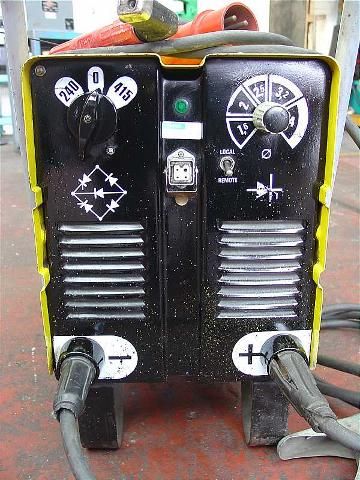
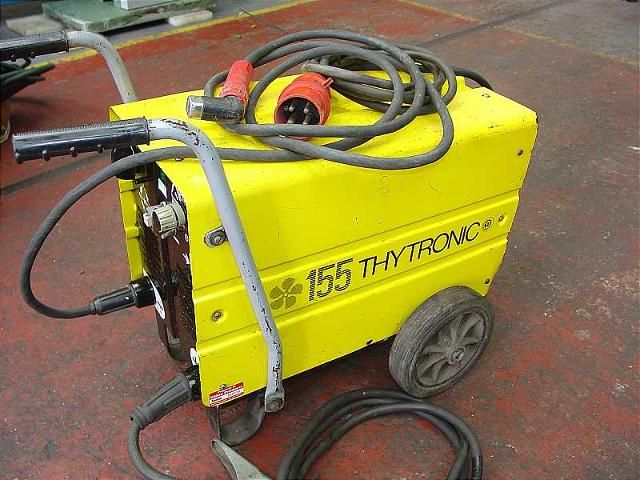
      welder 2.jpgHi,posted this on the welding forum but had no luck.Does anyone have or has had one of these?I was given it and was told it could be used to tig weld there were no leads with the one I got.The welder in the pics are identical to the one I have.welder 1.jpg

      #18057
      Andy Sproule
      Participant
        @andysproule22368
        #233995
        Simon Williams 3
        Participant
          @simonwilliams3

          Don't take this as the gospel word, because I'm still fairly far down the bottom of this learning curve… However my understanding is that pretty much any DC welder will be usable as the power supply for DC TIG welding, but you need the ancillary bits and gismos around it to make it work.

          In this instance you need a TIG torch and a source of shielding gas. This machine doesn't seem to have the controls for the gas built in, so the gas goes direct to the torch, and needs to be controlled somehow by the trigger. The other thing is that the welder you have doesn't have an on off switch, so the torch is always live, neither (AFAIK) have HF start feature so you will have to use it scratch start (I.e. the electrode is touched to the work piece and then dragged away quickly (but not too far!)

          All this, and the inherent difficulties of learning to TIG weld (it's not as easy as the guys on Youtube make it look) mean that this isn't, I don't think, the place from which to start. Just getting the electrode contaminated will frustrate you for days – so I think a beginner has got to start with a more expensive but more controlled machine and concentrate on the technique. Once you've got good at it and understand causes of weld faults then make it more difficult by using equipment which is more difficult to control and set up (but why would you want to!!!!)

          You can buy a TIG torch on ebay which has a trigger controlled valve which will turn the gas on and off, you may be able to remote control this welder via that four pin plug on the front panel, if you get past that you will almost certainly get demoralised because scratch-start almost inevitably contaminates the electrode and then you have to stop and grind it clean and so on and so on. Then there's the little matter of hand-eye co-ordination… As they say in these parts – "If I was you wouldn't start from ere!"

          If you want to TIG weld buy a TIG welder. It's quite an expensive facility to have in your workshop, but it's very useful.

          #234047
          Nicholas Farr
          Participant
            @nicholasfarr14254

            Hi Andy, all of what Simon says, but you could bid on this **LINK** and then all you have to do is get the gas sorted. There are other makes of course and were a cheap way for industry to upgrade to TIG back in the seventies, probably not many kicking about now though, so you may have to wait a while for one to pop up by which time you may have saved a bit more money and be able to buy a modern inverter type.

            Regards Nick.

            Edited By Nicholas Farr on 10/04/2016 19:19:53

            #234050
            michael darby
            Participant
              @michaeldarby61557

              Hi the 4 pin plug is for current control hence the local/remote switch

              #234051
              Nicholas Farr
              Participant
                @nicholasfarr14254

                Hi Andy, a newer one **LINK** but a bit more money and you would have to buy a TIG torch separately.

                I also agree with Michael about the current control, which is handy if your welding in a hard place to get in and out of and can not reach the welder control.

                Regards Nick.

                Edited By Nicholas Farr on 10/04/2016 19:28:53

                #234054
                Max Tolerance
                Participant
                  @maxtolerance69251

                  I agree with the other posters about the problems of using TIG. I used to have a full set up, HF strike, trigger control, the lot, and could make a decent weld, no problems. However I sold the kit because I only really used it for stainless steel fabbing and the cost of the gas got too much to justify keeping it. I suggest before you go down the route of buying a welder you check out the cost of the shielding gas. I used Argo shield from a large industrial gas supplier, it was only available in the larger sizes and although the cost of the gas may have been justifiable the rent on the cylinder made it very expensive. Too expensive for the amount of use I made of the kit. Now I just drop into the local sheet metal works when I need stainless welded. I still have a MIG set since the Co2 is not so expensive and small cylinders can be bought quite easily. This will do most of my needs in other metals and IMHO is the better buy.

                  #234069
                  Muzzer
                  Participant
                    @muzzer

                    Stick and TIG require constant current (CC) sources, whereas MIG / MAG requires constant voltage (CV). So it's possible to use one of these "HF units" to piggy back onto a stick welder but not a MIG /MAG machine. I used to have one of these HF units but never used it as I acquired a proper Interlas AC/DC TIG unit. An add-on HF unit is only half a solution.

                    Generally they contain the HF source itself (a spark gap and an air cored transformer to couple the spark to the torch for arc initiation and stabilisation) and solenoids for the gas and water. These need some form of control, so there's usually a torch or foot trigger input and sometimes a post flow timer. As the power source is in control of output current, there is no simple way to vary or enable the arc from the HF unit.

                    There are some pretty decent looking inverter TIG welders these days. If I didn't have the Interlas I'd probably have gone for one myself. If you only need to weld steel, DC will suffice. If you want to be able to weld aluminium, you will need an AC machine which will cost more. I can't imagine why you'd want to buy an ancient HF unit when you could instead spend the money on an inverter welder.

                    The gas companies here in the UK have us over a barrel in a nice cosy "rental" cartel. When I lived in Canada, I was able to buy my cylinders and buy my gas refills – no use, no cost. And the cylinders and gas were pretty reasonably priced. You've just got to grin and bear it.

                    #234070
                    Muzzer
                    Participant
                      @muzzer

                      BTW, this is the splitting image of my CEA Monomig 180 MIG welder, so presumably of very similar vintage, albeit a different model (MIG in my case). I acquired it 10 years ago and when I contacted CEA for a manual back then, they said it was "very very old". They managed to dig something out from their archives which was useful to me but it does mean that our machines date from The Ark and can't be long for this world. Just be wary before investing too much time and money on it. I've already had a few intermittent issues with mine….

                      #234072
                      Simon Williams 3
                      Participant
                        @simonwilliams3

                        I'd hate to think that we've dissed TIG to the point of it being pointless. It is a very versatile process, capable of welding almost any combination of metals (within reason), and giving excellent results from the point of view of appearance (a good stainless weld is indeed a pretty thing) and function (but only if you know how!)

                        That "know how" is a problem, but is surmountable – or at least I hope it is otherwise I'm wasting my time! The cost is an issue, and here it isn't just the cost of the equipment but also that the cost of the gas is cruel. You can buy some very neat all built in inverter based TIG welders, (and incidentally get a useful stick/ MMA welder in the bargain) for not a lot of money – typically less than these arc controllers seem to go for. But the cost of the gas is significant, and the rods are also not cheap because you need a wide variety of them to work with a wide variety of metals, such as us model makers and home machinists like to play with.

                        Having said all this, I like the TIG because there is nothing quite so useful at welding small items together. MIG is good, but clumsy if you are looking at something on the scale you can hold in one hand. Gas (Oxy fuel) is also useful, but the cost of running it has got really out of order.

                        If Andy would like some advice on the most cost effective way of tackling the issue of sourcing shielding gasses for TIG I'm sure we can pool our knowledge. For my part I've given up on BOC and Air Products (UK based) and I'm now on the system where you "buy" the deposit on a cylinder, and pay for the refill as and when you want it. It's still expensive, but it seems to be the best deal in town for the amount of gas I want to use.

                        Rgds to all Simon

                        #234077
                        Andy Sproule
                        Participant
                          @andysproule22368

                          Thank you for all the replies,plenty of food for thought.Didn't realize there would be problems and large cost with the gas.Will start looking at new machines.

                        Viewing 11 posts - 1 through 11 (of 11 total)
                        • Please log in to reply to this topic. Registering is free and easy using the links on the menu at the top of this page.

                        Latest Replies

                        Viewing 25 topics - 1 through 25 (of 25 total)
                        Viewing 25 topics - 1 through 25 (of 25 total)

                        View full reply list.