Threading myth …. busted!

Threading myth …. busted!

Home Forums The Tea Room Threading myth …. busted!

Viewing 18 posts - 26 through 43 (of 43 total)
  • Author
    Posts
  • #561183
    Martin Kyte
    Participant
      @martinkyte99762

      Couple of observations (and I use both methods, half angle and sraight in)

      Firstly there are times when cutting a thread is desireable on a fairly slender workpiece in order to ensure that the thread is concentric before using a die to clean up. Top slide set over puts less pressure on the work so you get less deflection. In addition to this the tool does not have to be exactly ground to the precise thread angle (hard to acheive if the tool has side rake). If it is slightly less than 55 or 60 degrees (according to thread form) the flank angles will be generated by the toslide angle provided the leading flank of the tool has been set accurately.

      Secondly for tools that have only a small radius on the tip (such as inserts) it is neccessary to take extra cuts once depth has been acheived by moving the tool axially to generate the flat bottom of the thread and ensure that the flanks are correct (that the threads are not too wide). This is not easy with a set over top slide.

      regards Martin

      Far from being a 'Myth' it's a case of horses for courses. Choose the methodology that suits the thread you want to cut and the equipment at your disposal.

      #561253
      Chris Mate
      Participant
        @chrismate31303

        Interesting, I am curious to know if the thread strenght, torgue that can be applied, had been tested for each method-?

        #561322
        Chris Crew
        Participant
          @chriscrew66644

          "Ahh, but what you're forgetting Gray is that most on this forum work to NASA standards and have limited time for what used to be a HOBBY. Also from an angled luddite."

          Ian, I loved your comment, it really amused me!

          I had a bit of a light-hearted 'run-in' a few months back with someone over the correct setting of clearances of lathe change-wheels. Personally, at the time, I thought the suggestion that was being made was pedantic nonsense and tried to say we are mostly amateurs pottering around in back-shed workshops, not working in the tool-room at Rolls-Royce. Naturally, I was sentenced to being in the wrong!

          Your comment encapsulates the point I was trying to make wonderfully. Well Done!

          #561345
          Graham Meek
          Participant
            @grahammeek88282

            A Cautionary warning,

            One problem I have with advancing the topslide in unison with cross-slide is this could cause a collision if working to a shoulder or a face when using a lathe equipped with a screw-cutting clutch.

            Using such lathes the screwcutting finishing point is initially set before screwcutting commences, sometimes with thou's spare as regards clearance. Thus for anyone who has made any of my screw-cutting clutches I would urge them to follow the method outlined in the articles.

            Generally,

            Henry Ford's Company once said, when asked to build the Rolls-Royce Merlin Engine during the war, that they could not work to the Rolls Royce drawings as the tolerances were too slack.

            Just because we work in sheds, or sometimes centrally heated workshops, there is no reason in my book why we cannot aspire to make better things. Those who look at their work, and think, I could have done that better are to be commended. This is how we were taught to hone our skills as apprentices, and as far as I am concerned this ethos has paid me huge dividends.

            Regards

            Gray,

            Edited By Graham Meek on 05/09/2021 12:01:13

            #561350
            SillyOldDuffer
            Moderator
              @sillyoldduffer

              Posted by Martin Kyte on 04/09/2021 11:11:05:.

              Far from being a 'Myth' it's a case of horses for courses. Choose the methodology that suits the thread you want to cut and the equipment at your disposal.


              Horses for courses is my take too, though maybe a bit of a myth has developed due to conservative Model Engineers ignoring tool improvements since the angled method was first developed in the 19th century. We have better horses now!

              The angle method dates back to treadle lathes and plain carbon steel cutters. These need all the help they can get, giving angled threading a strong advantage.

              Time marches on. The value of angled cutting became questionable after lathes beefed up to drive HSS cutters. HSS revolutionised metal turning because the alloy's improved heat-hardness can remove metal 5 or 6 times faster than a Carbon Steel cutter. After about 1900 lathes became much more rigid to handle the extra strain. However, many small workshops were – and still are – equipped with relatively light machines, ½HP being typical fdr many years. And even with HSS and a hefty lathe, there are times when angled threading is worth it.

              Time marched on again. Carbide can remove metal 10 to 20 times faster than HSS, and – provided the machine has sufficient power and rigidity and the work can take the strain – cutting threads straight-in is fast and efficient. VFDs have made it possible for hobbyists to own seriously chunky ex-industrial 3-phase machines so many have the wherewithal for brutal cutting.

              I don't think the border between angled and straight threading is clear cut; it depends on what you have My 800W mini-lathe could thread straight-in with a carbide insert but I felt more comfortable using the angled method. Mini-lathes aren't tough guys. Since upgrading to a WM280, about 3 times bigger than a mini-lathe, I almost always thread straight-in with carbide inserts because the bigger machine handles it well. But I still angle cut occasionally – mostly slender work, exactly as Martin says.

              Horses for courses.

              Dave


              Edited By SillyOldDuffer on 05/09/2021 12:25:55

              #561360
              Speedy Builder5
              Participant
                @speedybuilder5

                For the last year or so, my threading has not been up to scratch, single point screw cutting most often cleaned up with a chaser. I needed to change some gears the other day to get 19tpi yesterday and noticed that the 56 t gear (standard) was actually 58 t !!

                Boxford with screw cutting G/box

                #561380
                Martin Kyte
                Participant
                  @martinkyte99762

                  In my opinion all this 'blame it on the treadle lathe' is a red herring.

                  How many treadly lathes had screw cutting. Even when they did the amount of power available was far greater than that required to do single point thread cutting with any method straight or angled.

                  More important is rigidity and as I said with small workpieces the limiting factor is often the resilience of the piece being threaded. As to accuracy the angled method essentially generates the flank angle by the topslide offset and is less reliant on the accurate grinding of the tool.

                  The downside is, as I said, the difficulty in thinning the threads to obtain the correct fit so you can use the same tool for various TPI's

                  regards Martin

                  #561390
                  JasonB
                  Moderator
                    @jasonb

                    Martin how does the angled method produce the profile and not need a correctly ground tool? General advice is to set the topslide to less than half the thread angle, to get the right flank correct would need it to be exacyly half and even then you could get a stepped flank. Also if tool angle is in excess of the thread angle. it will again cut the flank wrongly.

                    Partial form inserts also allow you to cut a range of tpi and will go deeper on the lower end of their range so no need to move them lengthwise to get the valley flat

                    #561394
                    ega
                    Participant
                      @ega

                      JasonB:

                      Re your question to Martin – I think there is at least a partial answer to this in GHT's book.

                      #561415
                      Martin Kyte
                      Participant
                        @martinkyte99762
                        Posted by JasonB on 05/09/2021 16:13:59:

                        Martin how does the angled method produce the profile and not need a correctly ground tool? General advice is to set the topslide to less than half the thread angle, to get the right flank correct would need it to be exacyly half and even then you could get a stepped flank. Also if tool angle is in excess of the thread angle. it will again cut the flank wrongly.

                        Partial form inserts also allow you to cut a range of tpi and will go deeper on the lower end of their range so no need to move them lengthwise to get the valley flat

                        Hi Jason

                        That assumes you can create a perfect tool geometry. Almost nothing about screwcutting is going to be exact.

                        Lets assume that you can grind a tool tip to just less than 55 degrees (whitworth thread). We shall grind some side rake so that will reduce the angle anyway. Lets assume its a degree less. Setting the topslide to 27.5 degrees and the leading flank of the tool bang on to a guage. The tip of the tool will travel to the angle set by the slide which will be correct. You are perfectly right about the steps on the trailing flank but how big are they. Lets take 4 thou cuts. The 'steps' will then be 4 X Tan 1 = 4×0.0174 or 0.07 thou which is to my mind an acceptable surface finish especially if you tidy up with a die. You can always get a tool to be less than the angle you want with a simple guage so tools with bigger thread angle can be avoided.

                        You are again correct that inserts will allow threads to be cut deeper but you may not always want to lose core diameter.

                        It does make sense to set to not quite the thread angle with inserts ensuring that the bulk of the cutting is done on the front flank giving plenty of space for the chip to be cleared and to ensure a scraping cut on the trailing edge to tidy up.

                        I would say this was setting to slightly greater than half the angle though.

                        In general I would use the set over method for my own home ground tooling (and I possess a cutter grinder so angles are generally close) and straight in with inserts.

                        I shall have to dig out GHT and remind myself what he says.

                        Screwcutting is one of those things that most of us don't do enough of to really get good at it, me included. Mostly taps and dies suffice for our needs, and I suppose I am really thinking of the need to produce a precision thread without additional chasers, dies or files. Getting something that will do up tight and not fall off after 5 minutes is easy. Threads to induce accurate smoothe motion or ensure perfect concentricity and pitch well thats something else.

                        As I said before it helps to realise what a particular method solves for you before choosing it. Normally we do like I did and use the way we were shown until the "hang on a minute" moment comes or you start reading 'Thread' threads if you excuse the pun.

                        regards Martin

                        #561422
                        JasonB
                        Moderator
                          @jasonb
                          Posted by Martin Kyte on 05/09/2021 18:07:48:

                          Posted by JasonB on 05/09/2021 16:13:59:

                          Martin how does the angled method produce the profile and not need a correctly ground tool? General advice is to set the topslide to less than half the thread angle, to get the right flank correct would need it to be exacyly half and even then you could get a stepped flank. Also if tool angle is in excess of the thread angle. it will again cut the flank wrongly.

                          Partial form inserts also allow you to cut a range of tpi and will go deeper on the lower end of their range so no need to move them lengthwise to get the valley flat

                          Hi Jason

                          That assumes you can create a perfect tool geometry. Almost nothing about screwcutting is going to be exact.

                          Lets assume that you can grind a tool tip to just less than 55 degrees (whitworth thread). We shall grind some side rake so that will reduce the angle anyway. Lets assume its a degree less. Setting the topslide to 27.5 degrees and the leading flank of the tool bang on to a guage. The tip of the tool will travel to the angle set by the slide which will be correct. You are perfectly right about the steps on the trailing flank but how big are they. Lets take 4 thou cuts. The 'steps' will then be 4 X Tan 1 = 4×0.0174 or 0.07 thou which is to my mind an acceptable surface finish especially if you tidy up with a die. You can always get a tool to be less than the angle you want with a simple guage so tools with bigger thread angle can be avoided.

                          This is not the usually advocated method using half the angle, most would say set to 27 for 55deg or 29.5 for a 60deg thread

                          You are again correct that inserts will allow threads to be cut deeper but you may not always want to lose core diameter.

                          In which case a full form insert can be used

                          It does make sense to set to not quite the thread angle with inserts ensuring that the bulk of the cutting is done on the front flank giving plenty of space for the chip to be cleared and to ensure a scraping cut on the trailing edge to tidy up.

                          You won't get that scraping cut on the right side with a home ground tool if the tool is under the angle

                          I would say this was setting to slightly greater than half the angle though.

                          In general I would use the set over method for my own home ground tooling (and I possess a cutter grinder so angles are generally close) and straight in with inserts.

                          I shall have to dig out GHT and remind myself what he says.

                          Screwcutting is one of those things that most of us don't do enough of to really get good at it, me included. Mostly taps and dies suffice for our needs, and I suppose I am really thinking of the need to produce a precision thread without additional chasers, dies or files. Getting something that will do up tight and not fall off after 5 minutes is easy. Threads to induce accurate smoothe motion or ensure perfect concentricity and pitch well thats something else.

                          As I said before it helps to realise what a particular method solves for you before choosing it. Normally we do like I did and use the way we were shown until the "hang on a minute" moment comes or you start reading 'Thread' threads if you excuse the pun.

                          regards Martin


                          Another assumption is that I may just buy an insert and holder which will have the correct angles handy for those without a T&C grinder. The insert may even have the right radii which helps if it's a non standard size and a die is not available or simple because the thread was screwcut to save buying a die

                          Also being that the insert is held at right angles to a nice long holder it is far easier to set it correctly than trying to line things up by eye with a fishtail thread gauge as you have a 100mm plus length of holder to line up.to.

                          Lastly far easier to get the angle of feed correct using the straight in cross slide method* than risking the topslide scale being right or having to faff about setting with say a sine plate if you have one. ( * Bit of sideways movement if it's a deep thread or light machine to ease the load)

                          Given all those factors the beginner may get a more accurate result with inserts fed straight in. Infact don't really even need to buy a threading insert and holder if you have a DCMT or DCGT tool and want to do 55deg threads Or TCMT/TCGT for 60deg unless you want to get close to a shoulder. Well that's my way of looking at it anyway.


                          Edited By JasonB on 05/09/2021 19:30:43

                          #561425
                          Michael Gilligan
                          Participant
                            @michaelgilligan61133
                            Posted by Martin Kyte on 05/09/2021 15:06:32:

                            In my opinion all this 'blame it on the treadle lathe' is a red herring.

                            How many treadly lathes had screw cutting. Even when they did the amount of power available was far greater than that required to do single point thread cutting with any method straight or angled.

                            .

                            The round-bed Drummond for one …

                            ”… the inexpensive Type A "Round Bed" was announced in the Model Engineer Magazine of May 21st, 1908. Publicised, with some fanfare, as the first £5 screwcutting lathe …”

                            That said, I do agree regarding the power

                            MichaelG.

                            .

                            Ref.__ http://www.lathes.co.uk/drummondroundbed/

                            Edited By Michael Gilligan on 05/09/2021 19:38:26

                            #561448
                            Martin Kyte
                            Participant
                              @martinkyte99762
                              Posted by JasonB on 05/09/2021 19:18:37:

                              Posted by Martin Kyte on 05/09/2021 18:07:48:

                              Posted by JasonB on 05/09/2021 16:13:59:

                              Martin how does the angled method produce the profile and not need a correctly ground tool? General advice is to set the topslide to less than half the thread angle, to get the right flank correct would need it to be exacyly half and even then you could get a stepped flank. Also if tool angle is in excess of the thread angle. it will again cut the flank wrongly.

                              Partial form inserts also allow you to cut a range of tpi and will go deeper on the lower end of their range so no need to move them lengthwise to get the valley flat

                              Hi Jason

                              That assumes you can create a perfect tool geometry. Almost nothing about screwcutting is going to be exact.

                              Lets assume that you can grind a tool tip to just less than 55 degrees (whitworth thread). We shall grind some side rake so that will reduce the angle anyway. Lets assume its a degree less. Setting the topslide to 27.5 degrees and the leading flank of the tool bang on to a guage. The tip of the tool will travel to the angle set by the slide which will be correct. You are perfectly right about the steps on the trailing flank but how big are they. Lets take 4 thou cuts. The 'steps' will then be 4 X Tan 1 = 4×0.0174 or 0.07 thou which is to my mind an acceptable surface finish especially if you tidy up with a die. You can always get a tool to be less than the angle you want with a simple guage so tools with bigger thread angle can be avoided.

                              This is not the usually advocated method using half the angle, most would say set to 27 for 55deg or 29.5 for a 60deg thread

                              You are again correct that inserts will allow threads to be cut deeper but you may not always want to lose core diameter.

                              In which case a full form insert can be used

                              It does make sense to set to not quite the thread angle with inserts ensuring that the bulk of the cutting is done on the front flank giving plenty of space for the chip to be cleared and to ensure a scraping cut on the trailing edge to tidy up.

                              You won't get that scraping cut on the right side with a home ground tool if the tool is under the angle

                              I would say this was setting to slightly greater than half the angle though.

                              In general I would use the set over method for my own home ground tooling (and I possess a cutter grinder so angles are generally close) and straight in with inserts.

                              I shall have to dig out GHT and remind myself what he says.

                              Screwcutting is one of those things that most of us don't do enough of to really get good at it, me included. Mostly taps and dies suffice for our needs, and I suppose I am really thinking of the need to produce a precision thread without additional chasers, dies or files. Getting something that will do up tight and not fall off after 5 minutes is easy. Threads to induce accurate smoothe motion or ensure perfect concentricity and pitch well thats something else.

                              As I said before it helps to realise what a particular method solves for you before choosing it. Normally we do like I did and use the way we were shown until the "hang on a minute" moment comes or you start reading 'Thread' threads if you excuse the pun.

                              regards Martin

                              Another assumption is that I may just buy an insert and holder which will have the correct angles handy for those without a T&C grinder. The insert may even have the right radii which helps if it's a non standard size and a die is not available or simple because the thread was screwcut to save buying a die

                              Also being that the insert is held at right angles to a nice long holder it is far easier to set it correctly than trying to line things up by eye with a fishtail thread gauge as you have a 100mm plus length of holder to line up.to.

                              Lastly far easier to get the angle of feed correct using the straight in cross slide method* than risking the topslide scale being right or having to faff about setting with say a sine plate if you have one. ( * Bit of sideways movement if it's a deep thread or light machine to ease the load)

                              Given all those factors the beginner may get a more accurate result with inserts fed straight in. Infact don't really even need to buy a threading insert and holder if you have a DCMT or DCGT tool and want to do 55deg threads Or TCMT/TCGT for 60deg unless you want to get close to a shoulder. Well that's my way of looking at it anyway.

                              Edited By JasonB on 05/09/2021 19:30:43

                              I was just supposing a case amongst many. I don't disagree with you Jason. As I said i would go straight in with inserts. My point was if you undersand what each method does then you realise when to switch. You obviously use inserts so it makes sense to go straight in. I'm not advocating one thing over another.

                              regards Martin

                              #561452
                              Ian Johnson 1
                              Participant
                                @ianjohnson1

                                I forgot these photos were in my album, must have used them when this topic came up some time ago.

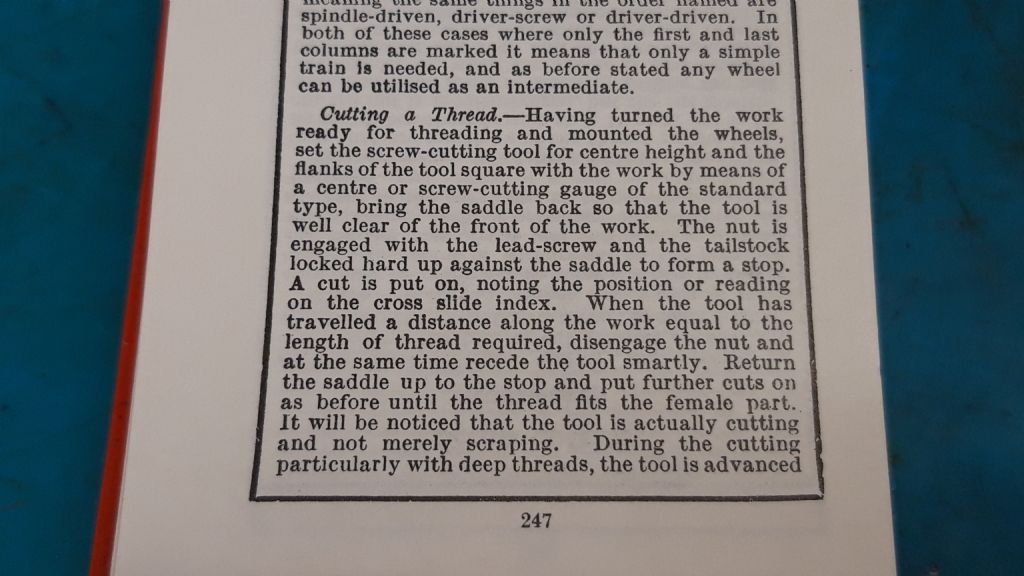
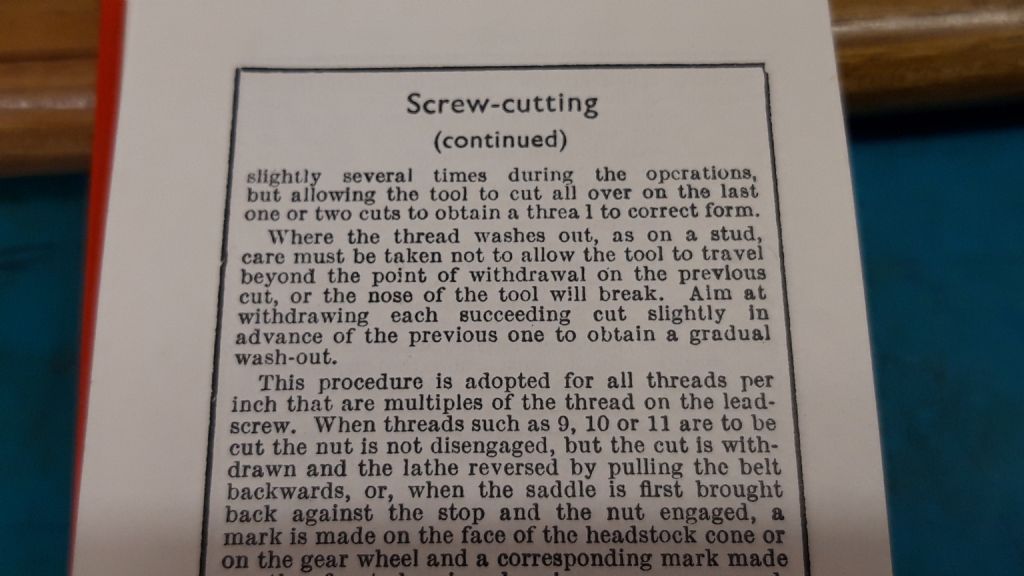
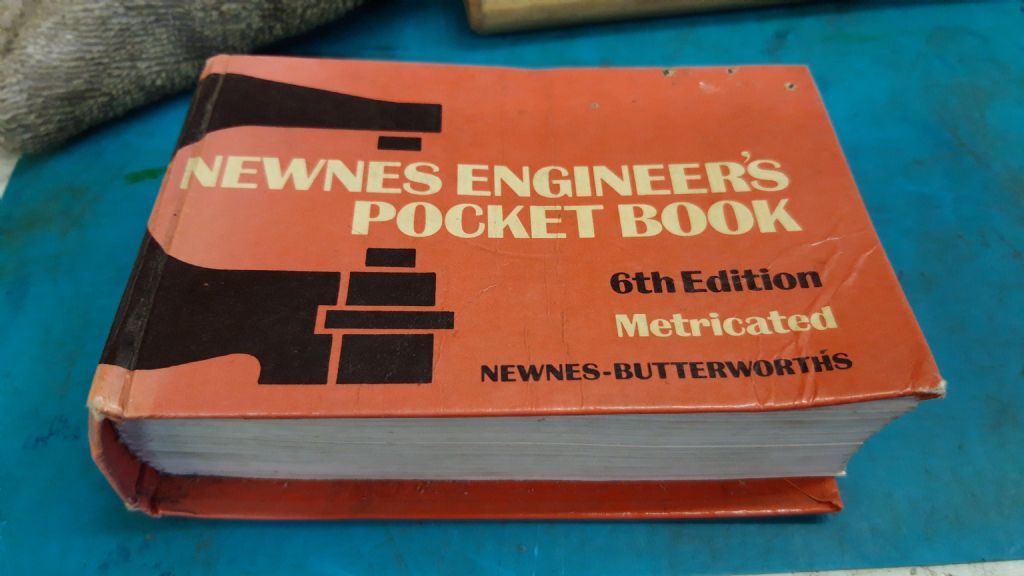
                                This is the method in 'Newnes Engineers Pocket Book' explains it all quite nicely. The technique is mentioned in bottom of the first page and carries over to the top of the second page.

                                'the tool is advanced slightly several times during the operations, but allowing the tool to cut all over on the last one or two cuts to obtain a thread to correct form'

                                That'll do me because that is the way I have always cut threads on a manual lathe, nice and simple!

                                20190916_185315.jpg

                                20190916_185243.jpg

                                20190916_185128.jpg

                                IanJ

                                #561507
                                Graham Meek
                                Participant
                                  @grahammeek88282

                                  I think the whole matter of the "set-over method" was spoiled when some one published tables for various "in-feeds" on the topslide for each thread.

                                  This put people off big time, as many have told me so.

                                  Those who have visited my workshop have seen how easy and quickly I can set-up and produce threads which involve no calculations, no setting with vernier protractor and the topslide was even set to 45 degrees in one instance to prove a point. As long as the tool is square to the work every thing will be fine.

                                  It was even clouded further, when another set of tables was produced to cater for the 1 degree less than half the thread angle.

                                  If the originator of the tables had read GHT's original article on Screw-cutting, the need for such tables would have not been necessary.

                                  Lastly it would pay to observe the manufacturers tolerance on the angle of a commercial tap, before worrying about slight variations in tool geometry due to side rake etc.

                                  Regards

                                  Gray,

                                  #561531
                                  Nigel McBurney 1
                                  Participant
                                    @nigelmcburney1

                                    According to early workshop practice,threads were cut with a tool with side rake and the cross slide set over,the thead was cut and then finished with a thread chaser,either hand held or clamped in the tool holder,These old chasers were carbon steel,so were all the cutting tools,and most dims were measured using fixed joint calipers and a rule,my neighbour over 50 years ago still owned the workshop where he and his father before him had a large shed which held a lot of machine tools plus capacity to keep four traction engines under cover and space to maintain others. ,the smallest lathe was 6 inch capacity with screw cutting by change wheels,and driven by belt from the overhead shafting or by a big treadle,the owner explained that the treadle was often used for small jobs as it saved all the hassle getting the big big electric motor going with the extensive line shafting. the lathes were really old ,the crosslide v ways were set below the level of the top of the saddle,possibly making it easier to mount jobs on the saddle for boring. the various features indicated build around 1880s .I have a carbon steel chaser with the name Joseph Whitworth stamped on the shank,chasers went back a long way. I myself being trained as an instrument maker where chasing direct without single point tools was the usual way for cutting threads, and I now have a good range of HSS machine chasers for screw cutting direct into brass and steel, though I have hss and carbide single point tools . Though you have to be quick and coordinated to withdraw the chaser and disengage the half nuts when working up to a shoulder.All the various methods of screwcutting have there use,it all depends on material,equipment available,and skill of the operator.

                                    #561572
                                    Clive Foster
                                    Participant
                                      @clivefoster55965

                                      Judging by what Grahams Meek says he, like me, primarily uses what I was shown as the Zero-to-Zero / Zero-2-Zero system. Along with the star turner alluded to by Geo.H.Thomas.

                                      The intrinsic forward feed of the top slide is no great issue when using an automatic screw cutting clutch or bed stop with that system. Simply bringing the saddle to the end of the thread, whether automatically with the clutch or by running up to the bed-stop with the slides retracted then bringing the cross-slide to zero and carefully feeding the top-slide forward until it gets to the preset zero produces an entirely adequate finish groove.

                                      Similar results are possible using the "feed forward a little with the top-slide set parallel to the bed every few plunge cuts" are possible if you know how many feed forward movements you intend to do during the process. I know an easy way to set this but that merely adds a smidgin more complication to an over elaborated technique that is totally unsuitable for use by neophytes. There are reasons why things might need to be done that way. But not for any normal thread.

                                      When it comes to Home Shop and generally inexperienced workers the elephant in the room which most pundits ignore is "F**** the thread doesn't fit now what do I do". Usually a bit more feed gets you there but a novice never really knows. Antediluvian penguins like me have the feel to sort it in mid-air but that takes years to gain.

                                      Zero-to-Zero is the only method that allows you to figure out what has gone wrong from first principles.

                                      If you use the cross slide to make the little extra feed when the thread you cut turns out tight it is calibrates the tool in-feed needed to produce the correct thread when using that particular tool. So if the thread depth is supposed to be 1 mm and your first effort turns out tight but, after a few more cuts, an extra 0.1 mm makes it just right you know to set the infeed to 1.1 mm before bringing the cross slide dial to zero. Something you can do with a bit of scrap before risking the real job. Far as I've heard overfeeding so the thread is too deep is almost unheard of with this method. I guess hand ground tooling is usually too pointed.

                                      Forget trying to do that with any other method. Especially if you have the job set up in the chuck with considerable work done needing just a thread to finish.

                                      Just because you have an insert doesn't necessarily mean that "book numbers" will be right. Partial thread ones need clear thinking for best results.

                                      In my experience Johannesson/SKF/Dormer chasers are dead on the money tho'. Harder to find now and not cheap but I'd not use anything else for threads I don't have Coventry dies for. Neither being something a newbie can sensibly afford when every £ scraped off the side of the plate of family finance must do the work of £5 or, better, £10.

                                      It can be hard for experienced folk to remember just how overloaded neophytes and inexperienced workers can be when at the beginning. Lots going on with thread cutting.

                                      What number do I re-engage the half nuts at. Aaargh, they don't want to go in. Oh God its nearly got to the end. Panic, Panic, gotta drop the nut NOW before things go Bang. Phew! Do I need to feed forward a bit this time? How far. Have I gone too much. Eeek finish looks like a ploughed field. Gotta start over. Again! Is this ME business really worth the effort.

                                      Remember.

                                      Much less stressful with an instructor, mentor or mate around to pat you on the shoulder says "Calm down. Take a few spring cuts. She'll come right." Pretty much always does. I did wonder about the attempt to do a thread in one cut tho'.

                                      Clive

                                      #561631
                                      Chris Crew
                                      Participant
                                        @chriscrew66644

                                        There is absolutely no need for anyone to panic, newbie or experienced, when screw-cutting. If you cut the thread at at 1 rpm or 1000 rpm exactly the same amount of material is removed by the tool per pass. If you feel you are going to be fazed by anything when screw-cutting, then cut the thread at the lowest possible speed the lathe is capable of running at. It will make very little, if any, difference to the finish of the thread and will give you plenty of time to think. If you can't even manage that, and I am not suggesting anyone can't, simply stop the lathe, collect your thoughts and start it again.

                                        I actually have an Ainjest rapid threader on one of my lathes which makes screw-cutting as easy as feeding buns to elephants, but even then I don't run the lathe at the highest speed the Ainjest will allow because I like to think that I have just that split second to react if the device fails to trip. It has never let me down yet but I always have one hand hovering over the stop-lever/brake on the Colchester, just in case.

                                        BTW, I always use the set-over top-slide method for both external and internal threads. For internal threads simply mount the tool upside-down in the tool-pool and cut the thread on the back of the hole. Then you only withdraw the cross-slide at the end of the cut as when external screw-cutting. You don't have to think about reversing the cross-slide travel which invites confusion.

                                        Edited By Chris Crew on 06/09/2021 20:47:00

                                      Viewing 18 posts - 26 through 43 (of 43 total)
                                      • Please log in to reply to this topic. Registering is free and easy using the links on the menu at the top of this page.

                                      Latest Replies

                                      Home Forums The Tea Room Topics

                                      Viewing 25 topics - 1 through 25 (of 25 total)
                                      Viewing 25 topics - 1 through 25 (of 25 total)

                                      View full reply list.