
Change old AC motor to BLDC motor in Sieg C6

Change old AC motor to BLDC motor in Sieg C6

Home › Forums › Electronics in the Workshop › Change old AC motor to BLDC motor in Sieg C6

Viewing 16 posts - 26 through 41 (of 41 total)
  • Author
    Posts
  • #871314
    Michael Gilligan
    Participant
      @michaelgilligan61133

      I tried to post this last night, but the forum software was playing silly B’s again

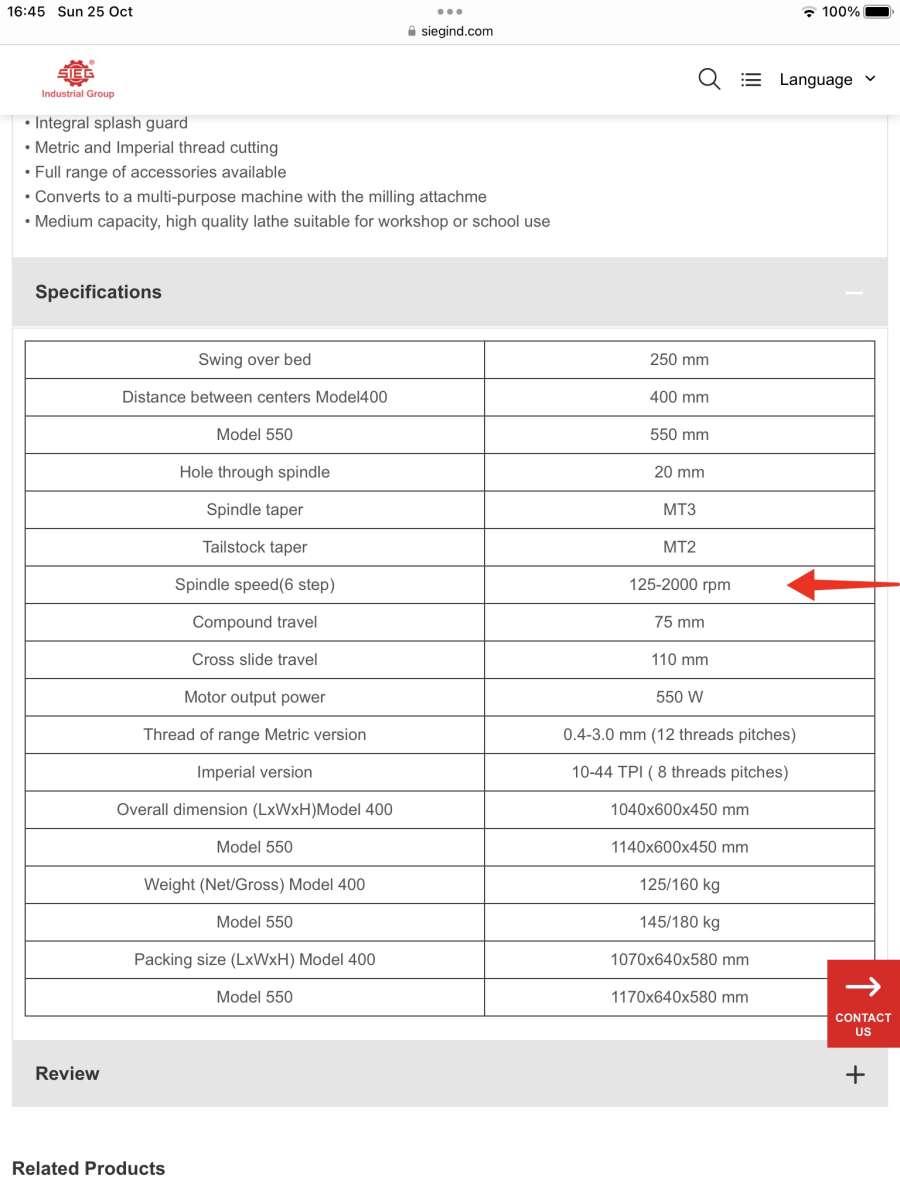
      Here is SIEG’s spec for the lathe:

      .

      IMG_2142

      .

      Methinks 5000 would be a risky bit of overclocking.

      MichaelG.

      .

      Credit: https://www.siegind.com/shop/c6-bench-lathe

      #871323
      Stuart Smith 5
      Participant
        @stuartsmith5

        I can’t see any mention of 5000 rpm from the OP.

        Stuart

        #871334
        Jens Eirik Skogstad 1
        Participant
          @jenseirikskogstad1

          Hi, quite a few comments to read through here… My goal isn’t to reach tens of thousands of RPM on the lathe. Rather, the objective is to achieve good torque at low speeds, and to have more flexibility in setting the desired RPM for specific materials—based on the required cutting speed and diameter.

          You’ve mentioned 3-phase electric motors and VFD-based speed control.
          Are there any advantages to using a 3-phase motor compared to a BLDC motor?

          #871342
          Hollowpoint
          Participant
            @hollowpoint
            On Jens Eirik Skogstad 1 Said:

            You’ve mentioned 3-phase electric motors and VFD-based speed control.
            Are there any advantages to using a 3-phase motor compared to a BLDC motor?

            Cheap, reliable, easy to set up, dozens of frame, mounting and shaft types.

            That said, I am not overly familiar with brushless motors.

            #871356
            duncan webster 1
            Participant
              @duncanwebster1
              On Stuart Smith 5 Said:

              I can’t see any mention of 5000 rpm from the OP.

              Stuart

              Mea culpa, it was John Haine who linked to a 5000 rpm motor. Spec above doesn’t mention motor speed. People seem to be confusing motor speed with spindle speed. If a slower motor is OK (3000rpm) then by all means 3 ph and vfd

              #871365
              duncan webster 1
              Participant
                @duncanwebster1

                According to This the original motor is 550W AC squirrel cage, so vfd and 3 ph definitely on the cards

                #871369
                Peter Cook 6
                Participant
                  @petercook6

                  BLDC motors are three phase, just driven by switched DC rather than AC. I have no experience of 3ph with a VFD, but BLDC motors seem to be much more compact than 3ph squirrel cage.

                  My 220W BLDC IS ABOUT 10% of the size  and weight of the original 1/4 hp single phase motor.

                  #871372
                  Huub
                  Participant
                    @huub
                    On Robert Atkinson 2 Said:

                    For a small lathe you would be better using a 4 pole 1500 RPM motor and VFD and turning the frequency up to 100Hz to get 3000 RPM than using a 2 pole and turning it down for lower speed. You can’t increase the current at lower speed due to resistive losses so will get much lower power and torque.

                    My knowledge from AC motors comes from what I have picked up the last 20 years from reading forums, so maybe I am totally wrong.

                    A low pole count motor will run at a low max RPM but will deliver a more constant torque at a lower RPM.
                    A high pole count motor will run at a high max RPM but the torque will decrease significantly when running at lower RPM.
                    My low pole count AC servos deliver an almost constant torque from 0 to their max (3000) RPM.
                    My AC spindle motor with VFD delivers a high torque from 200 RPM to 2250 RPM.
                    My low pole count BLDC motors deliver an almost constant torque from 400 to their max 3500 RPM.

                    So for more torque at low RPM (threading) I would select a low pole count motor and compromise on the max RPM.


                    #871377
                    Robert Atkinson 2
                    Participant
                      @robertatkinson2
                      On Huub Said:
                      On Robert Atkinson 2 Said:

                      For a small lathe you would be better using a 4 pole 1500 RPM motor and VFD and turning the frequency up to 100Hz to get 3000 RPM than using a 2 pole and turning it down for lower speed. You can’t increase the current at lower speed due to resistive losses so will get much lower power and torque.

                      My knowledge from AC motors comes from what I have picked up the last 20 years from reading forums, so maybe I am totally wrong.

                      A low pole count motor will run at a low max RPM but will deliver a more constant torque at a lower RPM.
                      A high pole count motor will run at a high max RPM but the torque will decrease significantly when running at lower RPM.
                      My low pole count AC servos deliver an almost constant torque from 0 to their max (3000) RPM.
                      My AC spindle motor with VFD delivers a high torque from 200 RPM to 2250 RPM.
                      My low pole count BLDC motors deliver an almost constant torque from 400 to their max 3500 RPM.

                      So for more torque at low RPM (threading) I would select a low pole count motor and compromise on the max RPM.


                      That is not quite correct.

                      For a given supply frequency speed is inversely proportional to number of poles. A two pole motor runs twice as fast at 50 Hz as a 4 pole motor of the same power. The two pole has half the torque of a 4 pole at the same power and frequency.

                      The change in torque is not directly due to the number of poles. It’s because of constant power. If you halve the speed (due to fewer poles) you have to double the torque to maintain the same power and vice versa. More poles will always run smoother due to a reduction in torque ripple.
                      A high pole count count induction motor does NOT produce less torque when run at lower speed with a VFD. The torque will be at least constant with reducing speed. The power reduces due to the lower speed.

                      The difference between BLDCs and induction motors with a VFD in respect of torque is that BLDCs are primarily constant current driven while induction motors are voltage driven. (modern VFD’s with vector control blur this distinction a little). While you BLDC does produce full torque at all speeds, including zero, the power (which removes metal) is proportional to the speed. Full torque at zero speed does n work. Low pole count BLDC motors suffer from significant cogging at low speeds.
                      BLDC motors are generally used at high speed when significant power is required.

                      The compromises depend on the use of the machine but there are multiple reasons why very few lathes and mills use 2 pole motors (even 3 phase ones) when they leave the factory.

                      Robert.

                      #871391
                      Huub
                      Participant
                        @huub

                        Robert,

                        Thanks for your clear answer.

                        If I get it right,
                        The 2 and 4 pole motor of the same output power, running at the same frequency at max RPM deliver the same torque and power at the lathe spindle if the spindle runs at the same RPM due to differences in pulley setup.

                        On my lathe I have rarely lack of power during turning operations but often lack of torque during threading operations.
                        If the 2 and 4 pole motors are geared to produce the same max RPM at the spindle, they would produce the same torque at low (200) RPM.

                        Huub


                        #871410
                        mgnbuk
                        Participant
                          @mgnbuk

                          Huub,

                          Google “speed power torque calculator” to work out what the “missing term” calculates to by entering the final spindle speed and either rated motor torque to find power, or rated motor power to find torque available at that speed (transmission losses not considered, but 5% loss per reduction stage would be a starting approximation). Pole count of the prime mover doesn’t matter than.

                          Any permanent magnet DC motor (brushed or brushless) is basically a constant torque machine – any power rating quoted is at maximum rated speed. VFD controlled synchronous motor is a bit different – speeds below “base speed” (rated motor speed at rated voltage & frequency) are constant torque operation (power falls as speed reduces) & speeds above “base speed” are constant power operation (torque falls as speed increases). DC motors with separately excited fields where the field voltage & current can be adjusted by the drive operate similarly to a VFD / synchronous AC motor, but require speed feedback (tachogenerator or encoder) to work in the constant power region.

                          Nigel B.

                          #871419
                          Robert Atkinson 2
                          Participant
                            @robertatkinson2
                            On Huub Said:

                            Robert,

                            Thanks for your clear answer.

                            If I get it right,
                            The 2 and 4 pole motor of the same output power, running at the same frequency at max RPM deliver the same torque and power at the lathe spindle if the spindle runs at the same RPM due to differences in pulley setup.

                            On my lathe I have rarely lack of power during turning operations but often lack of torque during threading operations.
                            If the 2 and 4 pole motors are geared to produce the same max RPM at the spindle, they would produce the same torque at low (200) RPM.

                            Huub


                            The first statement is clear and correct.
                            The second is ambiguous as it’s not clear how the low RPM is attained. Is it by a variable speed electronic drive .e frequency change or by changing the gear ratio?

                            Robert.

                            #871430
                            Huub
                            Participant
                              @huub

                              Robert:
                              If the 2 and 4 pole motors are geared to produce the same max RPM at the spindle, they would produce the same torque at low (200) RPM when RPM is controlled by a VFD?

                              Nigel:

                              Any permanent magnet DC motor (brushed or brushless) is basically a constant torque machine – any power rating quoted is at maximum rated speed.

                              My 1.5 kW brushed DC lathe spindle can be easily stopped by hand at 60 RPM but at 1850 RPM is produces more torque (power) the lathe can handle.
                              I have the same experience on my 600W (2100 RPM) and 1000W (3000 RPM) milling machine, that have brushed DC motors. Limited torque at low RPM.

                              In general:

                              My 600W milling machine (2150 RPM max) with AC motor and VFD has enough torque to do M10 tapping in steel. I could probably go higher but I am afraid to damage the plastic gears.

                              My servo motors deliver their torque at 0 RPM. On the lathe I can do M10 rigid tapping using a 600W geared 1:4 AC servo motor (max spindle RPM 750). That is, when I look at the AC servo driver torque display (almost 100% torque), also the limit in this setup.

                              For what it is worth, I am perfectly happy with the performance of the 1500W brushed DC motor on my lathe that runs at max 1850 RPM. It is due to its belt drive, the most quit machine in my hobby shop.

                              #871437
                              mgnbuk
                              Participant
                                @mgnbuk

                                My 1.5 kW brushed DC lathe spindle can be easily stopped by hand at 60 RPM but at 1850 RPM is produces more torque (power) the lathe can handle.
                                I have the same experience on my 600W (2100 RPM) and 1000W (3000 RPM) milling machine, that have brushed DC motors. Limited torque at low RPM.

                                No – same torque at all speeds with a permanent magnet DC motor.

                                1.5Kw @ 1850rpm = 7.74 Nm but 7.74Nm @ 60 rpm = 0.05 Kw, so no wonder you can stop the spindle by hand then ?

                                .6Kw @2100 rpm = 2.73Nm

                                1Kw @ 3000 rpm = 3.18Nm

                                both the above the kind of static torque you can apply with a torque screwdriver ?

                                When I used to buy such things for CNC retrofits, servo motors were always specified by stall torque not power. Servo motors are torque machines so “power” not really relevant, other than dictating the size of the drive you use with them & even then used full load current rather than power to spec the appropriate amp.

                                Bit of a PITA when speccing Chinese servos to have to delve into the spec sheet to find the stall torque when they put them in listings by power output.

                                Nigel B.

                                #871491
                                Robert Atkinson 2
                                Participant
                                  @robertatkinson2
                                  On Huub Said:

                                  Robert:
                                  If the 2 and 4 pole motors are geared to produce the same max RPM at the spindle, they would produce the same torque at low (200) RPM when RPM is controlled by a VFD?


                                  Yes.
                                  The VFD will maintain rated torque on both motors but the rated torque of the 2 pole is half that of the 4 pole for the same power. This is countered by the increased gear ratio on the 2 pole to get the same top speed. So torque and power is the same for both at low speed but power is less than rated.

                                  Robert.

                                  #871509
                                  Huub
                                  Participant
                                    @huub
                                    On Robert Atkinson 2 Said:

                                    So torque and power is the same for both at low speed but power is less than rated.

                                    Thanks.

                                    You made me rethink about why running high RPM spindles at low RPM is often troublesome. It is not the drop of torque at low RPM but the “lack of torque” in general and probably cooling for air cooled spindles.

                                  Viewing 16 posts - 26 through 41 (of 41 total)
                                  • Please log in to reply to this topic. Registering is free and easy using the links on the menu at the top of this page.

                                  Latest Replies

                                  Viewing 25 topics - 1 through 25 (of 25 total)
                                  Viewing 25 topics - 1 through 25 (of 25 total)

                                  View full reply list.