
Interactive article on How Machines Learned Precision

Interactive article on How Machines Learned Precision

Home › Forums › Suggested Online Resources › Interactive article on How Machines Learned Precision

Viewing 8 posts - 1 through 8 (of 8 total)
  • Author
    Posts
  • #867646
    glinscott
    Participant
      @glinscott

      Hi,

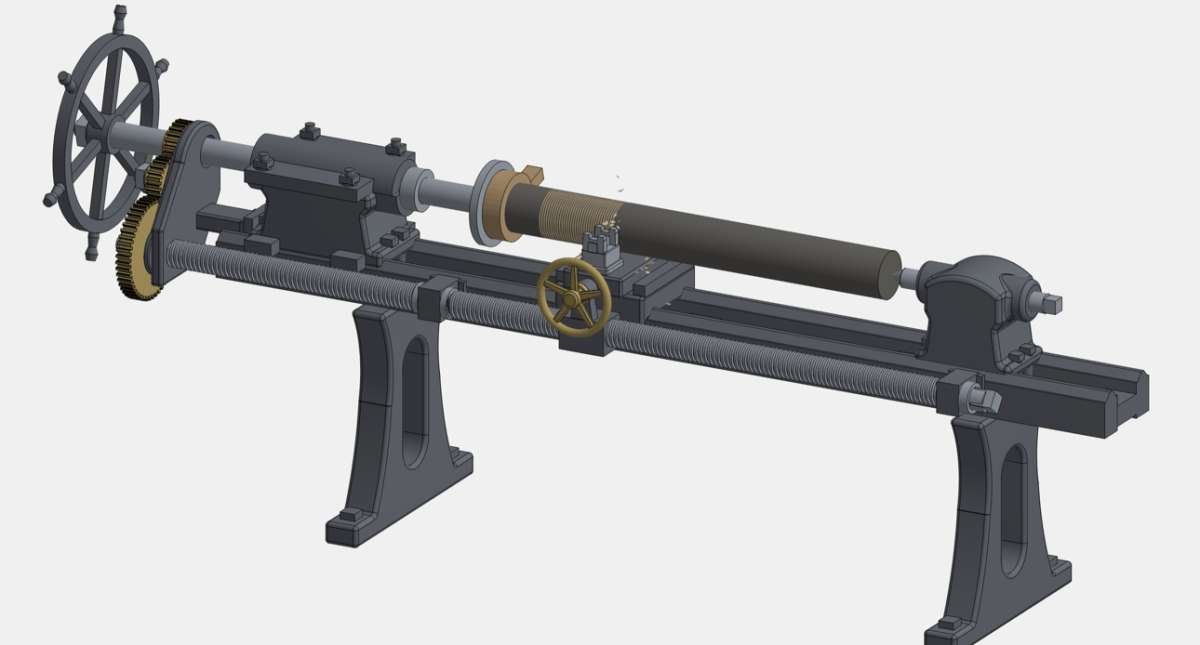
      This article is a follow-up to my previous one on Beam Engines: https://glinscott.github.io/beam-engine/.  Reading about Watt’s struggles to get an accurate bore led me down a very fun rabbit hole on the history of precision in machine tools.

      Article: https://glinscott.github.io/how-machines-learned-precision/

      lathe-small

      I’d again be grateful for any corrections or suggestions about parts that aren’t clear.

      Thanks!
      Gary

      #867830
      Nigel Graham 2
      Participant
        @nigelgraham2

        A wonderful work!

        Thankyou very much for showing us.

        It really rather awe-inspiring to learn just what became possible so early in the 19C.


        Steel rules with sixty-fourths are common, but I did have one with 1/128 divisions! Quite how anyone was expected to use that, I have no idea. A scribed line is likely at least that wide.

        I’ve also one of those transparent plastic rules with the parallelogram grids for measuring down to umpteenths – I have long forgotten the principle and how to use it, but vaguely recollect it uses “similar triangles” properties.


        I recall once seeing, probably in a history-book, a copy of a 16th or 17th wood-cut of boring a cannon barrel. The cutting head, such as it was, was not really shown but it was driven by manually rotating a long shaft in bearings on a line of posts in front of the muzzle. There was no feed as such, simply the operator pushing the cutter forwards as he turned the handle.  I think large guns of the day were more often of bronze than iron, but the task must have been very tedious and physically arduous.


        That three-plate method for making reference flats has a sonar equivalent, called Reciprocity Calibration, to calibrate a trio of nominally-identical piezo-electric transducers together, from each other. “Reciprocity” in this context means each transducer will work as a “projector” (underwater loudspeaker) and hydrophone. Transducer A is made to “ping” at B and C in turn, then B to C; over the required frequency range at a constant driving voltage, and the voltages of the received signals recorded. These and the known settings on the calibrated amplifiers and measuring instruments are then used to calculate the receiving and transmitting sensitivities of all three transducers.

        #867840
        Pete
        Participant
          @pete41194

          It’s only my opinion, but I’d suggest that at least quite accurate boring predates Watt’s struggles by a bit, and it seems logical that he would also have studied how large cannon boring on some very rudimentary machines was accomplished. Watt and others no doubt made large and relatively quick improvements in the machine tools and methods.

          The book is now out of print and was over $100 in the 1980’s when I bought mine. For anyone interested enough, there may be a local library with a copy though. The Art of Gunfounding by Carel de Beer is a fascinating glimpse into how it was done at the Woolwich Royal Arsenal in the 18th century. Luckily the head of the foundry was hired from I think the Netherlands in 1770 as a master founder if my memory isn’t faulty, a Mr. Jan Verbruggen. And his son Pieter was quite an accomplish water color painter. He painted and documented many of the steps involved in both the changed to vertical casting methods, the starting from solid drilling and machining of the bores, and the rough cast cannon exteriors. The same paintings are reproduced in that book. Verbruggen completely overhauled and changed how the Royal Arsenal produced their cast cannon barrels from then on due to using some very sound logical reasons and methods to increase casting quality, density, strength, accuracy and vastly reduce what previously were a lot of cannon failures in service. There’s other details and methods shown from a few other areas on the European continent. Even vertical cannon boring using Horses as the power source. Given the available technology, it was a huge, seriously labor intensive, and no doubt extremely expensive process. Boring any steam engine cylinder would be multiple times easier and cheaper.

          Watt did use the advantage of better and more scientific based engineering methods. Verbruggen was using heavy wooden frames as the machine tool frames, and mostly rack and pinion feeds. Without question the methods used on those cannons had a great deal to do with helping to kick start the industrial revolution and steam power. I also think the repeatable accuracy of there machining during that time period may have been a bit better than most might assume today. While they couldn’t actually measure to a high degree of accuracy, they were capable of producing gauges and machine to fit those. A few of my other books describe the general and accepted engineering practices of those Naval cannon no matter what bore size they had. Surprisingly, every single part from the cannon barrel trunnion size and the carriage dimensions were all based on a percentage of whatever the cannon bore size happened to be.

          #867907
          Ches Green UK
          Participant
            @chesgreenuk

            Gary,

            Thanks for that. I learned a lot, not least using the 3 plates to produce a flat surface.

            Now watching/reading the Beam article 🙂

            Ches

            #867914
            duncan webster 1
            Participant
              @duncanwebster1

              <p style=”text-align: left;”>John Wilkinson was the go-to man for precision boring of cannons and steam engine cylinders. His company did all Watt’s cylinders at first</p>

              #867935
              Bazyle
              Participant
                @bazyle

                Wasn’t there a series of articles in ME on the Soho works a year or so back showing the boring machines.

                #867951
                Nigel Graham 2
                Participant
                  @nigelgraham2

                  “… a lot of cannon failures in service…”

                  If that meant bursting, no doubt with men blinded, maimed or killed in the process. The ratings were cheap labour but not expendable.


                  Bazyle –

                  Yes. Unfortunately I forget by whom, if you mean the historical series I thought would be ideal for publishing separately, as a book.


                  #867969
                  Pete
                  Participant
                    @pete41194

                    Yes bursting was what was happening all too often Nigel. And that seems to have been the most important reason they hired Mr. Verbruggen and put him in charge of the Woolwich Arsenal. He then changed the previous foundry methods of casting barrels with a core and bored to finish size. He cast them solid without any core at all. That obviously took much longer and was more expensive of course, but the results seem to have proved it was the far better and more predictable method.

                    He also cast the barrels vertically with the muzzle end up in deep pits in the foundry floor. Both changes increased the metal density at the breech ends and any impurities or dross in the molten metal should then float to the top where the resistance to bursting would be needed the least, or removed completely when the sprue was cut off. Given what I’ve read and how little the RN seemed to care. Possibly the cost to replace burst cannons at that time might have had much more importance than any killed and maimed Royal Navy ratings did?


                  Viewing 8 posts - 1 through 8 (of 8 total)
                  • Please log in to reply to this topic. Registering is free and easy using the links on the menu at the top of this page.

                  Latest Replies

                  Viewing 25 topics - 1 through 25 (of 25 total)
                  Viewing 25 topics - 1 through 25 (of 25 total)

                  View full reply list.