Parting off on a mini lathe

Parting off on a mini lathe

Home Forums Beginners questions Parting off on a mini lathe

Viewing 20 posts - 26 through 45 (of 45 total)
  • Author
    Posts
  • #815086
    Dell
    Participant
      @dell

      I have a Myford 10 & had problems parting but now I have rear parting tool HSS parting tool upside down swarf falls away ( couldn’t run lathe in reverse as screw on chuck ) I don’t have problems but everything needs to be as ridged as possible .

      #815089
      Richard Simpson
      Participant
        @richardsimpson88330

        Just a question ladies and gents.

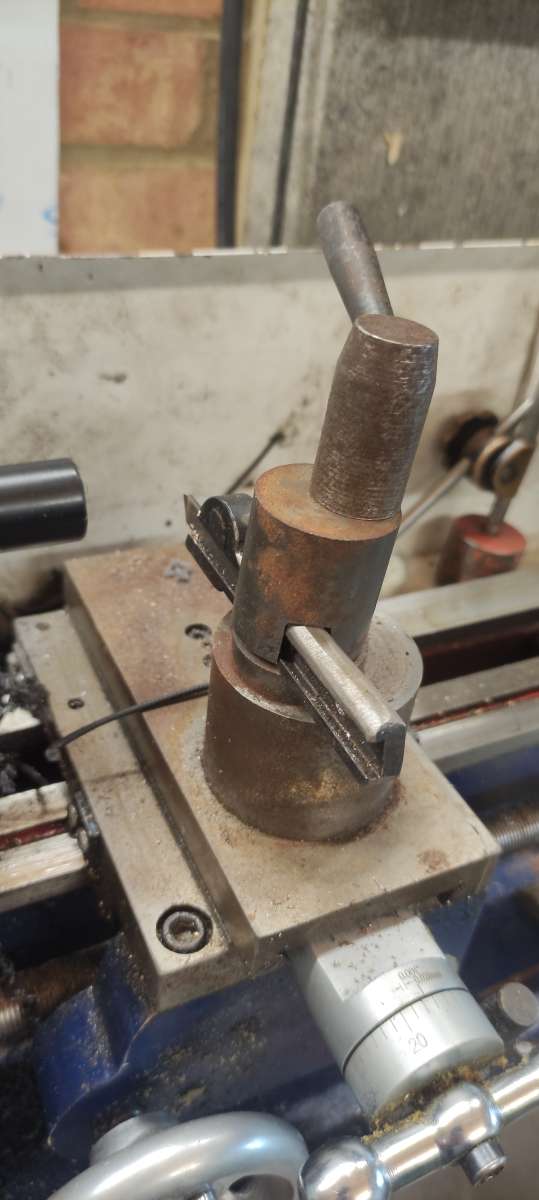
        I see a lot of references in this thread to rear mounted tool posts.  Reading the reasoning behind this I can see the advantage but what justifies using a rear mounted tool post over simply turning the tool upside down in the normal tool post and rotating the job clockwise instead of anti clockwise?

        #815097
        JasonB
        Moderator
          @jasonb

          Most using the read toolpost will have Myfords or similar where the chuck screws onto the spindle nose. If you run them backwards the chuck can screw itself off!!

          #815101
          Bazyle
          Participant
            @bazyle

            The main reason for the rear toolpost is the way most amateur lathe saddles are/were made with nothing to stop the rear of the saddle lifting off the bed, or if a plate was fitted eg Boxford it probably wasn’t set tight. So if the tool catches it lifts and when you examine the geometry that relieves the cut. The other reason is some people are obsessed with the fear of the chuck unscrewing when run in reverse.

            #815107
            SillyOldDuffer
            Moderator
              @sillyoldduffer
              On Richard Simpson Said:

              … what justifies using a rear mounted tool post over simply turning the tool upside down in the normal tool post and rotating the job clockwise instead of anti clockwise?

              Whilst running upside down in reverse is an advantage, rigidity is the main reason for using a rear tool-post.

              Comparison!

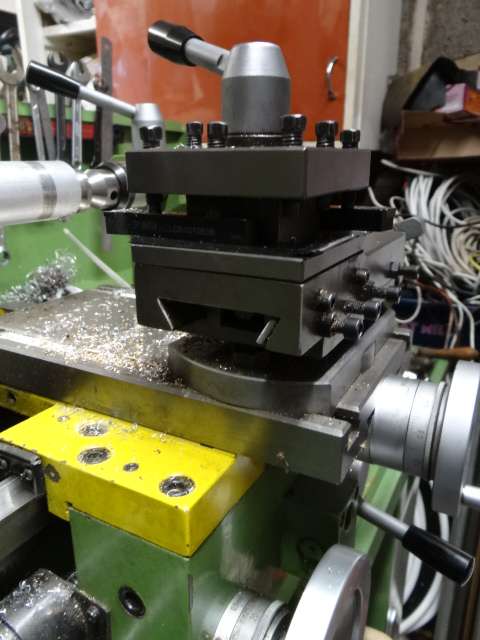
              My front tool-post is a towering multi-jointed edifice.  I’d describe it as spindly rather than solid, and it’s height causes it to increase forces by acting as a lever.  All front tool-posts are bendy, especially those on small lathes.

              When cutting, Newton’s third law applies: ‘when two bodies interact, they apply forces to one another that are equal in magnitude and opposite in direction.‘  A front-tool post’s ability to resist ‘opposite in direction’ forces is limited by how much metal is in it, the height,  the joints, and the route taken by reaction forces to ground.

              DSC06917

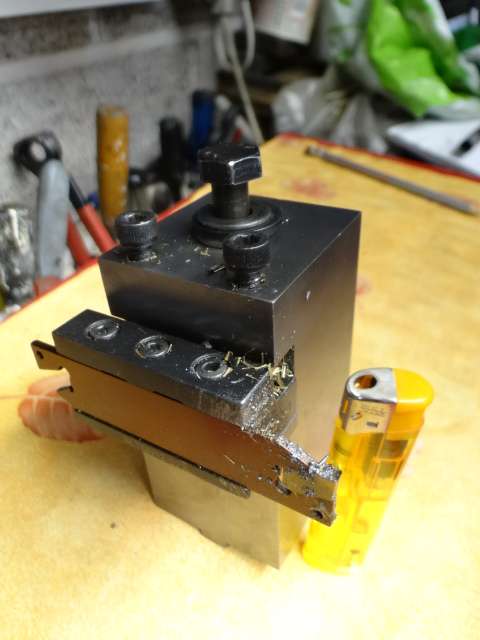
              In contrast rear tool-posts are a hefty solid block of metal firmly bolted to the saddle.  They are much stiffer than a conventional front tool-post.  Stubby with only two joints: the slot for the cutter, and where it joint the saddle.  Leverage is minimised too: cutting forces are taken almost directly straight down into the saddle.  It’s instructive to trace route taken by forces grounding through a front-tool post; it’s long and twisty – not ideal.

              DSC06918

              As front tool-posts go, though inferior to a rear type, the 4-way is fairly solid.  As QCTP tend to be more spindly with extra leverage through the tool-holders, they are often less rigid.  Therefore I suggest beginners think twice before rushing to fit them.  Ask what’s more valuable in your workshop – is it rigidity or the ability to swap HSS tools quickly?

              Dave

              #815114
              John Haine
              Participant
                @johnhaine32865

                What revolutionised parting for me was to start doing it at higher speed using power cross feed.  Higher speed gives lower chip load per rev and better cutting action by the tool, PXF is smoother and isn’t prone to “stutter” like humans.  I use a insert type parting tool in a QC toolholder (Dickson type).  My S7 has a custom toolpost without topslide and the feed is stepper powered by the CNC controller.

                #815120
                JasonB
                Moderator
                  @jasonb

                  Front QCTP works for me even on a “spindly” cross slide

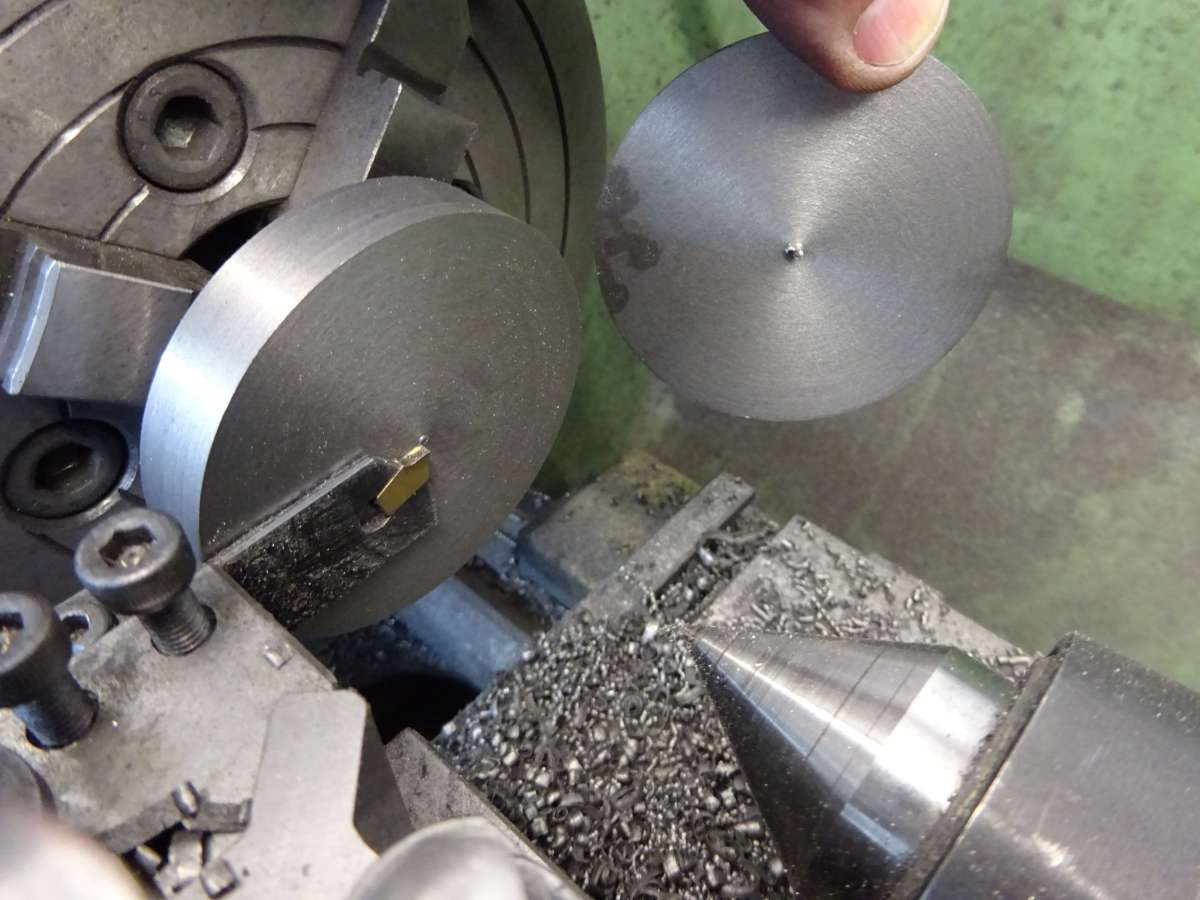
                  70mm cast iron parting a 1.5mm thick disc, part held by approx 15mm dia chucking spigot

                  DSC02442

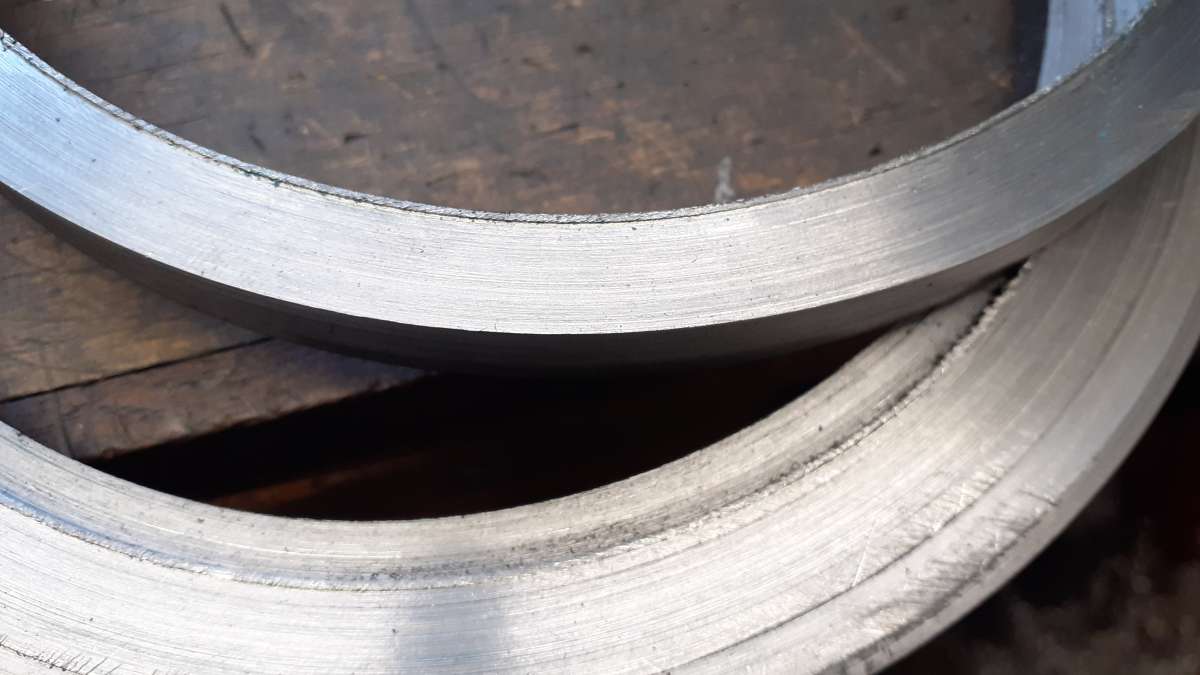
                  200mm dia x 25mm thick wall steel tube with 1.5mm HSS. I did saw the last 0.75mm rather than have the ring drop on the bed.

                  20230112_145504

                  #815134
                  Martin Kyte
                  Participant
                    @martinkyte99762

                    When cutting, Newton’s third law applies: ‘when two bodies interact, they apply forces to one another that are equal in magnitude and opposite in direction.‘  A front-tool post’s ability to resist ‘opposite in direction’forces is limited by how much metal is in it, the height,  the joints, and the route taken by reaction forces to ground.

                    Not quite as simple as that with regard to tool posts. Opposite usually involves  a couple which tranfers the force opposing the cut to the front ‘foot’ of the tool post and the front shear. Relaxation of the cutting force can cause the tool to ‘nod’ forward which tends to increase the depth of cut generally causing chatter and sometimes a dig in. When the operator is tentative in approach to parting this can often happen whilst with a more robust approach everything is ‘hard back on the stops’ and well out of the danger zone. That’s my interpretation.

                    #815188
                    old mart
                    Participant
                      @oldmart

                      When I made the rear toolpost for the Smart & Brown model A, I added a second lock at the rear of the saddle. Having a very long cross slide helps greatly, and what makes the biggest benifit for parting in particular is not using the top slide, giving added stiffness. Having power cross feed is a benifit especially as then you can keep a steady trickle of coolant running. The power cross feed has gone wrong again on the S&B, it is such an antiquated design that we are constantly putting off mending it.

                      #815210
                      Andy Stopford
                      Participant
                        @andystopford50521

                        I use either a GTN2 insert or, for small stuff, a HSS tool ground to ~0.9 mm wide, no top rake, in my WM180, standard top slide and QCTP.

                        With the insert, I try to run the lathe as fast as it seems happy at, and keep the feed heavy enough to ensure it keeps cutting. For diameters to great for the insert toolholder, I have a conventional HSS blade in the dedicated QCTP toolholder.

                        The main limiting factor on large diameters is the lack of torque at minimum speed (50 rpm). Maybe I’ll make a 3 step pulley sometime.

                        What does make a big difference is using a collet instead of the 3 jaw – unfortunately only possible up to 20mm diameter of course (ER32 collets), but it’s interesting how much smoother and faster parting off is, probably due to the reduced overhang, and maybe also to more positive location of the workpiece.

                        #815228
                        samuel heywood
                        Participant
                          @samuelheywood23031
                          On Richard Simpson Said:

                          Just a question ladies and gents.

                          I see a lot of references in this thread to rear mounted tool posts.  Reading the reasoning behind this I can see the advantage but what justifies using a rear mounted tool post over simply turning the tool upside down in the normal tool post and rotating the job clockwise instead of anti clockwise?

                          Pretty sure in “The Mini Lathe” by David Fenner, the author details such a device for the mini lathe & was quite pleased with how well it worked.

                          Given that it would be easier to implement than a rear tool place on said mini lathe, i’d say that would be the way to go if you are a little squeamish about a regular front mounted parting tool.

                          So far the regular flavour has worked fine for me, only broke one parting blade so far, due to operator lazyness (long tool overhang, on small dia~ should have been adjusted!) The resulting “explosion”  cured any inherrent lazyness in said operator. 😉

                          #815627
                          Howard Lewis
                          Participant
                            @howardlewis46836

                            Since the mini lathes have flange mounted chucks, there is no worry about the chuck unscrewing when running in reverse.

                            So why not mount the parting tool upside down, in the front toolpost, and run in reverse?

                            Which is what Richard Simpson suggested.

                            This is effectively the same as a Rear Toolpost, with the advantage that the swarf falls clear and is less likely to clog the newly cut slot.

                            Being a mini lathe, without power cross feed, the manual feed needs to be slow, and steady.

                            Howard

                            #815728
                            Beardy Mike
                            Participant
                              @beardymike

                              When I got my mini-lathe it was fitted with a QCTP that hung the tool off to one side by a long way, potentially even outside the footprint of the carriage. This caused no end of headaches when parting as the tool would move around, jam, and generally spoil my day.

                              I solved this problem by replacing the compound with a solid block of steel (the same height as the compound) and making a special parting blade holder that replaces the QCTP/4-way for parting operations. It holds the tool as close to the carriage centre as possible with maximally rigid support underneath.

                              IMG_20250223_114040
                              This makes a night and day difference. The tool no longer moves around, which majorly reduces the chance of jamming. It also allows for heavier cuts which avoids the risk of rubbing and the work hardening that rubbing can cause. I roughed mine out with an angle grinder and cleaned it up with a small shaper, but you could mill one or even just use a hand file

                              #816963
                              Pete
                              Participant
                                @pete41194

                                100% in agreement with what Jason has said, “Nikcole-Mini-Thin 1.0mm N left a pip of 0.5mm. This is my goto parting tool for small diameters but not Cheap”. That’s exactly what I first bought for use on my little Emco compact 5 lathe. Within there fairly small diameter cut off limit, they really are an excellent tool.

                                An additional point about cut off tools and rigidity. I first tried mine in the C5 Emco qctp I also bought, and it was I think “ok”, although maybe not the best performance I thought it should have been capable of. Unfortunately I had only bought the Emco qctp with the 3 tool holders it came with. Shortly after that, Emco, quit manufacturing the C5 lathe and any accessories. So no more extra tool holders were available. On little more than a guess it might work better, I then machined the top of the solid tool clamping block the bare C5 lathes were supplied with to put the carbide tip dead on center. But I was still cutting off from the front because of where the two threaded mounting bolt holes in the cross slide were located. This was long before the tool block idea to replace the compound was even being mentioned that I know of.

                                That Emco tool block these C5 lathes came with was meant to bolt to the top of the cross slide since even the compound for the C5 lathe was an extra cost item. As a workable solution to only having those 3 tool holders and replacing the compound any time I wanted to use that cut off tool, it would be ridiculous and much too time consuming. However mounting the tool on that solid steel block and removing the compound made multiple times more difference in how well the tool would then cut off. Night and day in fact. Any steel, stainless and even titanium cut off I tried seemed to still work just fine given the lathes size and actual rigidity. That’s not doing too bad on a little light weight lathe with a die cast aluminum carriage. Over the years I’ve since used it on two larger lathes with qctp’s, and one of them being about 10 times heavier than that little C5 I started with. Other than cost for the tool, inserts and limits for cut off diameter, I still think there performance matches the price. I’ve got proper cut off blades that can do much larger diameters, but there no where near as ridged as it. The tips Nikcole also list with a radius are a good option for producing a thread relief when doing single point threads.

                                For any lathe that has a tee slotted cross slide and can use it. I’d suggest that all of the real success of the GH Thomas and other rear mounted parting tools is due to removing the compound, any qctp and holders. Even with the compound, there’s a very noticeable difference between any cutting tool including cut off mounted in a qcth and the same in the usual 4 way tool post most lathes now come with. I wouldn’t want to be without my qctp and holders, but I’m not about to throw my 4 way tool holders away.

                                The effects of gravity helping in any way to remove a cut off tools swarf would be imaginary. Logically it should be helpful, and for a very long time I thought that as well because I’d read it being mentioned so many times. The realities and what those coils of swarf actually weigh versus the frictional drag on the walls of the cutting groove guarantee gravity isn’t going to help until that swarf completely clears and is then outside the tools groove. At that point there certainly not going to affect any cut off operation at all. Think about it, even the centrifugal rotational forces would be much higher than 1G of gravity, that’s simple physics. So if those coils of swarf aren’t being thrown clear from it, gravity isn’t going to be of any help at all.

                                It’s also easy to see that centrifugal effect. For any material being cut off or even turned like brass or cast iron that produces fine chips, they already get thrown as there being cut at multiple times more velocity than any free fall due to gravity would be. Those same chips only start to build up a bit on the tool as the cutting tip approaches the middle of the part and the rotational ft. / meters per min. gets closer to zero.

                                #817002
                                Howard Lewis
                                Participant
                                  @howardlewis46836

                                  Pete,

                                  The swarf DOES fall away with an inverted parting tool, so jam ups are very rare.

                                  Possibly, not using top rake helps keep the swarf as small chips, rather than long curls, as does a steady feed of oil, (engine or soluble).

                                  Certainly, using a rear toolpost, on more than one lathe, has made dig ins almost unknown.

                                  For a flange mounted chuck, mounting the tool inverted in the front post, and running in reverse produces the same effect. Far superior to a normal parting tool in a front post!

                                  Howard

                                  #817010
                                  JasonB
                                  Moderator
                                    @jasonb

                                    Last week I had to make a part similar to that which I showed on 4th Sept so took a video.

                                    Insert “blade” in a clamp type holder so added overhand, QCTP so some additional overhang, Topslide as that is what I use, OEM topslide clamp not the heavy ones some people seem to need to make. Used insert. Up the right way All on a far eastern 280 lathe.

                                    Parting a 1.5mm slice off 70mm dia iron casting. Only held by a 15mm dia chucking spigot which some would say makes it less rigid. Measuring the disc afterwards there was less than a thou difference in thickness from edge to middle. No Jams, I did stop once to extend the blade out of the holder and removed the tailstock support at the same time.


                                    #817048
                                    Pete
                                    Participant
                                      @pete41194

                                      Very nice surface finish your cut off tool leaves Jason. I’m more than a little impressed.

                                      Sorry but it doesn’t, and for the same rules of physics I already mentioned Howard. Yes it will drop out the bottom, but that proves nothing since that’s the direction the swarf is coiling up or being forced down and along the blade of the tool anyway. If that swarf is coiling up or even freely exiting the groove along the top of the blade cutting from the front, or dropping out the bottom with it turned upside down, gravity won’t make any difference in creating or not creating a jam, how could it?

                                      Hardinge even offered what was basically an overhead mounted parting tool on at least one of there turret lathes as an accessory. And if gravity was such a negative or help depending on the cut off tools orientation, that overhead mounted and applied cut off tool along with gravity would help keep any swarf down inside the groove. It doesn’t because its the fresh material being cut that helps to then push the previous material out of the groove being formed.

                                      Now if something like steel ribbon or coils of swarf does happen to drop out right away with a rear mounted parting tool, that means the width of it has to be a bit less than the groove width. If that’s true, then it’s going to be just as free to move without any jamming while cutting from the front. With or without the extremely minor effects from gravity, the cutting action and swarf removal is about the same.

                                      The cutting oil serves two purposes, it helps the cutting action to need a bit less pressure to cut, so a bit easier and maybe a bit more consistent. And provides lubrication on the swarf, each side of the groove, and the top / bottom of the cut off tools blade the material is sliding on. That friction reduction helps any already cut material slide along or off those surfaces much better, and for that reason reduces any material getting seized or jammed inside the groove by a lot.

                                      Now if the swarf did start being retained enough to cause jamming or even worse, tool breakage. That’s hundreds to possibly thousands of times higher force than 1G of gravity exerts pulling on a few grams of steel. And if any gravity actually was such a big help during cut off operations, you can be guaranteed industry and there large manual lathes would have started using it a very long time ago. In fact there far larger and heavier swarf would be affected much more by gravity if it did actually help. They almost always part off from the front because there’s already ample mass and rigidity. Some cnc’s might use rear parting tools, but that’s for other reasons than why it works better with our lathes. We have to cheat a bit to increase the limited rigidity were stuck with. So it is that large increase in tool mounting rigidity that makes all the difference with those rear mounted parting tools. Any tiny effect effect from gravity that might be somehow making a large difference while parting off is just about wishful thinking.


                                      #817051
                                      JasonB
                                      Moderator
                                        @jasonb

                                        Pete, although I did not video the whole cut what happens when cutting conventionally is that there is a constant stream of swarf working it’s way along the top of the tool until it meets the OD and then drops down. All the time it is sitting on the top of the tool there is a risk of some getting between the tool and the side of the cut and causing a jam or simply pushing the tool sideways.

                                        If I were doing that cut in CI with the tool upside down then the swarf would drop from the tip not remain in the cut until it worked it’s way to the OD. So less chance of becoming trapped. I’ve not been able to get curls of swarf when parting CI so it is just a pile of fine chips building up on the top of the tool.

                                        More likely to be a problem with HSS as you generally don’t have the side clearances that the insert tooling gives or the shaped tip that curls the swarf into a strip narrower than the kerf so any friction you mention will be lower or none at all..

                                        Suggest you look at some CNC machining ctrs, few have the tools mounted as we do in a lathe, many come in from the back with the tool inverted.

                                        #817089
                                        Andy Stopford
                                        Participant
                                          @andystopford50521

                                          If you have an upside down tool in the normal position at the front, and run the lathe in reverse, then it will try to lift the saddle – that might not matter with a dovetail type bed, but the raised V beds can have a fair bit of clearance between the bed, and the keeper underneath (since they’re designed to have the cutting load force the saddle down onto the V, and the keeper most of the time does nothing).

                                          I should have thought this would more than negate any swarf-clearing advantage of the upside down tool.

                                          I’ve just checked on my lathe, and it is possible to lift the saddle at the front. The rear has no detectable movement, so I guess a rear mounted toolpost would be OK, but I’ve never felt the need for one.

                                          #817141
                                          Howard Lewis
                                          Participant
                                            @howardlewis46836

                                            It may be purely as a means of using an extra tool more simply, but Capstan and Turret lathes in industry carried the parting tool in a rear toolpost

                                            I only started having parting problems when using hobby lathes; until making and fitting a rear toolpost. Since then have been an enthusiast.

                                            But the point about reverse running with flange mounted chucks, is valid, but suggests the presence of excess lift, and the need to adjust the Saddle gibs.

                                            But do whatever works for you!

                                            Howard

                                          Viewing 20 posts - 26 through 45 (of 45 total)
                                          • Please log in to reply to this topic. Registering is free and easy using the links on the menu at the top of this page.

                                          Latest Replies

                                          Home Forums Beginners questions Topics

                                          Viewing 25 topics - 1 through 25 (of 25 total)
                                          Viewing 25 topics - 1 through 25 (of 25 total)

                                          View full reply list.