Lightning

Lightning

Viewing 13 posts - 26 through 38 (of 38 total)
  • Author
    Posts
  • #851351
    duncan webster 1
    Participant
      @duncanwebster1

      I should have said in the feed to the 7805

      #851387
      Robert Atkinson 2
      Participant
        @robertatkinson2
        On duncan webster 1 Said:

        So it’s not as bad as I thought, only 7 blown signals, not 8. At least one of the signals has a blown 7805, which is outputting well over 5v, so what’s happening to the inputs on that one is a bit irrelevant.

        To incorporate the mods suggested would mean a new pcb, and I’ve already got 9 spares. I’ve also got time restraints, got to have them up and running for next public running, so I’ve decided to just fit sockets for the time being. Nano from AliExpress is only about £2, it’s just the pain of fitting them

        On the mk4 board when the panic is over, is it worth a resistor in the feed to the processor, to drop the voltage to 8v, then a beefy capacitor to mop up spikes? Any mileage in passing the inputs/outputs through ferrite beads?


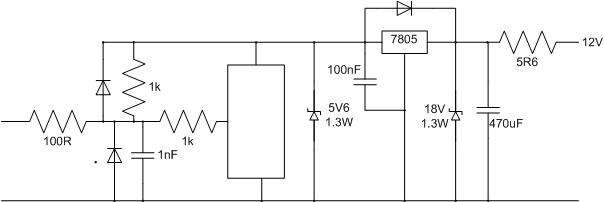
        Feed to 7805, Yes. a series resistor BEFORE your 470uF capacitor is a good idea. Also move the 18V Zener to the capacitor / 7805 input side of the resistor.


        #851391
        Robert Atkinson 2
        Participant
          @robertatkinson2
          On peter1972 Said:

          A 1N4007 is rated at 45A for a 1ms square pulse but its forward voltage would then typically be over 1.8V. I doubt the Arduino would survive. Adding a fairly high value of resistor in series with each Arduino input makes sense, but I would prefer to use much higher resistor values throughout.

          With the circuit shown, 1KΩ in series would not prevent correct operation of the circuit if the ternary signalling threshold levels programmed into the Arduino are modified accordingly.

          On Macolm Said:

          One thing to be aware of with schottky diodes is the very high reverse leakage current. It can be a maximum of several milliamps for a small diode, an amp or more for a larger stud diode.

          For the 1N5817 Schottky diode mentioned, the data sheet shows typical reverse leakage current of 3µA with 5V applied (at 25C).

          The 100R and 1N4007 reduces the stress on the internal protection. A 1ms 45A pulse is not a credible input condition.

          You can’t change the logic thresholds on any Arduino I’ve seen. Using a 1k series with 1k pullup places the input at 2.5V, not a good place.
          As I said earlier it would be ideal to to have the series 100R, diodes, pull-up (1k) and then a series 1k to the pin. A 1nF 50V ceramic capacitor to 0V after the 100R would help too.
          The low reverse breakdown voltage of typical Schottky diodes mae them unsuitable for ths application.
          Lightning protection for aircraft and avionics is part of my day job.

          Robert.

          #851406
          duncan webster 1
          Participant
            @duncanwebster1

            I’m using analogRead, so I can set my own thresholds, I need 2 as I said before. I do have capacitors to earth, will check the value.

            #851415
            peter1972
            Participant
              @peter1972

              The low reverse breakdown voltage of typical Schottky diodes make them unsuitable for this application.

              If Schottky diodes were to ever get over say 20V reverse voltage then the Arduino would be dead anyway.

              Using ordinary silicon diodes as discussed may well not give sufficient protection to the Arduino’s very delicate inputs. It has been suggested that a fairly high value resistor in series with each Arduino input would help.

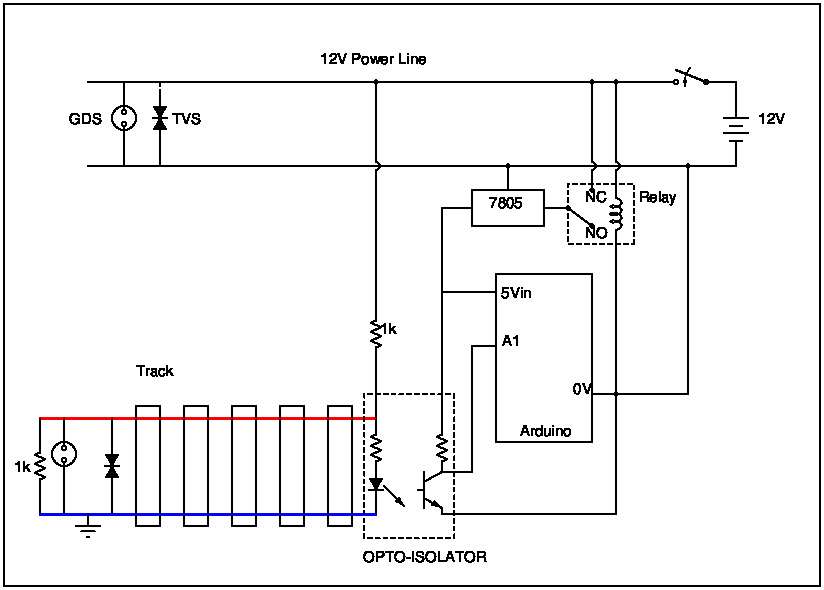
              I suggest putting an optocoupler between the ULN2003 and the 1kΩ resistor. An additional resistor would be needed to limit the current through the optocoupler’s LED.

              I still think we should question whether satisfactory operation could be achieved by using much higher values of the resistors giving very much better lightning protection.

              #851416
              duncan webster 1
              Participant
                @duncanwebster1

                The  ULNs seem to have survived. I chose to use 1k in the detection side as very high resistance would be more susceptible to leakage across the sleepers. However as readers will have realised by now I am not an electronics expert, a mere dabbler

                #851446
                peter1972
                Participant
                  @peter1972
                  On duncan webster 1 Said:

                  The  ULNs seem to have survived.

                  They will be much more robust than Arduinos and they incorporate clamping diodes. Part of my thinking was to give say 5kV isolation between signals so lightning close to one signal hopefully does not damage other signals via the interconnections. We don’t really know why so many of your circuits have been damaged. Anyway, use of optocouplers is probably not worthwhile although they are cheap. With lightning protection you have to draw the line somewhere.

                  On duncan webster 1 Said:

                  I chose to use 1k in the detection side as very high resistance would be more susceptible to leakage across the sleepers.

                  I have no idea what leakage to expect when a track section with plastic sleepers is soaking wet. You could adjust your ternary signalling thresholds to allow for some leakage.

                  The 100Ω resistors that have been suggested could be increased to say 1kΩ to improve protection but you would need to adjust the ternary signalling thresholds accordingly. All I’m saying is that I suggest the resistor values are reconsidered with a view to improving lightning protection.

                  #851504
                  Macolm
                  Participant
                    @macolm

                    The charge that leads to lightning is likely many millions of volts, with the flash usually flowing to ground. You can think of the path as forming an inductive potential divider, including any wire that is part of it. As a crude example, discharge from a height of 1000 metres of a charge at a potential of one million volts would result in an instantaneous drop of 1000 volts across a metre of wire in which it flowed. Indeed, things might well be much worse than this.

                    You can see that making the protection circuitry as compact as possible is a good idea, with a single AC connection to the flash path. In particular, capacitors need to have the shortest leads possible to be effective, with feed through capacitors the best choice, and choosing a “four terminal” configuration if possible. Ground planes with small surface mount capacitors can also be effective.

                    #851522
                    Robert Atkinson 2
                    Participant
                      @robertatkinson2

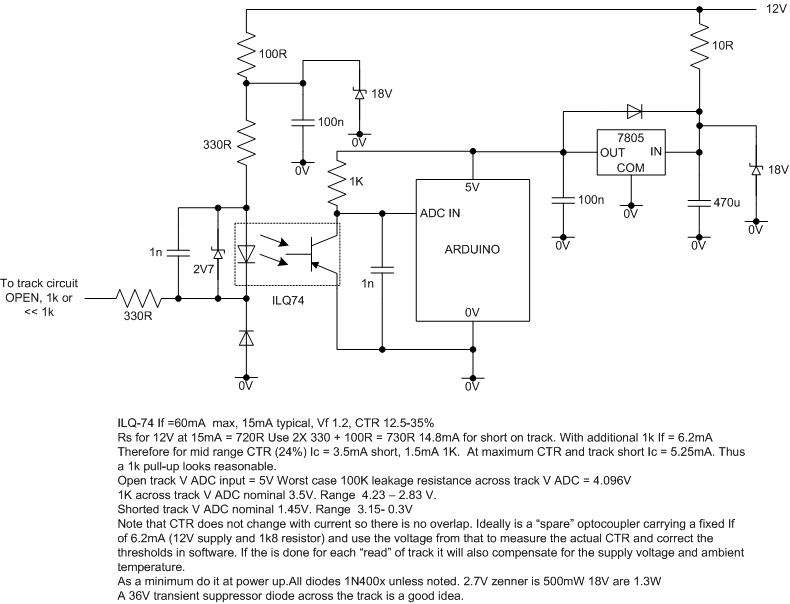
                      input protect

                      #851575
                      duncan webster 1
                      Participant
                        @duncanwebster1

                        I could have sworn I’d responded to this last night, must not have hit submit.

                        Thanks for that, I’ve saved it and the next batch of boards will be modified in accordance, but as I said before, I need to get the damaged signals up and running quickly before next public running.

                        Just a couple of questions to aid my understanding (never stop learning).

                        According to interweb “The ADC is optimized for analog signals with an output impedance of approximately 10 kΩ or less”. Does this mean that the 1k you show connected to the Arduino could be 10k? Would it be better to move the 1nF to the Arduino end? Could it usefully be bigger?I’m not looking for blistering fast response.

                        The LEDs are fed direct from the 12v, so the current to the processor is very low, I’ll measure it, but guess a few 10s of mA. Why is the 5R6 resistor so low? Is it to allow excess voltage to go back into the 12v supply?

                        I don’t think this matters, but according the the 7805 data sheet there should be 0.1uF across the 470uF and 0.2uF across the output. Both of these seem to be optional

                        #851578
                        Robert Atkinson 2
                        Participant
                          @robertatkinson2

                          Hi,
                          You could use a higher series resistor at the ADC input pin but I’d add an additional 1nF capacitor to ground at the input pin. This is because the ADC tends to draw current in pulses de to the multiplexer and the capacitor improves accuracy.
                          I sized the 12V input resistor low as I wasn’t sure if you had other loads on the 5V. It should be sized to drop about 4-5V at the maximum load but it’s not critical.
                          A “7805” is a generic number for a wide range of devices. Requirements for input and output capacitors depend on the exact (make and full part number) device. Typically you need a 0.1 across the input if the device is more than a few inches from the filter capacitor typically found in a mins supply. The 470uF fulfils this requirement. A capacitor on the output helps with noise and stability.and is mandatory for some specific devices.


                          #851603
                          duncan webster 1
                          Participant
                            @duncanwebster1

                            Thanks again, all understood

                            #851616
                            Macolm
                            Participant
                              @macolm

                              For the purpose of lightening protection the circuit Robert gives is comprehensive, but in addition, the physical layout is also important. In particular, the 1nF capacitor is critical, and the leads need to be as short as possible to minimise inevitable unwanted inductance. Take a look at this link from Murata showing how this translates to self-resonance, above which frequency the capacitor ceases to be fully effective. On the second page, the first diagram shows how you should best connect the capacitor, with a short lead to a ground plane, and short two terminal connection into the circuit.

                              https://www.murata.com/~/media/webrenewal/products/emc/emifil/knowhow/12to14.ashx

                              This all helps to minimise any feed through of any spike to the semiconductor.

                              Even better is the same configuration where the capacitor is a surface mount component, or best, a feed through capacitor.

                            Viewing 13 posts - 26 through 38 (of 38 total)
                            • Please log in to reply to this topic. Registering is free and easy using the links on the menu at the top of this page.

                            Latest Replies

                            Viewing 25 topics - 1 through 25 (of 25 total)
                            Viewing 25 topics - 1 through 25 (of 25 total)

                            View full reply list.