Four Index Thread Indicator

Four Index Thread Indicator

Home Forums General Questions Four Index Thread Indicator

Viewing 20 posts - 26 through 45 (of 45 total)
  • Author
    Posts
  • #584274
    John P
    Participant
      @johnp77052

      Hi Franco,

      i have sent you a PM .

      The article shows all of the information required ,Unfortunately you have the disadvantage in having a screw cutting gearbox ,i think there is lash up arrangement using 33 and 34 tooth gears which is not as good as a true 127 for imperial to metric conversion ,this would work for you if you could fit in a 127 gear some ware in the gear train ,i have a change wheel machine and find that is far better than a boxed machine.

      John

      #584280
      Tony Pratt 1
      Participant
        @tonypratt1
        Posted by John P on 06/02/2022 19:16:59:

        Hi Franco,

        i have sent you a PM .

        The article shows all of the information required ,Unfortunately you have the disadvantage in having a screw cutting gearbox ,i think there is lash up arrangement using 33 and 34 tooth gears which is not as good as a true 127 for imperial to metric conversion ,this would work for you if you could fit in a 127 gear some ware in the gear train ,i have a change wheel machine and find that is far better than a boxed machine.

        John

        Not a lash up but a very practical solution at minimal cost.

        Tony

        #584281
        Franco Convertini
        Participant
          @francoconvertini28916

          Hi John, I have already replied to you on the MP.
          I realize that for this project it is easier to have a lathe where you change the wheels. Is it possible that the box of my lathe does not have a 1: 1 ratio?

          Edited By Franco Convertini on 06/02/2022 19:35:06

          #584290
          old mart
          Participant
            @oldmart

            What I find hard to get my head around is rather than 8tpi, which is a nice round figure of 0.125" pitch, the Smart & Brown has an imperial leadscrew of 6tpi which is not a nice round figure,0.166666———-". The 24 digit threading dial cannot be disengaged from the leadscrew. That has a slight advantage, as before engaging the nut, you can quickly glance at it and be sure which way the saddle is going to move.

            #584302
            Pete Rimmer
            Participant
              @peterimmer30576

              In the article it's mentioned that the system works for integer pitch metric threads. What does one do when cuttiing non-integer threads which, let's face it, would be the more common?

              #584312
              John P
              Participant
                @johnp77052

                Pete ,

                You need to read the full article it covers all the pitches.

                John

                #584866
                Hopper
                Participant
                  @hopper
                  Posted by Martin Connelly on 06/02/2022 08:32:03:

                  For short lengths of thread keeping the half nuts closed is not too bad. For a long length of thread you can release the half nuts and move the carriage back in multiples of 5" (127mm) to pick up the correct position on the leadscrew. Your thread dial indicator engagement point will be different for each successive pass. There is a risk of getting the distance wrong if you do not have a good method of ensuring you move the correct distance. Best if the leadscrew is stopped before the half nuts are disengaged otherwise you have to reverse just enough to go back to the thread dial mark that was being used then make the 5" move. A DRO will help as you can set the zero point before moving back….

                  Martin C


                  20220210_170928.jpg


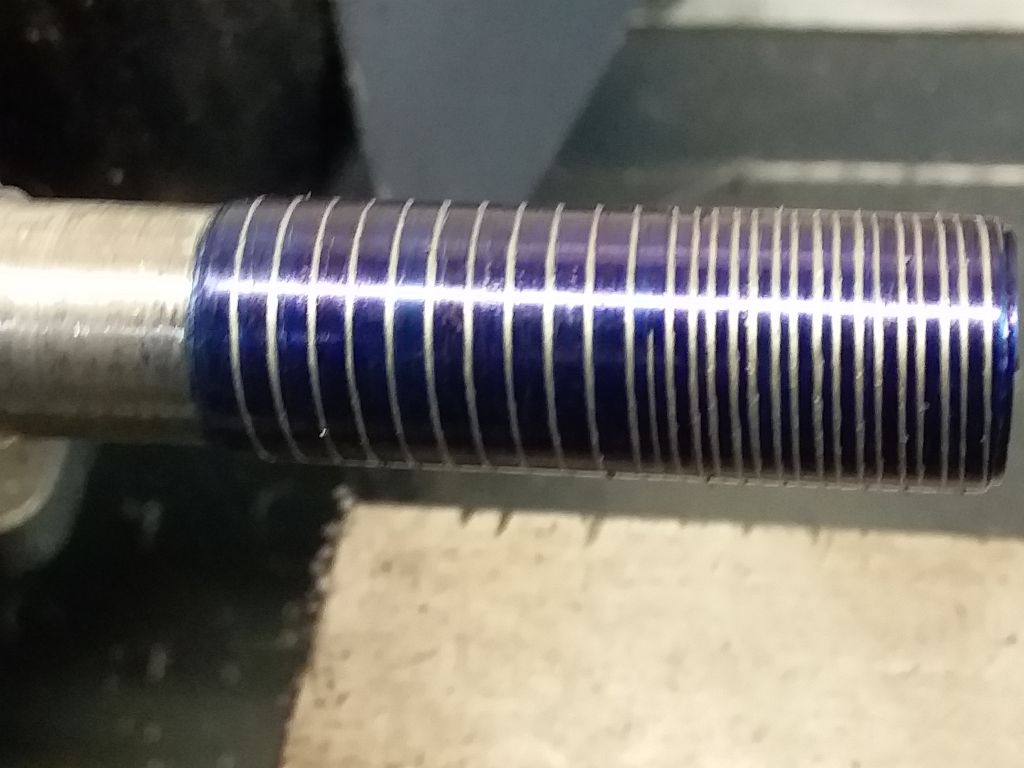
                  Well I just had to try this method on my imperial Myford ML7 because it sounds too good to be true — and it does not work, as above pic shows. Lathe change gears were set up to cut a 2mm pitch thread with an 8tpi leadscrew. Carriage movement was measured with dial indicator to be exactly 2mm per one revolution of the chuck. Lathe was stopped at the end of the first pass before disengaging halfnuts and carriage was moved by a carefully measured 5.000 inches and halfnuts re-engaged then lathe started and second pass taken.

                  First pass is visible at the left. Second pass, after using the above method resulted in the double thread on the right hand portion.

                  And I can not see mathematically any way that this method could possibly work. You stop the lathe, disengage the half nuts then move the carriage 5.000 inches or 127.00 mm to the right and re-engage the halfnuts. That would work ok on a 1mm pitch threads. You are re-engaging the halfnuts 127 full pitches away from the starting point. All good.

                  But on a 2mm pitch thread, 127 mm is halfway between two pitches. It needs to either engage at 126mm from the original disengagement point, or 128mm, which would be 63 and 64 pitches respectively. (But of course the halfnuts will not engage at these two points because they are each 1mm out of line with the thread on the leadscrew. )

                  And it does not work mathematically for any other metric thread pitch either. They all work out to oddball measurements, none of them 127mm. As 127 is a prime number, the only pitch that divides into it without getting into fractions of a pitch, is 1mm. It does not work for any other pitch, as far as I can see.


                  Edited By Hopper on 10/02/2022 11:02:32

                  #584871
                  Hopper
                  Participant
                    @hopper

                    OK, so on further thought: If winding the carriage back 5" works for a 1mm pitch, then winding back 10" would work for a 2mm pitch thread, ie 10" = 254mm = 127 full threads at 2mm pitch. And on the same principle, 15" (= 381mm = 127 x3) would work for a 3mm pitch.

                    But what about 1.5mm and 1.75mm pitches etc? Hmm further thought required. As Curly from the Three Stooges said, I tried thinking about it but nothing is happening.


                    Edited By Hopper on 10/02/2022 12:09:32

                    Edited By Hopper on 10/02/2022 12:13:01

                    #584874
                    Anonymous

                      Mathematically the number needed is the least common factor of 127 and a multiple of the metric pitch to make it an integer.

                      For 1.5mm pitch it is 2×1.5×127 = 381 = 15"

                      Andrew

                      Edited By Andrew Johnston on 10/02/2022 12:18:08

                      #584881
                      Hopper
                      Participant
                        @hopper

                        Aha. Thank you. I can see that. Basically half a 3mm pitch so the same 15" point.

                        So I guess .75mm pitch would also be 15". As in 4 x 0.75 x 127 = 381 = 15"?

                        And for .5mm pitch you could use 127mm/5" because it would equal 254 threads.

                        But what about 1.25 and 1.75? I'm thinking 1.25 x 4 x 127 = 635mm = 25", which is probably off the end of the Myford bed someplace!

                        Going the other way, 0.8 x 5 x 127 = 508 = 20". h

                        Could be handy for long jobs for sure. I think I will have to write them all down on a chart though. i will never remember the calculations by the time I ever need to use it!

                        And from my own faffing around in the shed this afternoon, I reckon one could use the thread indicator dial to measure off the carriage movement, rather than wrestling with a digital caliper as I did. One full turn of the TDI dial is two inches on a Myford. (16 tooth gear engaged with a 8tpi leadscrew). So to move five inches, it was a matter of use #1 on the dial for the first pass, then wind back two turns plus a half to get 5", so the #3 on the dial is lined up with the mark. 10 inches would be a matter of five full turns of the dial etc. As long as the halfnuts engage with the stationary leadscrew at that number,you are ready to go. Neat!


                        Edited By Hopper on 10/02/2022 13:48:16

                        #584882
                        John Slater 1
                        Participant
                          @johnslater1

                          I recall an aged turner many years ago recounting screwcutting with out the use of a thread indicator. His explanation centred on what he called chalk marks. Apparently if my aged memory serves the procedure was to mark the bed where the carriage was located establishing a start point. The lead screw was also marked along its length against a static part of the bed. On a Myford say the tailstock end leadscrew bearing so the point at which the half nuts were engaged was indicated. Thus a start point for the leadscrew and a corresponding start point for the carriage were established. The marks enabled the turner to return to the same start point relationship after each cut.

                          I've not tried the method but am not able to see why it wouldn't work and on the face of it should work for any pitch.

                          Or am I way off?

                          Maybe one of the ancient tomes on lathework might have a description although I'm unable to recall seeing it described in print.

                          John

                          #584883
                          Hopper
                          Participant
                            @hopper

                            Yes i think Martin Cleeve's book Screwcutting in the Lathe mentions the old chalk mark system but not sure it would work for metric on an imperial. I think to do that would require a chalk mark also on the chuck and a very long wait for both the chalk mark on the chuck and the leadscrew to both line up with their reference points at the same time. I used to try to do stuff like that using the leadscrew dog clutch on my Drummond for cutting odd TPI threads etc and it's a test of patience. Will have to have a read up on it in the morning. Getting late here now.

                            I got hold of that full article from MEW 149 too, so plenty of reading over breakfast tomorrow!

                            Edited By Hopper on 10/02/2022 13:54:57

                            Edited By Hopper on 10/02/2022 14:00:40

                            #584935
                            Martin Connelly
                            Participant
                              @martinconnelly55370

                              Hopper, I realised when I came back to this thread that I had forgotten that the pitch needs to go into 127 an integer number of times. So 1mm, 0.5mm, 0.25mm will work. You can also do 2mm with a 254mm (10" ) move.

                              Martin C

                              #584948
                              Hopper
                              Participant
                                @hopper

                                Thanks Martin. With Andrew's help I think we figured it out. Handy if you have a 9" long job, not so much for a 6" long job as you still have a long time to wait before the tool gets to the job, so not that much quicker than the reversing the lathe rotation method. And when you get out to using the 15" and 20" settings, even more so.

                                Reading the full article in MEW 149, it looks like that involves quite a long wait for the one mark to come around on either the 40T gear driven dial for integer threads, or even longer on the very large non-integer improvised set up for non-integer pitches.

                                And Martin Cleeve in his book on screwcutting mentions geared indicator dials but says they are no huge advantage because of the time needed for the mark to come around into alignment.

                                So not sure if any of the methods really offer a truly quick way of cutting metric threads on an imperial lathe, albeit they are in some cases a bit quicker than the reversing method but not by a huge amount. Will have to play about with it some more.

                                Meanwhile I am off to make some new changegear studs for the Myford, the type with the clamping nut on the easily accessible outer end. Sick and tired of wrestling around with those hidden nuts in behind the quadrant. Just noticed Brian Wood's book on lathe gearing for screwcutting has a nice drawing of the later type with the better nut location. Should be a nice little project for the day. Another day of screwing around in the shed!

                                #584980
                                Martin Connelly
                                Participant
                                  @martinconnelly55370

                                  Even with the nuts easily accessible changing the gears is still a pita indecision

                                  Martin C

                                  #585048
                                  Hopper
                                  Participant
                                    @hopper
                                    Posted by Martin Connelly on 11/02/2022 08:15:30:

                                    Even with the nuts easily accessible changing the gears is still a pita indecision

                                    Martin C

                                    Yes but it should downgrade if from a Right Royal PITA to a British Standard PITA. Every bit helps.

                                    #602592
                                    John P
                                    Participant
                                      @johnp77052

                                      Just as an update on threading indicators see this on lathes uk

                                      http://www.lathes.co.uk/universal-thread-dial-indicator/index.html

                                      John

                                      #602611
                                      Howard Lewis
                                      Participant
                                        @howardlewis46836

                                        Without having given the matter much thought, is the solution a gearwheel with a different number of teeth to engage the leadscrew, and a dial with ten divisions, rather than four?

                                        Have not really thought about it, so don't ask me "How many teeth"?

                                        You can't get gears with 31.75 teeth, and 32 would not be accurate enough in most cases, with a 10 division indicator disc..

                                        So, Thinking Caps on, and fire up the calculators!

                                        Howard

                                        Edited By Howard Lewis on 21/06/2022 17:19:08

                                        #602626
                                        Yngvar F
                                        Participant
                                          @yngvarf
                                          #602635
                                          DC31k
                                          Participant
                                            @dc31k
                                            Posted by Howard Lewis on 21/06/2022 17:17:57:

                                            So, thinking caps on, and fire up the calculators!

                                            The calculation is not too involved; it is the practicality that is a problem.

                                            40t on at 8tpi leadscrew, with a single dial graduation, will measure 5 inches or 127mm.

                                            Will (only) work for a metric thread that has an integer number of pitches in 127mm (i.e. 1mm and 0.5mm).

                                            Would be very slow as you have to wait for five inches of leadscrew to pass or 127 revs of the spindle.

                                            For 2mm pitch, you'd need an 80t gear, 10" of leadscrew and twice as much waiting.

                                            For 0.5mm pitch, you could use 20t and measure 63.5mm or 2 1/2".

                                            The maths is not complicated; it is the prime number buried in the conversion between the units that hinders any attempt at a practical solution.

                                          Viewing 20 posts - 26 through 45 (of 45 total)
                                          • Please log in to reply to this topic. Registering is free and easy using the links on the menu at the top of this page.

                                          Latest Replies

                                          Home Forums General Questions Topics

                                          Viewing 25 topics - 1 through 25 (of 25 total)
                                          Viewing 25 topics - 1 through 25 (of 25 total)

                                          View full reply list.