Best method to deburr/restore a straight edge

Best method to deburr/restore a straight edge

Home Forums Workshop Tools and Tooling Best method to deburr/restore a straight edge

Viewing 24 posts - 1 through 24 (of 24 total)
  • Author
    Posts
  • #827081
    thisdesignedthat
    Participant
      @thisdesignedthat

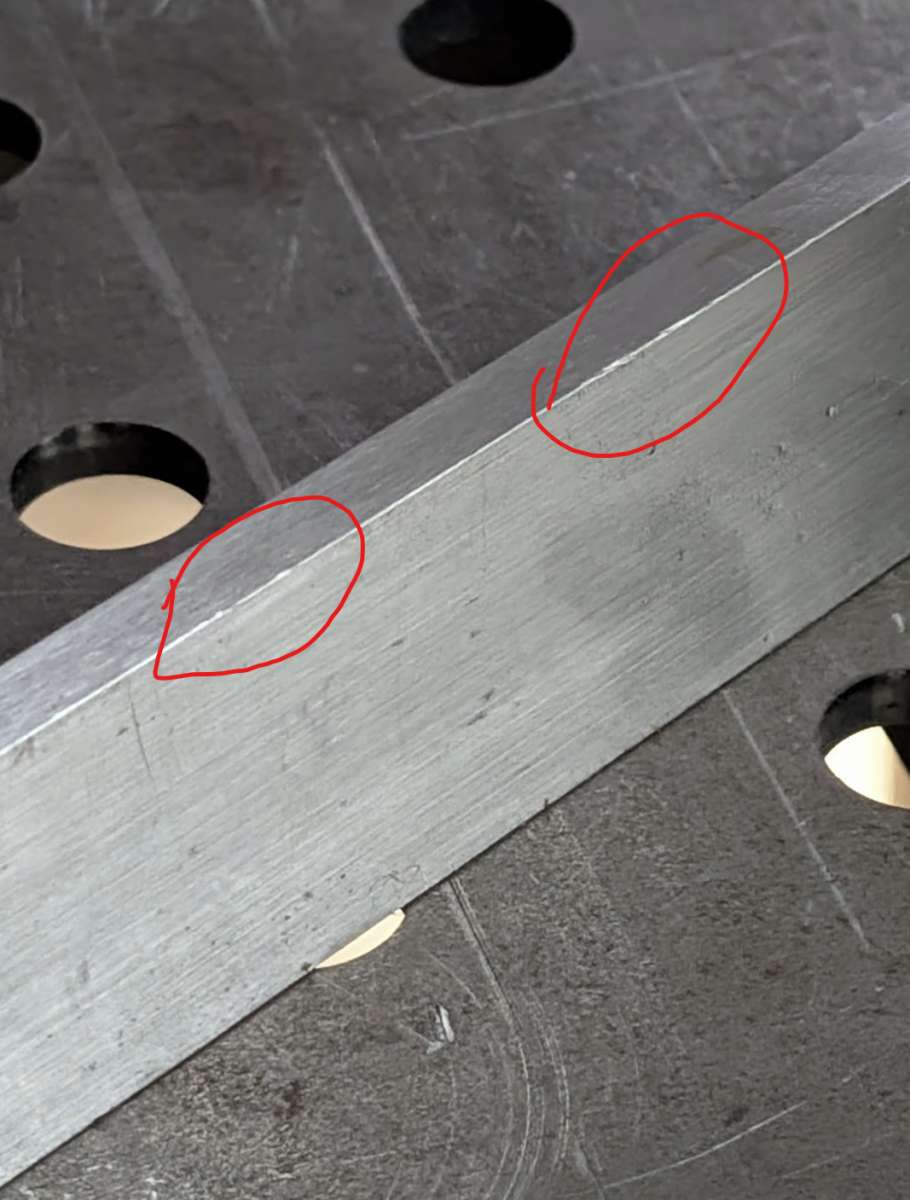
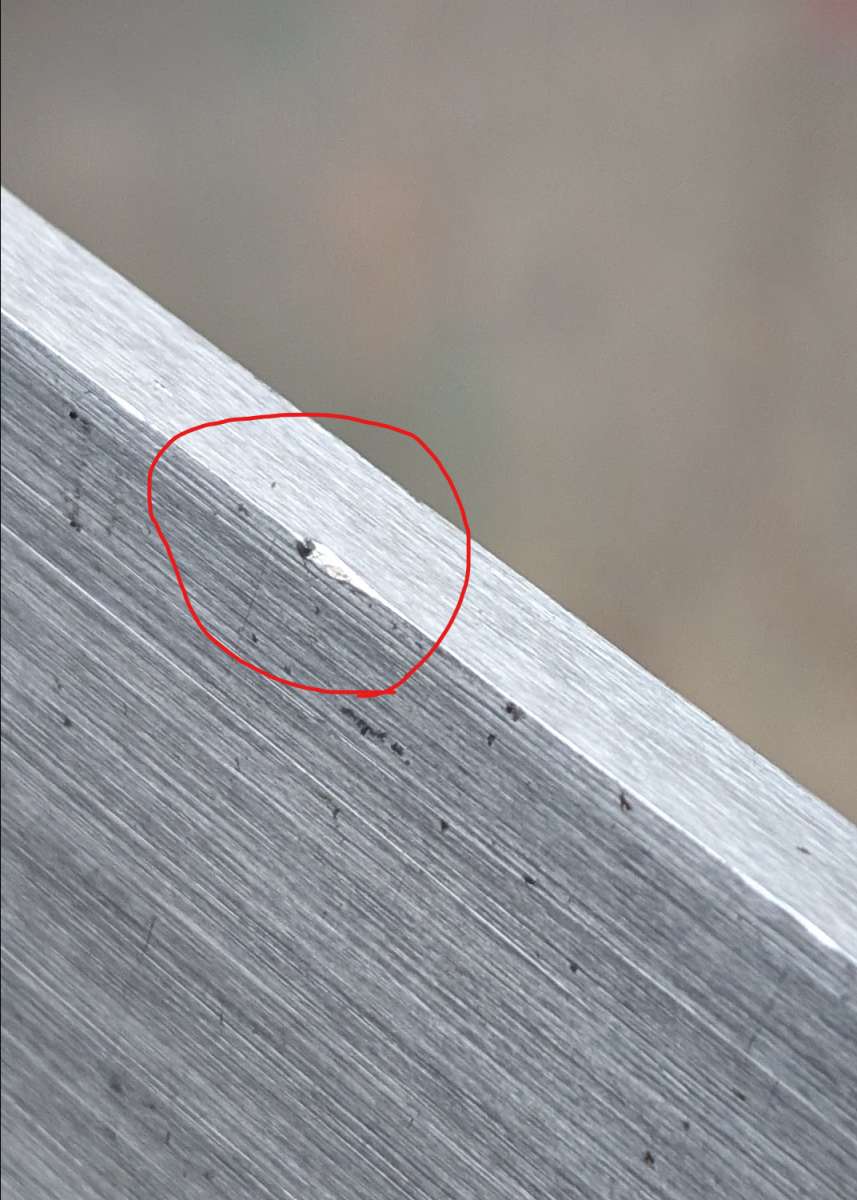
      I picked up a 1943 Moore & Wright straight edge last week. It was still in the wax paper and covered in oil. Upon cleaning it, I can feel a few small surface imperfections along its edge. I’ve tried to show them in the images below. I’m guessing this will affect its ability to measure a straight edge, and I was wondering what the best method is to remove these?


      Screenshot 2025-12-01 091019 Screenshot 2025-12-01 091050

      #827084
      noel shelley
      Participant
        @noelshelley55608

        600 wet or dry paper on a piece of flat material (metal) Do no more than is necessary, test it against a piece of glass. Noel.

        #827085
        thisdesignedthat
        Participant
          @thisdesignedthat

          Thanks Noel, this is 2ft in length so not sure i have anything that long and flat as a reference surface. i was hoping not to ruin the lovely ground surfaces, but i think this is probably the best approach.

          #827086
          DC31k
          Participant
            @dc31k
            On thisdesignedthat Said:

            I was hoping not to ruin the lovely ground surfaces

            Do some tests on a piece of steel scrap with different grits of abrasive paper. Pick the grit that most closely approximates the existing scratches on the piece.

            #827101
            Macolm
            Participant
              @macolm

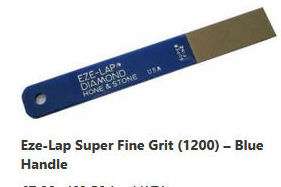
              I find that an Ezelap or equivalent diamond lap (600 or 1200 grit) is the best way to stone off burrs. You can stop precisely when you reach the undamaged flat surface.

              #827102
              peak4
              Participant
                @peak4

                A half hour video to peruse over a coffee;

                Bill

                #827107
                John Haine
                Participant
                  @johnhaine32865

                  +1 for EzeLap.  It is remarkably difficult to stone significant amounts off a ground surface.

                  #827108
                  noel shelley
                  Participant
                    @noelshelley55608

                    I also have a 24″ M&W in it’s nice wooden box and the grease proof paper ex MOD. Bear in mind what you will/would use it for ? Malcolms diamond lap is also a good idea, Your not going to do it much harm. The warmth of your hand will cause more distortion. Noel.

                    #827113
                    SillyOldDuffer
                    Moderator
                      @sillyoldduffer

                      Umm, the pictures aren’t clear, but looks to me as if the dings are on one side, possibly the inner side of a bevel where they don’t matter.  If so, “if it ain’t bust don’t fix it“.

                      Stoning a straight-edge is a good way of ruining it. So practice on something you don’t care about first!

                      I know Model Engineers lurve old-tools, but condition is everything.  If a precision straight-edge is needed, as opposed to being an object of desire, buy a new one and send it back if it’s no good.

                      A 1943 Moore and Wright is risky because it’s history is unknown.  Anything between “as new” and “abused in a horse-play sword fight by jackass apprentices”.

                      Ignore my utilitarian advice if your hobby is doing up old-tools, which many people enjoy.  I use tools to make things, where time mending tools is time-wasted.  Both are allowed!

                      Dave


                      #827123
                      thisdesignedthat
                      Participant
                        @thisdesignedthat
                        On SillyOldDuffer Said:

                        Umm, the pictures aren’t clear, but looks to me as if the dings are on one side, possibly the inner side of a bevel where they don’t matter.  If so, “if it ain’t bust don’t fix it“.

                        Stoning a straight-edge is a good way of ruining it. So practice on something you don’t care about first!

                        I know Model Engineers lurve old-tools, but condition is everything.  If a precision straight-edge is needed, as opposed to being an object of desire, buy a new one and send it back if it’s no good.

                        A 1943 Moore and Wright is risky because it’s history is unknown.  Anything between “as new” and “abused in a horse-play sword fight by jackass apprentices”.

                        Ignore my utilitarian advice if your hobby is doing up old-tools, which many people enjoy.  I use tools to make things, where time mending tools is time-wasted.  Both are allowed!

                        Dave


                        This isn’t a beveled straight edge, just a rectangular straight edge so those edges are in contact with the surface i want to measure

                        Yep, i agree, it was a bit of an impulse buy but i’ve learned my lesson with this one, even if it’s in wax paper and looks to be unused its not worth the risk with this type of measuring equipment. I paid £60 for it so not that much of an issue. But I see you can get something like the Kinex Precision Straight Edge 1000 mm (Made with an accuracy of 0.033 mm to 1 meter, according to DIN 874) for £100 off Amazon which i know i could return immediately if theres any issues

                        #827171
                        John Haine
                        Participant
                          @johnhaine32865

                          If you carefully rub the dings with a diamond hone they will quickly get flush with the neighbouring surface. And you might remove a few microns of material but for the kind of things you use a straight edge for that’s quite immaterial.  Certainly wouldn’t easily remove 33 microns which is the accuracy on the one you quote.  If you’re concerned, measure adjacent to the ding with a micrometer before and after – I bet you’d not notice any difference.  I have tried lapping off significant amounts and it’s really hard!

                          #827177
                          Diogenes
                          Participant
                            @diogenes

                            Yes, what John Haine is saying – I think – you only have to address the bits where bruising has raised metal – these only have to be taken slightly below the ‘good’ surfaces, as ‘locally as possible – leave the rest of it alone.

                            #827180
                            Macolm
                            Participant
                              @macolm

                              Not a lot further to say, but in a case like this I find a small drop of thin oil will make the lap float over the flat surface, but the sharp projections will penetrate the oil film and be abraded. Of course there is a degree of technique about it, but you quickly get the measure of it. I find the lap configuration below best for exact control.

                              As to whether to use oil or water, oil can sometimes soften the adhesive attaching the diamond coated metal foil, whereas I have found the use of water as lube can result in rust unless dried very carefully afterwards. Neither horse suited to the course?

                              EZELAP

                              #827183
                              Bill Phinn
                              Participant
                                @billphinn90025

                                It’s suboptimal being content with just taking away any protrusion from the dings, but preferable to regrinding/stoning the whole reference surface and ending up with a worse outcome, which I know I would with the equipment I have at my disposal if the straight edge had any pretensions to accuracy in the first place.

                                A slight amount of unevenness on one side in a couple of neighbouring spots won’t matter for most purposes as long as the vast majority of the reference edge itself is still flat and uninterfered with. The presence of the smoothed off dings may require you to use feeler gauges more often in some circumstances to corroborate what you think your eyes are seeing.

                                I can vouch for Kinex products. I have a few of their DIN 875/0 and DIN 875/00 squares bought about ten years ago and they are very good.

                                #827191
                                milesincam
                                Participant
                                  @milesincam

                                  If anyone wants to enjoy watching someone create top quality flat and straight surfaces using very accessible methods (and considerable skill and patience), then the youtube series by Gina Bazarko from Ukraine is hard to beat.  He achieves 1 micron flatness across a restored surface plate, ditto along some home made 1000mm straight edges, and even re-scraped some very long and worn guide ways on an old Soviet surface grinder.

                                  Well worth watching with a cup of tea and an appreciation of someone who just gets on with it, presents some very interesting and scientific (as in well-measured and controlled) lapping examples, and does it all with not a shred of pretension.

                                  https://www.youtube.com/@gena_bazarko/videos

                                  personally, I’d use a well flattened oilstone or slip to stone off dings, rather than a diamond.  Less risk of damage because it’s more difficult to reach the contact pressure to remove material, except on the bit that is sticking up.   Robrenz (as above) is informative on this, as is M. Bazarko.

                                  cheers all,

                                  Miles


                                  #827202
                                  Bill Phinn
                                  Participant
                                    @billphinn90025
                                    On milesincam Said:

                                    using very accessible methods

                                    “ I need to repair a lathe, a milling machine, a grinding machine. First of all, I need a special tool, a straightedge, a surfase plate, a 90-degree test angle, a 55-degree straightedge. I will make all these tools myself”.

                                    Clearly there are different notions of what is meant by “accessible”. Presumably Mr Bazarko won’t be making the tools needed to make the special tools needed to repair his three machines armed only with a dinged straightedge and a kitchen table.

                                    #827367
                                    Pete Rimmer
                                    Participant
                                      @peterimmer30576

                                      I bought an unused 4 foot straight edge and made a repeat-o-meter and manage to scrape straight edges to very decent standard, but for that steel straight edge I would get a hard stone and a soft slipstone. Run wire woll over the surface to take off the sheen then run the hard stone along the edge. Where it polishes is a high spot, use the slip stone tocarefully take it down loaclly. Keep repeating until the hard stone stops polishing a shiny spot and your high spot is gone.

                                      Using emery sheet on a flat face is a sure way to mess it up it’s just too uncontrolled.

                                      Here is my scraping which moves a 1 micron dial barely perceptibly:

                                      #827408
                                      Nigel Graham 2
                                      Participant
                                        @nigelgraham2

                                        Then having removed those bruises, I’d use it in three or places along its length so any remnant effects of the restored areas are cancelled out.

                                        #827411
                                        southernchap
                                        Participant
                                          @southernchap
                                          On peak4 Said:

                                          A half hour video to peruse over a coffee;

                                          Bill

                                          Absolutely this! But you don’t have to have a surface grinder and make precision ground flat stones yourself, or even spend lots to buy them.

                                          There’s an American seller that shows up on eBay.co.uk who makes different sizes of precision ground flat stones and the smaller 4″ ones aren’t that expensive.

                                          The benefits of precision ground flat stones are that whilst they’ll take off the high spots, they won’t remove any other material.  Sure, you might be able to avoid removing more material than you want with a standard stone or an ezelap diamond lap but then again, you might not.

                                          Give your straight edge a few passes with a precision ground flat stone and the high spots caused by the damage will go away and the damage low spots won’t matter (since they’re very small compared with the rest of the undamaged straight edge).

                                          They’ll be very handy for other tasks too, lathe beds, mill tables, parallels, bases of Chinese milling vices!  Just don’t use them for sharpening your chisels! 😉

                                          Search for the user “Jlrkmr2006” on eBay.co.uk and you’ll find the fella.

                                          #827421
                                          Pete Rimmer
                                          Participant
                                            @peterimmer30576

                                            The ground stones are the easiest think in the world to make if you happen to have a surface grinder. I use a 8″ cbn wheel on my Eagle grinder and make several at a time. They donoffer a mighty benefit for stuff like the above and especially for bringing a face in when scraping.

                                            #827447
                                            noel shelley
                                            Participant
                                              @noelshelley55608

                                              From the pictures the burrs are so small that removing them will do no harm. I use mine for checking cylinder heads Etc, we’re not really talking microns here. whilst having an optical flat may be nice is it needed ? Noel.

                                              #827577
                                              peak4
                                              Participant
                                                @peak4
                                                On Pete Rimmer Said:

                                                The ground stones are the easiest think in the world to make if you happen to have a surface grinder. I use a 8″ cbn wheel on my Eagle grinder and make several at a time. They donoffer a mighty benefit for stuff like the above and especially for bringing a face in when scraping.

                                                What type  of stones do you use?
                                                I did try with some cheaper, supposedly oil as opposed to water stones, but they were way too soft, and produced loads of abrasive dust when rubbed together.

                                                Bill

                                                #827591
                                                Pete Rimmer
                                                Participant
                                                  @peterimmer30576

                                                  Normally I use water stones Bill they cut well and tend top not clog up.

                                                  #827594
                                                  peak4
                                                  Participant
                                                    @peak4
                                                    On Pete Rimmer Said:

                                                    Normally I use water stones Bill they cut well and tend top not clog up.

                                                    Cheers, I bought a matched pair of dual grit ones from Lidl with that intention, but wondered if their hardness, having found cheap oilstones were far too soft.
                                                    I’ll have to venture into a cold workshop and set up the coolant mister again.
                                                    My little Herbert doesn’t allow for full fluid coolant, so I’m on mist and paper towels.

                                                    p.s. what grit is your CBN wheel?

                                                    Bill

                                                  Viewing 24 posts - 1 through 24 (of 24 total)
                                                  • Please log in to reply to this topic. Registering is free and easy using the links on the menu at the top of this page.

                                                  Latest Replies

                                                  Viewing 25 topics - 1 through 25 (of 25 total)
                                                  Viewing 25 topics - 1 through 25 (of 25 total)

                                                  View full reply list.