Bending sheet metal parts for a 3½ inch gauge locomotive model

Bending sheet metal parts for a 3½ inch gauge locomotive model

Home Forums Beginners questions Bending sheet metal parts for a 3½ inch gauge locomotive model

Viewing 25 posts - 1 through 25 (of 25 total)
  • Author
    Posts
  • #849868
    splat87
    Participant
      @splat87

      Hello everyone,

      This is my first post on the forum, so please bear with me if I am asking something obvious.

      I am building a 3½ inch gauge “Bantam Cock” model locomotive and I am planning the main/trailing/pony frames. I have searched the forum for posts about bending sheet metal, and also looked around online, but I have not found anything very close to what I need.

      The material is 3 mm / 1/8 inch cold rolled steel.

      The options I have considered are:

      Bending by hand in a vice
      This seems simple, albeit needing some force, but I am concerned it may not be accurate enough.

      Using a vice-mounted bending brake
      I have seen these available, but I am not sure whether a normal vice would provide enough pressure to bend 3 mm steel cleanly and accurately.

      Buying a small bending tool or press brake
      There are various tools available online, but I am unsure whether it is worth buying one for such a small number of parts.

      Having the parts laser cut and CNC folded by a supplier
      This may give the best result, but I have no idea what the likely unit cost would be for a small batch of one-off model engineering parts.

      Heating the steel and forming it around pins or a former on a steel plate
      This is another possibility, but I do not know how well it would work or what sort of accuracy could realistically be achieved.

      Has anyone here made similar parts for a model locomotive or other model engineering project? I would be very grateful for any advice on the best method, likely accuracy, tooling, or whether outsourcing the cutting and bending would be the most practical option.

      I am also planning to document the build on a website, including the background to the project and the approach I am taking, and I will post a link once I have made a bit more progress.

      Many thanks in advance for any advice.

      #849883
      Neil Wyatt
      Moderator
        @neilwyatt

        Hi Splat,


        A lot of people here can give practical advice. From my own experience simple folding jigs in a big (3-4″ heavy duty) vice can work well.

        You might be surprised that the difference between buying stock metal sheet and having parts laser cut isn’t as great as you fear.

        However bantam Cock is a well known design. If you visit Model Engineers’ laser (link below) you’ll see that many Bantam Cock parts are already available to be cut to order, so no custome setup or design costs.

        https://modelengineerslaser.co.uk/Catalogue/LocomotivePart/565

        Regards

        Neil


        #849899
        duncan webster 1
        Participant
          @duncanwebster1

          If you really must use CRS then I’d anneal it before cutting things like hornslots, otherwise it can bend due to locked in stress. I’d use hot rolled.

          I don’t think you’ll get far with one of those vice mounted things, very useful, but it doubt you’ll have success with 3mm stuff unless you have a large vice. If ME Laser can supply them pre-bent then that’s what I’d do.

          #849920
          noel shelley
          Participant
            @noelshelley55608

            I’m with Duncan, 3mm will take some bending neatly. Noel.

            #849927
            Bazyle
            Participant
              @bazyle

              Are you following the build instructions in ME? Typically they would give details of the necessary methods, but if not some other build series might help.

              #849932
              Nicholas Farr
              Participant
                @nicholasfarr14254

                Hi, if you can get one of these Miracle Bender it should do the job nicely, but they are not cheap. I’ve got a No. 1 one, and it will do 3mm up to 3″ or so wide without any heating. The biggest one I’ve used was a No. 2, but you can get No. 3 ones. The DIY box/pan folders are not man enough for anything over 1 or 2mm. Something like this press brake attachment would also work, but of course you will need a press of some kind.

                Regards Nick.

                #849940
                JasonB
                Moderator
                  @jasonb

                  Not being a Loco man I had to go and find some images of a Bantum Cock.

                  https://www.stationroadsteam.com/3-12-inch-gauge-bantam-cock-2-6-0–stock-code-11684/

                  I can’t see anything there that could not be bent with a basic bench vice and adjustable spanner.

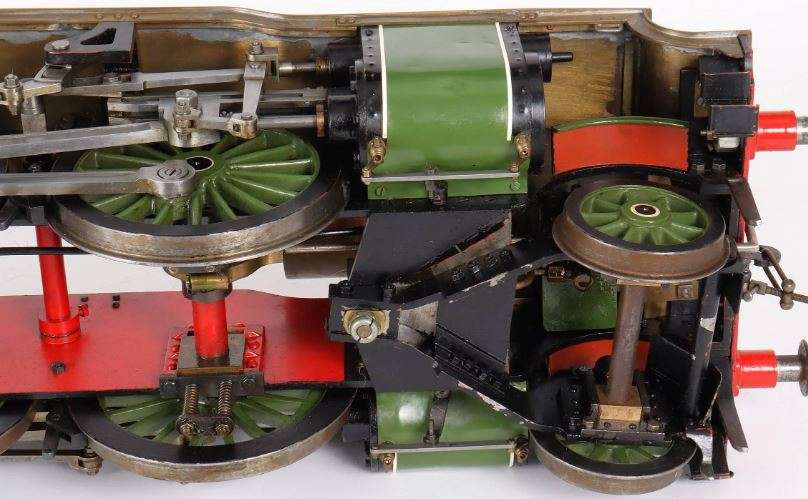
                  The frames look flat. The bogies are not particularly wide and do not have tight 90deg bends so nothing special needed unless I’m missing something? If there is can yu post a pic of the drawing.

                  #849947
                  Nicholas Farr
                  Participant
                    @nicholasfarr14254

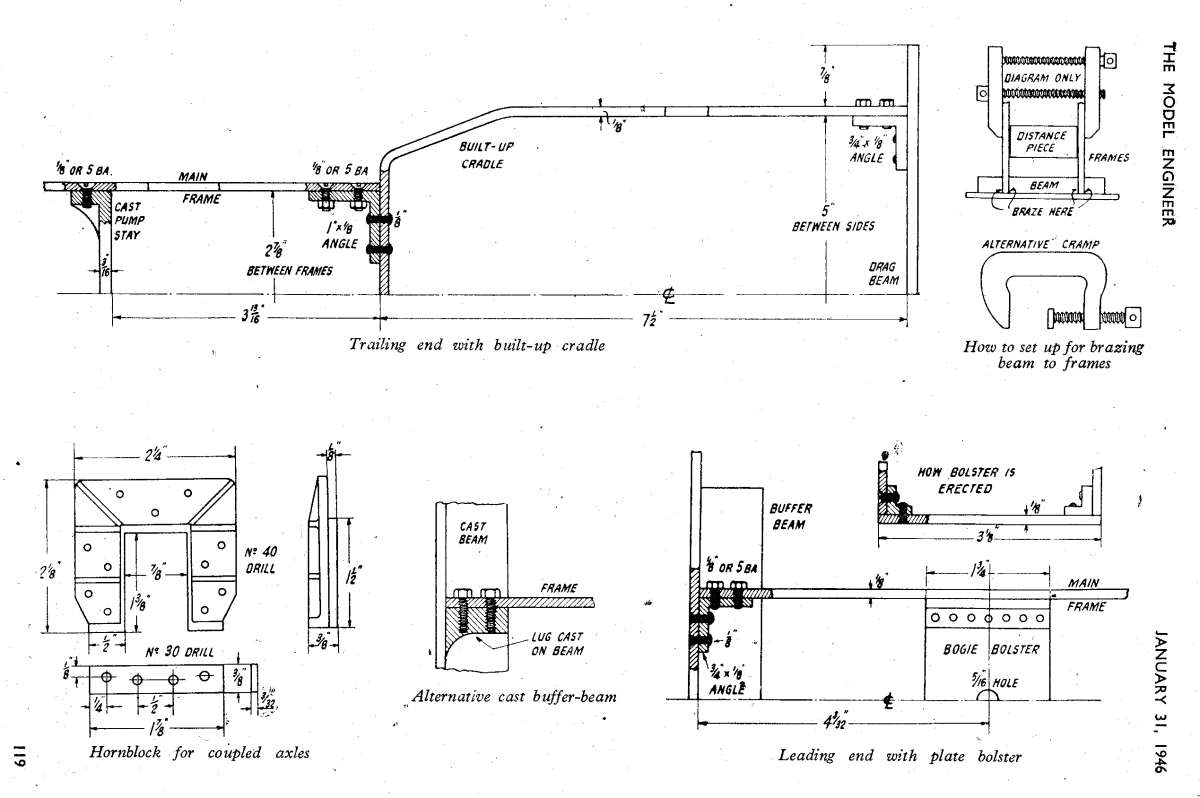
                    Hi, JasonB, I don’t have any of the drawings of the Loco in question, but I think the part may be similar to this one.

                    Trailing end

                    So while they are not all at 90 degrees, a big radius isn’t wanted. The press brake attachment I mentioned, would do these quite nicely I believe.

                    Regards Nick.

                    #849950
                    JasonB
                    Moderator
                      @jasonb

                      bogie

                      #849954
                      Nicholas Farr
                      Participant
                        @nicholasfarr14254

                        There are plans for a home made bender similar to a Miracle bender, that was a free plan in issue 18 of MEW, which is in the tools section the Workshop tag in the blue bar above. Free Plan : A Metal Bender I used one of these in my last day job, and I guess a previous employee made it, and that worked fairly well, but not as good as a real Miricale bender.

                        Regards Nick.

                        #849958
                        Nicholas Farr
                        Participant
                          @nicholasfarr14254

                          Hi JasonB, Ah! Yes, thanks for the photo.

                          Regards Nick.

                          #849961
                          JasonB
                          Moderator
                            @jasonb

                            I knew I had a video somewhere this is my “free” bender. Not sure of the post it was originally in but I think that is 3 x 12 or 3 x 16.

                            In real practice mark the start of the bend and have that against the vice jaw, mark the end and have the spanner against that. If there is a lot to do like on a set of traction engine spokes use a spacer to position the spanner consistantly for each one. Then bend to template which can be a printed sheet or bevel gauge if you have one.

                            #849964
                            Weary
                            Participant
                              @weary

                              Looks like the heftiest piece of bending in this loco is the frame around the rear pony-axle as per drawings posted by Nicholas Farr above

                              I have successfully bent similar frame-pieces in 3mm steel using JasonB’s method posted immediately above this post.   It just needs patience, care, and an element of naked aggression sometimes combined with a relatively heavy hammer!   But then, I am a ‘punk engineer’.

                              I also have one of  those bending ‘brakes’ that fits in a vice’s jaws and that works too, but really needs a somewhat hefty vice for easy bending.

                              Note however, that this builder has avoided the bending completely by constructing a rivetted or bolted right-angled box by combining flats & angle.  So, more than one-way of skinning this particular cat.  If you are hesitant maybe worth considering this as a solution if only in the short(ish)-term which could be replaced later when you have more confidence?

                              Thanks to Station Road Steam archive for the pics.

                              Phil.

                              #849969
                              Nigel Graham 2
                              Participant
                                @nigelgraham2

                                Whatever method you eventually use,  start with the material over-length and trim back to the bends.

                                Don’t gamble on precisely locating bends- they won’t behave! At least not with improvided techniques, big ‘ammers and cruelty to adjustable-spanners.

                                If necessary you can slightly un-bend an over-bent angle by compressing it, but you need be aware this can produce curves outside of the bend itself.

                                Rather than trying to make a bender operated by a vice, might be making one using a car-jack as “power-pack” in a heavy-section frame, with a cylindrical die pushing the steel down into a Vee-block (made from heavy-section steel angle, not one of your precision machine-tool accessories!) or channel.


                                I’ve not built a locomotive with cranked frames (though I similarly swan-necked my steam-wagon chassis’ 50 X 25 X 25mm hot-rolled steel channels… admittedly using a narrow-gauge railway, rail-bender!). However, I bought two different types of bar-bender from a company called WNS, and these can form 50 X 5mm mild-steel. I think one of them will cope with wider, 75mm, by 3mm plate, too.

                                #849972
                                Nicholas Farr
                                Participant
                                  @nicholasfarr14254

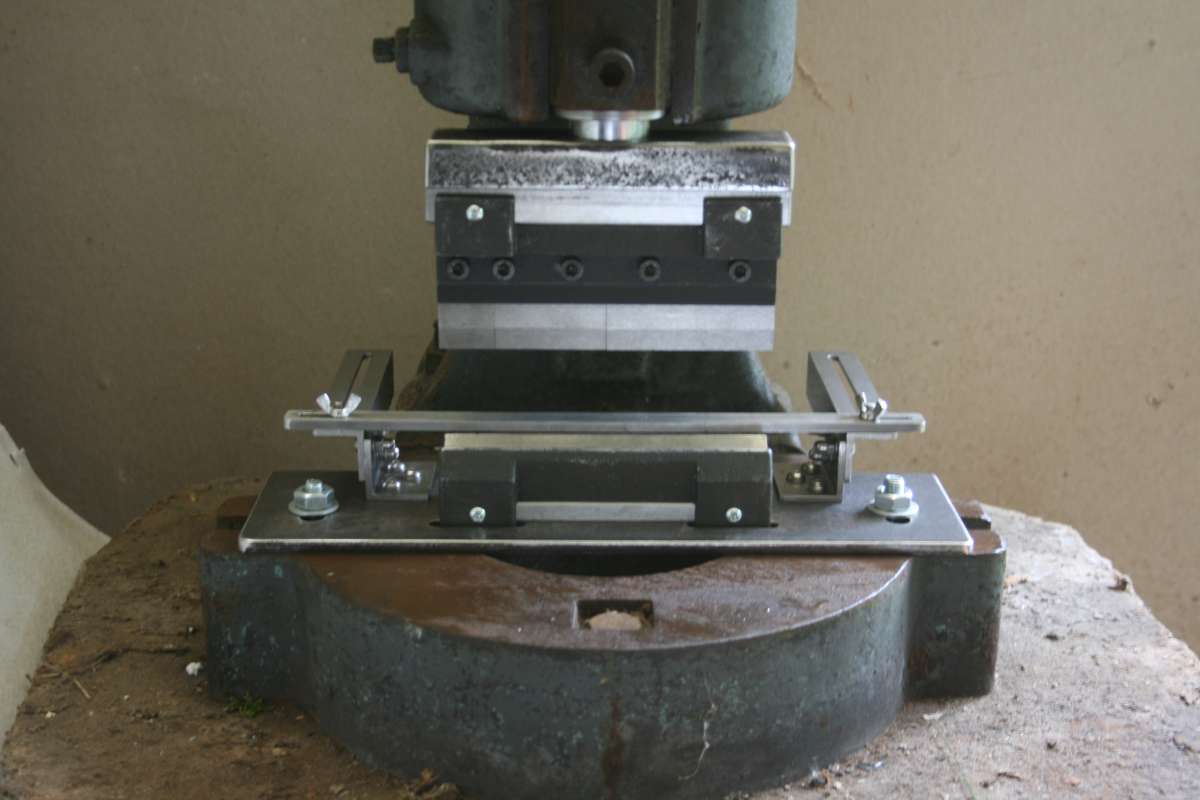
                                  Hi Phil, yes those that you can use in a vice are quite handy, but I’ve rarely used mine in a vice, but I have made provisions for using them in my Fly press.

                                  IMG_1127

                                  Regards Nick.

                                  #849993
                                  Weary
                                  Participant
                                    @weary

                                    Hello splat87,

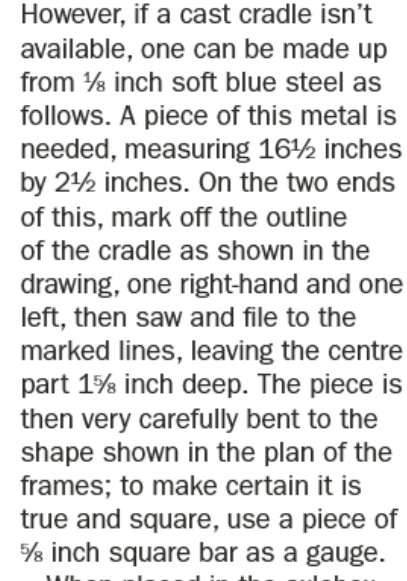
                                    I’ve had a chance to look at the drawing for this trailing frame now to see the elevation, which is a maximum of  2 7/16 inches (62mm) and  “a piece of metal is needed measuring 16 1/2 inches by 2 1/2 inches”

                                    I would suggest 3mm x 70mm CR4 as being modern equivalent, though imperial is still available in ER32B.  Unless you are going to get something sheared to size.

                                    CR4 is (relatively) ‘easy’ to bend and 3mm x 70mm well within the scope of amateur unsophisticated bending with the use of a few formers.  I wouldn’t over-think this exercise, LBSC disposes of it in a single sentence: “The piece is then very carefully bent to the shape shown in the plan of the frames; to make certain that it is true and square use a piece of 5/8 inch square bar in the frames.”

                                    (Explanatory note: the 5/8″ sq bar is placed in the axlebox cutouts to ensure that they are square to each-other across the resultant frame.)

                                    Maybe get a couple or so lengths say around 450mm long and ‘have a go’, starting from the middle and working outwards.  I would use some alloy or steel formers to assist in the bending.   The steel is (relatively) cheap and experimentation will soon show the way; don’t forget that LBSC was writing for constructors who had nothing like the sophisticated workshops considered ‘normal’ (or even ‘essential’) today.  JasonB’s post of 28th May at 06:56 above is pertinent!!

                                    Regards & best of luck,

                                    Phil


                                    #849997
                                    Neil Wyatt
                                    Moderator
                                      @neilwyatt
                                      On JasonB Said:

                                      bogie

                                      I’m pretty sure that the pony truck is easily bent using a vice and care. It’s pretty crude and not very critical, especially if you drill it after bending.

                                      #850000
                                      Neil Wyatt
                                      Moderator
                                        @neilwyatt
                                        On Bazyle Said:

                                        Are you following the build instructions in ME? Typically they would give details of the necessary methods, but if not some other build series might help.

                                        This was LBSC, reprinted in ME in about 2012-13, (previously published in a different mag).

                                        The ‘trailing cradle’ was supposed to be a casting but:

                                        temp


                                        So in typically LBSC fashion “the piece is then very carefully bent to the shape shown on the plan”.

                                        His section on the pony truck doesn’t even mention bending it, only that a ‘casting may become available’ for the pony truck.

                                        Build series were a lot shorter back in those days!

                                        Neil

                                        #850004
                                        JasonB
                                        Moderator
                                          @jasonb

                                          So from Phil’s image and the description Neil has posted I would tend to rough out the shape so that you are bending over shorter distances probably 2″ and 1 1/2″.

                                          Then bend, there are no actual dimensions as to where the bends fall so just stand the metal on edge on the drawing. A bit of tweaking to get the width right and the two edges parallel is likely to be needed.

                                          I would then stand the bent “U” shape on end with the two legs pointing upwards and mark out the cutouts for the axle boxes which should get them parallel to the face that bolts to the main frame.

                                          Other bending options when things get a bit wider is to clamp the work between two pieces of flat or angle which takes the place of the adjustable spanner jaws and lever them. This is 50 x 3 bright EN3, black bar would be easier. If you want to get fancy then instead of the bolts use longer bars with threaded ends, these can then be used as levers instead of the adjustable spanner.

                                          #850023
                                          Clive Foster
                                          Participant
                                            @clivefoster55965

                                            In an appropriately sized vice, such as my 5 1/2″ jaw Record 24, the V block and pusher style brake bender are well up to handling 3 mm steel. Albeit full width takes a certain effort. Mine has quite happily managed relatively narrow 4 mm, order of 1 to 2 inch(ish) wide.

                                            I don’t do much bending but, for me, those in vice benders are worth the relatively modest cost for the ease of checking bend angle against job or template. Improvised methods and simpler devices, like the quick bender in Jasons video work, fine at the bending bit given intelligent application but verifying correctness and re-inserting to adjust exactly on the bend line tend to be significant trouble. Unless you add complexity, such as angle gauging devices, which rather defeats the objective of simplicity.

                                            For me another advantage of those benders is making simple bending jobs routine.

                                            Put in vice, set pointed end of pusher along scribed line on job and squeeze. Simples.

                                            Improvised methods in my hands suffer from not only having to find the right bits to improvise with and but also difficulty remembering which particular improvisation works best on the style of bend in question. It’s frustrating to suddenly rediscover half way through a job why the particular improvisation being used didn’t do well last time out!

                                            That said one day I’ll get it clear that the natural maximum bend angle is more like 85° than 90° and stop over bending in “just needs a touch more” squeeze mode. Only had it 30 years so still time to learn.

                                            Clive

                                            #850061
                                            duncan webster 1
                                            Participant
                                              @duncanwebster1

                                              Any reason it needs to be 3mm? 2mm would bend a lot more easily

                                              #850076
                                              Nicholas Farr
                                              Participant
                                                @nicholasfarr14254

                                                Hi, I’d forgotten that it was repeated in 20121/13. Duncan, the drawing specifies 1/8″, but that’s not really available these days, so 3mm is what anyone would use now, and the bends are at a narrowing section, so I wouldn’t think it a good idea to go with 2mm, but they are not very wide so shouldn’t take too much effort to bend them.

                                                Regards Nick.

                                                #850144
                                                Martin Johnson 1
                                                Participant
                                                  @martinjohnson1

                                                  I would make up a crude former.  Steel for preference but a wood core with some thin steel draped over would probably suffice for a 1 off.  I would then bend the part over the former with red heat applied to the bends from my oxy propane torch.  Beware the fumes from the singed wood.  Doing it hot takes care of spring back and using a former means the bends are in the right place and right angle.  FINALLY when the bending is done mark out for the axleboxes and sundry holes and do those, which ensures they end up in the right places.  If you ensure there is a master face on your former it will make the marking out easy.

                                                  LBSC’s build descriptions are famously optimistic, so take with a large pinch of salt.

                                                  Martin

                                                  #850164
                                                  Nigel Graham 2
                                                  Participant
                                                    @nigelgraham2

                                                    LBSC’s own instructions hint that bending a sizeable steel sheet is not as easy as it seems. His “very carefully” suggests to me he knew things can go wrong, but he avoids saying that, and how to avoid them going wrong.

                                                    Bends absorb a finite amount of metal, the “bending allowance”, which is very hard to determine for a particular case. Also of course the bend axes have to be parallel and perpendicular to the long edges, and for a double-sided assembly like loco frame we need both parts to be a matching pair.

                                                    It is partly to ensure proper symmetry that I suggested bending an over-length strip then trimming to length; a point Martin expands on by his instructions to make the cuts-outs and holes after bending the plates.

                                                    #850308
                                                    splat87
                                                    Participant
                                                      @splat87

                                                      Thank you all for your responses. Apologies in my delay in getting back to you all. It is certainly very encouraging that there is a large amd active network of those willing to provide advice to beginners! Some responses to the comments made are included below apologies if I have not responded to everyone!

                                                      @neilwyatt I had seen the Laser Cook components on that website and I think I may look to use some of them in my project.

                                                      @nicholasfarr14254 thanks for putting me on the original form of this metal bender. I have seen quite a few. I assume Chinese replicas, on Amazon.

                                                      @jasonb thank you for your videos of simple metal bending is it certainly given me a little bit more confidence to try it out using the tooling that I have available.

                                                      @weary thanks for highlighting that interesting approach. I think I will have a go at doing the bending first as there are some components that I think will require bending rather than 90° riveted angles.

                                                      @martinjohnson1 an interesting approach to use a former and heating the components I think I will maybe start with “simple” bending a progress to this method if I’m not getting the desired results.

                                                      Off I go to the metal shop!

                                                      This is likely to be a long, and I acknowledge ambitious project for a beginner. I am looking forward to the challenge.

                                                    Viewing 25 posts - 1 through 25 (of 25 total)
                                                    • Please log in to reply to this topic. Registering is free and easy using the links on the menu at the top of this page.

                                                    Latest Replies

                                                    Home Forums Beginners questions Topics

                                                    Viewing 25 topics - 1 through 25 (of 25 total)
                                                    Viewing 25 topics - 1 through 25 (of 25 total)

                                                    View full reply list.