A Massive Scaling Error: Live With It Or … What?

A Massive Scaling Error: Live With It Or … What?

Home Forums Traction engines A Massive Scaling Error: Live With It Or … What?

Viewing 6 posts - 1 through 6 (of 6 total)
  • Author
    Posts
  • #830418
    Nigel Graham 2
    Participant
      @nigelgraham2

      For far too many years – interrupted by house moves, illness and all sorts of other factors – I have been fighting to build a 4″-scale Hindley “Light Delivery Van”, as the Edwardian builders advertised it.

      It was a small steam-wagon with a patented, distinctive form of locomotive-type boiler, and immediately behind that, the enclosed, compound inverted-vertical engine standing between the two crew seats. Transmission by two-speed gears and chain to a differential on the rear axle. Due to the boiler’s modest working pressure I am making the engine a twin-cylinder simple with the prominent top covers sized as if compound, for looks.

      My original work, now nearly thirty years on, was based on scaling a photograph in a photocopied page of a 1908 edition of Commercial Motor magazine, with some useful dimensions quoted in the text. Though since bodies were to buyers’ orders and E.S. Hindley & Sons didn’t believe in superflous standardising, their wagons are all a bit “individual”.

      Then only a few days ago, and with much-appreciated Alibre-driving help from David Jupp and Jason Bellamy, I re-examined a photocopy of a photograph I acquired much later in the project. It shows the rear of the engine on an incomplete wagon in the factory yard.


      I created a CAD tracing and drawing (after a struggle) from the scanned photocopy, and dimensioned it… Something was badly wrong.

      I looked at the photo again and waved a steel rule over it…. Very wrong.


      The boiler top and engine top should be roughly level with each other.

      If I locate the miniature’s engine as the ancient photo shows, it would stand four inches too tall, making the vehicle horribly wrong.

      If I locate it at the right level the engine will look horribly wrong but the lorry vaguely nearer right overall.


      Puzzled, I examined at the original magazine review. I must have failed to consider perspective and camera angle though the image was broadside. Further, advertising photographs with the driver on board give a clue to the boiler and engine height. The nearly horizontal steering-wheel is at his elbow-height (ish) as you’d expect, as is the ordinary wheel-valve “regulator” on the boiler top.

      Experimenting with an ordinary chair and a tape-measure suggest I had the general heights wrong when I drew the boiler’s outline long enough ago to give it to Western Steam at one of those sadly-missed Taunton MES’ exhibitions.


      Basically I have been building a huge cock-up without knowing it, for all these years…. The outwards appearance of the vehicle is not ever so far off but the engine is so prominent that just won’t look right.

      Effectively I ordered a 3.5″ or even 3″ scale boiler for a 4″ scale vehicle. The smokebox, machined from steel pipe, is much closer to proper scale diameter, thanks to a practically full-frontal archive photo.


      What a shambles. I never claimed full fidelity because there are no original and rather varied Hindley wagons, nor as far as known, any original drawings anyway, but even so..


      So where now?

      A totally new chassis, wheels, superstructure etc to match the boiler’s scale? A miniature lorry needs you to sit on it to drive it, so it can’t be too small. This thing, built with almost no drawings, represents many years of work, re-work, frustrations, failures….

      I almost felt like scrapping the whole thing but owe its completion to others, not least people who gave me archive material when very few model-engineers had even heard of Hindley engines, and to Helen Verrall who made its boiler. Also to friends who saw the project at various stages but are no longer with us to see it finished.


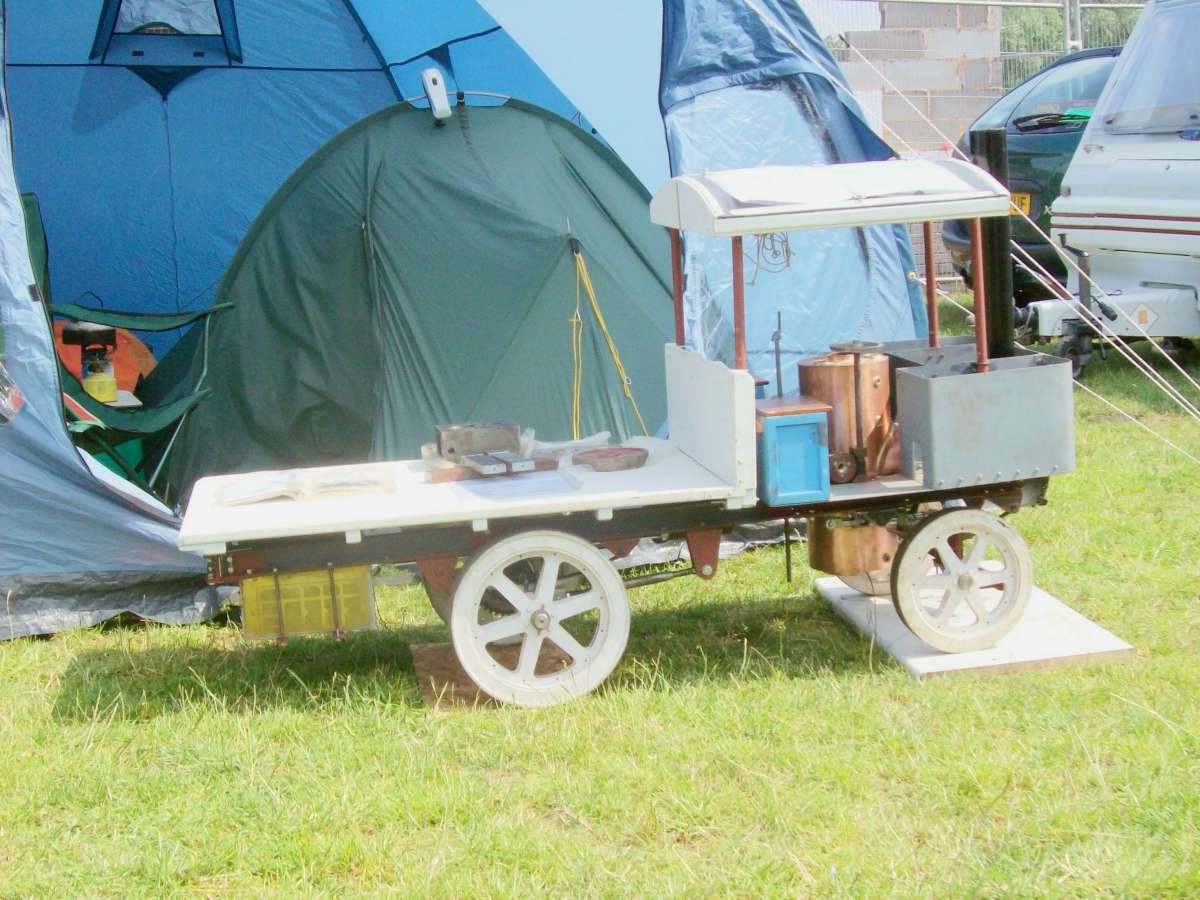
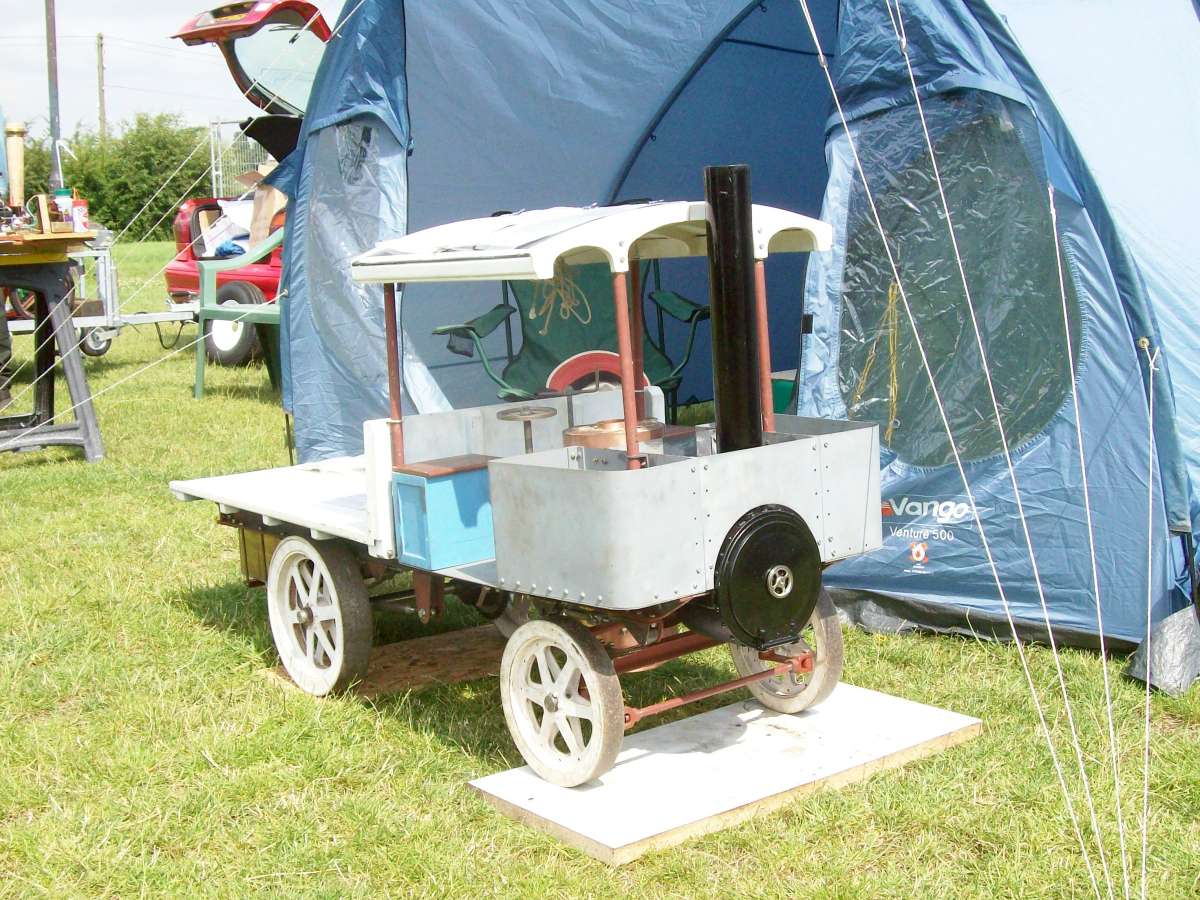
      This is the vehicle exhibited some years ago, with one workshop move (house included) in between; with little to show extra since apart from various engine components, boiler fittings and a lot of re-making. Yes the chimney is faithful to original! I copied the canopy, apparently an optional-extra, from the history-magazine photograph that “inspired” my whole madness – last Century.

      The engine stands behind the boiler, between the seats, with as much below as above the chassis top.

      The whole model is about five feet long by two wide.

      Hindley at MSRVS Rally June 2009 b

      Hindley at MSRVS Rally June 2009 a

      #830423
      Bazyle
      Participant
        @bazyle

        Extra thick cleading and dummy top?

        #830430
        JasonB
        Moderator
          @jasonb

          I was thinking the same as I read it.  I can think of at least three traction engines that have a small boiler inside a larger dummy outer structural tube that is the correct size for the scale.


          #830457
          Nigel Graham 2
          Participant
            @nigelgraham2

            Thank you for those suggestions but unfortunately I don’t think they’d work. I had pondered something like it myself.

            It would need adaptors to raise the various fittings in the top, and to extend the deep “stoking shoot” as Hindley themselves called it, making firing even more problematical.


            I considered another alternative.

            That smokebox is quite a bit larger than the boiler barrel, so replace the concentric spacer ring with an eccentric one to raise the boiler by about half an inch or a little more and still leave some space for lagging the uppermost area.

            Pros:

            – Slightly more prototypical: it should be slightly above the bunker tops, but not by much.

            – More clearance under the ashpan.

            – The cylindrical firebox has three simple supporting lugs resting via wooden insulators on angle-steel brackets, so these would need only thicker wood and longer retaining-screws.

            Cons:

            – Minor modifications to plumbing, but not significant.

            – The superheater flues even less accessible than already, but although the option is there superheating might not be very effective due to the long pipe runs. (The originals were not superheated, and seemed not even to have lagged pipes from boiler to engine!)

            – Still quite a lot of work for little gain.


            Further archive digging revealed I’d forgotten I have a pull-out feature on Hindley steam-wagons from Old Glory magazine, and careful study suggests I might have been panicked by the way the engine photo scales. The engine is very slightly above the boiler, but not by much – perhaps under half an inch on the model. It even differs in form from one wagon to another, judging by one tantalising image!

            The aesthetic problem came to the proportions of the engine.

            Could I change the design further from compound to simple-expansion by exploiting the new-found symmetry? (1.25″ and 2″ bores changed to 2 X 1.5″ bores.)

            It would allow modifying the crankshaft a little to bring the LP motion inwards by three-quarters of an inch to mirror the HP side.

            Result: Perhaps narrowing the engine casing and cylinder block just enough for slightly better proportions. I’d need draw it to investigate further. It won’t make a huge difference.

            This will also give:

            – more external shaft for the primary transmission pinion and feed-pump drive, presently cramped as I’d made that section a bit too short (I found long after making the shaft).

            – fractionally more room for the reversing-lever, between the engine and driver’s seat.


            Combining both changes would allow raising the slightly narrowed engine in the chassis by that half-inch, so although not fully solving the problem would improve the appearance slightly as well as giving some engineering, at cost of making any superheating option more difficult. (The tubeplate is very close to the petticoat pipe rim, but I could put the venturi higher into the chimney. Steam road vehicles seemed often to lack such niceties anyway.)

            Eeh, if it’s not one thing it’s another…

            #830494
            martin haysom
            Participant
              @martinhaysom48469

              does it really matter? so its not quit like you original planned it to be . its still a nice model. finish it enjoy it. nobody will know unless you tell them. you will have learnt a lot from making it.

              #830534
              Nigel Graham 2
              Participant
                @nigelgraham2

                Thankyou Martin.

                You are probably right that it does not matter all that much. I have never claimed to be able to make ultra-fidelity miniatures to the standards of Cherry Hill and Ron Jarvis, but have been trying to represent at least the spirit of the thing. Their big advantage was not just better metalworking then mine, but the existence of original drawings.

                Quite what I’ve “learnt”, I don’t know… Some good, a lot bad.


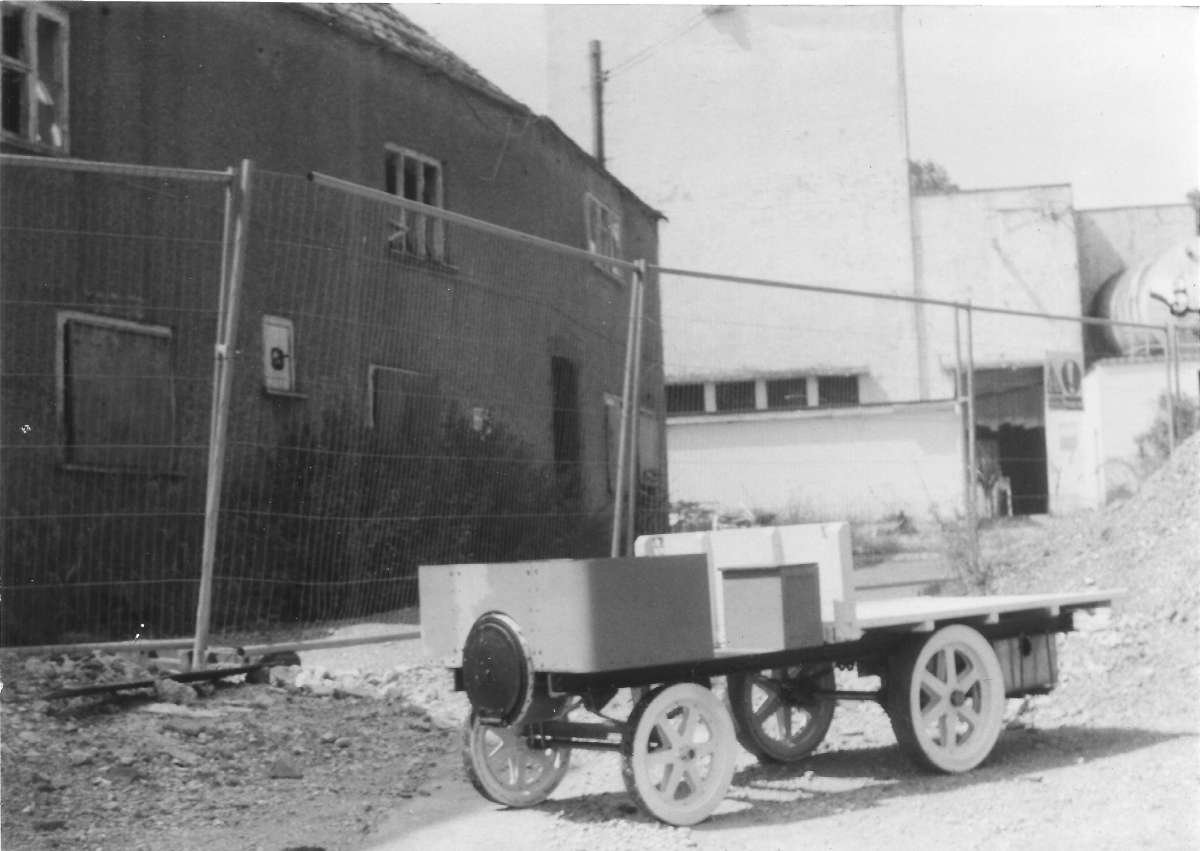
                In my photograph below, she poses at an earlier stage outside the sad ruins of her ancestral home in Bourton, North Dorset; and merely yards from where the originals posed for theirs. The building on the left is in some shots. The site is now a housing-estate, I believe.


                When I embarked on the “learning” hardly anyone had heard of E.S. Hindley & Sons and their wide range of products, including several years of building steam-wagons. There are a few preserved Hindley stationary engines and other bits and pieces, but no wagons.

                Since then a member of Taunton MES has built the same thing to about the same scale, in a fraction of the time I have taken: a miniature Hindley “Light Delivery Van”(LDV). I saw it on static display but not in steam.

                Further still, the professional preservation-engineer Richard “Turbo” Vincent has built a full-size replica to commission. I have not been able to view this but I have some photos of it by someone else, taken at the GDSF. Mr. Vincent thought its front wheels may be genuine Hindley: OEM yet!

                I knew both builders had faced the same frustrating lack of detailed information, let alone drawings, of these extinct vehicles. At least the replica photographs answered a few questions.

                I was told someone who joined my own model-engineering society has or had a miniature Hindley, but I never met him. I don’t think he was a regular member nor for long. I have no idea if he had built the wagon, so that would be the second already existing, or if it was the Taunton one.


                By then I had gone so far that it seemed wiser to keep going in my own sweet way, until only a few days ago.


                Why no original works drawings?

                Some history:

                The formerly significant engineering manufacturer, E.S. Hindley, collapsed a few years after WW1. Savages of King Lynn bought many assets or IP at the dispersal auction, but seems not to have continued manufacturing ex-Hindley products. Everything else not bought as useful was probably thrown away. It is said that local children traded “Penny Black” stamps found in the office, for some time afterwards!

                The major factor was suddenly losing sales of the “Standard” 5 and 7 ton undertypes to Pickfords, who had fitted them with spring-mounted box bodies for furniture-moving. Pickfords had switched to another supplier, possibly Foden, for unknown reasons.

                By the 19-teens steam traction for smaller road vehicles was fading anyway. Even the pre-War development of battery-electric cars and small lorries was losing to the new-fangled petroleum-spirit engine. The LDV was introduced in 1908 and a good number were sold, but despite some ingenious ideas it was really rather basic even for its time. Commerically, the Hindley steam-wagon effectively died with its manufacturer, c 1919, though this seems uncertain.


                C.W Harris’ engineering company in Chewton Mendip, Somerset, bought one Hindley steam-wagon. Contemporary photographs suggest Harris either built a copy under his own “Mendip” brand, or re-branded his Hindley to Mendip, legitimately or not is unknown; but he went on to build ‘Mendip’-branded, petrol-engined cars anyway.

                I once met someone who wangled a drive of the replica. He said it is not easy. Yet the Edwardian trade reviewers admired how easily they ran Hindley’s London show-room specimen round Finsbury Circus! Well, it “is so simple that any man of ordinary intelligence” can quickly learn it – says the Hindley catalogue so it must be right.

                Ghosts…

                Hindley at Bourton0002


              Viewing 6 posts - 1 through 6 (of 6 total)
              • Please log in to reply to this topic. Registering is free and easy using the links on the menu at the top of this page.

              Latest Replies

              Home Forums Traction engines Topics

              Viewing 25 topics - 1 through 25 (of 25 total)
              Viewing 25 topics - 1 through 25 (of 25 total)

              View full reply list.