my first lathe.

my first lathe.

Home Forums Beginners questions my first lathe.

Viewing 25 posts - 1 through 25 (of 36 total)
  • Author
    Posts
  • #440749
    jamie creighton 1
    Participant
      @jamiecreighton1

      so after looking for a while a hobbymat md65 came up for sale 15 miles away,i went to have a look and bought it.it comes with the milling head attachment and lots of extras such as the slow speed wheels,spare 4 and 3 jaw chucks,a box of collets etc.

      i spent a few nights after work cleaning it all up as it had been in a shed for a few years,it has come up very well,i also oiled it and adjusted the gib strips.

      so today i spent a few hours having a play and just turned down a bit of steel.

      in trying to get a good finishing cut and all seems well except every now and again the tool seems to dig in and leave a faint ring mark.

      ive tighten up the beds and that seems to have helped but anymore and the beds are too tight to move smoothly.also the lathe is not bolted down.

      any thoughts?

      yes i know its in the kitchen,being single has its rewards laugh

      #9970
      jamie creighton 1
      Participant
        @jamiecreighton1
        #440752
        Lainchy
        Participant
          @lainchy

          What sort of tooling are you using Jamie, and is it bang on centre height?

          #440753
          Paul Kemp
          Participant
            @paulkemp46892

            Jamie,

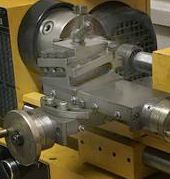
            Thats an interesting (strange) looking tool post? Do you (or does anyone else know) if that is original? The downward slope of the tool slots suggests that unless the tool has an interesting ground profile it would have a fairly hefty negative top rake? Or is there another secondary tool holder that fits in the tool post slots and the slope allows adjustment of tool height? Be interested in seeing some more pictures.

            My own MD65 must be 40 years old now it was the first lathe I ever owned and I think it's a fantastic little machine. That has the 'round tool post' Over that time it has done jobs that were far too big for it but it will still turn dead parallel over 6" or so.

            Paul.

            #440754
            SillyOldDuffer
            Moderator
              @sillyoldduffer

              A photo of the tool and work would help. Though I doubt it's the problem the temporary mounting balanced on boards may not be helping. Shouldn't be necessary to tighten the gibs until they actually grip.  Bolting down my mini-lathe didn't make any difference – it was OK on rubber feet.

              One thing that jumps out at me is the tool-post with angled slots:

              md65tp.jpg


              How are you holding the tool in it?

              Various possibilities:

              Tool blunt or wrongly angled.
              Poor steel (Rather a lot of metals don't machine well. Don't test lathes with unknown scrap!)
              Tool point extended too far and bending under cutting pressure
              Work bending under cutting pressure.
              Swarf getting trapped under cutting point. (This causes most of my finish problems.)
              Wrong speed & depth-of-cut combination.  (Experiment)
              Wants lubrication, especially if tool is HSS.
              Bed and or headstock bearings worn. (Should be obvious.)


              Dave


              Edited By SillyOldDuffer on 08/12/2019 14:09:56

              #440758
              jamie creighton 1
              Participant
                @jamiecreighton1
                Posted by Lainchy on 08/12/2019 13:39:09:

                What sort of tooling are you using Jamie, and is it bang on centre height?

                hi,yes the cutter is in the center.for the first few goes i used a rounded tip cutter,sorry i dont know the techical name,then i switched over to this cutter you can see in the pic,i made a much better finish and took finer shavings.i suspect i need to buy some new tooling.

                #440760
                jamie creighton 1
                Participant
                  @jamiecreighton1

                  cheers dave for the reply,

                  i do have the original round tool post,the one in the pic was on it when i bought it,its a quck change type.

                  the bearings do not appear to have any play,as does the main saddle,the cross feed and tool post gibs were bent out at both ends so i straightened them at work and re adjusted.

                  what is the larger bolt for in the center on both beds? is that for intially getting the gib strips in the right position?

                  Edited By jamie creighton 1 on 08/12/2019 14:40:34

                  #440768
                  SillyOldDuffer
                  Moderator
                    @sillyoldduffer

                    Posted by jamie creighton 1 on 08/12/2019 14:39:26:

                    what is the larger bolt for in the center on both beds? is that for intially getting the gib strips in the right position?

                    Just a guess as I've never looked closely at the MD65, but they're probably locking bolts. If so, (and believe an MD65 owner if he contradicts me ), then the gibs are set with them slackened,using only the screws with lock-nuts. May be a bit of a fiddle to set the gibs evenly with these so the slides don't bind at one end or in the middle of their travel. The gibs should be tight enough to stop the slides slopping about but not tight enough to make it hard to turn the controls.

                    Lock bolts on gibs aren't an adjustment. Rather they can be tightened to lock a slide in a fixed position as a way of eliminating accidental movement whenever that particular slide doesn't need to move. For example it's worth stopping the top-slide moving right-left when facing off front-to-back. Not sure about the MD65 but there may be a bolt or Allen Key on the saddle that locks it to the bed, again useful to reduce accidental movement.

                    Good practice to check locks are on or off correctly before using the lathe to take a cut. Lathes don't like cutting under power with the saddle locked!

                    Dave

                    #440770
                    jamie creighton 1
                    Participant
                      @jamiecreighton1

                      nice one cheers,that makes sense.

                      could someone link to some good quality tooling i can buy please? ive been looking but there's too much choice,whats best?

                      good old hss or the ones with throw away cutting tips?

                      #440781
                      magpie
                      Participant
                        @magpie

                        Hi Jamie. I had a MD65 some years ago but sold it when I needed to work bigger things. There is plenty of good advice on here about any problems you may have. Regarding cutting tools, I use both HSS & tipped tools but these days I only use HSS for plastics. Lots of tipped tools to be had from lots of suppliers and my main reason for using them is because I am getting very lazy in my old age, and can't be bothered re-grinding HSS despite having a Quorn. JB cutting tools would be a good place to look for tipped tools and their various tips for different jobs. I have no connection to them, just a satisfied customer.

                        #440798
                        Bazyle
                        Participant
                          @bazyle

                          100% the oddest toolpost I have ever seen, I suggest going back to the original round one for the moment.
                          I take it you are doing auto feed when the problem occurs because if you are manual feeding even changes is speed of hand movement can show up. There is always some backlash on the cross-slide however tightly the gibs are set and well the screw is adjusted. On the final cut lock the cross and top slides.

                          #440802
                          jamie creighton 1
                          Participant
                            @jamiecreighton1

                            thanks,i will put the original one back on.

                            auto feed is being used and i will try it with both slides locked .

                            #440972
                            Paul Kemp
                            Participant
                              @paulkemp46892

                              Jamie,

                              Thanks for the bigger picture. Never seen a tool post like that before! Can't imagine what advantage it gives, disadvantage I would say is the large negative top rake, not really what you want for steel. I think you will get better results with the conventional round tool post that came as standard, that will give you a zero or positive rake depending how the tool is ground. I get a decent consistent finish without locking slides on mine.

                              Paul.

                              #440977
                              jamie creighton 1
                              Participant
                                @jamiecreighton1

                                Cheers Paul,

                                I bought a small blank of delrin to have a play at the weekend.

                                im still not sure what type of tooling to buy, anyone have a link please or a good dealer to buy from please?

                                #440983
                                Lee Rogers
                                Participant
                                  @leerogers95060
                                  Posted by magpie on 08/12/2019 16:28:13:

                                  Hi Jamie. I had a MD65 some years ago but sold it when I needed to work bigger things. There is plenty of good advice on here about any problems you may have. Regarding cutting tools, I use both HSS & tipped tools but these days I only use HSS for plastics. Lots of tipped tools to be had from lots of suppliers and my main reason for using them is because I am getting very lazy in my old age, and can't be bothered re-grinding HSS despite having a Quorn. JB cutting tools would be a good place to look for tipped tools and their various tips for different jobs. I have no connection to them, just a satisfied customer.

                                  I think if your just starting out a set of HSS tools will be more forgiving than carbide tips and learn to grind your own. Old hands are only experienced because they've made all the mistakes and have a good memory and I do remember destroying a lot of carbide tips. Enjoy !

                                  #440985
                                  Lambton
                                  Participant
                                    @lambton

                                    Jamie,

                                    In the bigger picture of the strange tool post I notice that at least one of the top slide – cross slide securing screws is very loose. All four screws must tight ( but not over tightened). It is essential to eliminate all looseness if you are to get a good consistent cut.

                                    Eric

                                    #441011
                                    SillyOldDuffer
                                    Moderator
                                      @sillyoldduffer
                                      Posted by jamie creighton 1 on 10/12/2019 05:23:38:

                                      Cheers Paul,

                                      I bought a small blank of delrin to have a play at the weekend.

                                      im still not sure what type of tooling to buy, anyone have a link please or a good dealer to buy from please?

                                      Beware of plastics and metals difficult to machine! My start as a total beginner was dogged with problems caused by me assuming a metal-working lathe would obviously cope with anything. Not true! Plastics are usually gummy, pliable and easily damaged by heat. Many metals from finished products will have been carefully selected to suit a particular purpose and manufacturing process; zero consideration is given to chaps wanting to turn it on a small lathe! For example, aluminium window frames are made from an alloy intended to be extruded, too soft to machine well. There's a lot to learn about machining different materials.

                                      I wasted months as a beginner. I may have been unlucky because my entire collection of scrap metal turned out to be carp. Buying EN1A was a revelation – it's a mild-steel specifically formulated for machining. Plenty of suppliers other than Metal Supermarkets, but their description is worth repeating:

                                      EN1A is a low carbon-manganese free cutting steel suitable for machining using both automatic and CNC machines. EN1A is used for turned components, such as nuts, bolts, studs and hydraulic fittings.

                                      EN1A, also known as 230M07, can be case hardened to produce components with enhanced wear resistance.

                                      EN1A can also be supplied in a leaded grade, EN1A Pb, 230M07pb.

                                      The leaded grade is particularly good for turning, it's about twice as machinable as ordinary mild steel.

                                      Same advice when buying other metals especially Stainless Steel, Aluminium and Bronze: look for 'free-cutting' or 'suitable for machining' in the specification. Brasses are also somewhat variable, but they all seem to turn OK in a lathe. Plastics too need research.

                                      The ground steel rods from old printers and scanners mostly turn well, but I have one that's incredibly hard. Tricky for beginners to identify if problems are down to the lathe, tool, material, or the operator. In the absence of a tutor, this forum, books, and YouTube all help, but be prepared to experiment.

                                      Tools are another controversial subject. Personally I see little point in buying expensive high-end industrial cutters for occasional light use in my garage! Nor do I like the risk of buying from unknown web-sellers because there's more risk of factory rejects, 'too cheap' and counterfeit. (But people do get genuine bargains off ebay!)

                                      I prefer established UK based sellers. Mostly ArcEuroTrade, Warco and Tracy Tools (for Drills, Taps & Dies), but I've also used RDG, MachineMart and several others without grief. While hobby vendors rarely sell the best possible tools they're OK for my purposes. (The reason the best possible tools aren't carried is probably economic. While Model Engineers are keen to own good tools they are rarely prepared to pay full price for them! Impossible, I think, to profit selling good tools to hobbyists because most of 'em have tiny budgets.)

                                      I guess anyone starting with a second-hand MD65 isn't a serious professional machinist intending to make a living from it. Compromise is the order of the day. As a beginner my advice is avoid cheap and nasty, and don't get hung up on 'quality'.

                                      There's debate about HSS vs Carbide. HSS is more general purpose, but it needs to be kept sharp. That means buying a grinder and learning how to use it! There are chaps who find grinding easy, others – like me – struggle. Carbide inserts avoid sharpening problems: tad expensive to buy but very easy to use. I mostly use Carbide for convenience (at least 80% of the time) but switch to HSS when carbide doesn't produce a good finish(rare), or when a specially shaped tool is needed for awkward corners or fine work. Depends on what you're doing. Owners of powerful fast lathes turning big lumps will likely prefer carbide, small lathes used for delicate work will probably do better with HSS, as will big slow lathes. I used carbide OK on a mini-lathe, which is similar size/speed to the MD65, but I wasn't making clocks!

                                      Carbide inserts are available in a deeply confusing multitude of sizes and shapes. Hobby suppliers like ArcEuroTrade tend to stock the types useful to hobbyists, and you won't go far wrong buying them. Chaps who know what they're doing never recommend sets, but I recommend sets for beginners because beginners seldom know what they need or even exactly what they want a lathe for. Though I'm unlikely to buy a set now, I found sets invaluable for learning.

                                      The December issue of Model Engineer's Workshop Magazine includes a printed ArcEuroTrade Catalogue. Buy one! Both magazine and catalogue give a good idea of what's available and who sells it.

                                      Dave

                                      #441014
                                      Anonymous

                                        I'd agree with the crowd; bin the toolpost. The angles of the toolbit are all wrong; you need more side rake.

                                        I'd start with HSS toolbits and a bench grinder. You can ignore complicated grinding fixtures, a simple knife tool is only three angles, none of which are critical. Insert tooling can be tricky to get a good finish and is more expensive than HSS toolbits. I'd agree with SoD, know your material. If it's out of the scrap bin all bets are off; you may never get a good finish. Ideally start with EN1A; it's fairly simple to get a good finish. On the other hand EN3B, which is a common low carbon steel, can be difficult as it is slightly "sticky" and has a tendency to tear.

                                        Andrew

                                        #441018
                                        Anonymous

                                          Bother, beaten to it by SoD!

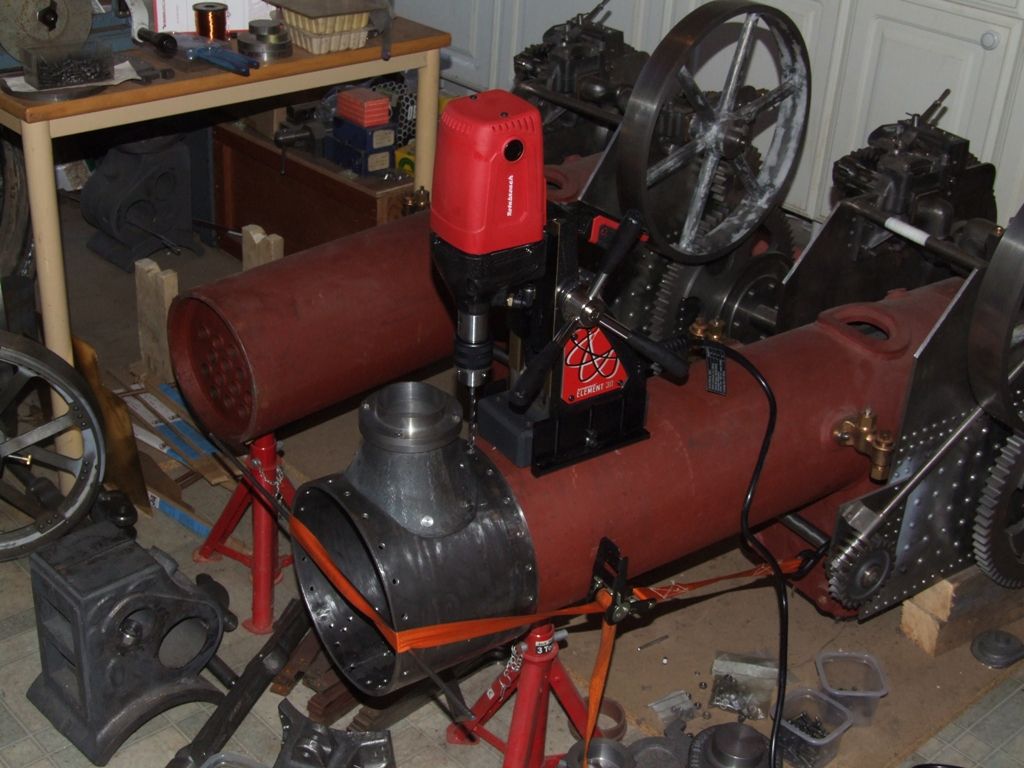
                                          But I bet he can't compete in the kitchen, sorry assembly shop, stakes. I used to have a lathe on the kitchen table, as well as a number of other engineering items in the kitchen:

                                          drilling_smokebox_me.jpg

                                          Now that I've had a new kitchen fitted the engineering stuff has migrated to the hall and sitting room.

                                          Andrew

                                          #441075
                                          jamie creighton 1
                                          Participant
                                            @jamiecreighton1

                                            many thanks fella's,ive ordered a set of hhs tools to get me started and also a small round bar of bronze to have a play with.

                                            just how sharp do the tools need to be? do they require further honing?

                                            not a problem if they do,i still have my wet stones from my cabinet making days,back then i always had a bald patch on my arm as i used the hair to gauge the sharpness lol

                                            #441086
                                            Bazyle
                                            Participant
                                              @bazyle

                                              Out of the frying pan etc. You know bronze is one of the difficult ones, it snatches tools and also work hardens. Don't risk drilling it until you understand it and have worked out how you will remove the broken drill. surprise

                                              #441088
                                              jamie creighton 1
                                              Participant
                                                @jamiecreighton1

                                                im a great believer in just having a go,you learn from your mistakes,well some people do lol

                                                #441125
                                                Howard Lewis
                                                Participant
                                                  @howardlewis46836

                                                  HSS is probably best for a newbie. Throw away tips are intended to run at high speeds and feeds are such that the metal is heated to the point of being softened. This is useful for turning hardened materials, where HSS will not cope,

                                                  Start by taking small cuts. with light feeds. Deep cuts and higher feed rates, (for roughing ) can come later when you have more experience.

                                                  Find a local Model Engineering club if you can, and join. You will get advice and help, face to face, and probably hands on, one to one, either on your machine, or someone else's.

                                                  Exact clearance angles are probably not too vital. Most folk will grind a knife tool with about 5 – 10 degrees clearance angles. (Cue howls from the perfectionists! )

                                                  It is unlikely that you will get on well with HSS tools with negative rake. I sometimes (mostly through sheer idleness ), use zero top rake.Too great a top rake will weaken the tool and shorten the life between regrinding. Softer materials, such as Aluminium, will accept greater top rakes than hard material.

                                                  Various books will show how to grind tools.

                                                  For a better surface finish, a radius on the edge of the tool can be stoned d or ground on. Too large a radius can induce chatter.

                                                  The most important thing is to ensure that the cutting edge is on the centre height of the job. Too high and the tool rubs instead of cutting, too low and it does not cut properly, and effectively has much too great clearance.

                                                  Both these faults will meant the tool does not cut to the centre, leaving a pip in the middle when facing.

                                                  If you do not yet have one, make a centre height gauge, and set the tool to it, always. There are various ways of finding the centre height. As a starting point, keep shimming a freshly ground tool until a facing cut leaves no pip in the middle. The set your gauge to that. All other tools can then be set to the gauge.

                                                  For tools in the front toolpost, the blade of the gauge is above the tool. Subsequent tools are then shimmed until they just make contact with the underside of the blade.

                                                  When / if you fit a rear toolpost, the gauge will need a second blade fitting below the original one. For this, fit the lower blade, loosely, set the upper blade, to the centre height cutting tool, again, The lower blade can then be brought up to contact the upper blade and locked in position. You are then ready to set tools in either the front or rear toolpost to the centre height. Tools in the rear toolpost will be mounted inverted, with the cutting edge facing down, hence the use of the upper surface of the lower blade.

                                                  You will make mistakes, but you will learn from them

                                                  Howard

                                                  #441136
                                                  Nigel Graham 2
                                                  Participant
                                                    @nigelgraham2

                                                    I wonder if that odd-looking tool-post had been made for some very specific work, not general-purpose turning, though I can't imagine what. A lot of brass machining perhaps?

                                                    '

                                                    A note on grinding tools: you can obtain satisfactory results grinding HSS tools on a straightforward off-hand grinder, but it takes quite a bit of practice. Without going to the extent of building an elaborate tool-grinder, many people replace the rather crude, as-bought rest on an ordinary grinder, with some form of fairly simple but effective, wider table with adjustable stops or fences. Harold Hall's book on the subject gives designs for such accessories.

                                                    '

                                                    I don't seem to have noticed very much difference in finish quality between HSS and carbide tools, all other things being equal. The inserts are indeed designed to rip the metal off at alarming rates, but that's on massive industrial production machines; and they seem perfectly happy at our modest speeds and feeds. " Can " does not equal " must ", here.

                                                    I think what would really matter is selecting the right tip for the material, though "our" stockists do try to sell ones best matched to our needs. (A tip manufacturer's full catalogue is a mind-boggler of work-materials, tip geometries, chip loads and nonchalant remarks about tip lives of 20 minutes. We hope for nearer 20 hours!)

                                                    For example, recently my band-saw took literally hours to cut a slice of 2.5"dia stainless-steel of unknown grade but once on the lathe – a Myford 7 – the metal cut beautifully with both HSS and carbide. Having turned a short length down to 2" and drilled and tapped the centre hole as required, I parted the disc off with an insert tool in the rear tool-post. I'd found the wider HSS blade was unhappy with the task. It was a slow process, a lot of very careful, patient feeding, clearing and lubricating, and experimenting with speeds; but gained a very good finish indeed. That was at no more than perhaps 100rpm for most of the depth (low pulley, back gear, inverter turned down a bit but still in the green speed sector).

                                                    I needed a decent finish, not so much for appearance though I wanted that too, as function. The disc is a thrust-washer against the end of a Nylon roller.

                                                    I think the crucial aspect is not tool material, but tool setting, so the cutting geometry is spot-on. I set the parting-tool height by the facing marks, before centre-drilling. (Parting-off and deep grooving also means ensuring the tool is at right-angles to the axis. I use the chuck face for alignment by gently pushing the tool-holder against it while tightening the post clamps.)

                                                    #441149
                                                    Hopper
                                                    Participant
                                                      @hopper

                                                      That is the most bizarre looking toolpost on a small lathe I have ever seen. And no amount of Googling around reveals anything even remotely like it. It has way too much negative rake for general purposes.

                                                      You need to put that toolpost to one side and use the standard one that holds the tool in the normal flat position.

                                                    Viewing 25 posts - 1 through 25 (of 36 total)
                                                    • Please log in to reply to this topic. Registering is free and easy using the links on the menu at the top of this page.

                                                    Latest Replies

                                                    Home Forums Beginners questions Topics

                                                    Viewing 25 topics - 1 through 25 (of 25 total)
                                                    Viewing 25 topics - 1 through 25 (of 25 total)

                                                    View full reply list.