Expected runout for a Boxford? – Don’t buy an old lathe they said.

Expected runout for a Boxford? – Don’t buy an old lathe they said.

Home Forums Manual machine tools Expected runout for a Boxford? – Don’t buy an old lathe they said.

Viewing 21 posts - 1 through 21 (of 21 total)
  • Author
    Posts
  • #838193
    Hollowpoint
    Participant
      @hollowpoint

      Hello guys

      I have recently upgraded my lathe from a Mk2 Boxford AUD to a Mk3 AUD. The reason for this is that the new one has a few advantages such as the metric gearbox, longer bed and increased centre height. It is also in much better condition.

      Anyway, the one concern I had when making the swap was that the new one might not be as accurate as the old one. I was hopeful but didn’t know what to expect, after some testing I am gobsmacked! But not because it’s bad, but because it far exceeded my hopes.

      Before I tell you the numbers, I would like to ask, what would you guys expect for spindle runout at the register and face? What would you expect for backplate repeatability? After removing and reinstalling the chuck? Etc etc. Bearing in mind the lathe is over 45 years old.

      I’m very curious. Because it’s often said. “Don’t buy an old lathe”.

      #838195
      JasonB
      Moderator
        @jasonb

        I think most people say beware of buying an old lathe as it could be worn not that it will be worn and clapped out. Or don’t buy if you can’t tell the difference between a good one and one that has just been repainted and gone over with Scotchbright.

        If it has been sitting unused in a school for 40 of those 45 years or was completely reconditioned and reground by the previous owner it is quite likely to be in good condition rather than one that may have been in a jobbing shop working 8hrs a day 24/7

        #838205
        Hollowpoint
        Participant
          @hollowpoint

          OK yes, I agree. Whatever you buy, you should aim for good condition. I’m not looking to get into another debate about “which lathe”. Rather into expectations of good used lathes. 🙂

          #838210
          JasonB
          Moderator
            @jasonb

            Again I would say it depends on the lathe, hopefully a good lathe would still be within the original allowed spec by the maker.

            But given an equal amount of use I would expect say a 2nd hand Hardinge to give better figures than a 2nd hand Boxford particularly as they were originally made to a better spec which I would likely be paying a lot more for.

            Do you know what the original factors specs were?

            Also given the recent Emco thread a good spindle is not the whole story – bed and tailstock wear could give problems even if the spindle was spot on possibly due to replacement bearings at some stage in it’s life which are easier to replace than doing a regrind.

            #838235
            Hollowpoint
            Participant
              @hollowpoint

              I don’t know the factory specs unfortunately. It would be good to know. I haven’t been able to find a test certificate anywhere. 🫤

              #838276
              SillyOldDuffer
              Moderator
                @sillyoldduffer

                As far as I know no-one on this this forum has ever said, “don’t buy an old lathe”.   They have said “Condition is everything”, because it’s the machines’ history that matters, not who made it, the number of features, or how old it is.  Old lathes have had longer to be knocked about than new ones, and they don’t come with a warranty.   Ideally test them before buying, not after!

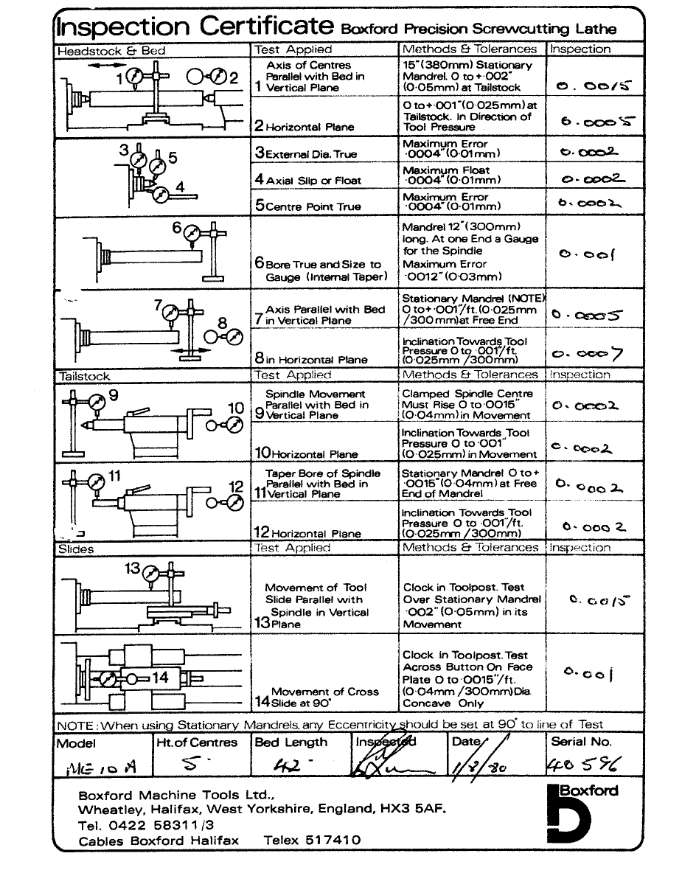
                This certificate might help. Though for Boxford’s somewhat cheaper ME10, I’d expect an AUD to be similar.

                Screenshot From 2026-02-18 17-25-39


                Dave

                #838303
                Hollowpoint
                Participant
                  @hollowpoint

                  Thank you. That certainly helps! 🙂

                  Mine spindle far exceeds the maximum error. So I expect that either it has had minimal use or perhaps it has been rebuilt. My spindle error is less than 2 microns on both the face and register! I am very very happy with that!

                  I have also now machined two backplates and tested the repeatability. Again almost unmeasurably low numbers.

                  I think I will now do more of the tests shown above and do a sort of belated test certificate. Just for my own reference of course.

                  Not that any of it matters really, it is far more accurate than I could ever be. It was just the initial “that’s too good to be true” moment that had me questioning my methods.

                  #838310
                  old mart
                  Participant
                    @oldmart

                    If your Boxford has a screw threaded spindle, 1 1/2″ x 8 it doesn’t matter at all how worn it is. Backplates will refit and retain their accuracy as long as the rear register sits fully against the face of the spindle. We have many chucks, faceplates and collet plates for both lathes which have radial clearances from 0.0005″ to 0.020″ and they all repeat perfectly. When a chuck needs dismantling for routine cleaning, the backplate gets fitted on its own to check that the front face still runs true and I have never needed to re skim one. A new bought or shop made backplate should be fitted and refitted several times before skimming true the front face, with the minimum cut depth to fully cover the whole surface.

                    The only thing that tends to annoy me slightly is that our two lathes at the museum have different spindle threads, but might be a good thing because they might not interchange perfectly between two machines.

                    The Smart & Brown model A is over 76 years old and very worn indeed, but if you know it well, it can give very good results. I would trust the Atlas 12 x 24 to give better facing over a large diameter than the S & B, and also better for diameters over 8″ long, but it is hardly worn at all in the bed.

                    #838364
                    Pete
                    Participant
                      @pete41194

                      Less than 2 microns Wow!!!! 👍👍👍 I wish my lathes were built to even twice that number.


                      #838380
                      Hollowpoint
                      Participant
                        @hollowpoint

                        Yes Pete. That was my reaction too, and then the doubt started to creep in. Haha.

                        But it seems to be, Unless I’ve made some glaring mistake!

                        #838385
                        Michael Gilligan
                        Participant
                          @michaelgilligan61133

                          Gorgeous !

                          … but you will need HEPA filters to keep the dust off 🙂

                          MichaelG.

                          #838395
                          Pete
                          Participant
                            @pete41194

                            Your set up and methods are how I would have done it, and I sure don’t know of any mistakes you could have made to create numbers like that. My Bison ER and even Schaublin ESX collets were I thought pretty decent, but none of them can do what yours seem capable of for basically zero run out on that pin. That might be even more impressive. 😁 Which manufacturer made your collets and collet chuck if you don’t mind me asking?

                            #838401
                            Hollowpoint
                            Participant
                              @hollowpoint

                              The collet chuck is Chinese, I think I purchased it from Chronos about 10 years ago. I made it a floating fit on the backplate and then trued it up to zero. Amazingly the test you see is after having removed it and then replacing it! The collets are Swiss made Rego-fix some of which are their “UP” ultra precision range. So maybe it’s not so surprising that they are good.

                              #838407
                              Pete
                              Participant
                                @pete41194

                                Thanks Hollowpoint, now I know what brand to buy if I ever need a new and different sized collet set than I already have. And even made to be adjustable, very well done getting your chuck and it’s nut to repeat to that level of accuracy. 👍

                                #838596
                                Hollowpoint
                                Participant
                                  @hollowpoint

                                  No problem.

                                  Fun fact – Rego-fix actually invented the ER collet system!

                                  #838689
                                  Pete Rimmer
                                  Participant
                                    @peterimmer30576

                                    Good result there.


                                    Here’s my 1942 South bend I rebuilt.


                                    #838749
                                    Pete
                                    Participant
                                      @pete41194

                                      Also very impressive Pete, did you have your spindles MT reground?

                                      Yes I did know Rego Fix invented the ER collets and their clever extraction nut. But thanks for mentioning it, many don’t seem to know that. Rego Fix also have a very good YT channel. https://www.youtube.com/@REGOFIX/videos For a tool holding invention that appears quite simple, there’s quite a bit of user information that can be gained from some of their older videos.

                                      I got very lucky a few years ago and managed to find and buy a very close to brand new Volstro rotary milling head. And verified as only being used once through a good friend. It uses a set of Schaublin E-25 series collets in it’s spindle. I also have a set of Schaublin ESX 25 collets bought long before finding this milling head. The ESX is for some reason what Schaublin uses or used for there own designation for their ER collets, or at least they did when I bought mine. All the dimensions and taper angles for the ESX are exactly the same as ER collets. So those are completely interchangeable with any other ER collet or chuck in the same size series.

                                      While I can’t guarantee it as a fact Hollowpoint. But having both types in the same size gave me the opportunity to directly compare and measure the E’s against the ESX. Those E collets are as afaik a design Schaublin invented and pre date Rego-Fix’s ER collet design by quite a few years.

                                      They both use the exact same collet body and nose tapers. The E series doesn’t have an extraction groove, so they also don’t use the ER type of eccentric ring inside the nut. And I’m fairly confident the E collets were never designed to or have any real ability in there holding range for anything smaller than there nominally marked tool shank sizes that the ER’s can do. I think that’s also because those E’s have only half the number of slots in them. They can still clamp down on a tool shank, and probably just as tight as the ER’s will. Slower when having to lever out the collet to then release the tool shank though. My E’s are imperial sized and Schaublin only marked them for one specific size on each collet. I have no choice but to use these E collets with this milling head, but I wouldn’t purposely buy them no matter how cheap instead of ER’s. I’m not even sure that Schaublin still make them.

                                      All the dimensions on each set are of course made to metric measurements. But I grabbed my imperial dial calipers for some quick comparisons. The E’s are approximately 1.375″ long, the ESX /ER’s 1.338″. The E’s do taper down and havw a slightly smaller base diameter since there slightly longer. There’s no extraction groove and they use a plain threaded nut interior that’s tapered to still fit the collet nose angle just like the ER’s do. The two different collet designs although very close and similar, aren’t interchangeable. And the E series collet chucks also use a smaller diameter collet chuck thread and smaller O.D. dimensions for the nut compared to what the ER’s use. Rego Fix also copied the same slotted nut and wrench design from Schaublin, it’s just larger in diameter.

                                      Since the same collet body and nose tapers were what Rego Fix also used when inventing their ER design. I’ve made some assumptions that could easily be incorrect. What I think they did is just go with what they knew had been proven to work for Schaublin’s E collet design. And for whatever reason they choose to do so, shortened the ER collets body taper by roughly .037″, added that extraction groove and the nuts eccentric extraction ring. Used that larger diameter collet chuck and nut thread, and likely because of their added method of easily extracting the collet and needing a larger cross section to strengthen the nut a bit. Then doubled the slots in the collets to allow that 1 mm holding range for each collet. Their ER design is definitely much better in multiple ways. I think that whoever at Rego Fix it was that came up with the collet groove, eccentric ring and then doubling the number of slots were genius’s to improve Schaublins design by that much.

                                      #838757
                                      Pete Rimmer
                                      Participant
                                        @peterimmer30576
                                        On Pete Said:

                                        Also very impressive Pete, did you have your spindles MT reground?


                                        No, I just set the bearing clearance according to the manual and gave it a good clean and polished the journals lightly and that was only to remove staining. In fairness, any plain journal lathe in good condition should really have very good runout test scores.

                                        It does go to show that you really cannot judge a book by its cover. The lathe was very sorry-looking indeed when I bought it (as a test subject for renovation), but the heart of it was good.


                                        #838816
                                        Hollowpoint
                                        Participant
                                          @hollowpoint

                                          Pete – that’s interesting information about the collets. I had assumed that they were all basically the same. There’s also the 472e collet, I’m not sure where that fits in.

                                          Pete R – Your southbend looks to be virtually perfect!

                                          I did go ahead and test my old lathe just out of curiosity. It’s not nearly as good condition, but the face was about 2um and the register about 12um. Considering it’s about 70 years old and had a fair bit of use I think that’s still OK.

                                          #838883
                                          Pete
                                          Participant
                                            @pete41194

                                            Well as I said Hollowpoint, I’m making a lot of assumptions about how Rego Fix really did it. The exact same angles, almost the same dimensions other than about 1 mm reduced size difference in overall length that was changed, and so far no other similar collets I know of that Rego Fix might have borrowed or used ideas from. That seems to make the E collets the most likely where they started. If someone had good rotary grinding equipment and I suppose EDM would make it easier to add the extra 6 slots since there so hard, I’d say one of those E 25’s could be modified enough to just be an ER. Even the collet size series are the same for those two different sets of 25’s I have. However I’ve never really looked into it, all I know for sure is that Schaublin did make at least the E 25 size. I don’t know if they also made anything like E 20’s, E 32’s, E 40’s etc. Some of the other ER series from the ER 8’s up to the ER 50’s might be 100% Rego Fix’s own design and invention efforts?

                                            Even 12um for my visualization purposes is only .000472″. Still pretty decent for anything I can think of that’s 70 yrs old.

                                            I had to Google those 472e collets. Definitely not something I knew about before. Since they do have that same extraction groove. Made after Rego Fix did all the work, or did Rego Fix steal there design? That seems unlikely given that Rego Fix is thought to have invented the ER’s. With a quick search, even Google says they invented them in 1974. “The design was created to improve on existing collet systems by adding a groove, allowing for a self releasing mechanism and a wider clamping range. The name ER comes from “E” (the previous standard) and “R” for Rego Fix”.

                                            The Vertex website does show 472e collets and was one of the first hits I got. From that website they lists them as ER 40 (472e) So just something interchangeable with ER’s, or maybe an Asian used designation instead?

                                            I’m not sure there even being sold or available anymore, of if they were ever sold in the UK. Maybe 25 years ago and from a few of the off shore tooling dealers here in North America there were some really cheap sets of appearing to be ER’s but not quite collets and chucks being sold. The set I looked at sure seemed to be poorly made. One of those tool dealers told me that at least one of the Chinese manufacturer’s had developed and were trying to put on the market there own design for something very similar to ER’s. But looking at them, the nose angle and it’s length wasn’t quite the same, and even visually, the body taper length was quite noticeably longer than ER’s. I remember reading some North American forum posts around that time about a few trying to get additional sizes or replacements of these collets to fit there collet chucks and it seems they were failing to find any from anywhere. Something that was tried and quickly failed possibly? But I’d bet some of those not quite ER old collets and chucks still show up on places like Ebay once in a while.

                                            #838892
                                            Michael Gilligan
                                            Participant
                                              @michaelgilligan61133
                                            Viewing 21 posts - 1 through 21 (of 21 total)
                                            • Please log in to reply to this topic. Registering is free and easy using the links on the menu at the top of this page.

                                            Latest Replies

                                            Home Forums Manual machine tools Topics

                                            Viewing 25 topics - 1 through 25 (of 25 total)
                                            Viewing 25 topics - 1 through 25 (of 25 total)

                                            View full reply list.