Building the V-Twin “Kelsey”

Building the V-Twin “Kelsey”

Home Forums Stationary engines Building the V-Twin “Kelsey”

Viewing 25 posts - 1 through 25 (of 119 total)
  • Author
    Posts
  • #823589
    JasonB
    Moderator
      @jasonb

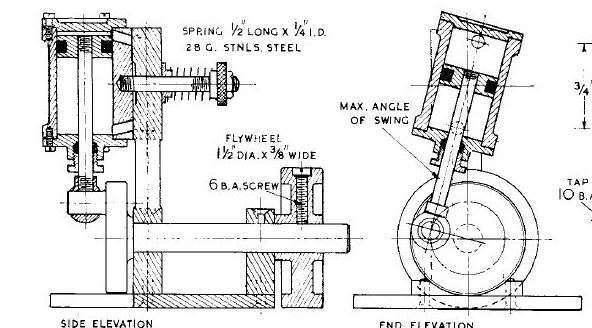
      A few weeks ago I came across a small single cylinder Oscillator in an old ME design  by E T Westbury while looking for something else and thought it would make a nice addition to my collection of small “boat” engines, updated to metric as usual. It was featured in a series of articles as an engine for beginners under the article title “Junior Model Engineer” and at sometime got named “Argus” after the then publisher of ME and plans can still be bought under that name from Sarik.

      Argus snip

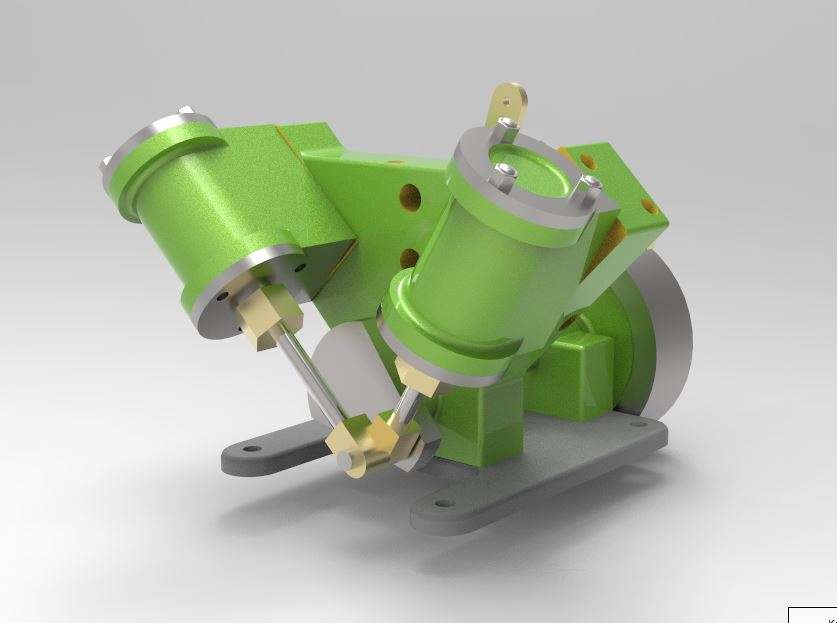
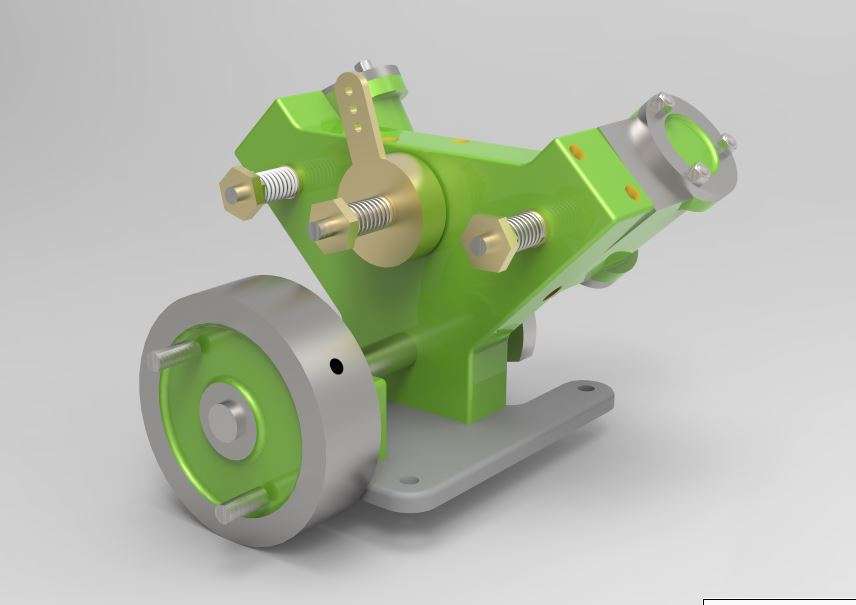
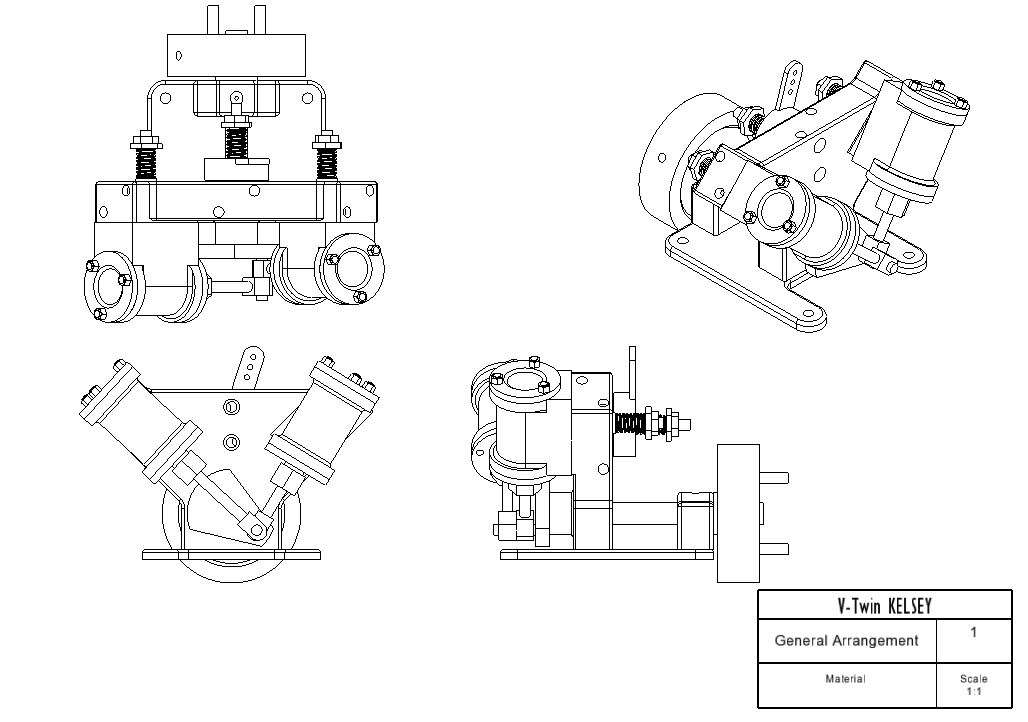
      Fast forward a couple of weeks to a recent thread where a new member wanted to know of designs for a small “Marine twin” which under scrutiny turned out to be an engine suitable to power a 1.1m hull with steam. During the thread I posted a couple of quickly cobbled together images of possible layouts created but playing about with some previously modelled CAD parts for other engines. Subsequently, I did a final design which will be the topic of this build thread and shall be known a “Kelsey

      V Twin 5

      V Twin 6

      Her vital statistics are

      12mm Bore

      17mm Stroke

      39mm Flywheel diameter

      Approx 55mm tall

      Double acting oscillatiing cylinders in a 90degree V configuration with combined reverser and throttle

      Construction will be from barstock which is an economical way to make an engine as well as eliminating the problem for beginners of establishing a datum on castings, holding them and the other problems that they can present. There will be no fabrication as silver soldering is often beyond a beginners comfort zone so all parts will be cut from solid. While I will make use of a milling machine as well as a lathe the engine could be done on just a lathe provided with a vertical slide or milling attachment as they are also sold as and I will mock up a few setups to show how the lathe can do the milling. I’m also happy to answer questions on alternative methods and tools, etc.

      #823598
      Michael Gilligan
      Participant
        @michaelgilligan61133

        Great stuff, Jason

        I regret there is no hope of me building one, but I shall be following with great interest.

        MichaelG.

        #823601
        JasonB
        Moderator
          @jasonb

          I have created a Gallery which can be accessed by clicking on my Traction engine avatar and will place various files related to the build there.

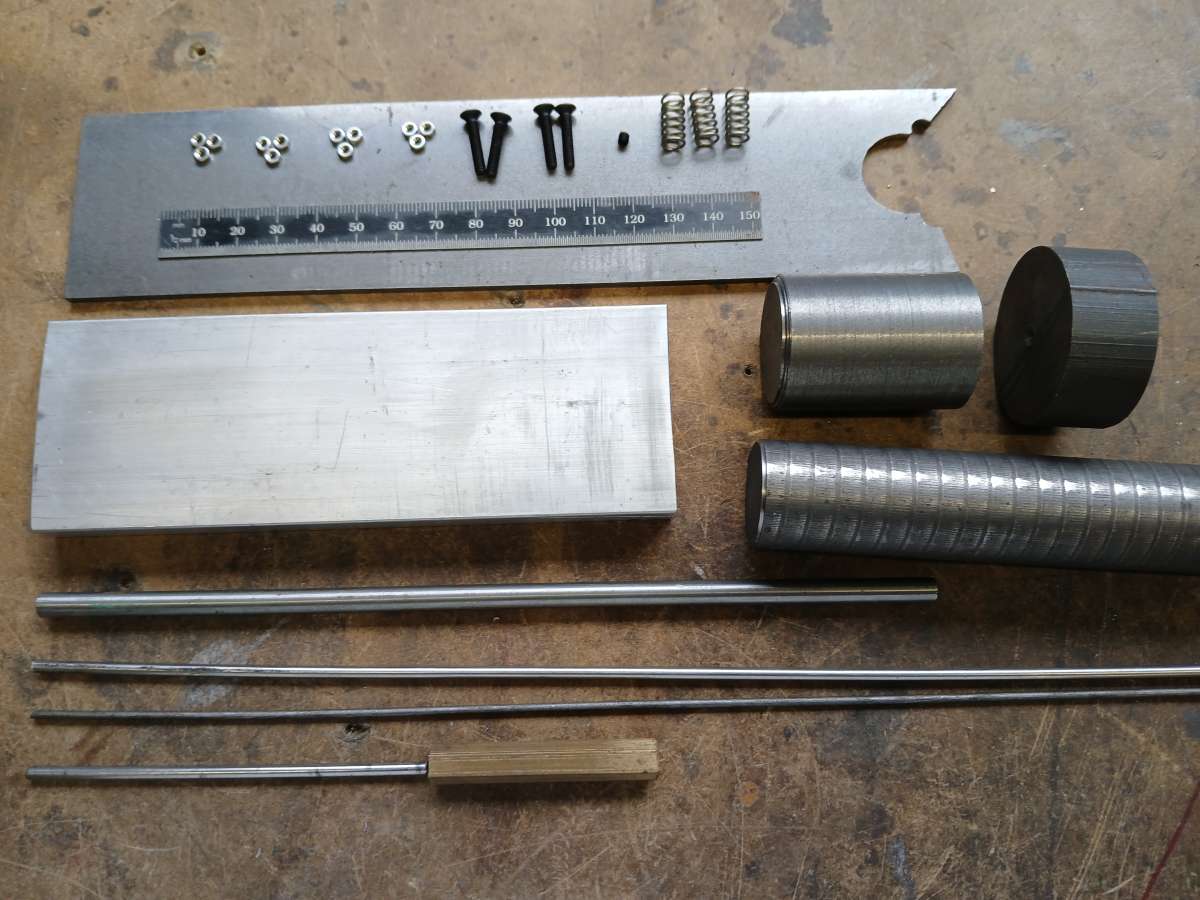
          One thing that cropped up in the earler thread was the cost of materials. I have prepared a Bill Of Materials, the second page of which is a “shopping list” of what should be required in the way of materials, fixings, etc for the engine. Pricing these up against the current M-Machine metals price list, Modelfixings Website and a couple of websites for the springs and O rings the cost as of today should come in just under £60.00 which compares quite favourably wth the Stuart V Twin kit at £169 and that for a smaller 7/16″ (11mm) bore engine.

          Note as my engine is only likely to get the occasional short run I have taken the “for display” option and used 6082 (HE30) aluminium for the main Y shaped standard and bearing block but pricing is based on using brass for a working engine. I allowed for 300mm lengths of the smaller section material and suitable 25mm increments of the larger items. This should hopefully morph into Kelsey over the next few weeks.

          20251105_142321

          Also in the gallery I will keep an updated PDF of The Drawings which will be added to when more parts have their 2D working drawings produced from the current 3D modeled parts.

          GA Snip

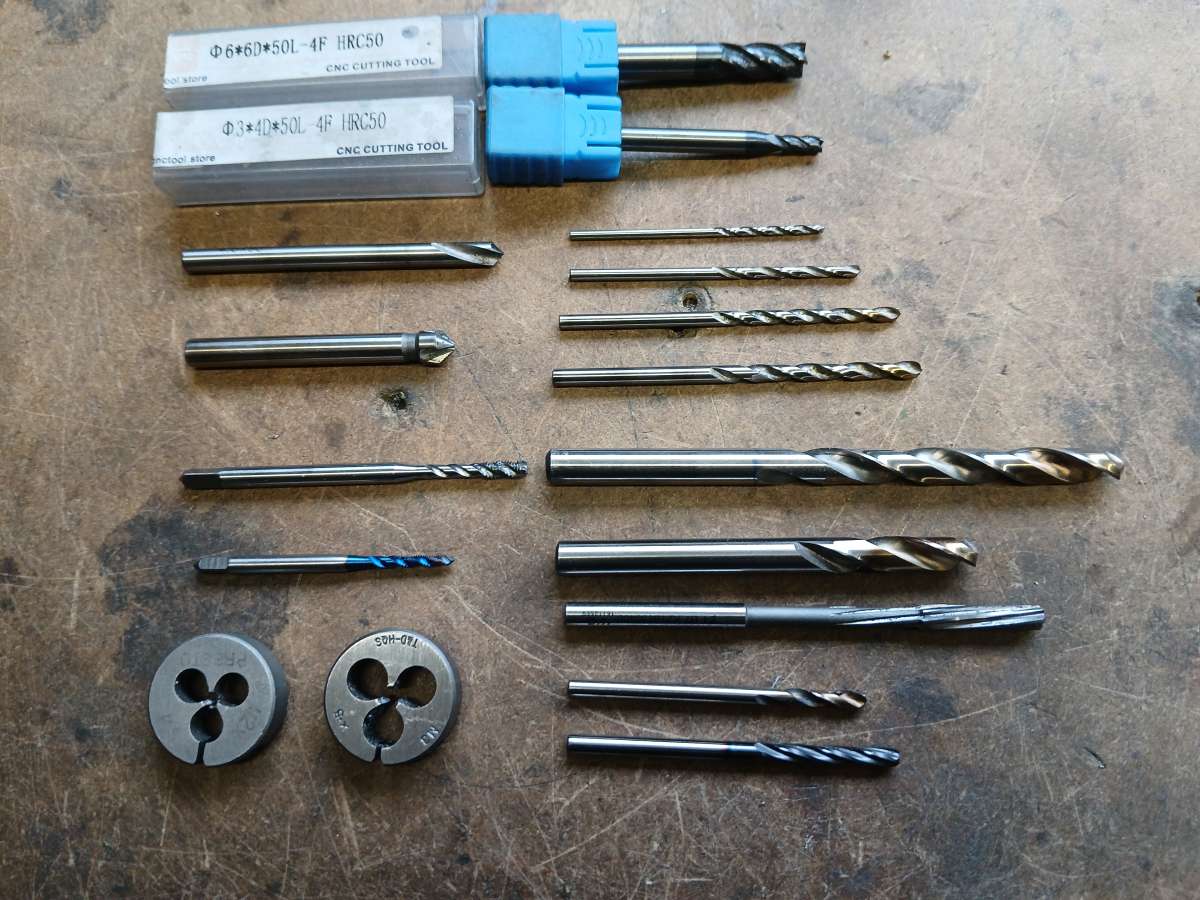
          I have tried to keep cutting tools to a minimum but these are likely to be most of what will be needed to make the engine

          20251105_143339

          From Top Left

          6mm and 3mm diameter 3 or 4-flute milling cutters

          Small countersink bit

          Spot Drill approx 4mm dia (Centre drill will do)

          M3 and M2 taps, preferably spiral flute but traditional 3-piece sets will do

          M2 and M3 Dies

          On the Right

          1.6mm Drill bit (M2 tapping size)

          2.0mm Drill Bit (M2 Clearance)

          2.5mm Drill Bit ( M3 tapping size)

          3.0mm Drill Bit ( M3 Clearance)

          6.0mm drill bit if drilling main bearings

          5.8mm Dril and 6mm Reamer if reaming main bearings. See subsequent text

          2.8mm Drill and 3mm reamer if reaming Pivots and end covers. See subsequent text

          Depending on the chosen steam/air connections a suitable tap & die will be needed and can also be used for the piston rod gland nut if fitted. See subsequent text.


          Note that those who have a good selection of imperial equipment may want to substitute the 3mm and 6mm diameter material with 1/8″ and 1/4″ in which case 5BA taps & die will be needed and the M2 threads can be replaced with 8BA


          #823639
          derek hall 1
          Participant
            @derekhall1

            Jason,

            That list of material and tooling needed is so useful to not just beginners, but everyone whom intends to build your “Kelsey” engine!

            Many thanks for that (thumbs up)

            Regards

            Derek

            #823641
            Richard Simpson
            Participant
              @richardsimpson88330

              Jason, a superbly put together set of drawings supported by equally incredibly comprehensive instructions, materials guide and tools guide.  I don’t think anyone could find a better beginners engine with all the supporting assistance to help them get their first steam engine built.

              #823684
              Jim Nic
              Participant
                @jimnic

                Great stuff Jason.

                I have lately started your Gamages single cylinder engine and when that is done this will be my next.  It’s rare for me to have my next project lined up so thanks for that.

                Jim

                #823905
                JasonB
                Moderator
                  @jasonb

                  Good to have you onboard Jim.


                  Well it seems the forums gallery is not going to be the best place to post the drawings as the links will be broken each time I post an update so I have not placed them under the “workshop” section of the forum which can be found on the blue bar at the top of the page or just go straight to the item by clicking here.

                  I have laid these ones out a bit differently to my other sets of drawings where I tend to use the parts centre line as the datum, instead I have use da corner or edge which should make it easier for those with limited equipment, as I will show in the build.

                  Talking of showing there will be a lot of photos which I feel can convey more than a lot of words if some of those engineering words are new to the reader. So far I’ve about 60 images and not even finished the second part!!


                  #823931
                  JasonB
                  Moderator
                    @jasonb

                    Base Plate

                    I have specified 3 x 50 flat steel plate for this on the drawings but it could be cut from 1/8″ x 2″ or other thicker flat bar or sheet if you have it to hand.

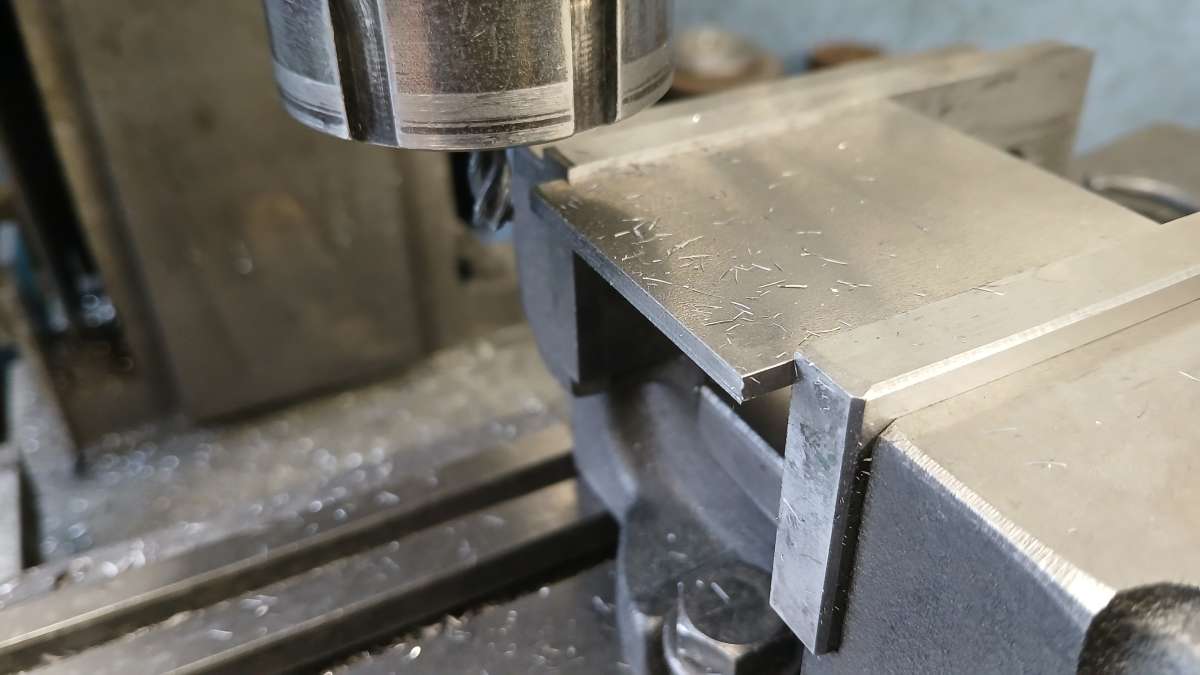
                    Start by sawing off a length a couple of mm longer than the 60mm required and remove any burrs with a file, that includes the factory edges that could have a ding or burr not just the freshly sawn one.

                    After ensuring your vice is mounted true to the mill hold with about 5mm sticking out to the side and take a cut to clean up the edge. I’m using a 6mm cutter and set with it’s end about 5mm below the bottom of the plate as that part of the cutter does not get used so much so may as well make use of the sharper bits.

                    20251107_142645

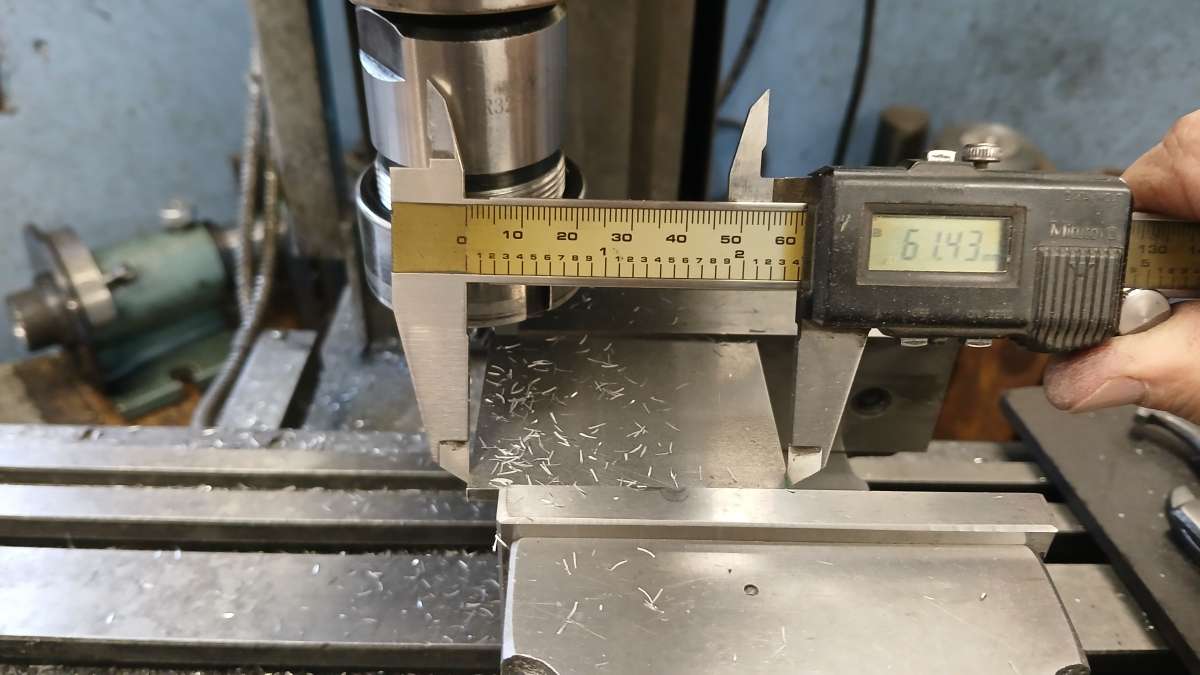
                    Remove from the chuck and deburr. I won’t mention removing the burrs again but good practice to do it as soon as a part comes out the vice or chuck so they don’t affect future measurements, stop it being held true or cut your fingers. Remount in the chuck with the other end facing out and again take a light clean up cut. Zero the handwheel dial or DRO. Take a measurement to determine how much needs to come off and use the handwheel to put on the cut or however many are needed to bring the part to final size of 60mm. In this case I took a cut of 1mm and then a final cut of 0.43mm.

                    20251107_142917

                    After a quick deburr the part can go back into the vice making sure if is sitting flat either on parallels or whatever you have to hand such as some flat bar, lathe tools, etc to pack it up off the bottom of the vice, again have some material sticking out the left side of the vice.

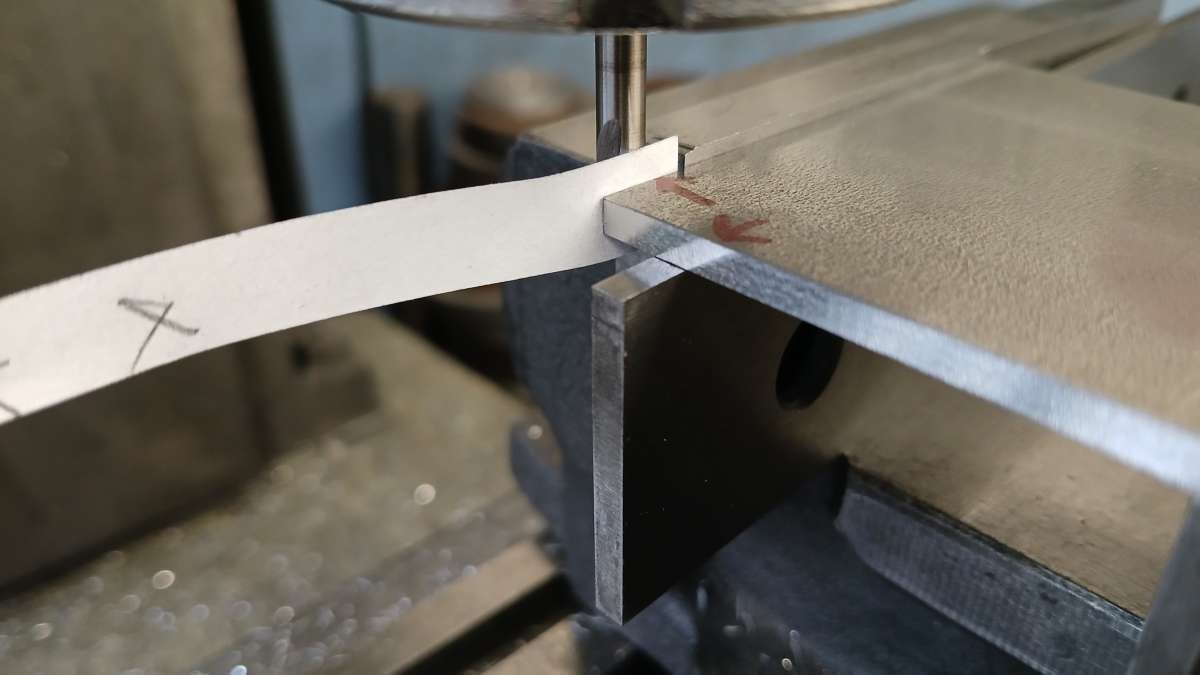
                    If you look at the drawings you will see that all dimensions have been taken from the top left corner so the next thing to do is establish that position. If you have an edge finder then that can be used on the two edges that form the corner if not put a piece of known diameter bar or a tool in your chuck and bring it towards an edge until it just traps a piece of paper and zero the handwheel. Then lift the tool and move over a distance equal to half the tool diameter + the paper thickness which will position the spindle axis directly over the edge. Pereat for the end and you now have a 0,0 datum.

                    20251107_144050

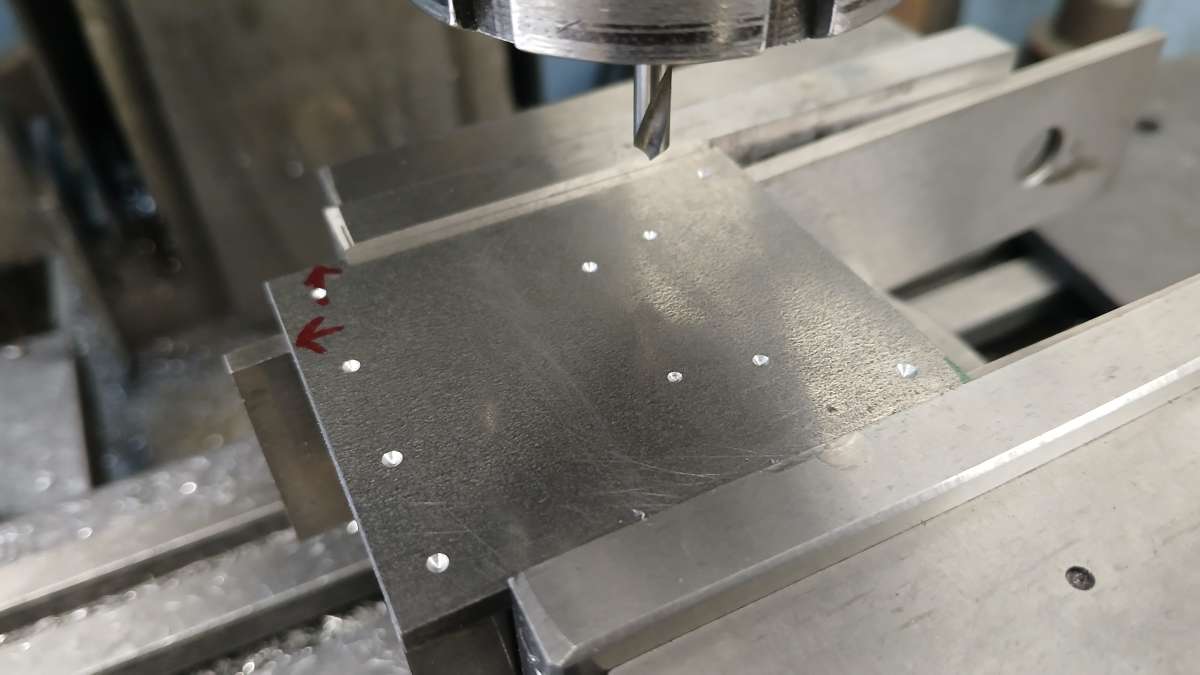
                    Chuck a spot drill or centre drill if you don’t have a spot drill and proceed to form a small divot at each position always approaching from the top and left in a positive direction which will eliminate any backlash.

                    20251107_144721

                    Change to a 3mm drill bit and go back through the positions drilling the eight 3mm holes. Then use a 6mm drill to do the last two which establish the internal corners of the cut out.

                    20251107_150148

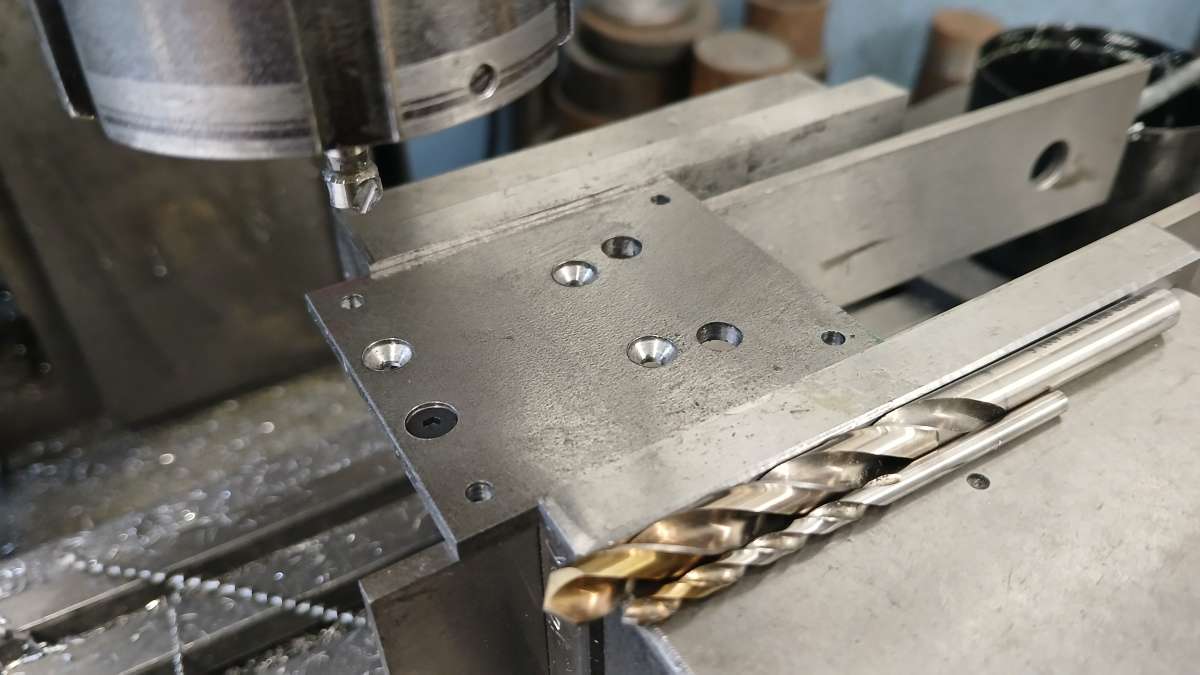
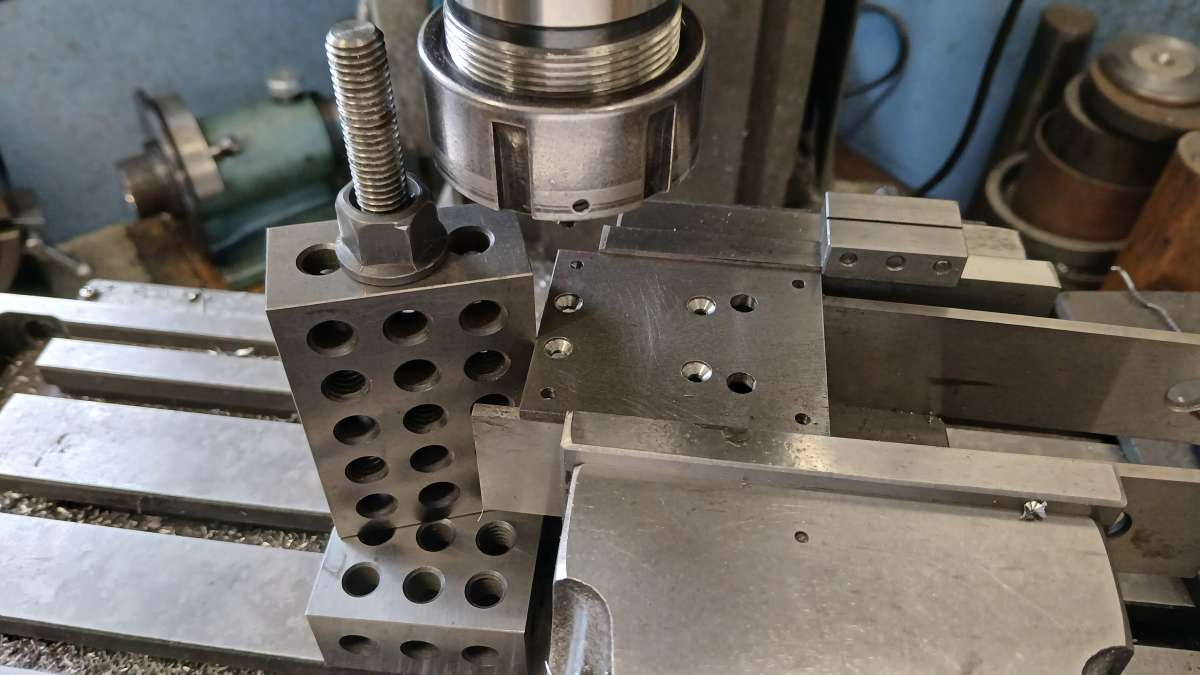
                    Slightly out of sequence. Before removing the part from the vice add a stop to locate the part against when it goes back into the vice to countersink the underside. This can be a vice stop as shown on the right or simply a block of something clamped to th emill table and touching the edge of the work. You can then just flip the work over and countersink the four holes without having to establish th eedge position again. Use a Csk screw to check th edepth of countersink.

                    20251108_083420

                    Cont…………….


                    #823938
                    JasonB
                    Moderator
                      @jasonb

                      ………..Cont

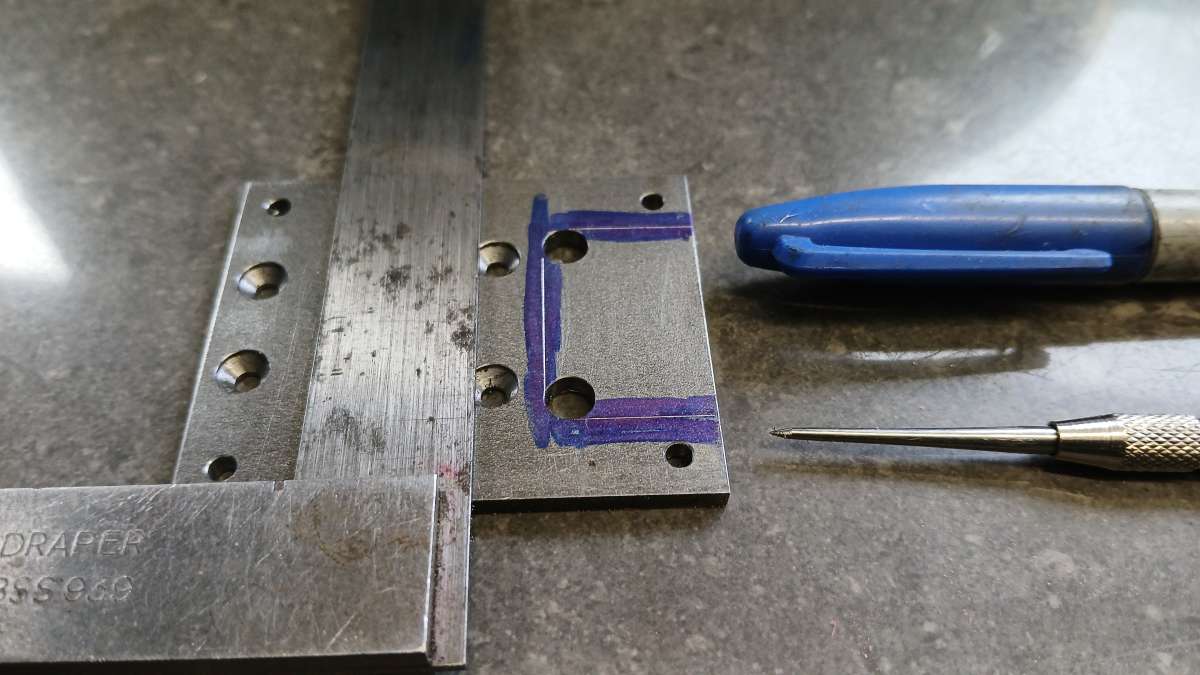
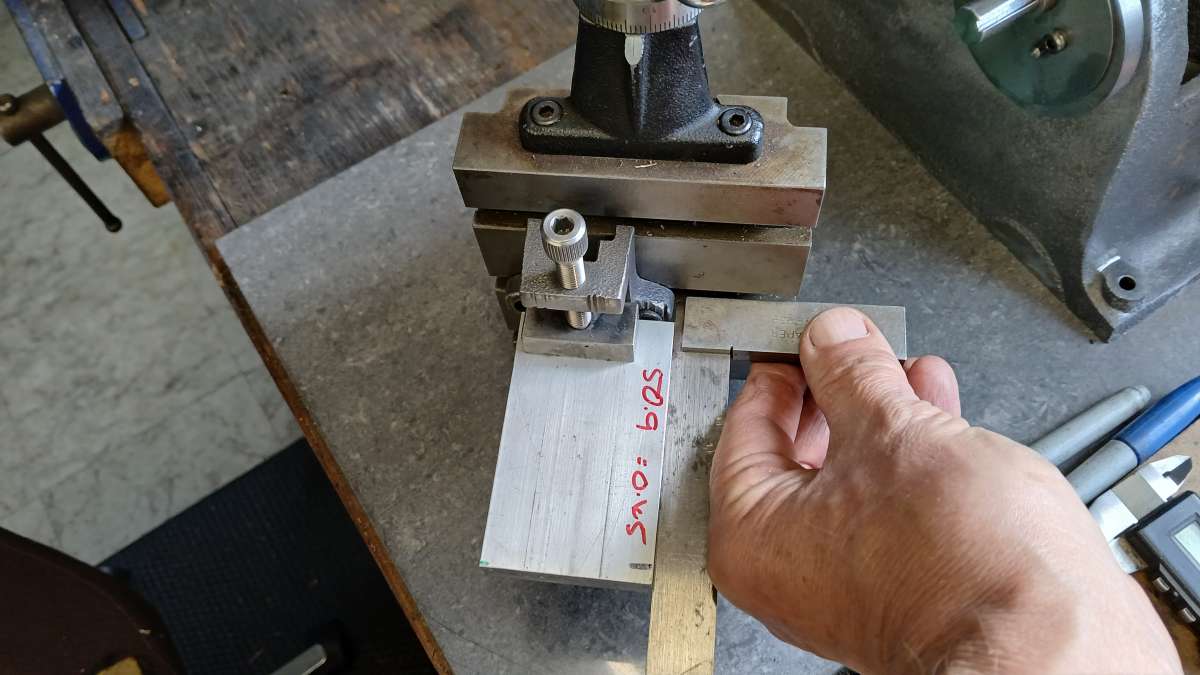
                      With all the drilling done the next job is to form the cutout which gives clearance for the crank thus keeping it a slow as possible for a shallow propshaft angle if used in a boat as well as keeping the centre of gravity low. Use some marking blue or in this case a sharpie so the scribed lines show up and put the shank of the 6mm drill bit into one of the holes. Bring the blade of a tri-square up against the drill shank and that gives the correct position to scribe your line, repeat for the other two.

                      20251108_083829

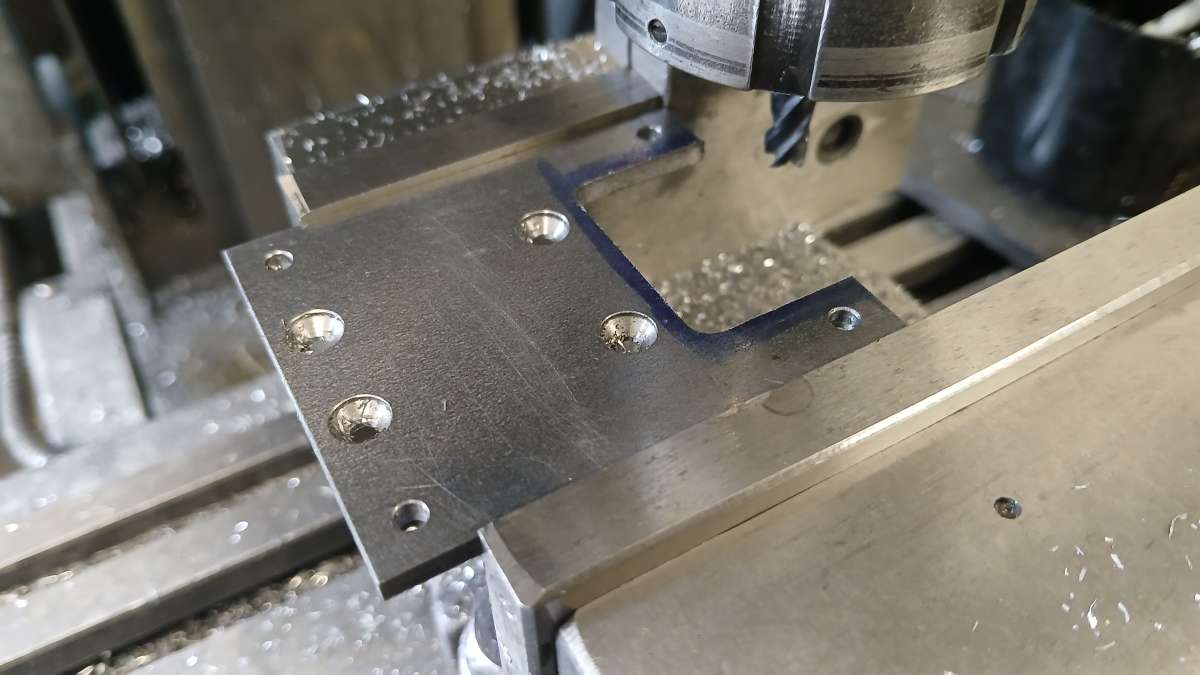
                      The waste material can then be sawn out keeping about 1mm from the lines. I used a hacksaw to do the two shorter cuts and then managed to get a junior hacksaw in to cut the long edge. The part can then go back into th emill vice against the stop and a 6mm milling cutter loaded into the collet. Using the same co-ordinates that positioned the two 6mm holes the three edges can be milled to final size.

                      20251108_084743

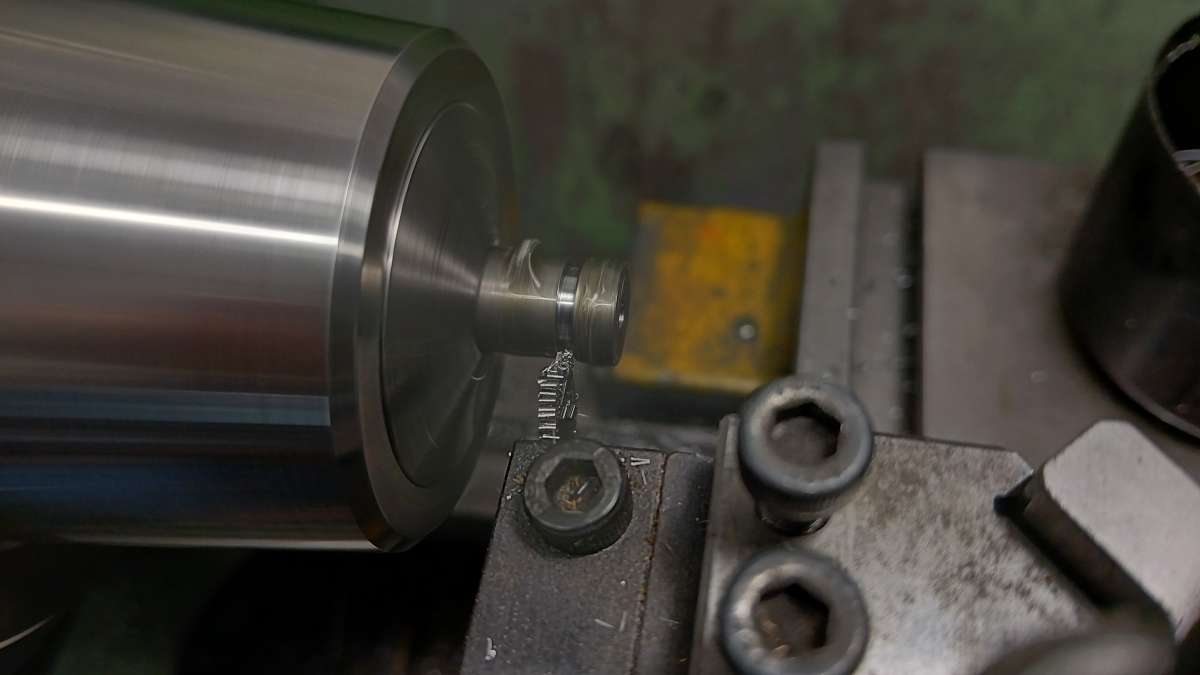
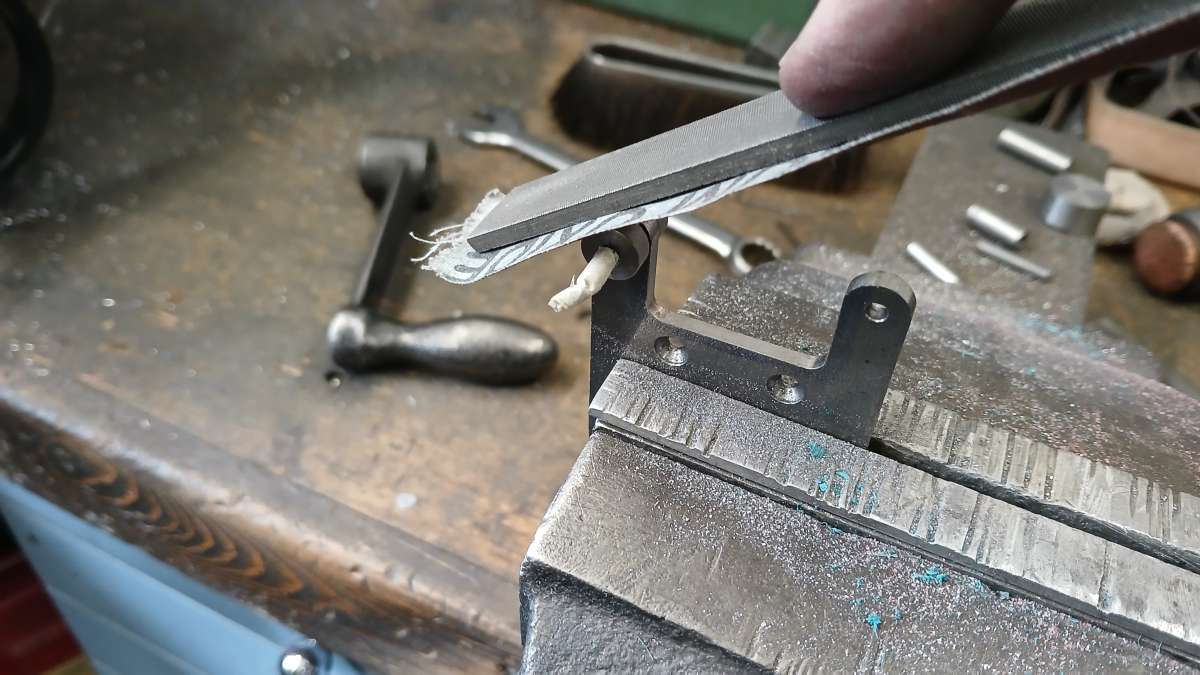
                      You could call the part complete at this stage but it looks nicer if the external corners are rounded over, I have shown a 5mm radius for all of these. Although they could be milled with the aid of a rotary table I doubt many beginners will have one so good old “filing buttons” can be used. These are nothing more than a piece of rod with a diameter twice that of the required radius and drilled to match so 10mm diameter in this caseand drilled to suit the hole which is 3mm this case. Drill deep enough to make two buttons about 4mm wide which can either be sawn or parted off. Pause the parting cut part way through to remove any burrs on the edges. Anything will do for the buttons that is to hand, I used 10mm mild steel but any metal will do and larger can be turned to 10mm diameter.


                      20251108_085420

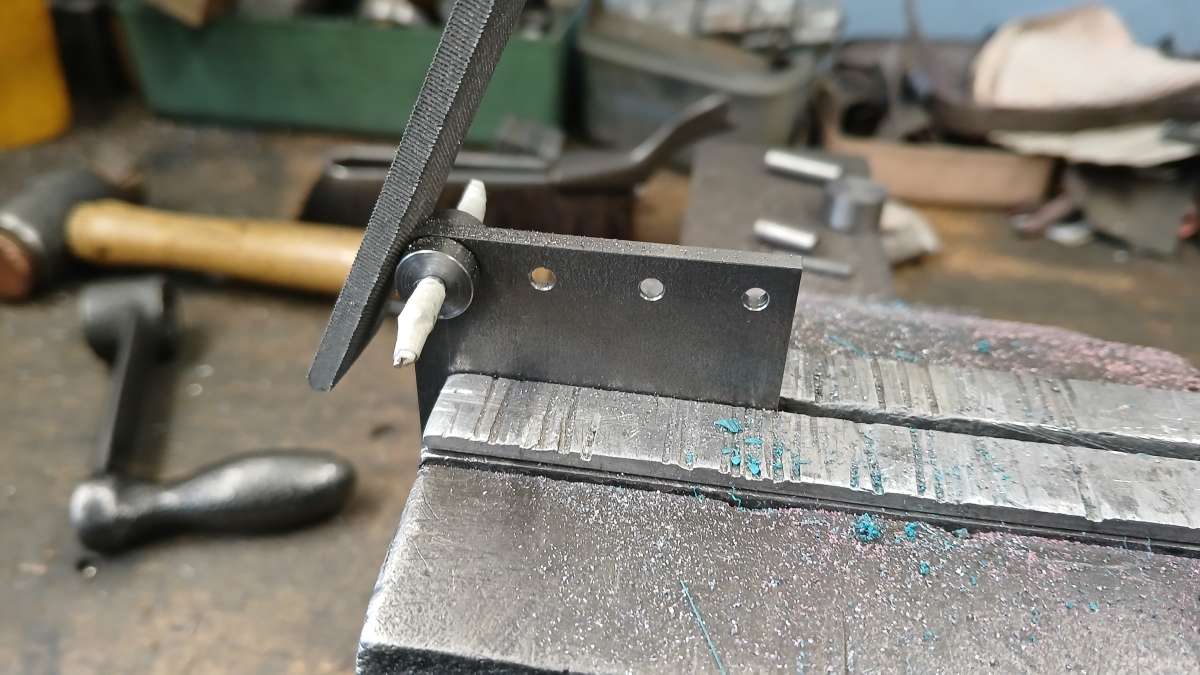
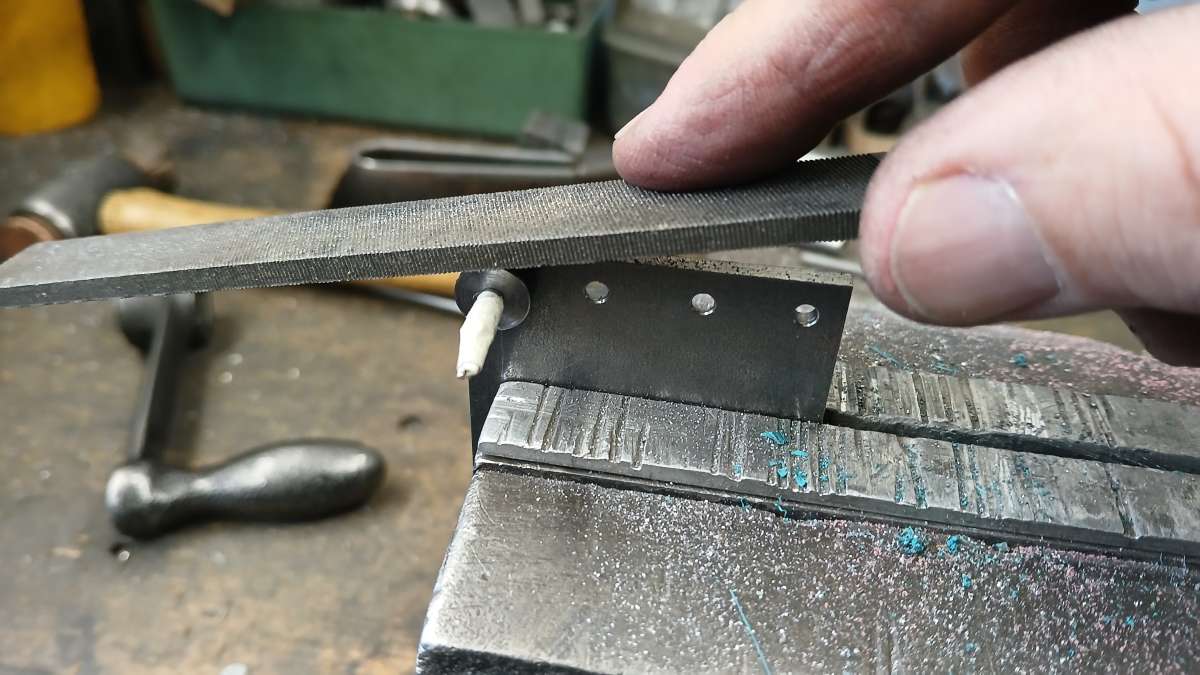
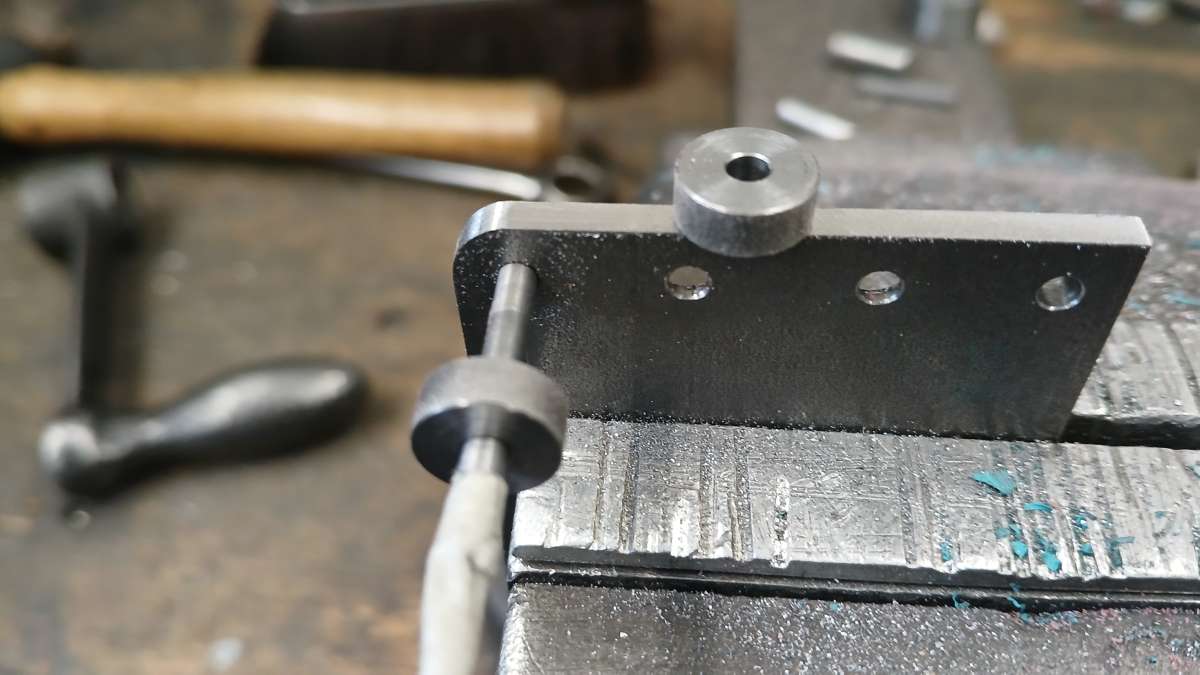
                      Saw of 25mm or so of the 3mm silver steel that you bought for the engine to use as a pivot for the buttons and slip it through one if the holes and then place a button on either side. To stop the buttons falling off I wind a small piece of masking tape around each end of the pivot rod.

                      The filing action should be in line with the base plate not across it. Start with the file fairly vertical and as you cut bring the handle down so the file is almost flat at the end of the cut.

                      20251108_090117

                      20251108_090122

                      As you reach the 5mm radius the file will start to roll on the buttons which stop it taking off mor emetal than wanted so just work your way around until it rolls in all positions after which th ecorner should look like this

                      20251108_090318

                      A strip of emery cloth backed by the file can be used for that final pass. The inner curves of the cut out will be a bit more fiddly as you can only use the end of the file, however some roughing out can be done with the file across the work making sure not to go too deep and score the buttons.

                      20251108_091806

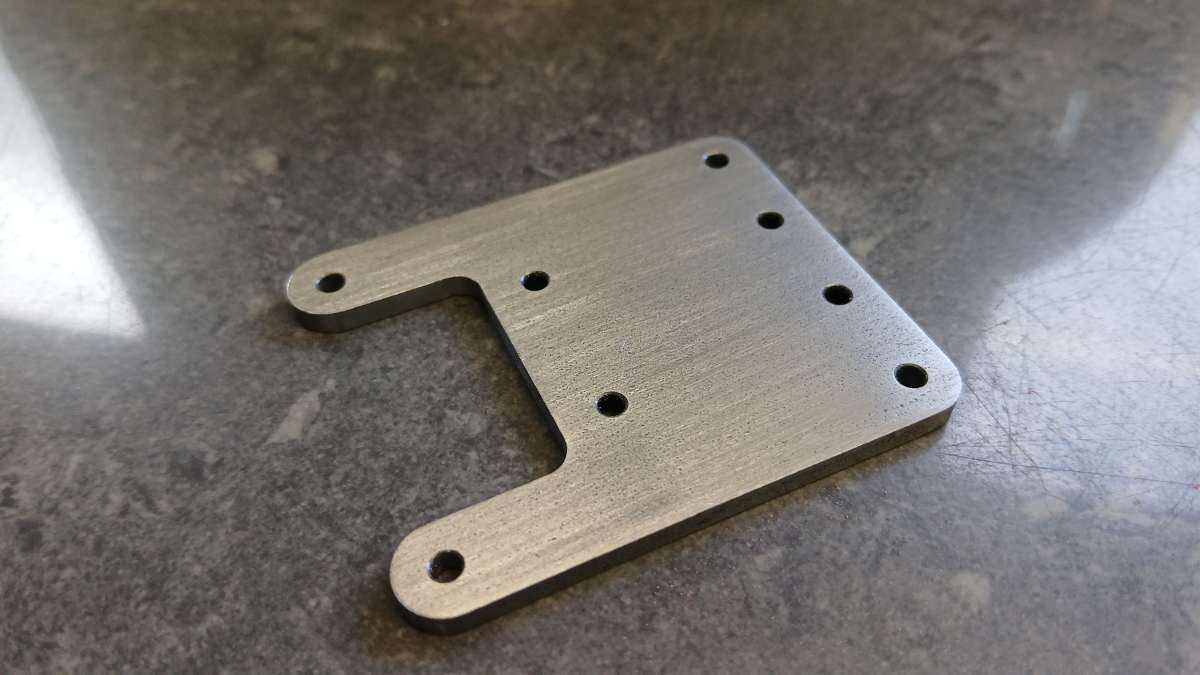
                      I have shown the top edges of the plate with a small radius, the is best left until the other parts are in position as you may not want to have the radius run all round. So at this stage the first completed part should look like this.

                      20251108_092428


                      #824066
                      andyp123
                      Participant
                        @andyp123

                        Great, this step-by-step guide is so helpful for a beginner to learn from your experience and skills.

                        thanks

                        Andy

                        #824079
                        Dalboy
                        Participant
                          @dalboy

                          I enjoy watching your builds. So far a well explained first piece.

                          #824486
                          JasonB
                          Moderator
                            @jasonb

                            Before making a start on the “V” shaped standard a question about my suggestion of Aluminium for an engine used for display as being a suitable material has been raised.

                            Fistly maybe I should explain what I mean by an engine that is made for display. I regard this type of engine as one built more by people who enjoy the build rather than making the engine to do actual work when finished. These type of engines are likely to be played with test run a few times when complete and maybe the odd occasional run after that. These runs are typcally at fairly slow speeds mostly on air with the odd opening up of the regulator or throttle to see what it can do and seldom have any load applied.

                            “Aluminium” is also a generic term used for many alloys. Some of the purer ones may not be so good to have other metals running against. Or they may not have much in the way of temper which again could cause a problem. My go-to alloy for this type of use is 6082 which is generally supplied in the T6 temper so will take the wear a display engine is likely to see and is also quite nice to machine though swarf can be a bit long!

                            There are also some good examples out there of other engines that use aluminium. One that springs to mind are the smaller beginners casting sets from P M Research in the US who are the American equivalent of Stuarts. They have several engine casting kits in aluminium and run brass pistons, valve and rods straight against the aluminum castings.

                            Another are the popular “potty” range of engines by our own Stew Hart that have featured in ME and been built by many beginners as they are often suggested as a suitable first engine and again parts like the cylinder and port face are aluminium.

                            So having covered that lets get on with the build.

                            #824502
                            JasonB
                            Moderator
                              @jasonb

                              The Standard


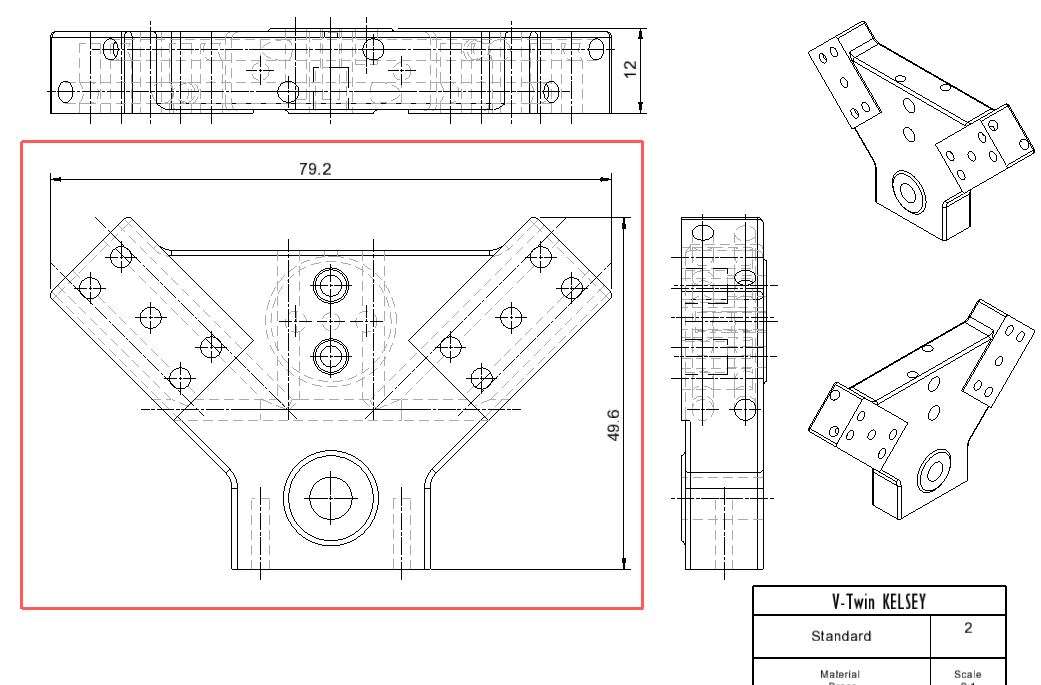
                              A first glance of the drawing for the standard on page 3 may look a bit daunting and I have only put a few overall dimentions on it. However the latest version of the drawings have now been uploaded and the budding builder can see that I have broken the job down into several stages all with their own drawing detailing that stage.

                              v twin3

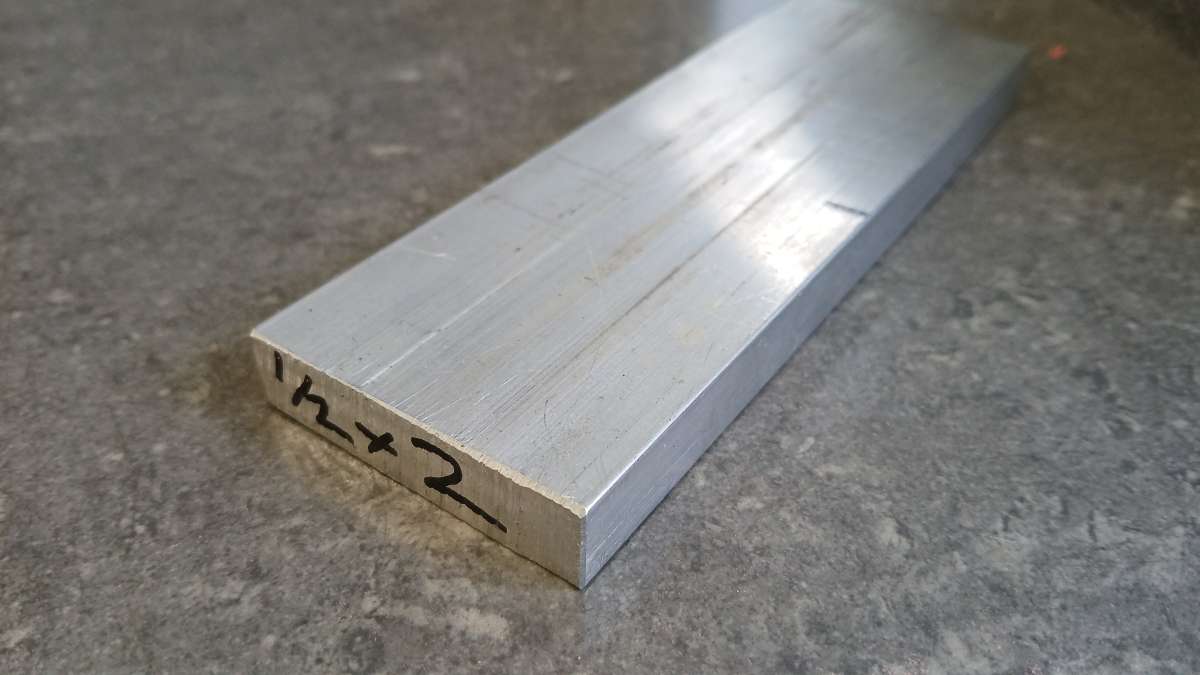
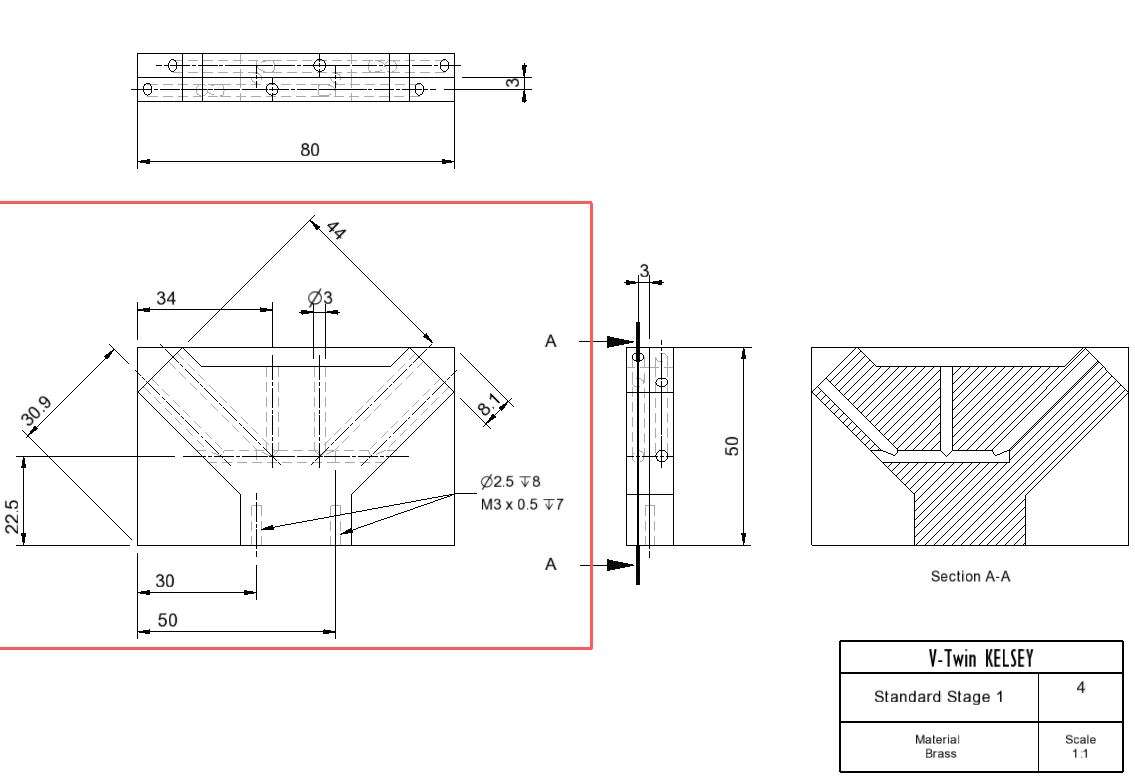
                              Looking at the BoM you can see I have specified 1/2″ x 2″ flat brass bar for a working engine or the same size in 6082 aluminium for a shelf queen. The 4″ length suggested will also provide material for other parts so the first thing to do is saw off a piece a little over 80mm which is the overall size for initial machining shown on drawing 4

                              20251108_092518

                              v twin4

                              The drawing also shows the initial machining height as 50mm which is what will be tackled first.

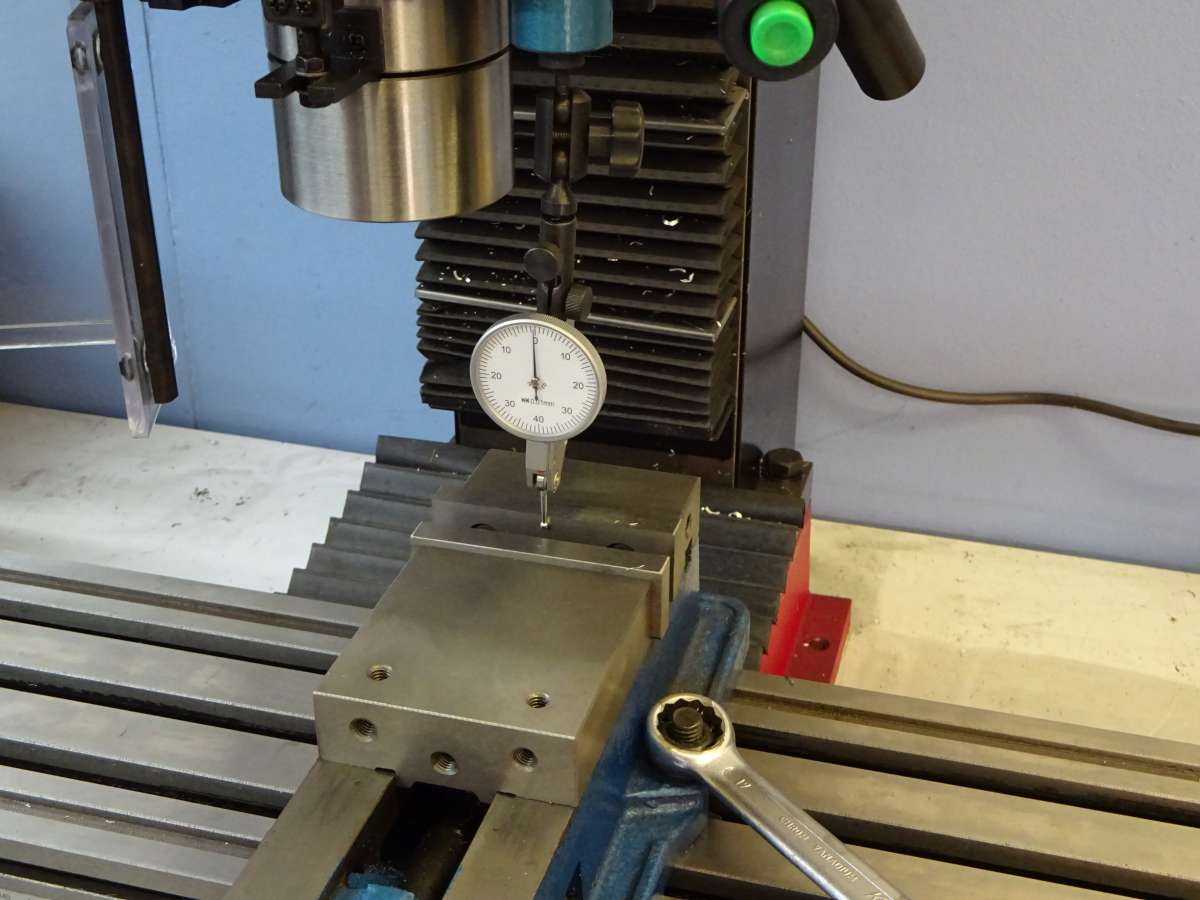
                              It should go without saying but for those new to the hobby that a mill vice should be set parallel to the tables axis, this is best done with a dial indicator against the fixed jaw so that the needle shows the same reading as the vice is moved from one side to the other. I’m also assuming that the mill is reasonably trammed eg the spindle if perpendicular to the table both sideways as well as front to back. The same applies if doing it on the lathe, set the vertical slide true across the lathe and the fixed vice jaw horizontal.

                              Photo 64

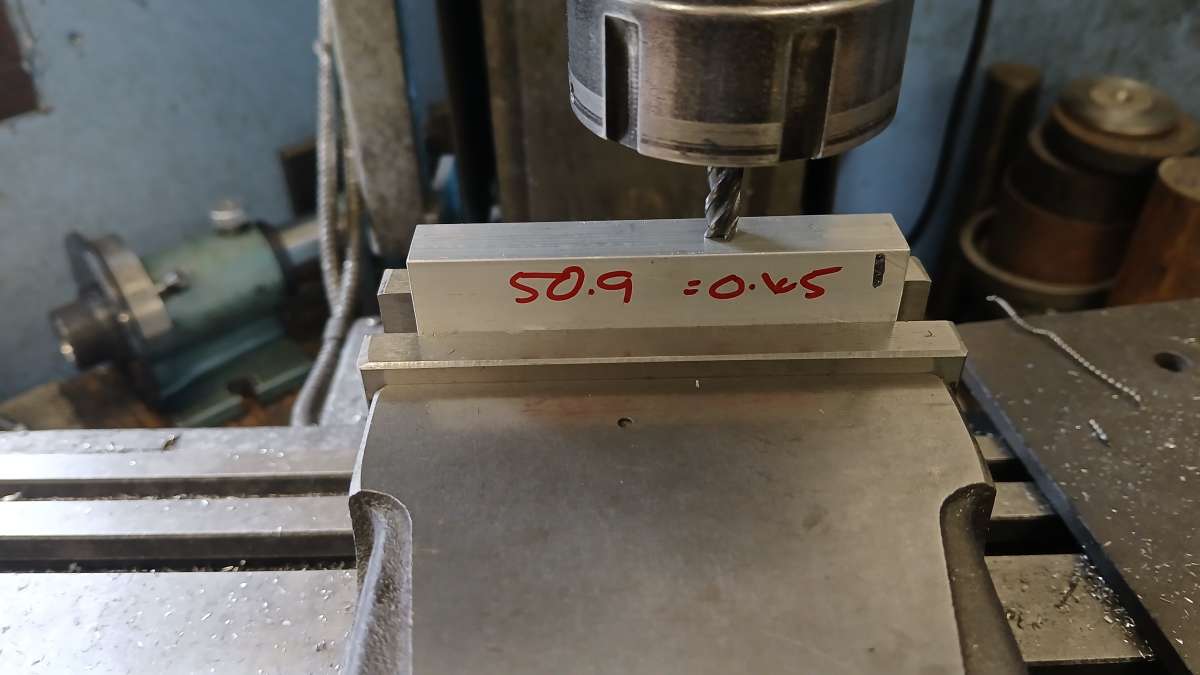
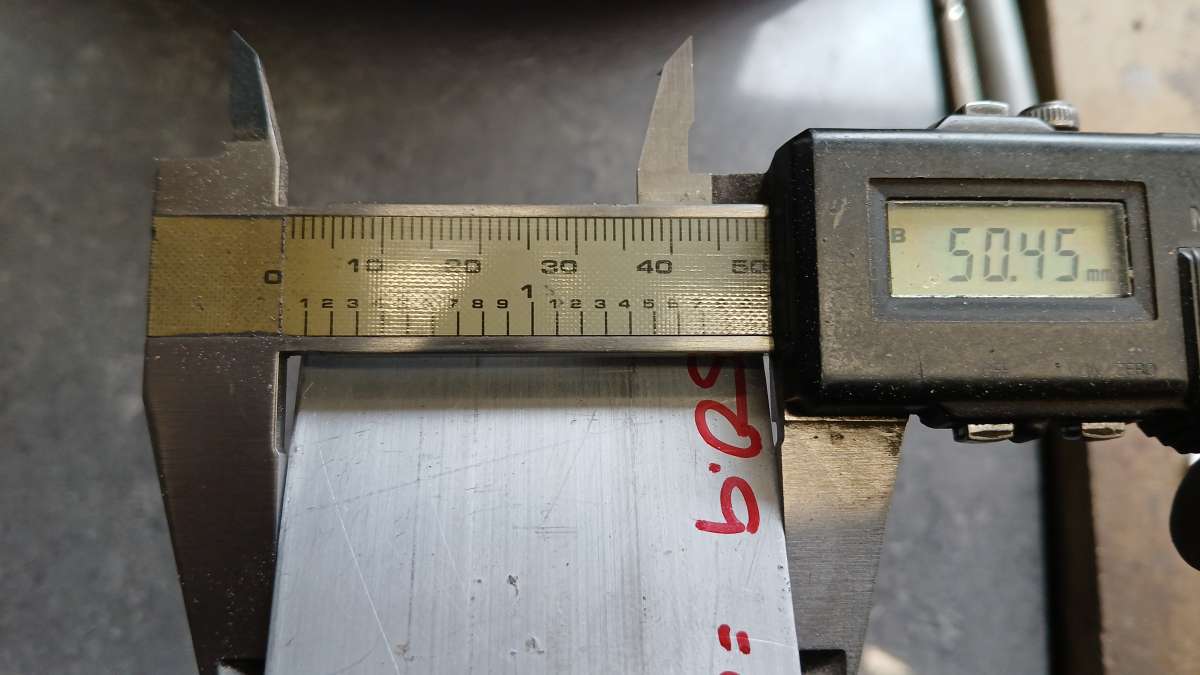
                              Take a measurement accross the 2″ width of the bar, deduct 50mm from that and half the remainder and that is what needs to come off the first side, in my case the bar measured 50.9mm so 0.45mm.

                              Making use of one of the factory edges set that against the bottom of the vice, Load the 6mm milling cutter and lower the mills head (or raise the knee) until a couple of mm from the top of the bar. Gently bring the cutter down to touch the work, lock the quill and zero the height dial or readout.

                              20251108_093059

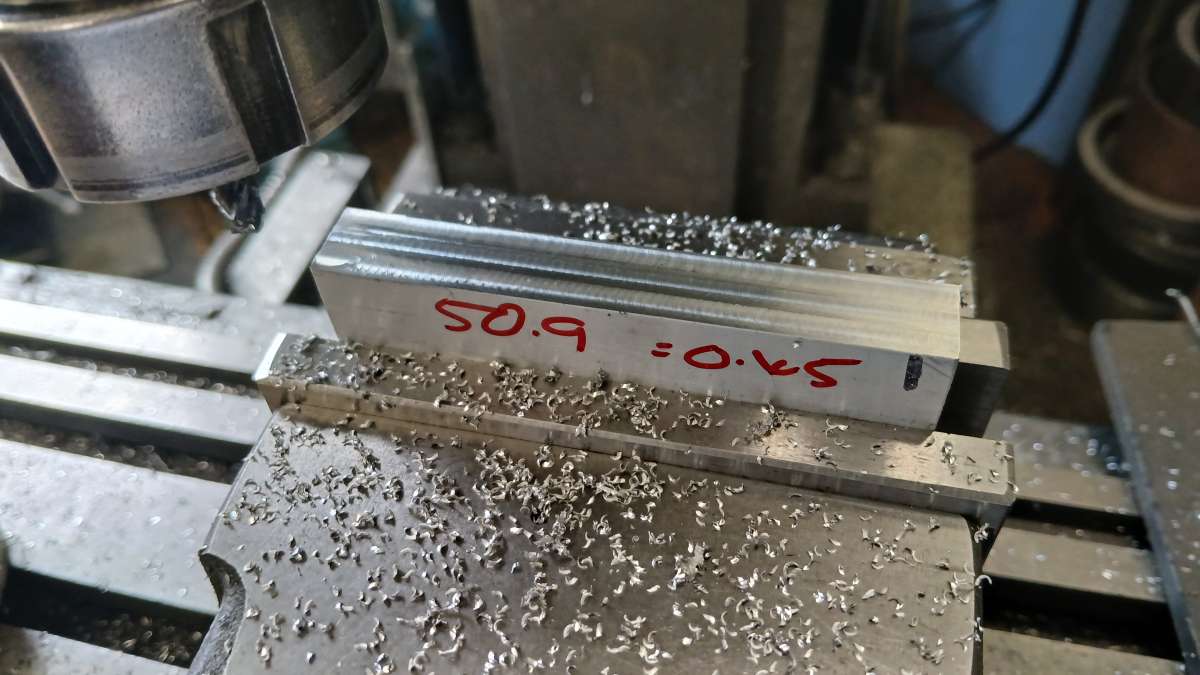
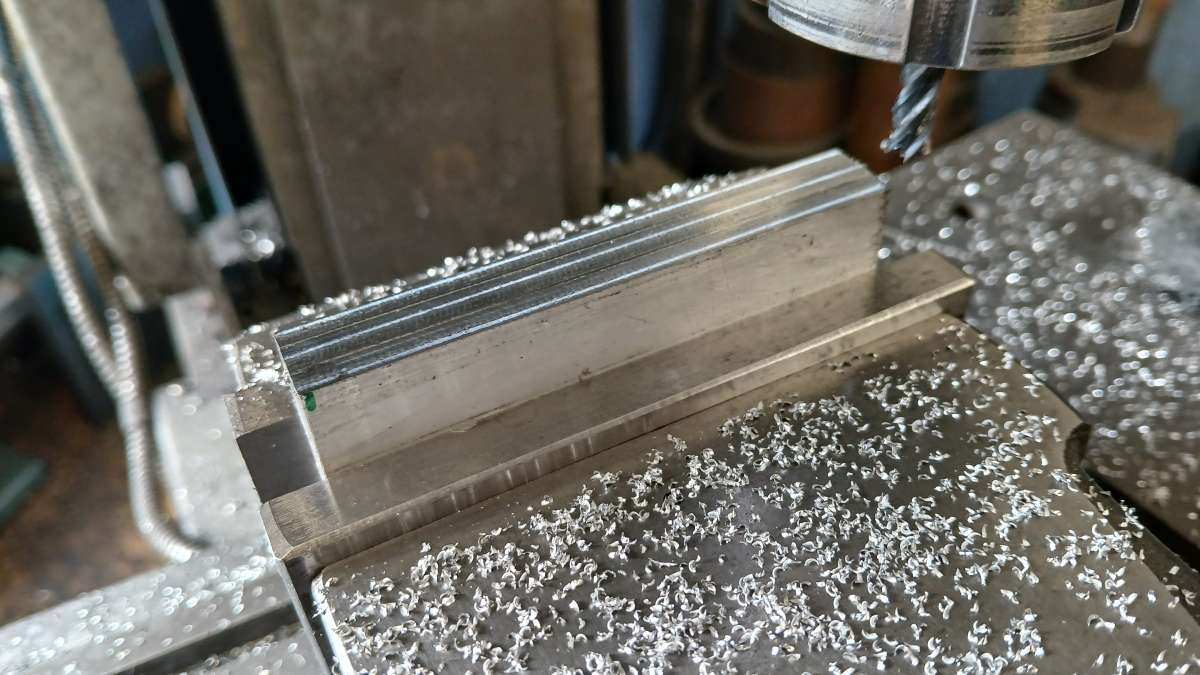
                              Raise the head and move the cutter clear of the work, lower back down past zero to 0.45mm and machine the top face of the bar, I used three passes of about 4mm width each. A sharp cutter should produce minimal burrs, if not find a sharp one. The brass can be cut dry but a little paraffin or WD40 applied to the aluminium will help with the finish.

                              20251108_093333

                              remove the metal from the vice and measure the remaining width and note how much neds to come off to arrive at the desired 50mm, I’d like to say this was skill but more luck on an initial cut.

                              20251108_093457_001

                              Put the metal back in the vice with the freshly machined face down. Lower the tool by the amount needed to come off and machine the top face. You now have a 50mm wide bar with sawn ends

                              20251108_093753

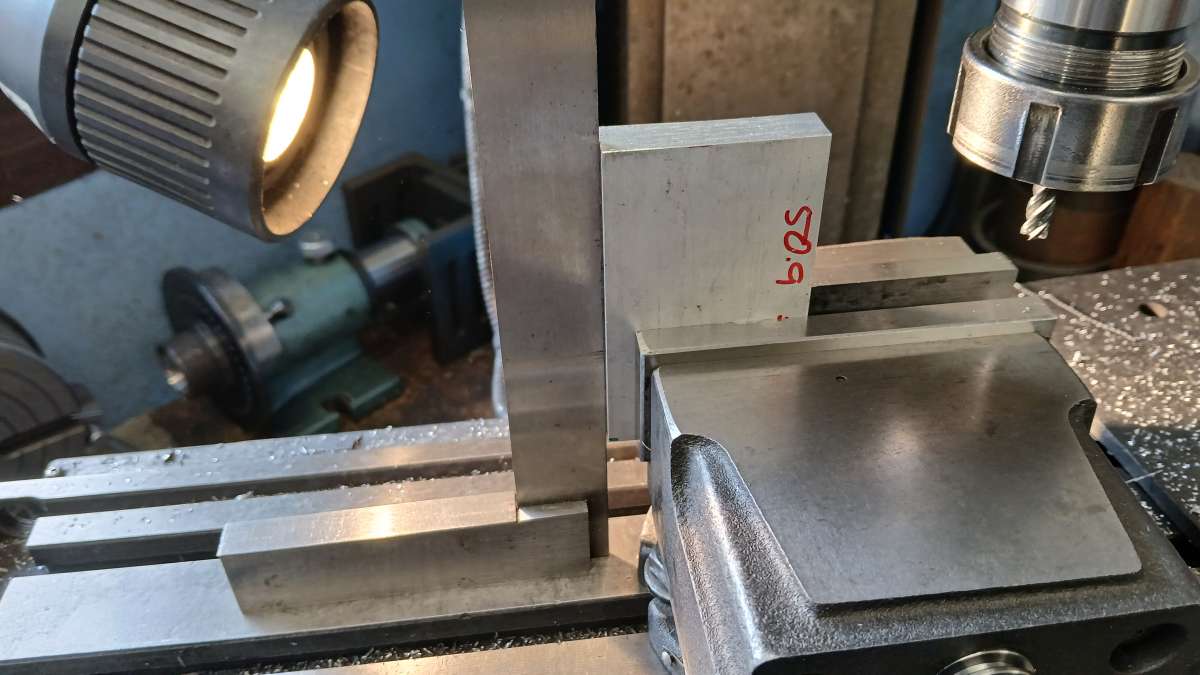
                              There are two ways to deal with cutting the ends, the bar could be held flat and the side of the cutter used to machine the end which I often do but I’ll show the other option which would be more suited if using the lathe. Put the metal in the vice with one sawn end facing upwards and just nip it up, use a tri square against the newly machined edge to check it is vertical and when happy tighten the vice, a light behind can make it easier to tell if there is any gap between work and square.

                              20251108_121745

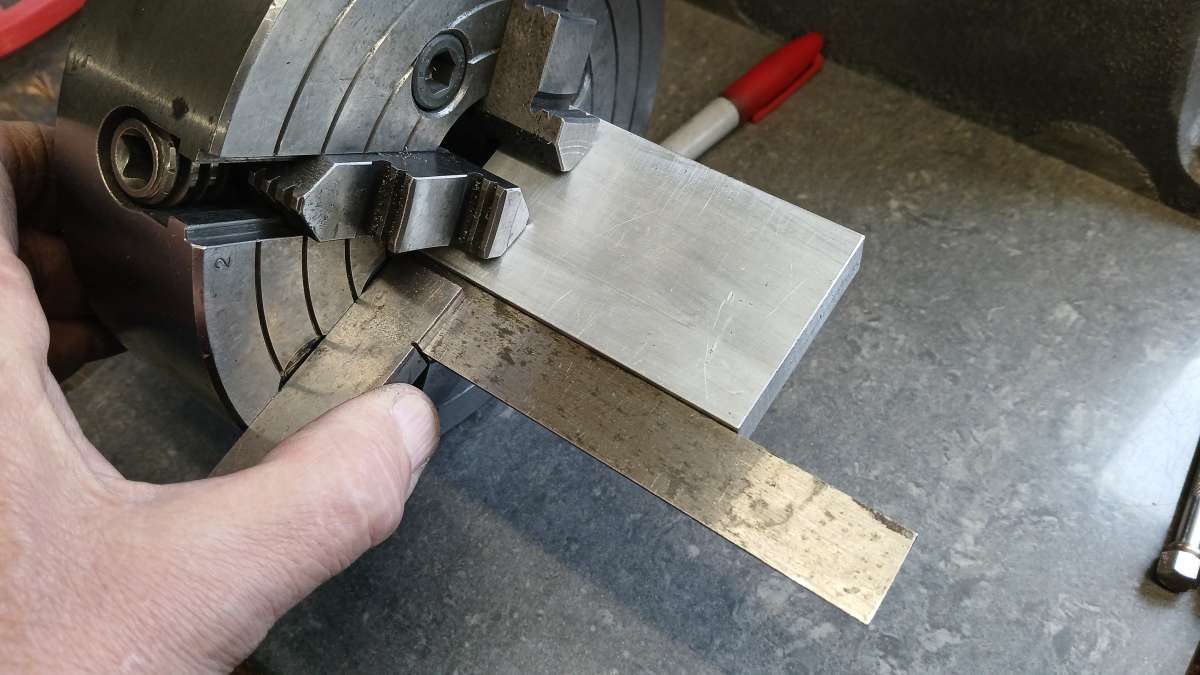
                              If doing it in the lathe then you can either hold the work in a 4-jaw, or in a vice mounted to a vertical slide. Again use a square to line up a previously machined edge, light cuts as there is a fair amount of stick out say 0.5mm max. These methods could also have been used for the earlier cuts and also the work to come.

                              20251108_094152

                              20251108_121602

                              Use the 6mm cutter again to just clean up the first end, then put that on the bottom and clean up the other end. Take a measurement of the length and then make one or more passes to arrive at the final 80mm. I had about 1.4mm to come off so did a pass at 1mm deep then a second at 0.4mm deep.

                              Cont………


                              #825028
                              JasonB
                              Moderator
                                @jasonb

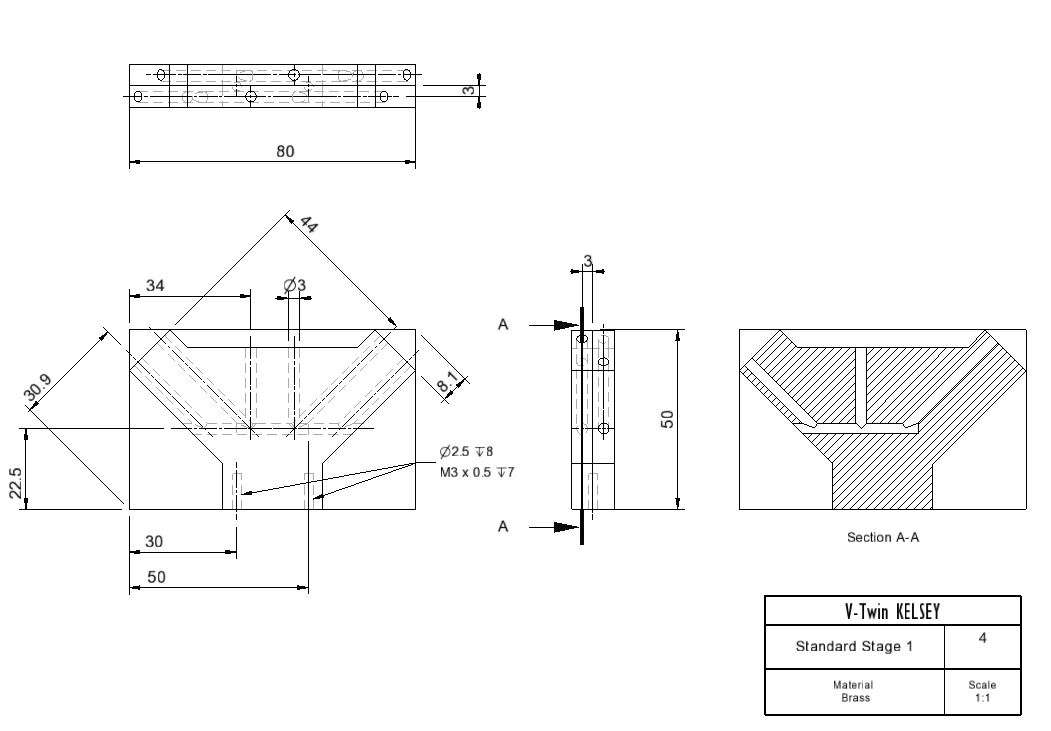
                                If you are wondering why I have shown the block of metal machined to 80x 50 rather than the overall size it is so that those using handwheels or even marking out with rule and a scriber can mostly use whole mumbers. Had I made it to overall size then everything would be to 2 or 3 decimal places which is OK if you have a DRO but many a beginner won’t

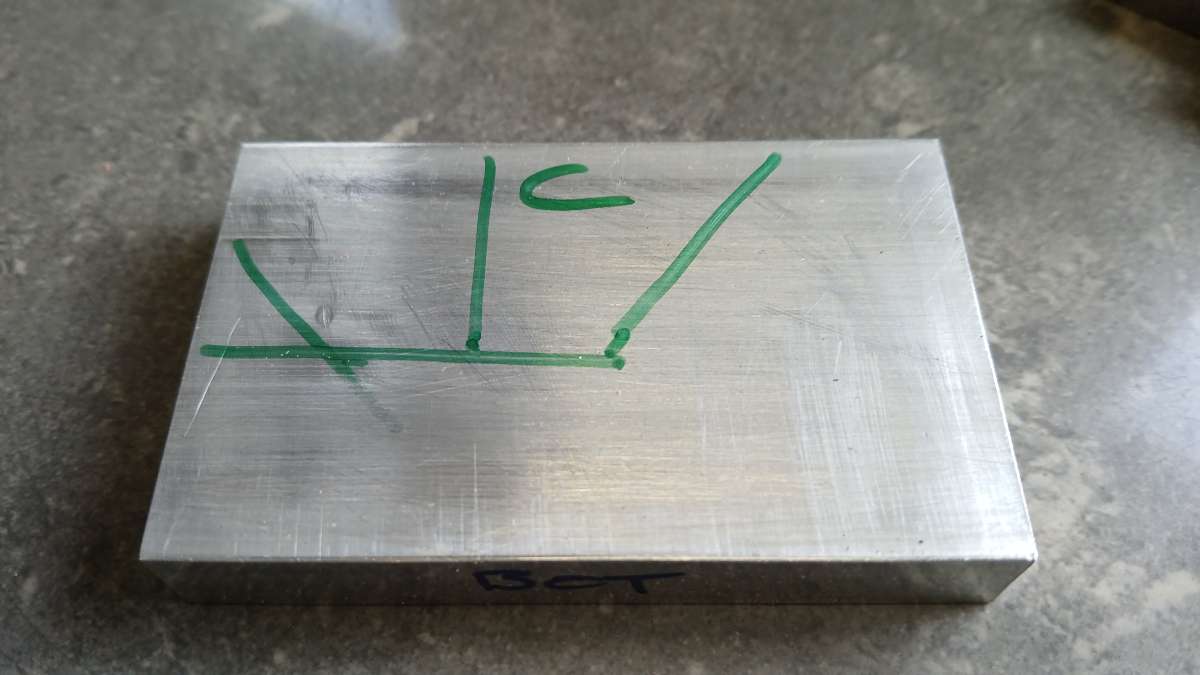
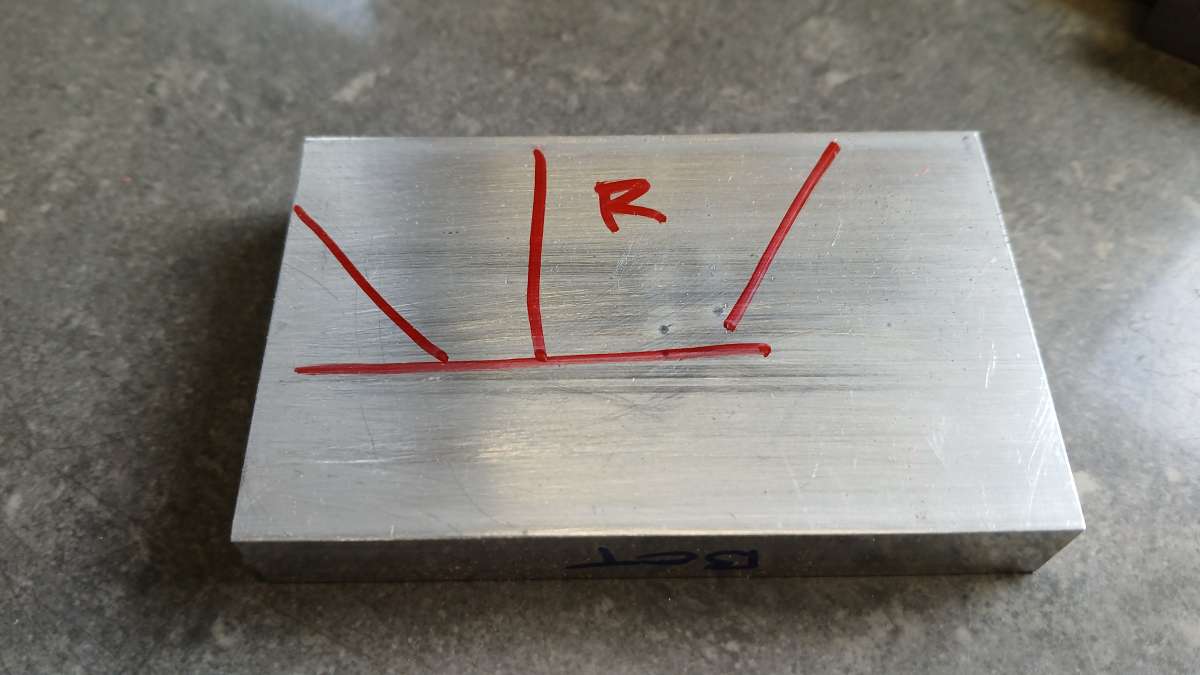
                                So with the block of metal to working size it is time to start making some holes. These will be the ones shown on Sheet 4 as stage 1. I have marked my metal with “C” for the cylinder side and “R” for the regulator side.

                                v twin op1

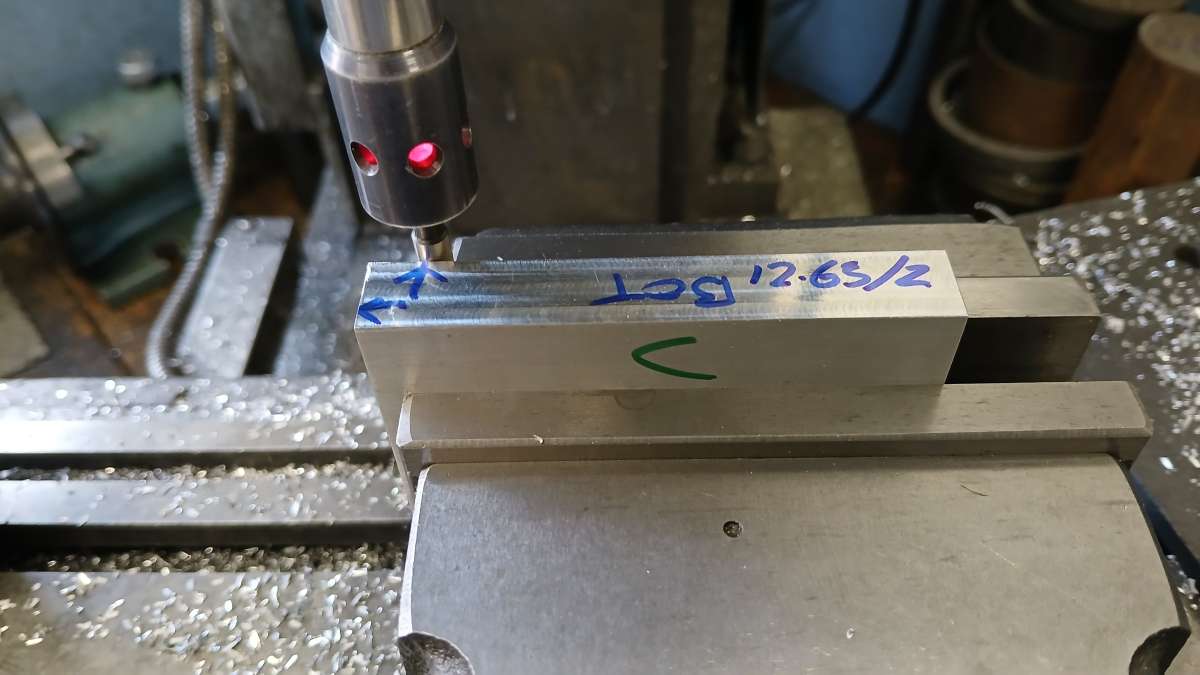
                                Starting with the two M3 tapped holes in the bottom, decide which way up you ar egoing to use the metal if there are any deep dings try not to have them where the cylinders or regulator go and clamp in the vice with a few mm sticking out the left side. In the same way as was done with teh base locate the lefthand end & zero the spindle over the edge. Then locate the rear face, I’m using my electronic edge finder but a manual one or the edge of a tool will do. However this time the spindle needs to be located over the centre of the metal so zero the dial a syou touch and then move by half the finder’s diameter plus half the thickness of the metal, min ewas just under 12.7mm (1/2″) at 12.65mm so I moved 2.54mm (half finder) plus 6.33mm = 8.87mm and zero the handwheel again.

                                20251108_133623

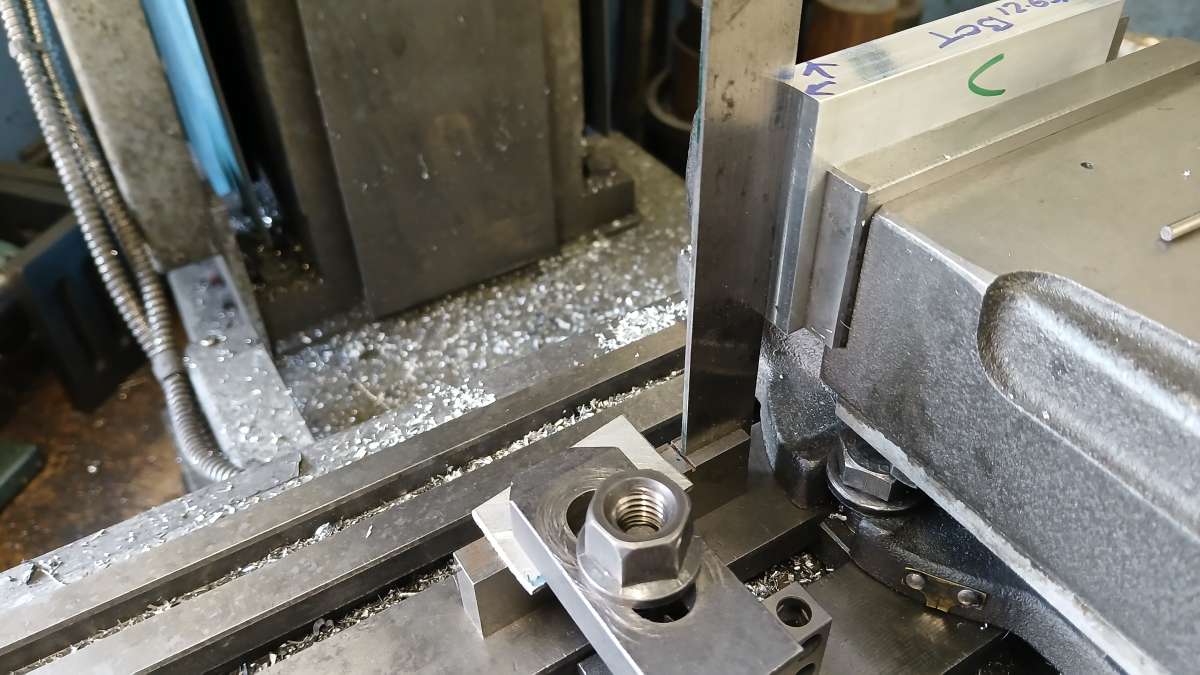
                                As there will be a lot of subsequent offsets from the same left hand side set up a stop, here I have used a trisquare clamped to the mill table as the stop will be needed at several heights the blade of the square is ideal.

                                20251108_134219

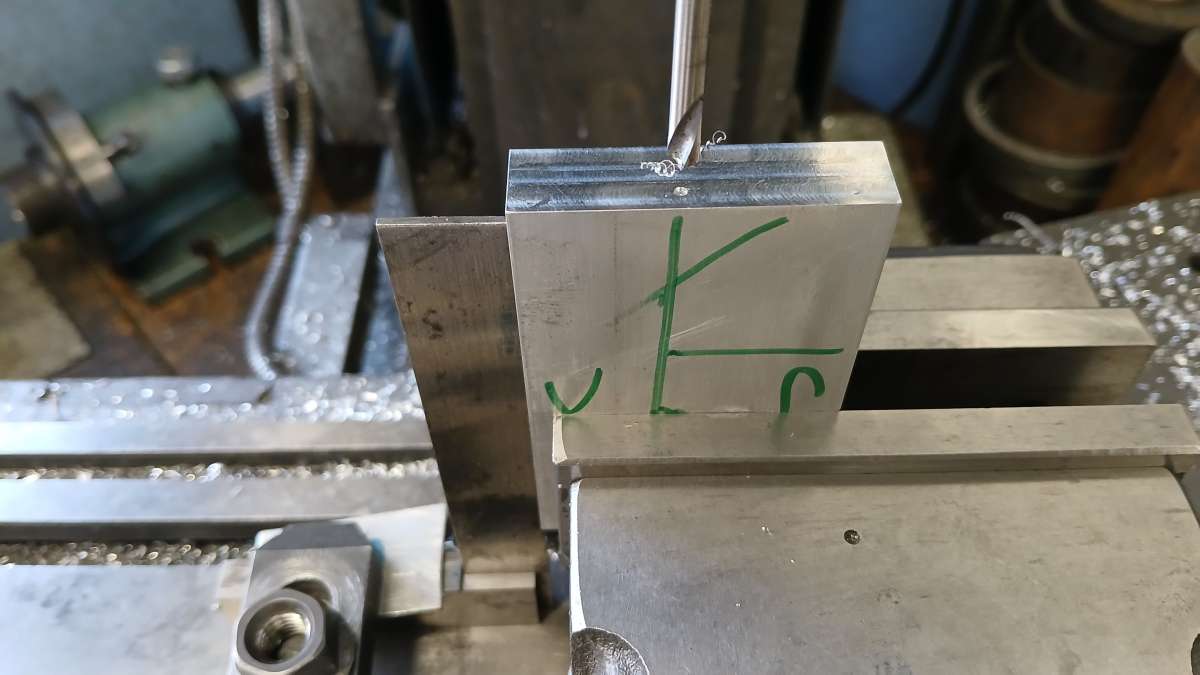
                                Pop a spotting drill into the chuck and move sideways 30mm and make a divot, them move to 50mm from the edge and make a second divot. Change to a 2.5mm drill bit and reposition over those two points again and drill 10mm deep.

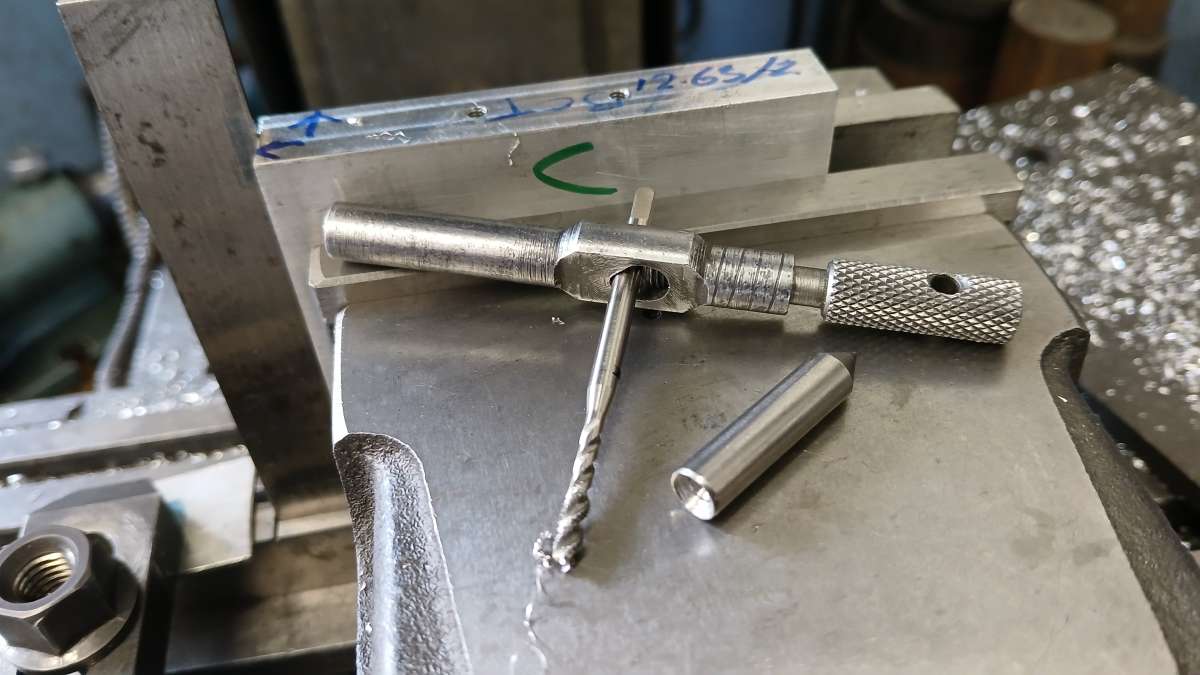
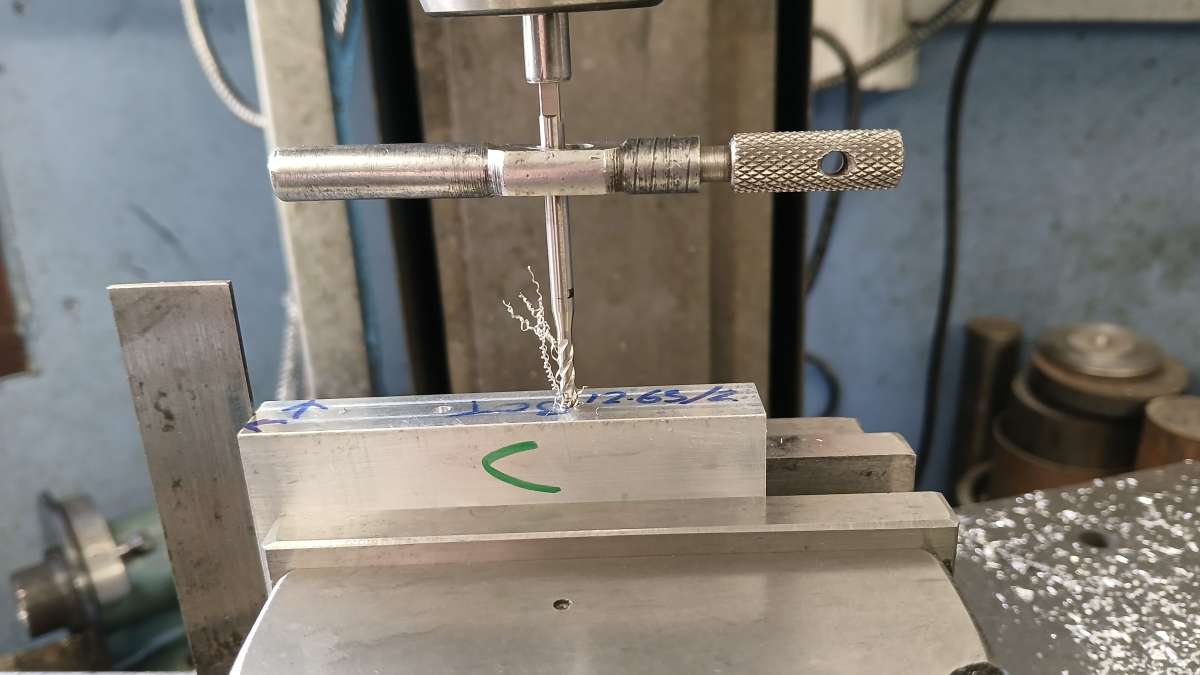
                                To help ensure holes are tapped vertically U use a simple piece of 6mm dia rod that has been turned to a point at one end and the other drilled with a centre drill or spotting drill. This can either locate in a ctr hole if the tap has one but as most small taps don’t us ethe other end to slip over the end of the tap. So reposition again at 30mm & 50mm to guide the tap as you turn it, a little tapping fluid or even paraffin will help the cut

                                20251108_134818

                                I tend to use “spiral flute” taps where only one is needed for each thread and they also push the swarf up out of the hole. Traditional taps will be OK, start with a taper and finish with the second, there is no real need on these to use the plug as there is plenty of depth for the screws to engage with.

                                20251108_134607

                                The drawing shows a section through the front set of linking holes, this is actually reversed on the other side so that can be taken advantage of by setting up for one hole and then rotating the work front for back and doing the other which saves a lot of repositioning. It is worth putting a few Sharpie lines on the part so you can keep track of things

                                20251108_133150

                                20251108_133157

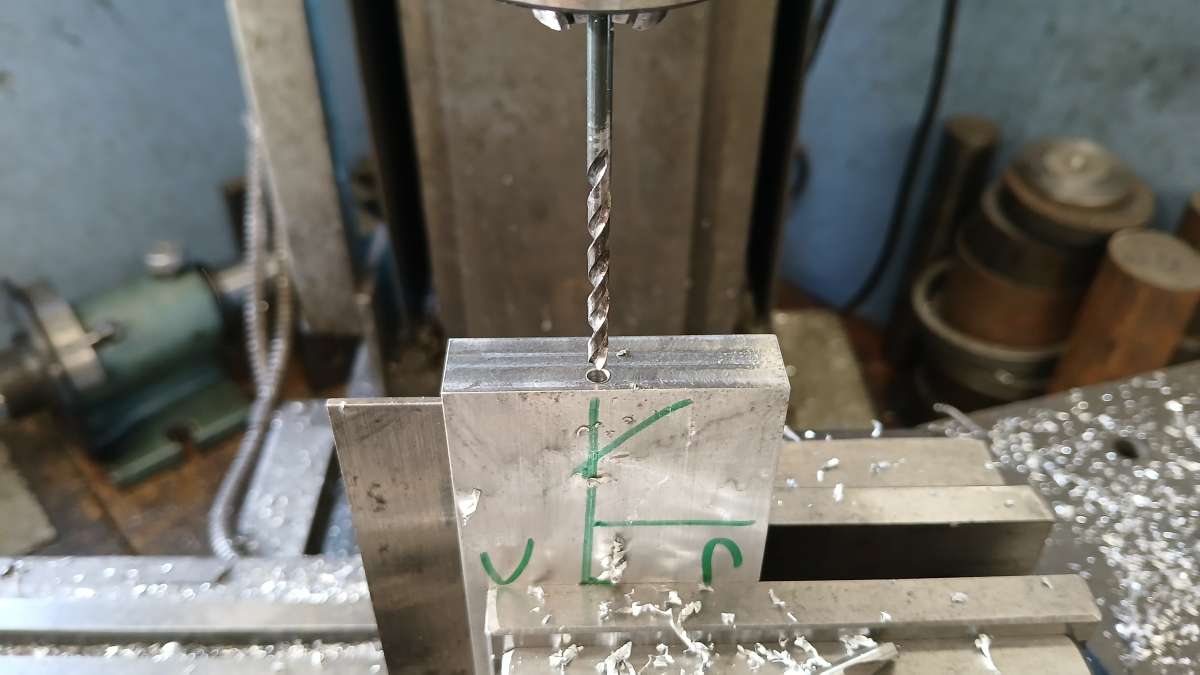
                                The sets of holes are offset 3mm from the centre line so feed the mill table 3mm away from you and lock the slide. Taking the horizontal hole first hold the work with the left end upwards and the bottom against the stop. Fit a spot drill and move over 22.5mm from the stop and make a divot, swap to a 3mm drill and drill to 50mm deep. You may need to slide a bit more drill shank out of your chuck as the hole gets deeper but it should be OK just keep well lubricated and retract the drill often to clear the swarf.

                                20251108_135033

                                20251108_135724

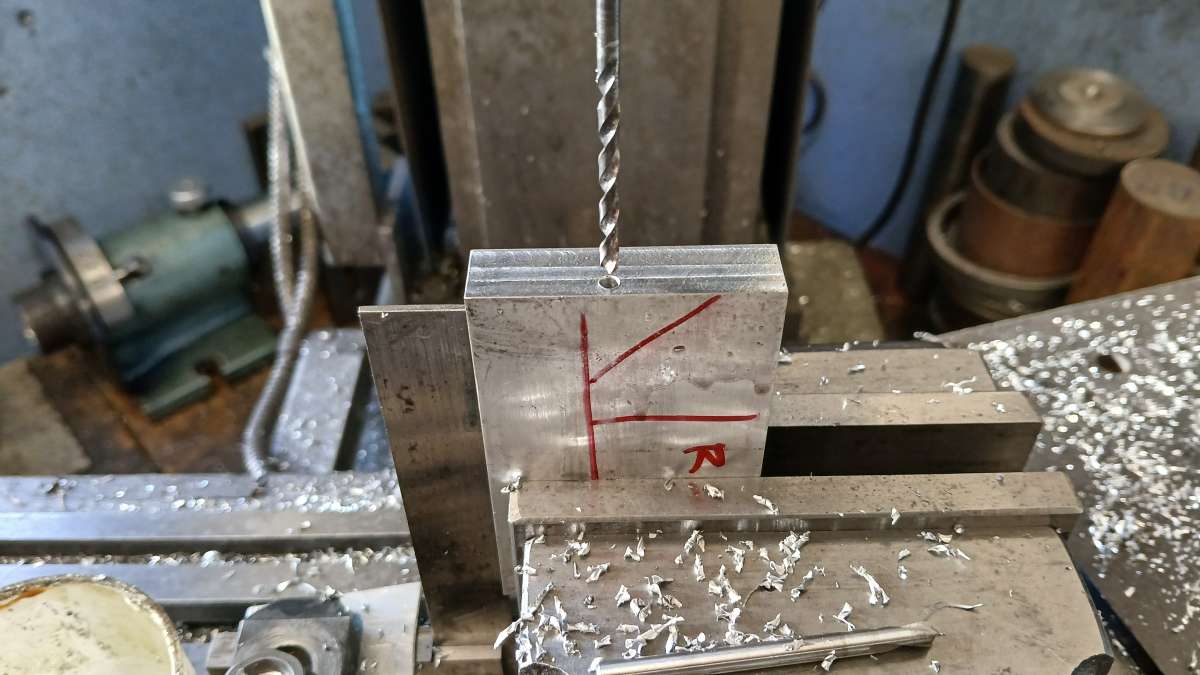
                                You can now flip the work over keeping the bottom edge against the stop and repeat for the other hole.

                                20251108_140303

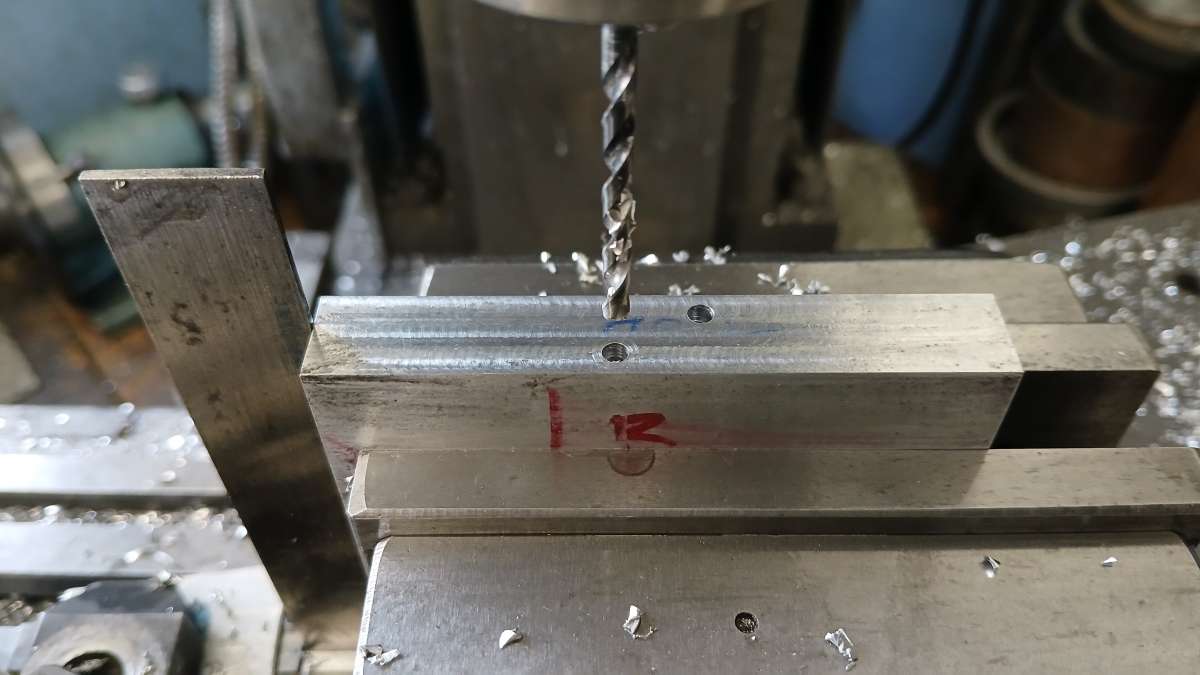
                                The two holes in the top can now be done in a similar way setting over 34mm from the stop, spot drilling, then 3mm down until you feel the drill break into the previously drilled hole. Flip and do the other one.

                                20251108_141312

                                Cont….

                                #825030
                                JasonB
                                Moderator
                                  @jasonb

                                  …… Cont

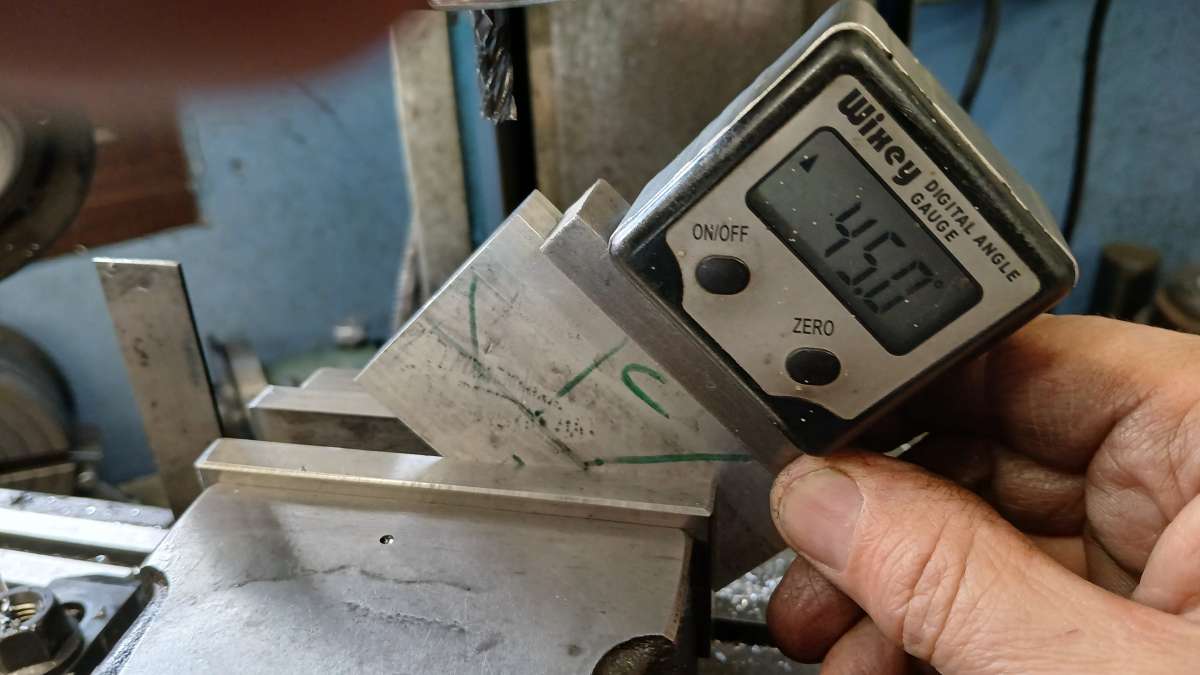
                                  Rather than start the other holes on an angled surface it will be easier if the two top corners are milled to 45degrees first. Set the work in the mill vice using something to set the angle. I am using a digital angle block but a set square out of a school geometry set will do.

                                  20251108_141747

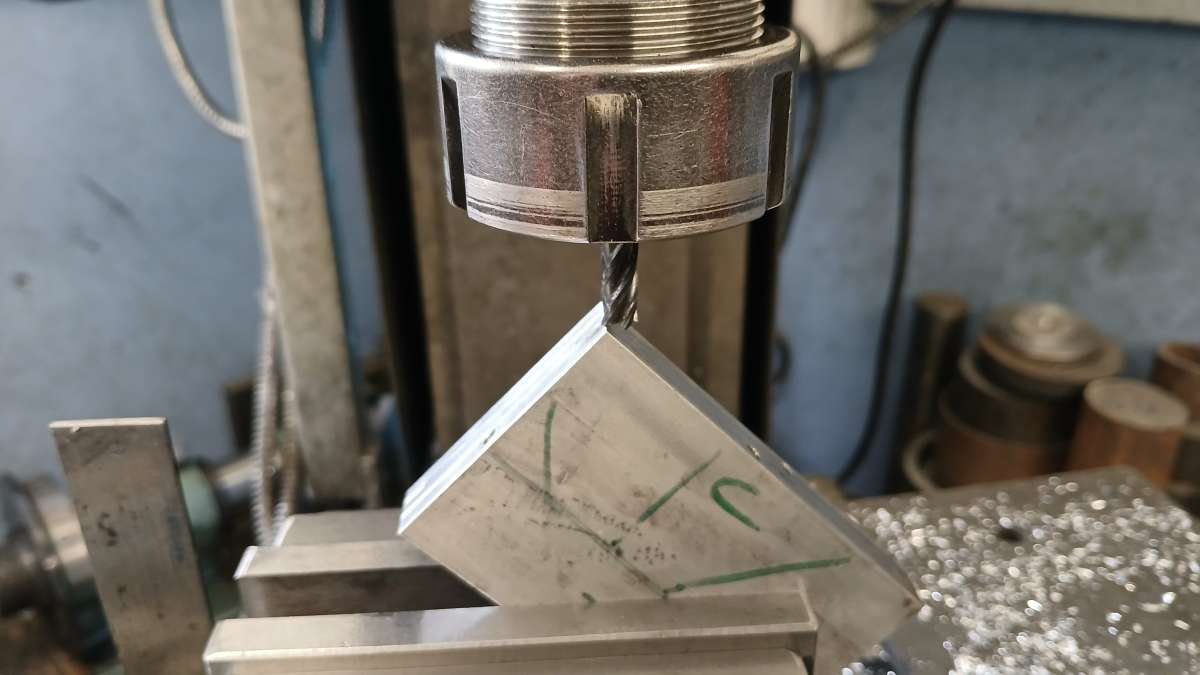
                                  Load the 6mm milling cutter again and bring it down so that one of the teeth just touches the corner and zero the height scale.

                                  20251108_141832

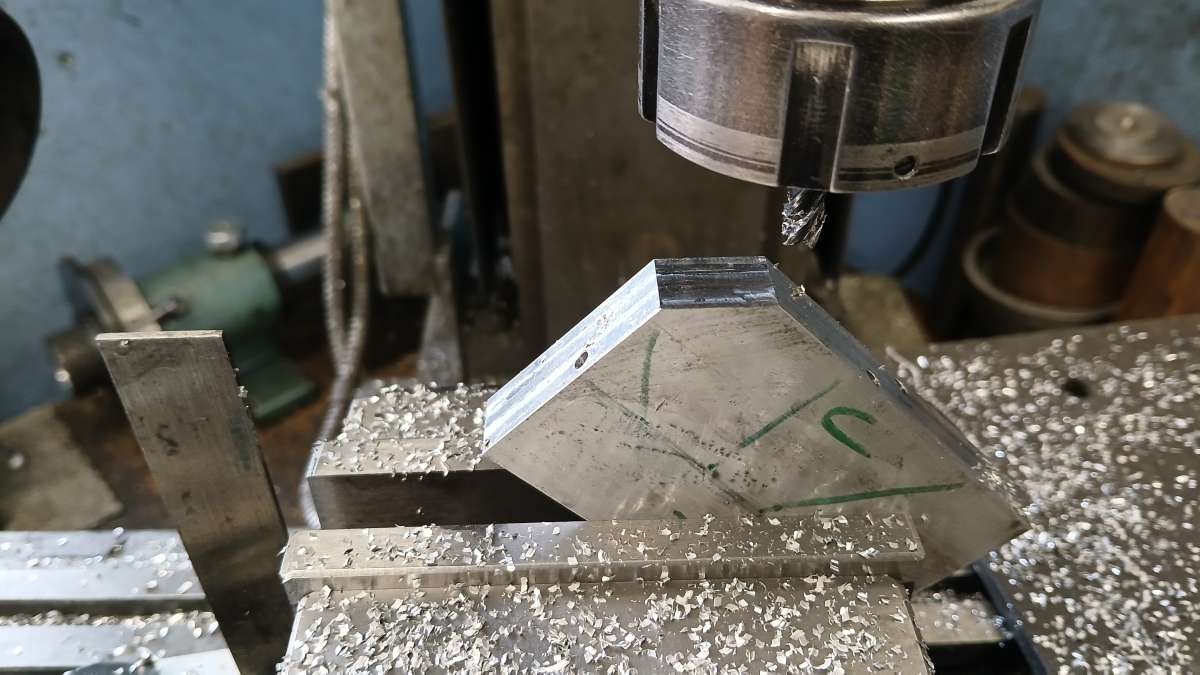
                                  The top corner can now be milled flat to a depth of 8.1mm, I did in in 2mm passes then a final 0.1mm finish pass. Repeat for the other corner

                                  20251108_142227

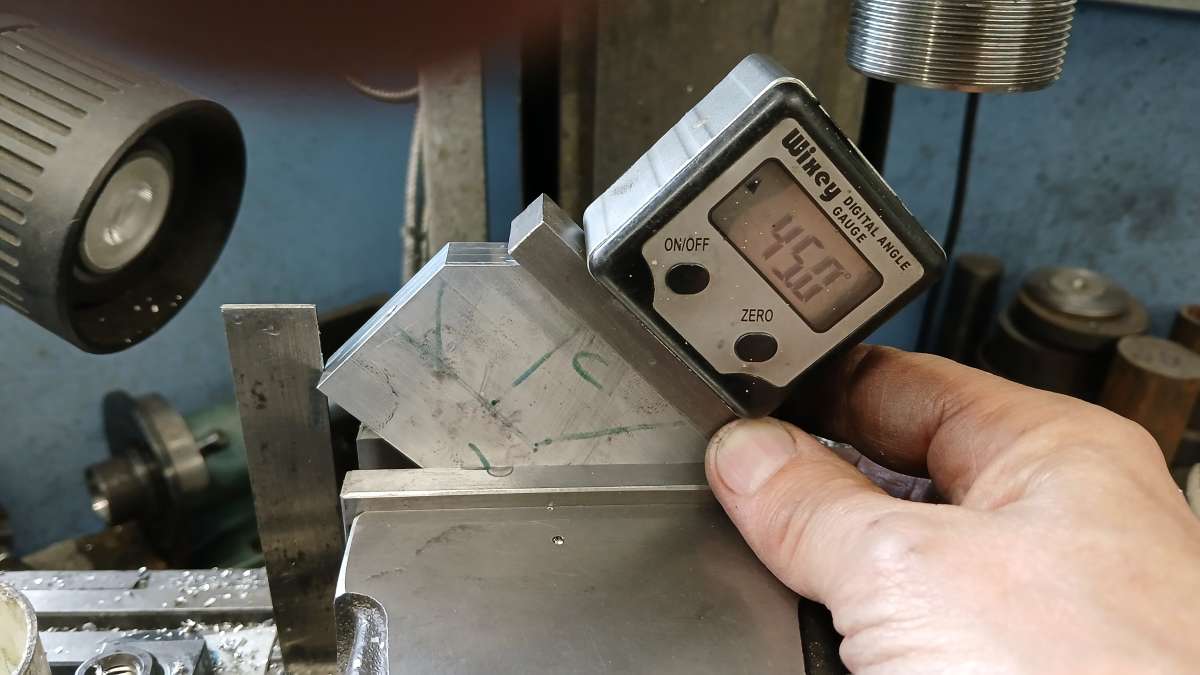
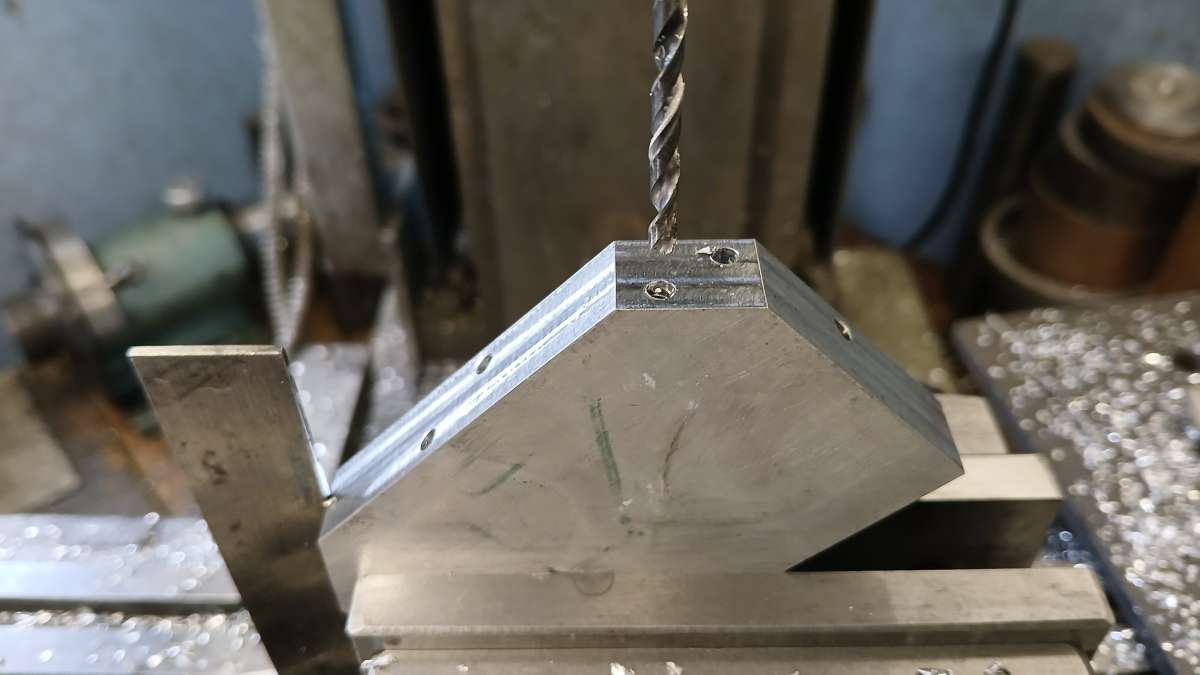
                                  Reset the work at 45degrees but this time with the bottom corner also touching the stop. Relocate the 3mm offset position which you made a not of the handwheel setting for and come sideways 30.9mm. Spot and drill 3mm until you feel the holes meet, repeat for the other side by flipping the work front to back.

                                  20251108_143128

                                  The last pair of holes are done again by mounting the work at 45degrees but this time with one of the angled faces against the stop. sideways offset is 44mm, repeat for the other side.

                                  20251108_144859

                                  Next time I’ll cover drilling the other holes that come in from the front and rear faces.

                                  20251108_145806

                                  #825563
                                  JasonB
                                  Moderator
                                    @jasonb

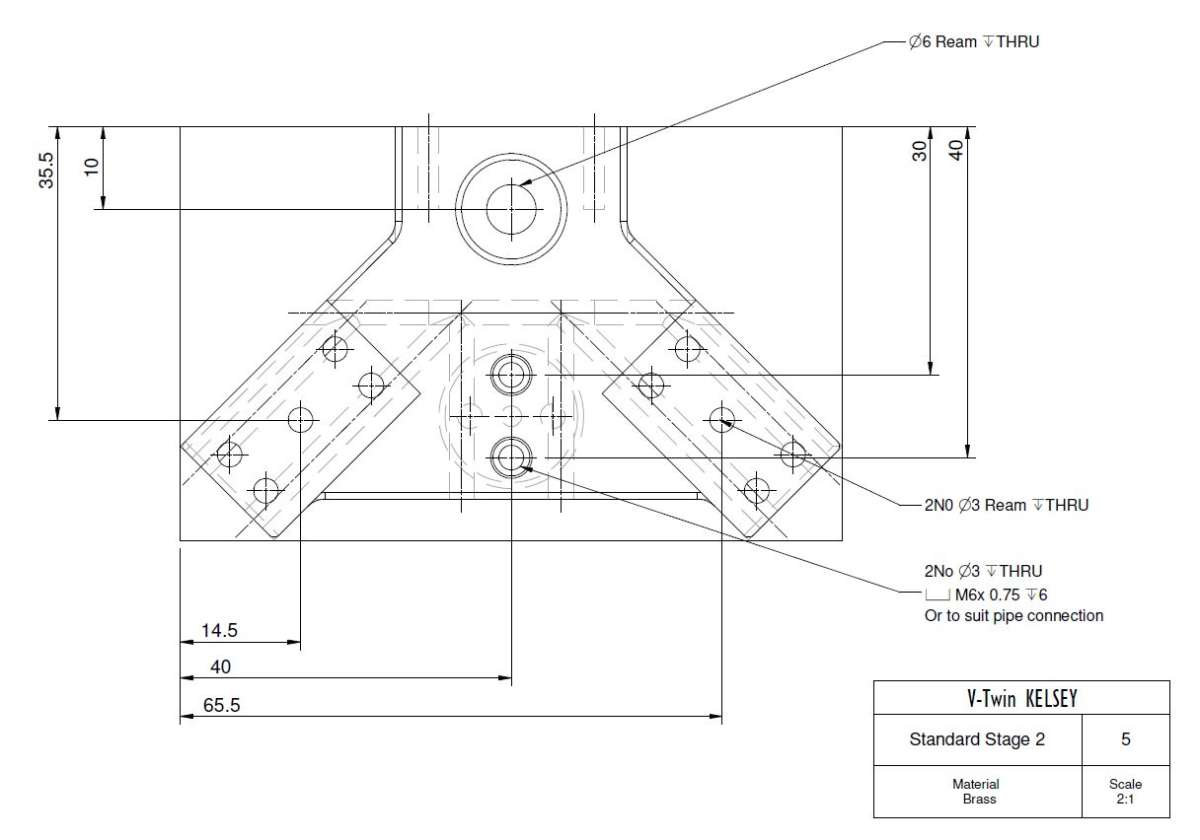
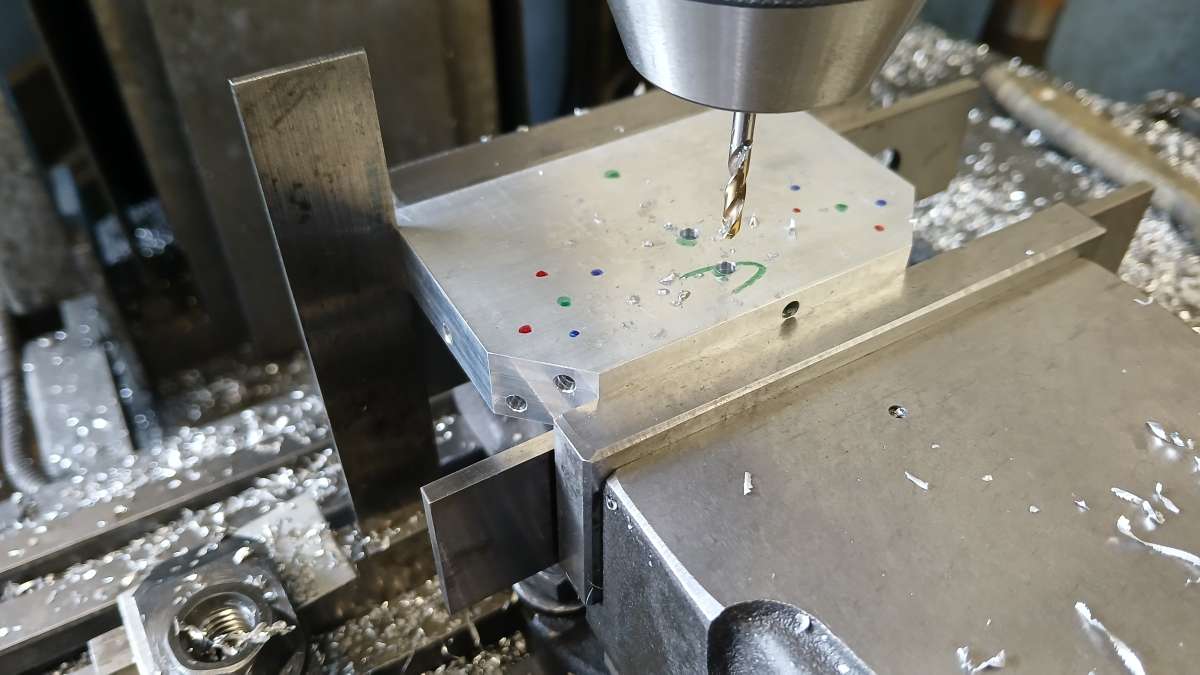
                                    Drawing No5 shows the second stage of drilling the standard and details the holes that pass right through. To keep an easy corner to indicate from and use as a datum, I have oriented the drawing upside down. I also marked up my drawings and the metal with some Sharpies to help keep track of what holes went where.

                                    v twin no 5

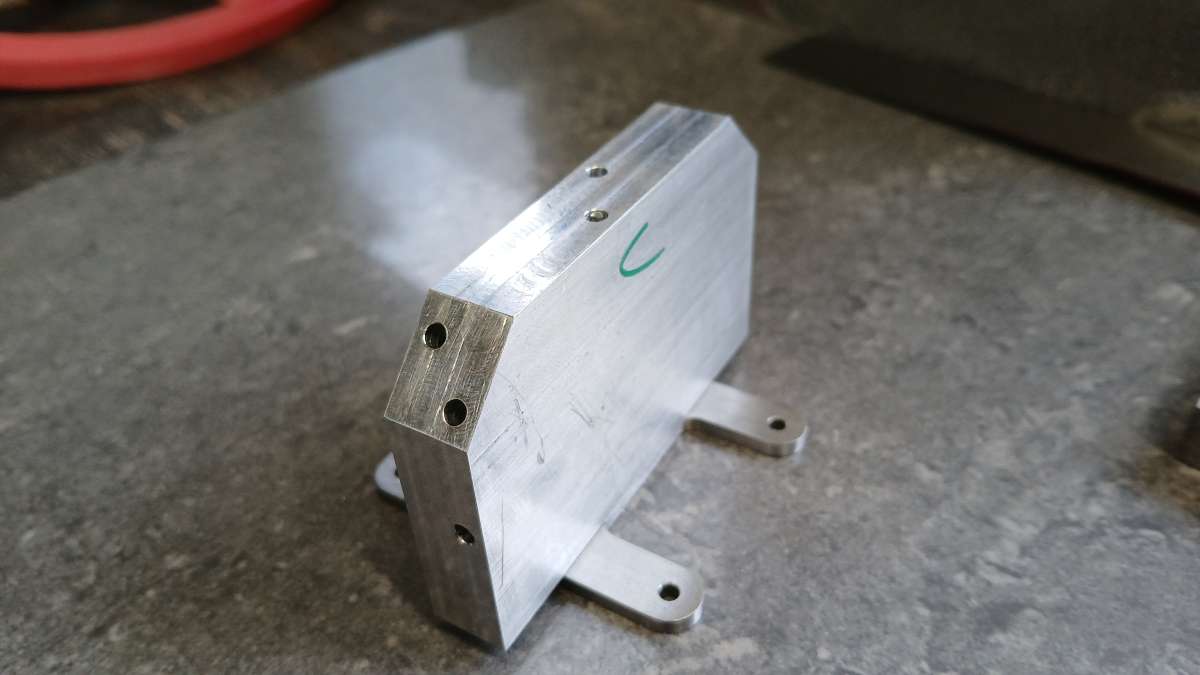
                                    So hold the part in the mill vice packed up on parallels and locate the far side and left hand end as before, zero the handwheels or DRO and position a stop. Move across 40mm to the cr line of the part then up 30mm, spot and then move up to 40mm and spot again. Change to a 3mm drill and drill right through at those two positions.

                                    20251109_092408

                                    These two holes are the steam/air inlet and exhaust so need to be threaded to suit whatever connections you intend to use. Off the shelf nut and nipple unions are likely to be 1/4″ x 40 or 32tpi ME if bought in the UK, Europe is more likely to use a fine metric thread such as M6x 0.75 which is what I have shown. But anything no larger than 1/4″ will be OK. Counter bore the two 3mm holes with the required tapping size drill to a depth of approx 6mm and thread the holes, use 5.3mm for the M6x 0.75.

                                    20251109_093209

                                    The crankshaft runs in a hole 10mm up from the datum edge so spot and then drill that preferably 5.8mm followed by reaming to 6mm but a good sharp drill would do at a push  if you don’t have a reamer and are making just for occasional display runs. My hole is a bit bigger at 8mm as I’m going to fit a bronze bush into the aluminium.

                                    20251109_093904

                                    The last two hole at this stage are for the cylinder pivots, locate the positions from datum, spot, drill 2.8mm and ream 3mm though again a 3mm drilled hole would do.

                                    20251109_094427

                                    #825565
                                    Dalboy
                                    Participant
                                      @dalboy
                                      I like the idea of different coloured pens for marking out the various holes or direction of holes so that it makes it easier to keep track of them all.

                                      #825568
                                      JasonB
                                      Moderator
                                        @jasonb

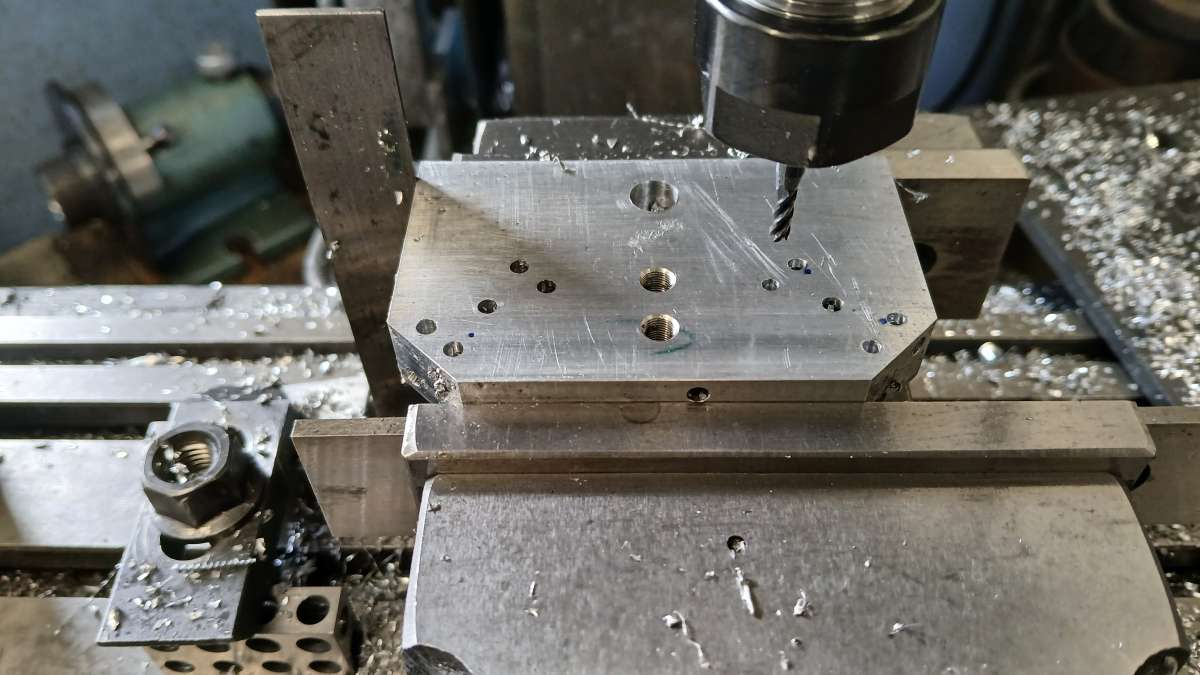
                                        Drawings 6 & 7 show the 3mm holes in the port faces. These are located in the same way as before, spotted and then I would suggest drilling at 2.5mm dia initially and then going back over the positions with a 3mm milling cutter to take them to the final size. This is more likely to see them end up in the correct position as there is a slight chance that if drilling straight in at 3mm the drill may get pulled over as it breakes into the passage which is offset to the side.

                                        I have shown depths which correspond to if the holes meet the passages towards the upper surface or the ones at the back so just check you have them right. You will feel when the drill has met the passage which is likely to be less than the depth shown but  don’t go any deeper than the indicated depths, particularly the 10mm ones.

                                        20251109_121506

                                        20251109_122228

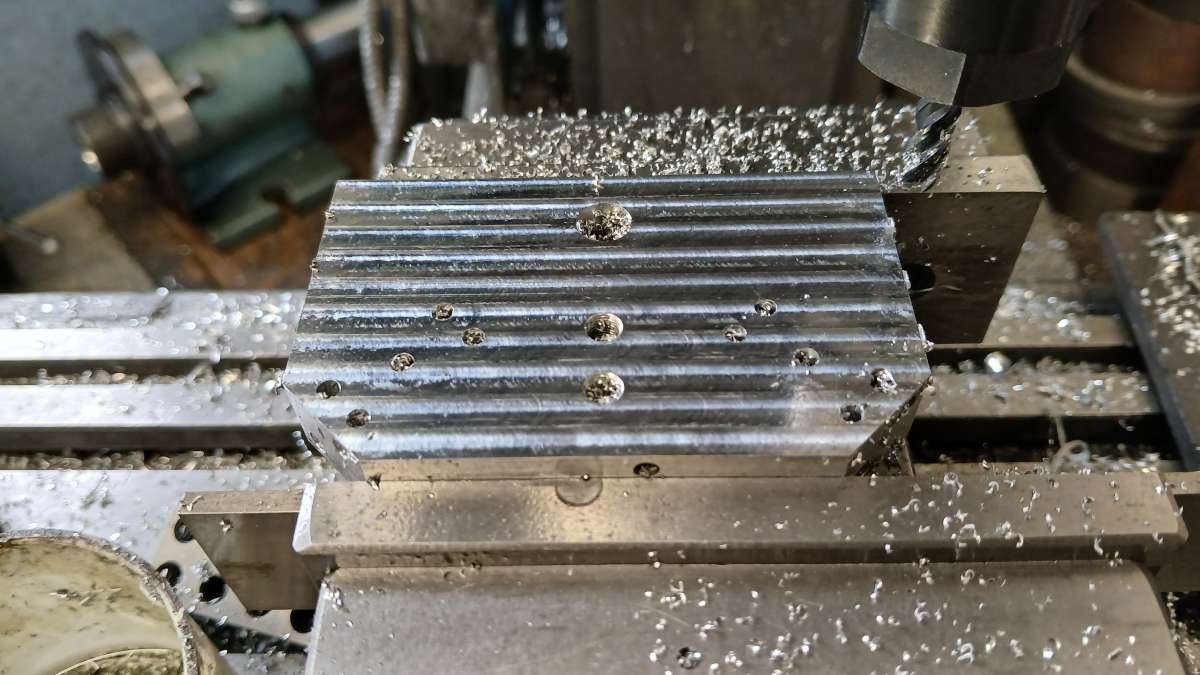
                                        To ensure that the port faces are square to the holes drilled at this setup the face can now be milled back to it’s final size. Check the thickness of the bar stock, deduct 12mm from that and then divide by 2 to give ho wmuch to take off this side. Mount a 6mm milling cutter, touch the surface and zero the Z dail, raise the cutter and move clear of the work. Lower the cutter to your worked out depth and take a series of cuts across the surface to clean it up.

                                        20251109_141439


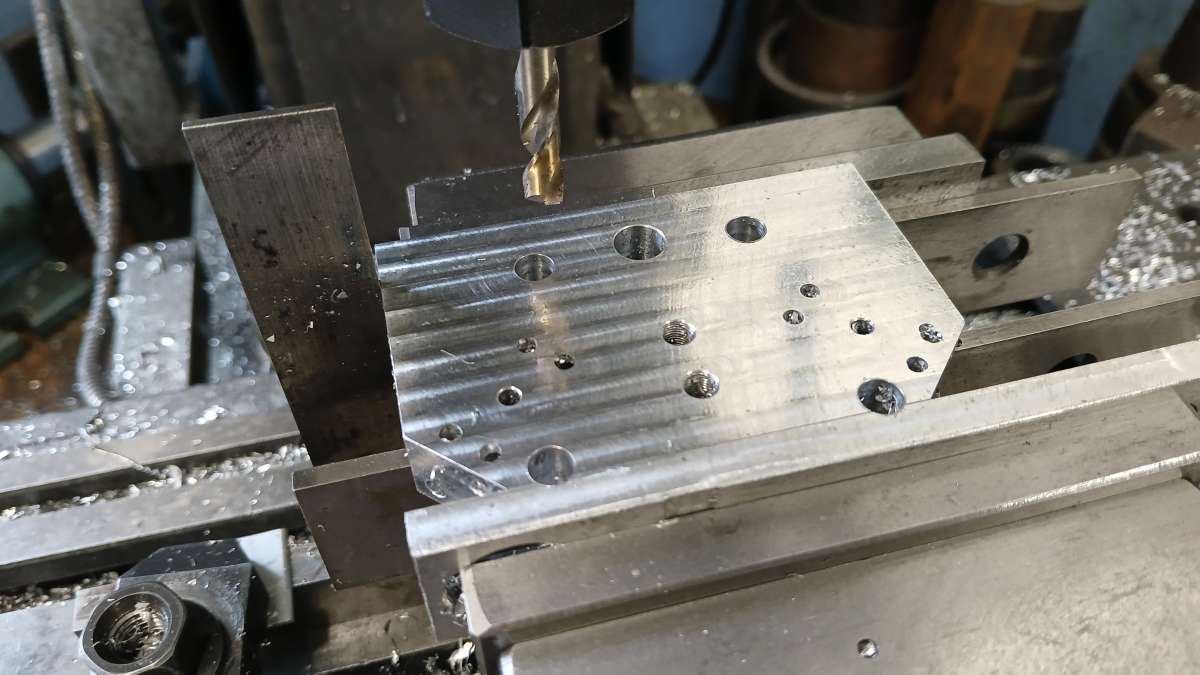
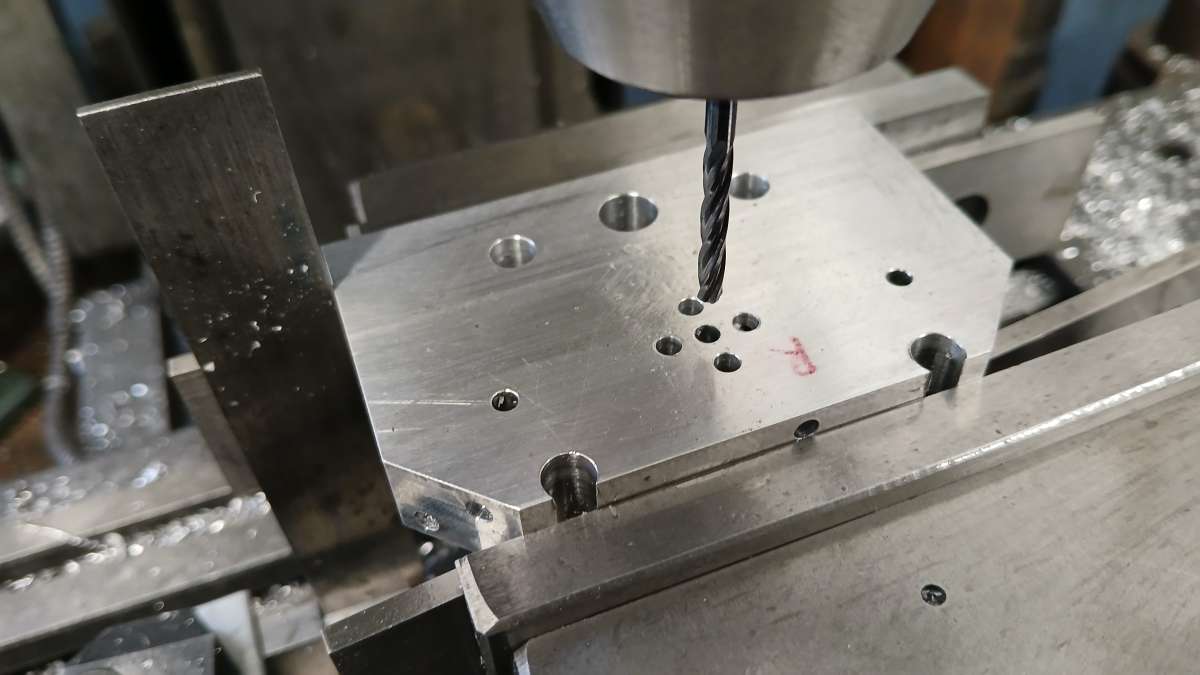
                                        Drawing No 8 shows the centre position of four 6mm holes which form the radii on the internal corners, these can just be spotted and drilled right through 6mm. As the two holes at the top of the engine will break out the edge place a piece of similar material between the work and the vice jaw. Alternatively a shorter piece of anything could be used between the two holes and after drilling say  3mm pilot holes they could be opened up to 6mm by plunge cutting with a milling cutter

                                        20251109_142903

                                        Lastly when you remove the work from the vice don’t deburr the eight steam port holes as a crisp edge is needed to ensure the steam/air flows at the right cylinder positions, the others can be deburred.


                                        #825749
                                        JasonB
                                        Moderator
                                          @jasonb

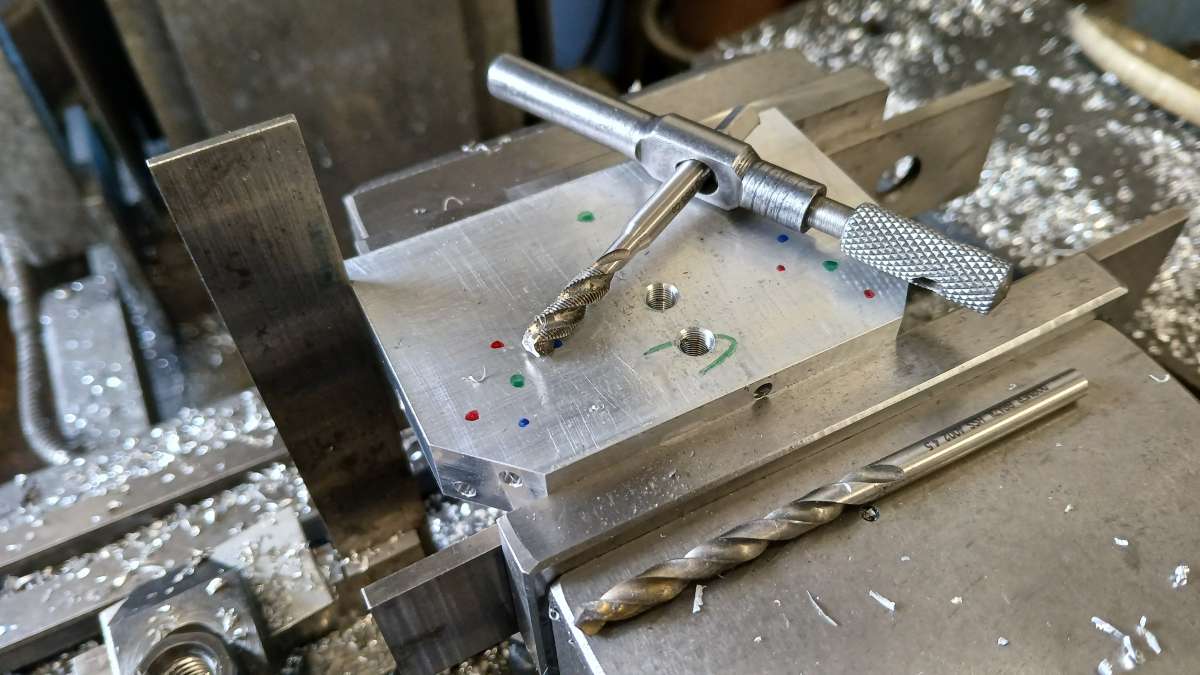
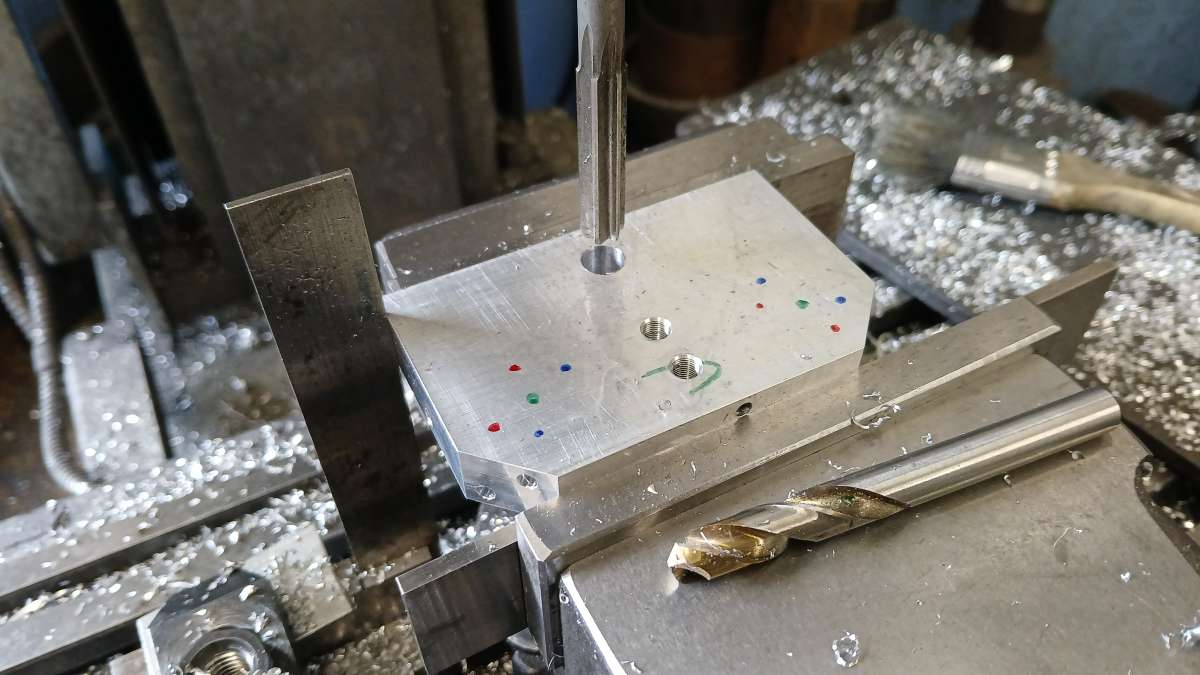
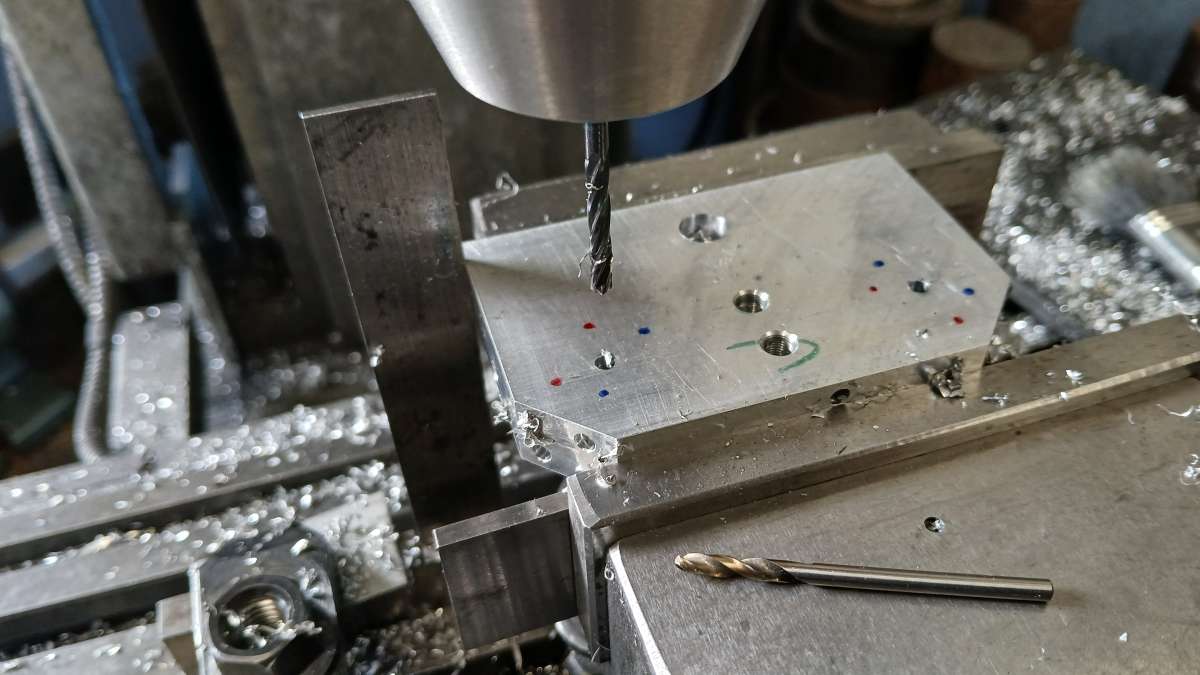
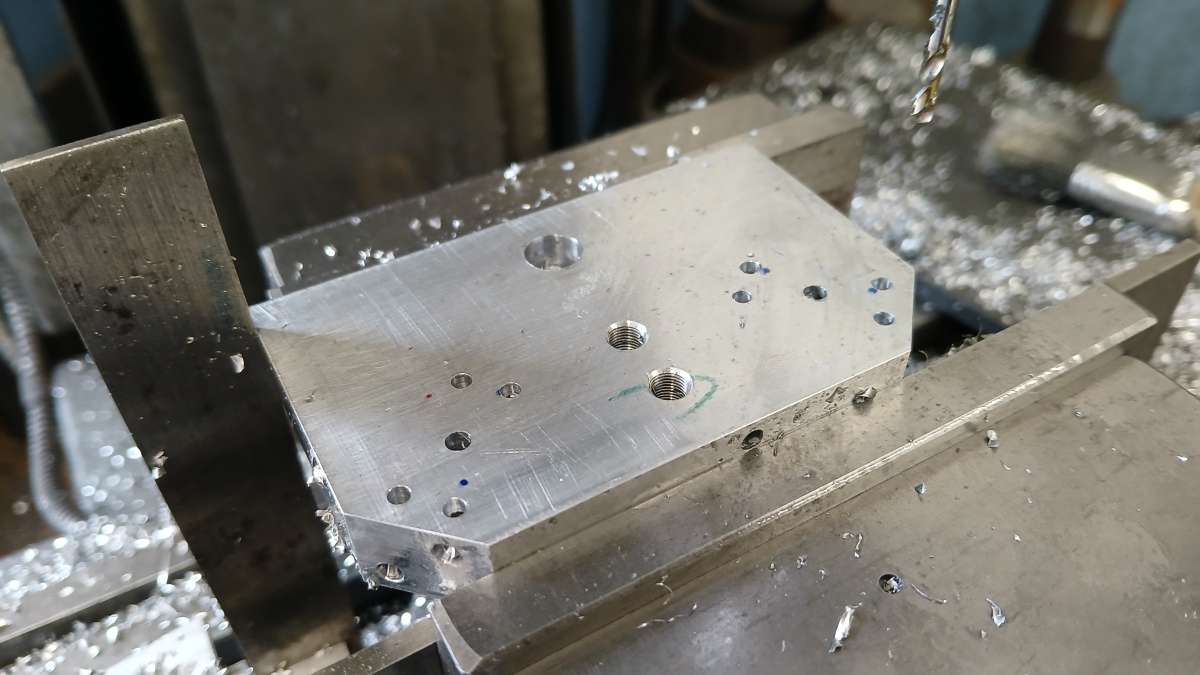
                                          The final few holes are drilled from the other side so turn the part over and locate against the stop, move 35mm in Y and 40mm in X. Spot, drill 2.5mm for a depth of 8mm and then tap M3 using the tap guided so that the hole is as true as possible.

                                          The two 3mm holes can be spotted and drilled 3.0mm to the required depth to meet the passages

                                          20251110_134444

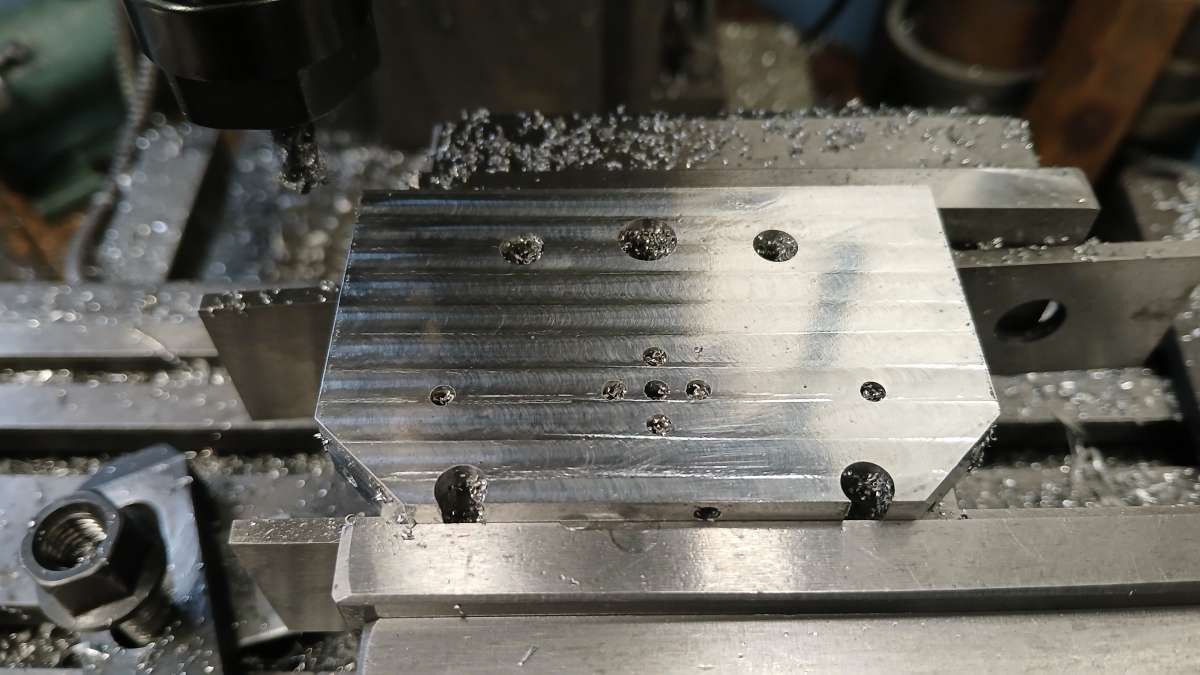
                                          Much like the other side this one can now be milled all over to bring the part to the final overall thickness of 12mm and thus ensuring the regulator face is suare to the hole for it’s pivot shaft.

                                          20251110_135447

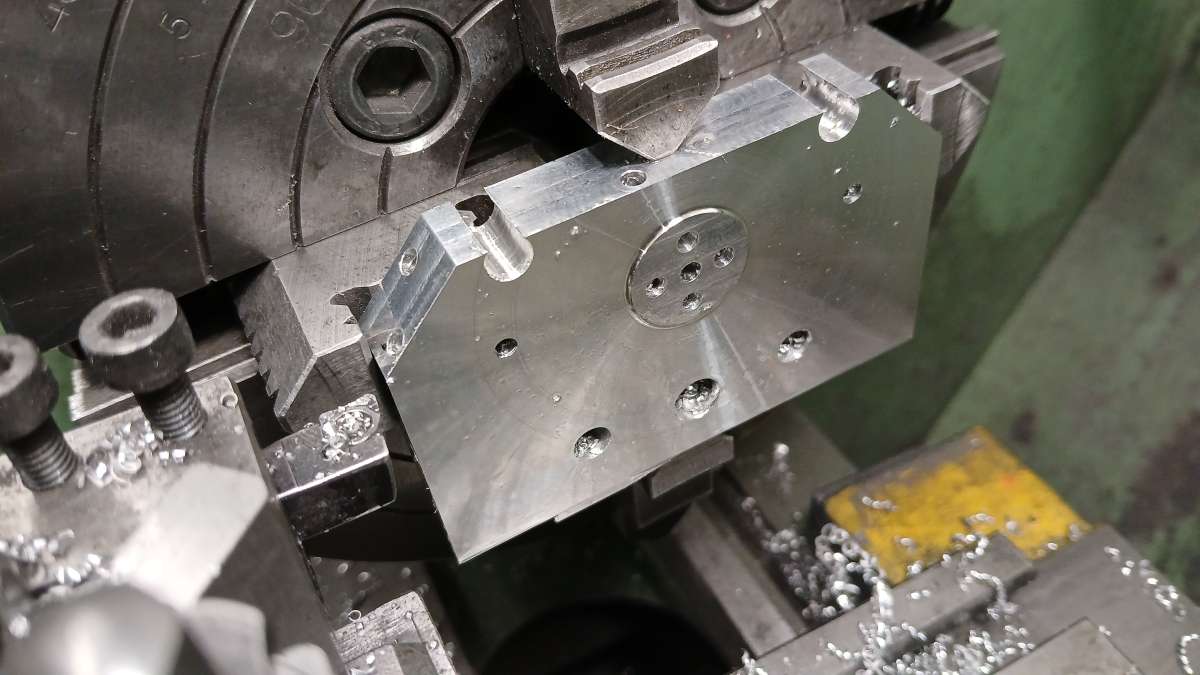
                                          At this stage the builder has the option to just leave the whole standard at 12mm thick or reduce the thickness to leave just the cylinder and regulator contact areas and a ring around the crankshaft hole proud of the surface. This is how to go about the machining if you choose the second option.

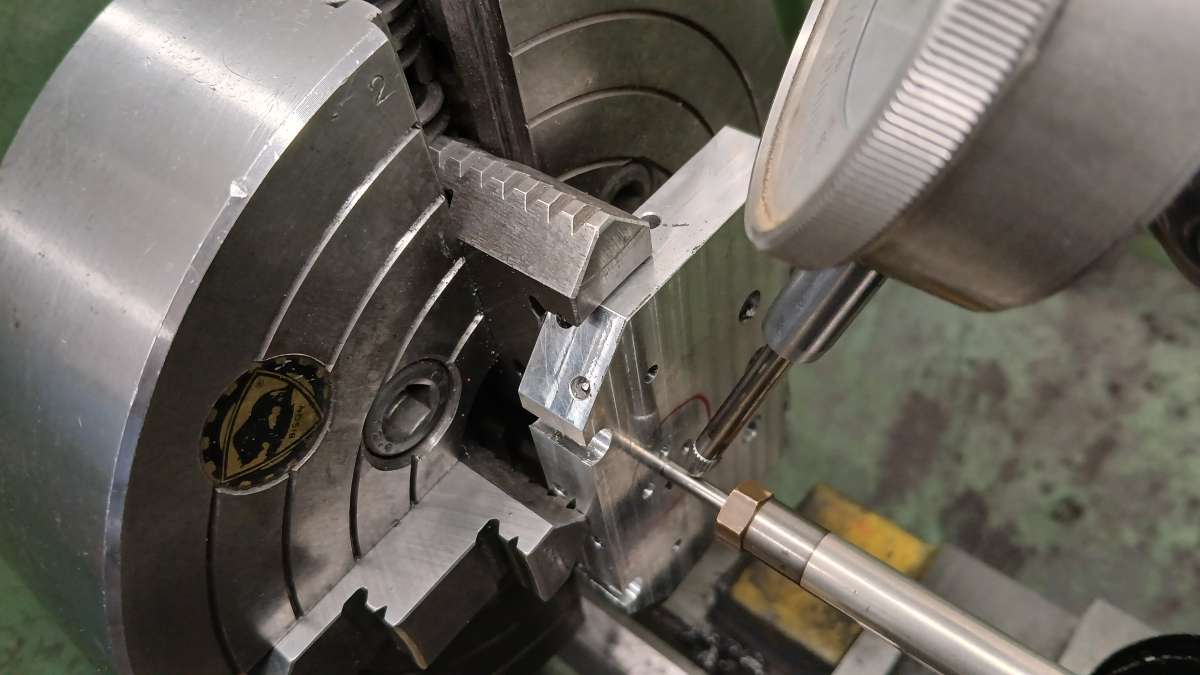
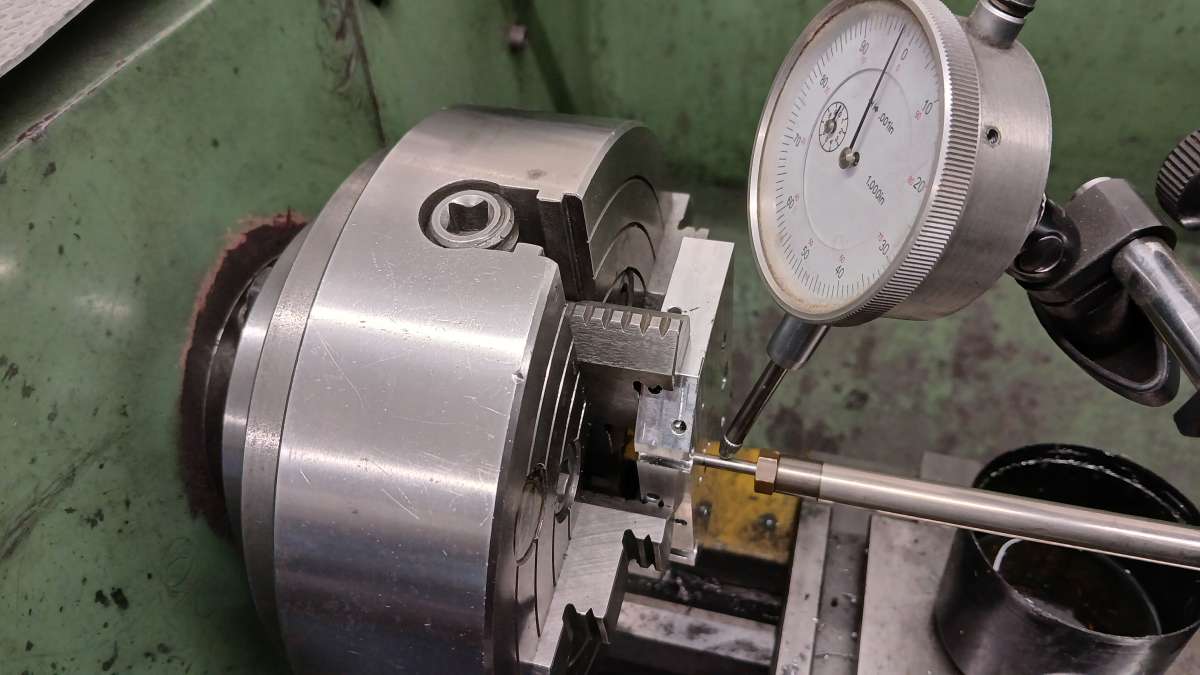
                                          Starting with the easier regulator side first mount the job in teh 4-jaw chuck and set the regulator pivot hole to run true. I’m using a sprung centre in teh hole but the long length of 3mm material on teh BoM will also do. Rest the Dial indicator anainst the end of teh rod and rotate the chuck by hand making adjustments to the jaws until th eneedle hardly moves. The work is resting against the two reversed jaws so that will stop any wobble affecting teh readings and also the thickness of teh cuts.

                                          20251110_140838

                                          20251110_140844

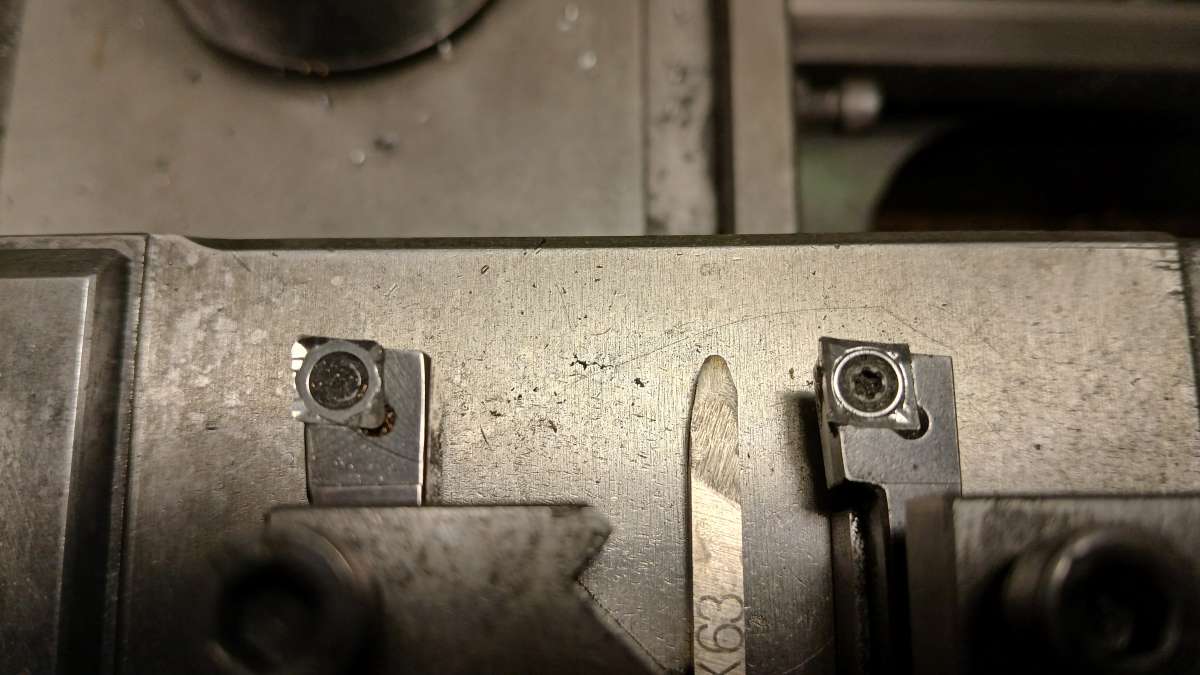
                                          A standard turning tool can be used (right) but if you really want that “cast look” then something with a bit more radius to leave a filler in the corners works best. Either a HSS tool ground with a rounded end (middle) ort an insert with more corner radius such a sthe one shown with 0.8mm radius (Left)

                                          20251110_141403

                                          Touch the tool against the face of teh work and zero the cross slide dial, move clear and start the lathe.

                                          20251110_141522

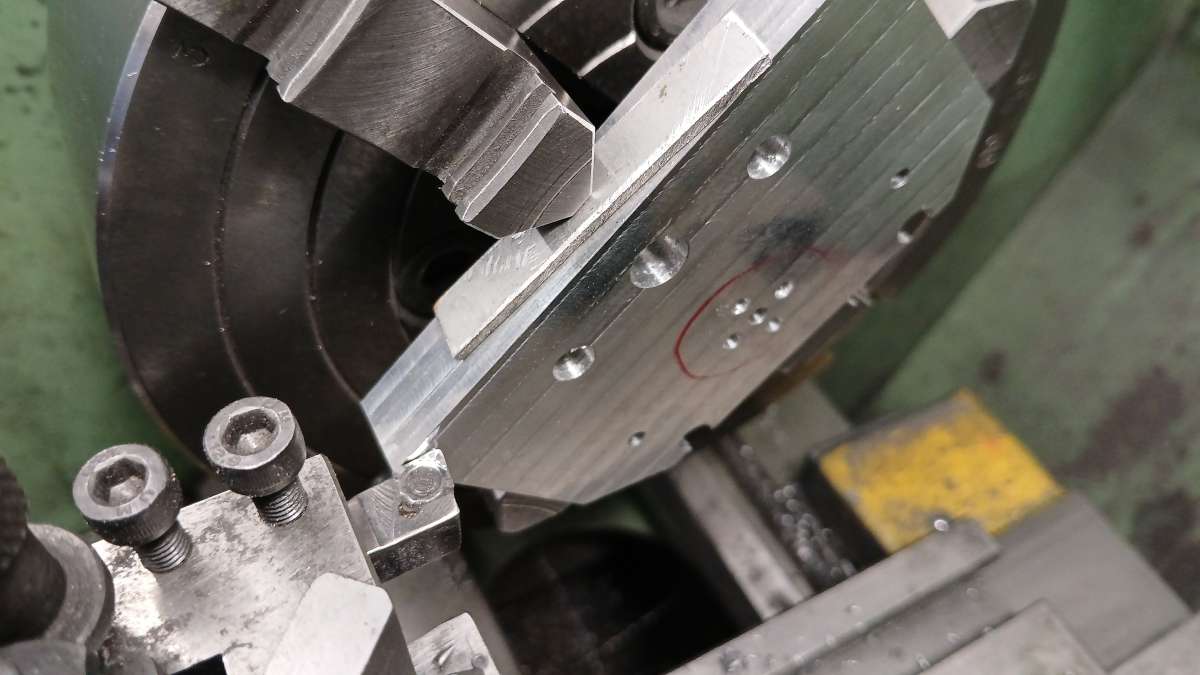
                                          Feed in the top slid 0.5mm and start facing the work, stop as you get near the 17mm diameter and zero the cross slide dial. Take a measuerment and work out how much more needs to come off then start the lateh again and using the handwheel dial take what was needed off.

                                          20251110_141935

                                          Back out the tool and put on the final 0.25mm depth with the topslide and take one smooth cut right upto the 17mm dia edge.

                                          20251110_142318

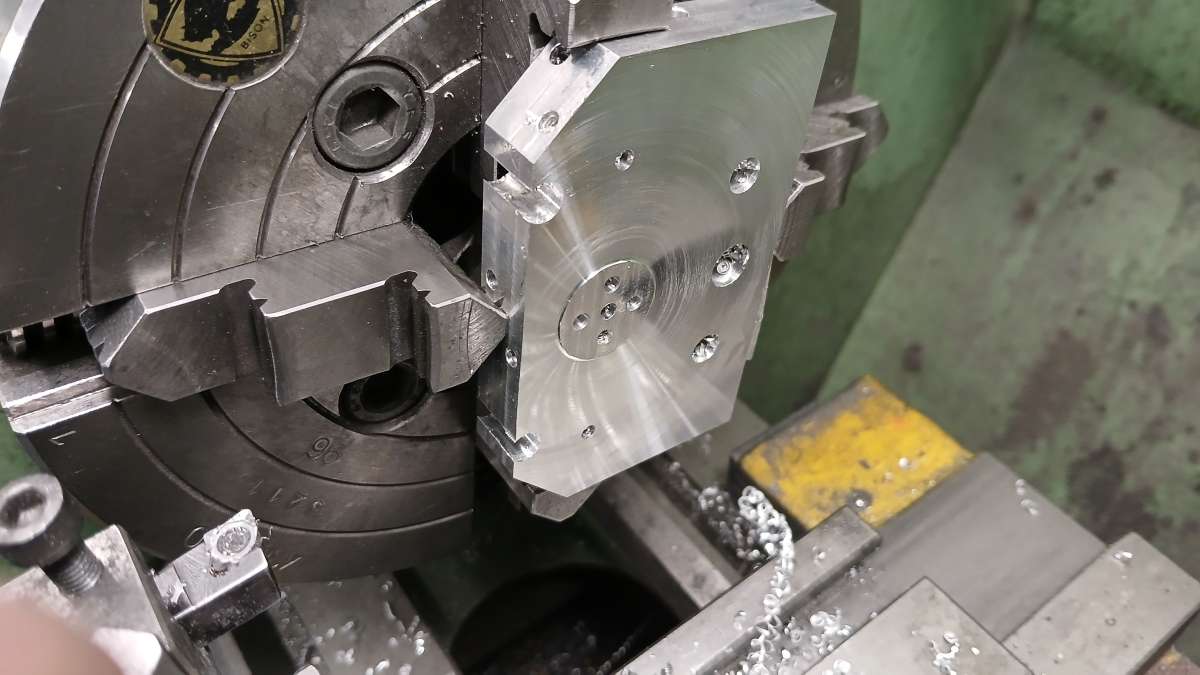
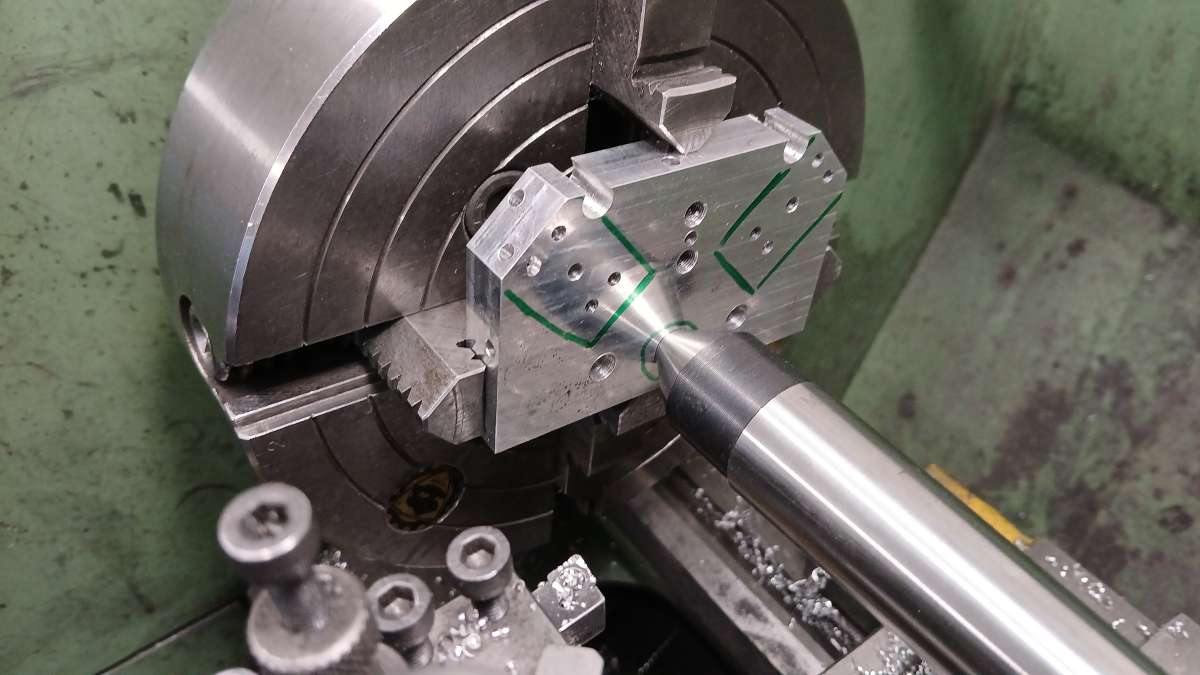
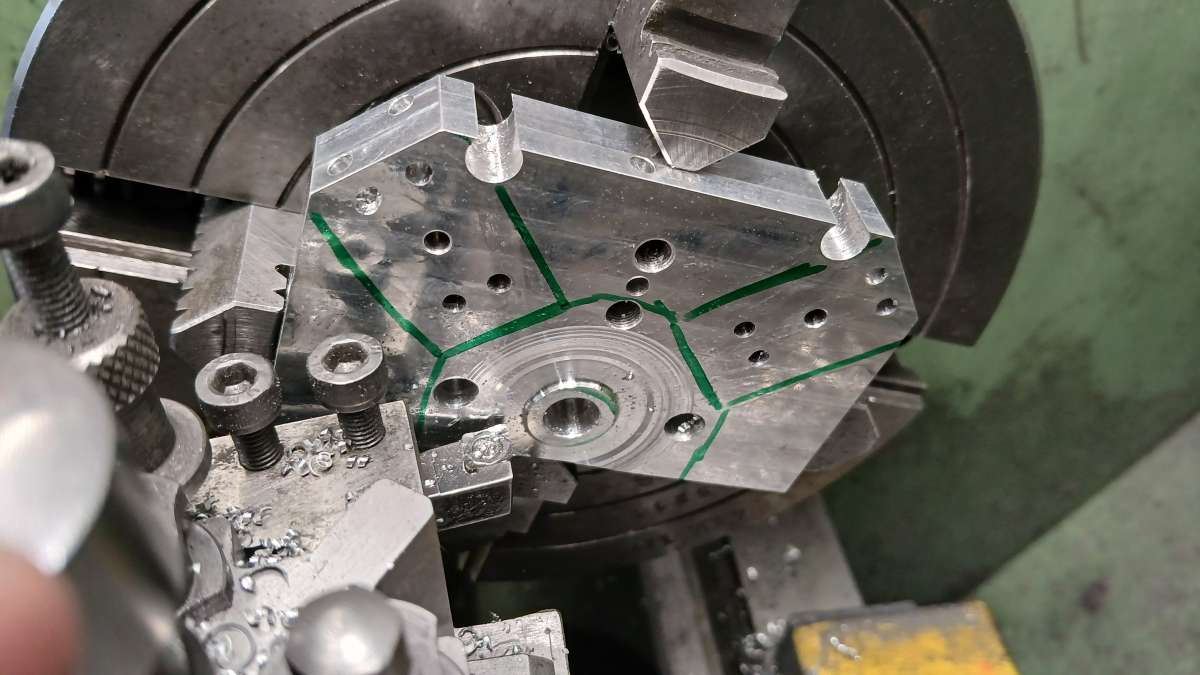
                                          The other side is set up in a similar way getting the crankshaft hole to run true, as the hole is larger I use a morse taper centre in the hole with it’s “blunt” end supported by the tailstock centre. Put a couple of Sharpie marks about 28mm from the diagonal corners as the turning wants to stay within those lines.

                                          20251110_143108

                                          Swing teh tool around a bit and this time have the work turning as you put on the two cuts while at the same time feeding in with the cros sslide, this will “ramp” the cutter down to depth. You can see I have an area 4-5mm wide all around the 12mm raised boss.

                                          20251110_143512


                                          To be continued.

                                          Any questions, comments,etc or am I talking to myself?


                                          #825755
                                          Dalboy
                                          Participant
                                            @dalboy
                                            On JasonB Said:
                                            Any questions, comments,etc or am I talking to myself?
                                            I certainly have been following and have made a couple of comments, even if they are only simple comments.


                                            #825806
                                            JasonB
                                            Moderator
                                              @jasonb

                                              Must admit I had missed your second comment as it fell between two postings and we don’t get the warning hear that other posts have been made while typing. Though we don’t seem to get many comments on builds here a syou probably know from your own posts.

                                              As i don’t mark out much the sharpie marks can help to know you are in the right sort of position, I was also working from a preliminary drawing with all the holes on it so a lot easier to make a mistake.

                                              But I try to put a few tips and reasons why I do things the way I do into these builds in the hope they will be useful to others. Sometimes I have to think twice as there is little point in my using tools that a lot of beginners may not have so need to go back to basics. If it were not for that I think the engine may be running by now but it’s not far off.

                                              #825809
                                              Adrian R2
                                              Participant
                                                @adrianr2

                                                Watching along, splendid first build and guide for anyone getting into the hobby. Comments:

                                                1) Noted that you used some packing to drill the overlapping holes at the edge and not your vice jaw.

                                                2) Bushing the crankshaft hole seems like a good idea, nicer to not run steel in aluminium even noting previous comments on durability. It’s also a good recovery strategy if you drill and end up with a sloppy fit as you could then make a top hat and loctite in and no-one would be any the wiser.

                                                #825810
                                                JasonB
                                                Moderator
                                                  @jasonb

                                                  Thanks I forgot to mention about the packing, will go back and add something.

                                                  #825830
                                                  Mark Easingwood
                                                  Participant
                                                    @markeasingwood33578

                                                    I am dipping in to this build.

                                                    Although as a non-experienced machinist, or engine builder, I don’t often feel qualified to comment on other peoples builds.

                                                    I have almost completed my fourth engine tho’, which happens to be a JB design. I just need to get some pictures and video of engines no. 2 & 3, and post them on the forum

                                                    Mark.


                                                    #825836
                                                    JasonB
                                                    Moderator
                                                      @jasonb

                                                      If they look as good as your other one then it will be worth the wait!

                                                    Viewing 25 posts - 1 through 25 (of 119 total)
                                                    • Please log in to reply to this topic. Registering is free and easy using the links on the menu at the top of this page.

                                                    Latest Replies

                                                    Home Forums Stationary engines Topics

                                                    Viewing 25 topics - 1 through 25 (of 25 total)
                                                    Viewing 25 topics - 1 through 25 (of 25 total)

                                                    View full reply list.