Ex-MIG Welder Gas Cartridges: Use Of

Ex-MIG Welder Gas Cartridges: Use Of

Home Forums General Questions Ex-MIG Welder Gas Cartridges: Use Of

Viewing 25 posts - 1 through 25 (of 27 total)
  • Author
    Posts
  • #818780
    Nigel Graham 2
    Participant
      @nigelgraham2

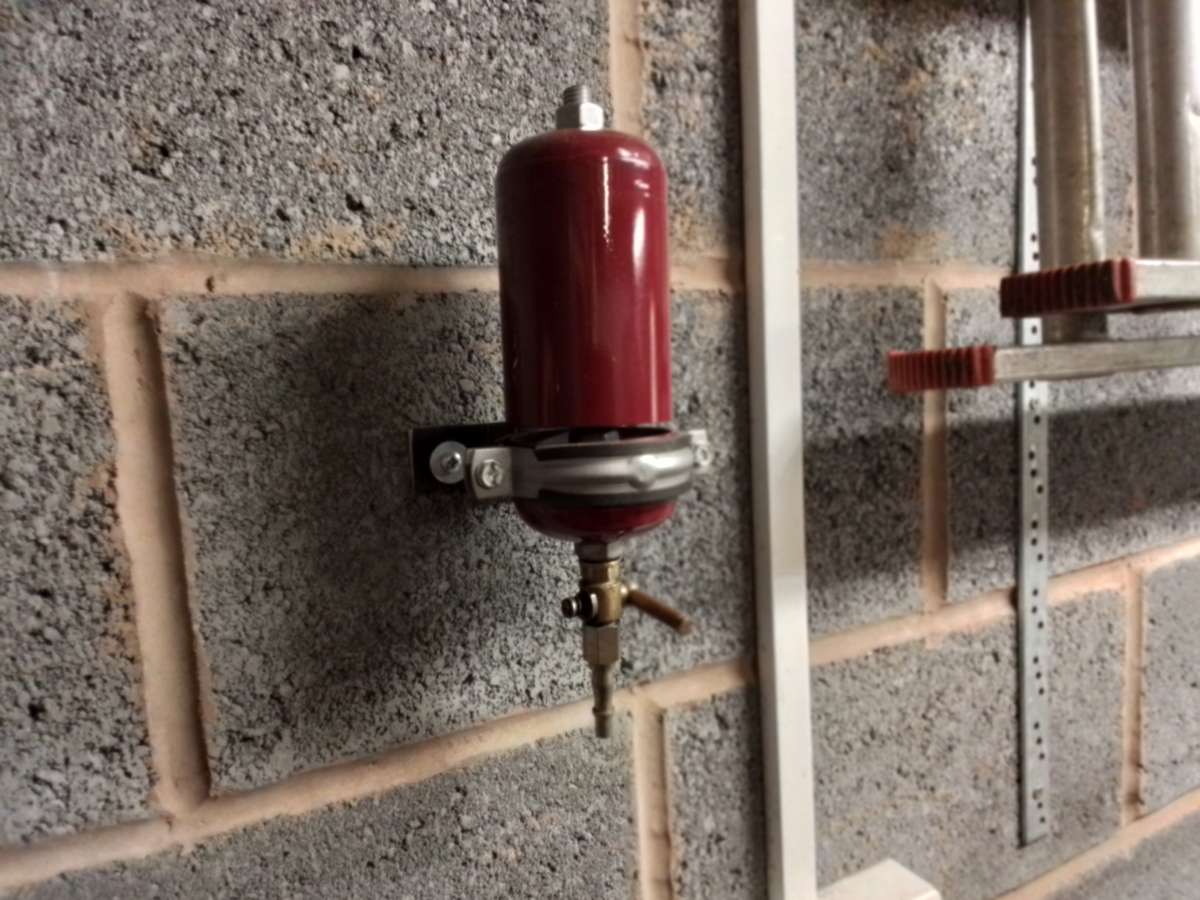
      I have a couple of empty, Clarke-labelled, CO2 cartridges, and now a possible use for one as a vacuum reservoir on a locomotive driving-truck. (Vacuum Reservoir: A tank to hold a lot of nothing!)

      The original welding-set had expired after long and sometimes hefty use, even unwitting bad use, by various people; but I did not think to retain the screw-on valve.

      The label says empty cartridges must not be refilled but “recycled” with ordinary steel scrap or empty food tins!

      Ideally I’d need remove the valve’s innards, leaving intact the brass bush whose thread I have yet to identify, to accept a purpose-made manifold for the brake system.

      ….

      An alternative is an empty plumbing blowlamp gas cylinder – perhaps better as these have larger bushes.

      …..

      Does anyone have experience of similar, can advise me on either type of cartridge, the valve, its removal or modification, points to note, etc., for such purposes, please?

      #818785
      noel shelley
      Participant
        @noelshelley55608

        Your not the first one to re purpose the disposable gas cylinders ! I have seen it used before for brakes.  Another High pressure cylinder often found is the Nitrous Oxide ones these have a test pressure of many hundreds of PSI. I would remove the valve body, remove the valve and then re thread to suit the new use or silver solder into a boss that will take the thread you need. Good Luck. Noel.

        #818787
        Speedy Builder5
        Participant
          @speedybuilder5

          The little brass fitting does come out, but they are really well stuck in. I had to use large pipe grips to get them out. Perhaps heat from a butane torch would have helped BUT I advise to use a small punch to release any residual gas and then knock the innards of the valve out first.

          Ps, my “recycling centre”  refuses to take these cylinders unless the valve is taken out first or the cylinder cut in two.

          Bob

          #818791
          Diogenes
          Participant
            @diogenes

            Having double-checked that the cylinder is EMPTY, a decent vice will often grip the edges of the valve and enable the body to be unscrewed from it.

            However the little regulators that attach these bottles to cheap welders are usually rubbish and it shouldn’t be hard to find a donor to supply the manifold / threaded bush.

            I think the threads are 1/8 BSP..

            #818792
            Nicholas Farr
            Participant
              @nicholasfarr14254

              Hi, I believe those brass valves are fitted with Thread-Lock, but you can buy those regulators that fit them, but the little pin in the valve will move up and down when they are empty by turning the cylinder upside down, and fall back again when you turn it back. I have welded a BSP socket on to one once after removing the valve, when I used one for relatively low pressure use.

              Regards Nick.

              #818794
              SillyOldDuffer
              Moderator
                @sillyoldduffer
                On Nigel Graham 2 Said:

                I have a couple of empty, Clarke-labelled, CO2 cartridges, and now a possible use for one as a vacuum reservoir on a locomotive driving-truck. (Vacuum Reservoir: A tank to hold a lot of nothing!)

                The label says empty cartridges must not be refilled but “recycled” with ordinary steel scrap or empty food tins!

                … 

                Point to note, there’s a good reason these cylinders should not be refilled.   Cylinder life is determined by both the pressure and the number of charge / discharge cycles it can take.  Disposable cylinders are made of remarkably thin metal because they are single use only.   There is no allowance for metal fatigue caused by charging and discharging cylinders.

                I don’t see much risk in repurposing a 900psi CO² cylinder to hold  a 14psi vacuum –  the metal isn’t flexed much by changes of a few psi and shouldl survive many cycles before cracking.   Conversely very foolish to recycle a disposable cylinder in an diving breathing set: if it fails underwater, you drown.   Likewise, I wouldn’t advise refilling them to 900psi in an air-gun because the cylinder is close to the users eyes, should it go bang.

                The Comet airliner is a famous example of a thin pressurised vessel failing due to pressure cycling metal fatigue.  The cabin skin was just a little too thin, and – worse – penetrated by many stress-raising holes, including square windows.

                Dave

                #818797
                Michael Gilligan
                Participant
                  @michaelgilligan61133

                  Drifting only slightly off-topic … this is a useful document:

                  https://firechiefglobal.com/wp/wp-content/uploads/2022/04/Firechief-Extinguisher-Service-Manual-2022-1.pdf

                  MichaelG.

                  #818803
                  noel shelley
                  Participant
                    @noelshelley55608

                    The current craze for using Nitrous Oxide as a recreational aid has resulted in some high pressure disposable cylinders. These can often be found in parks and other places where people gather(and not just the young). These have a test pressure stamped on the bottle of some 2000psi as I recall or 150 bar. These are quite heavy/thick walled compared to the Co2 bottles and a little larger. I have one or two, if your near me N Norfolk I can give you one.  Noel.

                    #818811
                    Robert Atkinson 2
                    Participant
                      @robertatkinson2

                      Due to recent legislation changes around NO I’d be wary of having a cylinder in the car. At least make sure you don’t have any balloons with it….

                      Robert.

                      #818813
                      Nigel Graham 2
                      Participant
                        @nigelgraham2

                        Thankyou gentlemen!

                        I doubt the NO2 cartridge would help much because it is far too small. I think I do have one somewhere – not an ex-nitrous oxide bottle but it once held compressed air, nitrogen or CO2, to supply a small bouyancy float.

                        A vacuum-brake reservoir’s pupose is to take a fairly large amount of air at low pressure-difference, to accelerate releasing the brakes. The ejector or vacuum-pump then exhausts the reservoir while the train is moving.

                        So it needs an appreciable volume.

                        A pressure-vessel in inherently weaker against external, than internal, pressure but even full brake vacuum gives well under atmospheric-pressure difference. The system already does have a pressure-regulator.

                        (Actually there was a craze in the 19C for high-jinks with that gas, not long after its analgesic – but well before its toxic – properties were discovered.)

                        ….

                        If possible I want to keep the valve bush intact, to use with the valve itself removed. I have some BSP fittings I can use as “thread-gauges” more easily than a regular thread-gauge.

                        I suspect the “No Refilling” is more sales than safety, but clearly no-one wants anyone to try refilling a compressed-gas tin without understanding what they are doing. It also says the gas should not be released into the atmosphere… whence presumably it came.

                        The only practical problem there may be otherwise, comes from Dave’s warning that the wall is very thin. The small pressure-differentials may not worry it but corrosion by internal condensation could. The bottle is made to take just one filling of carefully-dried, inert gas, not soggy atmosphere.

                        So a reservoir made for the purpose may be better. Given the low pressure differential and necessarily modest diameter, this could even be of a rigid plastic like PVC, though external pressure calculations are much more subtle than the standard ones for internal pressure, by involving the length.

                        Indeed this reminds me I already have a potential vessel made of PVC, about the size of a blow-lamp gas bottle, and made to take more than a vacuum-brake’s external pressure difference. It was a scrap-bin find, originally part of some marine-equipment experiment or other.*

                        Nor would it hard to make a vacuum-vessel test-tank that can be connected to the club’s boiler pressure-test set, and intended not to exceed 30psi at twice w.p.


                        ;;;;

                        *(I used a larger fabricated PVC drum about 150mm dia X 250mm long as the core of a winch for raising buckets of spoil from a cave “digging” project. It’s just piece of PVC pipe with PVC end-pieces machined and glued in.  Although the buckets are no more than about 20kg full – gauged by manual loading –  the rope must exert a fairly large pressure on the drum.)

                        #818828
                        Andrew Tinsley
                        Participant
                          @andrewtinsley63637

                          I don’t think anyone suggested refilling these cylinders. The question was how can they be repurposed.

                          Andrew.

                          #818835
                          bernard towers
                          Participant
                            @bernardtowers37738

                            Small airbrush compressor tanks?. Gang a few together.

                            #818866
                            Nicholas Farr
                            Participant
                              @nicholasfarr14254

                              Hi, the threads on these DIY gas cylinders are not 1/8″ BSP, they are near enough 10mm diameter and don’t have a standard thread, I have an Argon/CO2 one, which is pressurised to 60 bar at 20*C, now I don’t think there would be many people who would have a compressor of the sort of output in their home workshop producing a high volume of compressed air, and I don’t think anyone wishes to pressurise them anywhere near 60 Bar, and you are not supposed to decant from a larger high pressure cylinder. Yes, you need to cut them in half, or drill a big hole in them before you scrap them, and you should not put them in your domestic recycling bin. I cut about 3″ off the bottom of one once, to use as a little pot, but I can’t remember what I used it for. They are a handy bit of tube if you want some of that sort of size, but I can’t remember if they are seamless or not, but the one I cut was about 3mm wall thickness.

                              Regards Nick.

                              #818874
                              Robert Atkinson 2
                              Participant
                                @robertatkinson2

                                Hi Noel,
                                The NO cylinders being discussed arn’t the little “sparklets” sized ones, They are ones used with catering cream whippers and are similar in size to te disposable MIG gas ones.
                                Another option for vacuum or low pressure with more volume is a “ballon gas” cylinder. These have a non return valve in the ste whih needs removing. A request on freecycle or local yahoo groups will normally turn one up.

                                Robert.

                                #818897
                                Nigel Graham 2
                                Participant
                                  @nigelgraham2

                                  I am a bit puzzled by all the references to high pressures!

                                  Whilst that is true of the gas sold with the cylinder I want it store a fair volume of partial nothingness!


                                  I have just examined both a “Vortex MAP-X” 400gm blowlamp gas cartridge, and the CO2 bottle.

                                  The former’s label tells us it has a w.p. of 28Bar (approx 412psi), plenty of fire-hazard advice but nothing about disposal.

                                  The welding-gas label (generic, not itself Clarke, though used on a Clarke welder) is the opposite really, and says dispose of the empty “… with other ferrous metals”).

                                  Given the various difficulties and advice above, I think the blowlamp-fuel container the wrong choice despite a larger top fitting; the other much safer but its valve is very small.

                                  So making a reservoir for the task, designed to fit the driving-truck as well, may prove the simpler approach!


                                  #818917
                                  noel shelley
                                  Participant
                                    @noelshelley55608

                                    Robert, the ones I have are of the catering size, may be 2 pint or 1 L. The OP whilst telling us what it’s for has given no real idea of the capacity he needs ? One could be easily welded up to suit the purpose from big tube or rolled sheet or a breakers yard for a commercial vehicle air brake tank – they come in many sizes. In the days of vacuum wipers the reservoir was a thin pressed tank. Noel.

                                    #818932
                                    Michael Gilligan
                                    Participant
                                      @michaelgilligan61133
                                      On Nigel Graham 2 Said:

                                      I am a bit puzzled by all the references to high pressures!

                                      Whilst that is true of the gas sold with the cylinder I want it store a fair volume of partial nothingness!

                                      […]


                                      Classic ‘Topic Drift’ Nigel .. it was ever thus !

                                      Participants discuss what interests them.

                                      MichaelG.

                                      #818939
                                      JasonB
                                      Moderator
                                        @jasonb

                                        I’ve had this video bookmarked for several years, couple of nice engines made from old gas bottles. may get round to making one along those lines some day.

                                        #818946
                                        noel shelley
                                        Participant
                                          @noelshelley55608

                                          I’d like to think I had stayed on topic Michael ? And if a Co2 welding bottle was of a size the OP mentioned then the simple answer is YES it will work ! The mention of TP by me and others was to give some idea of strength or wall thickness and therefore the risk of collapse under vacuum. One point is that no need for a drain , as the reduced pressure will cause water to evaporate at normal air temps and be drawn out – if any had got in in the first place.

                                          Nox and sparklet bulbs would work ! Noel.

                                          #818968
                                          Michael Gilligan
                                          Participant
                                            @michaelgilligan61133

                                            I meant no dis-respect, Noel … simply stating a fact.

                                            MichaelG.

                                            .

                                            Incidentally, I may be the only person on this forum who has come near to being prosecuted by HSE for an incident with a vacuum vessel … but that’s another story, for another day.

                                            #818969
                                            Nicholas Farr
                                            Participant
                                              @nicholasfarr14254

                                              Hi, yes, the wall thickness of these was mentioned by Graham, who said they are thin, well those that hold Map gas/ propane/ butane, don’t need to be very thick, as when they are filled they become a liquid and a small amount of vaporized gas, and you only get any amount of pressure when the vapour is released, as the vapour boils, so there is not much pressure inside them. Pressure vessels always have to have a suitable wall thickness, and no I don’t believe it’s anything to do with sales, as to why you should not refill them, these things are filled with proper equipment and safeguards to those high pressures.

                                              Regards Nick.


                                              #818976
                                              john halfpenny
                                              Participant
                                                @johnhalfpenny52803

                                                I turned one into a compressed air whistle – interesting project, but of no practical use.


                                                20251006_120251ķ

                                                #819454
                                                Nigel Graham 2
                                                Participant
                                                  @nigelgraham2

                                                  Noel –

                                                  I agree any water in a vacuum reservoir may evaporate in use, as you say, but not in storage; and this is for a locomotive driving-truck that sees only occasional use.

                                                  Full-size locomotive and rolling-stock vacuum-brake systems have various “drip-traps” to clear condensation from them.

                                                  ….

                                                  Nicholas –

                                                  Low pressure? Not so, for fuel gases. They pressure has to be high to keep the fuel in its liquid state. As far as the Physics is concerned they are working rather as a locomotive boiler does, but with a different temperature range.

                                                  The Vortex ‘MAP-X’ label has this line:

                                                  PW 12 PH 28bar 0.4kg 1.0L .9mm

                                                  I assume these mean “Pressure Working 12 bar, Press. Hydraulic 28bar”; and the last value is the wall thickness. 12Bar = 180psi near-enough. Curious test to WP ratio though, about 2.3 : 1.

                                                  Also, a cylinder can withstand internal pressure far higher than external; but the most any vacuum-cylinder used in the open air at sea-level has to withstand is only 1bar, about 15psi.

                                                  A train vacuum-brake system works at 21-inch HG, about 5psi absolute, or ~10psi difference; limited by a safety-valve working “inwards”. This is in miniature as well as full-size.

                                                  (Incidentally the GWR used 25″ Hg, ~12psi difference.)

                                                  However, the strength of any given cylinder under external pressure is not easy to calculate because it depends on length as well as diameter and thickness; and here we are considering cartridges of appreciable diameter and length with very thin walls.

                                                  Even so, I doubt there is any problem in that regard with using ex-gas cartridges as vacuum tanks: the difficulties are the mechanical ones of trying to use the top bush with its non-standard threads, and their corrosion resistance from moisture within them.

                                                  Oh – and whether it will fit in the truck in question! That would be the Next Question.


                                                  In fact after igniting this thread I remembered I have a fabricated PVC cylinder that may well answer all questions. Its glued-in end-caps are quite thick, with M10 blind threads in them. The gas bottles remain an option still open.

                                                  #819486
                                                  Nicholas Farr
                                                  Participant
                                                    @nicholasfarr14254

                                                    Hi Nigel Graham 2, when I say low pressure, I mean compared with non-liquefied gases, typically Propane is stored at about 7 ish bar, which is low compared with the 60 bar in my Argon cylinder, and other gases that don’t liquefy. Liquefied gases have to absorb heat from the atmosphere in order for the gas to boil, so you don’t want a cylinder to have a too thick a wall section, as it will struggle to boil enough gas for your needs. We all know that Propane cylinders often get a layer of frost on the outside during cold weather, and very often you’ll get a lower flame than usual, this is more pronounced with Butane, as its boiling point is higher.

                                                    Regards Nick.

                                                    #819527
                                                    Robert Atkinson 2
                                                    Participant
                                                      @robertatkinson2

                                                      On regulations there is a general rule for non-steam pressure vessels (yes that includes vacuum). Vessels with a pressure volume product of 250 bar-litre are exempt from most inspection and testing in use. This is because the stored energy is limited.
                                                      So a 1 litre gas bottle as a vacuum tank is exempt from insption and most regulation.

                                                      Robert.

                                                    Viewing 25 posts - 1 through 25 (of 27 total)
                                                    • Please log in to reply to this topic. Registering is free and easy using the links on the menu at the top of this page.

                                                    Latest Replies

                                                    Home Forums General Questions Topics

                                                    Viewing 25 topics - 1 through 25 (of 25 total)
                                                    Viewing 25 topics - 1 through 25 (of 25 total)

                                                    View full reply list.