Odd Ball Pendulum

Odd Ball Pendulum

Home Forums Clocks and Scientific Instruments Odd Ball Pendulum

Viewing 22 posts - 1 through 22 (of 22 total)
  • Author
    Posts
  • #817619
    duncan webster 1
    Participant
      @duncanwebster1

      Rather than poach on Michael’s Antikythera thread I thought I’d start another. SOD’s link to the BHI article about the oddball pendulum is here

      And a learned paper on the mathematics behind it is Here

      I don’t think I’ll be attempting one!

      #817631
      Michael Gilligan
      Participant
        @michaelgilligan61133

        Many thanks for that link, Duncan

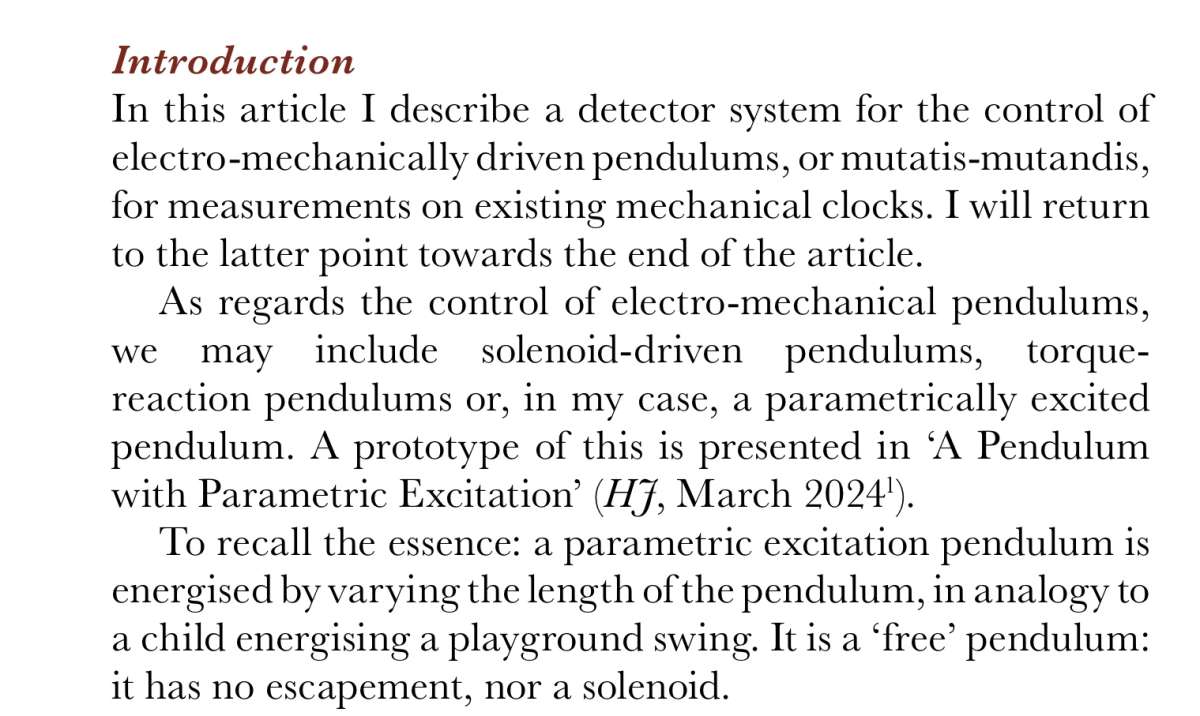
        The introductory text in the recent article contains a statement of analogy with which I was struggling:

        IMG_1104

        Perhaps reading the  older paper will get me into the right frame of mind.

        MichaelG..

        .


        #817632
        SillyOldDuffer
        Moderator
          @sillyoldduffer

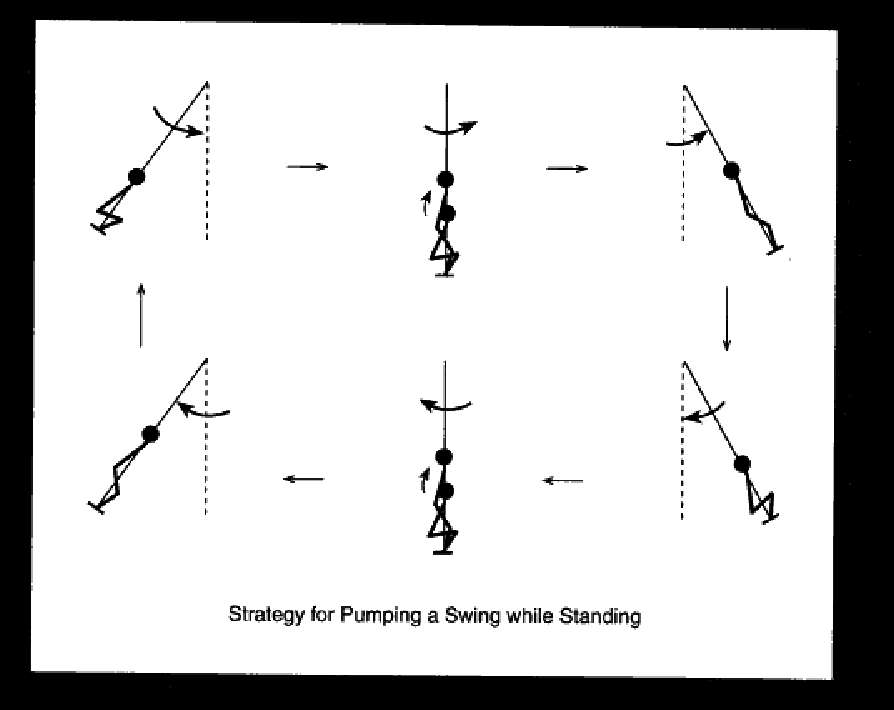
          What’s the problem? Seems to fit with the diagram on the front page of Duncan’s second link to the dreaded maths:

          pumping

          But now I think about it my brain hurts!

          Dave


          #817635
          Michael Gilligan
          Participant
            @michaelgilligan61133

            The problem is that the standing manoeuvre is only effective when the swing is already in motion … Presumably we are required to assume that  chaotic behaviour will suffice to get a pendulum away from its rest position.

            … it probably will

            … but it seems a convenient omission in the analogy

            [ note particularly the final statement that I quoted ]

            MichaelG.

            #817642
            Nigel Graham 2
            Participant
              @nigelgraham2

              Intrigued, although not a clock-maker, I followed both papers to the extent my very limited knowledge of electronics and Very Hard Sums allowed – I picked out the action rather that the circuit description or the mathematics.

              Although I take the point I am not entirely convinced by the analogy using just effective length because the excitation of the swing is by more than simply standing and crouching (i.e. by varying the length as a pendulum.)

              As I recall from Rather A Long Time Ago, it involved a sort of pumping action that imparted an angular thrust by moving one’s centre of mass back and forth; irrespective of sitting or standing on the seat. Indeed, the paper on how to operate a playground swing does point this out, I think, in analysing how a seated rider increases the amplitude; but does say this has a limit beyond which the greater swing is gained by standing.

              A person alternately standing and crouching on a swing will impart that angular force simply by body movement alternating the balance point, not by the purely vertical component. When we stand and crouch on the solid floor, we must move the position of our centre of mass slightly fore-and-aft with respect to our feet; with our sense of balance stopping us toppling. That’s all instinctive too, in very complex feedback mechanisms that animal biology “just do”.

              On a swing that lateral movement of mass is transmitted to a seat suspended on what the Physics text-books like to call “light inextensible strings”. (On a conventional swing the mass of the ropes or chains, and any suspension-point losses, probably are negligible; but is that so for the clock pendulum in this case?)

              This is illustrated for me by having had both knee joints replaced. If I try to crouch, or to kneel up as if praying, I topple forwards because the artificial joints do not let my upper legs and body tilt back far enough to compensate.  (This may depend on the joint types. My limit of bend is only just over 90º but others might have more flexible TKRs.)

              So whether sitting or standing, the swing rider is likely doing rather more than simply moving mass up and down the ropes: the action is creating a lateral force change as well as length change

              (I never had the nerve to take it to the point some of my fellow youngsters did, of approaching the horizontal!)

              Mention is made of the swing ropes taking a pronounced kink at certain points in the cycle – but is part of that due to the swinger effectively putting a rigid link between seat and rope, below his or her hands?

              So, what in fact is the electro-mechanical pendulum doing? I cannot see how simply moving the bob up and down will impart the angular force inherent in starting and maintaining any conventional pendulum (or playground swing); so what have I missed in the description? Is the mass oscillating also sideways?

              It’s certainly an interesting concept!

              #817645
              duncan webster 1
              Participant
                @duncanwebster1

                I must admit to being too lazy to go through the maths, but the real pendulum works by just raising and lowering the bob, so why doubt the sums? I don’t think the real pendulum will self start, and I suspect that just leaning back whilst stood on a swing gives it enough motion to then increase by vertical pumping, but I’m too old to go to the playground and check it myself. Next time I take the grandchildren I’ll take note

                #817657
                Michael Gilligan
                Participant
                  @michaelgilligan61133
                  On duncan webster 1 Said:

                  I must admit to being too lazy to go through the maths, but the real pendulum works by just raising and lowering the bob, so why doubt the sums? […]

                  Because although they are too hard for my stagnant brain … they are also too simplistic to describe reality.

                  Nigel has very helpfully elaborated on my ‘nagging doubt’ about the author’s analogy.

                  Can we really believe that [in your words]

                  the real pendulum works by just raising and lowering the bob

                  ?

                  MichaelG.

                  #817665
                  duncan webster 1
                  Participant
                    @duncanwebster1

                    Well unless the author of the BHI article is making it up why not? He says he’s made it and it works.
                    The force the the child on swing can exert on the outside world can only be directed along the line of the rope/chain as it is pin jointed at both ends and it is incapable of transmitting any bending moment

                    #817674
                    Michael Gilligan
                    Participant
                      @michaelgilligan61133
                      On duncan webster 1 Said:

                      Well unless the author of the BHI article is making it up why not? He says he’s made it and it works.
                      […]

                      I was merely attempting [and evidently failing] to express my discomfort with the author’s simplified description of his ‘free pendulum’

                      I have no doubt that it ‘works’ … but the analogy with the ‘vertically pumped’ swing is too broad-brush for me.

                      There must surely be some very interesting devils lurking in the detail !

                      MichaelG.

                      .

                      Edit: __  I will re-visit his March 2024 article, in the hope of enlightenment.

                      #817675
                      John Haine
                      Participant
                        @johnhaine32865

                        The key is not to think of the bob motion but its acceleration.  Any vertical accelerations add to or subtract from the force of gravity.  Imagine that a vertical acceleration is applied just before BDC – this slightly increases the downward force and there is a small horizontal component of this which accelerates the bob slightly towards BDC and increases its energy. Similarly a deceleration after BDC accelerates the bob away from BDC.  Both tend to increase amplitude.

                        Another approach recognises that the tension in the rod at BDC is slightly greater because of the centripetal force on the bob.  A lift at BDC inserts energy as it works against this force which can only go into the bob’s kinetic energy.

                        Both approaches result in a fractional amplitude gain dA of

                        dA/A = h/L

                        where A is the amplitude, h the lift, and L the pendulum length. Obviously the pendulum has to be swinging initially for this to work.  Back in days before low noise microwave transistors were developed the bees knees for RF amplifiers in radio telescopes and suchlike was the parametric amplifier which used a varactor diode varying the resonant frequency of a cavity at twice the signal frequency.

                        The child on swing analogy is not very helpful I think as she can in effect create a lateral force by stick out her legs and drawing them in again.

                        This is all explained very well by Philip Woodward, HJ August 2005, or Chapter 3.4 of Woodward on Time.  He was inspired to think about the problem by the “clacker toy” which was the rage amongst kids 20 or so years ago.

                        There was an article in HJ September 1987 by Peter Wills about his “Dynadromic Free Pendulum” which worked on the same principle.  In the cathedral of Santiago de Compostela in Spain there hangs an incense burner called O Butafumeiro which swings through an 80* arc releasing copious amounts of smoke.  It can be raised and lowered on its suspending rope through a pulley system once set swinging by a gang of priests to “parametrically pump” its motion.

                        #817677
                        Michael Gilligan
                        Participant
                          @michaelgilligan61133

                          Thanks, John

                          Much of this is still lurking in my head somewhere … but the brain, like the body, is decaying faster than one might have hoped.

                          MichaelG.

                          #817741
                          Nigel Graham 2
                          Participant
                            @nigelgraham2

                            Duncan –

                            That basically my point. A person sitting or standing still on a swing will not make it move, and as you say simply imparts tension to the ropes.

                            Using a swing necessitates imparting a lateral force as well – and that is indeed how it is used. As soon as you lean forwards or backwards, you add a horizontal component to what had been at first a purely vertical force, neglecting any swining from the act of simply climbing on board. That component is from a combination of moving your centre of mass, and the reaction to your muscle movements – and those are usually, deliberately quite powerful.

                            This is where the analogy does not really explain the pendulum. What sets the pendulum moving in the first place?

                            A conventional escapement operates by one pallet being wedged sideways by an escape wheel tooth at each half-swing, to start the pendulum swinging, or balance-wheel oscillating, and to maintain the motion; but the effective radius is constant and it demands some energy input at each cycle.

                            The cathedral’s incense-burner will swing, of course, at a rate set by its depth below the pulley – and is large enough to keep swinging for a long time – but it still needs someone to start it swinging. If the priest did not do that but simply hauled it back up, it may well swing slightly, but from perturbations in letting go of it and hauling it up, especially if the pulley journals are themselves suspended instead of fixed rigidly to the ceiling.

                            So what does this electro-mechanical type of pendulum use? Does the bob move slightly to and from the centre-line in its vertical oscillation? If so then it will act rather as does the child on a swing, by the off-centre mass and its sideways movement creating a small horizontal force.

                            #817742
                            duncan webster 1
                            Participant
                              @duncanwebster1

                              No one is suggesting that you can start a pendulum by moving the bob up and down, but you clearly can keep it swinging, as evidenced by the pendulum in the  article and the incense burner.

                              John’s explanation is good, lifting the weight at mid swing puts energy into the system. You can’t impart a horizontal force through a vertical rope.

                              #817752
                              Michael Gilligan
                              Participant
                                @michaelgilligan61133
                                On duncan webster 1 Said:

                                No one is suggesting that you can start a pendulum by moving the bob up and down […]

                                Mmm … I guess it’s just a matter of semantics; but my reading of Ben Tubbing’s words was exactly that ^^^ suggestion

                                MichaelG.
                                .

                                Quote:

                                To recall the essence: a parametric excitation pendulum is energised by varying the length of the pendulum

                                #817757
                                duncan webster 1
                                Participant
                                  @duncanwebster1

                                  plucked from the interweb

                                  Energise:- to give energy to

                                  Can’t help what you read into the original article, but if you put energy into a pendulum to replace the losses it keeps swinging


                                  #817758
                                  SillyOldDuffer
                                  Moderator
                                    @sillyoldduffer
                                    On Michael Gilligan Said:
                                    On duncan webster 1 Said:

                                    No one is suggesting that you can start a pendulum by moving the bob up and down […]

                                    Mmm … I guess it’s just a matter of semantics; but my reading of Ben Tubbing’s words was exactly that ^^^ suggestion

                                    MichaelG.
                                    .

                                    Quote:

                                    To recall the essence: a parametric excitation pendulum is energised by varying the length of the pendulum

                                    Well, Mr Tubbing did say the child’s swing was an analogy, and meaning 2 of ‘analogy’ in my Compact OED is “a partial similarity”.

                                    Top marks for spotting the disparity though – it went clean over my head.  As I got quite worried about it,  John’s explanation was most welcome.

                                    A thought.  For lifting and dropping the bob to excite the pendulum it must already be swinging.   A real pendulum will be moving slightly even if it appears to be still.   But it’s not, the world is noisy.  In open air we have draughts.  In an enclosure, there will be thermal air currents.  Vacuums are not empty.  There are tidal effects, vibration due to traffic, and micro-seismic events.  And in practice, unless perfectly balanced, the parametric lifting mechanism will swing the pendulum slightly when starting.  Once a well-suspended pendulum is moving, even a tiny displacement will be enough for parametric pumping to add energy.

                                    If I jump off a 20 story building, the earth moves when I land.  Not much, but it does.  That I grab all the attention by going spectacularly splat on the pavement doesn’t mean the planet is totally immobile.  And if the earth moves, so does a pendulum riding on it.

                                    Dave

                                    #817766
                                    John Haine
                                    Participant
                                      @johnhaine32865
                                      On Nigel Graham 2 Said:

                                      ….

                                      The cathedral’s incense-burner will swing, of course, at a rate set by its depth below the pulley – and is large enough to keep swinging for a long time – but it still needs someone to start it swinging. If the priest did not do that but simply hauled it back up, it may well swing slightly, but from perturbations in letting go of it and hauling it up, especially if the pulley journals are themselves suspended instead of fixed rigidly to the ceiling.

                                      …..

                                      Perhaps I should have made it plain that once hoisted aloft, the gang increase its arc up to 82 degrees by lifting and dropping it at strategic intervals – i.e. varying its length – at certain points in the swing.  Considering that it’s filled with lighted incense it must be terrifying!  It’s started presumably with a stick of bit of string but “pumped” up to its final amplitude.  The Wikipedia description leaves a lot to be desired technically but there’s a better one in Baker & Blackburn “The Pendulum, a case study in physics”.

                                      Youtube video here.

                                      #817767
                                      duncan webster 1
                                      Participant
                                        @duncanwebster1

                                        They will have to lower the incense burner to within reach to refuel it and set it alight, so they can give it a little push before hoisting it aloft

                                        #817768
                                        duncan webster 1
                                        Participant
                                          @duncanwebster1
                                          On SillyOldDuffer Said:
                                          On Michael Gilligan Said:


                                          …….

                                          If I jump off a 20 story building, the earth moves when I land.  Not much, but it does.  That I grab all the attention by going spectacularly splat on the pavement doesn’t mean the planet is totally immobile.  And if the earth moves, so does a pendulum riding on it.

                                          Dave

                                          when you’re standing on top of the building you have the same angular velocity as the ground, so relative to you it doesn’t move as you plummet earthwards. Provided that it you just let go, don’t jump forwards


                                          #817769
                                          Martin Kyte
                                          Participant
                                            @martinkyte99762

                                            You do have the same angular velocity as the ground when attached to the building. When you let go the situation changes. Assuming your forward velocity remains the same when you hit the deck you will be travelling faster forward than the ground. This is why satellites have to slow down to drop into a lower orbit.

                                            #817774
                                            duncan webster 1
                                            Participant
                                              @duncanwebster1

                                              you’re right, I’m wrong. Not unusual.

                                              #817776
                                              Martin Kyte
                                              Participant
                                                @martinkyte99762

                                                Don’t apologise Duncan it gets quite non intuitive very quickly. I can only intermittently visualise how tilted gyros appear to shift their mass to the pivot point.

                                              Viewing 22 posts - 1 through 22 (of 22 total)
                                              • Please log in to reply to this topic. Registering is free and easy using the links on the menu at the top of this page.

                                              Latest Replies

                                              Viewing 25 topics - 1 through 25 (of 25 total)
                                              Viewing 25 topics - 1 through 25 (of 25 total)

                                              View full reply list.