Myford ML7 faster speed

Myford ML7 faster speed

Home Forums General Questions Myford ML7 faster speed

Viewing 25 posts - 1 through 25 (of 27 total)
  • Author
    Posts
  • #507897
    Stephen Follows
    Participant
      @stephenfollows82099

      Has anyone upgraded a Myford ML7 lathe for faster speeds without fitting the overpriced bronze bearings and shaft?

      #27779
      Stephen Follows
      Participant
        @stephenfollows82099
        #507900
        Hopper
        Participant
          @hopper

          There was an article in MEW in the past couple of years sometime about converting a Drummond or Myford lathe to taper roller bearings. Author may have been Alan Hearsum? It involved machining the headstock in the mill to accommodate the larger OD of the roller bearings so not a simple job.

          And further back some years ago there was an article in ME or MEW on making a second headstock that clamps on the lathe bed and is driven off the lathe spindle via gears and/or toothed belts and pulleys to achieve high rpm.

          There is an online index somewhere that you can track these down on.

          I'm not sure that the bronze bushes would increase top speed significantly. Myford no longer seem to list them for sale so no info available.

          Edited By Hopper on 17/11/2020 00:17:00

          #507901
          Mike Poole
          Participant
            @mikepoole82104

            It is generally accepted that around 1000rpm is about the max for the standard bearings, some will be sure to say they have pushed it higher with no harm. It’s not really worth just going for a few hundred rpm extra and serious overspeed will hasten the demise of the bearings without a doubt. If you accept that a new shaft and bearings could be required sooner rather than later (and they do cost a bit) then give it a go. Some tipped tooling will work fine at low speed but some tips really do work best at higher speeds. One of the reasons for the Super 7 was the higher spindle speed needed with the increasing availability of HSS tool bits after the war that was in reach of the hobby machinist. Now we have carbide at reasonable prices many machines are a bit slower than optimum but power and rigidity are also left wanting. I suspect one of the attractions of tipped tooling is that is relieves us of the sharpening task but if you spend the money on decent sharpening equipment and invest some time in getting the tools right then HSS can be very economical and flexible.

            Mike

            #507906
            Steviegtr
            Participant
              @steviegtr

              Why would you want faster speeds. Slow is very therapeutic.

              Steve.

              #507918
              J Hancock
              Participant
                @jhancock95746

                I think it is when you're reducing that 1"dia bright you borrowed from work, down to 1/8"dia. between centres.

                That last cut , when it slowly climbs onto the toolpost and you think, " I wish I had a Super 7 ".

                #507967
                Andrew Moyes 1
                Participant
                  @andrewmoyes1

                  Stephen – I can say categorically, from first hand experience, that there is no problem with running the white metal bearings at double speed.

                  Soon after small inverters came on the market, I converted my ML7 using a 3/4HP 2850 rpm motor. I first ran it for over an hour at 1300rpm to check for signs of overheating and found the bearings only got slightly warm. I had rescraped the bearings to a better fit when I bought the lathe new in 1971. I sold the ML7 after some 40 years of use, the last 20 with the VFD, when I upgraded to a big bore machine. The bearings remained undisturbed from the original scraping with no measurable wear.

                  Fitting a VFD to an ML7 without fitting a 2-pole motor is a lost opportunity in my view. It certainly makes drilling holes under ½” diameter a much pleasanter experience, for example.

                  Myford believed the white metal bearings were good for the higher speed. Before the advent of VFDs, they advertised in their catalogues a dual speed 1425/2850rpm motor for use with the ML7, especially the Tri-Leva model, which all had white metal bearings. The speed change was achieved by switching from 4 to 2 poles. I’ve never heard of any problems on Tri-Levas.

                  Based on my own experience, I throw doubt on the scare stories and wonder where they originated. It wasn’t from Myford. They have spread like Chinese whispers even to the extent of now appearing on Tony Griffiths’ excellent website and therefore become ‘gospel’.

                  It may be that the change to bronze bearings has led to the belief that this was done because white metal bearings were inferior. That is not correct; there was a press release in Model Engineer magazine at the time explaining that it was because the white metal bearings had become prohibitively expensive to source. Myford said it was cheaper to supply a new hardened shaft with bronze shells than continue supplying white metal shells.

                  #507974
                  ega
                  Participant
                    @ega

                    Andrew Moyes:

                    Might you propose a suitable amendment to TG's website? He is receptive to suggestions.

                    #507989
                    SillyOldDuffer
                    Moderator
                      @sillyoldduffer
                      Posted by Andrew Moyes 1 on 17/11/2020 12:22:50:

                      I can say categorically, from first hand experience, that there is no problem with running the white metal bearings at double speed.

                      Based on my own experience, I throw doubt on the scare stories and wonder where they originated. It wasn’t from Myford. They have spread like Chinese whispers even to the extent of now appearing on Tony Griffiths’ excellent website and therefore become ‘gospel’.

                      It may be that the change to bronze bearings has led to the belief that this was done because white metal bearings were inferior. …

                      Sorry Andrew, you can't say that. A sample of one is far too small. You can say "I found no problem running the white metal bearings of my lathe at double speed", but that's all. The evidence offered doesn't support a categoric assurance or a conclusion that other sources are 'scare stories'.

                      I have a 1950's Engineering Book that discusses the pros and cons of bearing types in considerable detail. Cast-iron, Brass, Bronze, White-metal, plastics and exotics like Silver. It's based on a century plus of practical experience and scientific investigation. It's conclusions are based on tens of thousands of bearings run to destruction under different load and speed conditions with a variety of lubricants. The understanding gained is statistical, and the evidence shows that each bearing has comfort zone within which it has a predictable operating life. Moving outside the comfort zone by overloading, over-speeding or using the wrong lubricant reduces bearing life.

                      Andrew's observation is untrustworthy because bearing damage may take years to appear on a lightly loaded lathe. Quick obvious failures only occur after gross mistreatment, the effect of modest abuse is slow and subtle. Most of us don't spend days on end taking deep cuts at high speed. Nonetheless damage slowly builds up in a mistreated bearing, much faster if the lathe is busy. The consequences are unpredictable. It's a gamble, not a sure thing.

                      My book doesn't support the idea that bearings are 'inferior' or 'superior'. Rather, it considers bearing types in terms of cost and suitability for the job in hand. A steel axle running directly in cast-iron is an effective solution in some cases and completely wrong for others. White-metal and bronze cover different requirements, as do brass and plastic bushes. Oilite is different again. Though there's plenty of overlay, choosing bearings isn't guesswork.

                      Roller bearings can be claimed 'superior' to plain bearings because they're low-maintenance, have much lower starting resistance, and less rolling resistance. They're also harder to make well and the original versions were expensive and unreliable. Modern ones are so much better and cheaper they've pushed out plain bearings on a grand-scale, taking much of the need to understand plain bearings with them.

                      The sky is unlikely to fall in if bearing recommendations are exceeded, but its safer to assume the designer knew what he was doing and stick within the recommended limits. Depends on the requirement of course; I run my car as advised by the manufacturer because I want it to last at least 10 years without major work. Compare with Formula 1 where the engines are completely rebuilt after each race. I want bearings to last years, racing drivers only need a few hours and are paid to win races, not to mollycoddle the car.

                      Dave

                      #507990
                      Andrew Moyes 1
                      Participant
                        @andrewmoyes1

                        Dave

                        You say '…it's safer to assume the designer knew what he was doing and stick within recommended limits'.

                        Myford were the designers and were very happy to have their lathes run at the same top speed as mine. Tri-Levas were especially used in industry, I wouldn't say they were lightly loaded and I haven't heard of failures.

                        Whose are these recommendations then? Have you any information, other than hearsay, that Myford were wrong?

                        Andrew

                        #507994
                        Michael Gilligan
                        Participant
                          @michaelgilligan61133

                          Some interesting comments on this old thread from 2012 [including those from your good self, Andrew]

                          **LINK**

                          https://www.model-engineer.co.uk/forums/postings.asp?th=74899

                          … I don’t know where the confrontational Mr Williams disappeared to.

                          MichaelG.

                          #507998
                          old mart
                          Participant
                            @oldmart

                            Since only some jobs require maximum speed, and the gearing was changed to limit the max rpm to 1500, then as long as proper attention was taken to oil the bearings regularly especially when maximum speed was used, then I would not have any worries if I had one of these lathes. White metal has been used in faster applications and modern oils are so much better than those available when the Myfords were made. I use semi synthetic 5W40 motor oil in the Smart & Brown because it is superior at room temperature than any mineral based oil.

                            #508019
                            Clive Foster
                            Participant
                              @clivefoster55965

                              Agreed that speed per se is certainly not an issue.

                              The fast Holbrook C lathes supplied for diamond turning work ran plain white metal bearings at 3,000 or so rpm on much larger, much closer tolerance spindles with simple low pressure, distribute to the bearings, oil supply arrangements. Probably something over 10 times the surface speed of a Myford at 1,000 rpm.

                              Much more a case of machine condition, historical care, type of oil and user expectations. Properly looked after and fed appropriate oil from new 1,500 + reliable rpm is not unreasonable. Especially as high speeds mean low loads due to small cuts as the small workpieces go pretzel under ambitious cuts.

                              Different story with an older machine of unknown history, unknown wear and unknown lubrication. Even good cosmetic condition is no guarantee that its not been run dry, fed whatever oil was in the bottom of a scrounged can or even crashed a time or three and the trashed chucks binned.

                              In the real world if it runs OK, appears to have no bearing issues and is fed appropriate oil it will do fine up to 1,000 rpm or so. Much beyond that it takes at least some mechanical sympathy and bearing experience to judge how fast that particular machine can safely go and how long for. Hands up if you routinely check bearing temperatures.

                              Which you can't expect ordinary home workshop guy or gal to have or do. Certainly not neophytes. On top of that just how often will folk who haven't the knowledge, interest and experience to make an informed judgement gain any benefit for running above 1,000 rpm. My Smart & Brown 1024 spends most of its life loafing along under 500 rpm because there is no great benefit from running faster.

                              The publishing and declaiming classes are, in general, over-impressed by speed giving a false impression to the inexperienced.

                              So the realistic advice has always been up to 1,000 or so rpm is always fine on anything that isn't obviously abused or worn out. Want to go beyond that? Better check it out carefully and accept that an older, well used machine may no longer be up to reliable higher speeds. But frankly high speeds are mostly rarely worth it. Better to spend time on something of more benefit.

                              But then you get the sort of donkle-brain who proclaims loudly from the highest platform of total ignorance jacking sensible, realistic "when we have better things to worry about" advice into a hard limit whose transgression in even the smallest degree is signing up for a future of fire, brimstone and eternal damnation.

                              A boot in the fork whether figuratively, metaphorically or actually usually quietens such folk down for a while but there seems to be no permanent cure.

                              To quote Professor Joad "it all depends".

                              Clive says select your "depends" appropriately and all will be fine.

                              Clive

                              Edited By Clive Foster on 17/11/2020 16:57:58

                              Edited By Clive Foster on 17/11/2020 16:58:53

                              #508021
                              Howard Lewis
                              Participant
                                @howardlewis46836

                                White metal bearings are used because of their low friction characteristics. At high rubbing speeds, white metal bearing temperature needs to be controlled. Otherwise the composition of the white metal alloy starts to change.

                                White metal bearings of various compositions withstand high rubbing speeds, quite happily, in the engines of our cars, buses and trucks. But with oil fed under pressure, more to cool rather than lubricate. Marine main propulsion engines bearing temperatures are closely monitored, for this reason. In automotive applications, oil temperature is limited for the sake of the bearings, and to prevent oil degradation.

                                In automotive turbochargers, the bearings can be white metal bushes of the "sleeve within a sleeve" type so that rubbing speeds are reduced, despite the rotors spinning at speeds in excess of 100,000 rpm!l The advice to idle for a while before shut down is for the oil flow to cool everything before then oil flow ceases.

                                Shaft to bearing clearances, and surface finishes are chosen to minimise the chances of the bearing becoming overheated, and to regulate oil flow.

                                In a Myford lathe, the oil is usually drip fed, so flow is minimal, as is the cooling effect, so the limit on rubbing speed needs to be lower. The pressure exerted on the shaft / bearing combination must not be so great as to break through the oil film. If it does, boundary lubrication ceases, and metal to metal contact happens, followed shortly by seizure.

                                Consequently, the manufacturer places a limit on the speed at which the combination can run. Exceeding the recommended maximum will reduce bearing life. Dramatically, if sufficiently overspeeded; possibly from many thousands of hours to a matter of minutes!.

                                So the bearings may survive at high speed, as long as the loads are smaller, and there is adequate lubrication.

                                Howard

                                #508024
                                Martin Bryars
                                Participant
                                  @martinbryars38535

                                  I am either missing some point, or have misunderstood some posts, because it seems to be claimed that white metal bearings are only suitable up to around 1500 rpm. Admittedly the application is rather different, but car engines were produced for many decades with plain white metal bearings on crank- and cam- shafts running happily at much higher rpm for lengthy periods. They were not taking intermittent cuts of course, but presumably no-one is suggesting high revs on a lathe for that type of use, and of course they were well balanced and designed to take high revs.

                                  #508026
                                  Nick Wheeler
                                  Participant
                                    @nickwheeler
                                    Posted by Martin Bryars on 17/11/2020 17:20:25:

                                    I am either missing some point, or have misunderstood some posts, because it seems to be claimed that white metal bearings are only suitable up to around 1500 rpm. Admittedly the application is rather different, but car engines were produced for many decades with plain white metal bearings on crank- and cam- shafts running happily at much higher rpm for lengthy periods. They were not taking intermittent cuts of course, but presumably no-one is suggesting high revs on a lathe for that type of use, and of course they were well balanced and designed to take high revs.

                                    Those bearings do have a constant flow of (hopefully) pressurised oil.

                                    #508029
                                    Speedy Builder5
                                    Participant
                                      @speedybuilder5

                                      Many vintage engines and now small engines like lawn mowers are spit and hope (Non pressurised) oil feeds and white metal bearings.

                                      #508032
                                      Martin Bryars
                                      Participant
                                        @martinbryars38535

                                        As Speedy builder says, and some engines, for example Austin 7s, can be made pretty high revving, thinking of my sons' car.

                                        #508033
                                        Andrew Moyes 1
                                        Participant
                                          @andrewmoyes1

                                          …and there are power station steam turbines too. When I served my apprenticeship at Trafford Park, I used to make a point of walking to my place of work through the aisles where the turbines were manufactured. Those 1.5 million horsepower machines ran at high speed and high temperature on huge white metal bearings. Awesome and on a different planet of course to our humble applications. One day, I paused to ask a lathe operator turning a turbine shaft what would happen if he made a mistake. His reply stuck with me; “Yer put yer ‘at on and yer go ‘ome”.

                                          #508034
                                          SillyOldDuffer
                                          Moderator
                                            @sillyoldduffer
                                            Posted by Martin Bryars on 17/11/2020 17:20:25:

                                            … it seems to be claimed that white metal bearings are only suitable up to around 1500 rpm. …

                                            Not by me! Plain bearings are complicated. Howard's post covers the ground rather well: there's a world of difference between a drip fed white metal bearing and a pressure fed white metal bearing.

                                            Ideally there's never metal to metal contact in a plain bearing, and that holds true when it's spinning normally. The bearing rides on a cushion of oil, except when the bearing stops and starts. White metal reduces stop-start scraping during the short time it takes for oil pressure to build up.

                                            Bad things happen to bearings when the metal rubs. Avoided with clear oil-ways, plenty of not too thin / not too thick oil available, and pressure maintained (if it's a pressurised system). Running plain bearings too fast can fling oil out faster than the feed can replace it. This is much more likely on a drip fed Myford than an car engine with an oil pump. Overloading plain bearing is also likely to squeeze oil out, causing a metal to metal scrape.

                                            Worst case: grease gunned Myford fitted with an extra powerful motor driving a giant chuck at twice normal speed …

                                            Dave

                                            #508035
                                            Mike Poole
                                            Participant
                                              @mikepoole82104

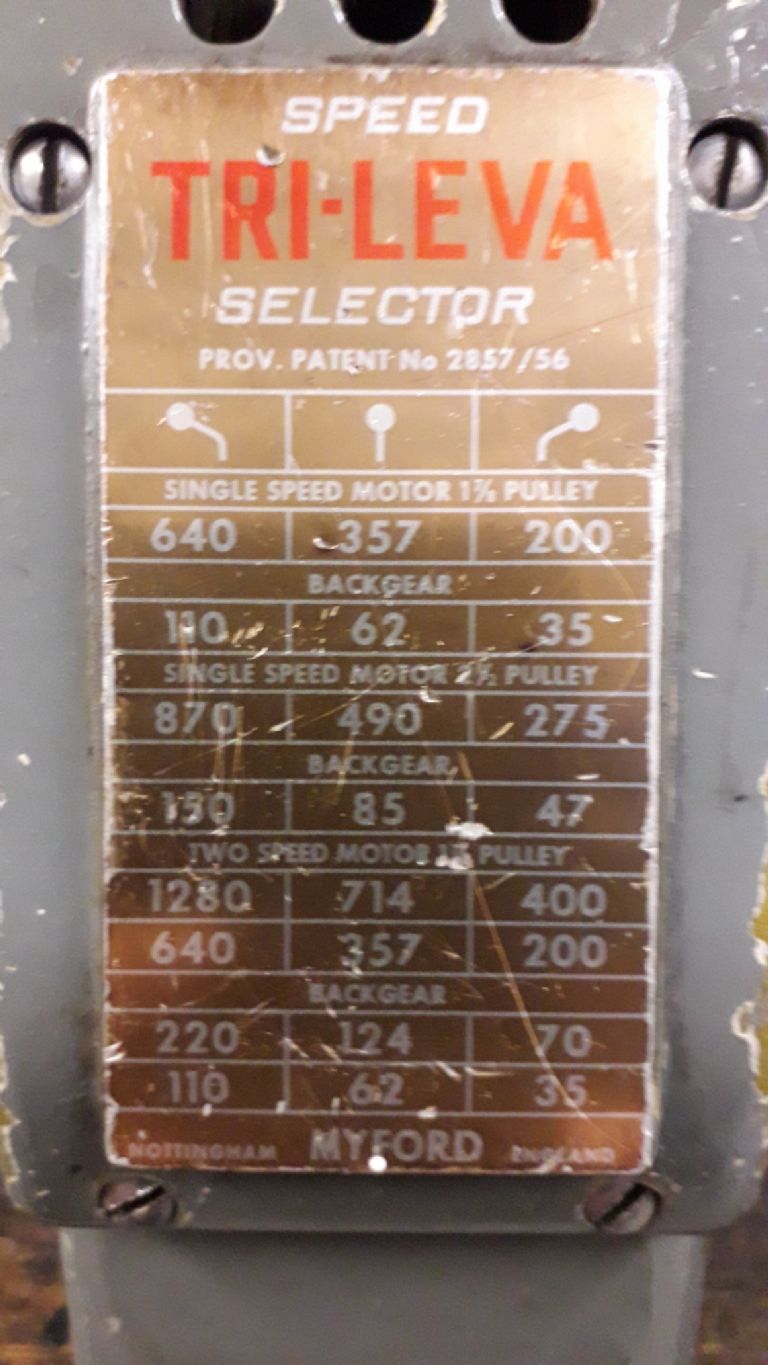
                                              The Tri Lever with the two speed motor seems to have a top speed of 1280rpm as detailed on the speed plate.

                                              Mike

                                              #508036
                                              Baz
                                              Participant
                                                @baz89810

                                                I am going to agree with Andrew Moyes, when I had my own business I purchased a Myford trileva for a particular job, it was fitted with a two speed motor and we were running it at 1500 revs for 40 hours per week, we had this particular job for eight years until the customer went bust and we moved the machine on through the trade. When I purchased the machine I done the usual adjustments including having a look at the spindle bearings, they were adjusted and new belts fitted and the machine put to work. During its time with us it was oiled daily but no maintenance work was done at all, we just flogged the life out of it. After the eight years it had no discernible play in the spindle or the slides, if I hadn’t needed the space I would have kept it. It was used for first and second operations on acetal blocks which ended up in syringe drivers.

                                                #508038
                                                A Smith
                                                Participant
                                                  @asmith78105

                                                  Daren't comment on top speeds I use in case I get a visit from the 1000rpm Police.

                                                  However, this what Myford sold.

                                                  20201117_171418_resized.jpg

                                                  #508040
                                                  Dave Halford
                                                  Participant
                                                    @davehalford22513

                                                    My lathe has a double row ball raced front and a single ball raced rear bearing.

                                                    Top speed is 1500rpm, not 3000 rpm – only wood lathes need to go that fast.

                                                    If you don't have flood coolant then red hot chips = fire hazard and I can get those with carbide at 50rpm on a 10" wheel rim.

                                                    You can use the new alu inserts on steel at model engineer feeds and speeds, even the give away price ones work OK.

                                                    So as Steve says in post 4 "why would you?"

                                                    #508053
                                                    Michael Gilligan
                                                    Participant
                                                      @michaelgilligan61133

                                                      No direct relevance, but permit me to reminisce …

                                                      When I worked in the vibration test lab, we had a ‘slip table’ for applying lateral vibration.

                                                      A four foot square Magnesium alloy plate which ‘floated’ on a film of oil on a granite block.

                                                      On the axis was a substantial hydrostatic bearing.

                                                      Woe betide anyone who set the thing in motion before the oil had insinuated itself everywhere !!

                                                      Someone did … and we were unable to get a new bearing from the manufacturer in time for an important job.

                                                      So I arranged to have one made by a local workshop.

                                                      Can’t remember the detailed dimension or the material spec. but the shaft was perhaps 3” diameter.

                                                      The plain bearing was machined from a block of hard Aluminium alloy and the central section relieved by 0.0004” to avoid bell-mouthing [and to provide a little reservoir for oil]. … The oil feed was at 3,000psi and it just wept away slowly at the edges of the table.

                                                      That’s a nicely configured Hydrostatic bearing.

                                                      MichaelG.

                                                    Viewing 25 posts - 1 through 25 (of 27 total)
                                                    • Please log in to reply to this topic. Registering is free and easy using the links on the menu at the top of this page.

                                                    Latest Replies

                                                    Home Forums General Questions Topics

                                                    Viewing 25 topics - 1 through 25 (of 25 total)
                                                    Viewing 25 topics - 1 through 25 (of 25 total)

                                                    View full reply list.