Motor temperature question

Motor temperature question

Home Forums General Questions Motor temperature question

Viewing 19 posts - 1 through 19 (of 19 total)
  • Author
    Posts
  • #835867
    Henry Rancourt
    Participant
      @henryrancourt22682

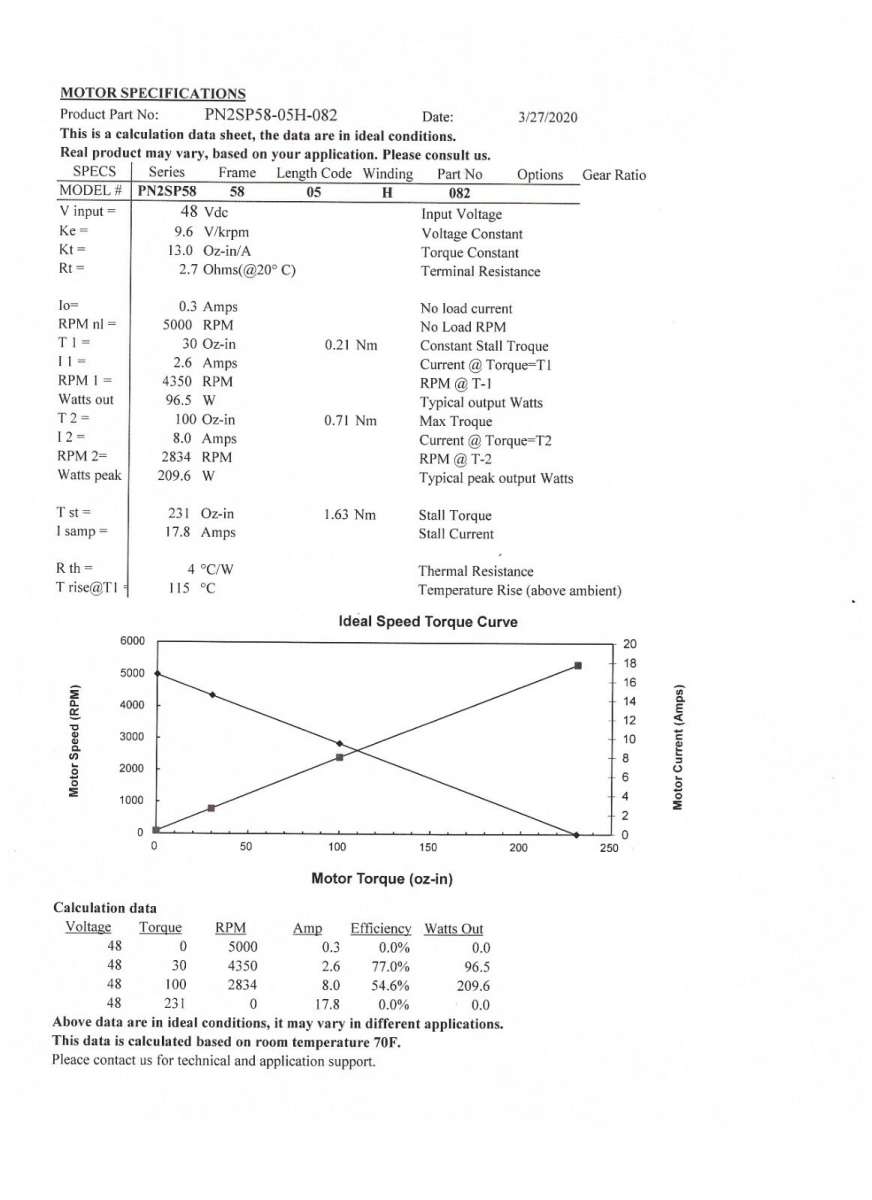
      I’m considering buying a Torkmotion brushed DC motor but I’m concerned about the spec sheet listed 115C temperature rise. I asked about this and was told, based on the specs, “the motor can cope with a continuous (ie all day long) current of 2.6A but it will get hot (115° above ambient), the speed at which you make it pull those 2.6A doesn’t really matter, be it 435 or 4350rpm. However, at 4350rpm and 2.6A (0.21Nm) your motor will put out 96W of mechanical power and produce (2.6*2.6*2.7=18W) of heat. At 435 rpm and 2.6A your motor will put out 9.6W of mechanical power but STILL produce (2.6*2.6*2.7=18W) of heat.”

      I like all the motor parameters except for the high heat and don’t understand the (2.6*2.6*2.7=18W) formula, but I would buy it if the temp. rise was lower, so I found an online watts to temp. calculator (https://calculator.academy/watts-to-temperature-calculator/) and entered the spec sheet thermal resistance 4C/W and 18W from the calculation above. The result was a temp. rise of 70C and I can live with that. Is the calculator appropriate for this application and do the results seem to be valid?

      torkmotion 48V

      #835875
      John Haine
      Participant
        @johnhaine32865

        Terminal resistance is 2.7 ohms. 2.6 squared times 2.7 gives power dissipated.

        #835876
        John Haine
        Participant
          @johnhaine32865

          It’s quite unclear where the 115 number comes from. That would require 29 W power dissipated not 18. Spec sheet is a bit of a dog’s dinner.

          #835887
          Robert Atkinson 2
          Participant
            @robertatkinson2

            There are multiple losses in a brushed DC motor. The resistance is the simplest to understand and is basically proportional to current. DC electrical power is voltage times amps. For this type of  motor the there are two voltages, the terminal voltage and the internally generated back EMF withis opposes it. The Back EMF if proportional t speed being zero at 0 speed and close to the applied voltage at full rated speed. It is not easy to separate the two voltages. Fortunatly the voltage across  a resistance is proportional to the current so we can determine the power in the motor resistance by multiplying the current squared by the resistance (i.e. multiplying the current by resistance once to give the voltage and a second time to give the power).
            Taking the given motor specification wih an applied voltage of 7V the motor will deliver full torque (230 oz/in) at stall (zero mechanical power)  and dissipate 18.25 W and reach a temperature of 73 degrees above ambient.
            At full input voltage, speed and torque (209.6 W mechanical power) the resistance will dissipate  the same 18.25 W . The dathseet says it will get to 115 degrees hotter than ambient. This implies 28.75 watts dissipation (115W / 4deg/W).
            This leaves a “missing” 10.5W.This is accounted for by other losses. Mainly magnetic “eddy current” losess but also mechanical e.g. bearings, brush friction etc.
            The data sheet is comprehesive as it’s servo rated motor.Srrvos will sit at full torque and zero speed in a lot of positioning applications which is why this is important data.

            It will only get that hot at full current and it is unlikey that you will be running full current all the time.

            Robert.

            #835898
            John Haine
            Participant
              @johnhaine32865
              On Robert Atkinson 2 Said:

              There are multiple losses in a brushed DC motor. The resistance is the simplest to understand and is basically proportional to current. DC electrical power is voltage times amps. For this type of  motor the there are two voltages, the terminal voltage and the internally generated back EMF withis opposes it. The Back EMF if proportional t speed being zero at 0 speed and close to the applied voltage at full rated speed. It is not easy to separate the two voltages. Fortunatly the voltage across  a resistance is proportional to the current so we can determine the power in the motor resistance by multiplying the current squared by the resistance (i.e. multiplying the current by resistance once to give the voltage and a second time to give the power).
              Taking the given motor specification wih an applied voltage of 7V the motor will deliver full torque (230 oz/in) at stall (zero mechanical power)  and dissipate 18.25 W and reach a temperature of 73 degrees above ambient.
              At full input voltage, speed and torque (209.6 W mechanical power) the resistance will dissipate  the same 18.25 W . The dathseet says it will get to 115 degrees hotter than ambient. This implies 28.75 watts dissipation (115W / 4deg/W).
              This leaves a “missing” 10.5W.This is accounted for by other losses. Mainly magnetic “eddy current” losess but also mechanical e.g. bearings, brush friction etc.
              The data sheet is comprehesive as it’s servo rated motor.Srrvos will sit at full torque and zero speed in a lot of positioning applications which is why this is important data.

              It will only get that hot at full current and it is unlikey that you will be running full current all the time.

              Robert.


              Why do you say “The resistance is the simplest to understand and is basically proportional to current.” then later assume it is constant?  The resistance is essentially the winding, which will increase slightly with temperature (but not enough to worry about).

              Henry, the bottom line is that if you are using this to run a watchmaking lathe you shouldn’t worry about it getting hot, even at maximum speed the actual power it has to deliver is very small.  Don’t overthink it.

              #835901
              Bazyle
              Participant
                @bazyle

                Whatever the setup is arrange a separate fan to run at full speed all the time and duct the air to run along the body and through the internals if possible.
                If you actually run a watchmaker lathe more than ten minutes an hour and need to all day everyday you must be a production facility and should look at a big solid induction motor. If you are an amateur spread your activities and go and have a cup of tea while the fan cools it down.

                #835960
                not done it yet
                Participant
                  @notdoneityet
                  On Bazyle Said:

                  Whatever the setup is arrange a separate fan to run at full speed all the time and duct the air to run along the body and through the internals if possible.
                  If you actually run a watchmaker lathe more than ten minutes an hour and need to all day everyday you must be a production facility and should look at a big solid induction motor. If you are an amateur spread your activities and go and have a cup of tea while the fan cools it down.

                  A good, practical reply to the thread.🙂

                  #835971
                  Robert Atkinson 2
                  Participant
                    @robertatkinson2
                    On John Haine Said:
                    On Robert Atkinson 2 Said:

                    There are multiple losses in a brushed DC motor. The resistance is the simplest to understand and is basically proportional to current. DC electrical power is voltage times amps. For this type of  motor the there are two voltages, the terminal voltage and the internally generated back EMF withis opposes it. The Back EMF if proportional t speed being zero at 0 speed and close to the applied voltage at full rated speed. It is not easy to separate the two voltages. Fortunatly the voltage across  a resistance is proportional to the current so we can determine the power in the motor resistance by multiplying the current squared by the resistance (i.e. multiplying the current by resistance once to give the voltage and a second time to give the power).
                    Taking the given motor specification wih an applied voltage of 7V the motor will deliver full torque (230 oz/in) at stall (zero mechanical power)  and dissipate 18.25 W and reach a temperature of 73 degrees above ambient.
                    At full input voltage, speed and torque (209.6 W mechanical power) the resistance will dissipate  the same 18.25 W . The dathseet says it will get to 115 degrees hotter than ambient. This implies 28.75 watts dissipation (115W / 4deg/W).
                    This leaves a “missing” 10.5W.This is accounted for by other losses. Mainly magnetic “eddy current” losess but also mechanical e.g. bearings, brush friction etc.
                    The data sheet is comprehesive as it’s servo rated motor.Srrvos will sit at full torque and zero speed in a lot of positioning applications which is why this is important data.

                    It will only get that hot at full current and it is unlikey that you will be running full current all the time.

                    Robert.


                    Why do you say “The resistance is the simplest to understand and is basically proportional to current.” then later assume it is constant?  The resistance is essentially the winding, which will increase slightly with temperature (but not enough to worry about).

                    Henry, the bottom line is that if you are using this to run a watchmaking lathe you shouldn’t worry about it getting hot, even at maximum speed the actual power it has to deliver is very small.  Don’t overthink it.

                    For a simple description the temperature coefficent of the conductor is unimportant. In practice it is not simple. The specified motor has a 2.7 ohm resistance at 20 degrees C. Copper has a temperature co-efficent of resistance of +0.393% per degree. So at 115 degree increase by 45% to 3.9 ohms. This is a power of 18W at 2.7A. At first glance this seems to account for the additional temperature rise. But if we take the stalled case with constant voltage supply (5.3V), starting at 2.7A the voltage would have to increase to 10.5V to maintain the current. Hence I ignored it on grounds of simplicity. The point I was making is that there are other important losses that contribute to the heating of the motor.

                    Robert.

                    #836019
                    Henry Rancourt
                    Participant
                      @henryrancourt22682

                      A thanks to all for the info. And I gather that the calculator I used and the results are valid. It seems to be a good match for a watchmakers lathe so I will buy it.

                      #836044
                      SillyOldDuffer
                      Moderator
                        @sillyoldduffer
                        On Henry Rancourt Said:

                        A thanks to all for the info. And I gather that the calculator I used and the results are valid. It seems to be a good match for a watchmakers lathe so I will buy it.

                        It is a good match.  The motor is rated at 96W continuous, which is all you need to know.

                        The 115°C figure refers to the hottest part of the motor, which is the copper windings inside, not the outer case.  As modern enamelled wire is good for between 180°C and 240°C, maybe more, the table quantifies the motor’s thermal safety factor, which is fine.   It will confidently deliver 96W out continuously without damaging itself.

                        Remember manual lathes never run continuously.  They have a “duty cycle”, which is the ratio between time spent working and time stopped. Idling also allows the motor to cool.  So it won’t get hot if the machinist drives the lathe moderately in short bursts.  Short of abuse or a major fault, unlikely the outer case of this motor will get anything like hot enough to boil water.  If it does, something is horribly wrong. The case is more likely to feel warm rather than hot unless a lot of metal is cut quickly,  Unlikely to get too hot to touch when driven by a watchmaker. A watchmaker’s lathe is a precision tool, not a chop saw.

                        Big lathes often work much harder for longer than small ones. Hard continuous work heats the motor and they don’t get much time to cool. Worth fitting a fan.

                        Good to apply due diligence when buying a motor, but specs are most valuable when the requirement is known.  That is, how much work is the lathe expected to do in what time? I’m guessing a watchmaker’s lathe will do watchmaker’s work at watchmaker’s rates.  If that’s wrong, ask again!

                        Dave

                        #836077
                        Henry Rancourt
                        Participant
                          @henryrancourt22682

                          This is from the 3rd reply “Taking the given motor specification with an applied voltage of 7V the motor will deliver full torque (230 oz/in) at stall (zero mechanical power)  and dissipate 18.25 W and reach a temperature of 73 degrees above ambient.”

                          The spec lists V input = 48V. What is the formula to calculate applied voltage, that resulted in applied voltage of 7V?Thanks

                          #836082
                          Mark Rand
                          Participant
                            @markrand96270
                            On Robert Atkinson 2 Said:

                            snip>

                            So at 115 degree increase by 45% to 3.9 ohms. This is a power of 18W at 2.7A.

                            <snip>

                            Robert.

                            2.7^2 x 3.9 = 28.431W

                            #836116
                            Henry Rancourt
                            Participant
                              @henryrancourt22682

                              It is the “at 115 degree increase by 45% to 3.9 ohms” that I don’t understand. How do arrive at that?

                              #836142
                              Robert Atkinson 2
                              Participant
                                @robertatkinson2
                                On Mark Rand Said:
                                On Robert Atkinson 2 Said:

                                snip>

                                So at 115 degree increase by 45% to 3.9 ohms. This is a power of 18W at 2.7A.

                                <snip>

                                Robert.

                                2.7^2 x 3.9 = 28.431W

                                Sorry I wasn’t clear,  Perhaps I should have put increase twice:
                                So at 115 degree increase by 45% to 3.9 ohms. This is a power increase of 18W at 2.7A. Note the motor current is 2.6A and resistance is 2.7 ohms

                                Robert.

                                #836145
                                Robert Atkinson 2
                                Participant
                                  @robertatkinson2
                                  On Henry Rancourt Said:

                                  This is from the 3rd reply “Taking the given motor specification with an applied voltage of 7V the motor will deliver full torque (230 oz/in) at stall (zero mechanical power)  and dissipate 18.25 W and reach a temperature of 73 degrees above ambient.”

                                  The spec lists V input = 48V. What is the formula to calculate applied voltage, that resulted in applied voltage of 7V?Thanks

                                  Noting the discussion around resistance change with temperature the 7 volts comes from Ohms law
                                  2.7 ohms times 2.6 amps = 7 volts. That is the voltage required to pass 2.6 amps. WITH THE MOTOR STALLLED.

                                  If the motor is running you have to add the back EMF (“generated” voltage) which is proportional to speed. This is designated Ke with a value 9.6V per 1000RPM (from datasheet).

                                  48V -7V = 41V 41/9.6 =  4270 RPM

                                  This is slightly different from the datasheet no load RPM (4350) as I’ve not allowed for the no load current and other minor details)

                                  Robert.

                                  #836146
                                  Robert Atkinson 2
                                  Participant
                                    @robertatkinson2
                                    On Henry Rancourt Said:

                                    It is the “at 115 degree increase by 45% to 3.9 ohms” that I don’t understand. How do arrive at that?

                                    Most metals resistance increases with temperature “temperature coefficient of resistance”

                                    The temperature coefficient of resistance of copper is + 0.393 percent per degree C change.
                                    The motor winding resistance at 20 deg.C is 2.7 ohms (from datasheet).
                                    Temperature increase is 115 deg.C (from datasheet)
                                    0.393 x 115 = 45.2% increase. 2.7 x 1.452 = 3.92 ohms.

                                    Robert.

                                    #836307
                                    Henry Rancourt
                                    Participant
                                      @henryrancourt22682

                                      Thanks Robert. My knowledge in electronics is clearly lacking so your replies are like lessons in electronics. And I have no idea how or why the 45.2% increase becomes 1.452. Would you please explain that?

                                      #836316
                                      Bill Dawes
                                      Participant
                                        @billdawes

                                        Temperature rise on motors, at least industrial squirrel cage ones that I am familiar with, have a temperature rise shown which is not necessarily what the temperature will actually be, it indicates max temp that insulation will resist. Standard industrial motors these days, which are generally fan cooled, have Class F insulation which allows a max rise of 80k above an ambient of 40 deg.C. ie total of 120.

                                        Bill D.

                                        #836323
                                        Robert Atkinson 2
                                        Participant
                                          @robertatkinson2
                                          On Henry Rancourt Said:

                                          Thanks Robert. My knowledge in electronics is clearly lacking so your replies are like lessons in electronics. And I have no idea how or why the 45.2% increase becomes 1.452. Would you please explain that?

                                          Simple method of calculating a percentage increas. My 1970’s maths teacher would have made me divide the 2.7 by 100, multiply by 45.2 and add 2.7. BUT 45.2 percent is the same as .452 (50% is 1/2 or 0.5) so yo can multiply the 2.7 to get the required increase. Adding 1 to it adds 100% of the original so you get the final value without the extra addtion step. like multiplying a price by 1.2 to get the VAT (I just add a tenth, twice).

                                          Robert.

                                        Viewing 19 posts - 1 through 19 (of 19 total)
                                        • Please log in to reply to this topic. Registering is free and easy using the links on the menu at the top of this page.

                                        Latest Replies

                                        Home Forums General Questions Topics

                                        Viewing 25 topics - 1 through 25 (of 25 total)
                                        Viewing 25 topics - 1 through 25 (of 25 total)

                                        View full reply list.