Chuck out of true

Chuck out of true

Home Forums Beginners questions Chuck out of true

Viewing 25 posts - 26 through 50 (of 62 total)
  • Author
    Posts
  • #421645
    JohnF
    Participant
      @johnf59703

      Grotto said —-Thanks for all the help

      John F – Good point about where the indicator stalk is on the head stock. I did it again against the register and there’s no movement in the gauge.

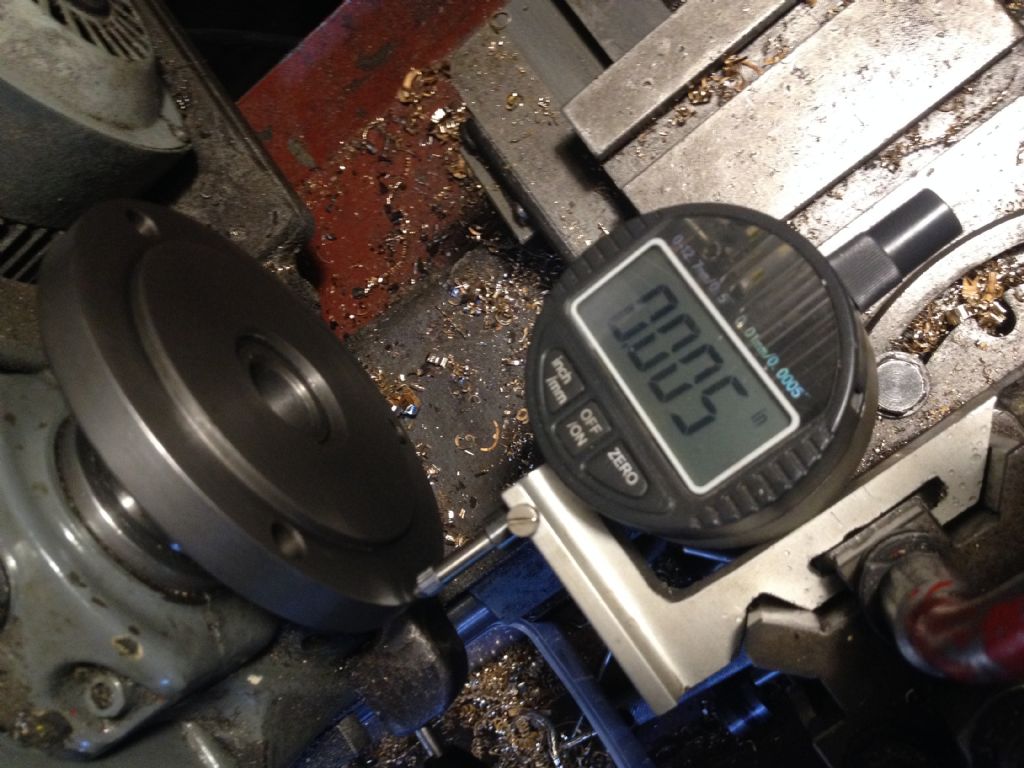
      also checked the back plate on the outer edge. Photo shows maximum…

      Grotto, re the above and the relevant photo, a runout of 0.005" is far more than it should be — look for 0.0005" or better ! From what you say about previous owner it has not been the original fitting/making of the backplate so one must assume something has changed.

      As has already been said and this also suggests to me there is some damage, dings of embedded swarf in the register or maybe the threads. A finger nail or tip can often detect imperfections not seen by the eye.

      Assuming the thread fitted easily when in reverse and if it is still tight when the right way around then clearly that is the first thing to solve. When that is solved re-check face with your clock and look for an improvement.

      Unless there is a serious bruise on the register part its unlikely the bore is damaged but look/feel for any swarf or scoring. However your photo suggests this is not the case. The rear face I would stone this with a very fine India stone – make sure it is flat and not worn !! If you don't have that use a parallel or similar with 800 paper– use very short back and forth strokes to ensure flatness and work around the the boss not just in one direction. This is to remove only any dings — take care not to remove parent material.

      Once the all the above is resolved should there be no further improvement I would consider skimming the face where the chuck locates BUT take care not to alter the diameter of the location register for the chuck body.

      Might be good to say where you are located there could be someone close by to offer hands on help ???

      Regards John

      #421673
      old mart
      Participant
        @oldmart

        Truing the face of the backplate is vital, but if the chuck register also runs eccentrically, something must be done about it. The only thing that can be done to the chuck fitting register is to reduce it till it runs true. This is not the end of the world. Most of the chucks I use have had their registers reduced on purpose. this enables the fine tuning of any size work after slackening the fastenings slightly and truing up the chuck with gentle tapping with a copper hammer before tightening up and rechecking.

        #421758
        JohnF
        Participant
          @johnf59703

          Very true Old Mart but we have not seen a true concentricity reading for the register yet and with the dial gauge Grotto is using it will be difficult to do this on the narrow register. The face is out by 0.005" and this will throw the chuck out even if the register is zero TIR so my assumption was too correct this first and see the result.

          Should the result not be conclusive then as you rightly say the register needs attention thus the chuck can be adjusted manually before final clamping is applied.

          It would be advantageous for Grotto to obtain a suitable clock – dial gauge to enable checking of the register TIR.

          All of this may be avoided if the reason the chuck has suddenly become tight fitting is resolved ?? Assuming of course it was OK before it became tight !

          #421764
          Michael Gilligan
          Participant
            @michaelgilligan61133
            Posted by Michael Gilligan on 30/07/2019 06:33:16:

            .

            The thread looks good from here, and [as per my previous post] is best left untouched.

            It may be a trick of the light, but … I think there is some scuffing on that parallel register, and that's where you need to focus your attention.

            MichaelG.

            .

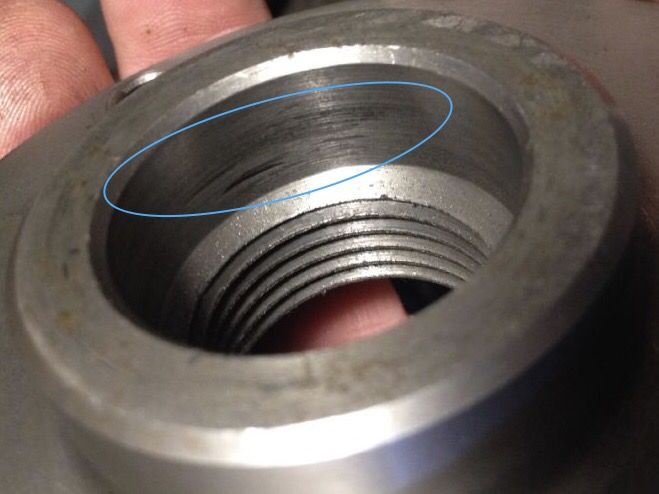
            Am I alone in thinking that the problem area is visible in Grotto's last photo ?

            … I have identified the 'region of interest' in this cropped version:

            img_3216.jpg

            .

            MichaelG.

            #421799
            Mick B1
            Participant
              @mickb1
              Posted by Michael Gilligan on 30/07/2019 22:59:47:

              Am I alone in thinking that the problem area is visible in Grotto's last photo ?

              .

              MichaelG.

              Nay lad, tha c'd well be right. Possibly a raised lip on the lower edge of the darkest gouge about a pitch or two above the thread?

              #421810
              Mick B1
              Participant
                @mickb1

                Worth adding that in the first set of pictures there are scuff marks on the spindle register that might correspond. Difficult to know how serious they might be without copping a feel…

                #421819
                SillyOldDuffer
                Moderator
                  @sillyoldduffer
                  Posted by Mick B1 on 31/07/2019 08:25:32:

                  Posted by Michael Gilligan on 30/07/2019 22:59:47:

                  Am I alone in thinking that the problem area is visible in Grotto's last photo ?

                  .

                  MichaelG.

                  Nay lad, tha c'd well be right. Possibly a raised lip on the lower edge of the darkest gouge about a pitch or two above the thread?

                  Maybe a bruise is the cause but Grotto's original post implies the chuck was OK up to the point it suddenly went wrong. To me that implies an event, something happened to cause the problem.

                  I wonder how often Grotto has the chuck on and off his lathe? If he's the kind of user who never moves the chuck, then damage inside is surely unlikely? On the other hand frequent chuck changing might explain bruising.

                  Not infallible, but new faults can often be traced to something that happened recently. What changed last? Bob Stevenson asked if the chuck had been dropped recently, I'd extend his question to cover anything out of the ordinary such as crashing the saddle, work camming out of the jaws, or a dig-in etc. If more than one person uses a machine, remember the one who had the accident may be reluctant to admit it!

                  In the absence of a crunch, I don't think Grotto has tried stripping the chuck and cleaning the insides yet. Swarf gets into the works and it can effect the jaw settings. That's my number one suspect until swarf is proved innocent. Less likely perhaps the scroll is damaged.

                  I'd suggest jaws inserted in the wrong order except the error it produces is obvious, hence unlikely in this case.

                  Before cutting metal to fix a problem I like to be certain of the cause. One thing's for sure; removing metal from the wrong place is likely to add more problems.

                  Dave

                  #421820
                  Mick B1
                  Participant
                    @mickb1

                    You're right about implying an event. I don't think those marks inside the backplate register could've arisen without one that involved some force beyond simple manual pressure.

                    #421823
                    not done it yet
                    Participant
                      @notdoneityet

                      Seems as though son might know more about the incident that caused this. Father should be more likely to know the registers need to be scrupulously clean when swapping chucks and would surely have noticed it ‘on his shift’, before posting on here. Ages, experience, etc of dad and son might be revealing?

                      That the 4 jaw goes on fine indicates that the back plate is damaged (or the 4 jaw back plate is loose on the register).

                      I think I would know if I had trapped some swarf in the register on my lathe, so it is likely a third party! Aluminium swarf would ‘smear’ quite easily, perhaps, but it would still be there in a thickness sufficient to throw off the accuracy of the chuck.

                      Show this post to son – and watch for his reaction?

                      #421824
                      Michael Gilligan
                      Participant
                        @michaelgilligan61133

                        Posted by SillyOldDuffer on 31/07/2019 09:44:22:

                        .

                        Maybe a bruise is the cause but Grotto's original post implies the chuck was OK up to the point it suddenly went wrong. To me that implies an event, something happened to cause the problem.

                        [ … ]

                        .

                        Like [perhaps] bumping the register on the end of the spindle nose thread whilst removing the chuck ?

                        No offence to Grotto intended … it's all-too-easy to do.

                        MichaelG.

                        .

                        We're on the same page, Dave.

                        #421825
                        Grotto
                        Participant
                          @grotto

                          Thanks again for all the help!

                          Unfortunately I’m located in Auckland NZ, so guess it’s not so handy for someone to drop around.

                          I do change chucks every so often, I didn’t appreciate they should be scrupulously clean (should have), and can’t swear it hasn’t been bumped ( hadn’t been dropped). I haven’t had any major crashes, but have had a few dig ins when parting. May have bumped the register?

                          no offence taken by any suggestions of mistreatment or carelessness, I tend to learn best by making mistakes and am learning to slow down and clean up, but limited time and space makes it hard.

                          i have pulled the chuck apart, no sign of any swarf in the gears, but will give it a good clean tomorrow (work & family have prevented me from putting in any workshop time today.

                          JohnF – what type of clock – dial would I need to check register TIR?

                          I'll investigate the “region of interest” tomorrow.

                          I’ll avoid removing any metal in the short term, that would be a last resort, can’t see that route leading me anywhere other than getting a replacement.

                          #421826
                          SillyOldDuffer
                          Moderator
                            @sillyoldduffer
                            Posted by Michael Gilligan on 31/07/2019 10:09:17:

                            Posted by SillyOldDuffer on 31/07/2019 09:44:22:

                            .

                            Maybe a bruise is the cause but Grotto's original post implies the chuck was OK up to the point it suddenly went wrong. To me that implies an event, something happened to cause the problem.

                            [ … ]

                            .

                            Like [perhaps] bumping the register on the end of the spindle nose thread whilst removing the chuck ?

                            No offence to Grotto intended … it's all-too-easy to do.

                            MichaelG.

                            .

                            We're on the same page, Dave.

                            Judging by how often I make them it's far too easy to make mistakes! A jolly good thing about owning a Chinese lathe is operator error doesn't worry me much. I'd be a nervous wreck if I was learning the ropes on a new Myford Connoisseur and kept dinging it.

                            If Grotto's chuck problem is due an accident, it's more important to know what it was than to play the blame game.

                            My mistakes are confessed on the forum because they might help someone else. Or perhaps it's because my cupboards are so packed with skeletons there's no room left for keeping the latest embarrassments secret.

                            blush

                            Dave

                            #421841
                            JohnF
                            Participant
                              @johnf59703

                              Grotto, Dave's [SOD] comment is very pertinent :-

                              Before cutting metal to fix a problem I like to be certain of the cause. One thing's for sure; removing metal from the wrong place is likely to add more problems.

                              Dave

                              Also Micheal G and MickB1 have good points, particularly Mick's comment about the spindle scuffs, looking at your photo's I would polish the machine spindle register under power with very fine or worn wet & dry – just enough to remove any surface grime or small burrs, DO NOT remove any scoring or deep marks just polish the surface, probably best with the paper wrapped on a suitable piece of flat metal. Remember to lubricate this area with oil [not grease] when fitting your chucks etc.

                              The dial indicator type you need is similar to this **LINK** I'm sure you will find a local supply of something similar

                              John

                              #421850
                              Howard Lewis
                              Participant
                                @howardlewis46836

                                For checking the Register, you are looking for very small errors, so a Finger Clock, of the Verdict type would be ideal, since they tend to be graduated in 0.0005" or 0.01 mm increments. By estimating between the graduations, you can achieve better than that.

                                Personally, I would be very wary of removing metal from the register on the mandrel, unless it is a raised bruise or burr. Once certain that the mandrel is free of burrs, if the problem persists, then my attention would be turned to the 3 jaw chuck and the faceplate to look for burrs on the register, or dirt or damage in the threads.

                                If the worst came to the worst, the chuck could be fitted with a new backplate, and the faceplate worked on until it is a snug fit. Any work held in the 4 jaw, or mounted on the faceplate will need to be centred, so any small errors will be countered by this.

                                Howard.

                                #421959
                                old mart
                                Participant
                                  @oldmart

                                  There is certainly a mark in the picture, it looks like the backplate was screwed on dry, and I always like just a tiny bit of oil when I change chucks.

                                  The lever type indicators are much easier to use on machinery, I would only use plungers in conjunction with a surface table, with their axis vertical.

                                  The recent legacy of tools and machinery included a Baty or Mercer plunger DTI in a box with a number of accessories including lever type adaptors. I hid it somewhere and haven't had time to have a good look at it. I wonder if such lever converters are available these days? I have just looked on ebay, there is a listing showing the lever I mentioned: 264409293958. The lever style can be bought very cheaply, probably not as robust as my Miyutoyo's, but so much easier to use than a plunger.

                                  Edited By old mart on 31/07/2019 21:41:00

                                  #421986
                                  Grotto
                                  Participant
                                    @grotto

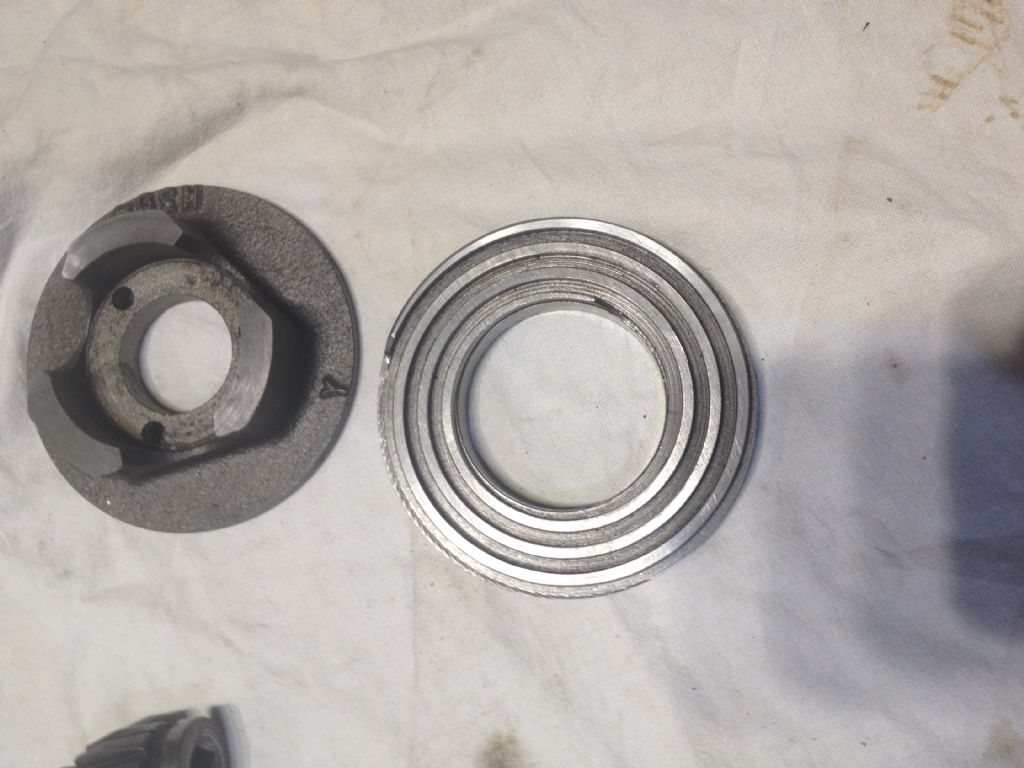
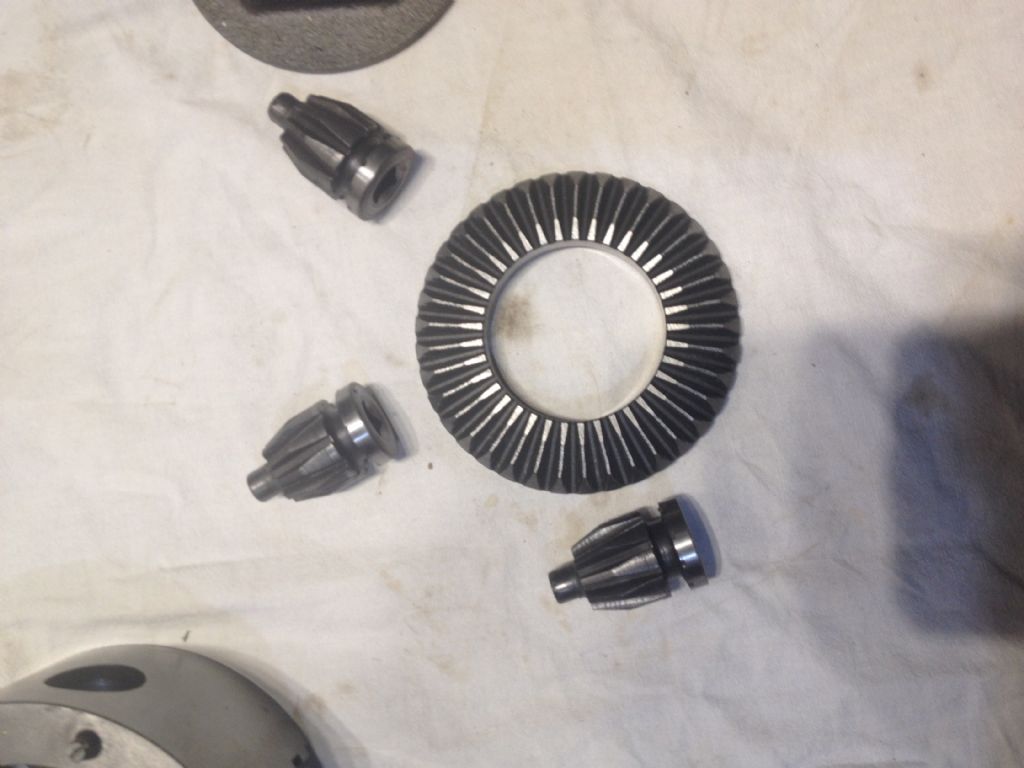
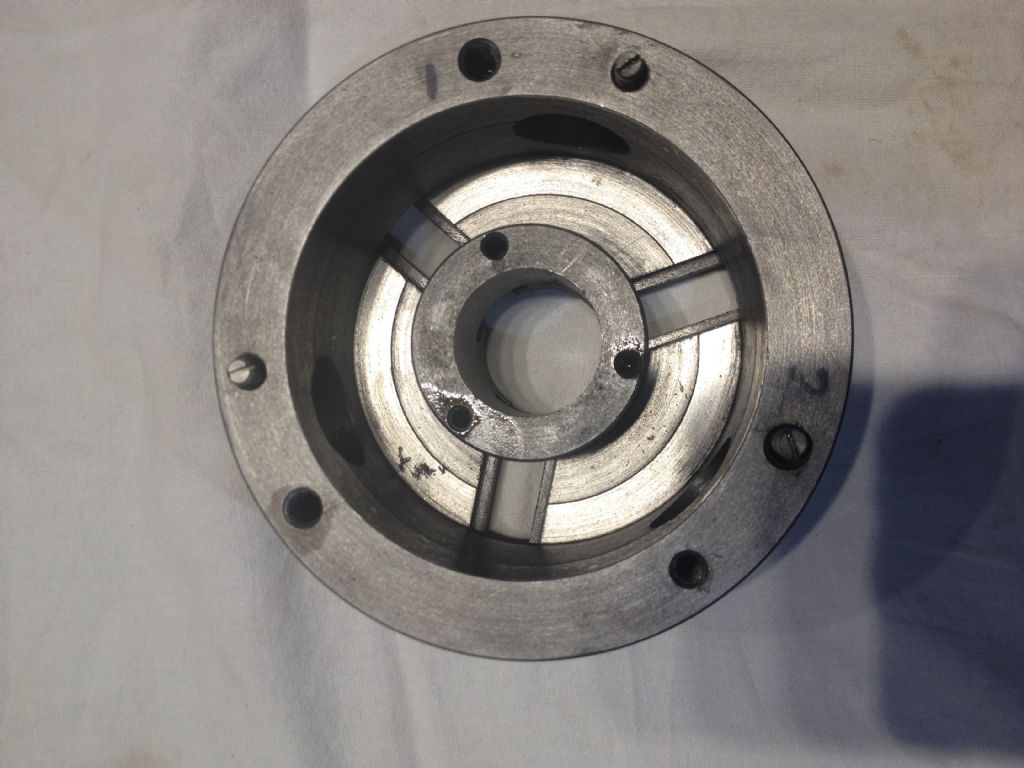
                                    Managed to get some time today, so pulled the chuck apart. No significant swarf, but gave it a good clean and lube and put it back together.

                                    It looks like some swarf has got between the scroll plate & chuck at some stage, but I don’t think this would cause issues.

                                    image.jpeg

                                    image.jpeg

                                    image.jpeg

                                    #421987
                                    Grotto
                                    Participant
                                      @grotto

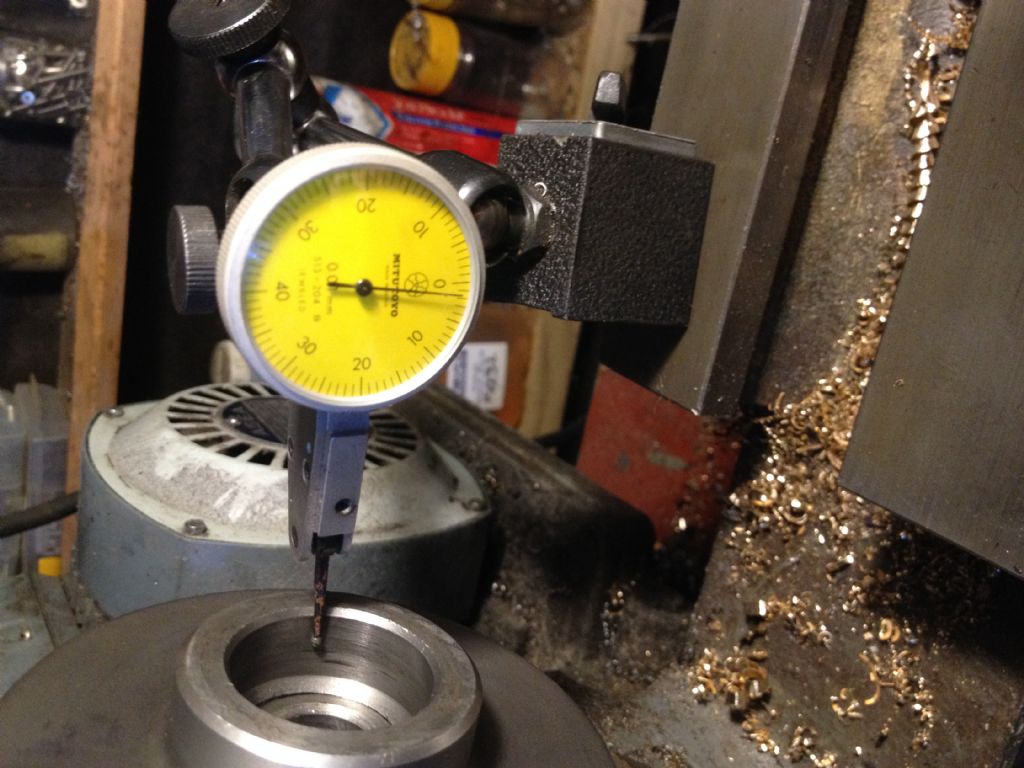
                                      I’ve checked out the “area of interest” and there may be a minor “groove” but no raised area.

                                      I used a lever DTI on the register, photo shows maximum variation…

                                      image.jpeg

                                      I'll have a go at polishing register with some very fine wet & dry & cutting fluid.

                                      I just happened to be given some round bar the right size for a back plate, so may have a go at making a new one. Not overly confident, but it'll be good practice.

                                      #422000
                                      not done it yet
                                      Participant
                                        @notdoneityet

                                        Posted by Grotto on 01/08/2019 06:46:53

                                        ….

                                        I just happened to be given some round bar the right size for a back plate, so may have a go at making a new one. Not overly confident, but it'll be good practice.

                                        Concentricity and dimensional precision (of the registers) are the two important aspects. All done without removal from the lathe chuck should ensure that. Threading precision is not so important as long as it is in line with the registers and is of the correct thread form. Again, if done without removal from the chuck should not be anything but on line.

                                        Initially an imposing challenge, but when you have done it once, you will wonder why you were worried – even if the first attempt is not too “pretty”!

                                        Have a look at the three part series of u-toob vids by doubleboost on making one.

                                        **LINK**

                                        #422152
                                        Grotto
                                        Participant
                                          @grotto

                                          Thanks,

                                          Watched doubleboost videos. Makes me feel a lot better knowing it’s not just me who sometimes takes too much off, and good to see the solution when you do.

                                          #422160
                                          JohnF
                                          Participant
                                            @johnf59703

                                            Grotto, do take care when"polishing" the machine spindle register — you are polishing to remove burrs only not removing any material that alters the OD !

                                            The register I was suggesting you needed the DTI for id the backplate chuck register seen here adjacent to the indicator probe – this is normally a very close fit in the chuck.

                                            image.jpeg

                                            #422185
                                            David George 1
                                            Participant
                                              @davidgeorge1

                                              When you come to finnish the diamiters on a back plate, take care that it is not warm as when it cools the size changes, a bore will shrink and an outside diamiter nice fit will be loose.

                                              David

                                              #422186
                                              not done it yet
                                              Participant
                                                @notdoneityet
                                                Posted by David George 1 on 02/08/2019 08:46:49:

                                                When you come to finnish the diamiters on a back plate, take care that it is not warm as when it cools the size changes, a bore will shrink and an outside diamiter nice fit will be loose.

                                                David

                                                Spot on. I found that on the first back plate I machined about 25 years ago. I very carefully cut the spigot, for the chuck, to a nice close fit – but it was much looser the next time I tried it. There was plenty of metal, so I cut it again, as I recall. An undercut at the inside corner of the spigot is also important if the chuck has a square corner. This is because they are unlikely to fit together perfectly without some clearance at that point.

                                                #422224
                                                Howard Lewis
                                                Participant
                                                  @howardlewis46836

                                                  The three places on the backplate that need to be accurate, if concentricity of the chuck is to be optimised, are:

                                                  1 ) Register for mandrel. Once this is satisfactory, the "backplate to be" can be screwed onto the Mandrel, and the other faces machined without disturbing the embryo backplate.

                                                  2 ) Squareness of front face of backplate

                                                  3 ) Outer Diameter of backplate where it fits in chuck body.

                                                  An adequate chamfer between the front face and O D is necessary, to prevent any foul in the corner of the recess in the back of the chuck.

                                                  Even with all the above at maximum precision, work held in a 3 jaw chuck is unlikely to runs absolutely true, 0.003" to 0.005" is fairly good. (I have seen one with less than 0.001" run out, but that is exceptional. )

                                                  For absolute concentricity, you have to mount the work in a 4 jaw chuck, and clock it and adjust until it is acceptably concentric.

                                                  Howard

                                                  #422230
                                                  Mick B1
                                                  Participant
                                                    @mickb1
                                                    Posted by Howard Lewis on 02/08/2019 13:02:31:

                                                    Even with all the above at maximum precision, work held in a 3 jaw chuck is unlikely to runs absolutely true, 0.003" to 0.005" is fairly good. (I have seen one with less than 0.001" run out, but that is exceptional. )

                                                    For absolute concentricity, you have to mount the work in a 4 jaw chuck, and clock it and adjust until it is acceptably concentric.

                                                    Howard

                                                    You can also get very good concentricity in a 3-jaw by using a set of soft jaws which you can bore to a set dimension whilst gripping a scrap piece of known round bar. These work best for components you've machined them to fit, but are often also useful for parts within a small range around that diameter.

                                                    My Warco's 3-jaw used with bar in the 6 – 20 mm diameter range will also often run within 0.001" TIR. I'm thinking that general build tolerances for such equipment may have improved since the 1970s.

                                                    #422240
                                                    Howard Lewis
                                                    Participant
                                                      @howardlewis46836

                                                      Yes, soft jaws, or a home made collet should produce absolute concentricity.

                                                      Very useful equipment, but not what the OP has, by the looks of it.

                                                      Chucks taking soft jaws are probably in the minority in the hobby world, much as they are useful.

                                                      Howard

                                                    Viewing 25 posts - 26 through 50 (of 62 total)
                                                    • Please log in to reply to this topic. Registering is free and easy using the links on the menu at the top of this page.

                                                    Latest Replies

                                                    Home Forums Beginners questions Topics

                                                    Viewing 25 topics - 1 through 25 (of 25 total)
                                                    Viewing 25 topics - 1 through 25 (of 25 total)

                                                    View full reply list.