Best dia slitting saw arbour to buy?

Best dia slitting saw arbour to buy?

Home Forums Beginners questions Best dia slitting saw arbour to buy?

Viewing 25 posts - 1 through 25 (of 58 total)
  • Author
    Posts
  • #825604
    andy198712
    Participant
      @andy198712

      Hi,


      want to add this to the Xmas list.


      i have a Sieg 2.7L mill. I mostly make bits for my classic motorbike in aluminium and little projects I set my self.


      what’s a good common, wide ranging dia arbour to buy? 1inch springs up a a lot?

      its R8 if it matters. Or I could do a straight shank one as I have a 25mm collet. But more looking at the diameter


      thanks

      andy

      #825611
      David Senior
      Participant
        @davidsenior29320

        Depends on the slitting saws. I have 13mm, 16mm, 22mm and 1″, all with R8 shanks

        1″ used to be the norm but I’m not sure any longer.

        Dave

        #825615
        not done it yet
        Participant
          @notdoneityet

          I have one that accepts three or four options.  I have both 20 (or 22) mm and 1” on my horizontal Centec.

          #825624
          jimmy b
          Participant
            @jimmyb

            I’ve made my own for a while now following a bad experience with a “universal” on…


            Jimb

            #825627
            SillyOldDuffer
            Moderator
              @sillyoldduffer
              On jimmy b Said:

              I’ve made my own …

              Jimb

              Me too, and I prefer buying to save time to making tools.   Though it works my multi-size holder isn’t concentric and the fit is loose.  The resulting wobble looks bad, so I made my own.   Not difficult, and fit and concentricity are much better.  Then I discovered many slitting saws are imperfectly concentric…

              Dave


              #825629
              JasonB
              Moderator
                @jasonb

                Classic bikes are likely to want imperial cuts so the saws tend to have imperial holes. 1″ would be my choice in that case and a 3″ dia saw as anything bigger in steel needs to be run a bit faster than ideal if the 2.7 is not to stall. Smaller saws will also tend to have a smaller bore but they also have a shallower cutting depth so unless you want to buy a lot of saws stick with the 1″ x 3″ option, maybe 4″ for non ferrous.

                If you are not bothered by width of cut then 22mm bore and 80mm dia saws would be a reasonable choice for that machine.

                #825641
                Bo’sun
                Participant
                  @bosun58570

                  Good morning Andy,

                  If you buy a readily available arbor, buy a good quality one.  I’ve experienced varying degrees of “runout” in some slitting saw blades, and runout in the arbor is only going to exacerbate this.  Too late now, but my 1″ MT3 one from ARC has been very good.


                  #825643
                  IanT
                  Participant
                    @iant

                    Good prompt at this time of year and with my off-spring asking for Christmas suggestions.

                    I think that all my slitting saws are 1″ bore – which fit my Horizontals. However for the new Seig, I purchased both 16mm and 22mm arbors (during Ketans fire sale – thinking mostly about gear cutters at the time). I probably need an R8 1″ too…so must add to the list.

                    Andy, I’m not sure that it makes much diference to you if the saw is Imperial or Metric but I’d guess you will be needing ‘heavier’ (larger) saws for your work. You can still get Imperial saws new (with 1″ bores) here in UK and they are out there in quantiy 2nd hand too. So I think 1″ would suit but if you want to be all Metric then I’d go for a 22mm arbor for the larger saw sizes.

                    Regards,


                    IanT

                    #825648
                    JasonB
                    Moderator
                      @jasonb

                      I’ve metric arbours in R8 for the SX2.7 and some of Ketan’s 22mm bore saws. On the X3 I tend to use a 1″ MT3 arbor so made a step down bush to go on the end so I can use the 22mm saws on both machines. I would think it an easy job to go the other way with a plain bush to allow 1″ saws to be use don a 22mm arbor.

                      As Ian says the smaller metric gear cutters tend to have similar bores to saws.

                      #825657
                      Julie Ann
                      Participant
                        @julieann

                        Metric slitting saws equals metric arbor, imperial slitting saws equals imperial arbor. Most of my slitting saws are imperial so I use 1″ and 1-1/4″ arbors on the horizontal mill. For deep cuts with slitting saws I prefer to use the horizontal mill as I’ve found slitting saws on the vertical mill go walkies with deeper cuts. Slitting saws on the vertical mill are limited to shallow cuts, such as slotting screw heads.

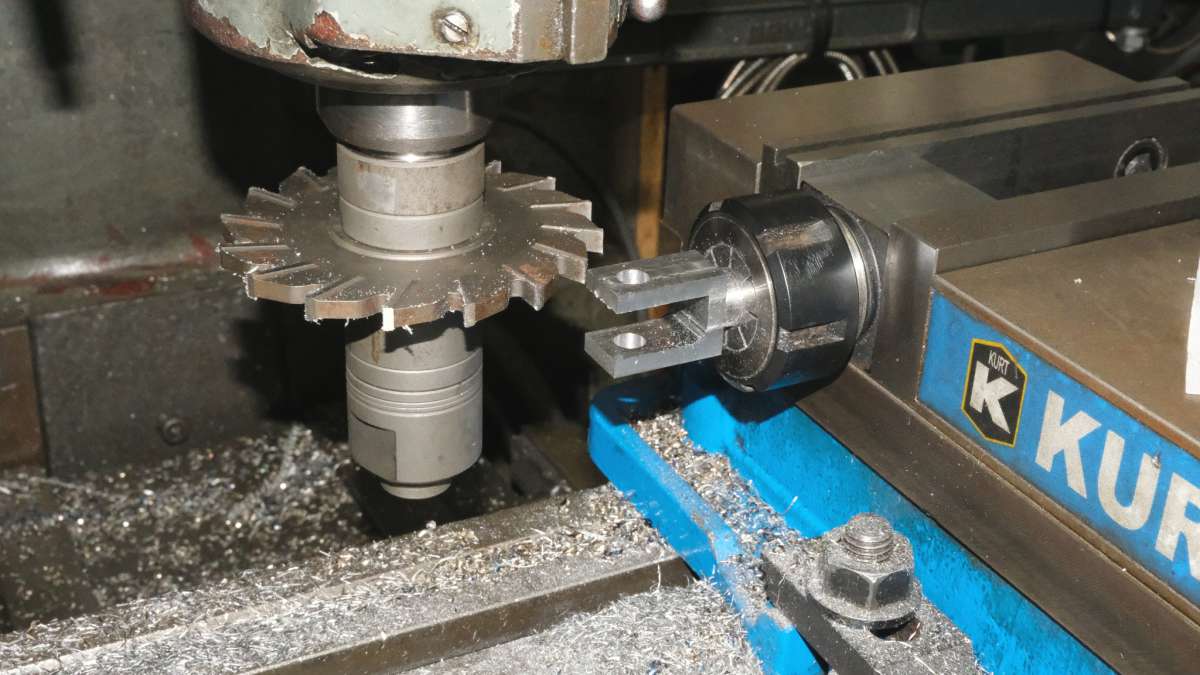
                        For the vertical mill I have a 1″ diameter R8 slitting saw arbor. I’ve never felt the need for other sizes. While slitting saws on the vertical mill are mostly limited to shallow cuts, with care larger cutters can be used:

                        Slot Finishing

                        The slot was roughed out using an endmill and the side and face cutter only used to bring the slot to final width and create the sharp internal corners.

                        Julie

                        #825659
                        Howard Lewis
                        Participant
                          @howardlewis46836

                          Most of my Slitting Saws are 12 bore, but one or two are 22mm

                          A friend has recently bought a Seig a 2.7 Mill  He has ER25 collets, so is making a parallel shank arbor to carry his 22mm bore saws.

                          If not, find a R8 blank arbor , turn a register and drill and tap the arbor before making a cap with a recess to clamp the saw. Preferably the cap should be countersunk to use a countersunk head capscrew.

                          If possible mill a couple of flats onto the clamp cap, for a spanner to help slacken when you want to remove the saw. Things will tighten up in use and and an Allen Key may not be able to slacken the cap screw.

                          Whatever you do, DO NOT use a key.  If the saw jams, it is likely to shatter and you will have jagged metal flying past you.

                          I was walking past a machine when an Apprentice had used a key and the saw shattered when it jammed!

                          Be cautious rather than ambitious when sawing!

                          Howard

                          #825663
                          Julie Ann
                          Participant
                            @julieann

                            I wonder why manufacturers generally supply slitting saws with keyways if they shouldn’t be used?

                            Julie

                            #825674
                            JasonB
                            Moderator
                              @jasonb

                              Though there are a lot of slitting saw arbours about that don’t have a key like you tend to find on the longer milling and stub arbours.

                              sa

                              #825680
                              IanT
                              Participant
                                @iant

                                I don’t use the keyway with slitting saws on either the lathe or horizontal but then I’m not trying to push them very hard. I would generally use one of my horizontals for this work, as the arbor can then be supported at both ends and this helps prevent the “walkies” that Julie refers to. I have vertical heads for both my horizontals but can’t recall ever using a (slitting) saw with them, although I’ve certainly used them on my lathes…maybe having the Sieg will change my habits in this respect.

                                However, when using plain (heavier) milling cutters on the horizontals, I do use the keyway as (with deeper/wider cuts) the cutter will tend to ‘spin’ on the arbor if not secured. Plain milling cutters are normally run at lower speeds than a slitting saw, which may (or may not) also be a factor. I haven’t thought too deeply about it but it’s the way (The Sainted) Pete & Norm taught me to do it a very long time ago.  🙂

                                Regards,


                                IanT

                                #825694
                                cedric 1
                                Participant
                                  @cedric

                                  On 22 November 2025 at 12:00 Julie Ann Said:
                                  I wonder why manufacturers generally supply slitting saws with keyways…

                                  Supreme optimism.

                                  And maybe indexing during manufacture?

                                  #825703
                                  Julie Ann
                                  Participant
                                    @julieann

                                    I can’t immediately find it but recall that I bought one of the keyless slitting saw holders as shown by JasonB. It was hopeless, out of true in the round, and axially, so the slitting saw wobbled in two directions.

                                    If the slitting saw has a keyway I use it. On the vertical mill the slitting saws aren’t driven hard, mostly shallow slots. On the horizontal mill I drive slitting saws harder. They are mostly used for cutting up hot rolled steel stock into suitably sized blanks. I usually run around 30 to 50 rpm, 4 thou per tooth and depth of cut up to 3/8″ per pass. On the horizontal mill I use flood coolant.

                                    Julie

                                    #825734
                                    old mart
                                    Participant
                                      @oldmart

                                      Some 1″ bore slitting saw blades arrived by magic at the museum a year or so ago and I made an R8 arbor, and clamped a lathe tool on its side in the mill vise to finish cut the inch step to ensure the minimum centre runout. The saws are big enough to give a 2″ deep cut and get run at the slowest speed that either mill can run at. I also have a little arbour which holds saws of about 2″ diameter that can cut up to about 5/8″ deep. I don’t use keys, prefering the saw to slip in the arbor for fear of flying bits.

                                      #825738
                                      JasonB
                                      Moderator
                                        @jasonb

                                        I wonder why we don’t tend to use keys in other similar items, I can think of quite a few that I have and none use any form of positive drive to the cutter. What makes a slitting saw need a keyway when other items don’t?

                                        Table saw

                                        Radial arm saw

                                        Cross Cut Mitre saws

                                        Mains and cordless circular saws

                                        Biscuit joiner

                                        Various disc type router cutters

                                        Spindle moulder tooling

                                        Wet diamond saw

                                        9″ and 115mm angle grinders

                                        #825762
                                        old mart
                                        Participant
                                          @oldmart

                                          The picture of Julie Ann’s vertical mill has a cutter in the arbor that I would not regard as a slitting saw at all, but more associated with horizontal mills, and would have to have a key.

                                          #825792
                                          andy198712
                                          Participant
                                            @andy198712

                                            Can’t thank you all enough for your input! Been really helpful!

                                            I think I’ll go for 22mm to start with

                                            The job I want it for initially is I’m making some yokes for the motor bike so need to make some slits for clamping the forks.

                                            I have also thought about making one from a soft ended R8 arbour but my lathe is down at the minute and Xmas is coming!

                                            I’d not thought about the key way to be honest.


                                            is the best bet with the saws slow rpm, slowest power feed it’ll do or slower hand feed.

                                            and full depth of cut (I’ve seen that said a few times)

                                            I would have thought a few lighter cuts but I guess with more guided by the cut it’ll hold its path better

                                            #825797
                                            cedric 1
                                            Participant
                                              @cedric

                                              RPM needs to take into account the largish diameter. So a 100mm slitting saw needs to run at a theoretical 100rpm. In practice a bit less is good. Maybe 75 to 90rpm  etc.

                                              #825800
                                              JasonB
                                              Moderator
                                                @jasonb

                                                This is where old school practice does not meet well with modern bench top machines.

                                                As Cedric says a slitting saw generally ends up running slowly as cutting speed is calculated using diameter simple rule of thumb for HSS in steel is 75 – 100ft/min which equates to approx 75 -100rpm.

                                                These slow speeds combined with a 4″ diameter work OK on older machines with gear or belt speed change as the motor can be kept at optimum speed even though the spindle is slow. However a modern brushed or brushless variable speed machine needs it’s motor running right at the bottom of it’s speed range to get the spindle to also run slowly and becomes a bit gutless.

                                                Back to my first reply where I suggested 3″ or 80mm saws and mentioned stalling. Using the minimum saw diameter to give the depth of cut will allow the spindle to run faster but you are likely to have to exceed the book speeds, even an 80mm saw will need to be run faster in steel unless it is a very shallow cut. Not so bad in aluminium as you can run about 3 times as fast but may need to keep depth of cut and feed rates in all materials a lot lower than the Likes of Julie are able to take so hand feed and not too deep per pass. The Sieg powerfee ddoe snot go anywhere near slow enough

                                                I did this video some time ago of the SX2.7 with an 80mm saw cutting 12mm steel. Starts off at book speed 100rpm and just stalls but manages OK when the saw is run faster than the usual recommended speed at 210rpm.

                                                Also note the use of a coarse tooth saw, use these for anything of thickness so the gullets don’t fill with swarf, keep the fine tooth saws for slitting screws etc.

                                                #825812
                                                andy198712
                                                Participant
                                                  @andy198712

                                                  Thanks Jason that’s helpful! Good tip on the saw blades too, I Wouk have assumed a finer tooth count but you make a valid point!

                                                  shows where assumptions get you 🙂


                                                  I mostly do aluminium which will make my life a bit easier! Will update comeXmas time!!

                                                  #825821
                                                  cedric 1
                                                  Participant
                                                    @cedric

                                                    For slitting alloy fork yokes, 50mm slitting saws might work, as the yokes are , what, 13-16mm thick? Smaller diameter slitting saw will give less radius at the end of the slot, which is a bit neater.

                                                    So 50mm slitting saw on aluminium could run at 400+ rpm. Keep plenty of WD40 on it for cutting fluid with ally.

                                                    I notice the 50mm blades have no keyway. They are thin and fragile so a bit of slip rather than jam and explode, as they can, may be a good thing.


                                                    #825832
                                                    JasonB
                                                    Moderator
                                                      @jasonb

                                                      50mm is going to be a bit tight and likely not fit the 22mm dia arbor you have opted for. May give enough depth on a smaller arbor but 22 plus the clamping flanges is likely to be 32-35mm overall diameter of the arbor so that leavs just 9mm

                                                      80mm saw at 100m/min in aluminium would run at 400rpm as a starting point and you could go a bit higher if all sounds good..

                                                    Viewing 25 posts - 1 through 25 (of 58 total)
                                                    • Please log in to reply to this topic. Registering is free and easy using the links on the menu at the top of this page.

                                                    Latest Replies

                                                    Home Forums Beginners questions Topics

                                                    Viewing 25 topics - 1 through 25 (of 25 total)
                                                    Viewing 25 topics - 1 through 25 (of 25 total)

                                                    View full reply list.