balancing article issue 4586

balancing article issue 4586

Home Forums Locomotives balancing article issue 4586

  • This topic has 12 replies, 5 voices, and was last updated 8 May 2018 at 14:04 by SillyOldDuffer.
Viewing 13 posts - 1 through 13 (of 13 total)
  • Author
    Posts
  • #1712
    duncan webster 1
    Participant
      @duncanwebster1
      #352902
      duncan webster 1
      Participant
        @duncanwebster1

        Unfortunately the printers have had there usual difficulty with superscripts, and so the equations at the top left of page 708 are badly misprinted. They should read

        The rotating rotating force on the front axle would be 890 * 402 / 106 * 1.414 = 2.0 N = 0.45 lbf


        The rotating rotating force on the rear axle would be 1942 * 402 /10 *1.414 = 4.4 N = 0.99 lbf


        and the reciprocating force to the loco is 3852 * 402/106 * 1.414 = 8.7 N = 1.96 lbf


        Let's hope that this site can cope! Don't know why it has changed the font size, I just cuat and pasted out of the original

        Edited By JasonB on 05/05/2018 16:13:05


        Edited By JasonB on 05/05/2018 20:48:48

        #352934
        duncan webster 1
        Participant
          @duncanwebster1

          Just noticed that even that isn't right, the last equation should be

          3852 * 402/106 * 1.414 = 8.7 N = 1.96 lbf

          let's see if that works, cut and pasted again from the same original

          #353006
          SillyOldDuffer
          Moderator
            @sillyoldduffer

            Enjoyed reading this article over breakfast and it was helpful to know in advance which printed formula had been mangled.

            Despite struggling with the maths (worthwhile) I found several points of other interest in the article. For example, Duncan mentions 'I am not aware of anyone measuring hammer blow on a model'. Now there's a challenge! My first problem is I can't even imagine how it might be done at full size! How is hammer is measured in practice, or is it always calculated?

            Dave

            #353011
            duncan webster 1
            Participant
              @duncanwebster1

              The first post seems to oscillate between getting the formulae right and getting them wrong. Does this site have a mind of its own? (Just spotted, it's been altered by JasonB)

              as to measuring hammer blow, the LMS set up a loco (Black 5 I think), coupled it to something immovable, applied grease to the track and ran it at high speed. At some very high speed it started lifting it's wheels off the track. I suppose they could have strain gauged the bit of track, but I have no concrete info. There is mention in the Bridge Stress Committee of instrumented track, but I'm not sure how that works, you'd have to be lucky to get the wheel over the right bit of track at the right time. Much more likely is that they weighed the relevant bits and pieces and worked it out. I believe major builders had balancing machines similar to that in the photo.

              I have read somewhere that the model gas turbine builders have balancing machines. All you need (all!) is two bearings set on force transducers and a means of capturing the data. As it doesn't really matter in model locos I'll stick to weighing and calculating. If you set each driver on an axle rolling on horizontal knife edges you can measure the initial out of balance quite easily.

              There are many many locos out there which just run without messing with this arcane stuff, but it keeps the grey matter going trying to work out the effects

              #353097
              John P
              Participant
                @johnp77052

                Posted by
                duncan webster 06/05/2018 11:43:38

                I have read somewhere that the model gas turbine builders have balancing machines.
                All you need (all!) is two bearings set on force transducers and a means of capturing the data.

                Hi Duncan
                Read through your interesting article a few times ,still trying to
                get to grips with it.
                Adding weights to simulate the motion gear and then balancing the
                wheels as a set seems to be what you wish to do.

                The gas turbine balancers are a much more simple thing to do as
                the objective is to reduce the imbalance to a small amount as possible.
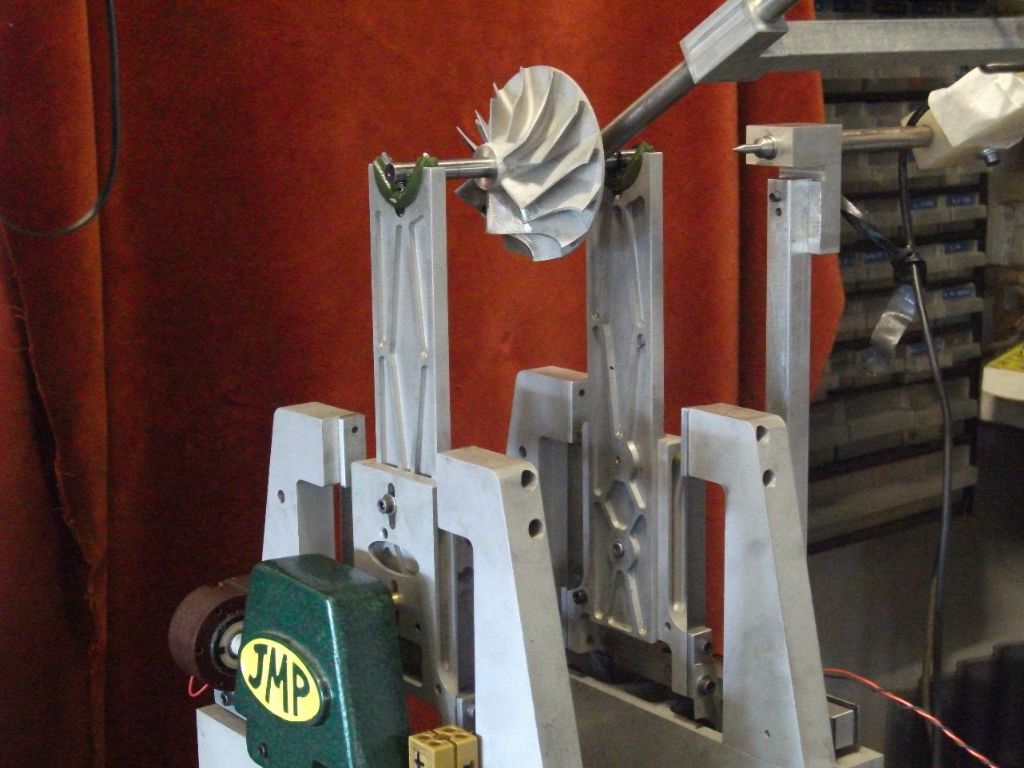
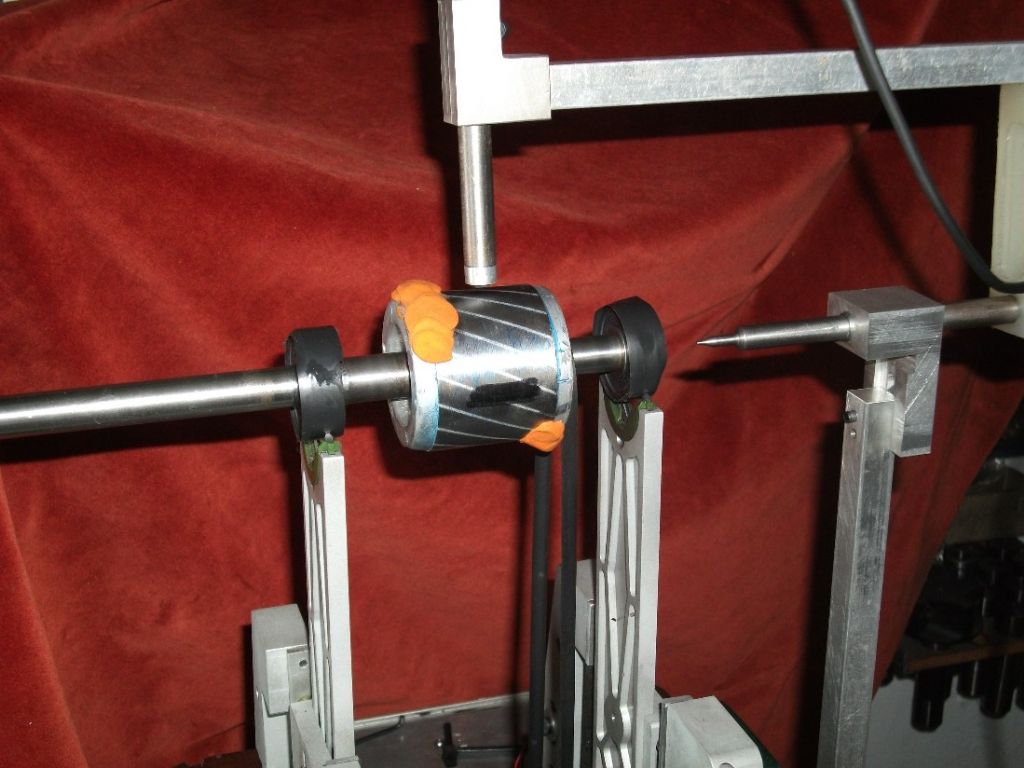
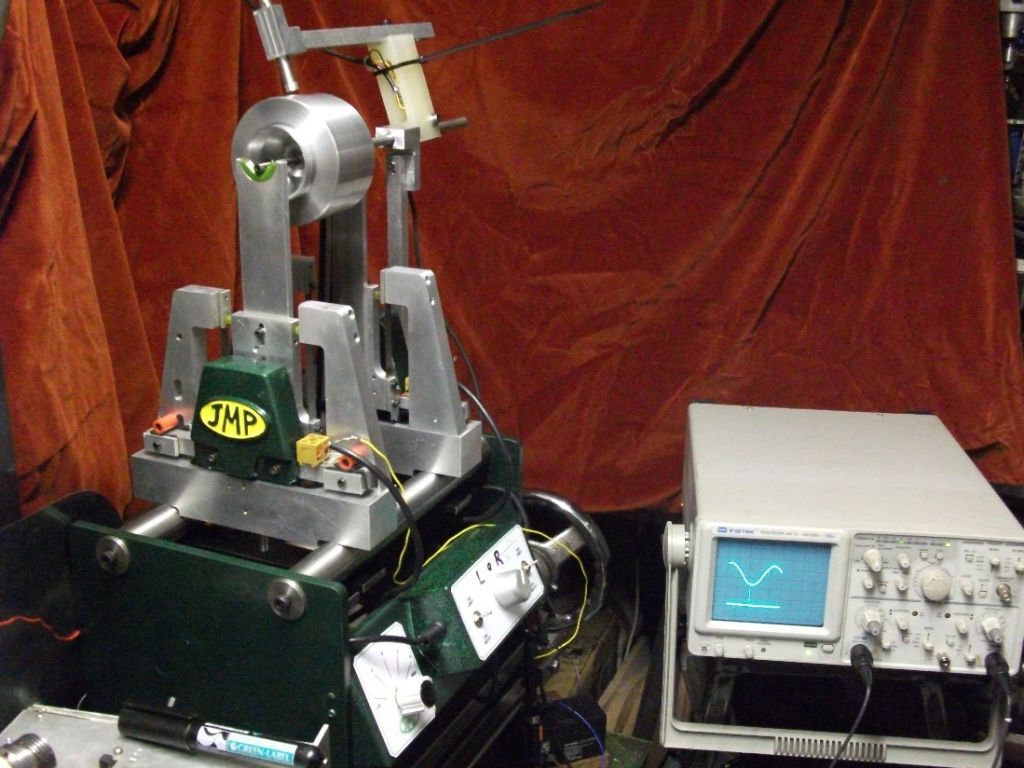
                The photo here is my two plane balancer ,the imbalance is displayed as
                a sine wave on an oscilloscope but has no values .Balance is achieved
                by adding weight to the light side (plasticene) and then removing metal from
                the opposite side,You may be able to see some metal scraped off
                the blades of this milled from the solid compressor wheel.
                This wheel needed only a few milligrams off the front plane and a little
                more off the rear to balance.
                The pickup coils are from an old washing machine solinoid valve and
                some neodymium magnets ,the signal is very small using an op amp
                gives a usable signal ,the balancer sits on the table of my mill which weighs
                in at about 500 kg but will pick up normal footsteps on the concrete floor
                in the workshop from 12 feet away.
                Most of these balancers seem to use piezos for the sensing , have
                used them they can be very sensitive and can pick up a lot of unwanted
                signals ,the quality of bearings can have some considerable influence
                on any displayed signal and can mask the information that you need.

                Some useful reading at http://www.universal-balancing.com on this site a balance tolerance calculator and some additional balancing info at http://www.turborebuild.co.uk

                John

                balance machine.jpg

                #353107
                Tim Stevens
                Participant
                  @timstevens64731

                  The effect known as hammer blow is, as I understand it, caused when the upwards force on the wheel is enough to overcome the down force from the spring, at a particular position of the parts, repeated each cycle. So, it is a repeated blow (not like leaping a hump-back bridge) and the hammering is when the wheel comes down back into contact with the rail. So, a high speed camera ought to be able to detect it, as would a microphone, I expect. Or even a small boy hanging by his toenails from the name plate.

                  The particular difficulty which I find interesting – of balancing steam locos – is the fact that generally the pistons move 90 degrees out of phase. This means that any unbalanced forces cannot be countered by those on the other side, as when one piston is at a dead centre, the other is (about) half way and max speed. As a result, they tend to cause rocking of the whole engine from side to side. If this happens at the resonant rocking frequency, the cup of tea carefully balanced in the cab will fly out of the window, followed by the fireman's hat. Other effects are also available.

                  The only 'answer' I have been able to find (apart from clever damping of sway) is to use three cylinders, working on an inboard cranked axle (no con-rods to the wheels, then) and possibly wheels linked by rods at 180 degrees. I suspect that finding room for the valve drive makes this difficult.

                  If there is to be a follow-up article, this might make a useful further topic, I suggest.

                  Cheers, Tim

                  #353108
                  duncan webster 1
                  Participant
                    @duncanwebster1

                    That is truly awesome. Notice I put an exclamation mark after the 'all'. Crying out for a write up in ME. Not clear how you rotate the disc, and is there a readout of angle so you know where the imbalance is rotationally?

                    I suspect what you have is a 'soft' balancer where you let the spindle move and measure the movement, as opposed to a 'hard' balancer where you stop it moving and measure the force it takes. I'd be interested in more details of your motion sensors as well. I've thought of using record player heads before, but never got any further than thinking

                    #353162
                    John P
                    Participant
                      @johnp77052

                      Hi Duncan

                      The first photo shows here this arm has a IR sensor which
                      moves in an arc of about 280 deg on the axis of the
                      item being balanced ,a felt tip line on the component
                      shows a pulse on the oscilloscope display.
                      Superimposing this on the sinewave generated by the motion
                      of the spinning component the arm is rotated to co-inside with
                      the peak or trough of the wave.
                      The rotor is driven by a small dc motor and a flat turntable belt,
                      the speed is adjustable .

                      In practice this rotor seen in the second photo would be spinning in
                      an anticlockwise direction ,the motion of the support bearing
                      moves to the right to provide a positive going wave .
                      A small weight is attached and the arm adjusted to the peak
                      of the positive wave.The rotor is stopped and the felt tip
                      mark is aligned with the sensor,if the speed of the rotor
                      is above resonance the weight will be at about the 9 o clock
                      position ,using a pointer to mark this position the weight
                      is removed and the rotor set spinning again ,adjusting the
                      position of the sensor to set the position of the wave the rotor is
                      stopped and the mark aligned again ,the position of the heavy or light
                      spot will be by the pointer depending whether the mark is aligned with
                      the peak or the trough of the wave.
                      Have sent you a PM.

                      This is as you suspected this is a soft balancing machine ,Joseph Noci
                      posted this thread which contains reference to a hard balancing
                      setup which may be more suitable to your application.

                      Joseph Noci 1 02/12/2016 13:47:16
                      A Hi-Speed Sensitive drill press.

                      John

                      photo 2.jpgphoto1.jpg

                      #353195
                      Another JohnS
                      Participant
                        @anotherjohns

                        Duncan;

                        Just a note that 4585 came today – looking forward (very much) to reading 4586, sounds like an interesting article, something to (as you say) keep the grey matter in check.

                        There's so much to learn, just not enough years to learn it in…

                        Tim – I did a bit of time (as I was was licensed to) in the cabs of large steam locomotives, and the clockwise sway of the locomotive's cab was noticable, especially on a 2-8-0 on a slowish-uphill drag. It was also told to me by a now deceased fireman/rail enthusiast that, on a Canadian 4-6-2 that we used to run in excursion service, that the trailing truck did the most work of any axle on that locomotive.

                        Again, interesting stuff; authors may not get much feedback, but interested novices like myself would certainly appreciate the articles.

                        John.

                        #353196
                        Tim Stevens
                        Participant
                          @timstevens64731

                          For those who are not mathematically inclined, there is another way to show what happens as you try to balance a to-&-fro motion with a round-&-round one. It can be produced on your knee as you sit at home – and it relies on nothing more complicated than paper, pencil, a ruler and a pair of compasses.

                          If there is interest in this as a way to understand better, please let the editor know and I will cobble something together.

                          My idea has appeared before, in the esteemed magazine Motorcycle Sport, in the mid 1970s, but as I wrote it then I can give myself authority to do it again.

                          Regards, Tim

                          #353272
                          duncan webster 1
                          Participant
                            @duncanwebster1

                            Tim said

                            If there is to be a follow-up article, this might make a useful further topic, I suggest.

                            As I said in the original, allowing for the fact that the various bits and pieces are not in the same plane gets more complicated, and is verging on text books, which might be out of place in ME. I could try to put something together, what does the forum think? The editorial team would have to sharpen up their act on printing formulae. For a loco built somewhat along the lines Tim was suggesting see

                            **LINK**

                            although this had 2 'motors' each with cranks at 90 degrees. This would make a super model, just drop out the motor/axle assembly from below if you wanted to work on it. Just a small point, con rods at 180 degress doesn't work as they are both on centre at the same time

                            Tim also offered another way of demonstrating reciprocating balance, bring it on says I.

                            Edited By duncan webster on 08/05/2018 12:40:52

                            #353287
                            SillyOldDuffer
                            Moderator
                              @sillyoldduffer
                              Posted by Tim Stevens on 07/05/2018 16:42:49:

                              For those who are not mathematically inclined,…

                              If there is interest in this as a way to understand better, please let the editor know and I will cobble something together.

                              Regards, Tim

                              Yes please Tim!

                              Maths is a tremendously powerful tool if only I understood how to use it properly. Anything that helps me understand balancing better will be read with interest.

                              Not sure what the ideal balance between numerate and practical articles is. Personally I'd like to see a tad more theory in the magazines, but then I'm a bit weird.

                              Dave

                            Viewing 13 posts - 1 through 13 (of 13 total)
                            • Please log in to reply to this topic. Registering is free and easy using the links on the menu at the top of this page.

                            Latest Replies

                            Home Forums Locomotives Topics

                            Viewing 25 topics - 1 through 25 (of 25 total)
                            Viewing 25 topics - 1 through 25 (of 25 total)

                            View full reply list.