Boring heads

Boring heads

Home Forums Workshop Tools and Tooling Boring heads

Viewing 25 posts - 1 through 25 (of 84 total)
  • Author
    Posts
  • #377437
    Ron Laden
    Participant
      @ronladen17547

      I have been looking at the boring heads in the ARC catalogue as I will soon have a need to bore a 100mm hole in a 25mm thick block. New to milling and never having used a boring head I was trying to figure out how its used.

      Would I be correct in thinking that once the work piece is centered to the spindle a hole is drilled big enough to take a cutter which is mounted vertically in the head. This cutter is used out to a size which allows the use of a cutter mounted horizontally which then cuts out to the finished size.

      Ron


      Edited By Ron Laden on 24/10/2018 16:14:12

      Edited By Ron Laden on 24/10/2018 16:19:28

      #19118
      Ron Laden
      Participant
        @ronladen17547
        #377441
        Neil Wyatt
        Moderator
          @neilwyatt

          Yes, but you might be dead by the time you've finished boring a 100mm hole with one if you start with a hole that small.

          Better to drill out a 3 /12" hole and knock it out with a cold chisel THEN bore it to final size.

          Neil

          Edited By Neil Wyatt on 24/10/2018 16:53:57

          #377442
          JasonB
          Moderator
            @jasonb

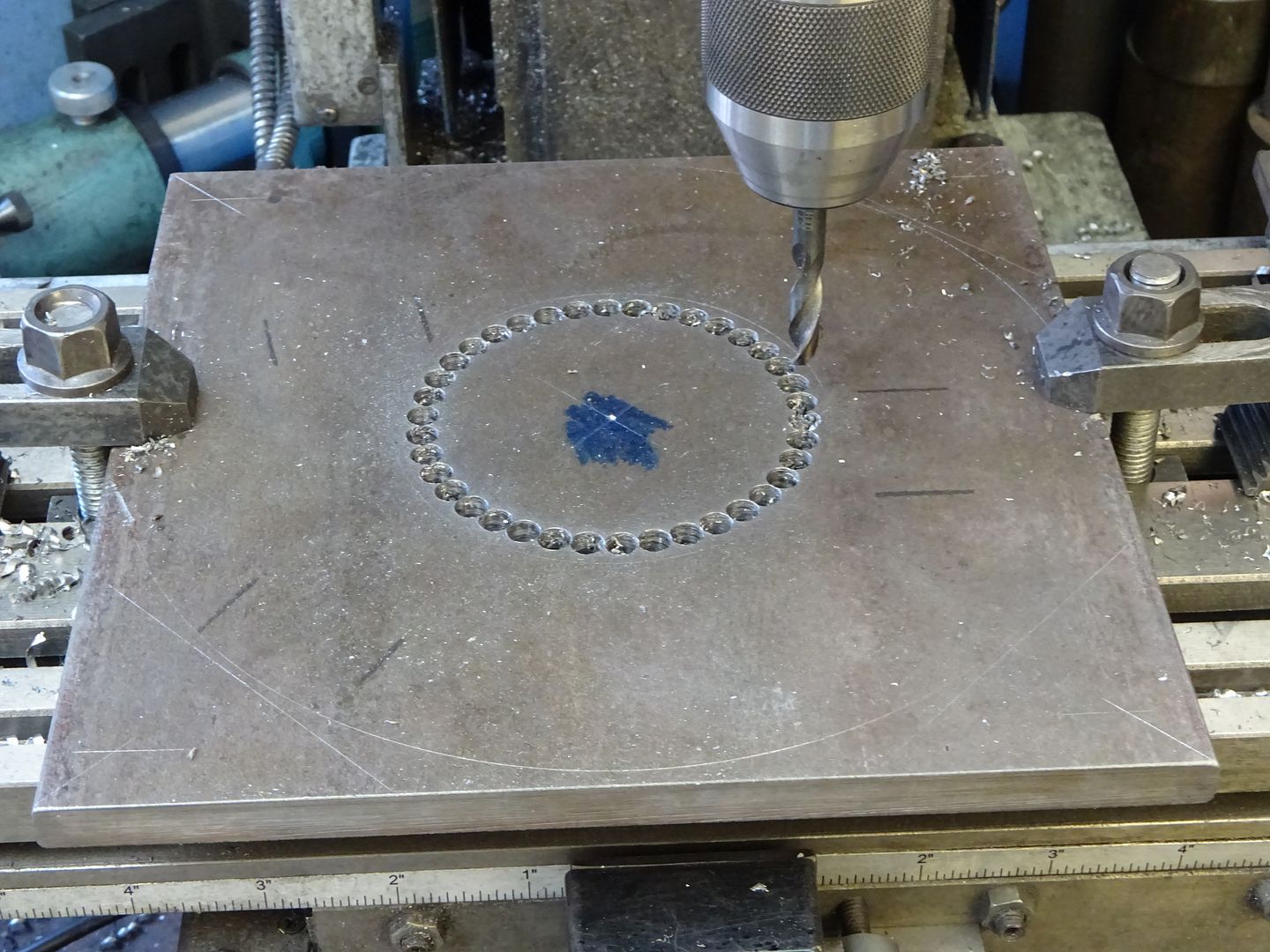
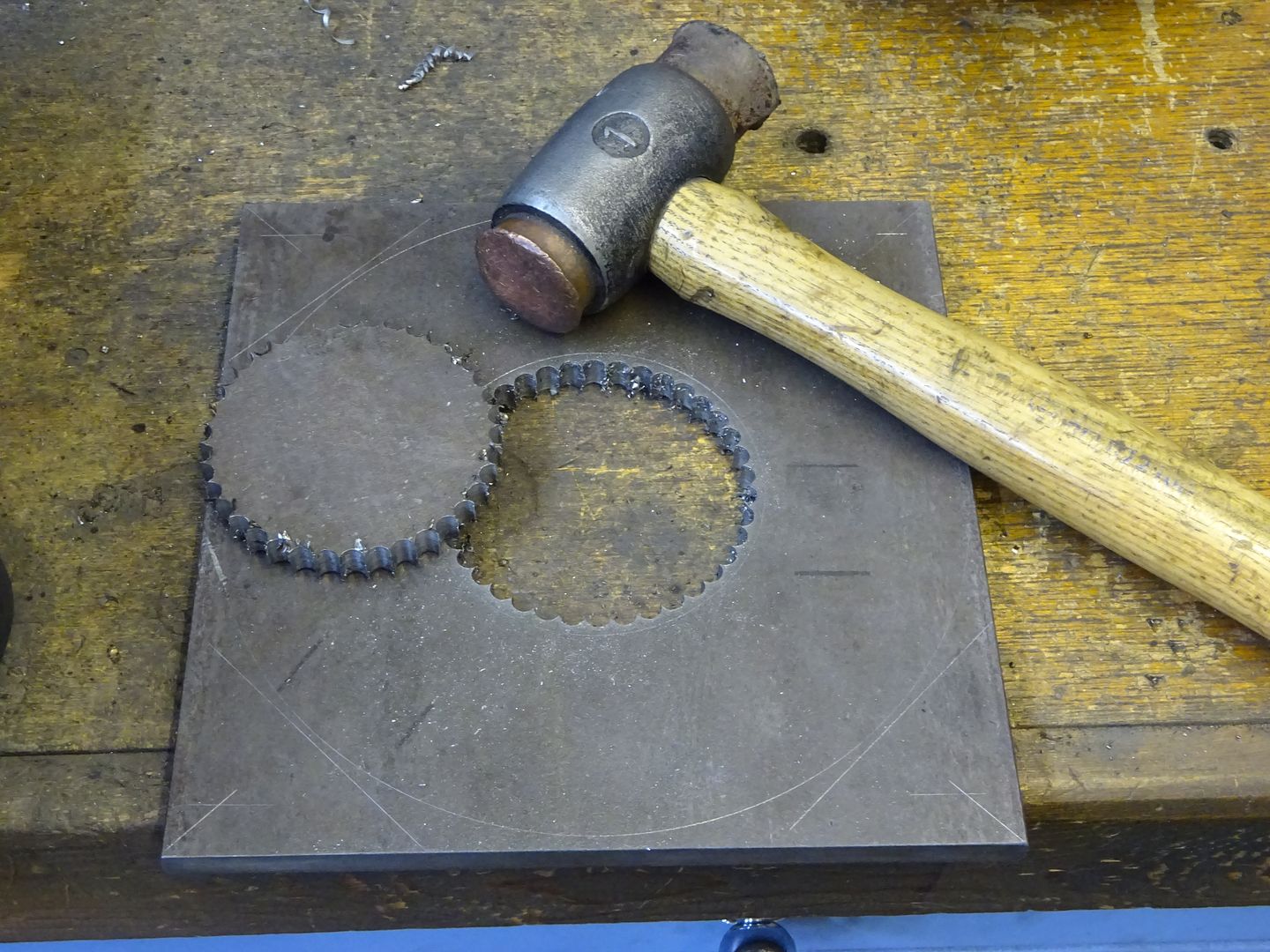
            As Neil says stitch drill it out first, if you get the holes spaced right it won't need much more than a tap with a big hammer and you get to use the bit in tne middle for something else.

            #377445
            ega
            Participant
              @ega

              Of course, if you have access to a large Rotabroach you will have an easier time to start with and a nicer bit in the middle.

              #377447
              not done it yet
              Participant
                @notdoneityet

                Presumably the outside dims are too big for your lathe?

                #377451
                mechman48
                Participant
                  @mechman48

                  + 1 for Neil & Jason suggestion

                  George.

                  #377464
                  Alan Vos
                  Participant
                    @alanvos39612

                    In case it isn't ******* obvious, practice on something smaller first. When I acquired a small boring head, it took a bit of experiment to figure out how to get the desired result. Once tamed, good results, even on an SX2P, which is not known for the finesse of the Z-axis.

                    #377475
                    Ron Laden
                    Participant
                      @ronladen17547
                      Posted by Alan Vos on 24/10/2018 18:30:14:

                      In case it isn't ******* obvious, practice on something smaller first. When I acquired a small boring head, it took a bit of experiment to figure out how to get the desired result. Once tamed, good results, even on an SX2P, which is not known for the finesse of the Z-axis.

                      I hope ******* is not what I think it may be Alan, but I will assume it isnt.

                      #377486
                      Simon Williams 3
                      Participant
                        @simonwilliams3

                        Ron, good evening to you.

                        At risk of asking a whole lot of questions you may have already addressed:

                        (1) What are you going to turn said boring head with? (Question of sufficient torque to cut material at 50 mm radius)

                        (2) What material are you cutting (same question as (1))

                        (3) What tolerance can you accept on the nominal finished diameter of 100 mm?

                        (4) How good (rigid and repeatable) is your boring head?

                        I've played this game, and (as Neil says – I paraphrase) you could die of caffeine poisoning waiting to get to the finished size, my experience with holes this big is that it is very difficult not to end up with chatter at the tool, which in turn jeopardises your ability to hit a given size. I also found that it was all too easy to stall the cutter in the work, which of course chips the edge.

                        Using a carbide tool solved some of the surface speed problems I encountered trying to do the job with a HSS cutter, but then it is a lot more difficult to adjust the cutter geometry than with HSS.

                        The reason for querying the quality of the boring head you envisage using is that you gets wot you pays for in terms of rigidity and settability (if that's a word).

                        If you've got a socking great milling machine which will run at a suitably low speed (say about 20 rpm for HSS) and a nice Wohlhaupter boring head then I'll wind me neck back in. If you've got a mini mill and a Chinese £20 boring head, well……

                        Look forward to hearing you've managed it.

                        Simon

                        #377490
                        Ron Laden
                        Participant
                          @ronladen17547

                          Hi Simon

                          I doubt I,ve addressed all the questions, as a beginner I probably dont realise what all the questions are.

                          I will be using my mill a SX2P, which is a mini mill its a 500 watt brushless but whether that is enough I dont know.

                          The material is 6082 T6 Ali

                          I can accept a couple of thou on the finished size.

                          I dont know how rigid and repeatable the boring head is, its a bit more than £20 but a lot less than you can pay and it comes with a set of carbide tools, how good or bad it is I have no idea.

                          I guess the only way to find out good or bad is to give it a try.

                          Ron

                          #377498
                          Simon Williams 3
                          Participant
                            @simonwilliams3

                            Hummmmmm

                            Thanks for your quick reply Ron, not sure how to break the news to you, and I'd be grateful if Jason and or Neil would chip in, but I think you are beyond the realms of SX2P capabilities, and stand a good chance of wrecking the motor/drive. You're going to be running the machine at bottom speed for an indefinite amount of time, and, from what I've read on this site, this is territory where these machines are not happy. Having said that I have no direct experience of this range of machines, so if someone wants to say I'm talking nonsense please do!

                            However, sorry to be the party pooper, but that's just the first problem.

                            The good news is that you are looking at cutting ally. At least that lets you push the cutting speed up towards the capabilities of the machine.

                            However I do worry about your wish to make a set size to a couple of thou. My experience of trying to set one of these boring heads to a given size is that they are lip service to the idea of boring rather than walking the talk. I have two ostensibly the same, but they are made differently and it makes a big big difference to the serviceability of the head. I estimate that the repeatability of setting is about +/- 10 thou, or 0.25 mm, you are going to struggle to hit a size to a couple of thou. One of the heads I have here has a captive gib built into the dovetail, I can set that to about +/- 5 thou, the other is the really cheap and nasty version, it looks the same but there is no gib and the setting screws bear on the side of the dove tail. On a good day with patience I can set this to about +/- 20 thou! It's rubbish! Hopefully Arc' don't sell these!

                            As you say, by all means try it and see how you get on, but be sceptical about the carbide tools you get as part of the kit. They look pretty enough, but to get good results the cutting edge needs to be at the centre height of the hole – in other words the point of contact of the cutting edge must be on a diameter of the hole. Some of these tools are made wrongly – the tool is located in the head on a diameter of the head, so the top face of the cutting edge needs to be BELOW the centre line of the tool, so that when it is mounted in the boring head you can twist the tool to give some top rake and bring the cutting edge up to the centre line. If the tool is too thick tilting the tool to give some rake pushes the top face of the tool way too high, and the cutting edge is actually trying to cut with negative rake. You won't get good results with this situation, even in aluminium.

                            Having been a douche of cold water, what about a more positive approach? Where are you in the country? If you fancy a trip to West Gloucestershire I'm pretty confident that my faithful Centec will stand a good chance, though of preference I'd stick it in the lathe and bore it out the old fashioned way. What's the overall size of the part? and the dimension of the hole centre to the furthest edge/corner?

                            Best of luck, Simon

                            #377500
                            Mark Elen 1
                            Participant
                              @markelen1

                              Hi Ron,

                              I bought that arc boring head along with the brazed tools. I’m about where you are in the grand scheme of things.

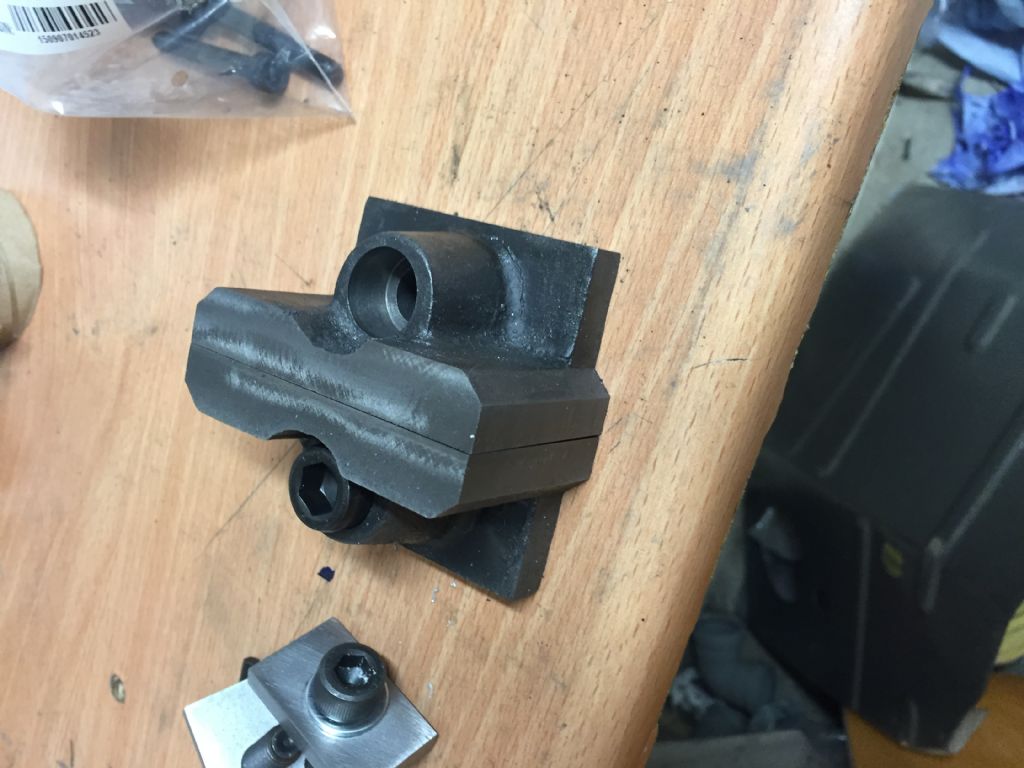
                              It’s all a learning curve. I got passable results with it on cast iron, but I was only boring to 18.5mm. I’ve since bought a boring bar with carbide inserts to fit it, along with uncoated inserts for Ali. (I’ve got a few Ali bores to do)

                              The photo below is the cast drilled out to 10.2 mm clearance then bored out to 18.5mm using the arc set.

                              image.jpeg

                              Cheers

                              Mark

                              #377504
                              not done it yet
                              Participant
                                @notdoneityet

                                When I have cut out discs for aluminium gears, I have used Starret/Bosch hole saws. Rather cheaper system than rotabroaches. Can get you close to finished size.

                                #377505
                                Emgee
                                Participant
                                  @emgee

                                  Hi Ron

                                  The worst part of the boring op will be the first cuts where the cut is intermittent because of the chain drilling, after that you will have a chance to experiment with different depths of cut and spindle speeds for best results.

                                  Also keep checking the diameter to establish accuracy of the head adjustment marks.

                                  Emgee

                                  #377506
                                  Anonymous
                                    Posted by Simon Williams 3 on 24/10/2018 20:32:55:

                                    If you've got a socking great milling machine which will run at a suitably low speed (say about 20 rpm for HSS) and a nice Wohlhaupter boring head ….

                                    Yes, on both counts, although minimum rpm is 30. smile

                                    However, I do have an el cheapo Soba boring head that I use on the Bridgeport. You can hit a thou or two but it takes some fiddling. As mentioned the tool geometry can be poor as bought and will rub rather than cut. Mine came with HSS toolbits that needed a serious regrind. It is essential to lock the boring head slide during every cut. A right pain, but still essential. Like boring in the lathe take spring passes when nearing size. To get any sort of proper usability you'll need to change all the socket head grub screws for proper US/UK ones.

                                    Another question; how are you going to measure the hole to a thou or two?

                                    Andrew

                                    #377509
                                    Simon Williams 3
                                    Participant
                                      @simonwilliams3

                                      Posted by Andrew Johnston on 24/10/2018 22:21:33:.

                                      Another question; how are you going to measure the hole to a thou or two?

                                      Andrew

                                      Hi Andrew, if that's aimed at me you are quite right to raise the question. I reckon my ability with an internal mic' at 4 ins diam is probably only +/- 1 or possibly 2 thou, so we're on the knockings of the specified accuracy anyway. Always assuming that my secondhand internal micrometer reads true (of which "true" is a whole new can o'Worms). I've got a suitably sized ball bearing we can use the OD as a putative standard and a 4 inch external mic' as corroborative evidence. What's the ISO 9001 speak for "somewhere handy"?

                                      (I was tempted to answer with something facetious about using a digital Vernier, but I thought I'd better not).

                                      Best Rgds Simon

                                      #377510
                                      Ron Laden
                                      Participant
                                        @ronladen17547

                                        Thanks guys but this is all putting me off buying the tool and having a go. I can in fact give this to a friend who works in a large machine shop and get it done that way its just that I was hoping to try it myself. If the mill is not capable of handling it then I dont want to try and risk damaging the mill.

                                        Andrew I have the part that fits the hole so that would have been the gauge.

                                        #377515
                                        not done it yet
                                        Participant
                                          @notdoneityet

                                          Better to have made the hole first? Then machine the part to fit? If part is already fixed there may be other ways to lose that last couple of thous.

                                          #377516
                                          ega
                                          Participant
                                            @ega
                                            Posted by not done it yet on 24/10/2018 22:01:25:

                                            When I have cut out discs for aluminium gears, I have used Starret/Bosch hole saws. Rather cheaper system than rotabroaches. Can get you close to finished size.

                                            Certainly cheaper, and fine when they will do the job. I have often found chip clearance a potential problem with holesaws when used on thick material, often necessitating frequent stops to clear and add lubricant. When, as with gear blanks, the middle rather than the hole is the object, I find it helpful to arrange things so that the kerf runs out at one or more points thus allowing the chips an easier exit.

                                            Apart from the fact that the Rotabroach type of cutter has flutes for chip clearance it has the added advantage that it cuts closer to size and, further, a pilot is not necessary so that the resultant slug has no central hole.

                                            #377527
                                            JasonB
                                            Moderator
                                              @jasonb

                                              Well that "cheap" import Soba that is in my picture above manages to cut holes for ball races that are a good fit. question

                                              Neil will be better able to comment on the power of an X2 but I'll stick an ARC boring head into the next size up SX2.7 later and see what it can do. SX2 certainly won't have the guts to turn a near 100mm holesaw let alone rotabroach with it's larger kerf but as the boring head allows a much smaller cut the load can be kept down.

                                              Not sure where this 20rpm comes from, more like 130rpm for steel and 170 for aluminium with HSS so 50% or more increase for Carbide tooling.

                                              Ron, is this to fit the "boiler" barrel of your traction engine?

                                              #377534
                                              Anonymous
                                                Posted by Simon Williams 3 on 24/10/2018 22:47:47:

                                                Hi Andrew, if that's aimed at me……………………………………..

                                                (I was tempted to answer with something facetious about using a digital Vernier, but I thought I'd better not).

                                                It was actually directed at Ron, but I forebore from saying calipers were the wrong answer! Turns out he's machining to fit an existing part, which is fine, as long as he doesn't get the part stuck. It's quite easy to get a part slightly skew when checking fit wherein it jams and won't come out.

                                                Andrew

                                                #377535
                                                not done it yet
                                                Participant
                                                  @notdoneityet

                                                  ’Posted by ega on 24/10/2018 23:46:07:

                                                  Posted by not done it yet on 24/10/2018 22:01:25:

                                                  When I have cut out discs for aluminium gears, I have used Starret/Bosch hole saws. Rather cheaper system than rotabroaches. Can get you close to finished size.

                                                  Certainly cheaper, and fine when they will do the job. I have often found chip clearance a potential problem with holesaws when used on thick material, often necessitating frequent stops to clear and add lubricant. When, as with gear blanks, the middle rather than the hole is the object, I find it helpful to arrange things so that the kerf runs out at one or more points thus allowing the chips an easier exit.

                                                  Apart from the fact that the Rotabroach type of cutter has flutes for chip clearance it has the added advantage that it cuts closer to size and, further, a pilot is not necessary so that the resultant slug has no central hole.

                                                  Your reply ignored what I wrote. Read the bit about ‘’getting close”. smiley You pick the size of cutter just below the hole size you require and finish off with a boring head, ther is no problem at all. I think the cutters cut the hole to size, not the piece cut out – well that is what I found when cutting circles for gears. I certainly would not trust a hole saw to give a perfectly finished hole at the nominal size. In my case the slugs needed a hole anyway – gears are like that – and were clearly finished to size on the lathe as the implest way to do it.

                                                  It was just an option, a possibility, a choice. If it doesn’t fit ones requirements, there are obviously other options. They are a great deal cheaper than a similar sized rotabroach, too – not just ordinary cheaper – the slug being a secondary consideration, I suspect, if a rotabroach was purchased for a one-off.

                                                  Are a few ‘frequent’ stops a problem with one hole? I don’t think so. Using a suitable coolant flow might well alleviate this problem somewhat, but the chips have to go somewhere, with either type of cutter and there will be less with hole saw (I think, anyway). A small hole in the slug could easily be filled, for many uses, if the slug were needed as a solid piece.

                                                  #377536
                                                  Anonymous
                                                    Posted by JasonB on 25/10/2018 07:18:13:

                                                    Well that "cheap" import Soba that is in my picture above manages to cut holes for ball races that are a good fit.

                                                    It must be boring being perfect. smile

                                                    Assuming 100fpm for HSS in steel the 'correct' speed is around 95rpm. I don't know what the minimum speed is for the SX2.

                                                    Andrew

                                                    #377538
                                                    JasonB
                                                    Moderator
                                                      @jasonb

                                                      I said good , not perfectsmile p

                                                      I've shown before that these machines can be stalled at the low speeds but luckily Ron is looking at Carbide tools and aluminium, add to that light cuts and I think it can be done.

                                                    Viewing 25 posts - 1 through 25 (of 84 total)
                                                    • Please log in to reply to this topic. Registering is free and easy using the links on the menu at the top of this page.

                                                    Latest Replies

                                                    Viewing 25 topics - 1 through 25 (of 25 total)
                                                    Viewing 25 topics - 1 through 25 (of 25 total)

                                                    View full reply list.