Warco WM16

Warco WM16

Home Forums Workshop Tools and Tooling Warco WM16

Viewing 21 posts - 26 through 46 (of 46 total)
  • Author
    Posts
  • #223645
    MW
    Participant
      @mw27036

      "But the best modification I made is to fit an AC motor and get rid of the gearbox"

      Theres something about DC motors that just never keeps up with the torque of an induction motor, i found anyway, i can understand why you'd do it.

      The WM18 is probably the zenith of this model with its 1.1KW motor, mines 750W written on the motor, but the spec on warco tells you its 600W, i could be wrong but i do find little inconsistencies regarding warcos info specs.

      P.S i love the rack and pinion feed for head elevation on the WM16, i've used a mill with a direct to leadscrew approach and it was hell to get the head up and down. Most times i use the rack to move about quickly then bolt up, use the fine feed on the quill. 

      Edited By Michael Walters on 02/02/2016 13:09:53

      #251268
      John Lintorn
      Participant
        @johnlintorn87585

        Hi guys! Just bought a used WM16. Everything seems in great condition. I took out the little gearbox inspection cover and noticed the gears do have grease but shouldn’t they be running in an oil bath? Any advice on lubricating the gears would be great!!

        #251272
        MW
        Participant
          @mw27036

          Hi John,

          Nope this is normal, this is the way mine looked from new. The grease is sufficient to keep things running smoothly. If you want to put more on it try molislip should do the trick.

          Michael W

          #251282
          John Lintorn
          Participant
            @johnlintorn87585

            Cheers Michael!

            #256175
            David Jenner
            Participant
              @davidjenner61726

              It would seem that these mills, like their lathe counterparts need some initial inspection and setting up, I have a Draper Mill/Drill/Lathe combo which needed an almost complete strip and rebuild before it was suitable to use. recently I bought a mini lathe second hand and have carried out an initial strip rebuild and adjust.

              I was quite shocked to find the gear train banjo out of alignment such that one set of gears was barely in 50% alignment!

              I'm researching milling machines at the moment to replace or supliment the draper, but expect to carry out some final fitting and alignment on anything I buy.

              Its down to cost at the end of the day, you still get a lot of machine for your money and an excuse to tinker!

              Regards Dave J

              #257309
              John Lintorn
              Participant
                @johnlintorn87585

                Clocking in the head.
                Now obviously it’s easy enough to clock the head in to the y axis as you can simply loosen off the bolts in the head. But I can’t find a way to clock the head in to the X-axis. Any suggestions?

                #257317
                Michael Gilligan
                Participant
                  @michaelgilligan61133
                  Posted by John Lintorn on 22/09/2016 11:42:34:
                  Clocking in the head.
                  Now obviously it's easy enough to clock the head in to the y axis as you can simply loosen off the bolts in the head. But I can't find a way to clock the head in to the X-axis. Any suggestions?

                  .

                  If it's wrong in the X, you will need to remove the column from the base, and either scrape it or shim it [according to taste] … This may be a long and tedious job.

                  Ideally, of course, it should have been built right … But, as Mr Stevenson never tires of telling us: These things are made "fit for purse".

                  MichaelG.

                  #257327
                  Brian Abbott
                  Participant
                    @brianabbott67793

                    Must say i have a problem with mine, i think the column is out to the base,

                    i can tram the head in ok so it stays true in the Z when using the quill, but when i wind the head up it moves.

                    Typical example would be, If i clock a hole up 0,0 with the quill fully out, then re tract the quill and wind the head down, clock the same hole and its out, normally quite a bit.

                    Always manage to work round it but it does need sorting out.

                    #257329
                    SillyOldDuffer
                    Moderator
                      @sillyoldduffer

                      Posted by Michael Walters on 02/02/2016 13:06:17:

                      The WM18 is probably the zenith of this model with its 1.1KW motor, mines 750W written on the motor, but the spec on warco tells you its 600W, i could be wrong but i do find little inconsistencies regarding warcos info specs.

                      Edited By Michael Walters on 02/02/2016 13:09:53

                      Strange coincidence. I come in from the workshop for a coffee having just taken the cover off the motor of my WM18 to check it was clean inside. (I mislaid the spindle cover a few weeks ago and have only just found it – and yes, swarf does get inside!)

                      I've noticed Warco inconsistencies too but put them down to 'true at time of printing' type confusion rather than deception. It must be hard to keep up with the many variations in the detail of this family of machines not to mention whether it's input or output power that's in the spec.

                      My version of the WM-18 does have an 1100W Output motor, hurrah. I don't think it makes much difference though. I suspect that 600W out is perfectly reasonable for a mill of that size. Perhaps I could take heavier cuts for longer with more risk of breaking something than you, but I don't work like that. And having a bigger motor hasn't made me any more skilled. If only it would!

                      A bit of good advice I picked up on the forum was to buy the biggest lathe or mill possible (subject to space, weight, money, quality and power requirements). For me the best thing about owning a WM18 is the extra space and travel I get from the worktable. It makes it much easier to mount work when you have plenty of room.

                      Cheers,

                      Dave

                      #257339
                      John Stevenson 1
                      Participant
                        @johnstevenson1

                        Small point X is long travel, side to side.
                        Y is short travel back to front.

                        Or was last time I used one 10 minutes ago. !

                        #257342
                        JasonB
                        Moderator
                          @jasonb

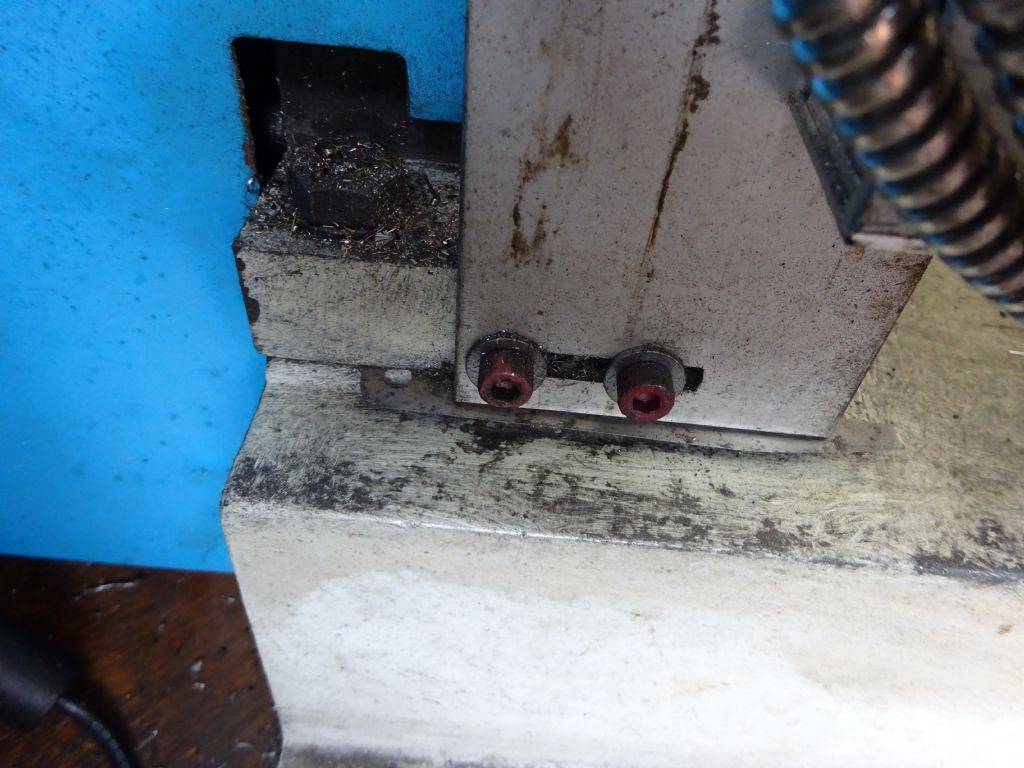
                          As Michael says if your column is leaning then a bit of shim or an old feeler gauge finger between the bed and column castings will do the trick, works OK on my X3

                          dsc01508.jpg

                          Now must get round to doing that on delivery strip down and rebuild, only had the mill 9 years without doing it. wink 2

                          #257344
                          david williams 14
                          Participant
                            @davidwilliams14

                            regular checks on tramming and a friends is great. having said that, I'm happy wit a centec 2a. just need to get a raising block machined

                            #257706
                            John Lintorn
                            Participant
                              @johnlintorn87585

                              Cheers guys!

                              Edited By John Lintorn on 24/09/2016 19:31:13

                              #258093
                              Sam Longley 1
                              Participant
                                @samlongley1

                                My WM 16 has only had 2-3 hours very light use on plastic & a bit of drilling. I have just started machining steel with it. Not had much luck but that is another story. However when milling a piece of free turning mild steel 12 mm wide * 2.8mm deep at 650 RPM with a 12mm end mill feeding very slow the machine suddenly stopped. Cannot recall if it was motor or just drive.

                                When I backed off from the work I re started & it ran very noisily & only about 150 RPM. I changed from H speed gear to low & it then ran Ok. went back to H again & it ran ok but slightly noisier.

                                If I wanted to have a look at this offending plastic gear some have mentioned, to check for meshing, can someone fill me in on how to find it before I rush in blindly in please.

                                It may be that it just jumped out of the main gear change( as suggested by an earlier post above) but I am not sure if that would explain the low RPM afterwards – or would it?-I only ran it like that for a couple of seconds & thinking back it may have been simple friction rotating the spindle

                                I would like to look inside first just for self satisfaction but where to look first would be useful

                                Thanks

                                #258106
                                MW
                                Participant
                                  @mw27036

                                  Hi Sam,

                                  I've been an owner of your model for a couple of years now, and seen off a fair few jobs under it's belt. I think it's capable with it's 750watt DC motor, however, mine eventually broke, after replacing fuse after fuse, i either blew the circuit box or the motor, either way i ended up taking one of my AC induction motors (with a VFD too) and basically bolting it a base and securing it with some angle iron.

                                  I don't have any running problems with this now, and i've heard alot of other users say it was the best modification they did to it. I'm not recommending you do this, if i had a working one i would've stuck with it, it could certainly handle steel but maybe not such a deep cut with that size of end mill.(You could probably afford to ramp up the speed a bit, i'd go for full power on low gear, about 1000 rpm, to get the best of the motors abilities, on low speed you're limiting the current)

                                  If you halved that depth it would probably be okay. End mills can take facing cuts much better than plunging ones, as i'm sure you know, slot drills are more suited to that.

                                  Have you checked with a torch in the oil sight to see if the engagement on the train is good? If it is i would leave it alone, but if you really want to get in there. You need to open a hatch, secured by 4 screws, that sits behind the headstock, you can get to this by rotating the head round, i would'nt recommend taking the whole head off as it would be a pain to get back on again. Don't worry about aligning it up again as there is a "positive stop screw" to ensure it sits vertical, only a feature on the newer models i think?

                                  You can get at all the gubbins that way, i have taken this gear train to pieces before so any questions don't hesitate to ask. should be an acronym for that. DHTA.

                                  Michael W

                                  Edited By Michael Walters on 27/09/2016 13:33:23

                                  #258111
                                  MW
                                  Participant
                                    @mw27036

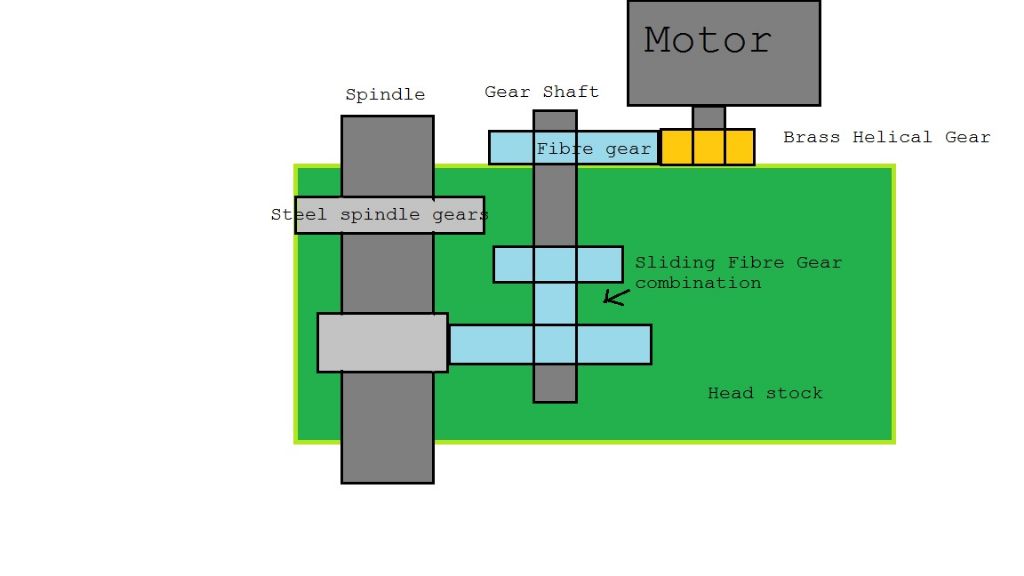
                                    I've made a basic picture of what the setup is like inside, it's fairly self explanatory but basically the sliding fibre gear part moves up and down as you twist between high and low, and sets up the right gear combination. How far it moves is down to the space on the shaft and a steel fork that moves the gear, which is connected to the switch.

                                    spindle view.jpg

                                    #258167
                                    Sam Longley 1
                                    Participant
                                      @samlongley1

                                      Michael

                                      Thanks for the details. I have decided to take a couple of days sailing up the coast on the boat so the mill will have to wait until I get back as I have had enough problems with it trying to make a T bolt ( see the thread using milling cutters) but I want to pick you up on your statement

                                      "If you halved that depth it would probably be okay. End mills can take facing cuts much better than plunging ones, as i'm sure you know, slot drills are more suited to that."

                                      No I did not know as I have never had a mill before so everything I do is totally alien to me. No one on the other thread has suggested that i cut on the side of the cutter nor have they suggested that i run at such a high RPM. Once I get back I might try that !!

                                      Edited By Sam Longley 1 on 27/09/2016 18:19:18

                                      #258173
                                      JasonB
                                      Moderator
                                        @jasonb

                                        "If you halved that depth it would probably be okay. End mills can take facing cuts much better than plunging ones, as i'm sure you know, slot drills are more suited to that."

                                        Sam I don't know what Michael is on about as you are not making plunge cuts. A plunge cut is where a cutter is fed vertically down into the work much like using a drill. The traditional slot drill is indeen suited to this as are modern centre cutting 3 and 4 flute cutters but it is not what you are doing.

                                        Sam on the other thread I have shown the side of teh cutter being used as well as the width with little depth. It was also the second paragraph of my first reply:

                                        "There are a couple of options for cutting, either do the full width and say 2mm depth each pass or to use more of teh side of the cutter and cut the full depth moving say 2mm sideways per pass.

                                        Edited By JasonB on 27/09/2016 18:38:24

                                        #258182
                                        MW
                                        Participant
                                          @mw27036

                                          Jason, i was merely making an aside, being an alien and unfamiliar concept to him, i wasn't sure if he was using these in place of a slot drill, i preferred not to assume this, as i don't know what he's making with it or hes not trying to do pocket milling with it. Perhaps it was irrelevant.

                                          I Still stand by my comment about the depth of the cutter in steel, i'd say no more than 1.4ish, and i'd consider that maximum for a roughing cut. He will need the full power of the motor for this and i don't think 1000rpm will be too taxing on the endmill provided he keeps a good feed going. This'll also help the motor by keeping the fan cool. If it's a bit hairy at that then you could lower it slightly to 800. 

                                          The 2.8 depth in that material just stood out as immediately odd to me. In the interests of a healthy WM16 mill. 

                                          Michael W

                                          Edited By Michael Walters on 27/09/2016 19:30:54

                                          #258186
                                          JasonB
                                          Moderator
                                            @jasonb

                                            Just converting & uploading a video for you sam, will put it in the other thread, should be done before the tide goes out.

                                            #258762
                                            Sam Longley 1
                                            Participant
                                              @samlongley1

                                              Michael

                                              I removed the grease cover & shone the torch in & saw the 2 gears. Glad I did this as you suggested because although it is not the cause of the graunching noise it did highlight that in high gear the gear was only just engaging & that I have to turn the gear knob far more than indicated on the dial. So thanks for that bit of info

                                              However, i sometimes turn the mill on in low gear & the machine fails to rotate properly making a horrible sound .

                                              If I turn the gear to high & then start it again it goes. Then if I stop it & go back to low it starts Ok. This has happened about 3 times so far. I have been away sailing so have not tried it much in the last few days.

                                              No idea what it is but it could be something major building.

                                            Viewing 21 posts - 26 through 46 (of 46 total)
                                            • Please log in to reply to this topic. Registering is free and easy using the links on the menu at the top of this page.

                                            Latest Replies

                                            Viewing 25 topics - 1 through 25 (of 25 total)
                                            Viewing 25 topics - 1 through 25 (of 25 total)

                                            View full reply list.