Superheaters

Superheaters

Home Forums General Questions Superheaters

Viewing 13 posts - 1 through 13 (of 13 total)
  • Author
    Posts
  • #811523
    Garry Coles
    Participant
      @garrycoles69390

      Hi, I have a question about superheaters. I’m building Doug Hewsons BR 2-6-4 Tank loco in 5 in gauge. I’m working around the front end of the boiler and was wondering do I actually need superheating. I will only ever be running this in my workshop, so it’s not going to have a hard life. The cost of the elements is so very expensive. I know I could make them, but getting the s/s materials over to Jersey can be so expensive by post. Any thouhts please.
      Garry

      #811526
      noel shelley
      Participant
        @noelshelley55608

        I don’t know the design but stainless 316 tube should be available at a reasonable price and then a few beers to someone to TIG weld the firebox end. The headers, wet and dry could be silver soldered or compression fitting. Or you could as you say not bother with super heat, But be warned, once it’s built and running the urge to put it on a track and see what it can do may prove irresistible ! Doug would not have included super heat if it wasn’t worth the candle. Noel.

        #811552
        duncan webster 1
        Participant
          @duncanwebster1

          It will work without superheaters but nothing like as well.


          #811558
          Speedy Builder5
          Participant
            @speedybuilder5

            Why introduce stainless as its expansion rate will be different to the copper boiler giving rise to possible joint leaks over its working life.

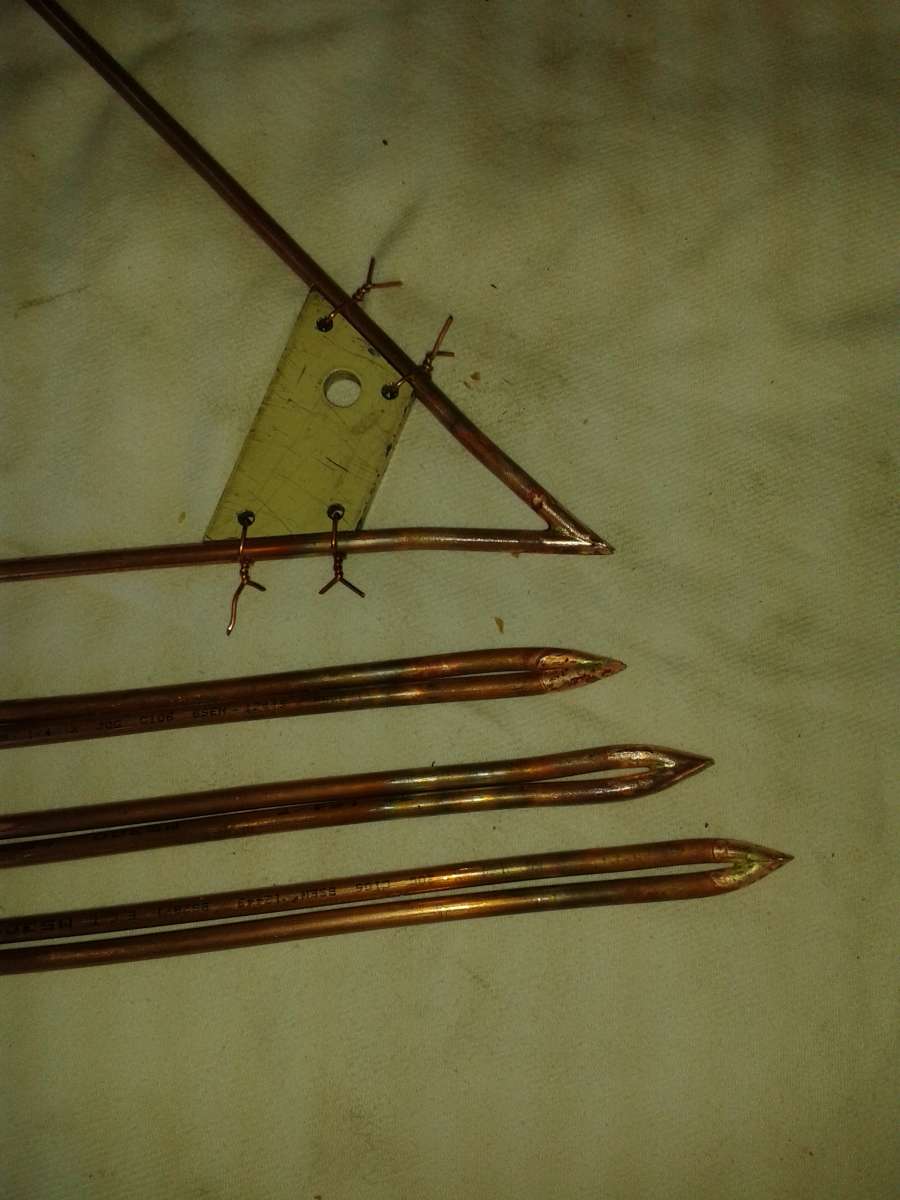
            Use copper with a brazed joint seems to work on my 5″ Speedy.  Think about the eventual life of the model when it passes into other hands and go for copper superheater tubes ??

            Superheater

            #811571
            SillyOldDuffer
            Moderator
              @sillyoldduffer

              Living in Jersey where post and packing is extra expensive might well change the answer!  As does Garry’s comment that the engine will only be run in his workshop.  Unless there’s a track in Jersey the engine will have to be moved to the mainland!

              There’s no advantage in superheat unless the engine is expected to do work.  Saturated steam will look, smell, and spin the wheels on a rolling road or short garden track just as well.   The engine won’t burn fuel as efficiently, accelerate, or pull a heavy load as well, but if that doesn’t matter, don’t superheat.

              What I’ve read about superheated models in old magazines suggests they often fail to deliver much, or any, benefit.   Reason, I think, is fairly obvious.  In a small model the surface area of the superheater’s pipework is large compared with the volume of heat contained inside.  Therefore heat leaks rapidly, and the temperature drops!  Even inside the boiler the temperature is well below superheat, so it cools superheated steam.  Assuming the steam inside is still superheated,  the pipes have to get from the smoke-box to the valves and from there into the cylinders.  None of it is well-insulated and performance will be good only if convincingly hot superheated steam fills the cylinder.

              At 150psi, saturated steam will be at 185°C, and red-heat in the firebox, say 600°C.   So 415° of superheat in the firebox isn’t difficult.  The question though, is how much of that sugar, if any, reaches the piston!   Much less value in steam that’s merely dry, or a bit less wet than normal.  In a small engine, I fear superheated steam is likely to re-saturate before it can do any useful work.  Anyone measured the temperature inside a model’s cylinder?  How hot is it?

              Based on the ratio between surface area and volume of small pipes, my gut predicts most model scale superheaters aren’t ‘worth the candle’.  Guts being highly unreliable though, anyone able to prove me wrong?   Good start would be to measure two identical engine with a dynamometer over many comparative runs; engines identical that is apart from one having a superheater.

              The history of superheat in full-size locomotives is interesting.   The scientists identified the advantages of superheat about 40 years before practical men could make it work.   A major problem was that wet steam is usefully self-lubricating and not hot enough to damage animal based lubricants.  Superheated steam is dry and hot enough to destroy natural lubricants, or at least all the affordable ones!  Result, a number of Victorian experimental engines that outperformed saturated steam locos until their pistons, cylinders and valves wore out after an hour or two…

              Superheated locos had to wait until the Chemists developed cheap heat resistant lubricants, after which the mechanical part was a doddle.

              Dave

              #811575
              MichaelR
              Participant
                @michaelr

                If you don’t want to be bothered with superheaters just coil the steam feed pipe from the regulator around the smoke box interior and then connect it to the cylinders, the heat in the smoke box will give a degree of steam drying.

                I have seen some good performing locomotives without superheaters.

                MichaelR

                #811581
                duncan webster 1
                Participant
                  @duncanwebster1

                  With the trouble SOD has been having I would have thought that he would havd known that guts are very unreliable.

                  Bill Hall showed conclusively that superheaters work in model locos, but radiant ones for preference. The heat lost from the outside of a short pipe is small compared with the energy flow through if, so the temperature doesn’t drop much. Superheat doesn’t make a lot of difference to pulling power all else being equal, but it reduces condensation on the cylinder walls, so you need to boil less water,  meaning less coal burn. Or conversely for a given amount of coal burn you get a lot more useful steam. Bill Hall did a series of tests reported in SMEE journal which proved this beyond doubt. Not sure whether it ever got published in ME.

                  #811657
                  Dave Wootton
                  Participant
                    @davewootton

                    Seems a shame to build a detailed and accurate loco like this and leave out the superheaters, even a copper non radiant would be better than nothing.  I belonged to a club that had a Springbok as a club loco, which was fitted with radiant superheaters reaching halfway along the firebox, it was not a spectacular performer but was a good passenger hauler, unusually fitted with slide valve cylinders. One day the superheater elements failed, and as the engine was needed for the following Sunday a couple of us set to and by passed the superheater connecting the regulator direct to the cylinders. This was the only change made to the engine. The following public running the loco did run and pull passengers as required, but was noticeably less lively and was horrendously “wet” with condensed water appearing at the chimney and just about everywhere else. Two weeks later with new superheaters installed it was back to it’s old self, everyone who drove it in both states was surprised at the difference in how lively the engine felt with the superheaters restored, and the general feeling was that less coal was consumed and that firing was easier. This is all entirely unscientific of course, but as a practical demonstration that superheating does make a difference to the performance of a loco, I remain convinced that Duncan in his post above is entirely correct. With the great amount of time and effort that goes into constructing a loco, the cost and extra work of making superheaters would seem to be worthwhile. I wish you happy steaming whatever course you decide on.

                    Dave


                    #811661
                    Nigel Graham 2
                    Participant
                      @nigelgraham2

                      Re SpeedyBuilder’s concern for different expansion rates…

                      There are no joints where that could give trouble.

                      If the headers are of the same material as the superheater elements (copper or stainless-steel) the only joints with a different metal are those between the headers and the regulator outlet, and the pipe(s) to the valve-chests.

                      Those are by unions or flanges with studs, and judging by the number of superheated miniature locomotives in service are evidently able to cope with the extremely tiny difference in dimensional change with temperature.

                      Some miniature locomotives have steel boilers with copper tubes, a combination one might expect to be prone to differential expansion problems, but it seems to work.

                      #811664
                      Charles Lamont
                      Participant
                        @charleslamont71117
                        On Nigel Graham 2 Said:


                        Some miniature locomotives have steel boilers with copper tubes, a combination one might expect to be prone to differential expansion problems, but it seems to work.

                        And, in UK practice, full size loco boilers have a steel shell, tubes, and foundation ring, and a copper inner firebox.

                        I have trouble with SoD’s argument on heat loss in the short distance from the bottom of the smokebox to the cylinders. A small amount of loss on the way does not invalidate the positive argument for superheat. And, just as a extreme counter example, model flash steam hydroplanes, which have a steam pipe exposed to an air flow over the boat of well over for 100 mph, can have enough superheat getting to the engine that they have been known to run with the top of the cylinder glowing dull red.

                        Another thing – the boiler has presumably got superheater flue tubes already, if you don’t put superheaters in them, what would you fill them with to balance the gas flow rate through tubes and flues?

                        #811682
                        noel shelley
                        Participant
                          @noelshelley55608

                          Sometimes I feel we get too concerned with theory ! The issue of expansion in this context is of no consequence if only because the superheater is only constrained at one end. Whether of copper or stainless will make no difference.

                          That copper and steel are mated together in both model and full size would seem to prove that there is little to worry about .

                          As to there being no track available, I was given some 1″ box scrap about 150′, This was turned into a 50′ length of 5″ gauge track in my garden. Where there’s a will there’s a way. Good luck. Noel

                          #811725
                          Dave Wootton
                          Participant
                            @davewootton

                            Charles makes a valid point in his post above, one thing I left out of my post about the Springbok was that we replaced the old superheater elements into their tubes simply to keep the gas flow through the superheater flues as it was before. We figured in our unscientific way that if left out the large dia flues for the s/heater they would act as a kind of bypass affecting the flow through the smaller flue tubes.

                            Dave

                            #821492
                            doughewson
                            Participant
                              @doughewson

                              Hello Folks,  I was wandering through Llangollen yard one day and saw the tubeplate out of 80072 one day and it had three rows ofsuperheater flues so the set me thinking, why do we only put one row of superheaters in our 5″ gauge boilers.  I thought the that I should try two rows in my boiler as I had received a surprise package from the long lamented “Whistons” one day and included in it were 10m of 5/32 x 24swg stainless tube so my Y4 needed new superheaters. so I tried that and they are still in there after 12 years of hard work.  I fitted my double row of elements in my 4MT boiler (in 80080) but the engine became too heavy to me to lift.  One day two chaps came from Co Durham to our railway and in conversation Eddie said to me had I finished my 4MT.  I said yes, so they said would I mind if they took it away with them to have a look at so of course I would love them too.  After a few weeks they emailed me and said that they were going to Gilling to give it a try and they took it and hooked on to ten of our MK1 coaches (weight 28 kg each).  Joe took it round for 2 hrs (average speed about 7 mph) and then Eddie took it for another 2 hours and when they compared notes they both said that they only had to top the boiler up a little evrey 6 laps. (Every 1.6 miles) Gilling is 440 yds round and is all laid with transition curves and superelevation for 7mph running.  I also met David Hudson at a Midlands Exhibition one day and I looked at his loco on the stand and I asked him “What are those three little pipes for”  He said they are for my Atomisers so I asked him what does it have inside his reply was “Nothing”.  I thought, I can copy that.  We then went on to the track at Morely (Derby MES) and when we were dropping our fires that was a gent from Sheffield waggling something around in his cab.  I asked him what he was doing and he said the he was cleaning his fire grate.  I said to him that he must have a rocking fire grate and he said “Yes and it has been in there for 10 years and I have never looked at it since”.  Now all the BR Std engines have atomisers and rocking fire grates so I have used them on all the locos I have designed apart from the GWR 5700/8750 Classes.  I have also designed a fine scale GWR Pannier but it just needs someone to build one which has the steam chest between the cylinders as per the works drawings.  Since then I have re-drawn the Britannia, the B1, the BR Std Class 4 4-6-0 and my own 80080, and now I am on with the BR 4MT 2-6-0 and done to the works drawings.  I am dying to get on with the BR Std Class 2 2-6-0 as it is a terrible mess.  The tender is pure Ivatt.  It is such a pity as it is a very popular engine.  Anyway I don’t think Gary need worry about superheaters as the engine will not be going anywere apart from if he eventually sells his engine the buyer will no doubt be very dissappointed.

                              Doug Hewson

                            Viewing 13 posts - 1 through 13 (of 13 total)
                            • Please log in to reply to this topic. Registering is free and easy using the links on the menu at the top of this page.

                            Latest Replies

                            Home Forums General Questions Topics

                            Viewing 25 topics - 1 through 25 (of 25 total)
                            Viewing 25 topics - 1 through 25 (of 25 total)

                            View full reply list.