Steam driven air pump for brakes

Steam driven air pump for brakes

Home Forums Locomotives Steam driven air pump for brakes

Viewing 19 posts - 1 through 19 (of 19 total)
  • Author
    Posts
  • #812508
    Werner Schleidt
    Participant
      @wernerschleidt45161

      Hello all,

      is there any knowledge about steam driven air pumps? I build for my own steam water pumps and now I want to start an air pump for braking. I think the steam part ist he same as in a water pump, but for the air part I have no idea.

      How large have to be the steam piston in relation to the air piston and which checkvalves have to be used.

      Many thanks in advance for any replies

      Werner

      #812539
      bernard towers
      Participant
        @bernardtowers37738

        definitely air pressure braking not vacuum

        #812544
        Werner Schleidt
        Participant
          @wernerschleidt45161

          The pump should load a reservoir with a pressure of around 3 bar/21 psi

          #812580
          noel shelley
          Participant
            @noelshelley55608

            Werner is it 3 bar or 21psi ? 3 bar is about 45psi. If you want 45 psi I look to the air piston being the same as the steam piston. If you only want 21psi then the air piston could be twice the size of the steam piston in area. Noel.

            #812588
            duncan webster 1
            Participant
              @duncanwebster1

              <p style=”text-align: left;”>I think noel means twice the area</p>

              #812683
              Werner Schleidt
              Participant
                @wernerschleidt45161

                Hi Noel, you catched me I made a dizzy mistake yes I mean 3 bar and I took the wrong conversion number.

                That is a good answer for the piston area  for a rough idea. I think I make at the beginning a simple air cylinder to drive with by an electric motor so I can have an idea of the power consumption by simple measurements and I can play with the valves, thightness and so on. I have no idea how the lenght of the working stroke of the piston is divided up in compression and pressure building up to a reserviour. If I compare it to a bicyle hand pump, only 20 % of the volume are overcome the tube presssure. If this is correct it last very long to load a reserviour.

                Many thanks for all your replies

                Werner

                #812694
                Nigel Graham 2
                Participant
                  @nigelgraham2

                  An air-brake system is normally controlled by an automatic regulating valve so th epump starts when the reservoir pressure falls below a certain value, and stops at full pressure.

                  Also the reservoir is sized to hold a volume of air generously exceeding that used by the brake cylinders, and at a significantly higher pressure with a regulator on the output.

                  So although the pump is only delivering a small volume air per stroke, it is working all the time it needs, and the reservoir is never depleted seriously.

                  I am not sure if power consumption will help very much. Steam consupmtion might be more significant.

                  #812708
                  Charles Lamont
                  Participant
                    @charleslamont71117

                    If I remember rightly, in full size it is 75psi. Air brake fitted steam locos are constantly active even when stationary; automatic drain traps trip, and the compressor tops up: Pst! ….. Tiff-Tuff .. Tiff-Tuff ……..

                    #812758
                    noel shelley
                    Participant
                      @noelshelley55608

                      People now for recreation use Nitrous oxide and the small high pressure cylinders it comes in, with a little adaption would make a good reservoir. They have a capacity of about 1 litre. Their stamped with the test pressure, and the brass valve in the top makes a good starting point for a system. Noel.

                      #812795
                      Martin Johnson 1
                      Participant
                        @martinjohnson1

                        I agree with Noel’s rough assessment of piston diameters..

                        It will also need care in design to minimise the dead space in the air pumping cylinder.  That is why some of the full size pumps used flat plate air valves on a grid in the cylinder wall – to keep dead space to a minimum.

                        I hope that translates into German, Werner.

                        Martin

                        #812877
                        Werner Schleidt
                        Participant
                          @wernerschleidt45161

                          Martin ,

                          that is a good point the minimizing of the dead band, that I have to keep in mind.

                          I think in winter time I give the air cylinder a go and start my experience. The same procedure I made some years a go by making of my own injectors and steam pumps.

                          Reading and writing in english is not a big problem for me, only a few times I need a translate program, but I am getting better by experience.


                          Werner

                          #812916
                          Nigel Graham 2
                          Participant
                            @nigelgraham2

                            Noel –

                            I don’t think recommending Nitrox cartridges a good idea, although I don’t know the law on its so-called “recreational” use outside of the UK.

                            The small, non-rechargeable, screw-fitting gas canisters sold for DIY-class MIG cylinders, or the butane equivalents for camping-stoves and blowlamps, would be better.

                            #812918
                            Another JohnS
                            Participant
                              @anotherjohns

                              Charles;

                              Just FYI, and a bit off topic.

                              In the Westinghouse Air Brake (WAB) system, the train line (the line that goes from carriage to carriage) is kept at a set pressure. Usually 90PSI. The compressor and main reservoir pumps to approx 120psi. That steam pump sound is caused by the steam pump trying to keep the pressure of the main reservoir up.

                              When a brake application is made by the engineer, say a “15 psi” application that pressure comes out of the train line, and individual reservoirs on each railway carriage, usually sitting at 90 psi, push the brakes on. That “15 psi” application takes the train line down from 90 to 75. (there is a valve on each car, the “triple valve” that actually lets the air out, it does not go back through the locomotive)

                              When the engineer/driver releases the brakes, the train line climbs up to 90, and through the “triple valve” on each car, the local reservoir is charged up to 90 again; that air for the train line comes from the main reservoir, and then the air compressor(s) kick in to charge the main reservoir back up to 120.

                              Like with commercial lorries, releasing air applies the brakes. Lorries don’t have the “triple valve”, because they have a separate air supply line (2 connections).

                              At least over here (Canada), the steam locomotive itself was fed direct air to the brake cylinders; there are two brake levers in the cab, one for the engine, the other for the train.

                              It’s been too many years (and my books are not at hand) since I did anything with full size locomotives here in Canada and the USA, and it’s early in the morning before coffee, but I think the above is a correct, simplified intro to why steam air compressors give that incredibly lovely sound once in a while!


                              #812934
                              parovoz
                              Participant
                                @parovoz

                                Hi All,

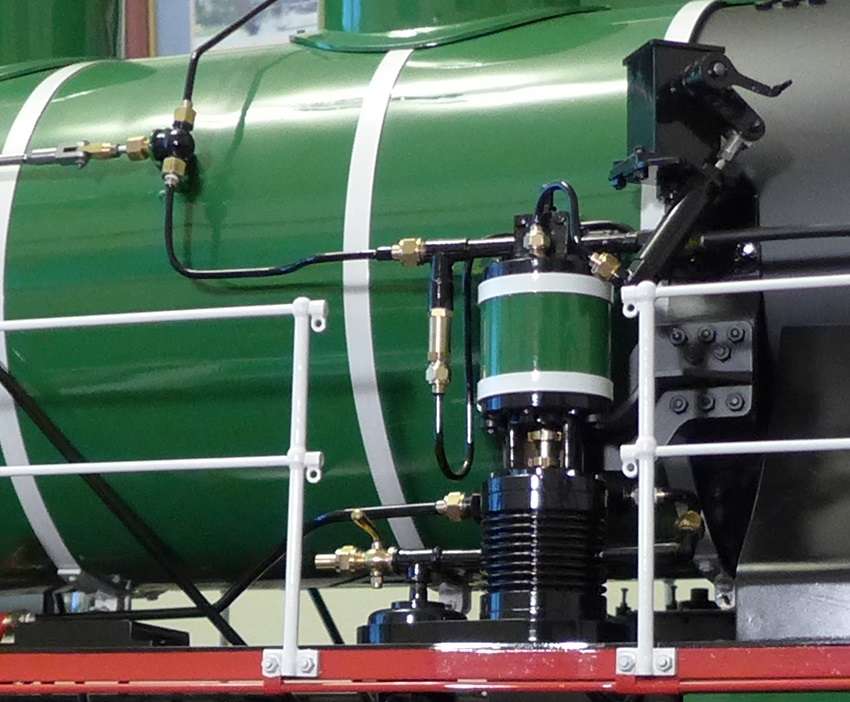
                                I have an air brake system on the Su class. It’s possibly a little over complex but does basically work. The brakes work at 15 to 20 psi, it’s an ‘inverse vacuum’ brake system in that I use larger diaphragm cylinders about 3 inch bore with fairly stout diaphragms in them. The brake compressor is based on a Brian Keim (USA) compressor. BUT the whole system runs at a two pressures. Why… Well, that’s where my usual slight overcomplication comes in. As per full size I have a mechanical lubricator feeding the steam side of the pump. This lubricator is driven by a steam piston fed from one side of the cylinder taking a pulse every time the top half of the cylinder is filled. In order for this to work correctly I have to keep the feed pressure fairly high. BUT, if the air cylinder is only providing 15 to 20 psi the drive pressure is too low. SO solution is, a pressure ‘relief’ valve on the compressor outlet set to 50psi. The compressor then needs to provide 50 psi to allow any air into the low pressure side of the system. The low pressure side is then safety-valved at 15 psi. So the system is supplied from the bleed of the compressor side and it then maintains the 15 psi needed to run the brakes. The compressor then has to ‘work’ at a sufficient level to allow the lubricator to operate correctly as per prototype….

                                Yes a lot of faff. Should I have gone for high pressure brakes in the 75 to 100 psi range…. YES…. But I only came up with the lubricator issue when the all the brake gear was constructed.

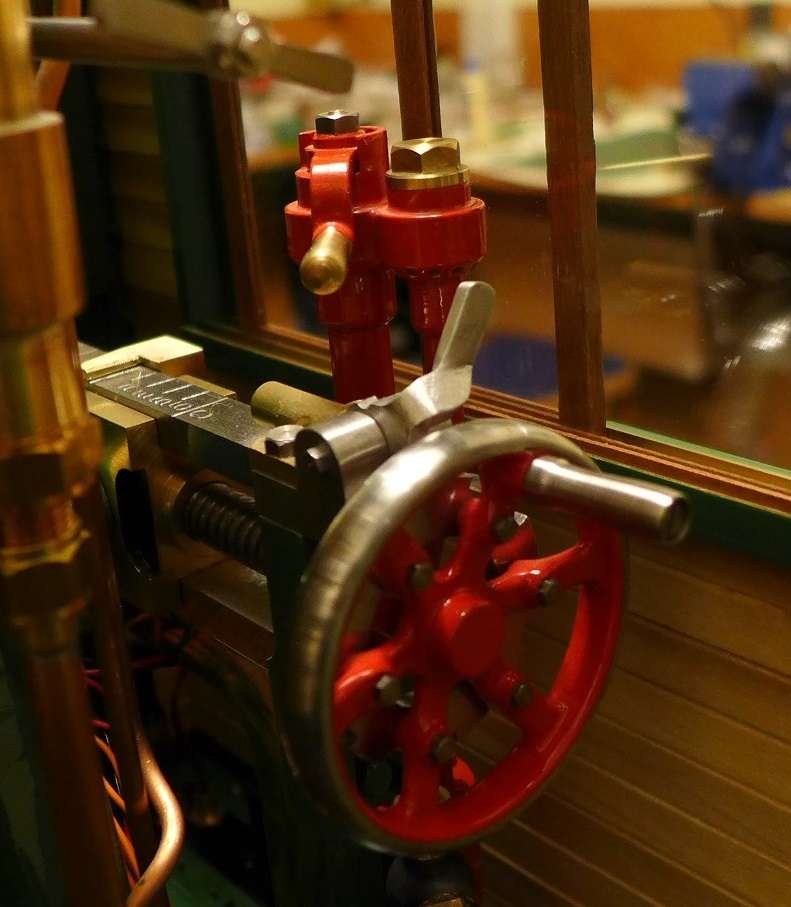
                                It’s controlled by a semi scale Westinghouse pattern brake control in the cab. Brakes operate on the three driving axles and the four tender axles.


                                Brake Compresor

                                Brake Valve

                                #813000
                                Howard Lewis
                                Participant
                                  @howardlewis46836

                                  On road vehicles, normal braking is by applying air to the brake cylinders.

                                  As a “fail safe”, if the air supply fails, heavy springs within the brake cylinders on the driving axles, apply the brakes to halt the vehicle.

                                  This why, before a broken down truck, bus, or coach, can be towed away, the spring brake has to be wound “off”, or an air supply arranged from the tow truck.

                                  Howard

                                  #813034
                                  Another JohnS
                                  Participant
                                    @anotherjohns

                                    Howard – thx – I’ve only seen truck brakes applied to some isolated narrow-gauge railway equipment, very likely I’ve misunderstood how they applied it.

                                    More fun reading to do with my morning coffee!

                                    A bit of googling brought this up – I was also wrong about “Triple Valves” on trucks: “When the brake is applied, the air then passes through the triple-valve system and air lines to the brake cylinder. In the cylinder, the pressure forces the spring to compress and the brake mechanics to engage.”


                                    #813037
                                    Werner Schleidt
                                    Participant
                                      @wernerschleidt45161

                                      Hi Paravoz,

                                      congratulations for this steam air pump setup! Which Steam and air piston diameters do you have?

                                      Ball or flat check valves at the air side? A very nice canopy setup of the brake valve and the handles!

                                      Werner

                                      #813044
                                      Martin Johnson 1
                                      Participant
                                        @martinjohnson1
                                        On Werner Schleidt Said:

                                        Martin ,

                                        that is a good point the minimizing of the dead band, that I have to keep in mind.

                                        I think in winter time I give the air cylinder a go and start my experience. The same procedure I made some years a go by making of my own injectors and steam pumps.

                                        Reading and writing in english is not a big problem for me, only a few times I need a translate program, but I am getting better by experience.


                                        Werner

                                        No problem Werner, I wasn’t sure whether the technical term “dead space” would translate.  I used to have problems translating technical German for work.

                                        Martin

                                        #813114
                                        Werner Schleidt
                                        Participant
                                          @wernerschleidt45161

                                          Hi Martin,

                                          in German there are, as in English for the same thing different discription possible, but you are correct dead space is the better wording.

                                          Werner

                                        Viewing 19 posts - 1 through 19 (of 19 total)
                                        • Please log in to reply to this topic. Registering is free and easy using the links on the menu at the top of this page.

                                        Latest Replies

                                        Home Forums Locomotives Topics

                                        Viewing 25 topics - 1 through 25 (of 25 total)
                                        Viewing 25 topics - 1 through 25 (of 25 total)

                                        View full reply list.