Selecting an Engineer’s level

Selecting an Engineer’s level

Home Forums General Questions Selecting an Engineer’s level

Viewing 25 posts - 1 through 25 (of 32 total)
  • Author
    Posts
  • #465070
    GingerLathe
    Participant
      @gingerlathe

      All,

      I've decided to level my lathe and although there are various methods to achieve this, I'm going to employ the use of an Engineer's level in this process. Now you can pay crazy money depending how accurate you want to go. A google offers up a number of options and I'd like to solicit people's thoughts on them:

      1 – Moore and Wright ELS range (165mm – 0.3mm/m) ~£150

      2 – Level developments 61R-0.05-140 (140mm – 0.05mm/m) £205

      3 – RDG tools brand (150mm – 0.05mm/m) £58

      Now what I find strange is the cost of #1 with an accuracy of only 0.3mm/m. Seems a high price for such an accuracy. Then we have the polar opposite for #3 which is very cheap for a reasonable high accuracy.

      Does anyone have any thoughts / advice? Do I need something more accurate than #1 for leveling my lathe (Murad Lathe)

      Thanks in advance

      #27292
      GingerLathe
      Participant
        @gingerlathe
        #465076
        Journeyman
        Participant
          @journeyman

          It matters not that the lathe is level but rather that the bed has no twist. The engineers level is one way to check that the bed is twist free. There are other cheaper and probably quicker methods to achieve the same outcome. Unless in a toolroom environment I cannot imaging that the level would find much use in the home workshop, a bit of overkill to make sure the shelves are straight.

          John

          #465078
          Former Member
          Participant
            @formermember19781

            [This posting has been removed]

            #465080
            Bo’sun
            Participant
              @bosun58570

              Hi Journeyman,

              What other methods would you suggest?

              #465084
              SillyOldDuffer
              Moderator
                @sillyoldduffer

                For what it's worth I'd say:

                • 0.3mm/m is a little insensitive for levelling a lathe, and 0.05mm is maybe over the top. The problem with sensitive levels is they take an age to settle, making them a little hard to use. Patience!
                • I'd go cheap because an Engineering Level is rarely used! Once a machine is levelled, that's it. So unless levelling is part of the day job, don't throw money at a tool that's doomed to live in a drawer until the end of time.

                Expensive tools tend to be more reliable and easier to use than cheap ones. A level that changes with temperature or when tapped on the bench, or gradually drifts is a time-waster. The quality is in the way the bubble is mounted.

                But lathe levelling can be done without spending a fortune on fancy kit. Provided it's sufficiently sensitive the level doesn't have to be unilaterally accurate. It can be 'calibrated' for the job in hand by turning it end to end and noting the difference between readings. More fuss and bother than just plonking a true level on the machine, but not massively so. So I'd happily spend an extra hour of my time with the £58 level, which might be completely satisfactory when new, rather than cough up £200 for a better instrument that never gets used again.

                Finally, no point in levelling unless the lathe is known to be cutting wrongly. If it ain't bust don't fix it!

                Dave


                Edited By SillyOldDuffer on 16/04/2020 17:17:21

                #465085
                mechman48
                Participant
                  @mechman48

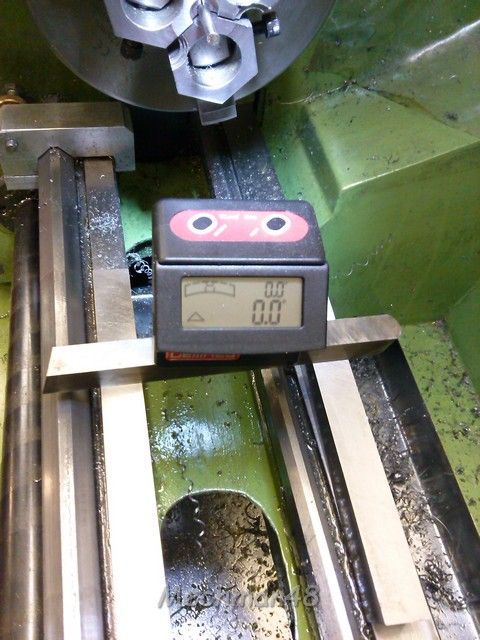
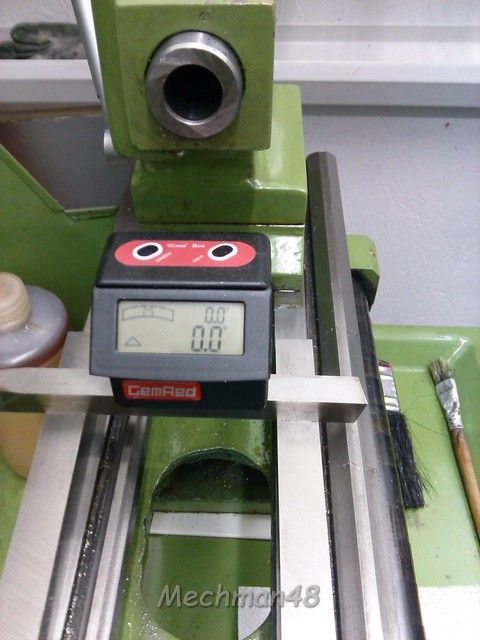
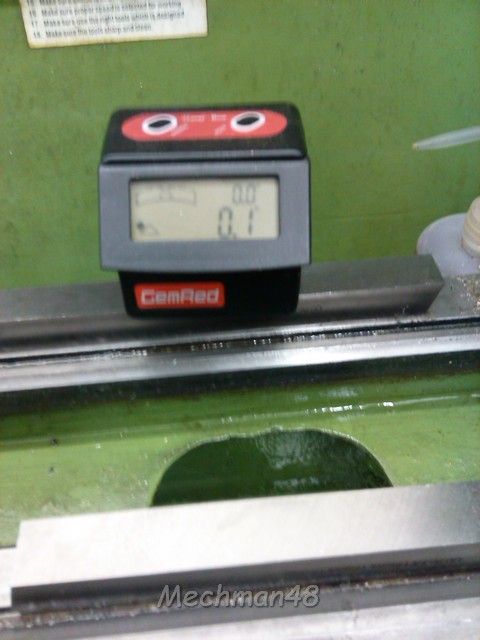
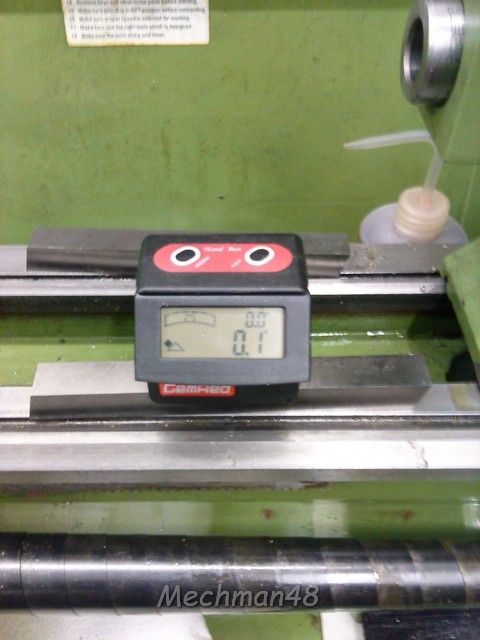
                  I used a couple of 12 mm HSS tool stock & a digi level to check for any twist on my lathe…

                  Headstock end…

                  lathe level check 2014 (1).jpg

                  Tail stock end…

                  lathe level check 2014 (2).jpg

                  along the bed… rear shear…0.1mm off…

                  lathe level check 2014 (4).jpg

                  Front shear…

                  lathe level check 2014 (3).jpg

                  Same as rear shear, obviously, 0.1mm off length wise, but no twist head stock to tail stock, good enough for me. Pay a £150 + for an engineers level for home check maybe twice a year, I think not.

                  I have used Eng' box levels, DTI's & electronic alignment equipment when I used to instal / realign turbines / pumps & gearboxes etc, when I was in the middle of the desert a few times but they had to be spot on, including adjustment & offsets for thermal expansion. Save your money for some useful tooling is my thought.

                  George.

                  #465087
                  JasonB
                  Moderator
                    @jasonb

                    The wear on an 80year old lathe could well throw the readings off anyway, 5microns of wear on one of the ways would be equal to 0.05/m if they are 10mm apart.

                    Is the lathe not cutting true? if it's OK then save your money.

                    #465092
                    GingerLathe
                    Participant
                      @gingerlathe

                      Thanks for all of your thoughts. Much appreciated! Looks like I need to reconsider my approach leveling given the cost and alternative approaches.

                      #465093
                      GingerLathe
                      Participant
                        @gingerlathe
                        Posted by JasonB on 16/04/2020 17:33:43:

                        The wear on an 80year old lathe could well throw the readings off anyway, 5microns of wear on one of the ways would be equal to 0.05/m if they are 10mm apart.

                        Is the lathe not cutting true? if it's OK then save your money.

                        It isn't cutting true although i haven't measured yet but I can see it isn't.

                        #465094
                        Journeyman
                        Participant
                          @journeyman
                          Posted by Bo'sun on 16/04/2020 17:05:54:

                          Hi Journeyman,

                          What other methods would you suggest?

                          The classic method I suppose is often referred to as Rollie's Dad's Method but there are plenty of threads on here covering how to do it. (The link is to a pdf file detailing the method.)

                          John

                          #465095
                          Pete Rimmer
                          Participant
                            @peterimmer30576
                            Posted by mechman48 on 16/04/2020 17:17:27:

                            I used a couple of 12 mm HSS tool stock & a digi level to check for any twist on my lathe…

                            Headstock end…

                            lathe level check 2014 (1).jpg

                            Tail stock end…

                            lathe level check 2014 (2).jpg

                            along the bed… rear shear…0.1mm off…

                            lathe level check 2014 (4).jpg

                            Front shear…

                            lathe level check 2014 (3).jpg

                            Same as rear shear, obviously, 0.1mm off length wise, but no twist head stock to tail stock, good enough for me. Pay a £150 + for an engineers level for home check maybe twice a year, I think not.

                            I have used Eng' box levels, DTI's & electronic alignment equipment when I used to instal / realign turbines / pumps & gearboxes etc, when I was in the middle of the desert a few times but they had to be spot on, including adjustment & offsets for thermal expansion. Save your money for some useful tooling is my thought.

                            George.

                            Your level is only resolving to 6 minutes of arc – that's not even it's accuracy, but it's resolution. A typical engineer's level will measure 10 seconds of arc or better, 36 times more sensitive to a change in angle.

                            In real terms it means that your electronic level won't register 6 thou of twist in a bed 4" wide (approx. the length of that HSS bit). It's not sensitive enough.

                            #465096
                            not done it yet
                            Participant
                              @notdoneityet

                              How many feet are supporting this lathe?

                              Mine is supported on just three. I consider using an expensive level an utter waste of time, effort and money for my example. I suggest you, perhaps, start by counting yours before proceeding to do anything, particularly shelling out for an unneeded item such as you are proposing.

                              #465106
                              Tony Pratt 1
                              Participant
                                @tonypratt1

                                Just adjust the lathe until it is cutting parallel. Plenty of information on the net

                                Tony

                                #465111
                                old mart
                                Participant
                                  @oldmart

                                  You can spend money on "levelling" using the most sophisticated and expensive means, but only actual comparison of machined diameters can tell you if the lathe is cutting correctly. Of course that result can be obtained without any resort to levels.

                                  A digital level which resolved to 0.1 degrees is accurate to no better than 1.74533mm per metre.

                                  Edited By old mart on 16/04/2020 19:38:44

                                  #465117
                                  Martin Kyte
                                  Participant
                                    @martinkyte99762

                                    Hi GingerLathe

                                    I bought mine from Rotagrip. 0.0002/10". Comes in at around £70. I did have to set it up which was pretty straight forwards and it's not the beautifull object you saw in toolrooms of yesteryear but it does the business at a reasonable price.

                                    regards Martin

                                    #465129
                                    old mart
                                    Participant
                                      @oldmart

                                      I can just see the chief engineer on a ship trying to use spirit levels to get the lathe in the workshop level. laugh

                                      #465135
                                      Mike Poole
                                      Participant
                                        @mikepoole82104

                                        Although the machines in a machine shop would be installed to be level it is not essential as the ship example illustrates. It can be useful on things like large mills to have level as a reference in some setups. It is quite possible that the slab we usually build a home workshop on will move depending on the weather so the machine level would need checking if using as a reference. Rollies dads method will sort out a lathe not cutting true if the bed is not true.As most people use a level once in a blue moon it might be worth just borrowing one. I have a couple if you are anywhere near Oxford.

                                        Mike

                                        #465138
                                        Alan Waddington 2
                                        Participant
                                          @alanwaddington2
                                          Posted by GingerLathe on 16/04/2020 17:55:21:

                                          Posted by JasonB on 16/04/2020 17:33:43:

                                          The wear on an 80year old lathe could well throw the readings off anyway, 5microns of wear on one of the ways would be equal to 0.05/m if they are 10mm apart.

                                          Is the lathe not cutting true? if it's OK then save your money.

                                          It isn't cutting true although i haven't measured yet but I can see it isn't.

                                          If it’s bad enough to see by eye, then levelling it is unlikely to cure the issue !

                                          #465144
                                          Clive Foster
                                          Participant
                                            @clivefoster55965

                                            Sometimes I could strangle Rollie's Dad. If folk don't pay careful attention to what they are doing and keep the brain properly engaged the poor lathe can end up wound tighter than the spring in my alarm clock yet still turning taper. Factoring in the relative torisional stiffness of lathe bed and bench is way to complicated!

                                            With smaller machines i've found that being very careful with shims et al to get the bed resting nicely on its feet with no stress and no clearance before being snugged down works as well as messing around with with levels or endless iterations of Rollie's Dad. Easy enough to use a torque wrench and dial gauge to verify that each foot moves down the same amount when tightening. Dial type torque wrench is best for that sort of thing. Naturally if you have a Myford or similar with a motor and other gubbins hung out the back its much easier if they can be removed temporarily so the bed is reasonably close to being balanced.

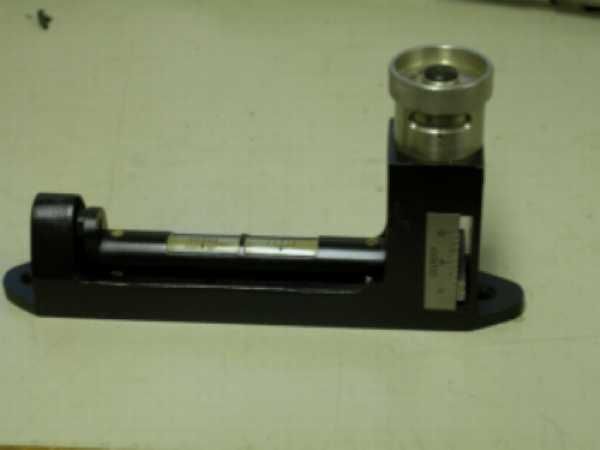
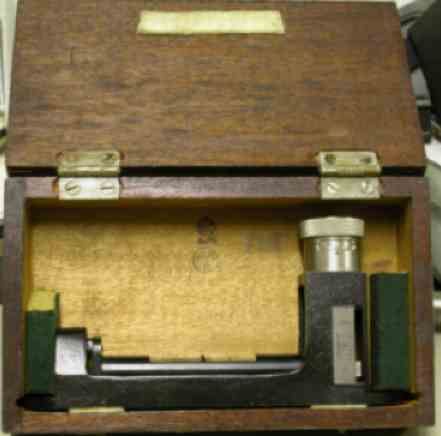
                                            In general levels sufficiently sensitive to get a lathe bed accurately aligned are a monumental faff to use and well capable of driving even the most mild mannered to profanity, drink or serious investigations into achieving orbital velocity by arm power alone. Best compromise I've found is the old British WW2 Gunners clinometer.

                                            clinometer 1.jpg

                                            clinometer 2.jpg

                                            About half the sensitivity of an engineers precision level at 30 seconds of arc per division, 0.14 mm / m, its easy to work to 10 seconds of arc or better. I recon 5 seconds of arc is realistic by exploiting the screw adjuster. The screw adjuster makes life much easier if you level actually isn't going to be a true level. Compact, being barely 6 inches long its easily switched end for end.

                                            Clive

                                            Edited By Clive Foster on 16/04/2020 22:58:31

                                            #465151
                                            peak4
                                            Participant
                                              @peak4

                                              If you still decide to purchase one, good brand name ones are often available on ebay for less than £30; e.g. Starrett, M&W, Rabone etc.

                                              Bill

                                              #465174
                                              Howard Lewis
                                              Participant
                                                @howardlewis46836

                                                If you buy a secondhand level, it can be checked for accuracy, and corrected, by taking a reading facing in one direction. When turned through 180 degrees the readings should be the same. If they are not, the level should be adjusted until the readings at 180 degrees are the same.

                                                Without a level, a lathe can be adjusted to eliminate twist by using the method advocated by Myford, and described in Ian Bradlewy's book, "The Amateur's Workshop" on pages 27 and 28.

                                                The Myford 7 Series Manual, again by Ian Bradley, describes the method on pages 41 and 42

                                                In "The Amateur's Lathe" L H Sparey, on pages 35 and 36, describes, (not so clearly, in my view ) how to level a lathe using a D T I.

                                                Howard

                                                #465177
                                                Journeyman
                                                Participant
                                                  @journeyman
                                                  Posted by GingerLathe on 16/04/2020 17:55:21:

                                                  Posted by JasonB on 16/04/2020 17:33:43:

                                                  The wear on an 80year old lathe could well throw the readings off anyway, 5microns of wear on one of the ways would be equal to 0.05/m if they are 10mm apart.

                                                  Is the lathe not cutting true? if it's OK then save your money.

                                                  It isn't cutting true although i haven't measured yet but I can see it isn't.

                                                  A lot of discussion on how to fix it but as yet the amount the lathe is "out" is unknown. I might suggest that if "it isn't cutting true" and can be seen without measuring, then something more fundamental might be askew. "Levelling" or better "Untwisting" is normally something employed to correct tapers measured in thousandths of an inch not something you can see with the naked eye.

                                                  John

                                                  #465179
                                                  Martin Connelly
                                                  Participant
                                                    @martinconnelly55370

                                                    The aim of the op is to align the spindle, bed and tailstock. Levelling the bed can be part of the process but is just one tool that can be used in the process. We should not keep saying levelling a lathe when we mean aligning the various parts of a lathe to give the required relative movements. Calling the process levelling makes some people think you need a level to do it and that that is all that is required.

                                                    Martin C

                                                    #465209
                                                    Michael Gilligan
                                                    Participant
                                                      @michaelgilligan61133
                                                      Posted by Martin Connelly on 17/04/2020 09:29:31:

                                                      The aim of the op is to align the spindle, bed and tailstock. Levelling the bed can be part of the process but is just one tool that can be used in the process. We should not keep saying levelling a lathe when we mean aligning the various parts of a lathe to give the required relative movements. Calling the process levelling makes some people think you need a level to do it and that that is all that is required.

                                                      Martin C

                                                      .

                                                      I was trying to keep out of this, Martin … but I do feel the need to re-state my understanding of the semantics:

                                                      Levelling in this context [as in surveying] is the process of using a level to compare heights.

                                                      … The ambiguity comes from the assumption that it must mean setting something horizontal.

                                                      MichaelG.

                                                    Viewing 25 posts - 1 through 25 (of 32 total)
                                                    • Please log in to reply to this topic. Registering is free and easy using the links on the menu at the top of this page.

                                                    Latest Replies

                                                    Home Forums General Questions Topics

                                                    Viewing 25 topics - 1 through 25 (of 25 total)
                                                    Viewing 25 topics - 1 through 25 (of 25 total)

                                                    View full reply list.