Poor finish using a flycutter

Poor finish using a flycutter

Home Forums Beginners questions Poor finish using a flycutter

Viewing 17 posts - 26 through 42 (of 42 total)
  • Author
    Posts
  • #838732
    Pete
    Participant
      @pete41194

      I’d also agree with Jason’s logic about insert replacement costs. For the same amount of metal removed, the costs would be about the same. Although I think an argument could be made for less cost with a face mill per pound of material removed because they can take much larger depths of cut a fly cutter shouldn’t be doing. If the mill has the rigidity and horse power to do it, that larger amount of material being removed per pass would be spread out over a larger portion of each inserts cutting edge.


      #838733
      JasonB
      Moderator
        @jasonb

        Regarding Pete’s comment about more use of the cutting edges, the other thing you can do with facemills depending on the type is machine upto an edge or even machine an edge so a bit more versatile than a flycutter that is generally regarded as a tool for clear flat surfaces.

        The other thing with a flycutter is you get a very interrupted cut which if on a small hobby lathe that may have plastic gears does not do them a lot of good as they are constantly loaded then unloaded.

        With a facemill provided to are not using it on too thin a piece of work at least one insert will always be cutting so you get a much quieter life. Certainly found that with my geared (metal) head X3.

        #838763
        Vic
        Participant
          @vic

          An interesting fly cut project:

          https://youtu.be/2rL4WD8iZbQ?si=iNk4TAbasDXQwtNM

          #838833
          Vic
          Participant
            @vic

            It’s very satisfying watching a job like this being done.

            https://youtube.com/shorts/nA99xMIVh0s?si=QEIAZdR2–vj4y2x

            #838847
            Vic
            Participant
              @vic
              On Pete Said:

              I’d also agree with Jason’s logic about insert replacement costs. For the same amount of metal removed, the costs would be about the same. Although I think an argument could be made for less cost with a face mill per pound of material removed because they can take much larger depths of cut a fly cutter shouldn’t be doing. If the mill has the rigidity and horse power to do it, that larger amount of material being removed per pass would be spread out over a larger portion of each inserts cutting edge.


              This guy goes into the cost difference.


              https://youtu.be/OMmigG7MUgk

              #838861
              Diogenes
              Participant
                @diogenes

                ..sorry, but that’s just laughable..


                #838865
                JasonB
                Moderator
                  @jasonb

                  Yes, it would be nice to see your own findings Vic rather than other peoples videos.

                  Pricing, I linked to APT inserts for Greensands, they do TNMG for the same cost so not double like in the video, Sumi specific inserts will always cost more than ones that fit generic heads. One can also get facemills where you can use upto 8 corners of a single insert so they would actually end up cheaper, he just used an insert that will work upto an edge which his flycutter wont. The Neutral inserts would also need an angled seat much like Pete mentions as they would rub if not set at an angle.

                  Poor choice of CNC path unless he wanted it slow. It would have been quicker to have the tool cut in a U shape which avoids lifting and having to go back to the start. Could even have had the curved part of the U overthe work rather than running out the end which would again reduce cutting time.

                  Talking of cutting time he was running a mich smaller chip load on that face mill, with 6 inserts it should have been able to be fed at 6 times the rate of the flycutter for the same given chip load but he only fed at 1/3rd the chip load. He even said it was a bit slow yet did not figure that into his times.

                  And what if you want more than to just skim a cylinder head, as he said on his machine the facemill will take 0.100″ but the flycutter 0.015″ so you would have to take 6 passes rather than one. Now tell me which is quicker.

                  Just so happened he had work that was wider than his chosen facemill but les sthat the sweep of the flycutter, what would have been the finish if it were 7″ x 7″ where the backcut would have shown? That previous part in the upside down video could have been done mach faster with a facemill fitted with the right inserts. but the shape did not suit this video On a smaller machine the additional offset that a large swinging flycutter needs to be able to put on a cut can also reduce the length of th epart that can be machined as you only have so much X travel.

                  #838872
                  JasonB
                  Moderator
                    @jasonb

                    Oh the other thing that is a bit strange. Usyally as the diameter of cutter increased we tend to reduce the spindle speed to keep the cutting speed the same.

                    He has the 7″ swing flycutter at 700rpm = 390m/min cutting speed

                    But the smaller 3″ facemill is only running at 580rpm = 138m/min cutting speed.

                    Can’t think why that would be unless trying to show the flycuter is faster, What do you think Vic?


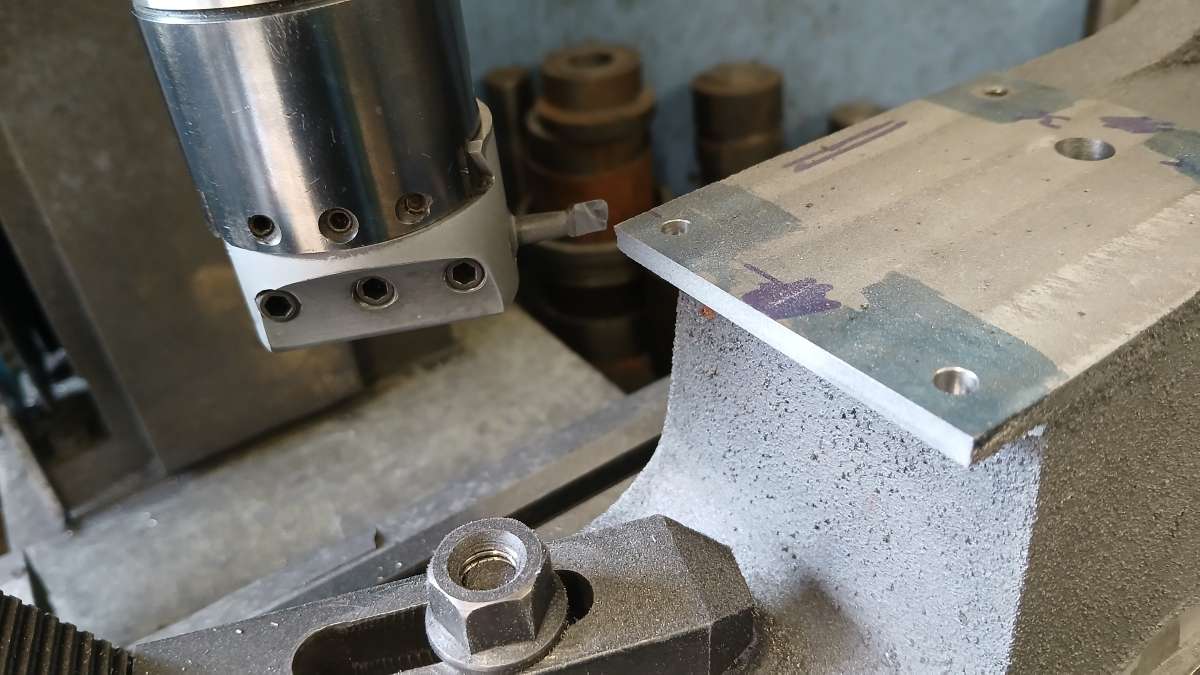
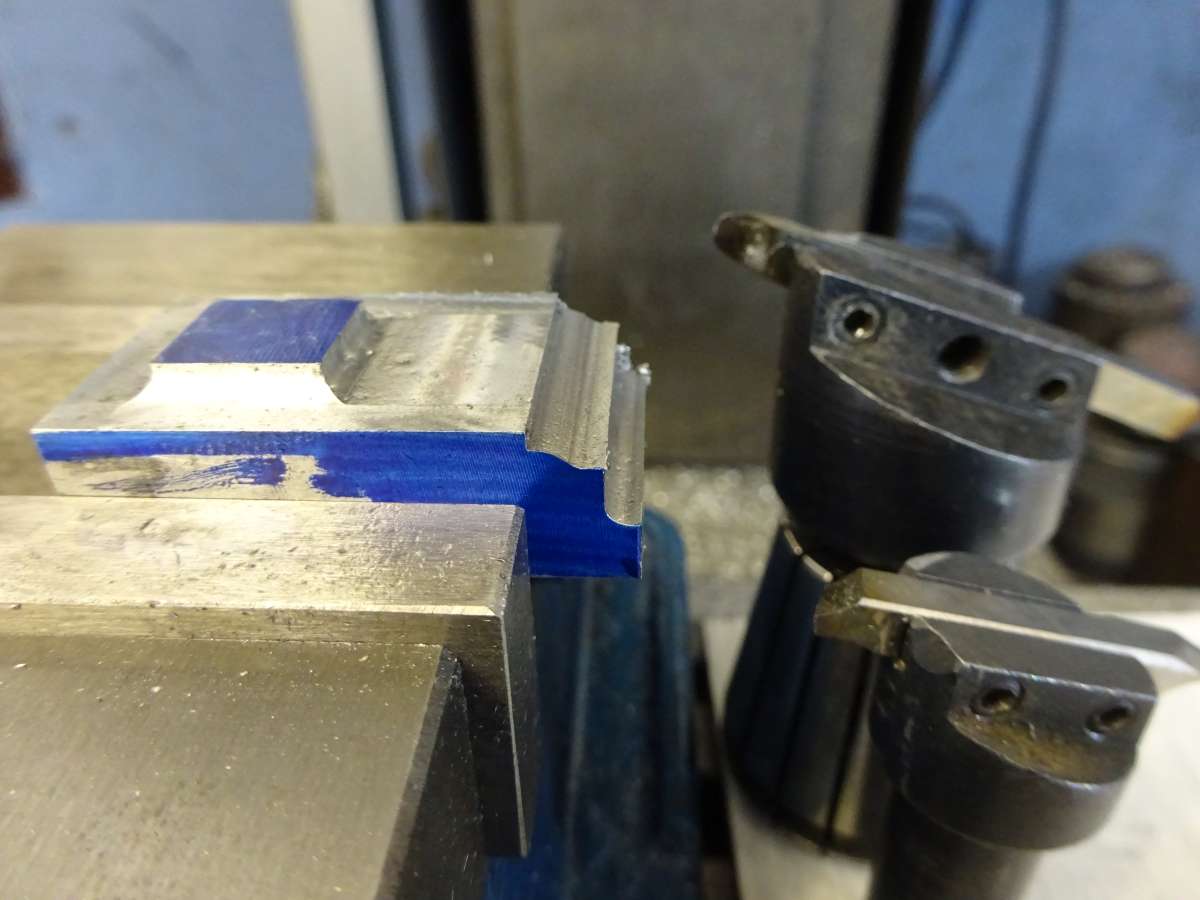
                    As for upside down cutting Been there and done it. Though I used the boring head as I don’t have a flycutter body that holds the bar horizontal like he has. I’m machining the underside of that overhanging lip. Tool ground to leave a fillet at the junction and angled to clear the slope of the face below.

                    20250901_135251

                    They can also be used as single point tool holders

                    Photo 89

                    #838910
                    Greensands
                    Participant
                      @greensands

                      The lessons I have learned from this useful discussion on the use of flycutters are 1) select if possible a sweep large enough to cover the area of cut to avoid the risk of cutting on the back stroke and 2) arrange for the direction of the cut to be along the Y direction, something I have not considered before. Live and learn.

                      #838963
                      Vic
                      Participant
                        @vic
                        On JasonB Said:

                        Yes, it would be nice to see your own findings Vic rather than other peoples videos.


                        My own findings about what exactly Jason? As I’ve already said, I’m not in a hurry like you, and I actually enjoy the process of fly cutting. The finish is, as others have demonstrated in the videos that have upset you so much, superior to a face mill.

                        I posted the videos for others benefit because you have made it quite clear fly cutters have little to no place in your workshop and that’s fine. We all have our own budgets for tooling, the way we wish to work with machines of differing capabilities, and time limits.

                        As a moderator I would have thought you’d be far less antagonistic to those with a different Point of view.

                        #838968
                        JasonB
                        Moderator
                          @jasonb

                          Just trying to give a balanced view compared to those videos, Others have also made comments about them though I went into detail about what I thought rather than just say they were laughable. I also don’t sell flycutters or facemills, unlike the guy in the video who sells those flycutters so his views and methods are quite likely to have a bias towards the flycutter.

                          I commented about what seemed odd speeds and feeds being shown, and hoped you may give some insight as to what speeds and feeds work for you, may help Greensands and the others get better results. I have posted here what feeds and results I get with flycutters as well as facemills. Also what I show is on hobby machines that Greensands and others use, unlikely to be the same as the large industrial CNC machine in the video.


                          As for budgets, I thought you quite liked buying direct from China. A 50mm facemill can be had for less than £10 not the £50 you mention and I expect inserts can also be had cheaply. I have previously posted my findings about the Banggood facemills and what it takes to get them cutting decently which should help those on a low budget. The ARC one sworked out of the box and it’s a shame they are not available.

                          #838994
                          JasonB
                          Moderator
                            @jasonb

                            I’m going to throw this out there to see what people think. Not trying to put people off using a flycutter as they have their place but I see quite a few comments that face mills are expensive to run .

                            Already pointed out in this thread is the fact a facemill will cut X times more material than a flycutter where X is the number of inserts so you are looking at using inserts at the same rate for a given volume of material removed. So you are not going to be using inserts at a faster rate than if they were in a flycutter

                            Cost of inserts. Again as I have mentioned the examples posted in the videos are by those selling flycutters so quite possible bias to them. Lets take that Tormach Superfly that uses SEHT inserts with 4 corners. You can also get facemills that take these so unlike the video that suggested corner for corner a facemill might be 7 times more expensive in reality they can cost exactly the same. ^ and * corner options ate also available that may bring costs down even more.

                            Now here is the bit that seldom gets mentioned when talking about cost of running. I don’t think anyone will disagree that a flycutter is a slow tool to use as it is single point. If running with an insert which allows the cutting speed to be higher they will still be 1/X times slower than a facemill in many cases again X being teh number of inserts.

                            To keep numbers simple lets say you are using a 6 insert cutter, for the same given chip load and DOC you can get teh metal removed in 1/6th the time. So say 10mmin job with the face mill takes 60mins with a flycutter.

                            If people or thinking that 50p or so difference in insert corner costs is a deciding factor then should we also be adding in the electricity costs. Lets say a 1000w motor at 30p per hour then the flycutter is going to use 24p more electricity to get the job done. But what about heating the workshop, lighting the workshop and powering DRo’s etc could be another 24p in winter maybe more and obviously less in summer. so lets say electric cost of 40p per hour to use a flycutter instead of a facemill.

                            So not hard to see from those three items that it could quite easily cost more in overal running costs to use a flycutter than a facemill. So if you have been thinking of trying one maybe you want to have another thought.

                            Keep the flycuter for where it is the better option but a lot of the time a facemill may be more suitable.


                            #839005
                            Graham Meek
                            Participant
                              @grahammeek88282

                              I was going to post this a few days ago, but thought better of it.

                              The Face mill shown in my picture previously on the Proxxon was 1 of 3 purchased second hand in the 1980’s. The cost of these cutters new at that time was £58.00. I had the 3 for £40.00, no eBay then. These were resharpened by a cutter grinding service for £20.00. After which I used them to build my 1/3 rd scale Quorn and they have been sharpened on this machine since.

                              Thus to date these cutters have cost me £1.50 approx per year, or 3p per week. Of course the longer I keep them so this cost will come down. In fact they will probably outlast me.

                              The secret to their longevity is to use the newly sharpened one on Brass only. When this cutter starts to show it is not cutting so well it gets used on Aluminium. Finally the cutter ends up on Steel after which it gets reground and the cycle gets repeated.

                              This is also applied to my Endmills and Slot drills.

                              One thing one does not get with a face mill is the Hammer blows to the spindle bearings when Fly Cutters are used to remove large amounts of material. Face mills give a constant loading to the spindle bearings, unless the operator is too lazy to change the cutter for a narrow section workpiece. Many a Bridgeport bearings have been ruined by Operators using fly-cutters. I know because I have had to replaced them.

                              Fly cutting was only ever used in industry to finish a surface, Flat, which could not be done any other way due to machine capacity. (Is this not what happens in the Home Workshop?). I have regularly machined pieces of Boiler plate for Milling fixtures which were in excess of a Metre square and that would not fit onto our largest surface grinder. The operation was also carried out at far lower surface speeds than some of the YouTube Guru’s use. One thing that is not wanted when trying to produce a flat surface is a lot of heat being put into the workpiece, which in turn will unlock the material stresses.

                              I hope these notes are taken in the spirit of enlightenment, rather than just adding to an argument.

                              Regards

                              Gray,

                              #839017
                              Michael Gilligan
                              Participant
                                @michaelgilligan61133

                                Your notes always bring some enlightenment, Gray !

                                MichaelG.

                                #839021
                                Andrew Crow
                                Participant
                                  @andrewcrow91475

                                  I would certainly agree with what’s been said in the last few posts, if you want to remove material use a face mill, carbide insert or HSS whatever you have or which suits the application best.

                                  For a final cut to get a better finish use a flycutter.

                                  #839023
                                  JasonB
                                  Moderator
                                    @jasonb

                                    Yes always good to hear your comments Gray. And similar to what I said about flycutters possibly damaging the gear on hobby machines and my query about the much higher speed of the flycutter shown over that used for the facemill.

                                    I’d have to work out what my cheap set of three flycutters cost, I think they came from Tracey back in the late 80s or early 90s and were used in preference to the larger MT shanked one bought several years later. A couple of bits of HSS again cost very little and freehand shaprened many times over the years.

                                    There is also the question of what is a poor finish. In my own case a lot of what I machine with the facemill will either be machined further, soldered or welded into a fabrication, be a mating surface or get painted. I all these situations provide dthe face is flat enough the look is only secondary. Others may have the need for work to have the bright reflective surface and be able to stop that being marked during further machining operations and in use when completed. Provided the poor finish is not actually uneven or tearing then there may be less need for one that “Looks nice”

                                    #839027
                                    Julie Ann
                                    Participant
                                      @julieann

                                      For general machining on hot rolled steel I get surface finishes ranging from 1um to 2um with facemills. In handwaving terms that translates to a shiny finish that feels perfectly smooth to the finish. It is also far better than I ever got with a flycutter.

                                      Julie

                                    Viewing 17 posts - 26 through 42 (of 42 total)
                                    • Please log in to reply to this topic. Registering is free and easy using the links on the menu at the top of this page.

                                    Latest Replies

                                    Home Forums Beginners questions Topics

                                    Viewing 25 topics - 1 through 25 (of 25 total)
                                    Viewing 25 topics - 1 through 25 (of 25 total)

                                    View full reply list.