Panhard & Levassor engine balancing

Panhard & Levassor engine balancing

Home Forums Related Hobbies including Vehicle Restoration Panhard & Levassor engine balancing

Viewing 20 posts - 1 through 20 (of 20 total)
  • Author
    Posts
  • #840942
    David Senior
    Participant
      @davidsenior29320

      Is anyone here an expert on the twin cylinder 7HP 1903 Panhard & Levassor engine?

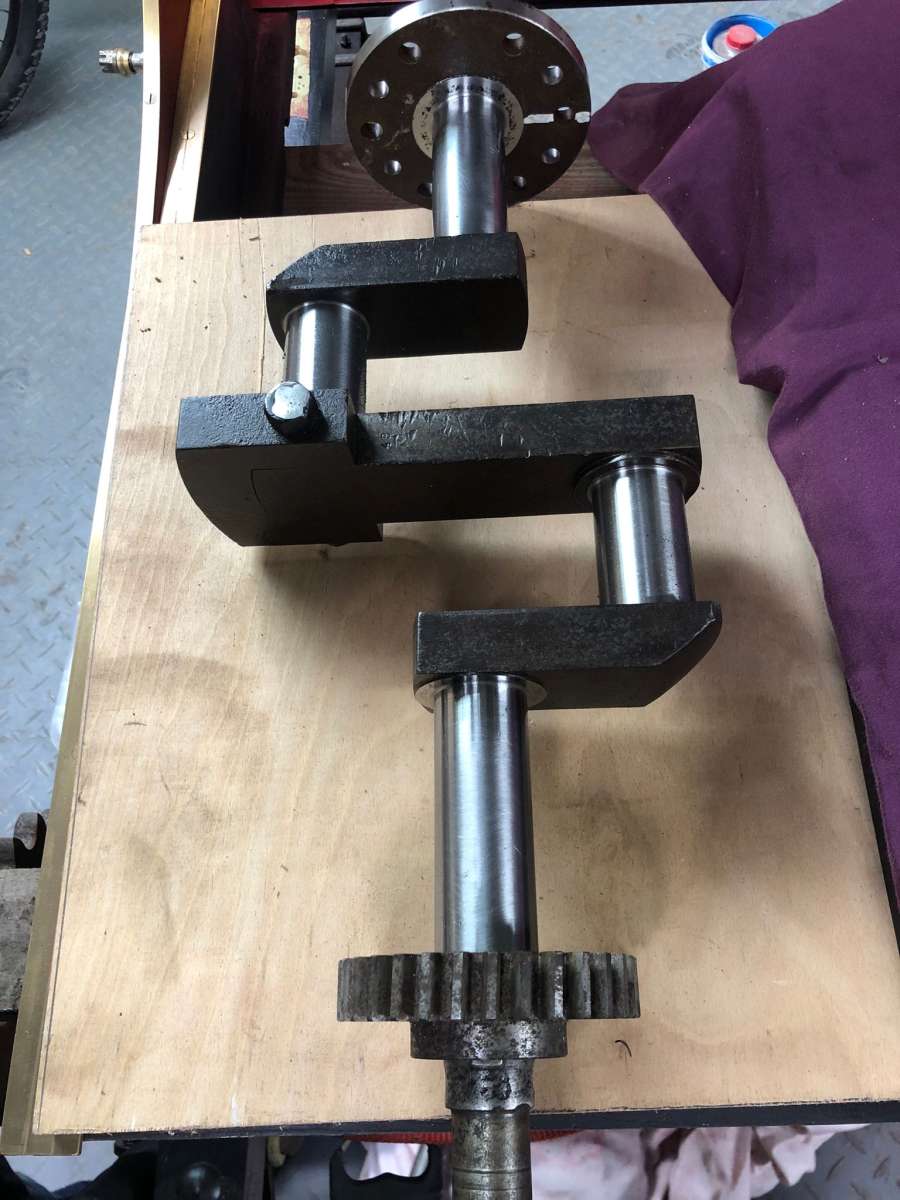
      I’m specifically interested in the engine balancing. It’s a 2 cylinder, 4 stroke engine, with the crankshaft having crankpins at 180 degrees (see photo). That means that the firing impulses are not even – in 1 rotation the crank sees 2 firing impulses at 180 degrees apart, then the next rotation it sees no firing impulses – bang, bang, nothing, nothing, bang, bang, nothing, nothing etc.

      IMG-20260228-WA0000

      Clearly that means the crank is seeing significant torque variation.

      You will notice from the crank photo that there is one (only) balance weight. I believe that the correct flywheel (which is huge – over 400mm dia and weighing around 40kg!) has balancing holes which I assume are sized to give static balance. (I don’t have the correct flywheel – the one I have has no balancing holes)

      I understand (though this may be incorrect) that this type of engine was originally built with no balance weight (hence the flywheel I have with no balance holes). If the balance weight and modified flywheel was a later improvement, could this suggest that the cranks were failing because of torsional vibrations, and Panhard introduced this modification to change the torsional vibration characteristics and allow the crank to survive?

      My quandary is this – do I remove the balance weight and use the existing flywheel – and hope the crank survives! – or do I drill holes in the flywheel to give static balance and keep the balance weight? Removal of the balance weight is my preference, but not if it is likely to result in a broken crankshaft! It would be good to hear from someone who actual has experience of this engine.

      Dave

      #840947
      duncan webster 1
      Participant
        @duncanwebster1

        It’s possible that the firing order is as you say, but on a modern flat twin you would have even firing impulses. Consider 2 revolutions in degrees, left hand cylinder fires at 0, 720, etc, right hand at 360, 1080 etc.

        As for balancing, if you do nothing the two rod and piston assemblies balance each other except that they are longitudinal displaced, so there is a small rocking couple about a vertical axis. This can be reduced by rotating balance weights, one as shown in the photo, and the second being the flywheel with holes in it. Doing this will introduce a rocking couple about a horizontal axis half way between the central balance weight and the flywheel. At a guess the weights are chosen to make the residual vertical axis couple equal to the horizontal axis couple.

        #840952
        David Senior
        Participant
          @davidsenior29320

          Duncan,

          presumably the modern flat twin that fires as you say will have a different crankshaft – where both crank pins are next to each other rather than 180 degrees apart?

          #840961
          Michael Gilligan
          Participant
            @michaelgilligan61133

            < gulp >

            You are clearly preserving automotive history, Dave

            Very wise to get this right, methinks !

            MichaelG.

            .

            Ref. [for other innocents]
            https://cars.bonhams.com/auction/15346/lot/306/1903-panhard-levassor-type-a-7hp-twin-cylinder-rear-entrance-tonneau-engine-no-5887/

            #840965
            David Senior
            Participant
              @davidsenior29320

              Yes. Regrettably it is not mine – I’m just helping out!

              Dave

              #840970
              Michael Gilligan
              Participant
                @michaelgilligan61133

                From a very different perspective … I might be tempted to have a chat with:

                https://www.dynamicenginebalancing.co.uk

                A test-run on a dynamic balancing machine should reveal a lot.

                MichaelG.

                #840972
                duncan webster 1
                Participant
                  @duncanwebster1


                  On David Senior Said:

                  Duncan,

                  presumably the modern flat twin that fires as you say will have a different crankshaft – where both crank pins are next to each other rather than 180 degrees apart?

                  No, just like the picture, but possibly a centre bearing, a BWM bike enthusiast will have further info.

                  #840974
                  duncan webster 1
                  Participant
                    @duncanwebster1

                    Just realised I’m making the assumption that the cylinders are horizontally opposed like a BMW bike. If they are side to side then the firing is uneven, Honda 250 was like that.

                    Comments on balancing stay the same

                    #840977
                    Michael Gilligan
                    Participant
                      @michaelgilligan61133

                      I am happy to be corrected, but almost certain that the BMW engines run both con-rods [side-by-side] on a single crank-pin.

                      MichaelG.

                      #840983
                      duncan webster 1
                      Participant
                        @duncanwebster1

                        Well I’m about to make your day then, this link1 confirms that BMW bikes have boxer engines, and this link2 shows that in a boxer engine the pistons move in opposite directions. The second link looks very like a Beemer engine to me

                        #840985
                        Michael Gilligan
                        Participant
                          @michaelgilligan61133

                          Yes … it illustrates what I described

                          🙂

                          MichaelG.

                          #840989
                          David Senior
                          Participant
                            @davidsenior29320

                            The cylinders are side by side, not horizontally opposed.

                            #840992
                            Michael Gilligan
                            Participant
                              @michaelgilligan61133

                              […]

                              We can count the crank-pins in a BMW boxer some other time.

                              MichaelG.

                              .

                              Edit: … I was wrong

                              and, for my penance:

                              https://altair.com/customer-story/bmw-motorrad-automating-crankshaft-modeling-using-simlab

                              #841016
                              duncan webster 1
                              Participant
                                @duncanwebster1
                                On David Senior Said:

                                The cylinders are side by side, not horizontally opposed.

                                <p style=”text-align: left;”>In that case definitely uneven firing order, but the little weight and holes in flywheel are for balancing as I said before</p>

                                #841018
                                David Senior
                                Participant
                                  @davidsenior29320

                                  Duncan,

                                  In your opinion would the balancing be significantly different between the 2 scenarios – no balance weight and an undrilled flywheel, or with the added balance weight and the flywheel drilled to compensate?

                                  Both would presumably balance each other the same in 1 plane, but they would give a rather different rocking couple about the vertical axis (or at least the distance between those forces would be greater).

                                  I’m struggling to understand why Panhard would have chosen to go to the balance weight option unless there was some other reason. As the only reason I can think of is to change the torsional vibration pattern in the crankshaft and get over a failure problem, I think I am going to have to stick with the balance weight and make the flywheel match.

                                  Dave

                                  #841024
                                  cedric 1
                                  Participant
                                    @cedric

                                    There must be Panhard Levasser enthusiasts out there who know the exact answer to your question.

                                    Don’t risk catastrophe by using guesswork, either your own or some random forum speculator.


                                    #841036
                                    duncan webster 1
                                    Participant
                                      @duncanwebster1

                                      As I said before with no balance weights there is a rocking couple about a vertical axis. The balance weights reduce this but cause a rocking couple about a horizontal axis. I’d try to find what was original, whether the weight was a later development and whether it was successful

                                      #841044
                                      Howard Lewis
                                      Participant
                                        @howardlewis46836

                                        As Duncan says, a primary balance weight introduces a secondary force at 90 degrees to the original, ( Hence the liking for 90 degree twins, fours, and V8s, where the secondaries from one cylinder balance out those from another cylinder. Although this introduces a horizontal rocking couple)

                                        A three cylinder vertical is naturally out of balance, but a vertical six (Effectively two 3s back to back) is smother because one end of the engine balances the other, although not entirely free of couples.

                                        The firing impulses will be asymmetric for a side by side two cylinder four stroke, as will the induction and exhaust pulses.

                                        “Boxer” engines are smoother because the primary out of balance forces from one cylinder are balanced by those from the opposite cylinder. But as the number of cylinders increases, the greater the tendency for horizontal couples causing the engine to “squirm” about a vertical axis.

                                        Steam locomotives, if balanced for  horizontal forces (The reciprocating components) produced vertical force – hammer blow) which the civil engineers hated because of the damage done to the track.

                                        One of the southern railway chief engineers avoided this, by not using balance weights, but gave passengers in the front carriages a very rough ride by jolting them back and forward, in time with the piston thrusts.

                                        It is possible that the flywheel was drilled, deliberately to throw it off balance, to negate the out of balance forces from the balance weight on the crankshaft. (Some 3 cylinder engines  have weights on the crank pulley and out of balance flywheels in an effort to produced better balance and smoother running). In which case the the parts must be fitted back in the original position. (Often by having an offset bolt hole, rather than a dowel).

                                        Howard

                                        #841195
                                        old mart
                                        Participant
                                          @oldmart

                                          There should be good static balance, but a large rocking couple which can only be addressed by having a secondary shaft, and then only partially. The flywheel is probably a casting and would have been balanced separately.

                                          #841199
                                          old mart
                                          Participant
                                            @oldmart

                                            I have just looked at another variation in the current Royal Enfield Interceptor crank, 270degrees, with a front mounted balance shaft to reduce the vibration.


                                            https://www.bike-parts-royalenfield.com/royalenfield-motorcycle/650-moto/INTERCEPTOR/INTERCEPTOR_650_TWIN_EURO_4/CRANKSHAFT/10/27/0/10

                                          Viewing 20 posts - 1 through 20 (of 20 total)
                                          • Please log in to reply to this topic. Registering is free and easy using the links on the menu at the top of this page.

                                          Latest Replies

                                          Viewing 25 topics - 1 through 25 (of 25 total)
                                          Viewing 25 topics - 1 through 25 (of 25 total)

                                          View full reply list.