Motor as alternator

Motor as alternator

Home Forums Electronics in the Workshop Motor as alternator

Viewing 23 posts - 26 through 48 (of 48 total)
  • Author
    Posts
  • #826992
    noel shelley
    Participant
      @noelshelley55608

      FORGET THE IDEA ! Start somewhere near where you need to be. Rod has beaten me to it. Small industrial diesel engines by these 2 makers, Kubota or Yanmar (2 & 3 cylinder ) are fitted to alsorts of machinery, boats, mowers, tractors, even John Deere use them. Early ones had a permag alternator about the size of a bean tin – this one you WILL need the controller for – this has a fairly modest output that would do your job. Or go for the later alternator that has the regulator and rectifier pack built in. Remember that the output of an alternator is dependant on speed, rated output will be at something like 6000rpm.

      You have given no idea as to the power you need. If using LED lights then the need to recharge the battery on the move may not be needed unless your running all night. You have given no idea as to the size of the battery, 7 Ah, 12Ah. The batteries for the alternators I have mentioned are about 30Ah, but the engines are electric start.

      More info needed. Good luck. Noel.

      Cedrics picture is the early type I mentioned above. REMEMBER you WILL need the controller for this type, and bear in mind the rotational speed needed – the slow speed of a steam engine will need for this unit to be geared /belted up, do you have room for a pulley of the required size ?  The engines to which these are fitted run at 3000rpm and may have a belt ratio of 1:2. N.

      #827000
      Robert Atkinson 2
      Participant
        @robertatkinson2

        Malcolm has got to the heart of the matter:

        What type of motor is it?

        If it is the most common type, permanent magnet DC with a commutator the output is DC so putting a bridge rectifier on the output will not change the polarity. Unless one connection is connected to the body of motor you just swap the connections for the polarity you want.

        So before we can help further please can the OP post details of the motor. Either a link to the supplier and / or full details of the motor make and part number or photos of the actual motor.

        If you haven’t bought the motor yet the best option is a permanent magnet brushless DC motor and a 3 phase (6 diode) bridge rectifier.

        Robert.

        #827003
        duncan webster 1
        Participant
          @duncanwebster1
          On here again Said:

          Apologies. Lot of miss typing.MY 1016

          Its a 24vdc motor.

          350w.

          18.7 a.

          2750 rpm

          Thing about direction is the steam engine not having a gearbox. The crank will be reversed  along with polarity.

          OP told us it’s an MY1016, Google brings up loads but no info on internal resistance or open circuit back emf when driven as a dynamo

          #827006
          JasonB
          Moderator
            @jasonb

            I said the type of motor early on, OP has said the type and I posted a link to one on ebay earlier today.

            Here are a couple being tested as dynamos


            #827011
            SillyOldDuffer
            Moderator
              @sillyoldduffer

              Getting close!  Jason confirms it generates, the only thing we don’t know is if reversing direction reverses the output polarity (see Robert’s post).

              Pretty sure it will unless the motor is unusual.  Test with a multimeter.   If polarity reverses a bridge rectifier will sort it out.  Otherwise, no rectifier needed.

              Dave

              #827018
              here again
              Participant
                @hereagain

                Cedric . The reason I have a Morris Minor alternator is because I have a Morris Minor to go with it!

                Very interesting reading all this. I ll start my thesis soon.

                #827032
                John Haine
                Participant
                  @johnhaine32865

                  I’m sure that original Morris Minors didn’t have alternators, they had dynamos!  It would really help if you could be clear in your naming – an alternator generates AC, and alternators have been standard fit in vehicles since the late 60s I would guess, but before that cars used dynamos.  They started using alternators as they were more efficient and probably cheaper to make once reasonably robust electronics could be made for the required rectifier and field current controller.  Up to then, dynamos generating DC used rather crude electromagnetic regulators.  Your 24V motor will in effect be a dynamo.

                  An interesting twist on this is that car/bike alternators can be used as reasonably efficient “brushless” motors though they often have a wound rotor to generate the magnetic field which needs slip rings (i.e. brushes!) to connect the DC current.  There used to be a guy exhibiting at ME exhibitions who would provide circuits for a scheme, I think he used them to drive locos.  I got into a long and interesting conversation with him at one show, and afterwards found some datasheets and application notes on the Allegro Microsystem brushless drivers which I copied to him.  Alas he was extremely demotivated when he discovered that standard components were available and I think he gave up on his home brew, which wasn’t my intention at all.

                  #827039
                  noel shelley
                  Participant
                    @noelshelley55608

                    Lets not start getting confused ! Whilst the windings of an alternator produce AC at some frequency and the large ones I have are 415 3phase, the ones in cars produce DC at the terminals after rectification. The OP needs something to charge a 12v battery whether it is an alternator or dynamo. In this application the hard part may be getting a high enough speed. Noel.

                    #827060
                    JasonB
                    Moderator
                      @jasonb
                      On noel shelley Said:

                      In this application the hard part may be getting a high enough speed. Noel.

                      But wouldn’t starting with a 24V 2750rpm motor be the better bet in this case rather than a spare part needing 6000rpm as suggested.

                      As the OP only wants 12V he won’t even need run the motor at the full 2750rpm. Probably a bit over half speed allowing for losses.

                      #827065
                      JasonB
                      Moderator
                        @jasonb

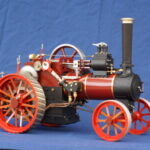
                        Having said that I don’t see a problem running the motor at a suitable speed. Take the drive off the Foden’s crankshaft as that is the fastest moving shaft. It’s got a good size disc flywheel so a simple friction drive off the flywheel rim will easily spin up the motor.

                        Something like when I was testing the 775 Dyno, lathe is running at 5-700 rpm to give 2500-3000rpm at the dyno. So as the OP only needs about half that he should easily be able to adjust the input dia to give the desired output at top crankshaft speed.

                        Say crankshaft speed of 150rpm, motor needs approx 1500rpm. Foden has a flywheel around 15″ diameter so 1.5″ dia friction drive. So quite easy to obtain the revs needed.

                        #827067
                        Robert Atkinson 2
                        Participant
                          @robertatkinson2

                          Sorry I missed the model number.

                          This is a permanent magnet DC motor with a commutator.

                          The polarity of the output will change with the direction of rotation. But this can be “fixed” by swapping the connections. The colour of wires will be “wrong” but if that worries you get some red and black heatshrink and put it over the wires.  You will have to run it at around 1500 RPM.

                          There are some minor issues with running it backwards and as a generator This is mainly around the brush assembly and armature reaction. But for this non-critical application it is insignificant.

                          Robert.

                          #827074
                          JasonB
                          Moderator
                            @jasonb

                            Not so easily “fixed” by just swapping the wires.

                            As it is a steam engine with no gearbox as stated the engine needs to be run in the opposite direction when you want to reverse so unless you disconnect the drive the motor could be driven in either direction. Hence my suggestion of a sprag (one way) clutch,

                            Sprag bearings are cheap to come by from most bearing suppliers put a couple of those on the motor shaft and then put the pulley on them. Set up to give correct polarity for forwards runing you will be making lecky for 99% of the run time.

                            #827091
                            noel shelley
                            Participant
                              @noelshelley55608

                              We STILL have no idea as to the duty required of the generator or the size of battery to be recharged. Then there is the issue of regulation. A simple circuit with a diode and relay would take care of the issue of reverse polarity and act as a block when the engine is not running.

                              Using LED lights I would question the need to recharge from the vehicle. A small and cheap ish car battery of say 30/35 Ah would last all night. Re charge back at base.  Good Luck. Noel.

                              #827095
                              duncan webster 1
                              Participant
                                @duncanwebster1

                                As its a road going foden it will be going forward for most of its life, a simple blocking diode will mean it charges when going forward and is safe when going backwards, but the OP still needs a control circuit to prevent overcharging.
                                Much simpler than sprag clutch

                                #827097
                                John Haine
                                Participant
                                  @johnhaine32865

                                  Or a bridge rectifier…

                                  #827099
                                  SillyOldDuffer
                                  Moderator
                                    @sillyoldduffer

                                    Just in case “here again” has been confused by the debate:

                                    • Jason has confirmed that the MY1016 is a DC motor that generates when spun.
                                    • The MY1016 will output up to 24V and 18A.  Probably less, but a reasonable choice for charging a 12V accumulator.
                                    • Being a DC motor, we confirm “here again’s” fear that reversing his steam engine will reverse the polarity of the generator’s output, which would be very bad for the battery.  This demands attention.
                                    • Simply connecting the generator to the battery is not acceptable for another reason:  the battery will power the generator as a motor, trying to move the engine.  Also very bad for the battery.  This also demands attention.

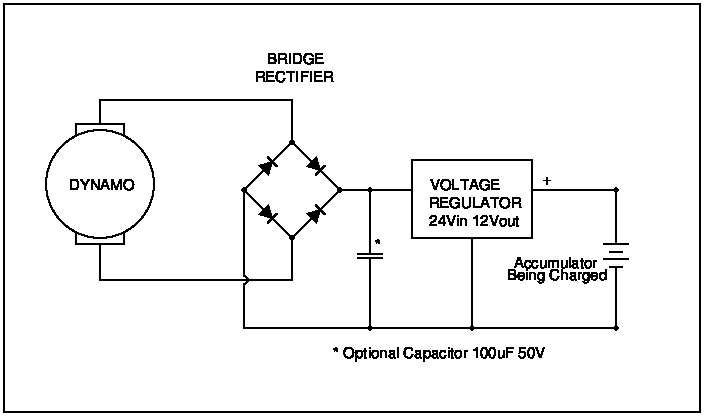
                                    I suggest the easiest answer is electronic, not mechanical.   I would build this circuit:

                                    dynamoCharger

                                    The Bridge Rectifier sorts out polarity reversals.  Doesn’t matter which way the genrator is turned, the output fed to the voltage regulator is always positive, job done.

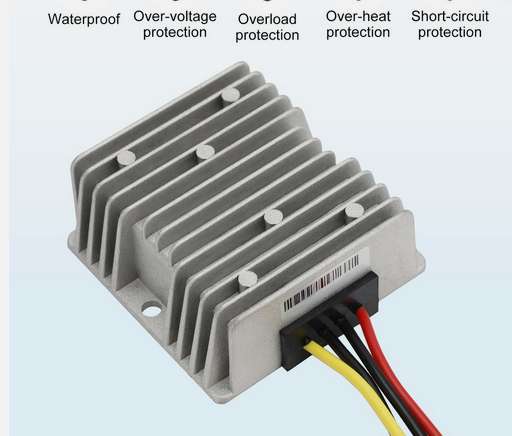
                                    This boost-buck voltage regulator converts any voltage between 9 and 36V produced by the generator to 13.8V at the output.

                                    Screenshot From 2025-12-01 10-08-09

                                    The regulator stops the battery from motoring the generator and 13.8V will charge the battery more effectively than the 12V module I suggested earlier.

                                    The capacitor marked* is optional.  Probably not needed with the boost-buck regulator shown above.  If it is required, to smooth the generator’s output, we can enjoy a long discussion about how many microfarads it should be!  If I were “here again”, I’d leave it out unless there’s a problem.

                                    Dave

                                    #827105
                                    John Haine
                                    Participant
                                      @johnhaine32865

                                      As the generator outputs DC it shouldn’t need much smoothing…

                                      Also there’s nothing to limit the charge current.  Note item 4 in the feature description:

                                      “4:This product does not have the function of charging the battery, it is only used for voltage conversion.”

                                      May just need a suitable series resistor?

                                      #827111
                                      noel shelley
                                      Participant
                                        @noelshelley55608

                                        The battery will act as a smoothing capacitor ?

                                        #827135
                                        Robert Atkinson 2
                                        Participant
                                          @robertatkinson2

                                          Oh dear I’m not doing very well with this thread 🙁

                                          A bridge rectifier on the output will automatically switch the polarity on engine reversal as SOD and others have said.
                                          If used for battery charging the regulator suggested by SOD wouls almost certainly need a blocking diode on it’s output.

                                          Robert.

                                          #827137
                                          noel shelley
                                          Participant
                                            @noelshelley55608

                                            At risk of splitting hairs 12V will not charge the battery you will need 13.6 – 14.25V DC. We need more info to give an answer that will work well. Ah well. Noel.

                                            #827145
                                            here again
                                            Participant
                                              @hereagain

                                              Sorry I am still here but busy day.

                                              Its only a 10ah  12v motorcycle battery. LED.  Flashing orange warning lights. 1/2 size Foden headlights with old type bulbs at present. I ll find an led holder that fits in one day.

                                              Being a Foden wagon there really is no way of taking a drive off the crank certainly not without cutting the bodywork up! So its flywheel driven.Unfortunately difficult to have any sort of power take off except to send steam to a stationary engine  but I can run it at night to power a string of lights . This would be running the engine in reverse to equal up wear from usual running forwards on the road.

                                              Jonathon

                                              #827164
                                              duncan webster 1
                                              Participant
                                                @duncanwebster1

                                                So you need a bridge rectifier. I wonder if a solar panel controller would do the control side

                                                #827175
                                                duncan webster 1
                                                Participant
                                                  @duncanwebster1

                                                  Ebay item 134798495863

                                                Viewing 23 posts - 26 through 48 (of 48 total)
                                                • Please log in to reply to this topic. Registering is free and easy using the links on the menu at the top of this page.

                                                Latest Replies

                                                Viewing 25 topics - 1 through 25 (of 25 total)
                                                Viewing 25 topics - 1 through 25 (of 25 total)

                                                View full reply list.