Motor as alternator

Motor as alternator

Home Forums Electronics in the Workshop Motor as alternator

Viewing 25 posts - 1 through 25 (of 48 total)
  • Author
    Posts
  • #826883
    here again
    Participant
      @hereagain

      I have a small 240v motor-8.7 amp-350w-2750rpm.
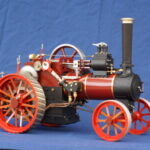
      <p style=”text-align: center;”>I intend to use this as an alternator on my steam engine for charging a 12v motorcycle battery. I know to to run it at 1500rpm and to use a voltage regulator but believe I need a diode as the steam engine can be reversed of course reversing polarity too ! Thats what I know nothing about. What type /rating would I need and where and how to fit it?  Any help appreciated. Thank you</p>
      Jonathon

      #826890
      John Haine
      Participant
        @johnhaine32865

        Do you mean alternator for AC or dynamo for DC? If DC is it a permanent magnet type or wound field? I assume the 8.7 amps is the starting current as 8.7 x 240 is around 2 kW!

        #826892
        SillyOldDuffer
        Moderator
          @sillyoldduffer

          Hi Jonathon,

          This may take some sorting out, so let’s take it in steps.  Bear with!

          First please confirm the motor ratings – as stated I can’t make sense of them:

          • 240v × 8.7A = 2088W, not 350W
          • A 350W motor at 240v is 1.46A, not 8.7A

          As well as getting the numbers right, we need to confirm that the motor will generate power.  Many AC motors don’t, so drive it with an electric drill with a multimeter, AC range, on the output to confirm it makes volts.  If it doesn’t then a car or motor bike alternator is a better choice.

          Can you post a photo of the motor plate, and of the motor as whole please.  We need to identify the type.

          The diode, actually a Bridge Rectifier is easy.   The hard part is ensuring the motor generates the voltage, frequency, and amps needed to charge a battery.   May be harder than you think: changing the speed of an alternator alters frequency rather than voltage, and, as alternators are only efficient at 50Hz/60Hz, the steam engine has to spin the motor at about 2750rpm.  That will producing 240V, to be is down-converted to 12v DC to charge the battery.

          One thing at a time though.  Tell us about the motor first.

          Dave


          #826894
          Nigel Graham 2
          Participant
            @nigelgraham2

            If you run an alternator the direction would not matter, as its output is a.c. and would need a full-wave rectifier to give d.c. for the battery-charging; with appropriate current or voltage smoothing and regulation between rectifier and battery.

            However, whether an alternator or a dynamo (d.c. output at the machine) it needs a field, be that a permanent magnet or a field-winding supplied from an auxiliary power-supply.

            #826896
            Fulmen
            Participant
              @fulmen

              Not sure if that will work. If you’re talking about an AC motor you will need to add an excitation winding somehow.

              #826899
              bernard towers
              Participant
                @bernardtowers37738

                Maybe a car type alternator would be better, if you use 15/16/17/18 acr type from lucas (other makes do the same thing) the rectifier and regulator are enclosed so some of the work is done for you. I would stay away from bike alternators as rotors and stators are usually crankshaft / crankase mounted so then you are into making casings etc.

                #826905
                JasonB
                Moderator
                  @jasonb

                  Sounds more like the spec for the small 24V DC motors not 240V so is that a typo along with the Amps which are 18.7. Typical e-bike/scooter motor.

                  #826910
                  here again
                  Participant
                    @hereagain

                    Apologies. Lot of miss typing.MY 1016

                    Its a 24vdc motor.

                    350w.

                    18.7 a.

                    2750 rpm

                    Thing about direction is the steam engine not having a gearbox. The crank will be reversed  along with polarity.

                    #826914
                    John Haine
                    Participant
                      @johnhaine32865

                      <p style=”text-align: left;”>Ok. So it may be wound field DC motor. Is there an obvious external magnetic field? How many wires from it? Is you battery 12 or 24V?</p>

                      #826917
                      Michael Gilligan
                      Participant
                        @michaelgilligan61133

                        The experts will chip-in shortly, I’m sure … but I suspect all you need is a beefy ‘Bridge Rectifier’

                        MichaelG.

                        .

                        Like this … but bigger 🙂

                        .

                        #826919
                        SillyOldDuffer
                        Moderator
                          @sillyoldduffer
                          On here again Said:

                          Apologies. Lot of miss typing.MY 1016

                          Its a 24vdc motor.

                          350w.

                          18.7 a.

                          2750 rpm

                          Thing about direction is the steam engine not having a gearbox. The crank will be reversed  along with polarity.

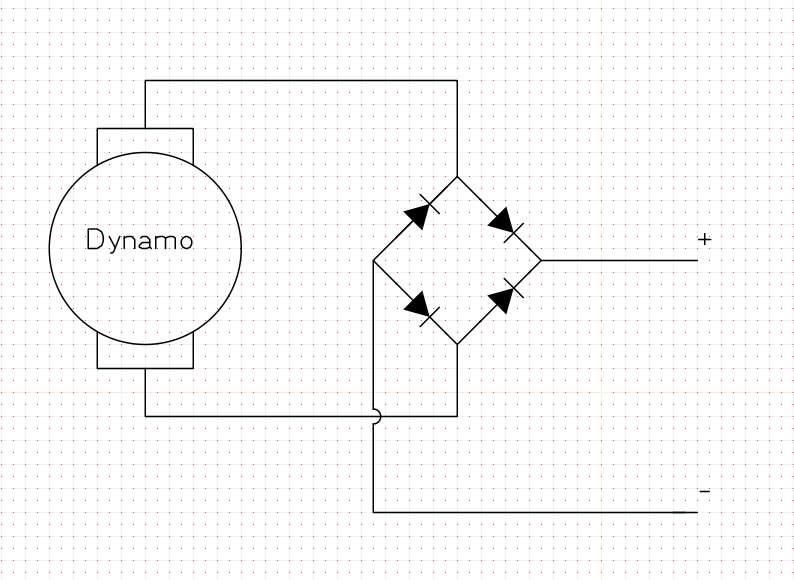
                          All becomes clear.  Try this circuit,

                          Screenshot From 2025-11-29 19-12-17

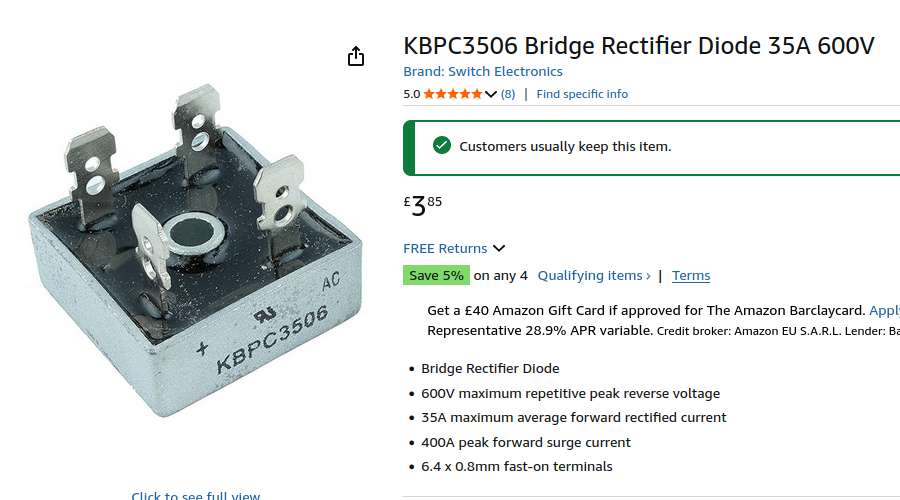
                          You could wire up 4 diodes as shown, but I’d buy a Bridge Rectifier:

                          Screenshot From 2025-11-29 19-17-54

                          There is a potential problem.  Although the rectifier switches so that it doesn’t matter which way the dynamo is turning, diodes drop about 0.7V.   Not a problem because here because the output is 24v and that needs to be dropped to 12v, by:

                          I’d fit the regulator and run the engine fast – more efficient,

                          What fun, please post a photo when it’s working,

                          Dave


                          #826921
                          here again
                          Participant
                            @hereagain

                            No magnetic field . 2 wires and 12v battery.

                            #826922
                            here again
                            Participant
                              @hereagain

                              Cant really slow engine down as its a road going half size Foden ! I have a Morrus Minor alternator but its so big for the space and very close to hornplates.

                              #826924
                              JasonB
                              Moderator
                                @jasonb

                                Speed the Dyno/ alternator gets driven at can be simply altered to suit by the pulley ratio.

                                Work out what your average engine shaft speed is then work out the ratio needed to spin the motor at it’s 2750rpm.

                                As you will mostly be running in forwards you could just put a sprag clutch into the drive so the motor only runs and charges when going forwards.

                                #826935
                                Nigel Graham 2
                                Participant
                                  @nigelgraham2

                                  Diodes to block reversed polarity would be easier and far more compact than adding to the machinery.

                                  A bridge rectifier as Dave shows would work even with a dynamo (d.c.) because in effect its output is a sort of “rectangular wave” with very long +ve half-cycles (forwards running) and short -ve half-cycles (reverse).

                                  Given that the reversals are infrequent, slow and short, it may not need even that, just a simple blocking diode.

                                  #826946
                                  duncan webster 1
                                  Participant
                                    @duncanwebster1

                                    If you don’t have at least a blocking diode, the motor will try to run the engine backwards when you want it stopped. If you have a charge controller that will probably sort that out, but then you havd to worry about applying reverse volts to the controller, so might still need a blocking diode.

                                    You wont get 24v out running at 2750 rpm. To find out its speed/voltage/current characteristic you could drive it with your Lathe and load it with combinations oh headlight/taillight bulbs

                                    #826950
                                    cedric 1
                                    Participant
                                      @cedric
                                      On here again Said:

                                      Cant really slow engine down as its a road going half size Foden ! I have a Morrus Minor alternator but its so big for the space and very close to hornplates.

                                      Morris Minor is ancient technology. Surely modern alternators are more compact? Something off a very small modern runabout car might fit? It could be worth a visit to your local breaker’s yard. I’ve seen small car alternators fitted to vintage motorcycles in place of the original DC generator. Only about 100mm diameter and similar length. I’ve a vague idea they come off a little Daihatsu or Hyundai/Kia or the like. Probably others suitable if you scrounge around.

                                      #826962
                                      Speedy Builder5
                                      Participant
                                        @speedybuilder5

                                        I for any other reason you are concerned about reverse, put a roller clutch onto the driveshaft/motor attachment ? But as others, use a diode bridge rectifier.

                                        Bob

                                        #826969
                                        SillyOldDuffer
                                        Moderator
                                          @sillyoldduffer
                                          On duncan webster 1 Said:

                                          You wont get 24v out running at 2750 rpm. To find out its speed/voltage/current characteristic you could drive it with your Lathe and load it with combinations oh headlight/taillight bulbs

                                          This is why I suggested spinning the motor with a drill and testing for output with a multimeter.  The problem is that motors are designed as motors and many types either won’t generate at all, or only do so weakly.  And if it works at all, it pays to experiment as Duncan suggests to find it’s speed/voltage/current characteristic.   Knowing the optimum speed allows the builder to select the most suitable pulley ratio.

                                          Best way to avoid complications is to buy an alternator or dynamo rather than repurpose an old motor.  Modern rather than old because they tend to be smaller and more reliable.

                                          Many motors work well enough to power a few miniature bulbs/LEDs on a model, but are less satisfactory for serious work like charging a battery.  Anyone know of a readily available DC or AC motor that’s cheap and just works as a no-fuss generator?

                                          Dave

                                          #826972
                                          John Haine
                                          Participant
                                            @johnhaine32865

                                            The OP has said that this is  DC MOTOR. It is not an alternator.  Has 2 wires so not wound field.  Best bet as Dave suggests is to drive it with an electric drill measuring the output voltage and setting the speed to get 24v. I would bet that is about the rated speed. Then try loading it to see current capability. Speed for 12v will be roughly half as much.

                                            #826976
                                            JasonB
                                            Moderator
                                              @jasonb
                                              On SillyOldDuffer Said:

                                              Anyone know of a readily available DC or AC motor that’s cheap and just works as a no-fuss generator?

                                              Dave

                                              775 Motor as reported here about a year ago in my Dynamo build. Other sizes will do similar.

                                              I suspect this is the type of motor the OP has, lots about with specs all around those sort of numbers and quite compact at just over a 4″ cube

                                              #826978
                                              Martin Connelly
                                              Participant
                                                @martinconnelly55370

                                                I would find out the specs for a bicycle hub dynamo. They are both small and designed to generate power. If a regulator is required I would expect that there is one to suit available as well. You don’t need a huge current to charge a battery, 350W would cook the average battery in a short time. The output from 12V bicycle hub dynamos is about 6W max and to some extent are self limiting but you could probably fit 2 if you wanted more power. You need to consider what the battery actually requires rather than feeding a potential 350W into it if the regulation fails. A battery cooking off is not a nice thought.

                                                Martin C

                                                #826981
                                                Rod Clemett
                                                Participant
                                                  @rodclemett60985

                                                  For one of his projects, a friend of mine used a small alternator originally intended for a Kubota.

                                                  Searching ebay for ‘Kubota 14A’ shows something similar, with a separate rectifier pack.

                                                  Not a massive output, but I suspect physical size and output might be somewhat connected!

                                                  Clem

                                                  #826983
                                                  Macolm
                                                  Participant
                                                    @macolm

                                                    It is certainly not an alternator. However, the exact motor configuration is fairly crucial to working out what to do, assuming it is still hoped to use it.

                                                    Could be:

                                                    -permanent magnet field

                                                    -shunt wound field, internally connected to armature

                                                    -series field ie “universal motor” (in which case very likely to have a fan to limit unloaded speed)

                                                    -some form of electronically managed motor

                                                    To get much further, this detail would need to be deduced, and some form of control devised to set the battery charging voltage and possibly limit the maximum current. If the battery is lead acid, it will be somewhat tolerant of abuse. If it is a new fangled lithium battery then precise charging characteristics are important.

                                                    #826990
                                                    cedric 1
                                                    Participant
                                                      @cedric
                                                      On Rod Clemett Said:

                                                      For one of his projects, a friend of mine used a small alternator originally intended for a Kubota.

                                                      Searching ebay for ‘Kubota 14A’ shows something similar, with a separate rectifier pack.

                                                      Not a massive output, but I suspect physical size and output might be somewhat connected!

                                                      Clem

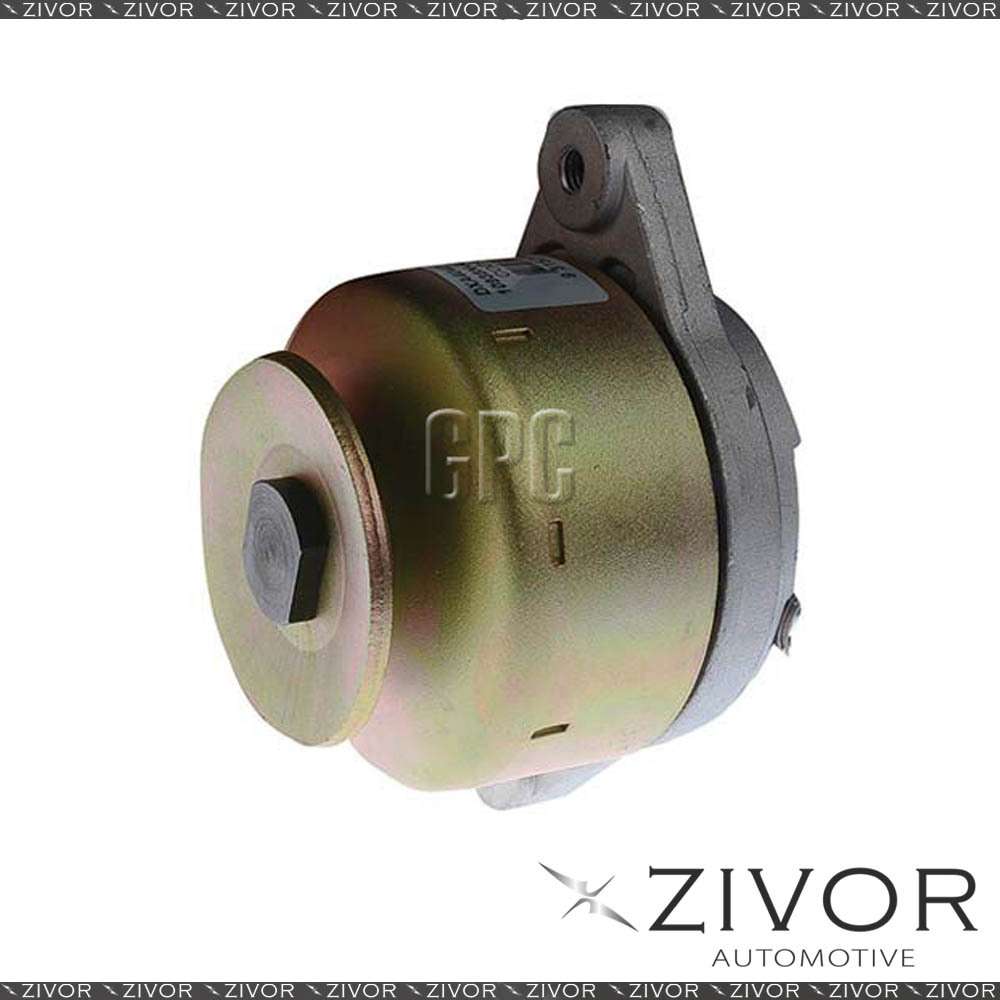
                                                      Good idea! The Kubota 14 amp alternator is barely bigger than the drive pulley.

                                                      Z09-DXA4042-87

                                                    Viewing 25 posts - 1 through 25 (of 48 total)
                                                    • Please log in to reply to this topic. Registering is free and easy using the links on the menu at the top of this page.

                                                    Latest Replies

                                                    Viewing 25 topics - 1 through 25 (of 25 total)
                                                    Viewing 25 topics - 1 through 25 (of 25 total)

                                                    View full reply list.