MIlling Machine Tripping RCBO

MIlling Machine Tripping RCBO

Home Forums Electronics in the Workshop MIlling Machine Tripping RCBO

Viewing 25 posts - 1 through 25 (of 30 total)
  • Author
    Posts
  • #849012
    Ady Wilson
    Participant
      @adywilson52106

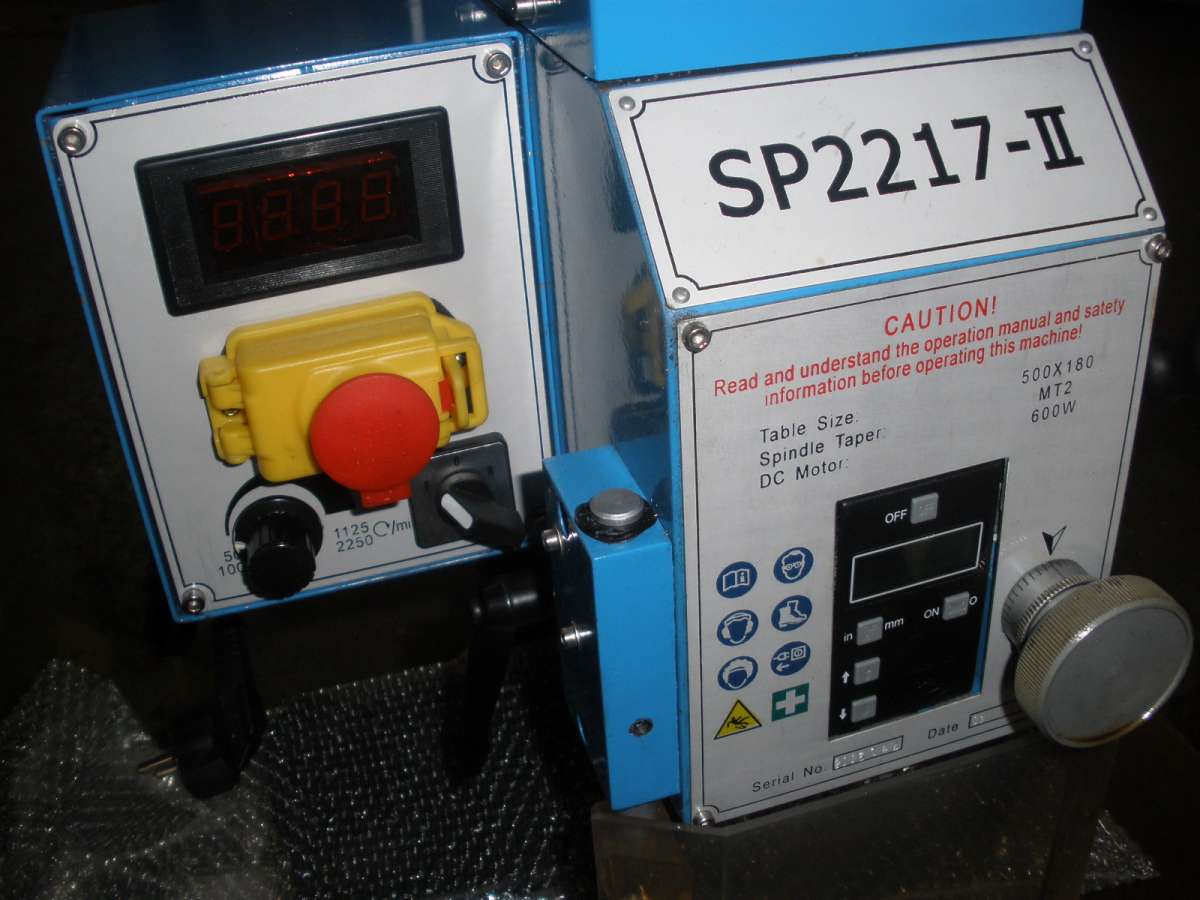
      I have a benchtop Chinese mill which I have owned for about 8 years.

      Same model as this –

      SP2217-II-2

      It`s 240V with variable speed. Over the last couple of years, it’s been tripping the RCBO in the consumer unit in the house. It started off being every now and but gradually became more frequent over time. Now as soon as I press the power button it immediately trips the electric.

      I have checked all the cables and sockets on the ring which it is plugged into (I even replaced the RCBO on the chance it might be faulty) and can’t see any problems. I even tried running it from the upstairs sockets ring and the same problem occurred.

      At the end of last year (when the problem was still intermittent) I replaced the motor thinking it might be the culprit. Obviously, that hasn’t helped.

      Today I took out the circuit boards and checked all the connections for damage or burning and couldn’t see anything obvious. I have ordered a new power switch in the hope something inside there is causing the problem.

      The questions I have are –

      Has anyone had any similar type of problems which they solved. Any info would give me some avenues to explore.

      Also, I disconnected the motor wiring on one attempt and the electric still tripped. My thought was that if the problem was with the motor, although the motor obviously won’t run the electric would not trip, but it did.

      Am I on the right track with the switch or are there other areas I should be checking. Any thoughts greatly appreciated.

      Ady.

      #849015
      Stuart Smith 5
      Participant
        @stuartsmith5

        Do you have anything else supplied by the same RCBO?


        #849016
        Phil S
        Participant
          @phils66830

          Hi Ady

          Just to clarify does it trip when you switch on power at the wall or when you press the start button ? Do you have access to a multimeter or Avo meter ?

          #849017
          Ady Wilson
          Participant
            @adywilson52106

            The machine is in the garage and I plug it in via an extension from a kitchen outlet when using it. I know this is not ideal but I have had the machine many years and it had performed fine until the last couplke of years when it occasionally tripped the RCBO every now and then. When I am out there I make sure nothing else is running like washing machine etc..

            It doesnt trip when the power is on at the wall, only when I press the switch to start the motor. Previously the motor would run for a minute or some seconds before it cut out. Now it trips on pressing the power. I do have a multimeter but am not sure where and what I should be testing for.

            #849018
            Alan
            Participant
              @alan14594

              I had a similar problem with an inverter powered lathe …

              It got much worse when I got a variable speed milling machine… It tripped every time I turned it on.

              The RCD powering the workshop was a type A, which is only suitable for a pure AC load.

              I fitted a type B rcd, which can cope with the odd signals coming fro an inverter.,.No further problems…

              Alan

              #849019
              Dave Halford
              Participant
                @davehalford22513

                Check the start up current without the motor just to put your mind at rest. You should not see a big spike.

                If you don’t see anything silly it’s the earth leakage part of the RCBO that’s tripping, which could mean there’s something else on the ring that’s leaking more than it should and the lathe power unit leakage is the last straw or the lathe power unit is the culprit or even the RCBO has gone over sensitive.

                Try a different ring.

                #849021
                peak4
                Participant
                  @peak4

                  It might be the RCD aspect that’s tripping, rather than the current overload.
                  I have a Newton Tesla setup which did the same, occasional at first, then always.
                  It turned out to be an interference suppressor which had gone slightly leaky to earth.
                  Repair was completed quickly and all’s fine now.

                  You mention running off an extension lead; have you tried a different one?

                  Bill

                  #849032
                  Robert Atkinson 2
                  Participant
                    @robertatkinson2

                    Late to this but some critical questions:

                    You say this is on a RCBO. There are two types of these, one feeding several circuits and a newer smaller type intened for use on a single (normally radial )circuit that replaces the MCB. As it sounds like an older installation I’m assuming it the multi-circuit type (one or two RCBO’s rateed at >32A in the consumer unit). These are often just RCDs with no overcurrent protection.

                    As Stuwart Smith 5 has already asked, what else is on the circuit withe the RCBO? If is is a single one or two in the consumer unit it’s likely feeding the whole or half of the house.

                    Unless the mill is the only item connected to the RCBO is is unlikely that there is anything wrong with the mill  The RCD/RCBO trips on the total leakage current on the circuit. Modern electronics and appliances and have interference filters and every one add a little bit of leakage current. This is a result of the basic operation of the filter compoments, not a fault.
                    Larger power items and those with motor drives need more effective filters and these have higher leakage current. As the mill was likely desigined for “industrial” standards it may be the largest leakage item on the RCD/RCBO. The leakage will still be below the the tripping current.

                    Over the years the number of items with leakage on the circuit has probably increased bringing it close to the trip level. Connecting the mill, with it’s high leakage current, pushes the total leakage over the trip level. Nothing ron with the mill it just tje final, albeit heavy, straw.
                    While it may not be part of your issue, if the live pin in the plug connects before the neutral when plugging into a live socket it is more likely to trip as it removes the live to neutral current in the Y capacitors causing a momentay increase in the apparent leakage.

                    To confirm the mill leakage current you need either a specialised leakage meter or a PROPER appliance tester (aka PAT). This needs to be capable of measuring AC leakage. the small battery ones only measure DC leakage. These or a “megger” will tell you if there is an insulation failure but not the filter leakage.

                    The cure is to feed the mill from it’s own circuit abd RCD. or convert to seperate RCBOs replacing the MCBS and removing  large one(s).
                    Time to consider a proper power connection to the workshop with it’s own two circit (one power one lights) consumer unit.

                    Robert.

                    #849050
                    not done it yet
                    Participant
                      @notdoneityet

                      Personally , I would not have replaced anything until tests were exhausted.

                      The most annoying (might have to restart a lot of clocks/timers), but effective check would be to switch off everything else in the home and then test to see if it is that one circuit causing the trip.  Subsequent checks/tests would follow after that, to determine the reason for the trips.

                      Electric cooker rings were a favourite to leak to earth, I suspect, long before RCDs and RCBOs were installed.  Back then, the first we knew about it was when the fuse blew!

                      #849063
                      KenL
                      Participant
                        @kenl

                        Robert is spot on with his answer.

                        It’s a common problem with VFDs and is usually caused by the cumulative effects of small earth leakages throughout the house wiring or from a single appliance that is plugged in to a seperate circuit fed by the same RCD.


                        My first action would be to unplug the washing machine, dishwasher, iron, immersion heater and any other device throughout the house that may be subject to internal condensation or is in a damp environment. You may find that this removes the problem and if so you can gradually re-connect all the appliances one by one until you discover the culprit.

                        #849068
                        blowlamp
                        Participant
                          @blowlamp

                          I was having a similar issue with my inverter equipped lathe and it turned out that the underground cable feeding my workshop was leaking power, but the RCBO only tripped when starting the lathe.


                          Martin.

                          #849093
                          Ady Wilson
                          Participant
                            @adywilson52106

                            Thanks for all the replies, it`s much appreciated. It gives me a some good avenues to explore. I will switch all appliances off and run a new extension cable I purchased out to the mill and see what happens. The feed I am using is from the downstairs sockets which are on their own RCBO. Basically there is the washing machine, fridge freezer, TV etc on that line. I have changed the RCBO out for a new one so hopefully I can rule it out. The mill worked fine for a few years without problem on the old one. Also I tried running a lead from the upstairs sockets (on seperate RCBO) but I was still getting the trip. I do have a lathe in the garage which runs fine. It has caused the RCBO on the downstairs sockets line to trip before on startup, but it is a very rare occurance.

                            I dont know if this means anything but I bought one of the RCD safety adpators which I plugged into the extension lead and then plugged the mill into it. Hoping it would save me having to go into the house everytime the power tripped while tinkering. It does trip and leave the power on, but on most occasions both it and the RCBO in the house trip.

                            Ady

                            #849108
                            Speedy Builder5
                            Participant
                              @speedybuilder5

                              Don’t just turn off appliances – unplug them (if possible).

                              #849110
                              KenL
                              Participant
                                @kenl
                                On Speedy Builder5 Said:

                                Don’t just turn off appliances – unplug them (if possible).

                                Speedy is absolutely correct, you must disconnect by unplugging or removing all three wires to the appliance. Often an earth leak can be via the neutral wire which will not always be disconnected by switching off. The favourite appliances for causing the problem are washing machines and steam irons where condensation can form inside the outer casing. Also consider that earth leakage can emanate from one of your other workshop machines so isolate those too. Using an extension lead is not really helpful TBH, it’s just another potential problem in the circuit.

                                #849120
                                Robert Atkinson 2
                                Participant
                                  @robertatkinson2

                                  Tripping an additional RCD at the mill end of the extension lead is unusual. That are the ratings of the RCBO and plug-in RCD? Is the RCD a reputable make?. The RCD may be more sensitive or/and faster than the RCBO.
                                  Roughly where are you located? There may be a member near who could help with tests.

                                  Robert.


                                  #849131
                                  Ady Wilson
                                  Participant
                                    @adywilson52106

                                    Thanks for the information. I will make sure I unplug everything and test again tomorrow.

                                    I live just outside Preston, Lancashire, in a small town called Longridge.

                                    I took the on/off switch off the machine and put a multimeter across the terminals. I only have basic knowledge in this department but can check for voltage and continuity on simple things. I watched a video where a guy was testing an identical switch which helped me greatly. I set my multimeter for 200k ohms. When I press the switch, I get a brief resistance reading and then it drops to zero signaling the circuit is closed. I was wondering how stable the resistance reading should be when the switch is initially pressed. I have the switch in the house with me now and when I operated the switch 10 times in testing, I got the following –

                                    62.0, 11.1, 7.5, 76.6, 27.0, 63.2, 2.8, 23.7, 69.8, 27.9

                                    Those readings were with the meter set at 200k Ohms. Is that kind of difference or fluctuation normal or could it cause an issue?

                                    #849160
                                    Robert Atkinson 2
                                    Participant
                                      @robertatkinson2

                                      By on-off do you mean the yellow switch with the emergency stop button on the cover?
                                      I would not expect any resistance reading in the 10’s of kilohms that your readings imply. Can you post a picture showing where you are measuring? Even if the switch contacts are faulty I’d not expect it to trip an RCD.
                                      The important measurement is at the 13A plug. Measure the resistance between  the earth pin and live pin with the machines power switch off and on. Then do the same between the earth and neutral pin. If the on-off switch is the magnetically held type (looks like it is) hold the green button down whaile making the ON measurement.  Use the highest resistance range your meter has.
                                      This will only test for insulation failure not ac leakage through the filter capacitors but at last it will  rule dc leakage at low voltage out.

                                      Robert.

                                      #849164
                                      SillyOldDuffer
                                      Moderator
                                        @sillyoldduffer
                                        On Robert Atkinson 2 Said:


                                        This will only test for insulation failure not ac leakage through the filter capacitors but at last it will  rule dc leakage at low voltage out.

                                        Robert.

                                        I’m too poorly to explain this sensibly, but could Robert address the possibility that one or more of the suppressor filter capacitors in the lathe is faulty and leaking enough current to earth to trip an RCB? Suppressor capacitors have a hard life because they are connected directly across the mains and sometimes fail by dribbling!   The possibility was mentioned early on by Bill (peak4), and not picked up, even though it’s a likely cause.

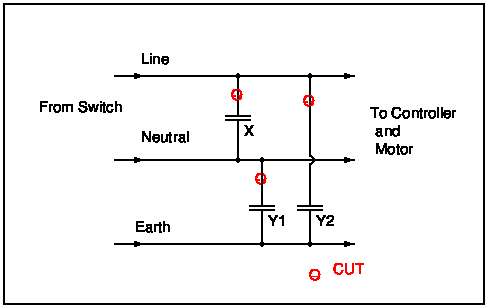
                                        Typical circuit:

                                        XCFilter

                                        Suppressor capacitors stop electro-magnetic muck entering and leaving the lathe, and it will run without them.  Therefore faulty capacitors can be detected by disconnecting them, see CUT above.  (I’d start with Y2).  As they’re cheap (RS Components) and easily swapped if a soldering iron is available, I’d replace them as the first move.   If Ady posts a photo of his board, should be possible to identify them.

                                        Unlikely that a faulty switch would trip an RCB – we’re looking for something leaking current to earth.

                                        Another possibility is dirt/swarf bridging tracks on the board – lathes are vulnerable to this! I suggest Ady give the board a good clean with contact cleaner and cotton buds, and look carefully with a magnifying glass for tiny slivers of metal.

                                        As electronics can be difficult to diagnose and fix even if the owner has the necessary test gear, the easy answer is for Ady to replace the whole controller board.  It’s the modern way – I don’t know of any commercial firms doing this type of simple repair. 🙁

                                        Dave


                                        #849180
                                        Dave Wootton
                                        Participant
                                          @davewootton

                                          Welcome back Dave, hoping you will feel much better soon.

                                          Dave

                                          Sorry if it’s a bit off topic but thought Dave’s return deserved a comment.

                                          #849196
                                          Ady Wilson
                                          Participant
                                            @adywilson52106

                                            Update –

                                            I unplugged everything from the upstairs and downstairs sockets in the house, which as I said earlier are on separate RCBO`s. That meant I could run two extensions, one from the upstairs and one from the downstairs, so when I tripped one, I could plug into the other. Giving me another chance to test before I have to go in house and reset.

                                            Something interesting I discovered. Normally when I start the mill by pressing the power button, the variable speed controller dial is its lowest setting (turned all the way to the left). I tried starting the mill a couple of times and it tripped the power immediately on pressing the button, no time for the motor to even begin to turn just an immediate trip. I must have rotated the speed dial unintentionally and when I reset everything and went back out and tried again the motor fired up and ran. It caught me off guard with it spinning so fast (holding fascia in my hands) so I immediately hit stop on the switch.

                                            When I put the speed dial back to lowest setting the power tripped immediately on next attempt to start. I reset and moved it up to about quarter and tried again. The motor fired up for a couple of seconds then everything tripped again. So, I moved the dial up about halfway and tried once more and the motor spun up and continued running. I let it run for about 10 seconds, switched it off and repeated and it worked fine. I did this another few times and all was good. I then tried moving the speed dial back to its zero position and the power tripped immediately. I repeated all I had done previously, trying different positions on the dial. Any position below halfway either causes an immediate trip or the motor runs a second or two and then a trip. If it is set halfway or above it runs ok.

                                            I am going to have a brew and then repeat what I did and let the motor run longer. If it works consistently I will plug all the appliances back in and try it again and see what happens.

                                            #849208
                                            Robert Atkinson 2
                                            Participant
                                              @robertatkinson2

                                              Welcome back Dave.
                                              A Y capacitor failure can certainly cause an RCD trip. They do tend to be cascading and catastrophic though. The RIFA brand film types are well known for the very smelly smoke they release on failure. The DC resistance checks will detect most capacitor failures but ideally an insulation tester would be used.

                                              The latest symptoms reported by Ady are interesting. It’s hard to know what is going on without knowing the design of the motor drive. It appears to have a brushless DC motor but that covers a wide range of designs. It might be something like  dynamic brake function.
                                              I await results of the re-test.

                                              Robert.

                                              #849217
                                              noel shelley
                                              Participant
                                                @noelshelley55608

                                                Very interesting ! Sounds like cap leakage being masked by the motor when running. For what they cost I would change them for a start. With out test gear it may be hard to solve. Noel.

                                                #849221
                                                Phil S
                                                Participant
                                                  @phils66830

                                                  If this is a brushless drive, then at low or zero speed very little current will be drawn from the DC rail in the control board, this may allow the voltage to climb up to a higher level than when the motor is spinning fast. The higher voltage could then breakdown across a component such as an EMC suppresion capacitor. As Ady has also had a similar issue with the lathe perhaps the mains voltage is too high ? I had an overvoltage issue at night when I lived on a new and expanding housing estate. It was fixed by uprating the 11kv supply cable to the estate transformer and adjusting the tappings.


                                                  #849229
                                                  Ady Wilson
                                                  Participant
                                                    @adywilson52106

                                                    I tested the potentiometer with no power and on the machine and it functions from 0 – 4.5 when turning it from min to max. It gave some erratic readings in the lowest postion initially. I took back off and blew it with some air and it seemed to right itself. I then put the multimeter on the outside terminals and got 4.5 which I beleive is right as it matches the maximum from previous test.

                                                    I then put the probes on the outer terminals and plugged the machine in (not running obviously). I got some very erratic readings with the meter set at 200Ac (hope thats what I should have had it set on lol). See video –

                                                    Is that a problem with the potentiometer or the feed to it?


                                                    #849247
                                                    Robert Atkinson 2
                                                    Participant
                                                      @robertatkinson2

                                                      Only DC on the pot. Typically about 5V.
                                                      Phil’s comment is about the mains voltage. I would not recommend measring mains with that meter. It is not safe. If you must measure mains connect it up with the equipment unplugged and don’t touch the meter or leads while power is on.

                                                      Robert.

                                                    Viewing 25 posts - 1 through 25 (of 30 total)
                                                    • Please log in to reply to this topic. Registering is free and easy using the links on the menu at the top of this page.

                                                    Latest Replies

                                                    Viewing 25 topics - 1 through 25 (of 25 total)
                                                    Viewing 25 topics - 1 through 25 (of 25 total)

                                                    View full reply list.