Lead Screw Adjustment

Lead Screw Adjustment

Home Forums General Questions Lead Screw Adjustment

Viewing 22 posts - 1 through 22 (of 22 total)
  • Author
    Posts
  • #825099
    Justin Thyme
    Participant
      @justinthyme24678

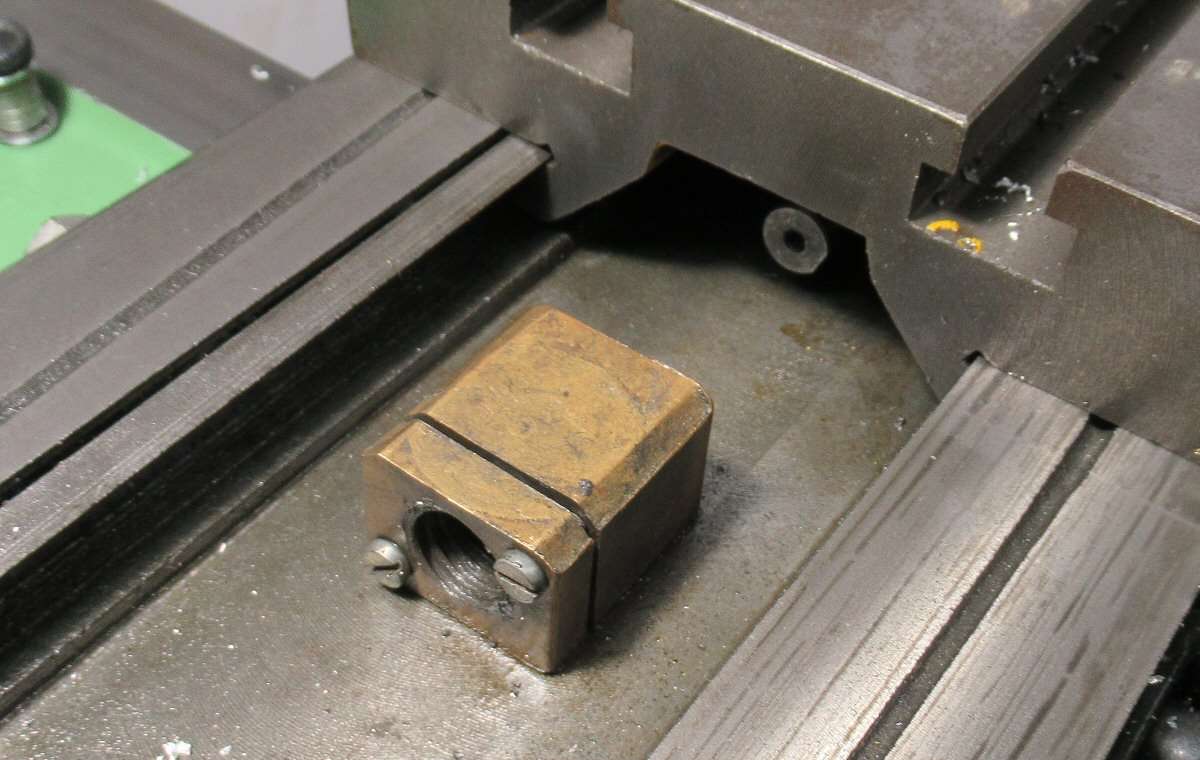
      How do these work, well I know what they do but this just rattles itself loose. there seems to be no way to lock it after adjustment.

      I have a couple of ideas how to resolve this problem, but first of all what is the norm, am I a bit missing  (there i nothing between these two plates)

      xLathexslide7155

      #825103
      DC31k
      Participant
        @dc31k

        What are you doing that causes such serious vibration?

        What you show is completely conventional, nothing missing.

        A dab of the weakest threadlock on the screws would seem a pragmatic way to overcome your difficulty.

        Very much as an aside, is there any preferred direction for the split nut? Assuming it is for the cross slide, should the thin side face the operator or face the back of the lathe? Should the answer be different if you do a lot of boring?

        #825105
        Dave S
        Participant
          @daves59043

          Threadlock the adjustment screws.

          Shouldn’t need adjusting very often.


          #825107
          Justin Thyme
          Participant
            @justinthyme24678

            no serious vibrations going on….   over time it just seems to gradually work its way loose, and providing I adjust it back up before aiming for high accuracy all is well


            just wondering if there was something missing,  we have some blue threadlock that may do the job (it tends to make things stiff rather than lock them)


            #825110
            SillyOldDuffer
            Moderator
              @sillyoldduffer

              The screws pull the gap closed, bending the part enough for the female thread to grip the male screw more tightly. It compensates for backlash.   However, don’t overdo it – a tight fit causes rapid wear.   I only tighten mine when backlash gets above about ⅓ of a dial turn.

              The adjusting screws are normally quite tight – enough to close the gap slightly.  I guess they’re loose because you haven’t tightened them enough to reduce backlash.  An unworn lathe may not have significant backlash yet, so the screws are loose.  I’d nip them up a bit harder or put some threadlocker on.

              The design is a compromise: bending the part is an inexpensive way of compensating for wear.  Posh anti-backlash mechanisms are costly.

              Dave

              #825111
              David Jupp
              Participant
                @davidjupp51506

                I’d be tempted to add spring washers under the screw heads, to see if that helps.

                #825115
                John Hinkley
                Participant
                  @johnhinkley26699

                  Looking at the split nut by zooming in (a lot) it appears to me that the “slot” goes all the way through, creating two separate items..  I would expect there to be some sort of spring mechanism between the two parts to impart a bit of anti-backlash to the nut.  If not entirely split. I’d be tempted to saw the thin bit off and put a spring between the two with longer bolts, then Loctite them in, once the backlash had been eliminated. If the spring is “just right”, in compression,it should compensate for wear and subsequent backlash automatically. Finding the Goldilocks spring might take a bit of experimentation

                  John

                  (It’s much easier to suggest hacking it about when it’s not your lathe!)

                  #825118
                  Bazyle
                  Participant
                    @bazyle

                    No you don’t need a spring between the parts. Star washers of spring washers might work if you have them. Threadlock is only meant to make the screw tight not lock it solid. They tried calling it “threadmakeitslightlytightnotlocked” but it was too long to ft on the bottle.

                    #825126
                    old mart
                    Participant
                      @oldmart

                      The design is very basic, just a nut with a saw cut 90% of the thickness so the small screws can bend the thin part and take up the backlash. They were on the museums round column mill on both X and Y axes. As soon as I could get hold of the right pitch internal Trapezoidal threading inserts, proper adjustable nuts were made.

                      I still have the old nuts which are 2.5mm pitch, left hand for the X and right hand for the Y and about 22mm diameter threads.

                      You also need to minimise the end float on the leadscrew which is adjustable.

                      #825144
                      SillyOldDuffer
                      Moderator
                        @sillyoldduffer
                        On SillyOldDuffer Said:

                        The screws pull the gap closed, bending the part enough for the female thread to grip the male screw more tightly. It compensates for backlash.   …

                        Dave

                        Or push the gap open, bending in the opposite direction.  I vaguely remember my mini-lathe was a pusher.  Can’t remember which round my current lathe is!

                        Dave

                        #825153
                        Diogenes
                        Participant
                          @diogenes

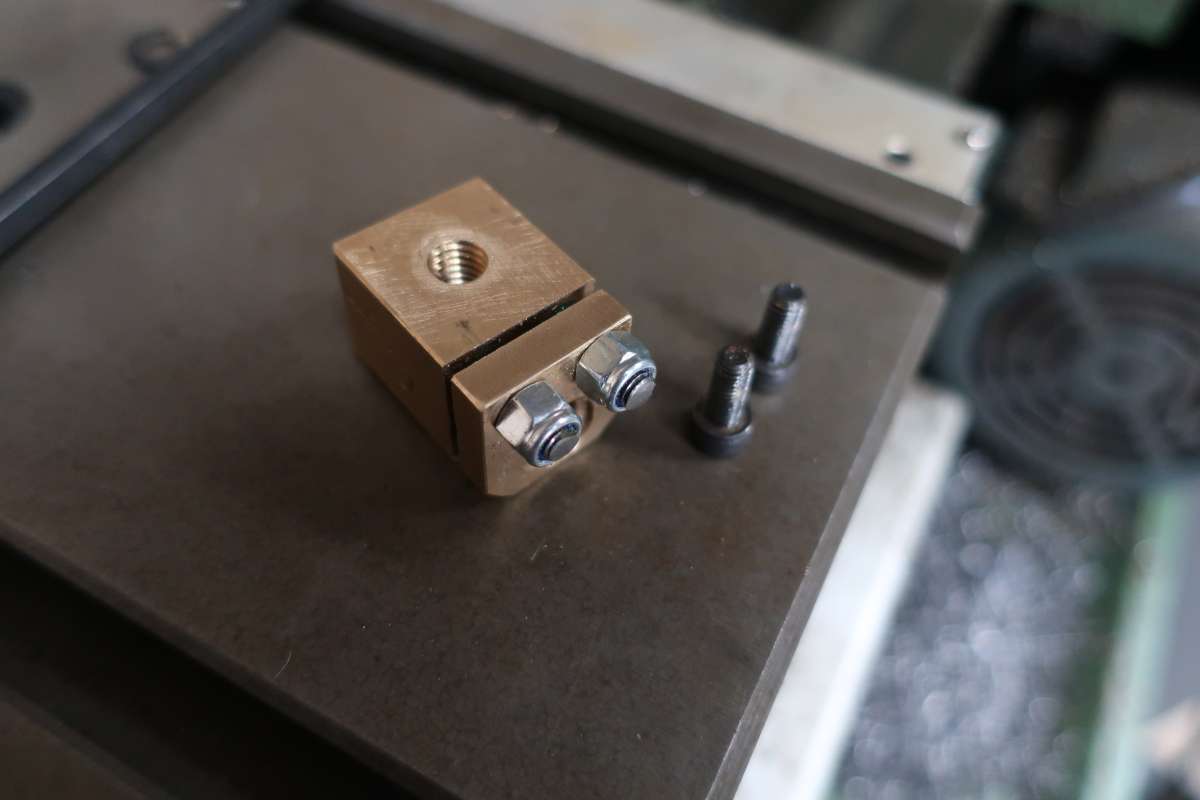
                          Fit studs in the body and use Nyloc nuts on the studs..

                          GH600 Cross slide nut

                          #825184
                          old mart
                          Participant
                            @oldmart

                            I got the hands of the leadscrew threads back to front and nobody noticed.

                            #826160
                            Justin Thyme
                            Participant
                              @justinthyme24678

                              first of all the two studs with the nylocks is the way to go and that is what I will be doing


                              However, I tried a spring washer between the gap and i thought it went quite well, seem to get a nice tightness to the lead screw.  so tried a dial gauge to assess how well it was working, and its hopeless

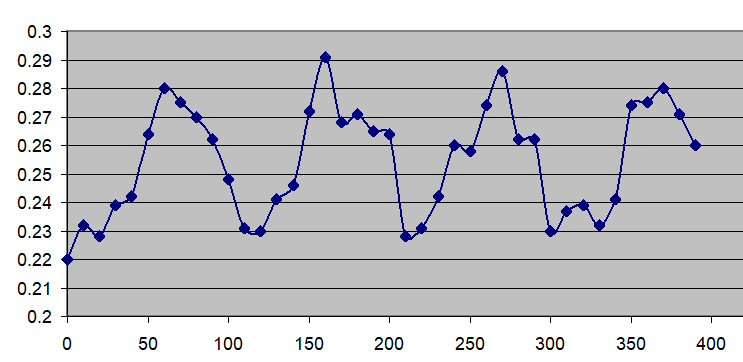
                              the following is graph plotting the lead screw against the dial gauge, the Y-axis is mm from the dial gauge and the X-axis is thou from the lead screw
                              I plotted every 10 thou of an inch and should have produced a straight line at 0.254mm

                              clearly the discrepancy is related to the rotation of the lead screw – but what is going on ?

                              Obviously I need to repeat this a few times to check for consistency

                              but should the floating part o the block be alwys allowed to move inwards – (rather than locked in place as I have it with the spring washer between)

                              xchart1

                              #826169
                              Diogenes
                              Participant
                                @diogenes

                                Try winding the slide right in, and then loosen the bracket that holds the screw/handwheel assembly and re-centralise it, with the aim of getting the screw co-axial with the nut – ‘best fit’ will do – a bit of trial and error will often find a sweet-spot.

                                Do I interpret correctly that deviation from ‘straight’ in your graph appears to be about 25um?

                                #826177
                                SillyOldDuffer
                                Moderator
                                  @sillyoldduffer
                                  On Justin Thyme Said:

                                  first of all the two studs with the nylocks is the way to go and that is what I will be doing

                                  Shouldn’t be necessary.  As Old Mart said “The design is very basic, just a nut with a saw cut 90% of the thickness so the small screws can bend the thin part and take up the backlash.

                                  The screws should be tight enough to bend the nut, making it unlikely they will vibrate loose.   Possibly the threads are damaged, more likely I guess, they’re not tight enough.

                                  However, I tried a spring washer between the gap and i thought it went quite well, seem to get a nice tightness to the lead screw.

                                  As the gap exists to let the nut bend, don’t block it with a washer.

                                  so tried a dial gauge to assess how well it was working, and its hopeless

                                  Misleading.  This form of backlash adjuster is a crude clamp.  No point I suggest in putting a DTI on it.  Adjust it by feel.   The screws are tightened just enough to bend the nut so it’s threads bear lightly on the lead-screw.   The handle should turn smoothly with reduced backlash  until wear loosens the clamp and the screws have to be retightened.  The purpose is to reduce backlash, nothing else.

                                  the following is graph plotting the lead screw against the dial gauge, the Y-axis is mm from the dial gauge and the X-axis is thou from the lead screw
                                  I plotted every 10 thou of an inch and should have produced a straight line at 0.254mm

                                  clearly the discrepancy is related to the rotation of the lead screw – but what is going on ?

                                  I think the DTI is detecting that the nut isn’t bent tight enough.   And DTIs are sensitive enough to pick up a trivially bent or worn lead-screw and looseness at the handle bearing end.  My advice, don’t jump to high-precision measuring too quickly.  It’s tricky to do properly, and is most useful for homing in and proving rather than understanding the big picture.

                                  but should the floating part o the block be alwys allowed to move inwards – (rather than locked in place as I have it with the spring washer between)

                                  The gap is essential.  To quote Old Mart again: “The design is very basic, just a nut with a saw cut 90% of the thickness so the small screws can bend the thin part and take up the backlash.”

                                  Apologies if I’ve misunderstood!  Might help to re-state the actual problem and explain how it affects cutting metal:

                                  • screws come loose
                                  • excessive backlash
                                  • feels wrong – binding or inaccurate movements

                                  Dave

                                  #826183
                                  Justin Thyme
                                  Participant
                                    @justinthyme24678
                                    On Diogenes Said:

                                    Do I interpret correctly that deviation from ‘straight’ in your graph appears to be about 25um?

                                    yes, every Ten ‘thou of an inch’ adjustment creates a movement between 225 and 285 microns.   So yes defianion 25 to 30 microns from expected
                                    25 too much when dial at 60thou
                                    25 too little when dial at 10 Thou


                                    If i have time today I will repaet the test a few times to get an average – then try it with the origina set up that allows to floating plate to move freely towards the main block

                                    #826191
                                    cedric 1
                                    Participant
                                      @cedric
                                      On Justin Thyme Said:

                                      first of all the two studs with the nylocks is the way to go and that is what I will be doing


                                      However, I tried a spring washer between the gap and i thought it went quite well, seem to get a nice tightness to the lead screw.  so tried a dial gauge to assess how well it was working, and its hopeless

                                      the following is graph plotting the lead screw against the dial gauge, the Y-axis is mm from the dial gauge and the X-axis is thou from the lead screw
                                      I plotted every 10 thou of an inch and should have produced a straight line at 0.254mm

                                      clearly the discrepancy is related to the rotation of the lead screw – but what is going on ?

                                      Obviously I need to repeat this a few times to check for consistency

                                      but should the floating part o the block be alwys allowed to move inwards – (rather than locked in place as I have it with the spring washer between)

                                      xchart1

                                      You may be overthinking things here. I’m a bit unclear from your description on exactly what you are doing. But if you are measuring cross slide movement with a dial indicator versus the feedscrew movement shown o  the graduated handwheel, it is not telling you much.

                                      Stiction between the sliding surfaces will account for the inconsistency. Backlash in the nut is not critical. Cutting forces will push the cross slide nut back against the thread and take it any slack.

                                      Just take up excess backlash with the nut so there is only a few thou of freeplay on the handwheel dial and carry on turning.

                                      #826216
                                      Dave Halford
                                      Participant
                                        @davehalford22513

                                        Unless you specially degreased the ways and nut for the photo it all looks a little too dry to run smoothly.

                                        #826217
                                        ChrisLH
                                        Participant
                                          @chrislh

                                          Any thread with inclined flanks (e.g. Acme, M, Un, etc.) will produce cyclic variations in advance movement if the leadscrew is not perfectly concentric with the nut quite apart from the effects of having adjustable nuts.

                                          #826231
                                          cedric 1
                                          Participant
                                            @cedric

                                            Just looking at your chart again, and reconciling the two different measurement systems, it looks like you are getting a variation of between .02mm and .03mm, which is about .001″. One thou.

                                            You really can’t expect to get much better than that on a low cost hobby lathe. In fact you are lucky to get that close. It’s not an industrial precision grinder.

                                            Again, I’d adjust your nut to eliminate most of the freeplay and carry on turning . Learn to turn the handle back past any backlash and always approach from the positive direction.

                                            ChrisLH’s point about concentricity of the screw and nut is very relevant too, especially on a low cost hobby lathe where manufacturing standards are notoriously inconsistent. Bent screw can do it too.


                                            #826255
                                            Graham Meek
                                            Participant
                                              @grahammeek88282

                                              Having the backlash adjustment too tight will wear the parts quicker than having them slack. As there is nowhere for the oil or grease to lubricate the parts. If you are after near perfect linear movement then this is not going to come from a hobby machine.

                                              Emco advised 0.05 mm backlash on their FB2 and F3 milling machines. My Maximat Super 11 lathe gave 40 years service with a backlash of 0.05 mm on the cross-slide feedscrew, I can only ever remember adjusting that about a half dozen times.

                                              Regards

                                              Gray,

                                              #826293
                                              old mart
                                              Participant
                                                @oldmart

                                                Unless your leadscrew is new, there is the problem of uneven wear because most work is carried out with the bed close to the central position. So even if you get the backlash minimised in the centre, it may be tight at either end of the travel.

                                              Viewing 22 posts - 1 through 22 (of 22 total)
                                              • Please log in to reply to this topic. Registering is free and easy using the links on the menu at the top of this page.

                                              Latest Replies

                                              Home Forums General Questions Topics

                                              Viewing 25 topics - 1 through 25 (of 25 total)
                                              Viewing 25 topics - 1 through 25 (of 25 total)

                                              View full reply list.