How does this temp trip work?

How does this temp trip work?

Home Forums General Questions How does this temp trip work?

Viewing 19 posts - 1 through 19 (of 19 total)
  • Author
    Posts
  • #526118
    IanH
    Participant
      @ianh

      I have been investigating the failure of a fan heater….don’t shout, it is just a lockdown diversion. It has what looks like a bimetallic type thermal trip fitted such that if the fan fails for example, the heater overheats operating the trip. The trip is on the incoming live and goes open circuit, so once tripped nothing works. The fan motor and heater elements are downstream of the trip.

      I assumed that once it cools down it will reset, but it won’t do this whilst the unit is still switched on.

      I think the trip is generating a bit of heat which keeps it open circuit? If you turn the unit off (isolate it from the mains), it resets after a short period.

      How does the trip manage to not reset whilst still connected to the mains? I imagined that to generate heat it will need to pass a small current, but once tripped it is isolated from the neutral.

      Have I forgotten/missed something simple?

      Ian

      #27961
      IanH
      Participant
        @ianh
        #526120
        Emgee
        Participant
          @emgee

          As described the thermal switch ideally isolates the live supply to the heater element and fan motor which does provide greater safety than just isolating the heater element.
          Your switch it seems is isolating the neutral conductor, that sounds unsafe to me.
          It may be possible to arrange the wiring so the fan would still operate if the thermal trip opens the circuit but this may compromise safety by delaying the time when the heater is dismantled to find the cause of the trip operating, usually caused by a build up of dust drawn in by the fan, it's amazing how much fluff is collected in such devices.

          Emgee

          #526130
          not done it yet
          Participant
            @notdoneityet

            Don’t assume! If the fan fails, do you really want your safety device to operate continuously? All devices have a lifetime operation rating. A safety switch should not be operating often.

            Possibly the switch has a small solenoid which holds the bimetallic strip, preventing it re-switching until disconnected from the mains supply? Or maybe there is a heating device which keeps the metal strip heated in the off-position?

            Any heater would be connected to the neutral somewhere. It does not need to be in series with the heater.

            Question: Does this trip operate if the fan is still running (think here if the fan air flow is disrupted?

            You will have to investigate yourself, I suspect, unless there is someone on here that deals with these devices on a regular basis.

            #526136
            Bazyle
            Participant
              @bazyle

              If the fan or heater element is not open circuit due to the fault then when teh trip opens it has a voltage across it which could run a small heater or solenoid to keep it open. If you have a power monitor you can plug the machine into it might show it thugh teh power consumption woud be very low. If you are quick before it resets you could do a continuity test and expect quite a high resistance but not open circuit if it is a heater. A solenoid you might hear click back.

              #526138
              Martin Connelly
              Participant
                @martinconnelly55370

                I have a wall mounted fan heater with a thermostat and a bimetallic overheat trip. However my overheat trip also has a plastic button to reset it that can only be reached by taking the cover off. This means that if it trips you have to look inside so any fluff or dust build up would be obvious. It's a Dimplex heater.

                Martin C

                #526165
                Dalboy
                Participant
                  @dalboy

                  My heater stops working and the bi-metal strip does not turn the heater off on occasions i found that a blow out with the air line "outside naturally" sort the problem out. But then I get a little more dust than some

                  #526169
                  Grindstone Cowboy
                  Participant
                    @grindstonecowboy
                    Posted by Emgee on 10/02/2021 13:08:25:

                    Your switch it seems is isolating the neutral conductor

                    Sorry, I don't understand that?

                    Rob

                    #526197
                    duncan webster 1
                    Participant
                      @duncanwebster1

                      SWMBO insists that we have several electric fan heaters. These seem to be designed with an air inlet underneath so that they suck up fluff and dog hair from the carpet or floor. This builds up on the heater matrix and if you don't sort it out causes an awful smell and the heater eventually burns out. Ah well you say, take it apart and clean it out now and again. They've thought of that, you need a special tool to get the screws out. Fortunately I've got most of them, but one actually had those security screws where you can't unscrew them. I did manage to drill the heads off and get the remains out with Mole grips. Built in short life? I've found one which stands up and has the inlets on the side, much better.

                      #526210
                      IanH
                      Participant
                        @ianh

                        I also have a small portable fan heater that I use in the garage sometimes and we also take it away in the caravan. This has two settings, 1kw and 2kw suggesting two separate heating elements. If you leave it on, eventually when the room warms up it will switch itself off (elements and fan), then it switches itself back on when things have cooled down.

                        If I took this one to bits I expect I would find a bimetallic temp device that resets with power on acting as a thermostat. In addition I would hope to find a thermal fuse, a one time device designed to protect against overheating following fan failure for example.

                        This was what I was expecting in the dodgy heater, but instead found just the mystery device. The instructions say that if it shuts down you should turn it off, wait 5 mins and then turn it on again. If it trips out a second time call an electrician.

                        I think the device does have a heater on board to keep it tripped under power, I just can't see where the neutral is! I will see if I can get a photo….

                        #526219
                        Bazyle
                        Participant
                          @bazyle

                          The 'neutral' is the mains neutral being connected all the way through the heater element becaue it is still connected.

                          #526325
                          John Baron
                          Participant
                            @johnbaron31275

                            Hi Guys,

                            These thermal switches use a PTCR device to which is in series with the mains supply and the rest of the circuit to generate enough heat to keep the switch open as long as the mains is connected. There is no neutral connection as such.

                            The circuit path is through the on/off switch through the thermal switch, through the elements and then out to neutral. The thermal switch is still live when the heater is switched on and connected to the mains supply.

                            NOTE: The PTCR is often a black pellet of resistive material that heats the bi-metal strip.

                            #526518
                            IanH
                            Participant
                              @ianh

                              Thanks for that, that explanation makes sense. I will examine the trip more closely and see if I can identify the PTCR device.

                              Thanks again,

                              Ian

                              #526551
                              John Baron
                              Participant
                                @johnbaron31275

                                Hi Ian, Guys,

                                I've very recently seen a thermostat that uses what appears to be a ceramic strip with a printed on resistive material that heats up and causes the ceramic strip to bend and open a pair of contacts. Rated at 15 amps as well.

                                If you have ever opened a microswitch, the mechanism looks to be very similar, the ceramic strip replacing the phosphor bronze leaf as in the microswitch.

                                #526588
                                Mike Crossfield
                                Participant
                                  @mikecrossfield92481

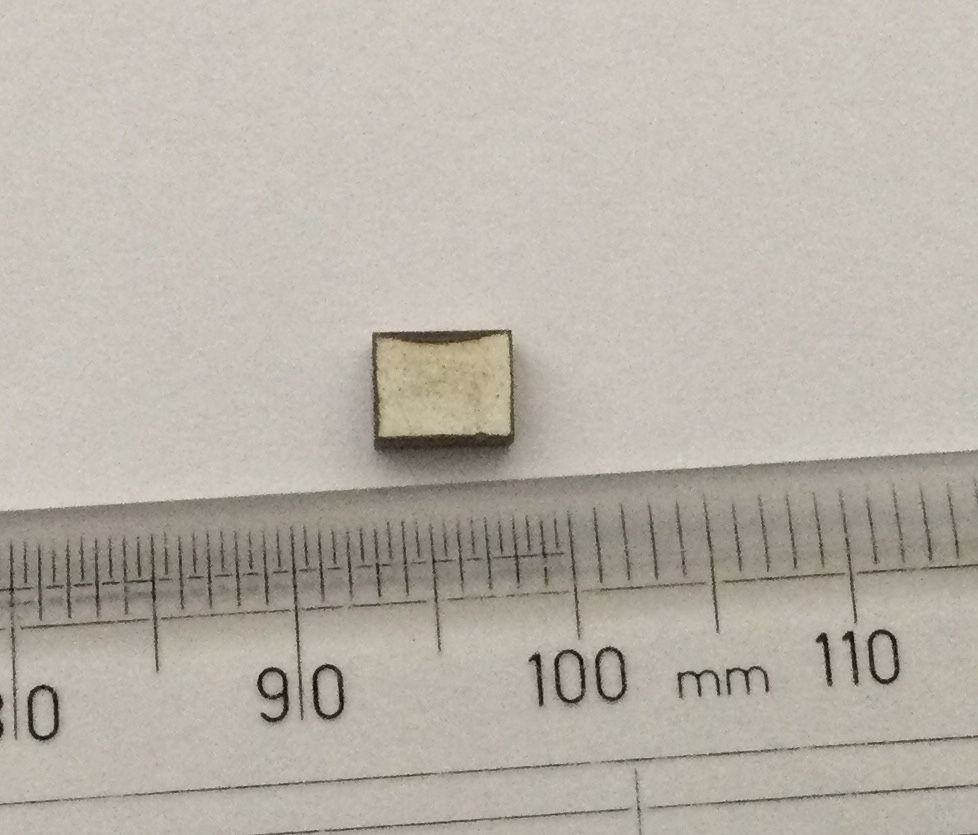
                                  By coincidence my workshop fan heater recently failed catostrophically. Out of curiosity I opened it up to investigate the over-temperature thermal switch. As suggested by John Baron, I discovered that built into the bimetallic switch assembly was a chip resistor. This was electrically across the contacts, so that when the switch opened it came into circuit. It measured around 17k ohm, so it would dissipate around 3 watts, sufficient to keep the switch open until the mains supply was removed. Neat arrangement. Picture of the chip resistor attached.

                                  Mike

                                  37a7f653-4437-490a-8081-8df16a3628c2.jpeg

                                  #526628
                                  Steviegtr
                                  Participant
                                    @steviegtr

                                    The biggest problem with fan heaters is the bushes on the fan spindle. They go black & tight. If you lubricate them they will run again ok for a short while. Until they sieze again. Most are rivetted together, but we used to drill out the rivets & clean the shaft & bushes. Relube & use screws & nuts to reassemble. Dad had an Electrical shop in Leeds. He did dozens for customers. Always worked & lasted well once the above was done. Plus a good cleanout as mentioned above. The problem being the fan slows down & the heat gets too great for the trip.

                                    Steve.

                                    #526634
                                    John Baron
                                    Participant
                                      @johnbaron31275

                                      Hi Steve, Guys,

                                      Yes I used to do that as well ! Plus giving the oily felt a good wash and soaking in degreaser and then a soak in hot oil to re-lubricate the felt. Record player motors used to suffer in the same way.

                                      #526646
                                      Nick Clarke 3
                                      Participant
                                        @nickclarke3

                                        I had one of those fake logburners that actually conceal a fanheater.

                                        When that stopped working I took it apart an discovered two thermal switch devices. Checking part numbers which fortunately were visible I discovered one was a self resetting device and the second was a trip once only, non resettable one at a higher temperature.

                                        So there are (at least) two different kinds of thermal switch/cut-out

                                        The fan was so full of dust that it was stiff to turn – hence the cut-out cutting out permanently, thank goodness!

                                        #526892
                                        John Baron
                                        Participant
                                          @johnbaron31275

                                          Hi Guys,

                                          I mentioned earlier that I had been looking at a thermal switch that used a ceramic element to open and close a switch, I've taken some pictures so that you can see the parts and the arrangement of the device.

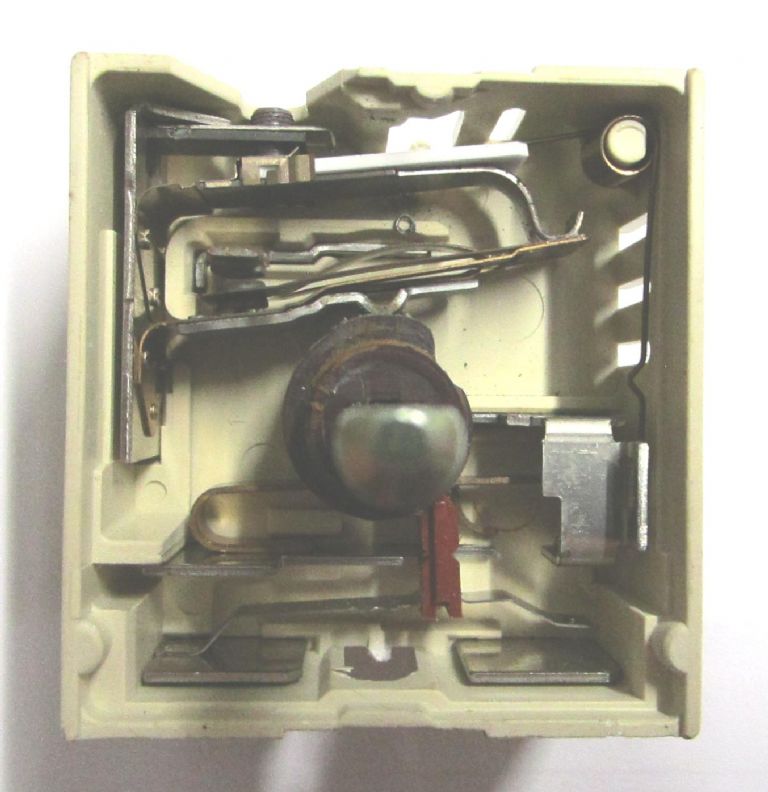
                                          13-02-2021-002.jpg

                                          This picture is an over all view inside the plastic case. The thermal mechanism is at the top and there is an auxiliary switch at the bottom of the picture. The auxiliary switch is not thermally activated it is a straight on/off one.

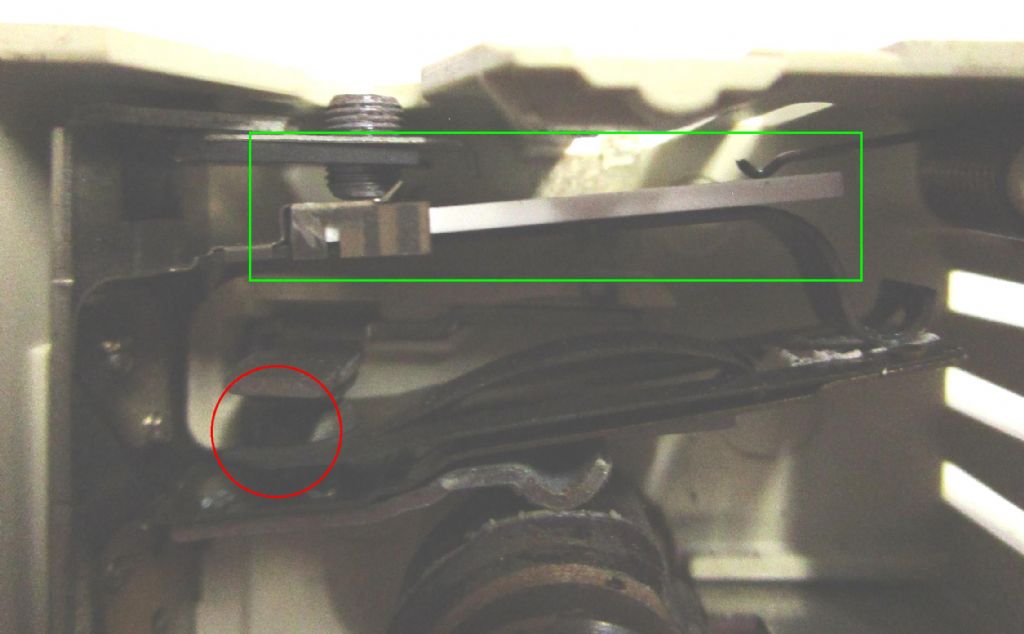
                                          13-02-2021-003.jpg

                                          I've outlined the ceramic element in green and the switch contacts in red. There is a spring on the right bearing on the ceramic strip, and an adjusting screw on the left which can be adjusted with an Allen key through the top. I did notice that the adjusting screw is connected to the live mains input ! So this is just for factory adjustment. The cam on the switch shaft brings the thermal device into play.

                                          13-02-2021-004.jpg

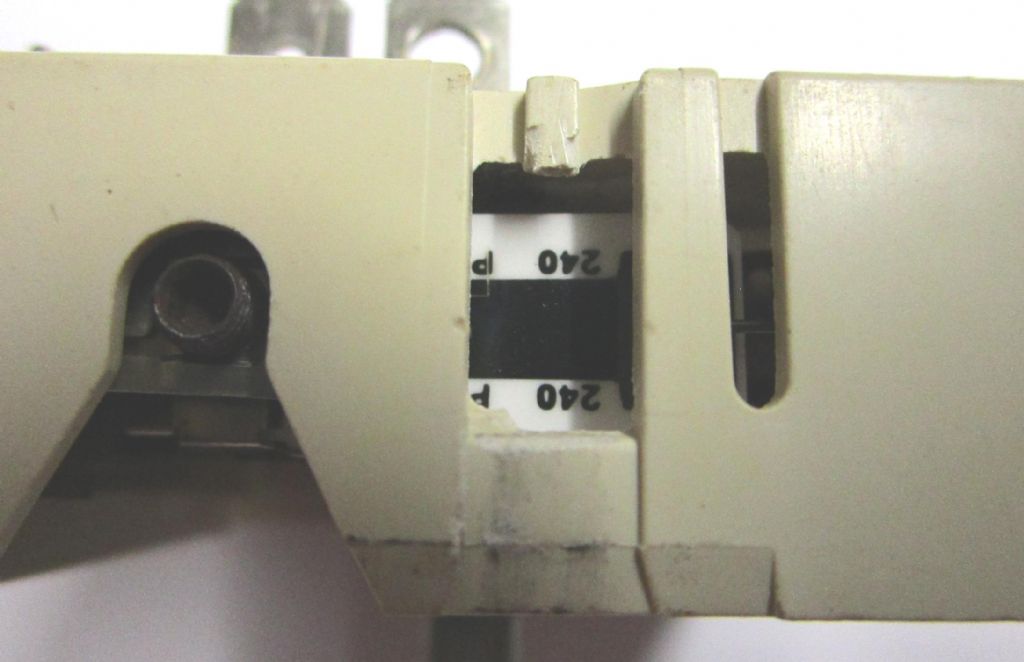
                                          I tried to photograph the ceramic strip. I broke out the bit of plastic so that I could take a picture of it. You can see the voltage rating and the printed resistive element which measures about 15K ohms. You can feel the heat radiating off it after about 15 or 20 seconds. The contacts short the ceramic element out when the switch operates.

                                          Quite ingenious !

                                        Viewing 19 posts - 1 through 19 (of 19 total)
                                        • Please log in to reply to this topic. Registering is free and easy using the links on the menu at the top of this page.

                                        Latest Replies

                                        Home Forums General Questions Topics

                                        Viewing 25 topics - 1 through 25 (of 25 total)
                                        Viewing 25 topics - 1 through 25 (of 25 total)

                                        View full reply list.